We may earn a commission from links on this page, at no extra cost to you.
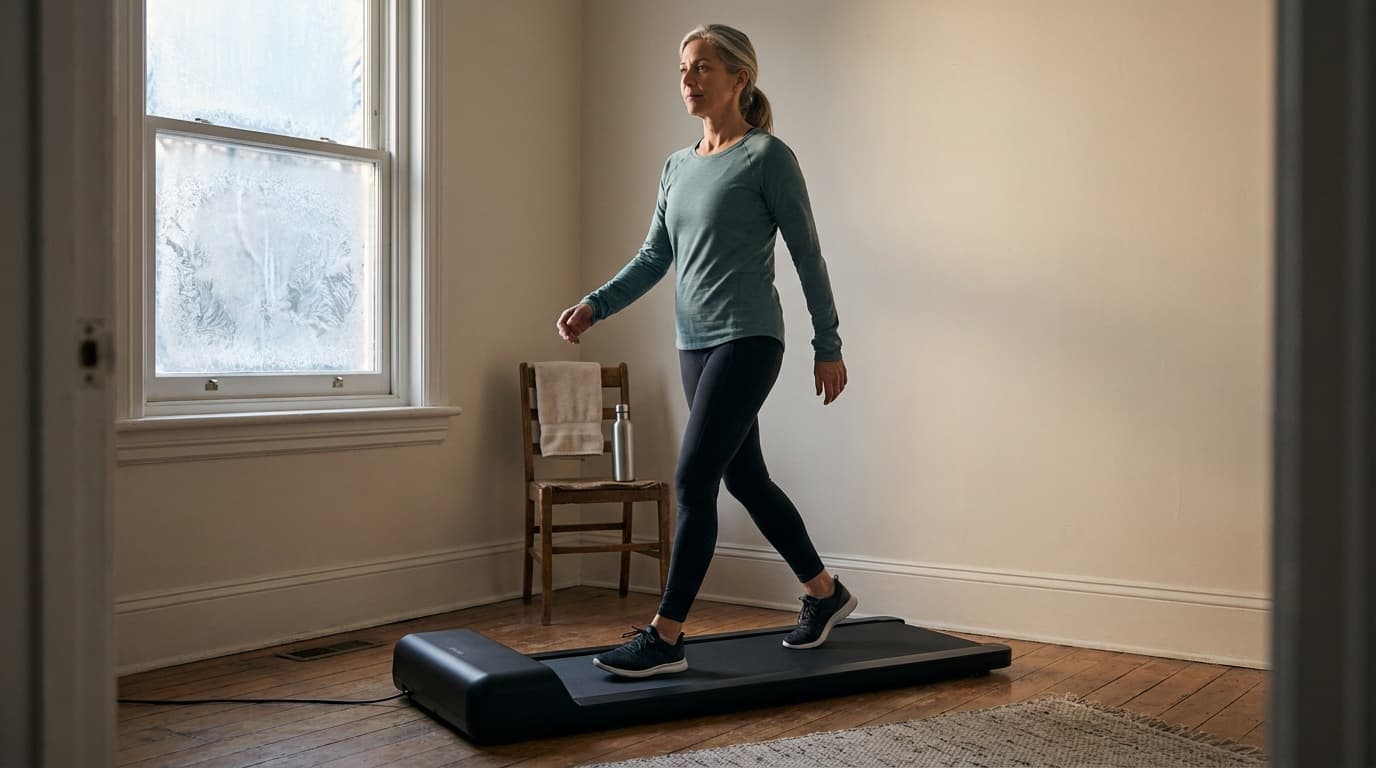
The best walking pad workouts mix easy walking with blocks at 3.0 to 4.0 mph, because that is where walking turns into real exercise and where most walking pads top out. In a treadmill study of adults aged 21 to 40, 3.0 mph averaged about 114 steps per minute and 4.0 mph about 129, both above the 100 steps per minute that marks moderate intensity (Tudor-Locke et al., 2019). Five 30-minute sessions a week meets the CDC's 150-minute target for adults.
Walking pad speed chart
Use this chart to pick speeds for the workouts below. Steps per minute are the average measured at each treadmill speed in the CADENCE-Adults study (adults 21 to 40). METs come from the 2024 Compendium of Physical Activities treadmill codes at 0% grade. One MET is the energy you use sitting still; about 3 METs and up counts as moderate intensity.
| Speed | Minutes per mile | Average steps per minute | METs (treadmill, 0% grade) | Best use |
|---|---|---|---|---|
| 1.0 mph | 60:00 | 68 | 2.3 | Typing and focused desk work |
| 1.5 mph | 40:00 | 84 | 2.8 (1.2 to 1.9 mph) | Email, reading, calls |
| 2.0 mph | 30:00 | 96 | 3.0 (2.0 to 2.4 mph) | Warm-ups, easy recovery minutes |
| 2.5 mph | 24:00 | 106 | 3.5 (2.5 to 2.9 mph) | Easy workout pace, interval recoveries |
| 3.0 mph | 20:00 | 114 | 3.8 (3.0 to 3.4 mph) | Steady moderate walking |
| 3.5 mph | 17:09 | 122 | 4.8 (3.5 to 3.9 mph) | Brisk blocks |
| 4.0 mph | 15:00 | 129 | 5.8 (4.0 to 4.4 mph) | Hardest walking blocks on most pads |
A quick check without a tracker: count your steps for 15 seconds and multiply by four. If you are at 100 or more and can still talk in full sentences, you are in the moderate zone. If you are working hard at 3.0 mph, that is your brisk pace, and it is fine for it to be slower than the chart.
For typing speeds and desk setup, see how to use a walking pad while working. The workouts below are for dedicated sessions.
Before you start
Set up for a safe session
Clear the space
UREVO's Strol 2E Pro manual asks for 1.2 m (about 4 ft) of clearance side to side and 2 m (about 6.5 ft) front to back.
Start slow
Step on at the lowest speed, then speed up. Most walking pads have no handrail in walking mode, so change speed in small steps.
Wear shoes
Supportive walking shoes, not socks. See the [best walking shoes](/fitness/best-walking-shoes) if yours are worn out.
Know your stop
Keep the remote in your hand or pocket and learn the pause button before your first interval.
Listen to your body
The Strol 2E Pro manual says to assess your health before use and stop if you feel unwell. If you have a heart condition, joint problems, or are new to exercise, check with your clinician first.
Workout 1: the 20-minute starter
For the first two weeks, or any day you feel flat. Total: 20 minutes.
| Minutes | Speed | Feel |
|---|---|---|
| 0 to 5 | 2.0 mph | Easy warm-up |
| 5 to 15 | 2.5 to 3.0 mph | Steady, can talk easily |
| 15 to 20 | 2.0 mph | Cool down |
Do it three to five days a week. When the middle block feels easy for three sessions in a row, stretch it by 5 minutes before you raise the speed. Changing one thing at a time is the simplest way to avoid sore shins and calves.
Workout 2: the 30-minute steady walk
This is the workhorse. Five of these a week is 150 minutes, the full CDC recommendation for moderate activity. Total: 30 minutes.
| Minutes | Speed | Feel |
|---|---|---|
| 0 to 5 | 2.0 to 2.5 mph | Warm-up |
| 5 to 25 | 3.0 to 3.5 mph | Moderate: breathing harder, still talking in sentences |
| 25 to 30 | 2.0 to 2.5 mph | Cool down |
Workout 3: brisk intervals
Because walking pads top out around 4 mph, intervals are how you make a flat pad harder. Total: 30 minutes.
| Minutes | Speed | Feel |
|---|---|---|
| 0 to 5 | 2.5 mph | Warm-up |
| 5 to 25 | Repeat 5 times: 2 min at 3.5 to 4.0 mph, then 2 min at 2.5 mph | Hard but controlled, then easy |
| 25 to 30 | 2.0 mph | Cool down |
Start with three rounds and add one every week or two. If your pad has a short belt and you are tall, keep the fast blocks at 3.5 mph; our guide to choosing a walking pad explains why stride length and belt length collide at speed.
Workout 4: incline walk
Incline raises the work without raising the speed, which is exactly what a 4 mph pad needs. Total: 30 minutes. This one needs a pad with incline.
| Minutes | Speed and grade | Feel |
|---|---|---|
| 0 to 5 | 2.0 to 2.5 mph, flat | Warm-up |
| 5 to 25 | Repeat 4 times: 3 min at 2.5 to 3.0 mph with 6 to 8% grade, then 2 min flat at 2.5 mph | Legs and lungs working, posture tall |
| 25 to 30 | 2.0 mph, flat | Cool down |
On a pad where incline is set with support legs before you start, such as the Strol 2E Pro, skip the alternating: walk 5 easy minutes at 1.5 to 2.0 mph on the incline to warm up, 20 minutes at a steady 2.0 to 2.5 mph, then 5 easy minutes to cool down. Keep your hands off anything you might grip for support; if you need to hold on, the grade or speed is too high.
BEST FOR INCLINE WORKOUTS
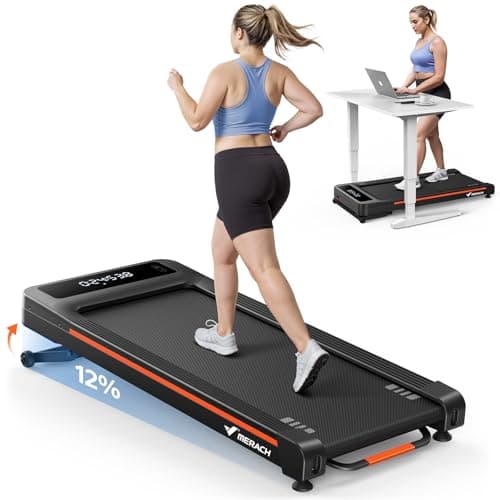
MERACH W50 Walking Pad with 12% Auto Incline
Kit Score 8.5/10 · Check current price
Buy on AmazonBest for: Standing-desk users who want incline training throughout the workday, heavier users over 250 lbs who need a confidence-inspiring deck, or anyone running a home office where the pad stays in place permanently.
- Motorized 0 to 12% incline plus a wider 16.5-inch belt and a 10-hour continuous-use rating, the only continuous-use figure published among these pads
- 400 lb weight capacity: the most headroom for heavier users or all-day office deployment
- No fold-flat storage: at 50.2 inches long and 69.2 lb, this unit lives under a standing desk and does not move easily between rooms
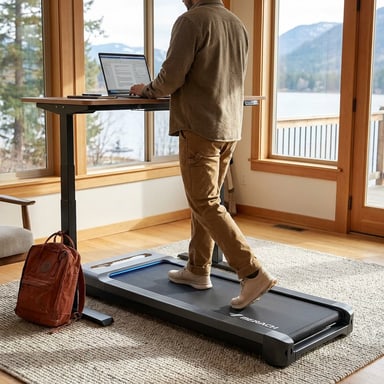
The MERACH W50 is the one pad here that changes grade while you walk. MERACH lists 0 to 12% auto incline adjustable from the remote, 0.6 to 4.0 mph, a 400 lb user limit, a 16.5 by 41.3 inch belt, a 1.25 HP continuous and 3.5 HP peak brushless motor, and up to 10 hours of continuous use. The tradeoff is size: it does not fold, and at 6.1 inches tall it is the thickest pad in Kit's walking pad specs dataset.
FIXED INCLINE, FOLDING HANDLEBAR
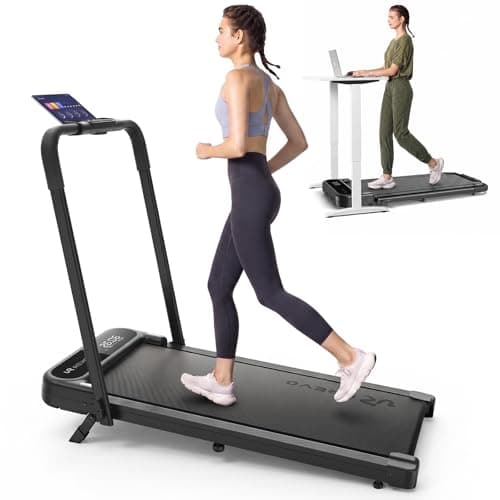
UREVO Strol 2E Pro Walking Pad Treadmill
Kit Score 7.9/10 · Check current price
Buy on AmazonBest for: Home-office walkers who want incline, a 300 lb capacity and the option to jog, from one pad near $200.
- Only pad near $200 that combines a 12% incline, a 300 lb listed user limit and a 6.2 mph top speed
- 4.2 inches tall with the handlebar down and 44 lb with transport wheels, so it fits under most standing desks and rolls under a sofa
- 4.0-star Amazon average across 2,170 ratings, with motor longevity under running use the recurring complaint
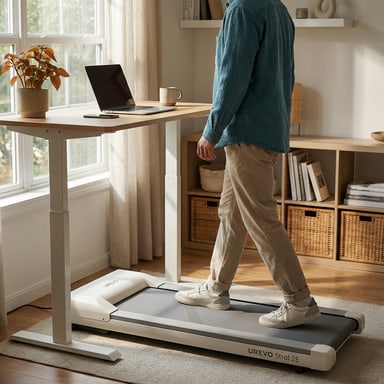
The UREVO Strol 2E Pro lists up to 12% incline, 0.6 to 4.0 mph with the handlebar folded down, and up to 6.2 mph with the handlebar raised and locked. Its manual shows the incline is set by locking the front support legs and installing the center support feet, so you choose it before the session. The manual also says the remote only accelerates to 4.0 mph; reaching 6.2 needs the console button. Note the weight limit: UREVO's product page says 300 lb, but the manual's safety section says 265 lb, so plan around the lower number. More in the Strol 2E Pro review.
Workout 5: the desk-day stack
On workdays, the best workout may be the one you never schedule. Three or four blocks of 20 to 30 minutes at 1.5 to 2.0 mph adds roughly 5,000 to 11,500 steps at the cadences in the chart above, and it is gentle enough to repeat daily.
FLAT PAD FOR SPEED-ONLY ROUTINES
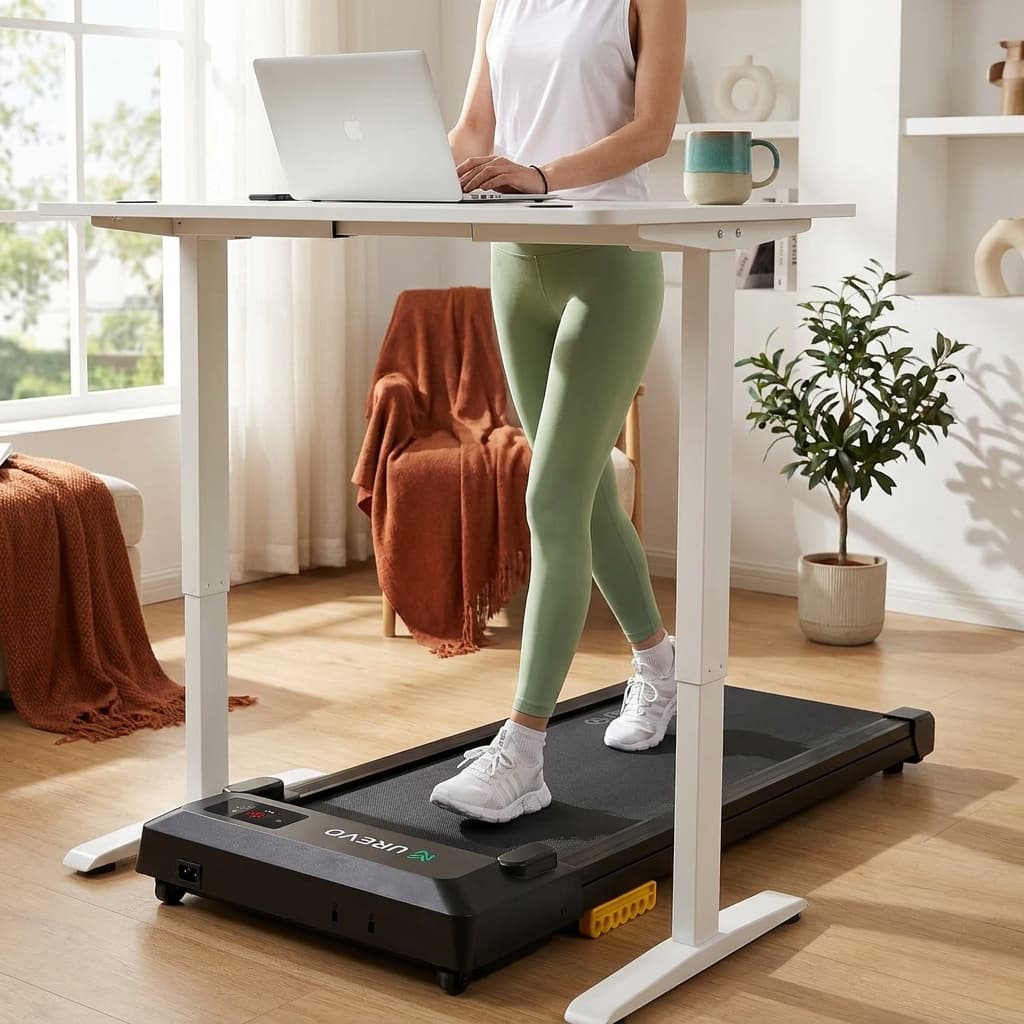
UREVO Smart Walking Pad
Kit Score 8.0/10 · Check current price
Buy on AmazonBest for: Work-from-home walkers who want reliable daily-use performance and app tracking without paying a premium brand markup.
- 2.5 HP motor and multi-layer shock absorption at a budget price point
- App-connected with MIIT workout modes and step tracking, remote included
- 35.43-inch belt is much shorter than the WalkingPad C2's 47.2 inches, which may feel limiting for taller users or long strides
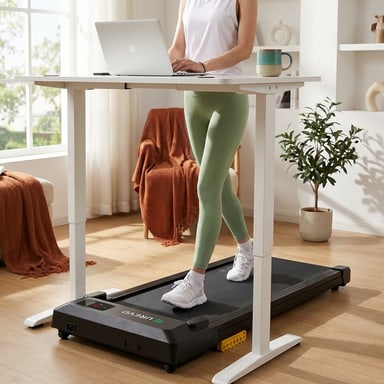
The UREVO Smart Walking Pad handles Workouts 1, 2, 3, and 5. Its Amazon listing gives 0.6 to 4 mph, a 2.5 HP motor, a 265 lb user limit, and a 35.43 by 15 inch belt, with no incline. The UREVO Smart Walking Pad review covers what the low price leaves out. To compare all four pads Kit covers, including the fold-in-half WalkingPad C2, see the best walking pads.
A sample week
This mix reaches about 150 minutes of dedicated walking plus desk-day steps. Swap days freely; keep at least one easy or rest day between the two hardest sessions.
| Day | Session | Dedicated minutes |
|---|---|---|
| Monday | Workout 2, steady walk | 30 |
| Tuesday | Workout 5, desk-day stack | desk time |
| Wednesday | Workout 3, brisk intervals | 30 |
| Thursday | Workout 1, starter, or rest | 20 |
| Friday | Workout 4, incline, or Workout 2 on a flat pad | 30 |
| Saturday | Workout 2, steady walk, or a walk outside | 40 |
| Sunday | Rest or an easy walk | 0 |
New to regular walking? Start with Workout 1 three days a week for two weeks, then add a day. The free walking plan builder builds an 8-week version around your schedule.
Adding a weighted vest
A weighted vest is a way to make a flat pad harder once the steady walk feels easy. Two rules matter on a walking pad:
- Count the vest in the weight limit. The pad carries you and the vest. A 220 lb walker in a 20 lb vest is at 240 lb, which is under the UREVO Smart's 265 lb listing but at the ceiling of a 220 lb-rated pad such as the WalkingPad C2.
- Walk, do not run, with the vest. Keep vested sessions to Workouts 1 and 2 at first, and add the vest before you add speed or incline, never all three at once.
Kit Authority uses about 5% of body weight as a conservative starting load. Our weighted vest walking guide for beginners explains that estimate and how to progress, the vest sizing calculator gives a personal starting weight, and the best weighted vests for walking compares adjustable options.
Where these numbers come from
| Claim | Source | Checked |
|---|---|---|
| Treadmill cadence by speed (68 steps/min at 1.0 mph up to 129 at 4.0 mph); about 100 steps/min marks moderate intensity (3 METs); 15-second count method | Tudor-Locke et al., Int J Behav Nutr Phys Act 2019 | Sep 2026 |
| Treadmill walking METs at 0% grade (2.3 at 1.0 mph to 5.8 at 4.0 to 4.4 mph); level walking 3.0 to 3.4 mph 3.8 METs; hill walking 6 to 10% grade, moderate-to-brisk pace, 7.0 METs | Compendium of Physical Activities, walking | Sep 2026 |
| Adults need 150 minutes of moderate activity a week, for example 30 minutes a day, 5 days a week | CDC, adult activity recommendations | Sep 2026 |
| MERACH W50: 0.6 to 4.0 mph, 0 to 12% auto incline, remote incline control, 400 lb, 16.5 x 41.3 in belt, 1.25 HP continuous and 3.5 HP peak, up to 10 hours continuous use | MERACH, NovaWalk W50 TrekPad | Sep 2026 |
| MERACH W50: 6.1 in tall, non-folding | Kit Authority walking pad specs dataset (from MERACH and the Amazon listing) | Sep 2026 |
| UREVO Strol 2E Pro: 0.6 to 4.0 mph walking mode, 0.6 to 6.2 mph running mode, up to 12% incline, 300 lb | UREVO, Strol 2E Pro product page | Sep 2026 |
| Strol 2E Pro manual: 1.2 m side and 2 m front-to-back clearance; incline set with front support legs and center support feet; remote accelerates only to 4.0 mph; 265 lb (120 kg) maximum weight capacity; stop if unwell | UREVO Strol 2E Pro user manual V2.0 (PDF) | Sep 2026 |
| UREVO Smart Walking Pad: 0.6 to 4 mph, 2.5 HP, 265 lb, 35.43 x 15 in belt | Amazon listing, ASIN B097BKS6Z9, read through the Amazon Creators API | Sep 2026 |
| WalkingPad C2: 220 lb user limit, 1 to 4 mph | Amazon listing, ASIN B0H6WSKDZN, read through the Amazon Creators API | Sep 2026 |
Minutes per mile and steps per session are Kit Authority's arithmetic from the published figures. The workouts are general guidance built on those figures, not a medical program, and we have not used these walking pads ourselves.
Frequently asked questions
What speed should I walk on a walking pad to lose weight?
Speed matters less than total minutes. Brisk blocks at 3.0 to 4.0 mph burn more per minute than desk pace, but hours at 1.5 to 2.0 mph during a workday can add up to more. Pair consistent walking with changes to what you eat; our guide on how many steps a day to lose weight runs the numbers.
Is 2 mph on a walking pad good exercise?
It is useful movement and a good warm-up, but it sits just under the moderate-intensity line for most adults. In the CADENCE-Adults study, 2.0 mph averaged about 96 steps per minute, and the Compendium rates treadmill walking at 2.0 to 2.4 mph at 3.0 METs. Add minutes at 2.5 to 3.0 mph or faster to count toward the 150-minute weekly goal.
How long should a walking pad workout be?
Twenty minutes is a good start and 30 minutes is the standard session. Five 30-minute sessions a week reach the CDC's 150-minute recommendation. Build duration before speed or incline.
Can you do interval workouts on a walking pad?
Yes, and they are the main way to make a flat pad harder. Alternate 2 minutes at 3.5 to 4.0 mph with 2 minutes at 2.5 mph. Change speed in small steps, since most pads have no handrail in walking mode.
Can I run on a walking pad?
Only on pads built with a running mode, and only in that mode. The UREVO Strol 2E Pro goes to 6.2 mph with its handlebar raised and locked. The UREVO Smart, MERACH W50, and WalkingPad C2 are walking-only pads that top out around 4 mph. For regular running, a full treadmill is the better tool; see walking pad vs treadmill.
Next steps: size a pad to your height and desk with the walking pad fit checker, plan indoor days with our guide to getting 10,000 steps at home, or fix a slipping or drifting belt with the walking pad troubleshooting guide. Our research approach explains how we source specs.
Keep going
Related buying guideBest walking pads 2026: budget, incline, and heavy-duty picksFree tool: Walking Pad Fit CheckerRelated guides
 Complete fitness loadoutWeighted-vest starter kitBuild the complete kit
Our recommendations draw on manufacturer documentation, retailer listings, owner feedback, and comparisons with alternatives.
As an Amazon Associate I earn from qualifying purchases. We may earn a commission from links here, at no extra cost to you. How we research →
Top picks
Related buying guide
Best walking pads 2026: budget, incline, and heavy-duty picks