
The best-value lightweight down jackets come from brands that sell good down for less: OutdoorGearLab gives the Eddie Bauer CirrusLite Hooded its budget award for lightweight warmth and calls Decathlon's Simond MT100 a great budget option, and Switchback Travel names REI Co-op's 650 Down Jacket its best budget down jacket. Among the technical hiking brands, Rab's Microlight Alpine gives the most weather protection and down per dollar in our lineup, Mountain Hardwear's Ghost Whisperer Hoody is the lightest, and Marmot's Guides Down 2.0 Hoody is the warm, heavy option for cold camps.
A down jacket earns its place in a pack by doing one thing well: warmth that weighs very little and compresses small. When the ridge goes cold, when weather rolls in faster than the forecast said, or when camp drops below comfortable the moment the sun does, the right puffy is the difference between a great day and a miserable one.
Which down jacket brands give the best value?
Value in a down jacket comes down to how much good down you get per dollar, and whether the shell and features fit how you hike. Here is how the brands independent testers rate for value compare with our four picks.
Best-value down jacket brands
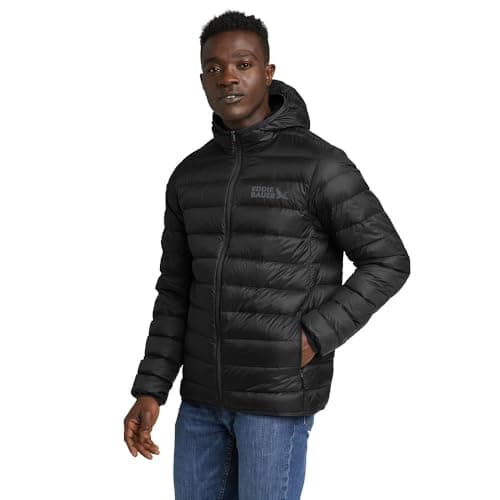
Eddie Bauer (CirrusLite Hooded)
OutdoorGearLab's budget award for lightweight warmth, and our value pick: 650-fill down, light and packable, best for layering and mild cold rather than standalone winter warmth.
Decathlon (Simond MT100)
Switchback Travel calls the MT100 one of the best values in the lightweight down jacket category, citing a $119 price and 11.3 oz men's weight with 800-fill down. It is best for mild conditions, active use, or as a midlayer.
REI Co-op (650 Down Jacket, Magma 850)
Switchback names the 650 Down Jacket its best budget down jacket, and OutdoorGearLab gives the Magma 850 its best value upgrade award, calling it surprisingly affordable.
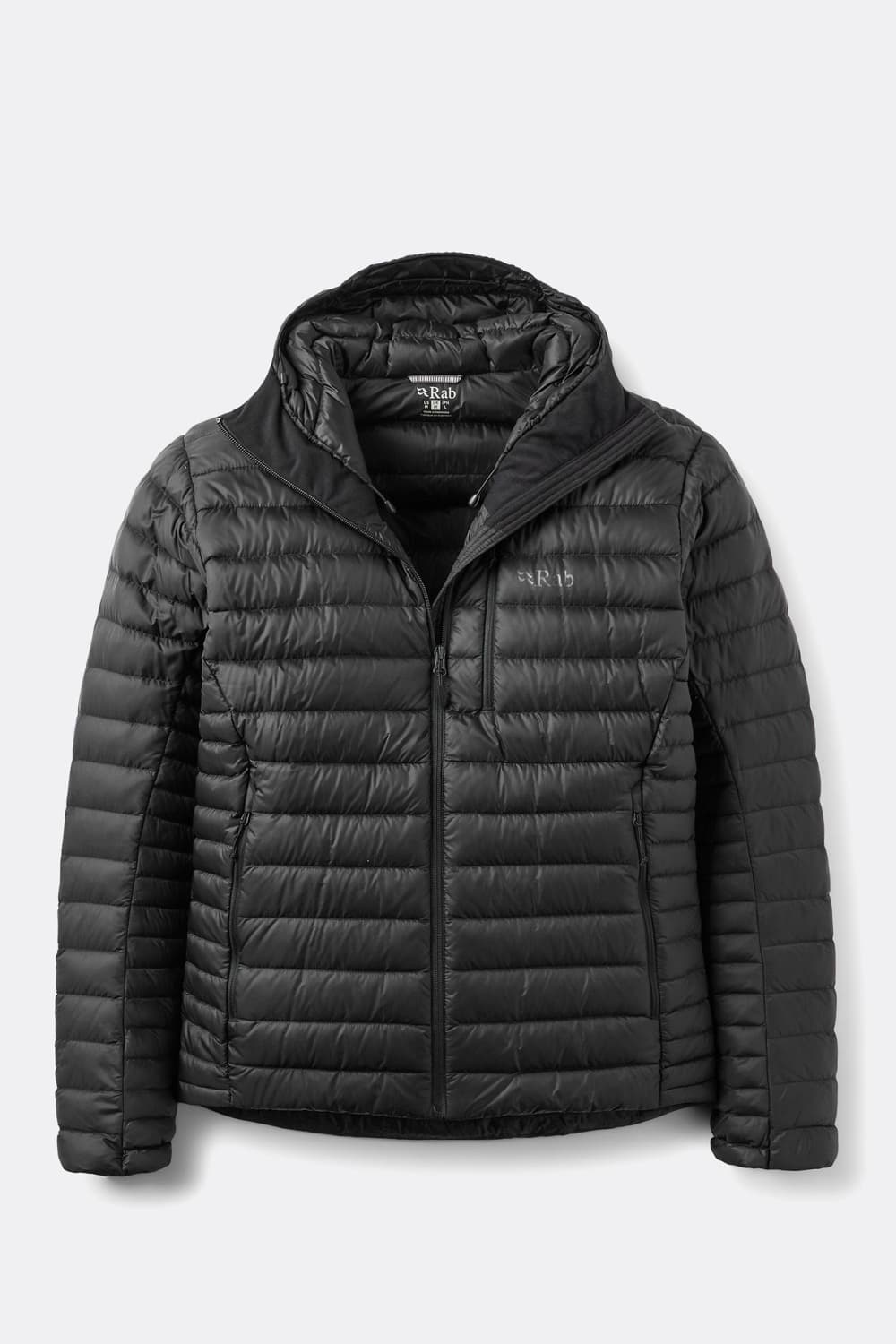
Rab (Microlight Alpine)
The value pick among technical hiking brands here: a $325 list price for 5.3 oz of hydrophobic 700-fill down and a 30D Pertex Quantum shell, about 77% more down than the Ghost Whisperer at a lower list price.
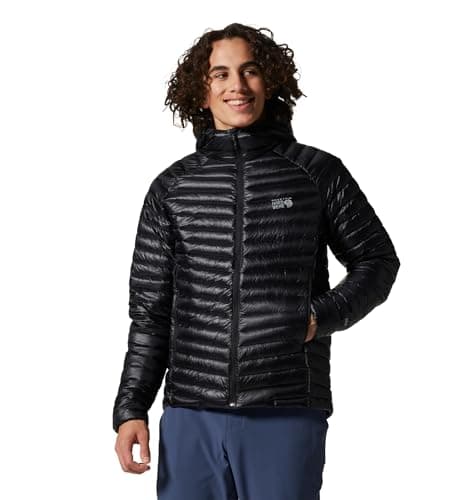
Mountain Hardwear (Ghost Whisperer Hoody)
Not the cheapest, but the lightest technical pick: 800-fill down, 3 oz of fill, and 10.7 oz total on Mountain Hardwear's scale. You pay for weight savings, not raw warmth.
How we picked
Every jacket here is scored against the Kit Score, which weighs fill power and fill weight, warmth-to-weight ratio, packability, shell weather resistance, and durability. We cross-referenced the makers' spec pages with independent testing from OutdoorGearLab and Switchback Travel and with owner reviews. We did not test these jackets ourselves.
Our quick picks
What actually matters in a down jacket
Down jackets are sold on marketing language more than almost any other piece of gear. These are the numbers that decide how warm, how light, and how packable a jacket will be.
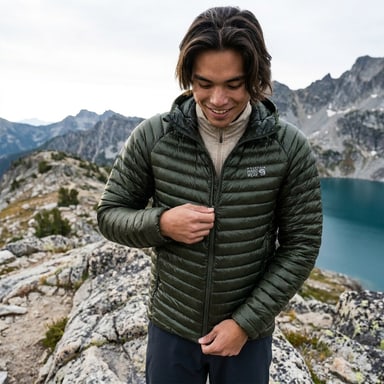
Best overall: Mountain Hardwear Ghost Whisperer Hoody
BEST OVERALL
Mountain Hardwear Ghost Whisperer Hoody
Best for: Ultralight backpackers and thru-hikers who prioritize packability and warmth-to-weight and are willing to handle the shell with care.
- 10.7 oz with a hood and two zippered hand pockets, and it packs into its own pocket
- Ultralight 10-denier shell snags and abrades more easily than heavier alternatives
Kit Score 8.1/10 · $312.38 Price checked Oct 24, 3:33 PM CDT · how we score gear
Buy on AmazonProduct details
At 10.7 oz for a hooded men's medium, the Ghost Whisperer Hoody is one of the lightest down hoodies available, with 800-fill RDS down inside a 10-denier recycled ripstop shell. OutdoorGearLab names it the best down jacket for ultralight adventures, and it stuffs into its own hand pocket.
- Fill power
- 800-fill RDS-certified down, 3 oz fill (men's M)
- Jacket weight
- 10.7 oz / 302 g (men's medium, Mountain Hardwear)
- Shell fabric
- Whisperer 10D x 10D recycled ripstop
- Cuffs
- First cuff baffle filled with synthetic insulation to resist wetting out
- Adjustments
- Rear hood cinch and drawcord hem
- Packability
- Stuffs into its own hand pocket, with a carabiner clip loop
More strengths
- OutdoorGearLab's best down jacket for ultralight adventures
- Synthetic-filled cuff baffles keep the cuffs from wetting out
Other tradeoffs
- Only 3 oz of down, so it is less warm at rest than heavier jackets
For backpackers and thru-hikers who track grams, the Ghost Whisperer is the benchmark. Mountain Hardwear fills the current hoody with 3 oz of 800-fill RDS-certified down inside a 10D x 10D recycled ripstop shell, and lists the men's medium at 10.7 oz (302 g). OutdoorGearLab names it the best down jacket for ultralight adventures, and its lead tester carried it on the Arizona Trail and the Appalachian Trail.
The first baffle at each cuff is filled with synthetic insulation so the cuffs do not wet out when you wash your hands or brush snow. The features are minimal: two zippered hand pockets, a rear hood cinch, and a drawcord hem, and the whole jacket stuffs into one of its hand pockets, which has a carabiner clip loop.
The tradeoff is durability. A 10-denier shell snags on rough rock and branches, so this rewards careful handling. When a snag does happen, treat it as a repair, not a replacement: a gear-literate repair shop can patch an ultralight shell for a fraction of the jacket's price. Our sister site Stitch Authority explains how to choose a clothing repair service you can trust with technical fabric.
Fill power is the quality of the down; fill weight is the quantity. Higher fill power gets the same warmth from less down, which is why premium jackets weigh and pack smaller.
Editor's choice: Rab Microlight Alpine Down Jacket
EDITOR'S CHOICE
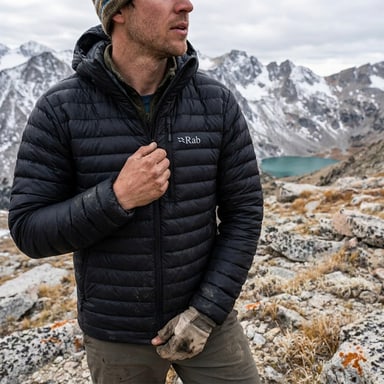
Rab Microlight Alpine Down Jacket
Best for: All-conditions hikers and alpinists who want reliable weather protection and genuine warmth without paying premium-tier prices.
- Hydrophobic down and a fluorocarbon-free DWR shell for extra weather resistance
- Heavier than ultralight competitors at roughly 15 oz; not the pick if pack weight is paramount
Kit Score 8.8/10 · Check current price · how we score gear
Buy at RabProduct details
The Microlight Alpine pairs a windproof 30D Pertex Quantum shell with 5.3 oz of hydrophobic 700-fill recycled down in zoned baffles, so it blocks wind and handles light precipitation better than most jackets at its price. OutdoorGearLab credits its DWR coating and hydrophobic down with extra weather resistance.
- Fill power
- 700-fill recycled down with Grangers hydrophobic finish
- Down weight
- 5.3 oz / 152 g (men's M)
- Jacket weight
- 15.09 oz / 428 g (men's medium)
- Shell fabric
- 30D Pertex Quantum, recycled
- DWR treatment
- Fluorocarbon-free DWR on shell plus hydrophobic down
- Baffle construction
- Zoned: micro baffles front and back, nano baffles under arms for venting
More strengths
- Zoned baffles: smaller under the arms for mobility, larger across the core for warmth
- More down than the Ghost Whisperer/2 at a lower list price
Other tradeoffs
- 30D shell and zoned baffles add bulk compared with ultralight hoodies
The Rab Microlight Alpine is the pick when conditions are unpredictable. Rab fills it with 5.3 oz of 700-fill recycled down with a Grangers hydrophobic finish, wrapped in a windproof 30D Pertex Quantum shell with a fluorocarbon-free DWR, and lists the men's medium at 15.09 oz (428 g). OutdoorGearLab credits its DWR coating and hydrophobic down with extra weather resistance.
Rab zones the baffles, with smaller ones under the arms for mobility and larger ones across the back, shoulders, and front for warmth. The hood has a wired peak, there is a chest pocket, and one hand pocket doubles as a stuff pocket with a clip loop. At a $325 list price it costs less than the Ghost Whisperer while carrying more down and a tougher shell. For hikers in maritime or shoulder-season mountains, this is the jacket that earns its keep most consistently. Rab sells it direct in the full XXS to 3XL size run, so the buy button goes to Rab's own store.
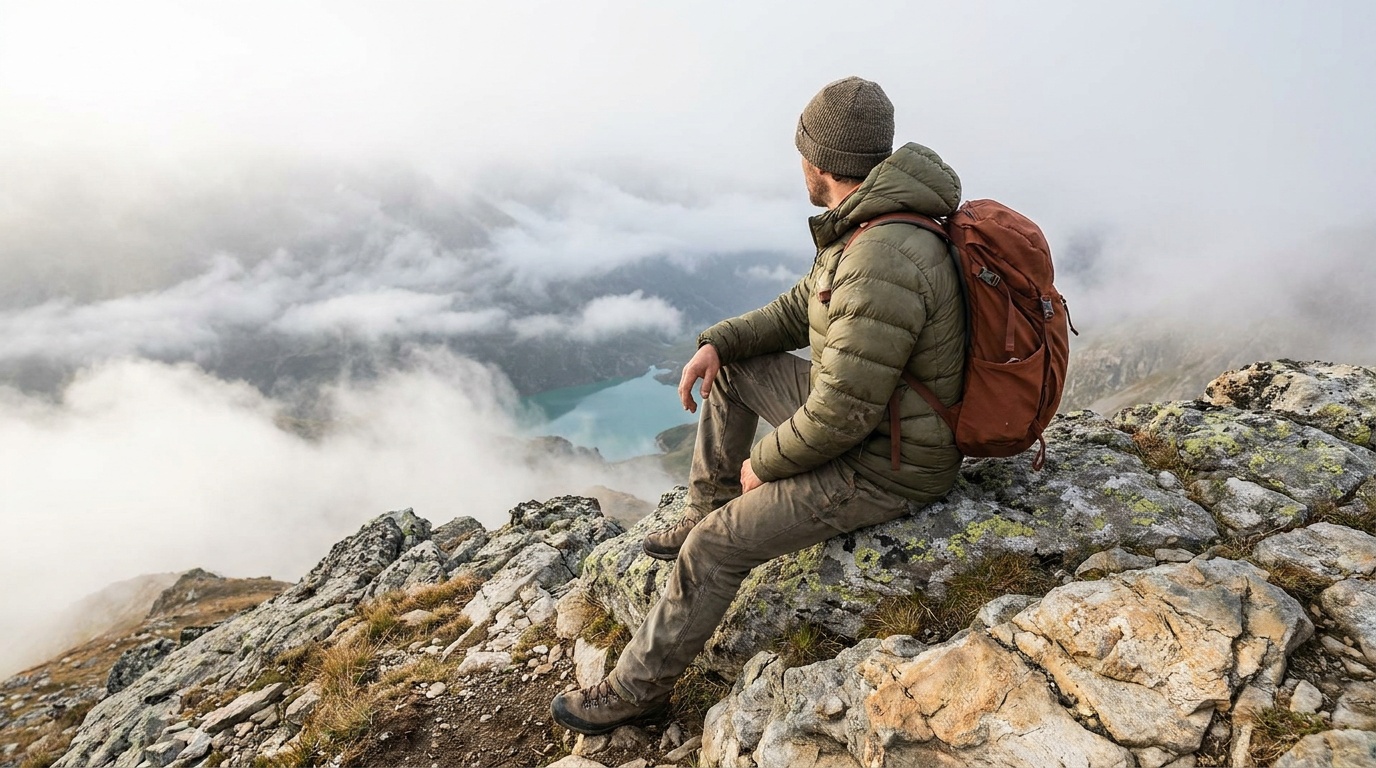
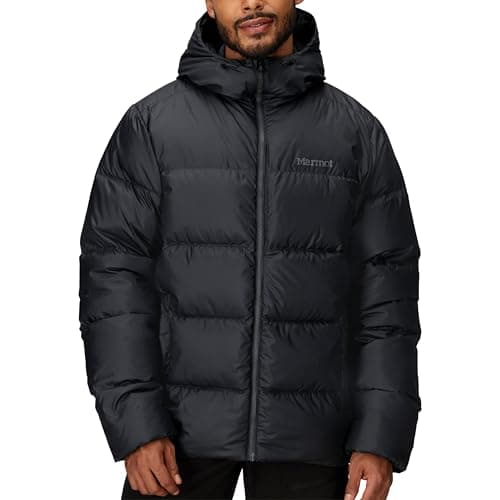
Warmest: Marmot Guides Down 2.0 Hoody
WARMEST
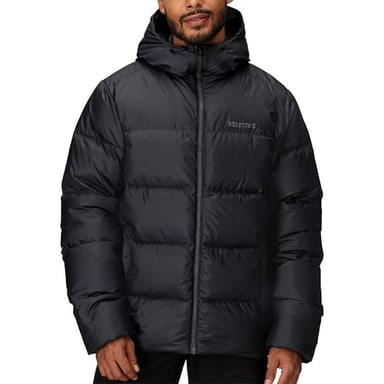
Marmot Guides Down 2.0 Hoody
Best for: Cold-weather campers, belayers, and winter day hikers who want maximum warmth at rest and do not mind carrying the weight.
- Big, overstuffed baffles built for warmth at rest
- 1 lb 10 oz and bulky; Marmot says it does not pack as small as lightweight jackets
Kit Score 8.0/10 · $300.00 Price checked Oct 24, 3:33 PM CDT · how we score gear
Buy on AmazonProduct details
The Guides Down 2.0 Hoody is Marmot's big-baffle puffy for cold, slow days: a 700-fill blend of recycled down and Ceiba flower fiber inside a 100% recycled polyester ripstop shell with a C0 DWR finish. At 1 lb 10 oz it is the heaviest jacket here, and the warmest for belays, summit breaks, and camp.
- Fill power
- 700-fill blend: 80% recycled down, 20% Ceiba flower down
- Jacket weight
- 1 lb 10 oz / 741 g (Marmot)
- Shell fabric
- 100% recycled polyester ripstop with C0 DWR
- Pockets
- Two zippered hand pockets and a zippered chest pocket
- Hood, cuffs, and hem
- Adjustable fixed hood, elastic-bound cuffs, adjustable drawcord hem
- Packability
- No stuff sack or self-stowing pocket (Marmot)
More strengths
- Adjustable hood and drawcord hem seal out cold air
- Tough recycled polyester ripstop shell for rough use around camp
Other tradeoffs
- Elastic-bound cuffs have no adjustment, and there is no stuff sack or stow pocket
The Marmot Guides Down 2.0 Hoody is the cold-camp specialist. Where the lighter jackets above prioritize packability, the Guides prioritizes warmth: big, overstuffed baffles filled with a 700-fill blend of 80% recycled down and 20% Ceiba flower fiber, inside a 100% recycled polyester ripstop shell with a C0 DWR finish. Expect a heavier, bulkier jacket than the others (Marmot lists it at 1 lb 10 oz), but for stationary cold (summit breaks, belays, sitting around camp) that warmth earns its keep.
It has an adjustable hood, a drawcord hem, two zippered hand pockets, and a zippered chest pocket. The cuffs are elastic-bound rather than adjustable, and Marmot says it does not come with a stuff sack or stow pocket and does not pack as small as lightweight jackets. The 2.0 replaces the original Guides Down Hoody, which Marmot no longer sells.
Best value: Eddie Bauer CirrusLite Down Hooded Jacket
BEST VALUE
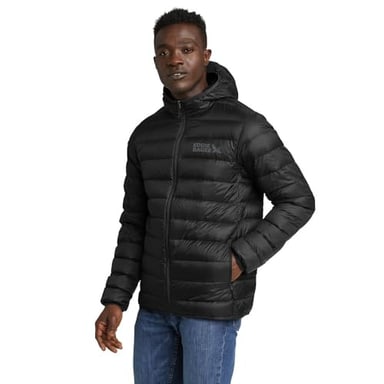
Eddie Bauer CirrusLite Down Hooded Jacket
Best for: Hikers on a budget who want a light, packable puffy for shoulder seasons, cool evenings, or layering under a shell.
- OutdoorGearLab's budget award for lightweight warmth
- 650-fill down makes it a mild-weather jacket, not a winter standalone
Kit Score 7.7/10 · $109.14 Price checked Oct 24, 3:33 PM CDT · how we score gear
Buy on AmazonProduct details
The CirrusLite Hooded puts 650-fill RDS-certified down in a soft recycled nylon shell with a StormRepel DWR finish, and weighed 9.9 oz in a men's small in OutdoorGearLab's measurements. It gives up warmth and durability to the pricier jackets here, but costs a fraction as much.
- Fill power
- 650-fill RDS-certified down
- Jacket weight
- 9.9 oz (men's small, OutdoorGearLab measured)
- Shell fabric
- Recycled nylon with StormRepel DWR
- Pockets
- Two zippered hand pockets
- Cuffs
- Elastic
- Sizes
- Regular S to XXL, Tall M to 3XL (Eddie Bauer)
More strengths
- Light at 9.9 oz and compresses to softball size
- Comfortable, soft shell that layers easily under a rain jacket
Other tradeoffs
- Thin shell lacks abrasion resistance, per OutdoorGearLab
The CirrusLite Hooded is the jacket to buy when price matters more than peak performance. Eddie Bauer fills it with 650-fill RDS-certified down and finishes the recycled nylon shell with its StormRepel DWR, and OutdoorGearLab weighed a men's small at 9.9 oz. OutdoorGearLab gives it a budget award for lightweight warmth and found it compresses to softball size.
Know what you are buying: OutdoorGearLab rates its warmth as best suited to spring and fall in milder climates, and the soft, thin shell gives up abrasion resistance. Use it as a shoulder-season jacket or as a warm layer under a rain shell, not as a standalone winter coat.
How they compare
| Spec | Ghost Whisperer Hoody | Microlight Alpine | Guides Down 2.0 | CirrusLite Hooded |
|---|---|---|---|---|
| Kit Score | 8.1/10 | 8.8/10 | 8.0/10 | 7.7/10 |
| Price | $312.38 Price checked Oct 24, 3:33 PM CDT | Check current price | $300.00 Price checked Oct 24, 3:33 PM CDT | $109.14 Price checked Oct 24, 3:33 PM CDT |
| Best for | Ultralight backpackers and thru-hikers who prioritize packability and warmth-to-weight and are willing to handle the shell with care. | All-conditions hikers and alpinists who want reliable weather protection and genuine warmth without paying premium-tier prices. | Cold-weather campers, belayers, and winter day hikers who want maximum warmth at rest and do not mind carrying the weight. | Hikers on a budget who want a light, packable puffy for shoulder seasons, cool evenings, or layering under a shell. |
| Why it stands out | 10.7 oz with a hood and two zippered hand pockets, and it packs into its own pocket | Hydrophobic down and a fluorocarbon-free DWR shell for extra weather resistance | Big, overstuffed baffles built for warmth at rest | OutdoorGearLab's budget award for lightweight warmth |
| Tradeoff | Ultralight 10-denier shell snags and abrades more easily than heavier alternatives | Heavier than ultralight competitors at roughly 15 oz; not the pick if pack weight is paramount | 1 lb 10 oz and bulky; Marmot says it does not pack as small as lightweight jackets | 650-fill down makes it a mild-weather jacket, not a winter standalone |
| Fill power | 800, RDS certified | 700, recycled, hydrophobic | 700, recycled down and Ceiba blend | 650, RDS certified |
| Fill weight (men's M) | 3 oz | 5.3 oz | Not listed | Not listed |
| Jacket weight | 10.7 oz (men's M) | 15.09 oz (men's M) | 1 lb 10 oz | 9.9 oz (men's S, OutdoorGearLab) |
| Shell | 10D recycled ripstop | 30D Pertex Quantum, DWR | Recycled polyester ripstop, DWR | Recycled nylon, StormRepel DWR |
| Packs into own pocket | Yes (hand pocket) | Yes (hand pocket) | No | Not listed |
How to choose the right down jacket
The right jacket depends on how you use it, not on which one has the highest fill power number on the tag.
Match the jacket to your hiking style
Ultralight backpacking or thru-hiking
The Ghost Whisperer Hoody is the pick. The weight and pack size savings compound across a long route; handle the shell with care and it will serve you well.
Alpine, mixed conditions, or unreliable weather
The Rab Microlight Alpine is the standout. The hydrophobic down and DWR shell keep it working in drizzle and damp air that would flatten an untreated jacket sooner.
Cold camps, belays, or long stops
The Marmot Guides Down 2.0 is the one: the most loft of the group, at the cost of weight and pack size.
Tight budget or mild weather
The Eddie Bauer CirrusLite Hooded, or the other value brands above such as the Decathlon Simond MT100 and REI Co-op 650, which independent testers rate highly for the money.
Fill power explained
Fill power measures down quality: how many cubic inches one ounce of down fills when it lofts. Higher fill power means more warmth per ounce, so a maker can use less down for the same warmth and build a lighter, more packable jacket. Fill weight, the actual ounces of down inside, matters just as much: two jackets with the same fill power differ in warmth mostly by how much down they hold.
Fill power in plain terms
550 to 650 fill
Switchback Travel finds this range in most entry-level and mid-range jackets, including the 650-fill Eddie Bauer CirrusLite. Fine for everyday wear, but heavier and bulkier for the warmth.
700 fill
A common middle ground. The Rab Microlight Alpine and Marmot Guides Down 2.0 both use it, adding more down to get their warmth.
800 fill and up
Where Switchback says premium down starts, used by brands like Mountain Hardwear in their top jackets. Lighter and more compressible for the same warmth.
900 fill and up
Rare, and mostly from specialist brands. The gains over 800-fill are real but small for three-season hiking.
Buying for fall and winter
Fall and winter are when a down jacket earns its place in the pack rather than the closet. Mornings at elevation can start near freezing while afternoons turn mild, so a packable down layer lets you start at dawn and stuff it away by midday. Size it to fit over a fleece, not over a t-shirt. Prior-season colors of the same jacket are often discounted as retailers make room for new ones; the fill and shell are usually unchanged, but check the spec before you buy, since some models (like the Marmot Guides, now in a 2.0 version) get updated.
If your fall plans lean toward foliage trips, the down layer stays in the pack most of the day, so packed size matters more than maximum warmth.
FAQ
What lightweight down jacket brands are the best value?
Independent testers point to Eddie Bauer, Decathlon, and REI Co-op. OutdoorGearLab gives the Eddie Bauer CirrusLite Hooded its budget award for lightweight warmth and calls Decathlon's Simond MT100 a great budget option; Switchback Travel calls the MT100 one of the best values in lightweight down and names REI Co-op's 650 Down Jacket its best budget pick. Among technical hiking brands, Rab's Microlight Alpine gives the most down and weather resistance per dollar in our picks.
Is 700-fill or 800-fill down worth the price difference?
For most hikers, 800-fill is worth it only if you will notice the weight and pack-size difference, which means backpackers and thru-hikers more than car campers. A 700-fill jacket with more down, like the Rab Microlight Alpine, can be just as warm; it simply weighs and packs a bit bigger. If you mostly wear the jacket at camp or around town, 700-fill saves money.
Can I wear a down jacket in the rain?
Down jackets are not rain jackets. They are insulation layers for dry cold, or for wearing under a shell when it is wet. The Rab Microlight Alpine pairs hydrophobic treated down with a DWR shell, and the Marmot and Eddie Bauer shells are DWR-treated too, so they shed light drizzle better than untreated down, but none of these will keep you dry in sustained rain. Carry a waterproof shell with your puffy.
Do women's down jackets fit differently than men's?
Usually, yes. Women's versions are generally cut with a shorter torso, narrower shoulders, and more shape at the waist, while the fill power stays the same. Check the brand's own size chart rather than assuming your usual size translates, especially if you plan to layer a fleece underneath.
Where these numbers come from
| Claim | Source | Checked |
|---|---|---|
| Eddie Bauer CirrusLite Hooded budget award for lightweight warmth; Decathlon Simond MT100 a great budget option; REI Co-op Magma 850 best value upgrade, surprisingly affordable; Ghost Whisperer best for ultralight adventures; Rab Microlight Alpine DWR coating and hydrophobic down for extra weather resistance | OutdoorGearLab, Best Men's Down Jackets (updated Jun 16, 2026) | Sep 2026 |
| Eddie Bauer CirrusLite Hooded: 650-fill down, 9.9 oz measured (men's S), recycled nylon shell, StormRepel DWR, two zippered hand pockets, compresses to softball size, warmth suited to milder spring and fall, less abrasion resistant | OutdoorGearLab, Eddie Bauer CirrusLite Hooded review (Oct 17, 2025) | Sep 2026 |
| Eddie Bauer CirrusLite Down Hooded Jacket: 650 fill power, StormRepel DWR, secure zip pockets, $149 list, regular and tall sizes | Eddie Bauer, Men's CirrusLite Down Hooded Jacket | Sep 2026 |
| REI Co-op 650 best budget down jacket; Decathlon Simond MT100 one of the best values in lightweight down at $119 and 11.3 oz with 800-fill; fill power ranges; fill power vs fill weight; store down uncompressed | Switchback Travel, Best Down Jackets (updated Jul 27, 2026) | Sep 2026 |
| Ghost Whisperer Hoody: 800-fill RDS-certified down, 3 oz / 84 g fill, 10.7 oz / 302 g men's M, Whisperer 10D x 10D recycled ripstop, synthetic-filled first cuff baffle, rear hood cinch, drawcord hem, stuffs into its hand pocket with a clip loop, $399 list | Mountain Hardwear, Men's Ghost Whisperer Hooded Down Jacket | Sep 2026 |
| Rab Microlight Alpine: 700FP recycled down with Grangers hydrophobic finish, 5.3 oz / 152 g fill, 15.09 oz / 428 g men's M, windproof 30D Pertex Quantum with fluorocarbon-free DWR, zoned baffles, wired hood peak, chest pocket, stash pocket with clip loop, XXS to 3XL, $325 list | Rab, Men's Microlight Alpine Down Jacket | Sep 2026 |
| Marmot Guides Down 2.0 Hoody: 700-fill blend of 80% recycled down and 20% Ceiba flower down, 100% recycled polyester ripstop, C0 DWR, adjustable fixed hood, drawcord hem, elastic-bound cuffs, zippered hand and chest pockets, 1 lb 10 oz / 741 g; no stuff sack or stow pocket (Marmot Consumer Care answer on the same page) | Marmot, Men's Guides Down 2.0 Hoody | Sep 2026 |
We did not test these jackets ourselves. Weights and fill figures are the makers' published specs for a men's medium unless noted, and comparisons of warmth, durability, and weather resistance summarize OutdoorGearLab and Switchback Travel testing and owner reviews.
For more gear recommendations covering what to wear, carry, and eat on trail, browse the full hiking gear guide, read about down vs synthetic insulation, or see how we research and rate.
Keep going
Related guides
 Complete hike loadoutDay hike kitBuild the complete kit
Our recommendations draw on manufacturer documentation, retailer listings, owner feedback, and comparisons with alternatives.
As an Amazon Associate I earn from qualifying purchases. We may earn a commission from links here, at no extra cost to you. How we research →