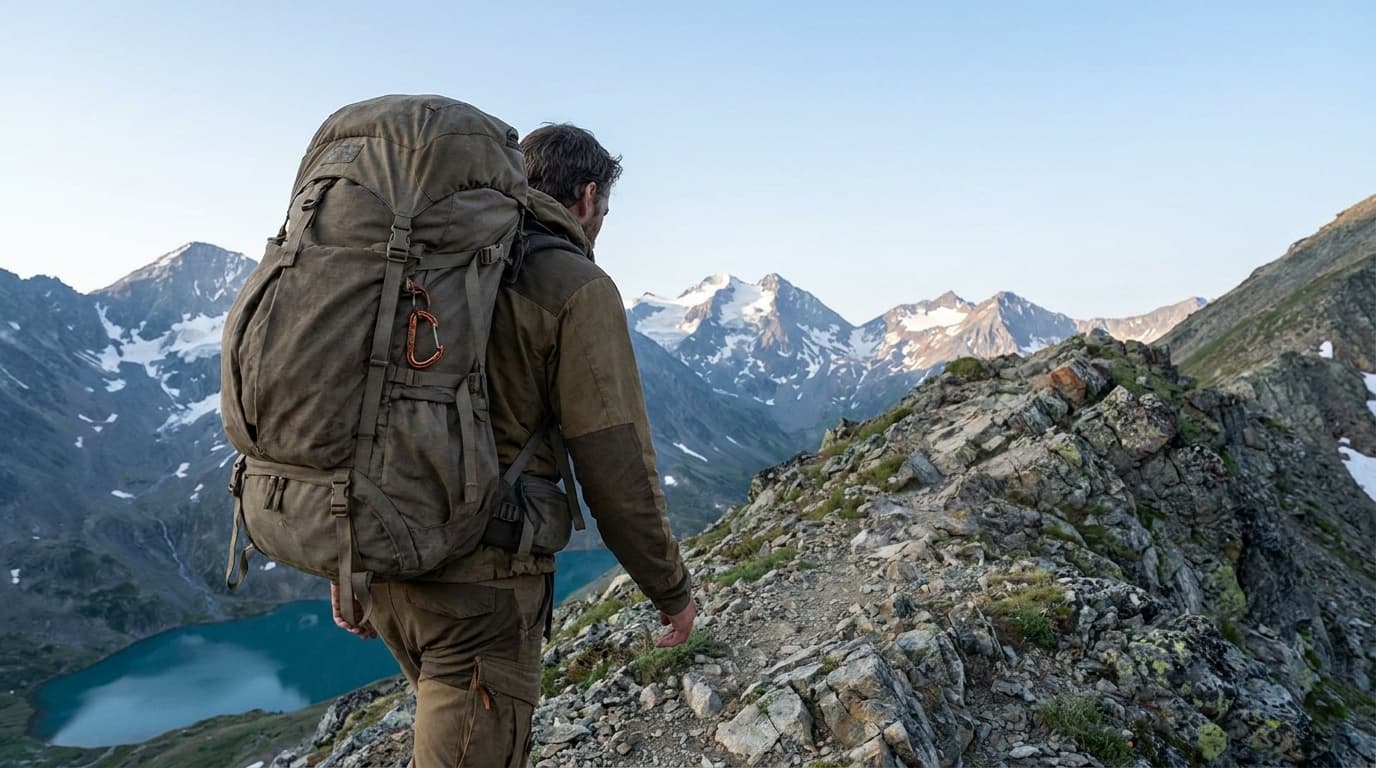
The Osprey Atmos AG LT 65 is the backpacking pack to buy for most three-season trips: it is Outdoor Gear Lab's best overall pick, and its suspended mesh back keeps air moving under a 30 to 40 lb load. Women should start with its twin, the Aura AG LT 65. If you want less weight, the Gregory Paragon 60 (3.72 lb) and Osprey Exos 58 (2.84 lb) are the testers' other favorites, and the REI Co-op Trailmade 60 is the budget pick.
Our quick picks
How we picked
Every pack is scored with our Kit Score: fit and torso range, suspension and load rating, weight, capacity, ventilation, and value. We started from the 2026 picks at Outdoor Gear Lab, Switchback Travel, CleverHiker, and GearJunkie, then checked every weight, torso range, and load rating against the maker's page. Osprey, Gregory, and Deuter packs are sold on Amazon by Amazon or the brand store; REI and Hyperlite Mountain Gear sell theirs directly. We have not carried these packs; the sources table at the end shows where each number comes from.
The picks
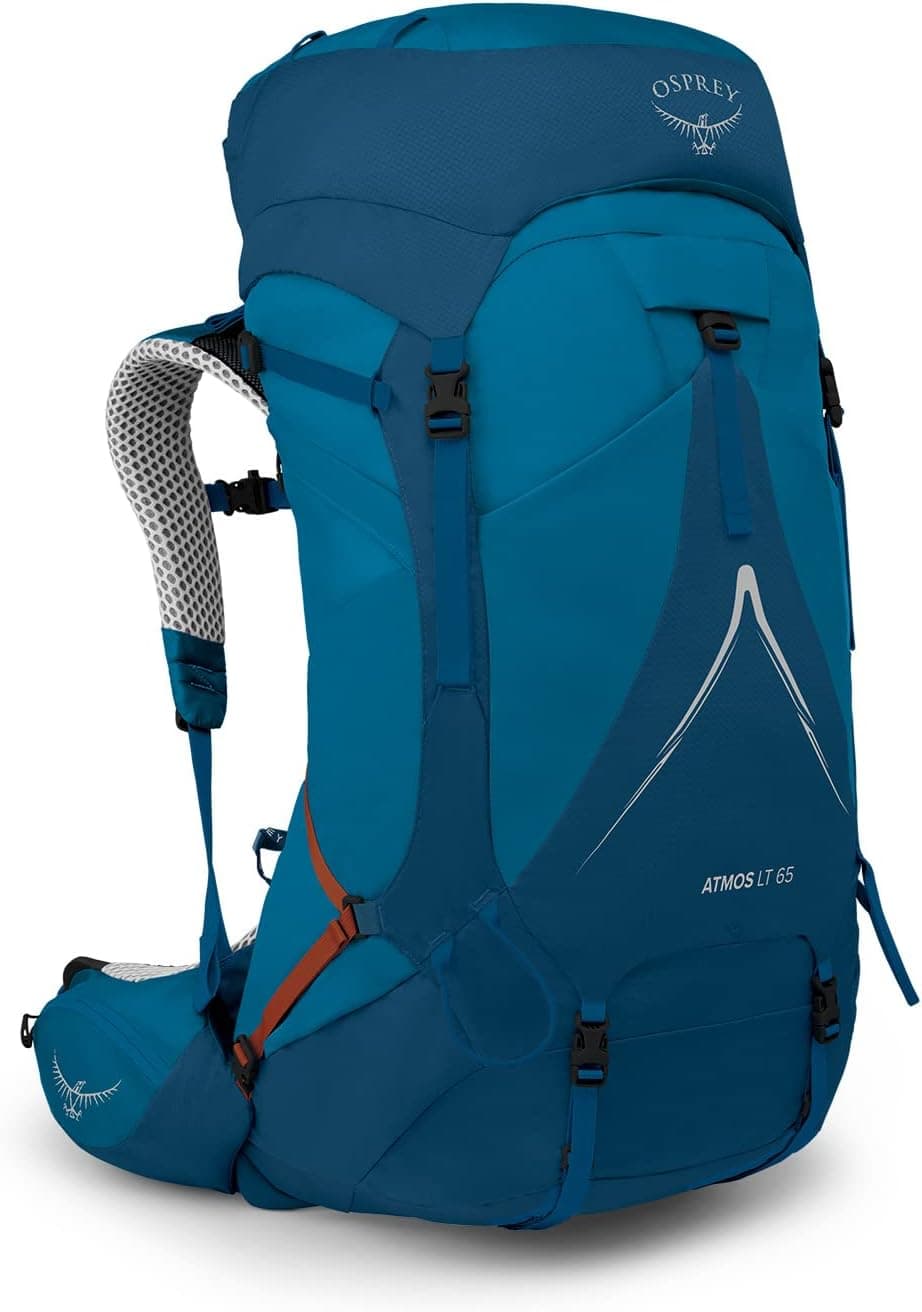
Best overall: Osprey Atmos AG LT 65
BEST OVERALL
Osprey Atmos AG LT 65
Best for: Three-season backpackers who prioritize back ventilation and all-day comfort over ultralight gram-counting, and plan to carry loads in the 25–40 lb range.
- Top-ranked comfort in independent lab testing, with the suspended mesh back panel consistently praised for heat and pressure-point relief under loads up to 40 lb
- Suspension feels less structured above 40 lb; heavy haulers moving into 45–50 lb territory may prefer a stiffer frame
Kit Score 8.4/10 · $319.95 Price checked Oct 25, 3:41 PM CDT · how we score gear
Buy on AmazonProduct details
The Atmos AG LT 65 earns the top spot by pairing Osprey's Anti-Gravity suspended mesh back panel with a lighter, cleaner build than the standard Atmos. The tensioned trampoline mesh runs from the shoulder blades all the way into the hip belt fins, creating a consistent air gap that keeps your back noticeably cooler than foam-contact designs.
- Weight
- 4.07 lb (S/M) / 4.25 lb (L/XL)
- Capacity
- 65L (S/M) / 68L (L/XL)
- Torso fit
- S/M: 17–20 in, L/XL: 21–23 in
- Load range
- 30 to 40 lb
- Hip belt
- Fit-on-the-Fly, two zippered pockets
- Back system
- Anti-Gravity tensioned mesh, fully suspended
- Rain cover
- Integrated (included)
More strengths
- Two torso sizes with 3–4 inches of micro-adjustability and moveable Velcro hip belt padding let most body types dial in a precise fit without a fit specialist
- Integrated rain cover, side-panel zip access, and recycled bluesign-approved fabrics round out a thoughtful, streamlined feature set
Other tradeoffs
- Premium price point narrows its appeal for occasional backpackers
The Atmos AG LT 65 is Outdoor Gear Lab's Editors' Choice for best overall backpacking pack, and Switchback Travel and CleverHiker both award its heavier sibling, the standard Atmos AG 65. The reason is the Anti-Gravity back: a tensioned mesh panel that runs from your shoulders into the hip belt and holds the pack off your back, so sweat has somewhere to go on a long, warm climb.
Osprey lists it at 65 liters and 4.07 lb in S/M (17 to 20 inch torso) and 68 liters and 4.25 lb in L/XL (21 to 23 inches), rated for 30 to 40 lb. It has two zippered hip belt pockets, an integrated rain cover, and Osprey's All Mighty Guarantee. Read our full Osprey Atmos AG LT 65 review.
Capacity: 65 to 68 L | Weight: 4.07 to 4.25 lb | Torso: 17 to 23 in (two sizes) | Load: 30 to 40 lb
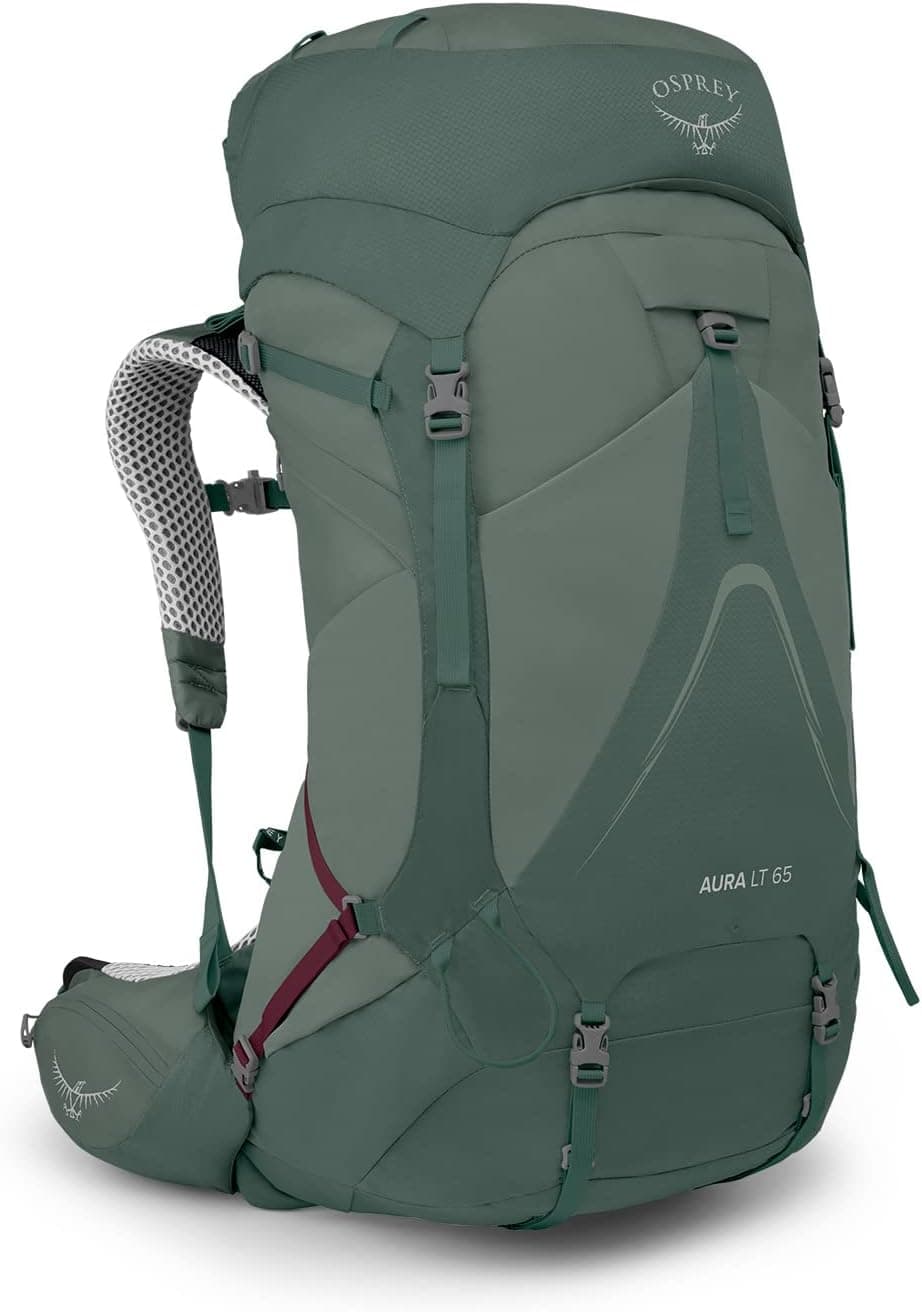
Best for women: Osprey Aura AG LT 65
BEST FOR WOMEN
Osprey Aura AG LT 65 Women's Backpacking Pack
Best for: Women backpacking three seasons with 30 to 40 lb loads who want the coolest-carrying framed pack.
- Switchback Travel's best overall women's backpacking pack
- About 4 lb, heavier than the Exos and Eja
Kit Score 8.5/10 · $319.95 Price checked Oct 25, 3:41 PM CDT · how we score gear
Buy on AmazonProduct details
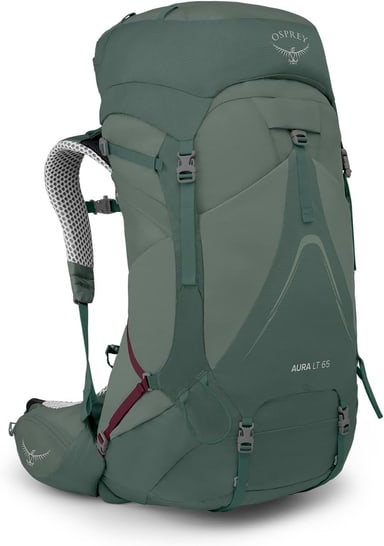
The Aura AG LT 65 is the women's Atmos AG LT: the same suspended Anti-Gravity mesh back that keeps air moving, on a harness and hip belt shaped for women and sized for 13- to 20-inch torsos. Osprey rates it for 30 to 40 lb and lists 65 liters at 4.01 lb in WM/L. Switchback Travel names it the best women's backpacking pack.
- Capacity
- 63 L (WXS/S) / 65 L (WM/L)
- Weight
- 3.84 lb (WXS/S) / 4.01 lb (WM/L)
- Torso fit
- WXS/S: 13–17 in, WM/L: 18–20 in
- Load range
- 30 to 40 lb
- Back system
- Anti-Gravity suspended mesh, 4 mm peripheral frame
- Extras
- Two zippered hip belt pockets, integrated rain cover
More strengths
- Suspended mesh back runs cooler than contact back panels
- Two torso sizes reach down to 13 inches
Other tradeoffs
- Priced at the top of the mainstream packs
The Aura AG LT 65 is the Atmos built for women, and Switchback Travel names it the best overall women's backpacking pack. It keeps the same suspended mesh back and 30 to 40 lb load range on a harness and hip belt shaped for women. Osprey lists 63 liters and 3.84 lb in WXS/S (13 to 17 inch torso) and 65 liters and 4.01 lb in WM/L (18 to 20 inches), so it fits shorter torsos than the Atmos.
Capacity: 63 to 65 L | Weight: 3.84 to 4.01 lb | Torso: 13 to 20 in (two sizes) | Load: 30 to 40 lb
Best all-around: Gregory Paragon 60
BEST ALL-AROUND
Gregory Paragon 60 Backpacking Pack
Best for: Backpackers who want one lighter framed pack for weekend to week-long three-season trips.
- Best overall at CleverHiker and GearJunkie
- Padded mesh back sits against you, warmer than the Atmos's suspended mesh
Kit Score 8.7/10 · $299.95 Price checked Oct 25, 3:41 PM CDT · how we score gear
Buy on AmazonProduct details
The Paragon 60 is the best all-around pack for backpackers who want less weight without giving up a real frame. Gregory lists 60 liters at 3.72 lb with a 50 lb max load, an adjustable torso, and a FreeFloat hip belt that moves with your stride. CleverHiker and GearJunkie both name it their best overall backpacking pack; the Maven 58 is the women's version.
- Capacity
- 60 L
- Weight
- 3.72 lb (MD/LG)
- Torso fit
- 18–22 in (MD/LG); SM/MD also sold
- Hip belt
- 27–53 in, FreeFloat dynamic hip belt
- Max load
- 50 lb
- Women's version
- Gregory Maven 58
More strengths
- Under 4 lb with a 50 lb max load
- Adjustable torso and a wide 27 to 53 inch hip belt range
Other tradeoffs
- 60 L is tight for a bear canister plus winter layers
The Paragon 60 is CleverHiker's and GearJunkie's best overall backpacking pack, and it ranks fourth at Outdoor Gear Lab. It is the pack for people who want to shed weight without losing a real frame. Gregory lists 60 liters at 3.72 lb with a 50 lb max load, an adjustable 18 to 22 inch torso in MD/LG (an SM/MD is also sold), and a FreeFloat hip belt that adjusts from 27 to 53 inches. The Maven 58 is the women's version.
The trade against the Atmos is airflow: the Paragon's padded mesh back sits against you rather than floating on a trampoline. At 60 liters it is also tighter for a bear canister plus cold-weather layers.
Capacity: 60 L | Weight: 3.72 lb | Torso: 18 to 22 in (MD/LG) | Max load: 50 lb
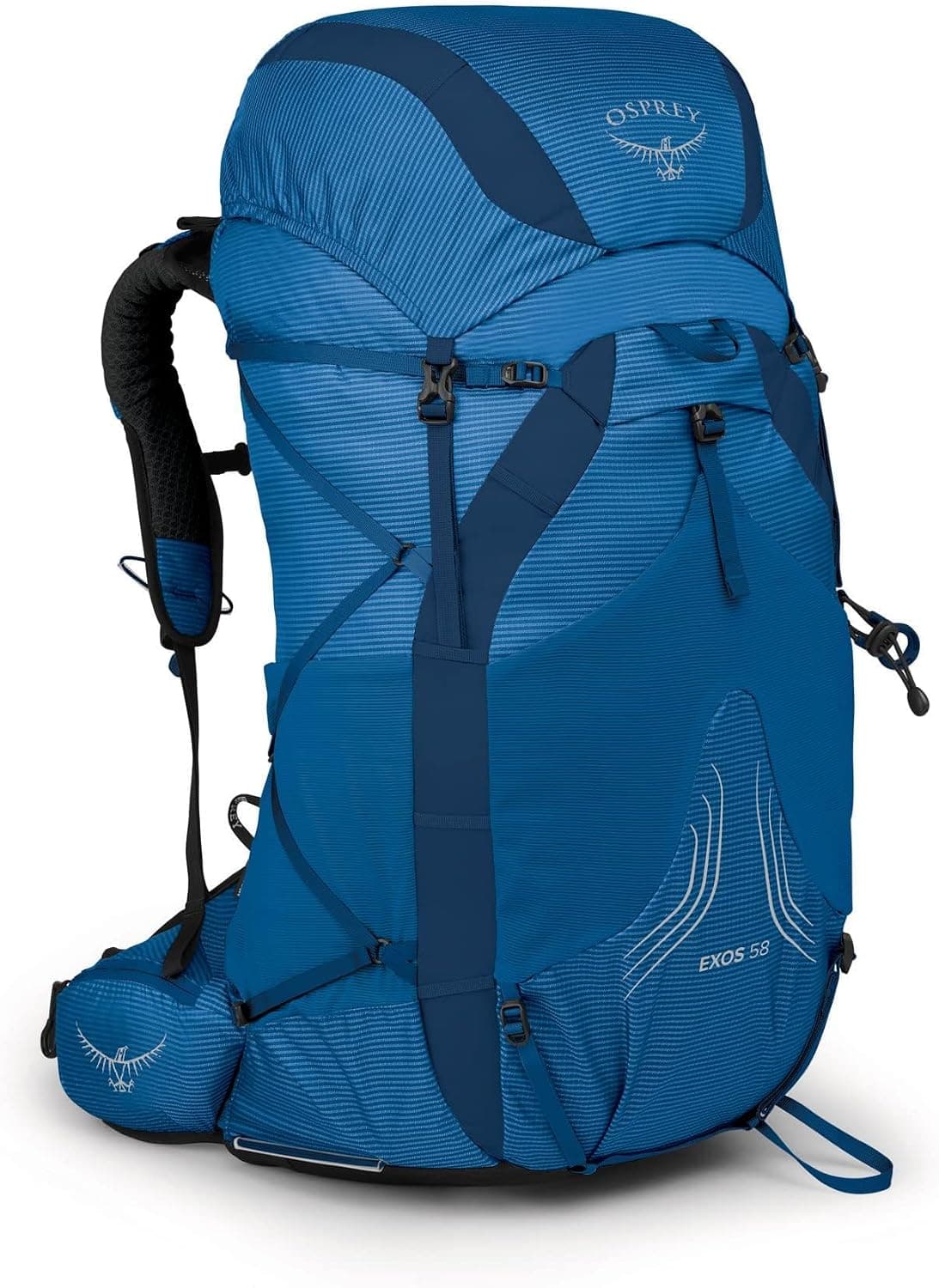
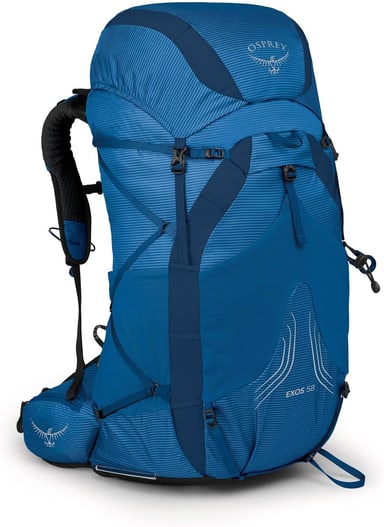
Best lightweight: Osprey Exos 58
BEST LIGHTWEIGHT
Osprey Exos 58 Ultralight Backpacking Pack
Best for: Backpackers who keep their total load under about 35 lb and want a ventilated pack under 3 lb.
- Tester consensus pick: Switchback Travel, CleverHiker, and GearJunkie
- Rated to 35 lb, so not for heavy winter or long food carries
Kit Score 8.5/10 · $285.00 Price checked Oct 25, 3:41 PM CDT · how we score gear
Buy on AmazonProduct details
The Exos 58 is the lightweight pick that does not ask you to give up a frame or ventilation. Osprey lists 58 liters at 2.84 lb in S/M, more than a pound under the Atmos, with an AirSpeed suspended mesh back, two hip belt pockets, and a 30 to 35 lb load range. The Eja 58 is the women's version.
- Capacity
- 58 L (S/M) / 61 L (L/XL)
- Weight
- 2.84 lb (S/M) / 2.94 lb (L/XL)
- Torso fit
- S/M: 17–20 in, 4 in of adjustment
- Load range
- 30 to 35 lb
- Back system
- AirSpeed suspended mesh, LightWire frame
- Women's version
- Osprey Eja 58 (13–17 in and 18–20 in torsos)
More strengths
- Under 3 lb with a suspended mesh back
- Women's Eja 58 on the same platform
Other tradeoffs
- Less padding than the Atmos for loads near the top of its range
The Exos 58 is the closest thing to a tester consensus: Switchback Travel calls it the best balance of comfort and weight, CleverHiker picks it as its lightweight ventilated pack, and GearJunkie names it the best ventilated. Osprey lists 58 liters at 2.84 lb in S/M, more than a pound under the Atmos, with an AirSpeed suspended mesh back, 4 inches of torso adjustment, two hip belt pockets, and a 30 to 35 lb load range. The Eja 58 is the women's version.
Keep your total load under about 35 lb. Above that, a heavier frame like the Atmos or Paragon carries better.
Capacity: 58 to 61 L | Weight: 2.84 to 2.94 lb | Torso: 17 to 20 in (S/M) | Load: 30 to 35 lb
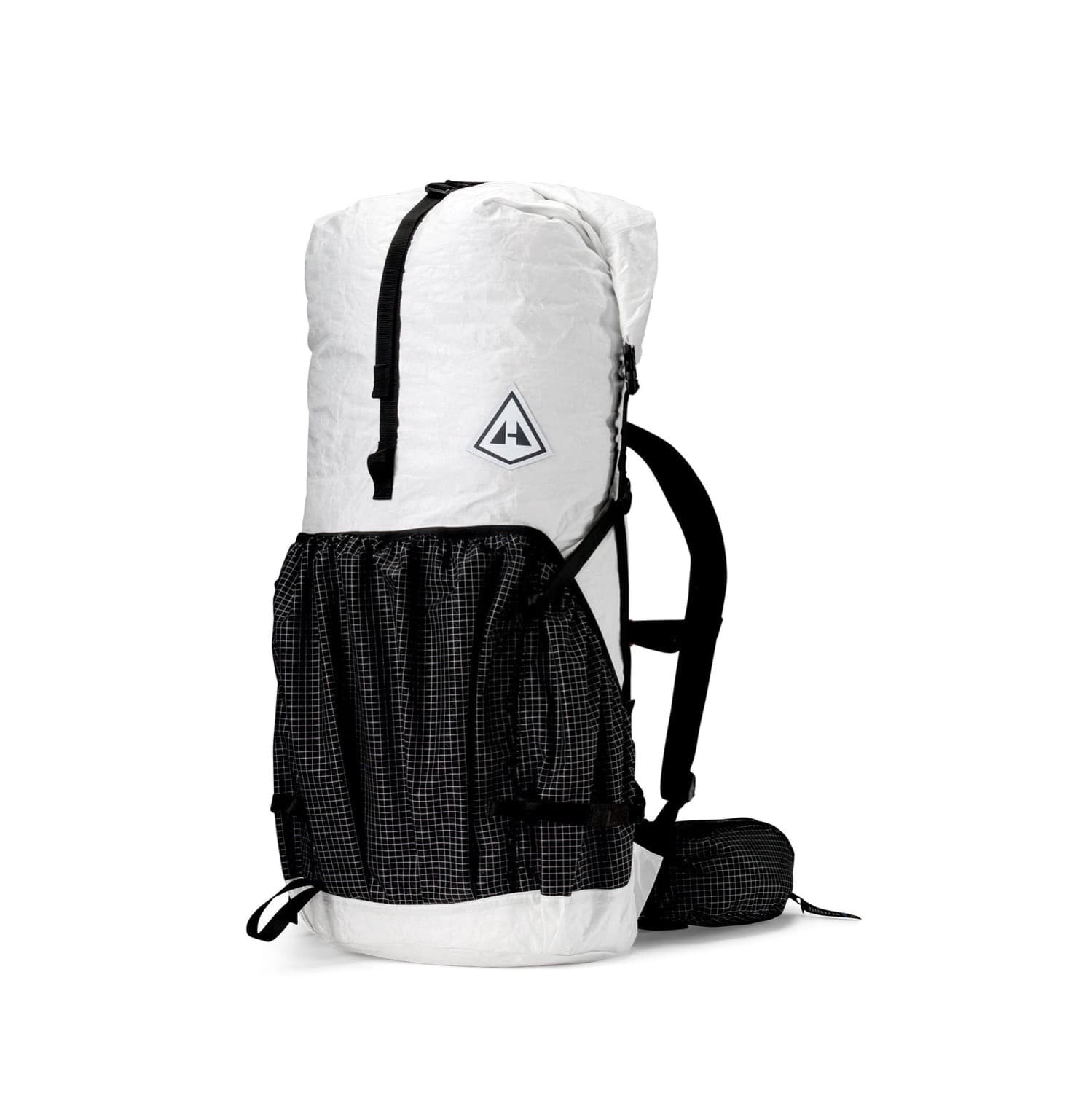
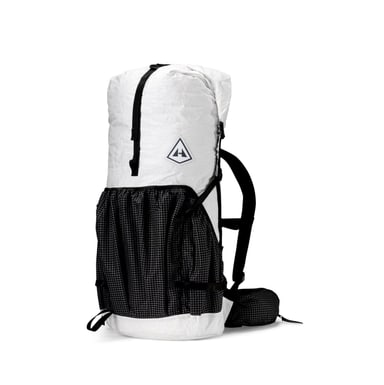
Best ultralight: Hyperlite Mountain Gear Southwest 55
BEST ULTRALIGHT
Hyperlite Mountain Gear Southwest 55
Best for: Thru-hikers and long-distance backpackers with a light base weight who want the lightest framed pack that still carries 30-plus lb.
- Under 2 lb for 55 L with a real frame and 40 lb max load
- Highest price here, sold only direct
Kit Score 8.3/10 · Check current price · how we score gear
Buy at Hyperlite Mountain GearProduct details
The Southwest 55 is the ultralight pack the testers keep choosing for long trails. Hyperlite Mountain Gear lists the 55-liter version at 30.8 oz, under 2 lb, with two removable aluminum stays, a 40 lb max load, and Dyneema Woven Composite fabric that sheds water. Torso sizes are fixed, so measure before you order.
- Capacity
- 55 L (also 40 L and 70 L)
- Weight
- 30.8 oz (874 g), size M
- Torso fit
- Fixed sizes: XS under 15 in, S 15–17, M 17–19, L 19–21, Tall 21+
- Max load
- 40 lb
- Frame
- Two removable aluminum stays
- Fabric
- Dyneema Woven Composite 3.9, Dyneema hip belt pockets
More strengths
- Top ultralight or thru-hiking pick at Outdoor Gear Lab, Switchback Travel, and GearJunkie
- Water-resistant Dyneema fabric with big outside mesh pockets
Other tradeoffs
- Fixed torso sizes and a simple roll-top: no lid, no fancy pockets
The Southwest 55 is Outdoor Gear Lab's Top Pick for ultralight thru-hikers, Switchback Travel's best ultralight pack, and GearJunkie's best thru-hiking pack. Hyperlite Mountain Gear lists the 55-liter version at 30.8 oz in size M, under 2 lb, with two removable aluminum stays, a 40 lb max load, Dyneema hip belt pockets, and Dyneema Woven Composite fabric.
It is a simple roll-top, built for a light base weight. Torso sizes are fixed (XS under 15 inches up to Tall at 21-plus), so measure before you order, and it costs the most of any pack here. Buy it direct from Hyperlite.
Capacity: 55 L | Weight: 30.8 oz (M) | Torso: fixed sizes, under 15 to 21-plus in | Max load: 40 lb
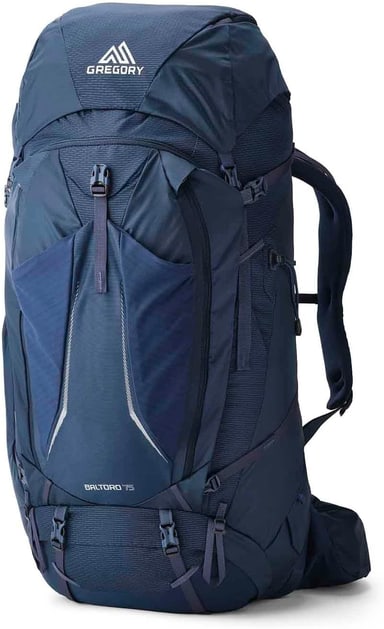
Best for heavy loads: Gregory Baltoro 75
BEST FOR HEAVY LOADS
Gregory Baltoro 75 Backpacking Pack
Best for: Backpackers who regularly carry 40 lb or more: winter trips, bear-canister routes, or carrying gear for a family.
- 65 lb max load, the highest here
- 5.34 lb empty, the heaviest pack here
Kit Score 8.5/10 · $399.95 Price checked Oct 25, 3:41 PM CDT · how we score gear
Buy on AmazonProduct details
The Baltoro 75 is the pack for the heavy trips: winter overnights, bear-canister country, long food carries, or hauling shared gear for kids. Gregory rates it for a 65 lb max load on a perimeter alloy frame with its FreeFloat A3 suspension, and lists 75 liters, 9 outside pockets, and 5.34 lb. Switchback Travel and CleverHiker both pick the Baltoro 75 and women's Deva 70 for heavy loads.
- Capacity
- 75 L
- Weight
- 5.34 lb
- Torso fit
- 18–22 in (as listed by Gregory); three sizes
- Hip belt
- 30–52 in, oversized zippered pockets
- Max load
- 65 lb
- Frame
- Perimeter alloy frame, fiberglass cross-stay, FreeFloat A3 suspension
- Women's version
- Gregory Deva 70
More strengths
- Nine outside pockets and front U-zip access to the main compartment
- Tester pick for heavy loads at Switchback Travel and CleverHiker
Other tradeoffs
- More pack than a three-day summer trip needs
When the load is heavy, Switchback Travel and CleverHiker both pick the Baltoro 75 and its women's version, the Deva 70. Gregory lists 75 liters with a 65 lb max carry weight on a perimeter alloy frame and FreeFloat A3 suspension, nine outside pockets, front U-zip access, and an 18 to 22 inch torso range. That makes it the pack for winter overnights, bear-canister routes, long food carries, or hauling a child's share of the gear.
At 5.34 lb it is the heaviest pack here, and it is more pack than a summer weekend needs. Outdoor Gear Lab ranked the smaller Baltoro 65 low, which is why we feature the 75.
Capacity: 75 L | Weight: 5.34 lb | Torso: 18 to 22 in | Max load: 65 lb
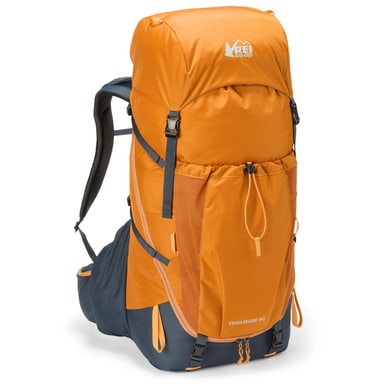
Best budget: REI Co-op Trailmade 60
BEST BUDGET
REI Co-op Trailmade 60 Pack
Best for: New and occasional backpackers who want a light, adjustable 60 L pack without paying premium-pack prices.
- Lowest price of any framed pack here
- 35 lb load rating, below the Atmos and Paragon
Kit Score 8.3/10 · Check current price · how we score gear
Buy at REIProduct details
The Trailmade 60 is the budget pack the testers keep recommending. REI lists 60 liters at 3 lb 5 oz with an adjustable 17 to 21 inch torso, hip belt pockets, a 35 lb load rating, and two hip belt sizes up to 53 inches. Switchback Travel names it the best budget pack and Outdoor Gear Lab gives it a Best Buy.
- Capacity
- 60 L
- Weight
- 3 lb 5 oz (S–L hip belt) / 3 lb 8 oz (XL–3XL hip belt)
- Torso fit
- Adjustable, 17–21 in
- Hip belt
- 31–41 in or 40–53 in, with pockets
- Max load
- Up to 35 lb
- Women's version
- REI Co-op Trailmade 60 (women's)
More strengths
- Adjustable torso and two hip belt sizes up to 53 inches
- Budget pick at Switchback Travel, Outdoor Gear Lab, and CleverHiker
Other tradeoffs
- Sold only at REI
The Trailmade 60 is Switchback Travel's best budget pack, an Outdoor Gear Lab Best Buy, and a CleverHiker pick. REI lists 60 liters at 3 lb 5 oz, an adjustable 17 to 21 inch torso, hip belt pockets, two hip belt sizes (31 to 41 and 40 to 53 inches), and a load rating up to 35 lb. A women's version is sold too.
The 35 lb rating is the limit to respect: it is a light, framed pack for summer and shoulder-season trips, not a winter hauler. It is sold only at REI.
Capacity: 60 L | Weight: 3 lb 5 oz | Torso: 17 to 21 in | Load: up to 35 lb
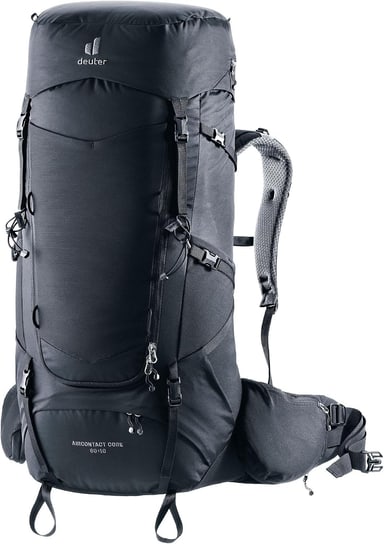
Most adjustable: Deuter Aircontact Core 60+10
MOST ADJUSTABLE
Deuter Aircontact Core 60+10
Best for: Backpackers who need maximum torso-fit flexibility, plan to share the pack, or want capacity that scales from a 3-night weekend to a week-long route.
- 16.5–24.4 in of back-length adjustment is the widest range in this roundup, which makes it a reliable fit across body sizes and a good shared pack
- At 5 lb 1.5 oz it is among the heaviest packs here, and the contact back panel runs warmer than suspended-mesh designs on hot, humid days
Kit Score 8.3/10 · $300.00 Price checked Oct 25, 3:41 PM CDT · how we score gear
Buy on AmazonProduct details
The Aircontact Core 60+10 is Deuter's 2025 replacement for the Aircontact Core 65+10, which is now discontinued. Same idea: a contact back system with Air Spacer mesh over an external aluminum Y-frame, a wide tool-free back-length range (42–62 cm), and a 10 L extension collar. Deuter lists it at 2,310 g and a 10–20 kg recommended load, with a lifetime warranty. Over half the fabric is recycled.
- Weight
- 5 lb 1.5 oz (2,310 g), Deuter spec
- Capacity
- 60 L, extendable to 70 L via the collar
- Back length
- 16.5–24.4 in (42–62 cm) tool-free adjustment; fits 5 ft 7 in to 6 ft 9 in
- Recommended load
- 22–44 lb (10–20 kg)
- Back system
- Aircontact with Air Spacer mesh, external aluminum Y-frame, ActiveBalance shoulder straps, VariFlex hip fins with Pull-Forward
- Dimensions
- 33 x 13.4 x 11.4 in (84 x 34 x 29 cm)
- Access and pockets
- Front U-shaped zipper, height-adjustable detachable lid, separate bottom compartment, wet compartment, zip-out bottle holder, hydration sleeve to 3 L
More strengths
- 10 L extension collar scales the pack from a long weekend to a week without swapping packs
- Lifetime warranty plus Deuter's repair service, and the Core line has a long track record for durability
Other tradeoffs
- New enough that Amazon owner ratings are sparse; Amazon stock comes from third-party sellers, so check deuter.com if the listing is empty
The Aircontact Core 60+10 has the widest fit range here. Deuter lists a tool-free back-length adjustment from 42 to 62 cm (16.5 to 24.4 inches), and a 10-liter extension collar takes the 60-liter body to 70. That makes it the pack to share between partners, or to buy before you know your torso length. The previous Aircontact Core 65+10 was Outdoor Gear Lab's pick for easiest to pack and unpack.
It carries on a contact back over Air Spacer mesh and an aluminum Y-frame, rated for 10 to 20 kg (22 to 44 lb). That transfers load well on rough ground but runs warmer than the Atmos, and at 2,310 g (5 lb 1.5 oz) it is the second-heaviest pack here. Deuter backs it with a lifetime warranty.
Capacity: 60 L, +10 L collar | Weight: 2,310 g | Back length: 42 to 62 cm | Load: 10 to 20 kg
Pick the pack by your torso and your heaviest load, then by weight. A light pack that cannot carry your food and water is the heavy one on day three.
Compare the picks
| Spec | Atmos AG LT 65 | Aura AG LT 65 | Paragon 60 | Exos 58 | Southwest 55 | Baltoro 75 | Trailmade 60 | Aircontact Core 60+10 |
|---|---|---|---|---|---|---|---|---|
| Kit Score | 8.4/10 | 8.5/10 | 8.7/10 | 8.5/10 | 8.3/10 | 8.5/10 | 8.3/10 | 8.3/10 |
| Price | $319.95 Price checked Oct 25, 3:41 PM CDT | $319.95 Price checked Oct 25, 3:41 PM CDT | $299.95 Price checked Oct 25, 3:41 PM CDT | $285.00 Price checked Oct 25, 3:41 PM CDT | Check current price | $399.95 Price checked Oct 25, 3:41 PM CDT | Check current price | $300.00 Price checked Oct 25, 3:41 PM CDT |
| Best for | Three-season backpackers who prioritize back ventilation and all-day comfort over ultralight gram-counting, and plan to carry loads in the 25–40 lb range. | Women backpacking three seasons with 30 to 40 lb loads who want the coolest-carrying framed pack. | Backpackers who want one lighter framed pack for weekend to week-long three-season trips. | Backpackers who keep their total load under about 35 lb and want a ventilated pack under 3 lb. | Thru-hikers and long-distance backpackers with a light base weight who want the lightest framed pack that still carries 30-plus lb. | Backpackers who regularly carry 40 lb or more: winter trips, bear-canister routes, or carrying gear for a family. | New and occasional backpackers who want a light, adjustable 60 L pack without paying premium-pack prices. | Backpackers who need maximum torso-fit flexibility, plan to share the pack, or want capacity that scales from a 3-night weekend to a week-long route. |
| Why it stands out | Top-ranked comfort in independent lab testing, with the suspended mesh back panel consistently praised for heat and pressure-point relief under loads up to 40 lb | Switchback Travel's best overall women's backpacking pack | Best overall at CleverHiker and GearJunkie | Tester consensus pick: Switchback Travel, CleverHiker, and GearJunkie | Under 2 lb for 55 L with a real frame and 40 lb max load | 65 lb max load, the highest here | Lowest price of any framed pack here | 16.5–24.4 in of back-length adjustment is the widest range in this roundup, which makes it a reliable fit across body sizes and a good shared pack |
| Tradeoff | Suspension feels less structured above 40 lb; heavy haulers moving into 45–50 lb territory may prefer a stiffer frame | About 4 lb, heavier than the Exos and Eja | Padded mesh back sits against you, warmer than the Atmos's suspended mesh | Rated to 35 lb, so not for heavy winter or long food carries | Highest price here, sold only direct | 5.34 lb empty, the heaviest pack here | 35 lb load rating, below the Atmos and Paragon | At 5 lb 1.5 oz it is among the heaviest packs here, and the contact back panel runs warmer than suspended-mesh designs on hot, humid days |
| Capacity | 65 to 68 L | 63 to 65 L | 60 L | 58 to 61 L | 55 L | 75 L | 60 L | 60 L, +10 L |
| Weight | 4.07 to 4.25 lb | 3.84 to 4.01 lb | 3.72 lb | 2.84 to 2.94 lb | 30.8 oz | 5.34 lb | 3 lb 5 oz | 5 lb 1.5 oz |
| Torso | 17 to 23 in | 13 to 20 in | 18 to 22 in (MD/LG) | 17 to 20 in (S/M) | Fixed sizes | 18 to 22 in | 17 to 21 in | 16.5 to 24.4 in |
| Load rating | 30 to 40 lb | 30 to 40 lb | 50 lb max | 30 to 35 lb | 40 lb max | 65 lb max | Up to 35 lb | 22 to 44 lb |
| Back | Suspended mesh | Suspended mesh | Padded mesh | Suspended mesh | Two aluminum stays | Padded mesh | Framed, adjustable | Contact mesh |
| Women's version | Aura AG LT 65 | Women's pack | Maven 58 | Eja 58 | Unisex | Deva 70 | Women's Trailmade 60 | Not listed |
| Where to buy | Amazon, Osprey | Amazon, Osprey | Amazon, Gregory | Amazon, Osprey | Hyperlite | Amazon, Gregory | REI | Amazon, Deuter |
How to size a backpacking pack before you buy
The most common pack-buying mistake is choosing the capacity before measuring your torso. Our backpack size selector helps with liters; fit comes first.
Five steps to a pack that actually fits
Measure your torso length
Stand straight and find the bony bump at the base of your neck (C7). Measure from there down your spine to the top of your hip bones (iliac crest). That number, in inches, is your torso length.
Match it to the maker's range
Ranges differ by brand. The Atmos AG LT S/M fits 17 to 20 inches and L/XL 21 to 23, the Aura goes down to 13, the Trailmade adjusts 17 to 21, and the Southwest comes in fixed sizes. If you sit between sizes, try both or pick an adjustable pack.
Check the hip belt on your hips
The padded hip belt should sit centered on your hip bones, not your waist. Buckle it snug before adjusting the shoulder straps. If you cannot get the belt right, the torso size is wrong.
Match the load rating to your heaviest day
Add base weight, food, and water for your longest stretch. Under about 30 lb, the Exos, Southwest, and Trailmade carry well; 30 to 40 lb suits the Atmos, Aura, and Paragon; above that, the Baltoro is built for it. Our [base weight calculator](/tools/base-weight) helps you add it up.
Load it before you commit
Fill the pack with 20 to 30 lb and walk around for ten minutes, at home or in a store. Pressure points and hip belt problems show up fast.
For a full walkthrough, read how to size a backpacking pack.
FAQ
What is the best backpacking pack for beginners?
The REI Co-op Trailmade 60. It is the budget pick at Switchback Travel and Outdoor Gear Lab, adjusts from 17 to 21 inches of torso, weighs 3 lb 5 oz, and costs the least of any framed pack here. If you already know backpacking will be a habit, the Osprey Atmos AG LT 65 or Gregory Paragon 60 is worth the step up.
What is the best backpacking pack for women?
The Osprey Aura AG LT 65, Switchback Travel's best overall women's pack, which fits 13- to 20-inch torsos. For less weight, the Osprey Eja 58 and Gregory Maven 58 are the women's versions of the Exos 58 and Paragon 60.
Is a 65L pack too big for a weekend?
For two- to four-night trips, 65 liters is comfortable rather than excessive, with room for a bear canister and extra layers. If you pack light or hike in warm weather, 55 to 60 liters is plenty, and the Exos 58 or Paragon 60 saves weight.
Does back ventilation matter in a backpacking pack?
On long, warm climbs, yes. Suspended mesh backs like the Atmos, Aura, and Exos hold the pack off your back so sweat can dry. Contact backs like the Deuter Aircontact and padded mesh like the Paragon run warmer but keep the load close, which some hikers prefer on rough ground.
Where these numbers come from
| Claim | Source | Checked |
|---|---|---|
| Atmos AG LT 65 Editors' Choice best overall; Hyperlite Southwest 55 Top Pick for ultralight thru-hikers; Trailmade 60 Best Buy; Paragon 60 fourth; Aircontact Core 65+10 easiest to pack; Baltoro 65 ranked low | Outdoor Gear Lab, best backpacking backpacks | 2026-10-03 |
| Atmos AG 65 best overall men's; Aura AG LT 65 best overall women's; Trailmade 60 best budget; Southwest 55 best ultralight; Baltoro 75 / Deva 70 for heavy loads; Exos / Eja 58 best balance of comfort and weight | Switchback Travel, best backpacking backpacks | 2026-10-03 |
| Paragon 60 best overall; Exos 58 lightweight ventilated; Baltoro 75 load hauler; Trailmade 60 listed | CleverHiker, best backpacking backpacks | 2026-10-03 |
| Paragon 60 best overall; Exos 58 best ventilated; Southwest 55 best thru-hiking | GearJunkie, best backpacking backpacks | 2026-10-03 |
| Atmos AG LT 65: 65 L / 4.07 lb (S/M, 17–20 in), 68 L / 4.25 lb (L/XL, 21–23 in), 30–40 lb load | Osprey, Atmos AG LT 65 | 2026-10-03 |
| Aura AG LT 65: 63 L / 3.84 lb (WXS/S, 13–17 in), 65 L / 4.01 lb (WM/L, 18–20 in), 30–40 lb load | Osprey, Aura AG LT 65 | 2026-10-03 |
| Exos 58: 58 L / 2.84 lb (S/M), 61 L / 2.94 lb (L/XL), 30–35 lb load | Osprey, Exos 58 | 2026-10-03 |
| Paragon 60: 60 L, 3.72 lb, 18–22 in torso, 27–53 in hip belt, 50 lb max load | Gregory, Paragon 60 | 2026-10-03 |
| Baltoro 75: 75 L, 5.34 lb, 18–22 in torso, 30–52 in hip belt, 65 lb max carry weight, 9 outside pockets | Gregory, Baltoro 75 | 2026-10-03 |
| Southwest 55: 30.8 oz (M), fixed torso sizes, 40 lb max load, two aluminum stays, Dyneema Woven Composite | Hyperlite Mountain Gear, Southwest | 2026-10-03 |
| Trailmade 60: 60 L, 3 lb 5 oz, 17–21 in torso, up to 35 lb | REI, Trailmade 60 (men's) | 2026-10-03 |
| Aircontact Core 60+10: 2,310 g, 42–62 cm back length, 10–20 kg load, lifetime warranty | Deuter, Aircontact Core 60+10 | 2026-10-03 |
We have not carried these packs. Weights, torso ranges, and load ratings are the makers' published figures.
Ready to plan the trip? See more hike gear, or read how we research and rate.
Keep going
Free toolPack-Size SelectorWhat size pack (in liters) your trip actually needs.Related guides
 Complete hike loadoutDay hike kitBuild the complete kit
Our recommendations draw on manufacturer documentation, retailer listings, owner feedback, and comparisons with alternatives.
As an Amazon Associate I earn from qualifying purchases. We may earn a commission from links here, at no extra cost to you. How we research →