
For most travelers, a knee-high graduated sock at 15-20 mmHg is the right flight sock; step up to 20-30 mmHg if you have clot risk factors or bad swelling. A Cochrane review of 12 trials found stockings on flights over five hours cut symptomless deep-vein clots from a few tens per thousand passengers to two or three per thousand, and the CDC's travel guidance targets 15-30 mmHg at the ankle for higher-risk travelers. The rest comes down to fit, construction, and how long you will wear them.
Our quick picks
The numbers that actually matter
How we picked
Every sock here was evaluated against the Kit Score: compression level in mmHg, graduated-compression construction, material quality and breathability, sizing range, and verified-owner consensus on fit across multiple limb shapes. Price-per-pair was factored in for value rankings. We have not worn these socks on test flights; compression levels and materials are the makers' specs.
Best overall: Comrad 3-Pack knee high compression socks
Frequent flyers burn through socks fast. Comrad's 3-pack solves the rotation problem: three pairs at once, a SmartSilver odor-control treatment for back-to-back travel days, and graduated compression that is strongest at the ankle and eases up the leg. Sizing runs by shoe size and calf circumference (Small fits a 10 to 14 inch calf). The 15-20 mmHg level is the right entry point for most healthy travelers and easy to wear all day through a connection.
BEST OVERALL
Comrad 3-Pack Knee High 15-20 mmHg Graduated Compression Socks
Best for: Frequent flyers who want to stock several pairs at once and value antibacterial treatment for back-to-back travel days.
- True graduated compression verified by owner reports: strongest at the ankle, tapering toward the knee, with consistent performance across the 4.4-star aggregate from 1,700+ Amazon reviewers
- Elasticity noticeably weakens after 3-6 months of daily use according to longer-term owners, shortening the effective lifespan compared to merino-blend alternatives
Kit Score 8.5/10 · $101.99 Price checked Oct 25, 3:41 PM CDT · how we score gear
Buy on AmazonProduct details
Comrad's nylon-spandex knee-high delivers true graduated compression at 15-20 mmHg with a SmartSilver antibacterial finish that keeps odor in check across multi-day travel. The 3-pack format makes the per-pair cost competitive for anyone who wants a dedicated flight sock that can rotate through a week-long trip.
- Compression
- 15-20 mmHg true graduated compression
- Materials
- 91% nylon, 9% spandex with SmartSilver antibacterial treatment
- Style
- Knee-high, contoured fit
- Sizing
- S through XL; wide-calf options in M and L
- Amazon rating
- 4.4/5 (1,700+ reviews)
- Pack
- 3 pairs per listing
More strengths
- SmartSilver antimicrobial treatment addresses the odor problem that plagues compression socks worn through long travel days and in shared sleeping spaces
- Wide-calf sizing in Medium and Large fills a gap that most competitors leave open, and owners with athletic builds confirm the contoured fit stays up without rolling
Other tradeoffs
- The 3-pack format requires a higher upfront outlay; per-pair cost is competitive only when all three pairs are needed
Best premium: CEP Flight Tall 20-30 mmHg
CEP's Flight sock is not a general athletic sock repurposed for flying. It is built for travel: 20-30 mmHg graduated compression in a knee-high merino blend (49% polyamide, 36% merino wool, 15% spandex), a padded footbed, and a no-slip fit meant to stop bunching through a long travel day. For long-haul flyers who wake up with puffy ankles, this is the pick.
Graduated compression means tightest at the ankle and gradually looser up the calf. That gradient is what pushes blood upward. A sock that squeezes uniformly is just tight, not therapeutic.
Best budget: Physix Gear Sport 20-30 mmHg
Physix Gear delivers a firm 20-30 mmHg compression range at $15 to $20 a pair. The construction is basic compared to CEP or Comrad but the mmHg level is not. For travelers who want real compression without spending on premium brands, they are easy to replace when the elastic eventually tires.
BEST BUDGET
Physix Gear Sport Compression Socks 20-30 mmHg
Best for: Budget-conscious travelers who want clinically relevant 20-30 mmHg compression for flights without spending on premium brands.
- True 20-30 mmHg compression at a fraction of medical-grade pricing, backed by more than 94,000 Amazon reviews with consistently positive owner sentiment on travel and flight use
- The top band can feel constrictive on wider calves; owners with heavier legs report a tourniquet-like sensation at the cuff
Kit Score 8.2/10 · $19.20 Price checked Oct 25, 3:41 PM CDT · how we score gear
Buy on AmazonProduct details
A high-volume Amazon bestseller offering firm 20-30 mmHg graduated compression at a sub-$20 price point. The nylon-spandex blend is moisture-wicking and holds its compression well through repeated washings, making it a practical pick for occasional flyers who want real compression without a premium outlay.
- Compression
- 20-30 mmHg graduated
- Materials
- Nylon, spandex
- Style
- Knee-high (calf-length)
- Sizing
- S/M, L/XL, XXL; men's and women's
- Amazon rating
- 4.5/5 (94,500+ reviews)
More strengths
- Lightweight nylon-spandex construction wicks moisture and stays thin enough to wear inside most travel footwear
- Easy to size: fits men's and women's feet across a wide range, available from S/M through XXL
Other tradeoffs
- Some buyers note thinner fabric and reduced elasticity in more recent production runs compared to earlier pairs
Best value for women: Sockwell Women's Circulator
The Circulator's advantage is versatility across a full travel day. Moderate graduated compression (15-20 mmHg) in four zones, a merino wool and bamboo rayon blend for temperature regulation and odor control, and an ultra-light cushion sole that works through a layover walk and an evening out. It is made in the USA. Women who want one pair to handle the whole trip, not just the flight, will get more use out of this than a single-purpose flight sock.
BEST VALUE
Sockwell Women's Circulator Moderate Graduated Compression Sock
Best for: Women looking for a do-everything travel sock that covers long flights, layover walking, and evening use without switching pairs.
- Merino wool and bamboo rayon blend provides genuine thermoregulation: warm in cool cabins, non-clammy during walking, and naturally odor-resistant over multi-day trips
- Women's sizing only under this ASIN; men will need the separate Circulator listing
Kit Score 8.8/10 · $32.95 Price checked Oct 25, 3:41 PM CDT · how we score gear
Buy on AmazonProduct details
Sockwell's flagship travel sock pairs graduated compression at 15-20 mmHg with a merino-bamboo-nylon blend that regulates temperature, resists odor, and stays soft through a full day of airports and sitting. Designed and manufactured in the USA with American-grown wool, it sits at a price where the materials actually justify the spend.
- Compression
- 15-20 mmHg graduated
- Materials
- 32% merino wool, 31% bamboo rayon, 32% stretch nylon, 5% spandex
- Style
- Knee-high with ultra-light cushion sole
- Sizing
- S/M (women's 4-7.5), M/L (women's 8-11)
- Origin
- Made in USA with American-grown wool
- Amazon rating
- 4.6/5 (5,100+ reviews)
More strengths
- 15-20 mmHg compression is the travel-medicine sweet spot for most healthy adults on long-haul flights, firm enough to reduce swelling without requiring a prescription
- Arch support, seamless toe closure, and a turn-welt top band deliver all-day comfort reported by owners who wear them for full travel days including flights and multi-hour train connections
Other tradeoffs
- Less firm grip at the top band compared to 20-30 mmHg options, which some owners with pronounced leg swelling find insufficient
How they compare
| Product | Kit Score | Price | Best for |
|---|---|---|---|
| Comrad 3-Pack Knee High 15-20 mmHg Graduated Compression Socks | 8.5 | $101.99 Price checked Oct 25, 3:41 PM CDT | Best for: Frequent flyers who want to stock several pairs at once and value antibacterial treatment for back-to-back travel days. Why it stands out: True graduated compression verified by owner reports: strongest at the ankle, tapering toward the knee, with consistent performance across the 4.4-star aggregate from 1,700+ Amazon reviewers Tradeoff: Elasticity noticeably weakens after 3-6 months of daily use according to longer-term owners, shortening the effective lifespan compared to merino-blend alternatives |
| Physix Gear Sport Compression Socks 20-30 mmHg | 8.2 | $19.20 Price checked Oct 25, 3:41 PM CDT | Best for: Budget-conscious travelers who want clinically relevant 20-30 mmHg compression for flights without spending on premium brands. Why it stands out: True 20-30 mmHg compression at a fraction of medical-grade pricing, backed by more than 94,000 Amazon reviews with consistently positive owner sentiment on travel and flight use Tradeoff: The top band can feel constrictive on wider calves; owners with heavier legs report a tourniquet-like sensation at the cuff |
| Sockwell Women's Circulator Moderate Graduated Compression Sock | 8.8 | $32.95 Price checked Oct 25, 3:41 PM CDT | Best for: Women looking for a do-everything travel sock that covers long flights, layover walking, and evening use without switching pairs. Why it stands out: Merino wool and bamboo rayon blend provides genuine thermoregulation: warm in cool cabins, non-clammy during walking, and naturally odor-resistant over multi-day trips Tradeoff: Women's sizing only under this ASIN; men will need the separate Circulator listing |
Comrad 3-Pack Knee High 15-20 mmHg Graduated Compression Socks
- Best for
- Frequent flyers who want to stock several pairs at once and value antibacterial treatment for back-to-back travel days.
- Why it stands out
- True graduated compression verified by owner reports: strongest at the ankle, tapering toward the knee, with consistent performance across the 4.4-star aggregate from 1,700+ Amazon reviewers
- Tradeoff
- Elasticity noticeably weakens after 3-6 months of daily use according to longer-term owners, shortening the effective lifespan compared to merino-blend alternatives
Physix Gear Sport Compression Socks 20-30 mmHg
- Best for
- Budget-conscious travelers who want clinically relevant 20-30 mmHg compression for flights without spending on premium brands.
- Why it stands out
- True 20-30 mmHg compression at a fraction of medical-grade pricing, backed by more than 94,000 Amazon reviews with consistently positive owner sentiment on travel and flight use
- Tradeoff
- The top band can feel constrictive on wider calves; owners with heavier legs report a tourniquet-like sensation at the cuff
Sockwell Women's Circulator Moderate Graduated Compression Sock
- Best for
- Women looking for a do-everything travel sock that covers long flights, layover walking, and evening use without switching pairs.
- Why it stands out
- Merino wool and bamboo rayon blend provides genuine thermoregulation: warm in cool cabins, non-clammy during walking, and naturally odor-resistant over multi-day trips
- Tradeoff
- Women's sizing only under this ASIN; men will need the separate Circulator listing
How to choose the right compression sock for flying
Five checks before you buy
Start with your flight length
The CDC calls clot risk negligible on flights under 4 hours, so a short hop is about comfort only. On long-haul or overnight flights, 15-20 mmHg suits most people; 20-30 mmHg is for heavy swelling or clot risk factors.
Know if you have a medical reason to size up
A prior clot, recent surgery, recent childbirth, active cancer, or a combination of factors such as pregnancy, obesity, or hormone therapy raises travel clot risk. Ask your doctor what level to wear and whether you need more than socks; above 30 mmHg is medical-grade territory.
Measure your calf circumference
Compression socks that are too loose do nothing; too tight and they cut off circulation. Most brands publish a calf measurement chart alongside shoe size, so measure before ordering.
Choose graduated over uniform
Graduated compression runs tighter at the ankle and loosens toward the knee. Uniform-pressure socks are marketed as compression but lack the mechanical action that moves venous blood.
Match material to your trip
Synthetic blends (nylon, spandex) pack small and dry fast. Merino blends add warmth and odor resistance for multi-day trips where you might re-wear a pair.
Who actually needs flight compression socks
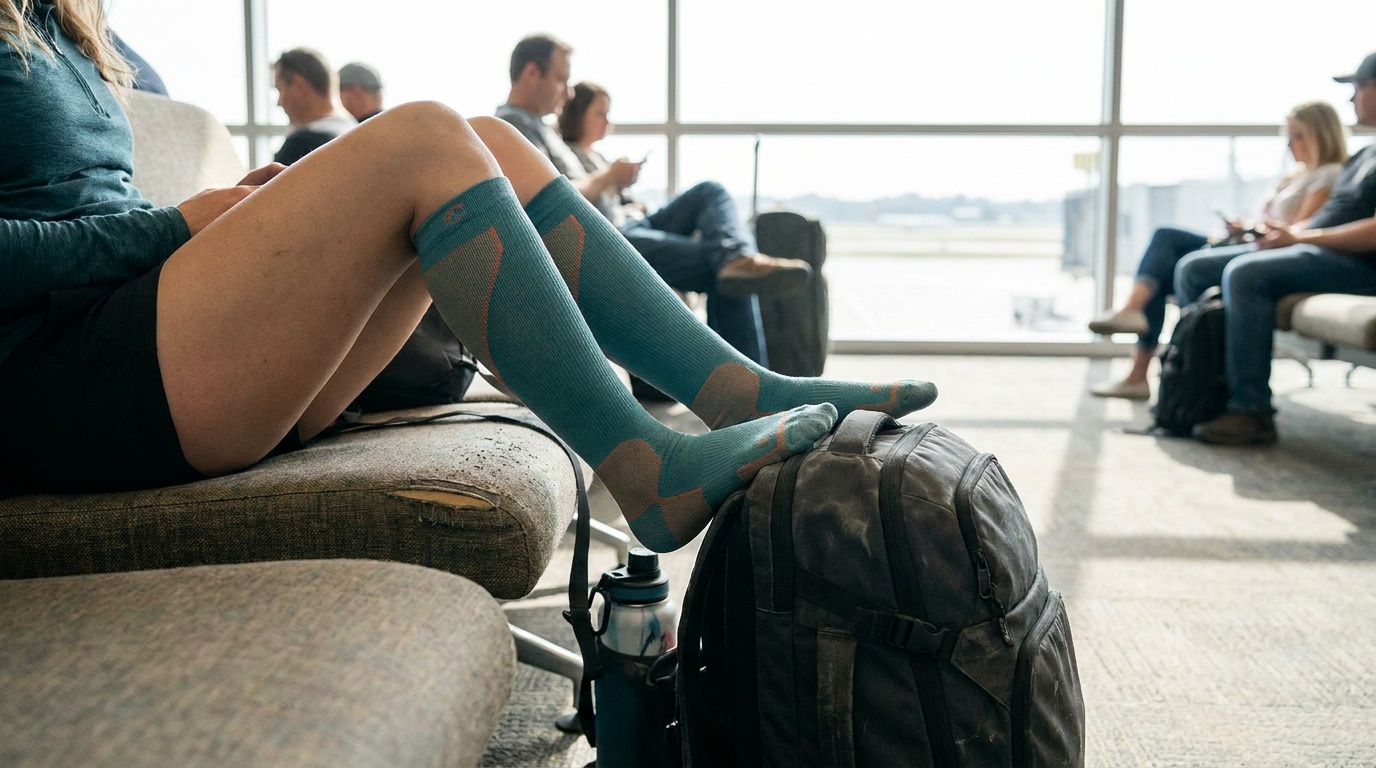
Compression socks do two jobs on a plane: they cut ankle swelling, and they lower the chance of a symptomless clot on long flights. For clot prevention, guidelines focus on people at higher risk. The American Society of Hematology, cited in the CDC Yellow Book, advises against stockings purely for clot prevention in travelers without risk factors, but suggests them for long-distance travelers at substantially increased risk. The case for wearing them gets stronger if any of these apply:
- A prior blood clot, recent surgery, or active cancer
- The weeks after giving birth (check with your doctor on mmHg level)
- Two or more risk factors together, such as pregnancy, obesity, or hormone therapy
- Flights over 4 hours, especially in a window or middle seat where you move less
- Ankles that reliably swell on long flights
Healthy travelers on a 2-hour hop have little to gain beyond comfort. Whatever you wear, the CDC also recommends walking the aisle, calf exercises, and choosing an aisle seat when you can.
Comfort on a long flight also depends on the bag you carry on. If you are choosing one, see our guides to the best underseat luggage, the best carry-on luggage and the best travel backpacks.
Where these numbers come from
| Claim | Source | Checked |
|---|---|---|
| 12 trials, 2,637 passengers with follow-up, flights over 5 hours: symptomless DVT in 3 with stockings vs 47 without; no symptomatic DVT or pulmonary embolism occurred | Cochrane, compression stockings for airline passengers (2021 update) | 2026-09-25 |
| Symptomatic clot risk negligible under 4 hours; ACCP cites 15–30 mmHg below-knee stockings for high-risk travelers on journeys over 6 hours; ASH advises against stockings for travelers without risk factors and suggests them for those at substantially increased risk; walking, calf exercise, aisle seat | CDC Yellow Book, DVT and pulmonary embolism | 2026-09-25 |
| Comrad: 15-20 mmHg graduated, 91% nylon / 9% spandex, SmartSilver odor control, 3 pairs, Small fits a 10 to 14 in calf | Comrad listing on Amazon, ASIN B0BJ6VF46C | 2026-09-25 |
| CEP Flight: 20-30 mmHg graduated, padded footbed, no-slip fit | CEP listing on Amazon, ASIN B0DBRLJHQY | 2026-09-25 |
| CEP Flight Tall fabric: 49% polyamide, 36% merino wool, 15% spandex | Road Runner Sports, CEP Flight Tall | 2026-09-25 |
| Physix Gear: 20-30 mmHg graduated | Physix Gear listing on Amazon, ASIN B01J4MF53Q | 2026-09-25 |
| Sockwell Circulator: 15-20 mmHg graduated, 32% merino, 31% bamboo rayon, 32% nylon, 5% spandex, made in USA, sizes S/M and M/L | Sockwell, Women's Circulator | 2026-09-25 |
FAQ
What mmHg compression level is best for flying?
15-20 mmHg covers most healthy travelers on standard flights. Step up to 20-30 mmHg if you fly long-haul frequently, have a circulation condition, or tend to wake up from overnight flights with significant swelling. Anything above 30 mmHg is typically prescription territory.
Do compression socks actually prevent DVT?
They reduce symptomless deep-vein clots on long flights. A Cochrane review (updated 2021) pooled 12 trials of flights longer than five hours: 47 of the passengers without stockings developed a symptomless clot versus 3 of those wearing them, out of 2,637 with follow-up, which works out to a drop from a few tens per thousand passengers to two or three per thousand. The trials were too small to show an effect on symptomatic clots or pulmonary embolism, since none occurred. Socks are not a substitute for walking the aisle or medical advice for people with diagnosed clotting disorders.
Can I wear compression socks for the whole travel day, including walking layovers?
Yes. Knee-high graduated compression socks at 15-20 mmHg are comfortable enough for a full day: the flight, the terminal walk, and the ride to the hotel. The Sockwell Circulator and Comrad packs are specifically designed with this multi-context use in mind. If you are at 20-30 mmHg and the sock feels restrictive while walking, that is usually a fit issue, not the mmHg level.
What are the best compression socks for women who fly frequently?
Two picks cover most frequent female flyers. For an everyday flight-to-layover sock, the Sockwell Women's Circulator pairs 15-20 mmHg graduated compression with a merino blend that regulates temperature and resists odor across back-to-back travel days. For a woman who wants a fresh pair every leg without doing laundry, the Comrad 3-pack gives three antibacterial-treated pairs at the same 15-20 mmHg. Step up to a 20-30 mmHg sock like the CEP Flight only if long-haul swelling or a circulation condition warrants it. Fit matters more than brand for women: measure your calf circumference and match the size chart, since a sock sized by shoe alone often runs loose at the calf.
What compression level should frequent long-haul flyers use?
Most frequent long-haul flyers do well at 15-20 mmHg, and the CDC Yellow Book cites a range of 15-30 mmHg at the ankle for higher-risk travelers on long journeys. Choose 20-30 mmHg if you wake up from long legs with significant ankle and calf swelling or your doctor has advised firmer compression; the CEP Flight Tall is purpose-built for that. Anything above 30 mmHg is medical-grade territory and worth a physician's input first.
More gear for the journey is in our travel hub. Read more about how we research and rate every pick on the site.
Keep going
Complete loadoutLong-flight comfort kitFive packable pieces for neck support, darkness, quieter cabins, leg comfort, and more consistent sleep away from home.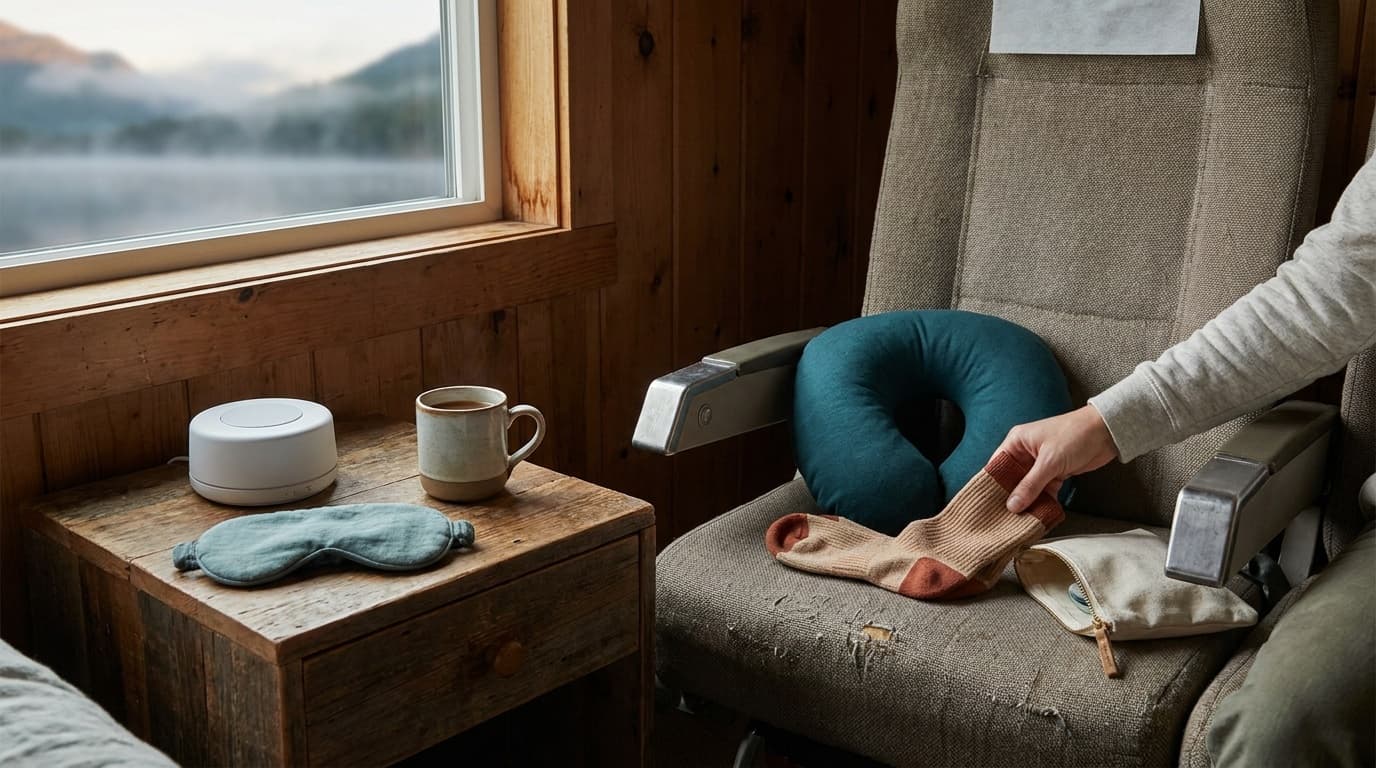

Our recommendations draw on manufacturer documentation, retailer listings, owner feedback, and comparisons with alternatives.
As an Amazon Associate I earn from qualifying purchases. We may earn a commission from links here, at no extra cost to you. How we research →
Top picks
 Best BudgetPhysix Gear Sport Compression Socks 20-30 mmHg8.2/10
 Best ValueSockwell Women's Circulator Moderate Graduated Compression Sock8.8/10
 Best OverallComrad 3-Pack Knee High 15-20 mmHg Graduated Compression Socks8.5/10
 Best PremiumCEP Flight Tall Compression Socks 20-30 mmHg7.5/10