The best car-camping stove is the one that boils your coffee fast, simmers your sauce without scorching it, and still works when the wind picks up. We researched spec sheets, owner reviews across thousands of verified purchases, and comparisons from OutdoorGearLab, Wirecutter, and REI Co-op Journal to narrow it down to four stoves worth buying.
Our quick picks
How we picked
Every stove here is rated against Kit Authority's Kit Score: output-to-weight ratio, simmer control, ignition reliability, wind resistance, setup time, and value at the verified street price. We pull from verified-owner review aggregates (Amazon, REI, Backcountry), independent lab reviews, and manufacturer spec sheets. Simmer figures and BTU ratings are manufacturer-stated unless a third-party source is cited.
The picks
Best overall: Camp Chef Everest 2X
BEST OVERALL
Camp Chef Everest 2X 2-Burner Camping Stove
Best for: Car campers who want a single stove that can sear, saute, and simmer without compromise, and cook fast for groups of two to four.
- Exceptional simmer control despite high peak output: OGL rated simmering 9/10
- At roughly 14 lbs it is bulkier and heavier than budget alternatives
Kit Score 8.1/10 · $228.45 Price checked Oct 24, 3:33 PM CDT · how we score gear
Buy on AmazonProduct details
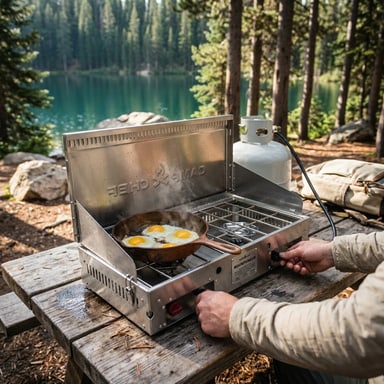
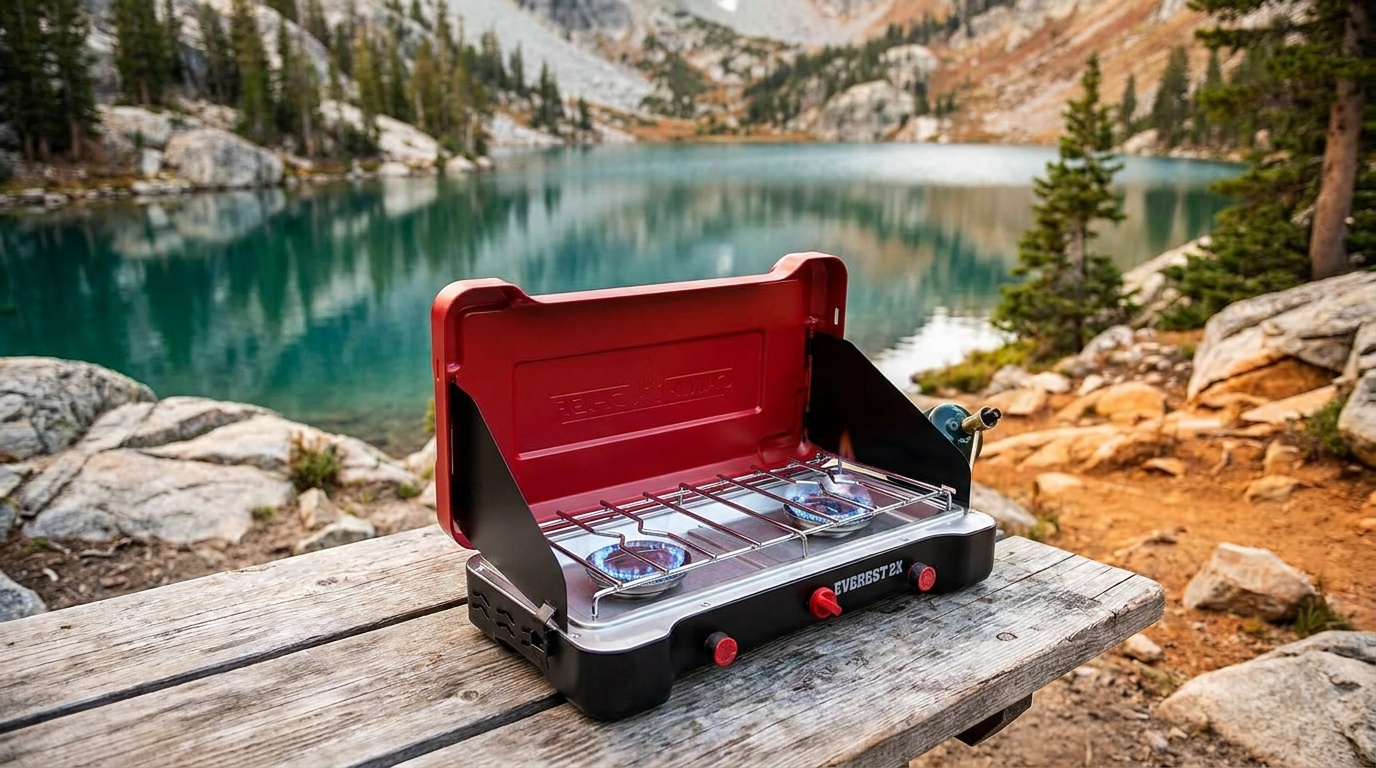
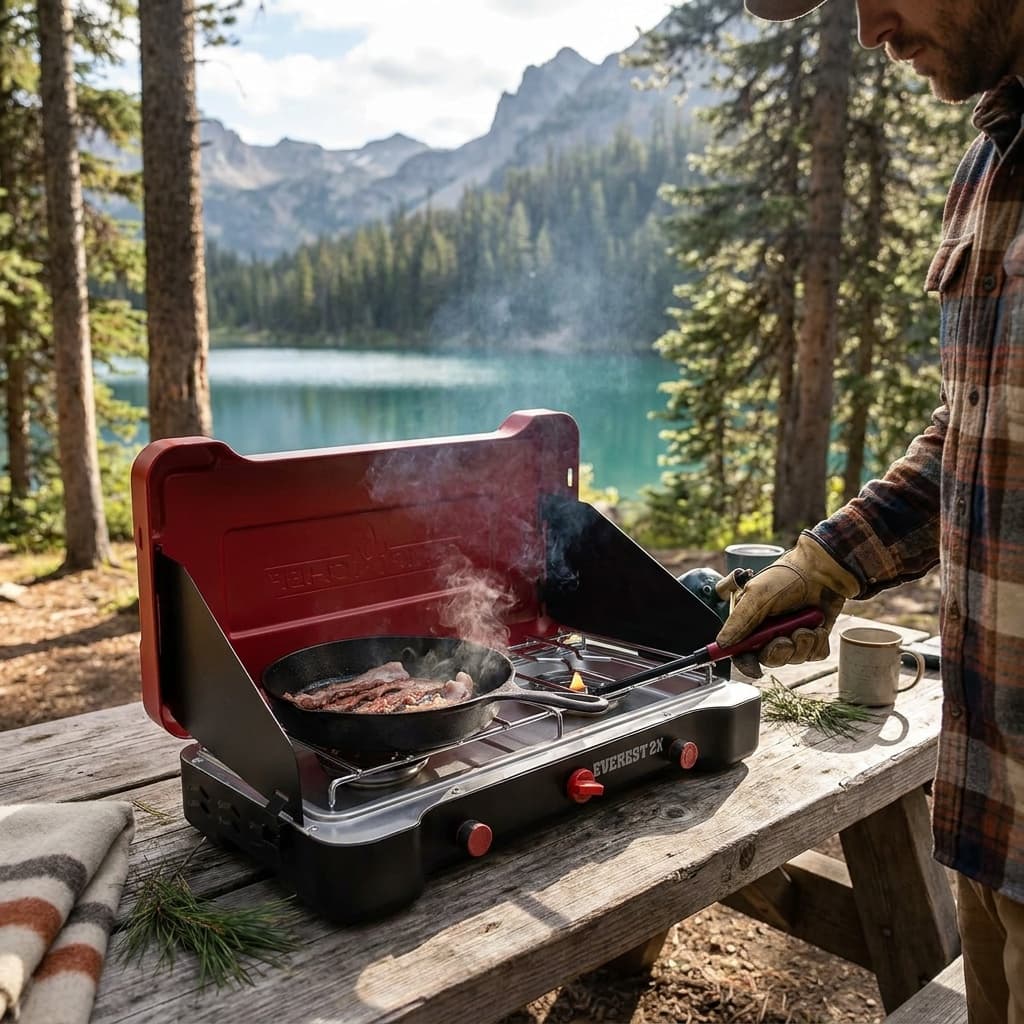
The Everest 2X is the most versatile two-burner propane stove in its class, pairing jet-level output with enough low-end control to hold a steady simmer. A three-sided folding windscreen lid and stainless steel burner heads handle breezy conditions that stall most competitors.
- BTU output
- 40,000 total (20,000 per burner)
- Cooking surface
- 215 sq. in. (21 x 9.5 in.)
- Weight
- 14 lbs
- Packed dimensions
- 24 x 13 x 6 in.
- Ignition
- Matchless piezo
- Fuel
- Propane (1 lb canister or adapter for 5 lb tank)
More strengths
- Near-seamless folding windscreen performs well in moderate wind; boil time barely affected by breeze in third-party testing
- Boils 1 liter in about 3 min 21 sec: one of the fastest in class
Other tradeoffs
- Fuel efficiency rated low (5/10 by OGL); burns through propane faster than the Mountaineer or Cascade Classic
The Everest 2X earns its place at the top because it covers every cooking mode a car camper needs: a hard rolling boil for pasta, a true low simmer for sauces, and enough BTU headroom to sear a steak in a cast-iron skillet. Camp Chef's three-sided windscreen handles gusts that trip up thinner-walled stoves, and each burner has matchless ignition. At 12 lbs it is not a backpacker's stove, but for a tailgate or a family site it loads easily and sets up in under a minute. Verified owners consistently flag the simmer dial as the feature they value most, and OutdoorGearLab named the Everest series its top pick in the two-burner category in back-to-back evaluations. The $190–$230 street price is a step above the Coleman options but well below the Mountaineer, and the cost-per-BTU math is hard to beat. Read our full Camp Chef Everest 2X review.
Best for: Car campers who want a single stove that can sear, saute, and simmer without compromise, and cook fast for groups of two to four.
Best value: Coleman Cascade Classic
BEST VALUE
Coleman Cascade Classic 2-Burner Camping Stove
Best for: Budget-conscious car campers who prioritize fuel economy and gentle heat control over raw speed, and do most cooking in sheltered sites.
- Lowest fuel consumption among two-burner propane stoves tested: ideal for multi-day trips
- Slow peak boil: averaged 6 min 39 sec for 1 liter, the slowest gas-powered stove in OGL testing
Kit Score 7.7/10 · $219.99 Price checked Oct 24, 3:33 PM CDT · how we score gear
Buy on AmazonProduct details
The Cascade Classic is Coleman's updated two-burner, the lightest full-size propane stove in its price bracket. Reviewers consistently note surprisingly precise simmer control for the price, though peak output is modest and wind resistance is below average.
- BTU output
- 20,000 total (10,000 per burner)
- Cooking surface
- 240 sq. in. (20 x 12 in.)
- Weight
- 9.7 lbs
- Packed dimensions
- 21 x 13 x 3.5 in.
- Ignition
- Rotary piezo (matchless)
- Fuel
- Propane (1 lb canister)
More strengths
- Multi-turn knobs deliver fine simmer control: sauteing and sauce work are manageable
- At 9.7 lbs and under 21 in. packed, it is easy to carry and store
Other tradeoffs
- Wind shields provide below-average protection; burners struggle to stay lit in moderate breezes without additional blocking
The Cascade Classic occupies a quieter niche than the Everest: it is the stove that rewards patience. Its two 10,000 BTU burners are not the fastest in the class, but owner review aggregates across REI and Amazon consistently call out its simmer control as better than expected at this price. Coleman's "PerfectFlow" pressure regulation helps keep output consistent as the propane cylinder cools. Its WindBlock panels are shallower than the Camp Chef screens, so sheltered or semi-sheltered sites are where it shines. At $100–$145 it undercuts the Everest 2X by $80–$90. If you cook mostly eggs, oatmeal, chili, and one-pot dinners rather than high-heat sears, this is the right tool. Coleman lists 20,000 BTU total.
Best for: Budget-conscious car campers who prioritize fuel economy and gentle heat control over raw speed, and do most cooking in sheltered sites.
Best premium: Camp Chef Mountaineer 2X
BEST PREMIUM
Camp Chef Mountaineer 2-Burner Camp Stove
Best for: Overlanders, river-trip basecamp cooks, and serious outdoor chefs who cook daily in wind-exposed conditions and want a stove that can run on a 20 lb tank for a week without resupply.
- Top-rated fuel efficiency in OGL testing (10/10): the included 20 lb tank connection lowers per-meal fuel cost significantly
- At $470 it costs roughly twice the Everest 2X for incremental rather than transformative performance gains over that stove
Kit Score 8.1/10 · $469.99 Price checked Oct 24, 3:33 PM CDT · how we score gear
Buy on AmazonProduct details
The Mountaineer is the most fuel-efficient stove in its BTU class and the most wind-resistant two-burner unit OGL has tested: only 40 seconds slower in windy versus calm conditions. Comes with a 5-foot hose and regulator for 20 lb propane tanks, a meaningful advantage for extended base camping or overlanding.
- BTU output
- 40,000 total (20,000 per burner)
- Cooking surface
- 302 sq. in. (24 x 12.5 in.)
- Weight
- 16 lbs
- Packed dimensions
- 25.25 x 13.75 x 5.25 in.
- Body material
- Rust-resistant aluminum
- Fuel
- Propane (compatible with 20 lb tank via included 5 ft hose and regulator)
More strengths
- Exceptional wind resistance: nearly no boil-time penalty in breezy conditions, outperforming every two-burner stove tested
- Larger 302 sq. in. aluminum cooking surface handles cast iron, large stockpots, and wide skillets simultaneously
Other tradeoffs
- Heavier and bulkier than any other option here; some owners report latch fit issues requiring adjustment
The Mountaineer is the stove you buy when you cook outdoors seriously and often. It produces 40,000 BTU total, or 20,000 per burner, matching the Everest 2X on rated output rather than exceeding it. The premium buys a rust-resistant aluminum body, a large cooking surface, excellent wind performance, and a suitcase-style latching lid; Camp Chef describes the aluminum construction and transport-first design. It also includes the hose and regulator for a 20 lb refillable tank, which cuts fuel cost and resupply stops on long base-camp trips. The price is genuinely steep. If you camp fewer than 15 nights a year, the Everest 2X delivers similar burner output for far less. The Mountaineer earns its place for durability, wind resistance, and bulk-tank logistics, not a fictional 30,000-BTU burner.
Best for: Overlanders, river-trip basecamp cooks, and serious outdoor chefs who value a large cooking area, aluminum construction, wind performance, and a bulk-tank setup.
How to choose a car-camping stove
| Product | Kit Score | Price | Best for |
|---|---|---|---|
| Camp Chef Everest 2X 2-Burner Camping Stove | 8.1 | $228.45 Price checked Oct 24, 3:33 PM CDT | Best for: Car campers who want a single stove that can sear, saute, and simmer without compromise, and cook fast for groups of two to four. Why it stands out: Exceptional simmer control despite high peak output: OGL rated simmering 9/10 Tradeoff: At roughly 14 lbs it is bulkier and heavier than budget alternatives |
| Coleman Cascade Classic 2-Burner Camping Stove | 7.7 | $219.99 Price checked Oct 24, 3:33 PM CDT | Best for: Budget-conscious car campers who prioritize fuel economy and gentle heat control over raw speed, and do most cooking in sheltered sites. Why it stands out: Lowest fuel consumption among two-burner propane stoves tested: ideal for multi-day trips Tradeoff: Slow peak boil: averaged 6 min 39 sec for 1 liter, the slowest gas-powered stove in OGL testing |
| Camp Chef Mountaineer 2-Burner Camp Stove | 8.1 | $469.99 Price checked Oct 24, 3:33 PM CDT | Best for: Overlanders, river-trip basecamp cooks, and serious outdoor chefs who cook daily in wind-exposed conditions and want a stove that can run on a 20 lb tank for a week without resupply. Why it stands out: Top-rated fuel efficiency in OGL testing (10/10): the included 20 lb tank connection lowers per-meal fuel cost significantly Tradeoff: At $470 it costs roughly twice the Everest 2X for incremental rather than transformative performance gains over that stove |
Camp Chef Everest 2X 2-Burner Camping Stove
- Best for
- Car campers who want a single stove that can sear, saute, and simmer without compromise, and cook fast for groups of two to four.
- Why it stands out
- Exceptional simmer control despite high peak output: OGL rated simmering 9/10
- Tradeoff
- At roughly 14 lbs it is bulkier and heavier than budget alternatives
Coleman Cascade Classic 2-Burner Camping Stove
- Best for
- Budget-conscious car campers who prioritize fuel economy and gentle heat control over raw speed, and do most cooking in sheltered sites.
- Why it stands out
- Lowest fuel consumption among two-burner propane stoves tested: ideal for multi-day trips
- Tradeoff
- Slow peak boil: averaged 6 min 39 sec for 1 liter, the slowest gas-powered stove in OGL testing
Camp Chef Mountaineer 2-Burner Camp Stove
- Best for
- Overlanders, river-trip basecamp cooks, and serious outdoor chefs who cook daily in wind-exposed conditions and want a stove that can run on a 20 lb tank for a week without resupply.
- Why it stands out
- Top-rated fuel efficiency in OGL testing (10/10): the included 20 lb tank connection lowers per-meal fuel cost significantly
- Tradeoff
- At $470 it costs roughly twice the Everest 2X for incremental rather than transformative performance gains over that stove
Match the stove to how you actually cook
Group size
Two to four people covers the Everest 2X's sweet spot. Larger groups cooking full meals may benefit from the Mountaineer's wider cooking area; solo campers or couples can save money with either Coleman.
Cooking style
Higher output can shorten boil times and support larger cookware, while flame control matters for eggs, sauces, and one-pot meals. Results depend on wind, cookware, temperature, and fuel use.
Site exposure
Open, breezy sites (lakeshores, desert flats, ridgeline dispersed camps) punish stoves with shallow windscreens. The Mountaineer and Everest 2X both handle wind better than the Coleman options.
Fuel logistics
Fuel connections are model-specific. Confirm the stove, regulator, hose, and cylinder combination in the manufacturer instructions; the Mountaineer includes a hose and regulator for a bulk propane tank.
Budget
$50–$75 for a no-frills first stove; $100–$145 for a fuel-efficient upgrade with better simmer control; $190–$230 for the all-around best; $430–$470 for the serious daily-driver premium tier.
Peak output gets water boiling; flame control keeps the rest of dinner from scorching.
Frequently asked questions
Can I use a car-camping stove in wind?
Any open-frame stove loses heat efficiency in wind: fuel burns faster and cook times stretch. Stoves with three-sided windscreens (the Camp Chef Everest 2X and Mountaineer 2X both have them) hold output far better than two-sided or no-screen designs. If your typical camping sites are exposed, prioritize windscreen depth over raw BTU rating.
What size propane canister should I use?
Fuel connections are model-specific, so use only the cylinder, regulator, and hose combination named by the stove manufacturer. Some tabletop stoves accept a 1 lb cylinder directly, while others require a hose or are designed around a bulk tank. The Camp Chef Mountaineer 2X includes a hose and regulator for a bulk propane tank.
Is the Coleman Classic still worth buying in 2026?
Yes, for the right camper. It lacks matchless ignition and has minimal wind protection, but its PerfectFlow regulator, decades-proven reliability, and sub-$75 street price make it the correct choice for infrequent campers, beginners, and anyone who wants a capable backup stove they do not have to worry about. It does one thing: it cooks food reliably. If you need more than that, spend more.
For more car-camping gear guides, browse the camp hub. Questions about how we research and score every pick are answered on how we research and rate.
Keep going
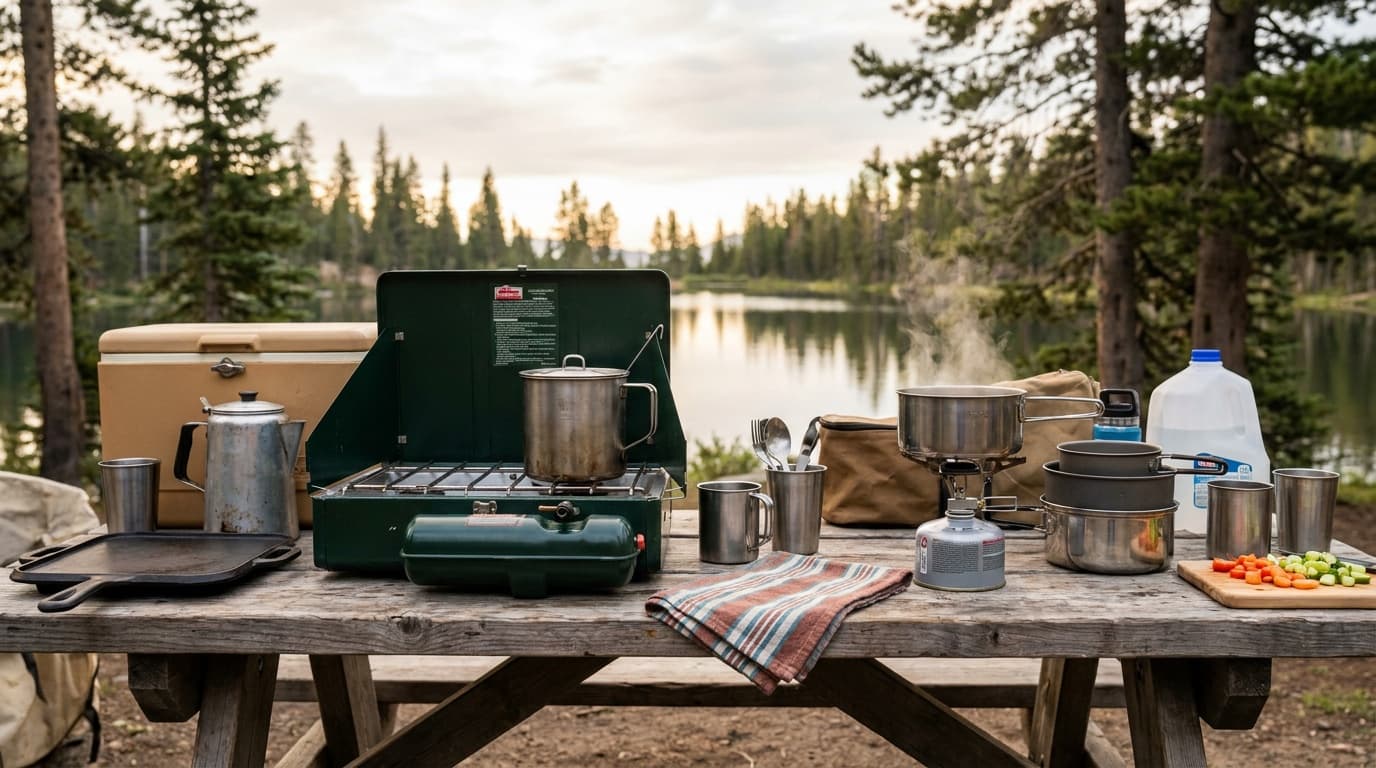
Complete loadoutCamp kitchen kitA durable base-camp cooking setup built around heat, cookware, coffee, cold storage, workspace, and water.Free tool: Stove Fuel CalculatorRelated guides
Our recommendations draw on manufacturer documentation, retailer listings, owner feedback, and comparisons with alternatives.
As an Amazon Associate I earn from qualifying purchases. We may earn a commission from links here, at no extra cost to you. How we research →