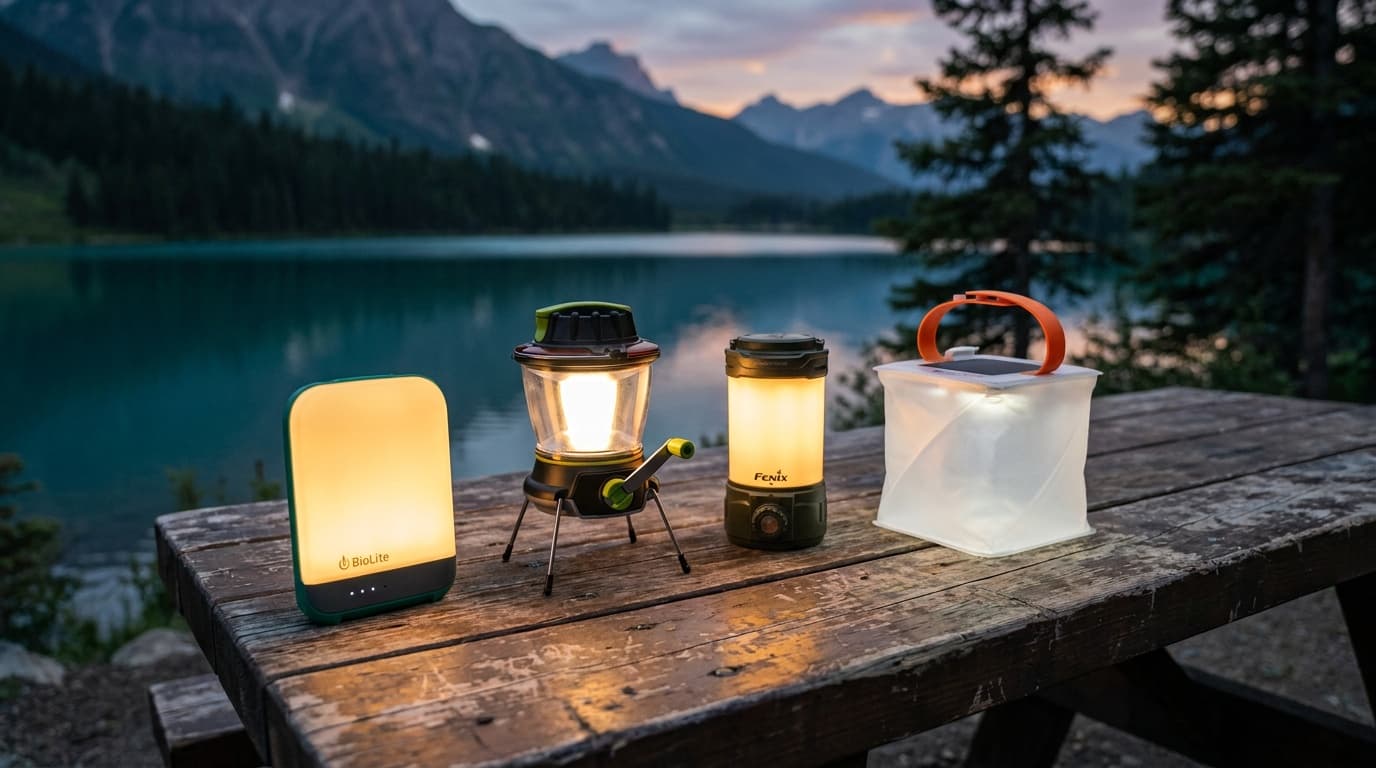
The BioLite AlpenGlow 500 is the best camping lantern for most car campers because its warm light modes, 500-lumen ceiling, and built-in power bank cover both atmosphere and practical camp chores. Five alternatives below offer more output, better weather resistance, solar charging, or multiple lights for less money.
Our quick picks
The picks
Best overall
BEST OVERALL
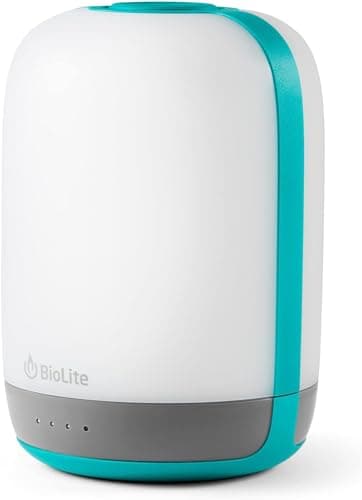
BioLite AlpenGlow 500 Lantern
Best for: Car campers and tent campers who want versatile ambiance lighting, a reliable power bank backup, and the widest set of modes in a mid-size package.
- Dims from 500 lumens down to 5, so one lantern covers cooking light and a soft in-tent glow
- Micro-USB charge port is outdated compared to competitors moving to USB-C, and the port seal has shown minor water ingress in heavy rain
Kit Score 8.5/10 · $79.95 Price checked Oct 23, 6:22 AM CDT · how we score gear
Buy on AmazonProduct details
The AlpenGlow 500 balances genuine campsite brightness with a wide range of lighting modes, from dimmable cool and warm white down to candle flicker and full multicolor cycling. Its 6,400 mAh battery doubles as a power bank and the ChromaReal LEDs (CRI 90) render colors accurately in low-light conditions.
- Max Lumens
- 500 (manufacturer rating)
- Runtime
- 5 hrs (high) / 200 hrs (low)
- Battery
- 6,400 mAh Li-Ion, micro-USB charge-in
- Weight
- 13.4 oz (380 g)
- Water Resistance
- IPX4
- Charge Out
- USB-A 5V/2.4A (device charging)
More strengths
- 200-hour low-end runtime means you can run it at ambient brightness for a full weekend trip without recharging
- ChromaReal broad-spectrum LEDs produce warmer, more natural light than most lanterns at this price
Other tradeoffs
- Single-button interface with shake activation has a learning curve and occasionally requires a repeat shake to change modes
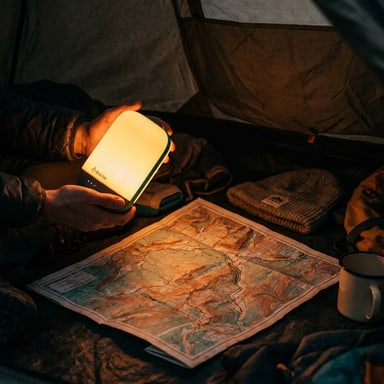
The BioLite AlpenGlow 500 earns the top spot by covering more use cases than any other lantern in this price range. Output runs from 5 lumens up to 500, and BioLite lists nine light settings, including 2,700 K warm white, 5,700 K cool white, and a shake-activated candle flicker. That range matters: most lanterns lock you into one color temperature, while the AlpenGlow lets you drop to warm white for in-tent reading and switch to cool white for cooking prep.
The built-in 6,400 mAh battery doubles as a USB-A power bank for charging phones, which makes it genuinely useful for multi-night trips away from a power source. BioLite rates it for 5 hours on high or up to 200 hours on low. A hook on the base lets you hang it overhead without extra gear.
At $75–$85 street, it costs the same as the competition and does more of the jobs. The main trade-off: it is heavier than a minimalist backpacking light, so it belongs in a car-camp kit or a base-camp box. Read the full BioLite AlpenGlow 500 review.
Best value
BEST VALUE
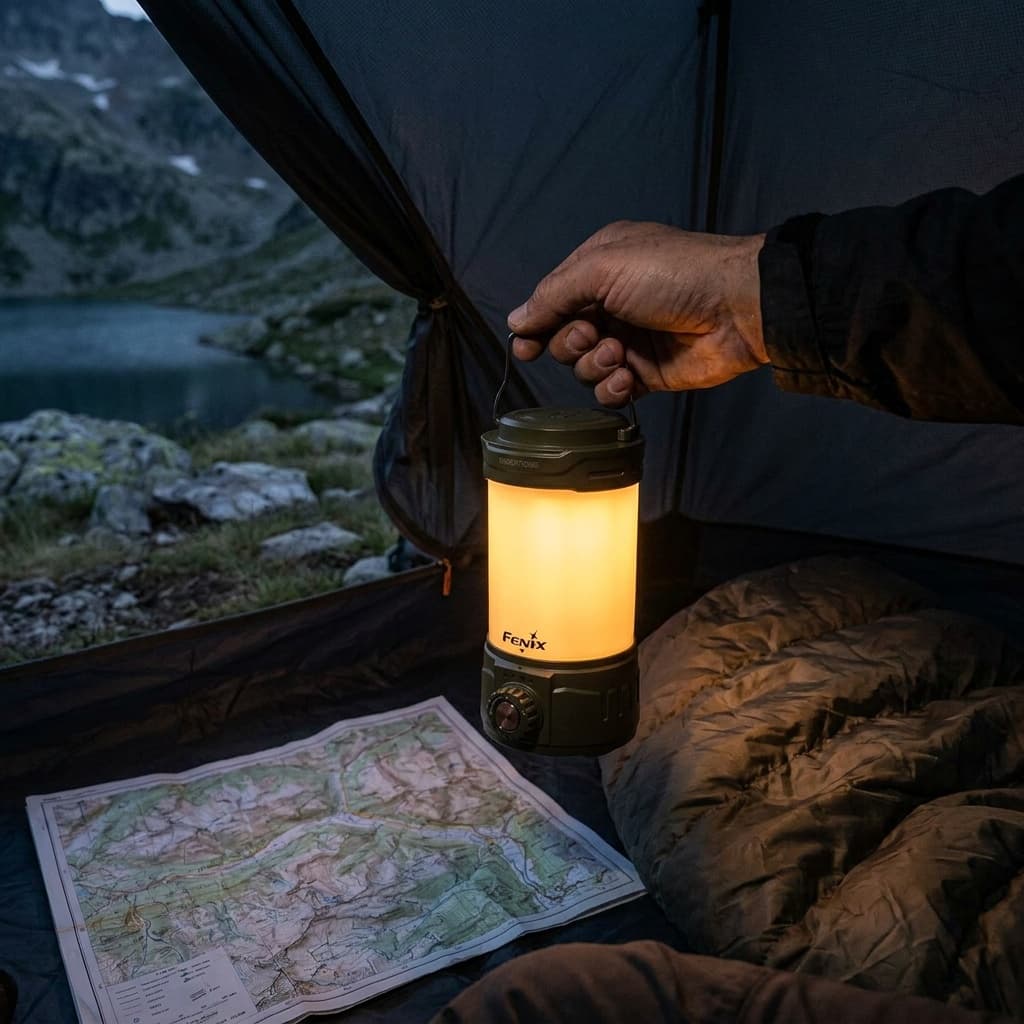
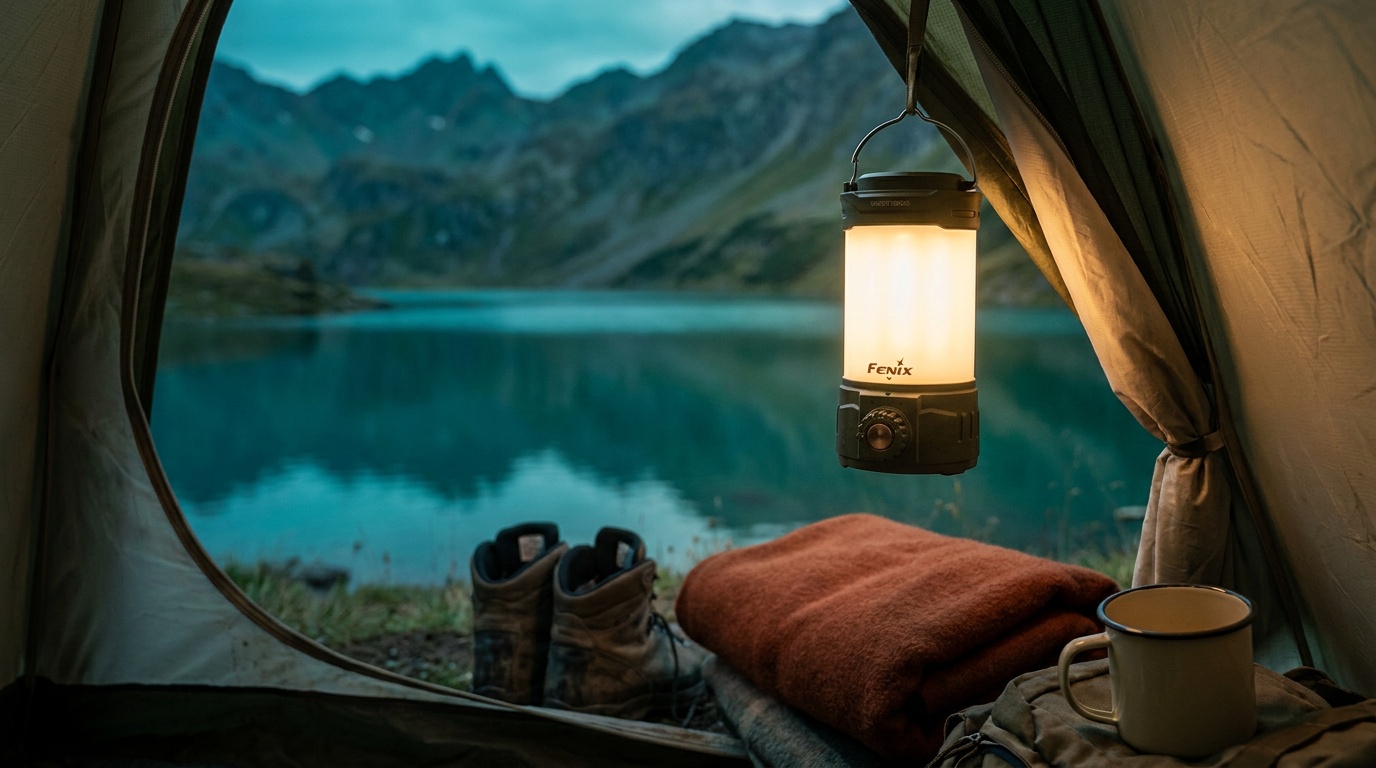
Fenix CL26R Pro Rechargeable Camping Lantern
Best for: Backpackers and weight-conscious campers who want USB-C recharging, IP66 protection, and enough output for a campsite without carrying a heavy lantern.
- IP66 rating is the strongest weatherproofing here: it handles direct water spray, not just splashes, which matters on exposed campsites
- High mode steps down to roughly 50% brightness after 20 minutes due to thermal management, so peak output is not sustained
Kit Score 8.8/10 · Check current price · how we score gear
Buy on AmazonProduct details
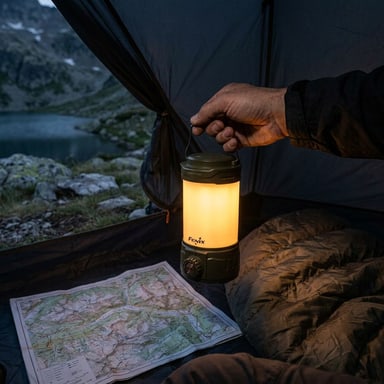
The CL26R Pro is the most compact high-output lantern in this group: it weighs 199 g before its battery goes in, runs on a single included 21700 cell, and carries IP66 dust-and-water protection. Nine modes (seven white, two red) include separate 360-degree ambient levels and a forward-facing beam.
- Max Lumens
- 650 (combined 360 and downward modes)
- Runtime
- About 5 hrs on high (independent test; Fenix rates 10) / up to 408 hrs (lowest)
- Battery
- 21700 Li-Ion 5,000 mAh, USB-C charge-in
- Weight
- 7.02 oz without battery (273 g with battery)
- Water Resistance
- IP66
- Power Bank
- USB-A 5V/2A output; 5,000 mAh capacity
More strengths
- Rotary knob plus single button gives the most intuitive one-handed control of any lantern in this group, no mode memorization required
- 408-hour low-end runtime on one included 5,000 mAh cell: a week-long trip on low mode is realistic without a recharge
Other tradeoffs
- The folding handle has raised durability questions in independent testing, though it holds up under normal camping use
The Fenix CL26R Pro is the surprise of this group: it produces 650 peak lumens with the longest low-mode runtime here (408 hours), weighs 199 g before its battery goes in, and carries an IP66 ingress-protection rating. IP66 means it is dust-tight and rated for powerful water jets, not just splash resistance. For backpackers who camp in variable weather, that rating is meaningful insurance that the other lanterns here do not offer.
USB-C recharging fits the 2026 gear ecosystem, and Fenix quotes about 3.5 hours for a full charge. The included 5,000 mAh 21700 cell supports high-output use and up to 408 hours at the lowest setting. One caveat from independent bench testing at 1Lumen: high mode measured 418 lumens against a 500-lumen rating, stepped down after about 20 minutes, and ran about 5 hours, half of Fenix's 10-hour claim. Plan on medium for long evenings.
At $75–$90 street the Fenix sits at the same price tier as the top two picks, so "best value" here means best compact utility rather than cheapest sticker price. If you want one lantern that handles trail camp, rain, and a gear-charging emergency, read the full Fenix CL26R Pro review.
Best budget solar
BEST BUDGET SOLAR
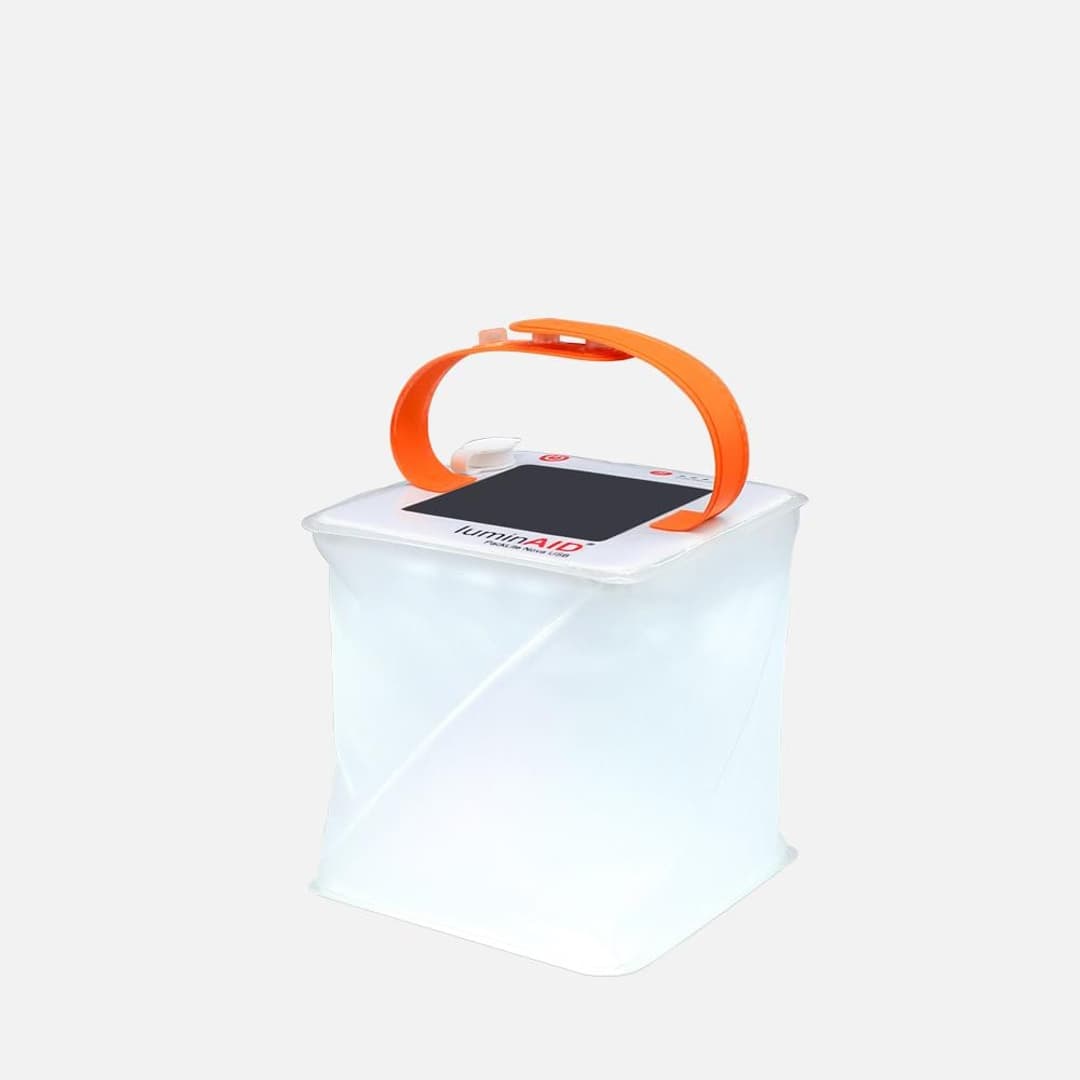
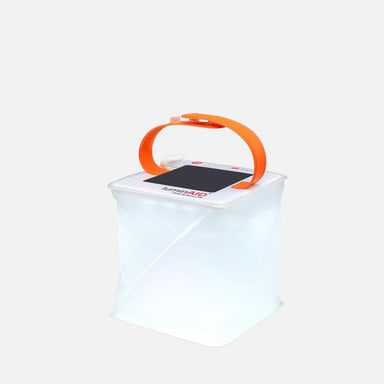
LuminAID PackLite Nova USB Solar Lantern
Best for: Backpackers, families, travelers, and emergency-kit builders who want a light, inexpensive lantern that can recharge itself in daylight.
- Compresses to one inch thick and weighs 5 ounces, so it disappears into a pack or emergency kit
- The 75-lumen ceiling is for a tent or close-range task, not a group cooking area
Kit Score 8.2/10 · $32.99 Price checked Oct 23, 6:22 AM CDT · how we score gear
Buy on AmazonProduct details
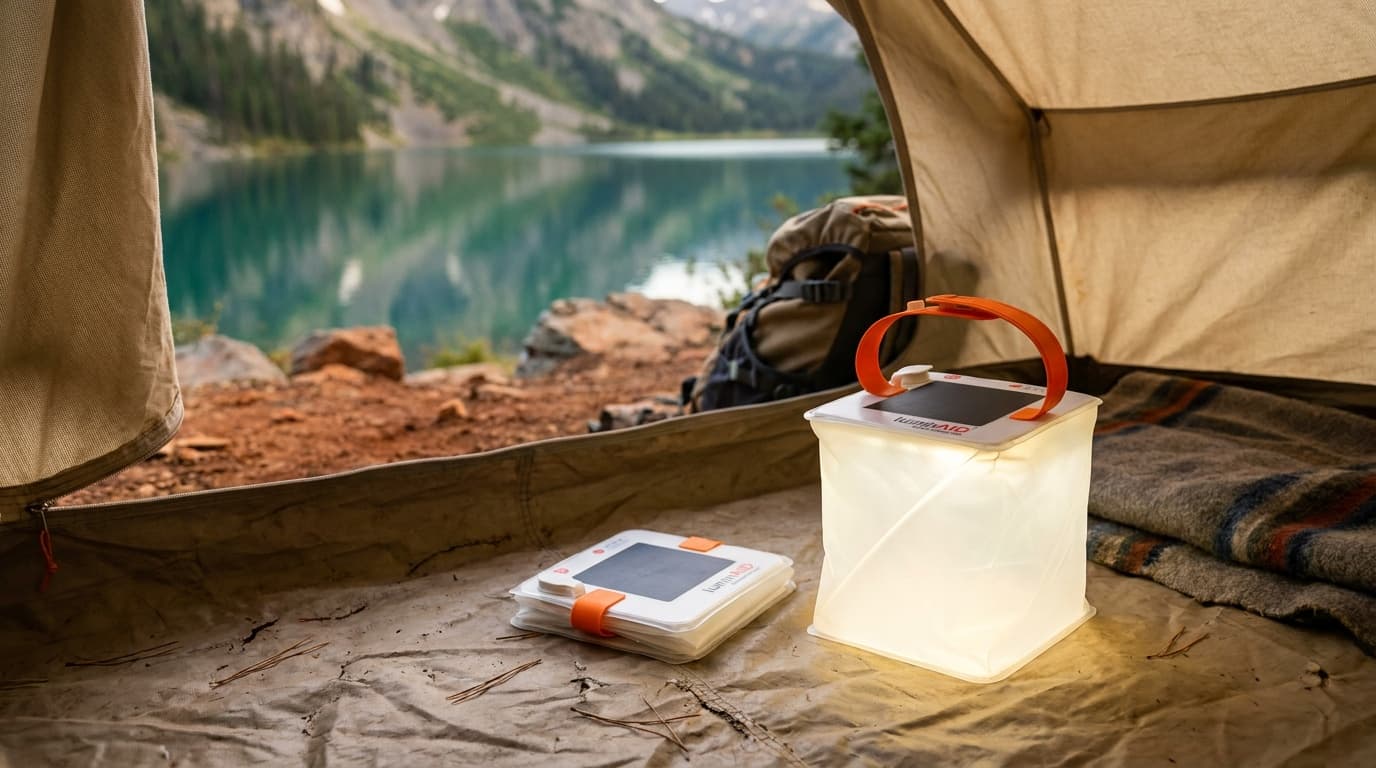
The PackLite Nova is a 5-ounce inflatable lantern that compresses to one inch thick, charges from the sun or USB, and produces up to 75 lumens through a soft cube-shaped diffuser. It is waterproof, floats, and runs for up to 24 hours on low, making it a practical personal light for tents, emergency bins, and travel.
- Max Lumens
- 75
- Runtime
- Up to 24 hrs on low
- Charging
- About 10 hrs solar; 1–2 hrs by micro-USB
- Weight
- 5 oz (142 g)
- Water Resistance
- IP67 waterproof; floats
- Packed Size
- 4.75 x 4.75 x 1 in
More strengths
- Solar charging works without a separate panel, while micro-USB can refill it in 1 to 2 hours before a trip
- The waterproof inflatable body floats and spreads light more evenly than a bare flashlight beam
Other tradeoffs
- This Nova model does not charge a phone, and its soft body should be kept away from sharp tools
The LuminAID PackLite Nova is a different category of lantern: a 75-lumen inflatable cube that costs about $27, weighs 5 ounces, and compresses to one inch thick. It is not trying to light a group site. It is trying to be the lantern that always fits in a pack, car, or emergency bin.
LuminAID quotes about 10 hours of direct sun for a solar refill, or 1 to 2 hours over micro-USB. The IP67 waterproof body floats, and the five brightness settings run for up to 24 hours on low.
The Nova is a strong secondary lantern for car campers and a practical tent light for backpackers. It cannot charge a phone and will not replace a high-output task lantern. The LuminAID PackLite Nova review covers that boundary.
Best high output
BEST HIGH OUTPUT
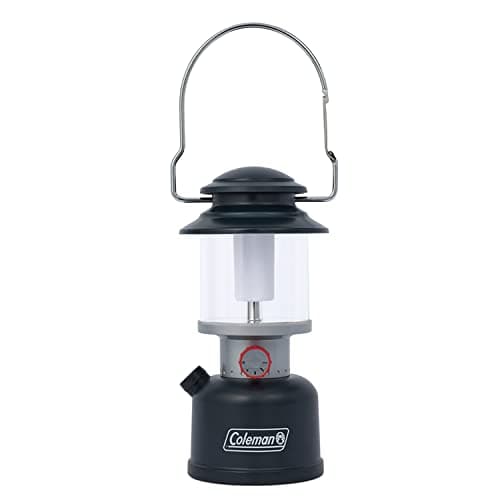
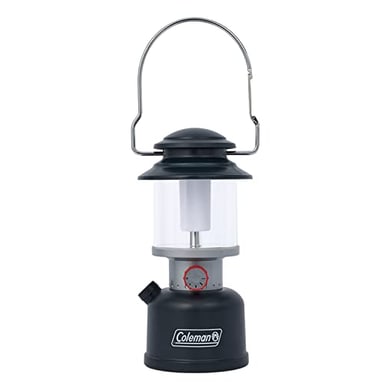
Coleman Classic Rechargeable 800L
Best for: Lighting a whole table and cook area with one familiar, tough lantern.
- 800 lumens is genuine area lighting, the most output in this guide
- Rated for 5 hours on high, so run it on medium or low for evening-long light
Kit Score 8.4/10 · $59.99 Price checked Oct 23, 6:22 AM CDT · how we score gear
Buy on AmazonProduct details
The familiar Coleman lantern shape with a modern rechargeable core and 800 lumens, the most raw light in this guide. It lights a full picnic table and the cooking area behind it, and survives being knocked off both.
- Output
- 100 / 300 / 800 lumens
- Runtime
- Up to 5 hrs high / 45 hrs low
- Battery
- 4,800 mAh Li-ion, USB charge-out
- Build
- IPX4, impact resistant to 1 m
- Weight
- 2.2 lb
More strengths
- Impact and water resistance suit the way lanterns actually get treated
- Classic handle hangs from any branch, pole, or tent loop
Other tradeoffs
- Bulkier than the compact rechargeables; this is a basecamp light
The most raw light in this guide, in the most familiar shape in camping. Coleman's classic silhouette carries a 4,800 mAh rechargeable battery and three steps of output: 100, 300, and 800 lumens. The top step lights a full picnic table and the cook area behind it, and Coleman rates the body IPX4 water resistant and impact resistant to a 1-meter drop. A USB port lets it top up a phone while it runs.
The trade is battery arithmetic: Coleman rates it for 5 hours on high and up to 45 hours on low, so run it on medium for evening-long light. At 2.2 pounds it is also a basecamp light, heavier than the compacts above.
Best for: One tough lantern that lights the whole table.
Best multi-pack
BEST MULTI-PACK
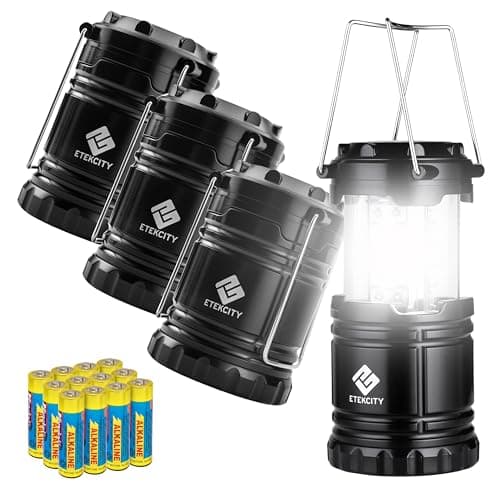
Etekcity LED Lantern 4-Pack
Best for: Families who need light in four places at once, and glovebox spares.
- Four points of light for the price of one premium lantern
- Modest output per lantern; these light spaces, not campsites
Kit Score 8.4/10 · $27.99 Price checked Oct 23, 6:22 AM CDT · how we score gear
Buy on AmazonProduct details
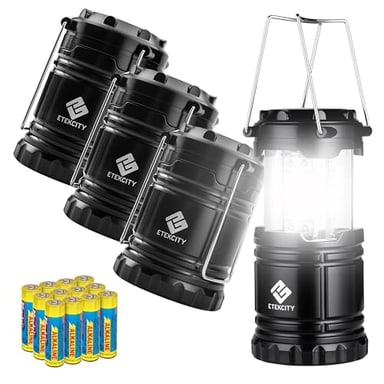
The one-per-person answer. Four collapsible battery lanterns for around $23 means light in the tent, at the table, and in a kid's hand at the same time, with no charging queue and batteries in the box.
- Count
- 4 lanterns
- Power
- 3 AA each; 12 AA included
- Output
- Up to 154 lumens each
- Runtime
- Up to 50 hrs
- Design
- Collapsible, pull-to-light
More strengths
- AA power means spares from any gas station and zero charging management
- Pull-up collapse design is simple enough for children to run themselves
Other tradeoffs
- Plastic build to a price, so treat them as consumables over years rather than heirlooms
The real campsite problem is rarely one bright light; it is light in four places at once: the tent, the table, the cooler, a kid's hand. Four collapsible AA lanterns for around $23 solve that with no charging queue, and gas-station batteries keep them running. Each one takes 3 AA cells (all 12 come in the box), and Etekcity rates it at up to 154 lumens and up to 50 hours of light.
Each lantern is modest on its own, lighting a space rather than a site, and the plastic build is honest about the price. As a system, they cover a family camp better than one premium lantern ever will.
Best for: Families needing light everywhere at once, and glovebox spares.
Comparison
| Product | Kit Score | Price | Best for |
|---|---|---|---|
| BioLite AlpenGlow 500 Lantern | 8.5 | $79.95 Price checked Oct 23, 6:22 AM CDT | Best for: Car campers and tent campers who want versatile ambiance lighting, a reliable power bank backup, and the widest set of modes in a mid-size package. Why it stands out: Dims from 500 lumens down to 5, so one lantern covers cooking light and a soft in-tent glow Tradeoff: Micro-USB charge port is outdated compared to competitors moving to USB-C, and the port seal has shown minor water ingress in heavy rain |
| Fenix CL26R Pro Rechargeable Camping Lantern | 8.8 | Check current price | Best for: Backpackers and weight-conscious campers who want USB-C recharging, IP66 protection, and enough output for a campsite without carrying a heavy lantern. Why it stands out: IP66 rating is the strongest weatherproofing here: it handles direct water spray, not just splashes, which matters on exposed campsites Tradeoff: High mode steps down to roughly 50% brightness after 20 minutes due to thermal management, so peak output is not sustained |
| LuminAID PackLite Nova USB Solar Lantern | 8.2 | $32.99 Price checked Oct 23, 6:22 AM CDT | Best for: Backpackers, families, travelers, and emergency-kit builders who want a light, inexpensive lantern that can recharge itself in daylight. Why it stands out: Compresses to one inch thick and weighs 5 ounces, so it disappears into a pack or emergency kit Tradeoff: The 75-lumen ceiling is for a tent or close-range task, not a group cooking area |
| Coleman Classic Rechargeable 800L | 8.4 | $59.99 Price checked Oct 23, 6:22 AM CDT | Best for: Lighting a whole table and cook area with one familiar, tough lantern. Why it stands out: 800 lumens is genuine area lighting, the most output in this guide Tradeoff: Rated for 5 hours on high, so run it on medium or low for evening-long light |
| Etekcity LED Lantern 4-Pack | 8.4 | $27.99 Price checked Oct 23, 6:22 AM CDT | Best for: Families who need light in four places at once, and glovebox spares. Why it stands out: Four points of light for the price of one premium lantern Tradeoff: Modest output per lantern; these light spaces, not campsites |
BioLite AlpenGlow 500 Lantern
- Best for
- Car campers and tent campers who want versatile ambiance lighting, a reliable power bank backup, and the widest set of modes in a mid-size package.
- Why it stands out
- Dims from 500 lumens down to 5, so one lantern covers cooking light and a soft in-tent glow
- Tradeoff
- Micro-USB charge port is outdated compared to competitors moving to USB-C, and the port seal has shown minor water ingress in heavy rain
Fenix CL26R Pro Rechargeable Camping Lantern
- Best for
- Backpackers and weight-conscious campers who want USB-C recharging, IP66 protection, and enough output for a campsite without carrying a heavy lantern.
- Why it stands out
- IP66 rating is the strongest weatherproofing here: it handles direct water spray, not just splashes, which matters on exposed campsites
- Tradeoff
- High mode steps down to roughly 50% brightness after 20 minutes due to thermal management, so peak output is not sustained
LuminAID PackLite Nova USB Solar Lantern
- Best for
- Backpackers, families, travelers, and emergency-kit builders who want a light, inexpensive lantern that can recharge itself in daylight.
- Why it stands out
- Compresses to one inch thick and weighs 5 ounces, so it disappears into a pack or emergency kit
- Tradeoff
- The 75-lumen ceiling is for a tent or close-range task, not a group cooking area
Coleman Classic Rechargeable 800L
- Best for
- Lighting a whole table and cook area with one familiar, tough lantern.
- Why it stands out
- 800 lumens is genuine area lighting, the most output in this guide
- Tradeoff
- Rated for 5 hours on high, so run it on medium or low for evening-long light
Etekcity LED Lantern 4-Pack
- Best for
- Families who need light in four places at once, and glovebox spares.
- Why it stands out
- Four points of light for the price of one premium lantern
- Tradeoff
- Modest output per lantern; these light spaces, not campsites
How we picked
Every lantern here was evaluated against the Kit Score: verified lumen output, rated runtime across modes, ingress protection, weight, recharge method, and value at street price. We aggregate manufacturer specs, independent lab measurements where available, and verified-owner reviews to surface the consensus performance picture.
The fun add-on: solar string lights
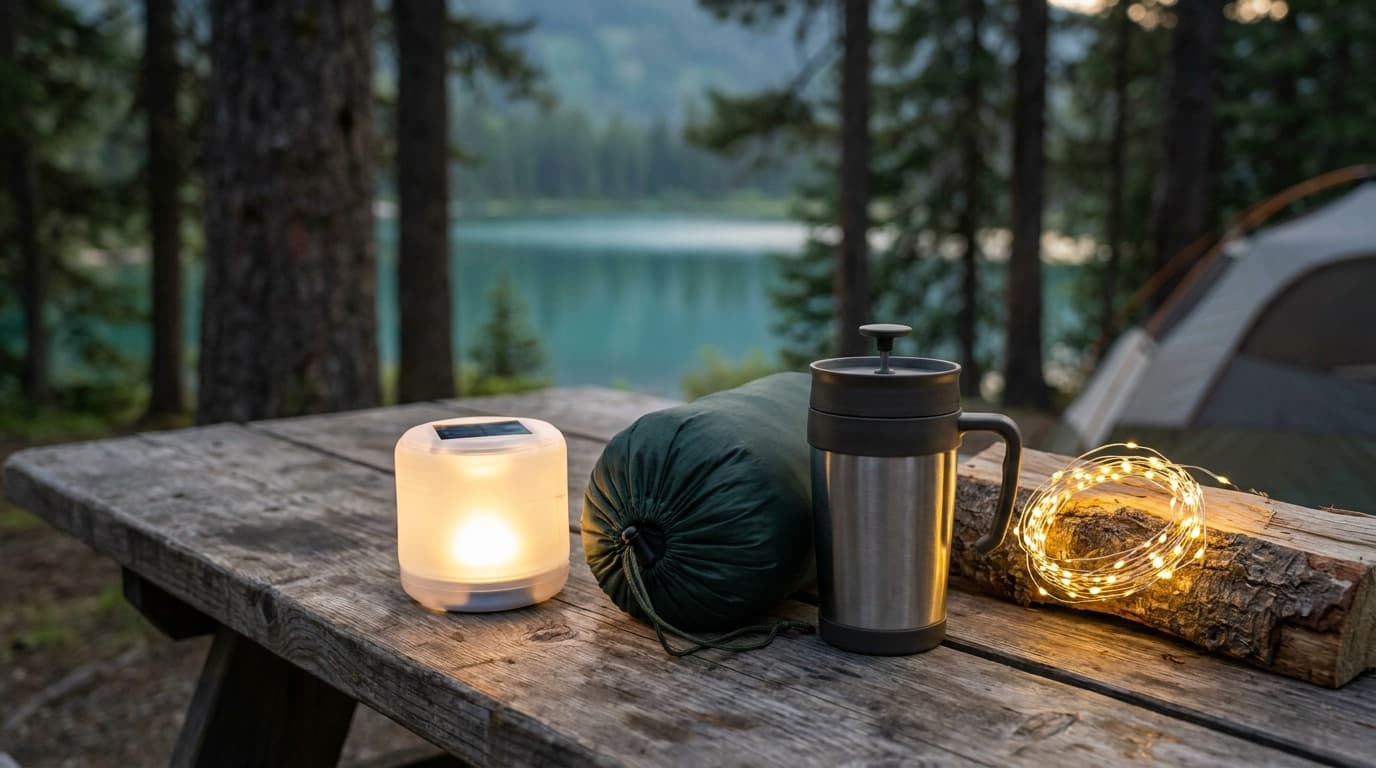
The MPOWERD Luci Solar String Lights spread 100 warm lumens across 18 feet and wind back into their own solar housing. They make a tent, awning, or picnic table more comfortable without the glare of one bright point source.
They are not one of the four primary lanterns because distributed ambient light cannot replace focused cooking or repair light. Pair them with a proper lantern, then read the Luci Solar String Lights review if camp atmosphere earns space in the kit.
How to choose the right camping lantern
Start with your campsite type
Car campers have no weight limit, so raw output and feature count matter more. Group sites benefit from 500+ lumens and a wide diffuser. Backpackers need to weigh every gram: the PackLite Nova is the lightest choice here, while Fenix earns its extra weight with much higher output and IP66 protection. Solo weekend hikers can often use a personal lantern plus a headlamp.
Lumens versus lumen modes
Peak lumen numbers are marketing. What matters is the mid-range mode you will actually use for 90% of the trip. A lantern rated at 600 lm that only sustains that for 3 hours is less useful than one rated at 400 lm that holds a consistent 200 lm for 20 hours. Check the runtime table across all modes, not just the top-line figure.
Rechargeable or battery-powered
Rechargeable (USB-C or USB-A) lanterns cost less to run over time and are lighter because you are not carrying spare AA or D cells. The trade-off: if you forget to charge before a trip, you are dark. Battery-powered lanterns are recoverable from any gas station. Four of the five picks here are rechargeable, which is the right default for planned trips with reliable charging access; the Etekcity set is the AA-powered exception.
Color temperature and dimming
Warm light (2,700 K–3,000 K range) is better for relaxed evenings: easier on the eyes and less glaring around a table. Cool white (5,000 K+) shows true colors and works better for cooking, first-aid, or gear repair. The BioLite AlpenGlow is the only primary lantern here with a wide color and temperature range. For most campers, useful low modes matter more than novelty effects.
Water resistance
IPX4 (splash-resistant) is the baseline for most camping lanterns, and it is what BioLite and Coleman publish for these picks. The Fenix CL26R Pro's IP66 (dust-tight, jet-water resistant) is meaningfully better for rain camping or canoe trips, and the LuminAID is rated IP67 and floats. If your trips involve river crossings or reliable Pacific Northwest rain, weight the ingress rating higher in your decision.
How to pack your camp lighting kit
Assess trip type
Solo or group? Backpacking or car camp? The answers determine how many lumens you actually need and how much weight you can afford.
Pick a primary lantern
One lantern per site. 300–600 lm for group use, 100–200 lm for solo or in-tent use.
Add a personal light
Every person in the group should have a headlamp or pocket lantern. The site lantern is not a substitute for task lighting.
Charge before you leave
Build a "charge everything" step into your pre-trip checklist. Rechargeable gear needs 24-hour notice, not 30 minutes.
Pack spare power
A 10,000 mAh power bank covers roughly one full recharge of a mid-size lantern with some left for your phone. The BioLite's built-in power bank is a lighter alternative if you own it already.
The lantern most campers need is not the brightest one, it is the one they actually charged before leaving.
Frequently asked questions
How many lumens do I need for a camping lantern?
For a solo tent: 50–150 lm is enough for reading and navigation. For a two-person campsite: 150–300 lm covers most needs. For a group picnic table or cooking setup: 400–600 lm is the useful range. Above 600 lm, you are likely paying for output you will use rarely. Focus on the mid-mode runtime at the brightness you actually camp at, not the peak spec. For a deeper breakdown by campsite scenario, see how many lumens you need for camping.
Are LED lanterns better than gas lanterns for camping?
For nearly all campers today, yes. LED lanterns produce no heat, no carbon monoxide, and no fuel cost per use, are safe inside a tent, and run silently. A propane gas lantern still wins on two counts: it produces a warm flame-quality light some campers prefer at a picnic table, and fuel canisters are available at any big-box store with no charging required. But gas lanterns cannot be used inside tents or enclosed shelters, run hot enough to burn, and cost $0.50–$1.00 per evening in fuel. All five picks in this guide are LED, and four are rechargeable, which is the right default in 2026.
What is the difference between a lantern and a headlamp for camping?
A lantern is area lighting: it throws diffuse, 360-degree light across a table, tent, or cooking area so everyone can see. A headlamp is task lighting: a directional beam that follows your eyes and leaves your hands free. Neither substitutes for the other. The standard camp kit is one lantern per site (300–600 lm for groups) plus one headlamp per person; see our best headlamps guide for the personal-light half of that equation.
Are rechargeable camping lanterns reliable for multi-night trips?
Yes, for most planned trips. Start from each lantern's published runtime at the mode you will actually use, not the maximum-lumen claim. Charge by USB before departure, use lower modes for ordinary evenings, and bring a power bank when the trip exceeds the baseline. The LuminAID adds direct solar refill, and the AlpenGlow 500, Fenix, and Coleman can each top up a phone from the same battery.
How long does a rechargeable camping lantern last on one charge?
It depends almost entirely on the mode. On high, most lanterns here are rated for about 5 hours: BioLite and Coleman both publish 5 hours at full output, and an independent bench test of the Fenix CL26R Pro also measured about 5 hours on high. On low, the ratings stretch to 45 hours (Coleman), 200 hours (BioLite), and 408 hours (Fenix). For a long weekend, a medium setting for a few hours each evening is realistic on one charge; running high every night is not.
What is IP66 and does it matter for camping lanterns?
IP ratings are a standardized measure of a device's protection against solids (first digit) and water (second digit). IP66 means the lantern is dust-tight (6) and protected against powerful water jets from any direction (second 6). For most campground camping, IPX4 splash resistance is sufficient. If trips involve heavy rain or canoe camping, IP66 from the Fenix CL26R Pro is worth considering. The LuminAID is rated IP67 and floats, but its output is much lower.
Where these numbers come from
Every lumen and runtime figure above is the manufacturer's rating unless it is labeled as an independent measurement; none is a Kit Authority measurement. Makers rate lumens under lab conditions, and a diffused lantern delivers less useful light than the number implies, which is why the picks lean on runtime and weather rating. To see each rating next to independent measurements where they exist, open our lantern rated vs measured dataset. Checked September 25, 2026.
| Claim | Source | Checked |
|---|---|---|
| BioLite AlpenGlow 500: 500 lm high, 5 h high / up to 200 h low, 6,400 mAh (23.6 Wh), 13.4 oz, IPX4, micro-USB in, USB-A out at 2.4 A, $79.95, 1-year warranty | BioLite AlpenGlow 500 | 2026-09-12 |
| Fenix CL26R Pro: 650 lm max (500 high, 200 medium, 50 low), up to 408 h on low, 21700 cell, USB-C in and USB-A out, IP66, 1 m drop rating | Fenix CL26R Pro | 2026-09-12 |
| LuminAID PackLite Nova USB: 75 lm turbo for 3 to 5 h, 50 lm for 6 to 8 h, 25 lm for 12 to 14 h, 12 lm for 18 to 24 h; 10 h solar or 1 to 2 h USB; 5 oz; IP67, floats; 4.75 in cube packing to under 1 in | LuminAID PackLite Nova and REI listing | 2026-09-12 |
| Coleman Classic Rechargeable 800L: 800 lm high, 300 medium, 100 low; up to 5 h high / 45 h low; 4,800 mAh lithium-ion; IPX4; impact resistant to 1 m; USB charge-out; 2.2 lb; 3-year warranty | Amazon listing B09HN1BXRG (coleman.com blocks automated reads) | 2026-09-25 |
| Etekcity 4-pack: 3 AA per lantern, 12 AA included, up to 154 lm, up to 50 h, 30 LEDs, collapsible | Amazon listing B01C5QSENQ | 2026-09-25 |
| BioLite AlpenGlow 500: 5 lm minimum, nine light settings, 2,700 K warm and 5,700 K cool white, CRI 90, shake-activated candle mode | BioLite AlpenGlow 500 | 2026-09-25 |
| Fenix CL26R Pro: 199 g without battery, about 3.5 h USB-C charge, seven white and two red modes | Fenix CL26R Pro | 2026-09-25 |
| Fenix CL26R Pro independent bench test: 418 lm on high (rated 500), step-down after about 20 min, 5 h 5 min on high (rated 10 h) | 1Lumen, Fenix CL26R Pro review | 2026-09-25 |
| LuminAID PackLite Nova: 5 brightness levels, about 10 h solar or 1 to 2 h micro-USB, IP67, does not charge phones | LuminAID PackLite Nova and Amazon listing B0716JV1SG | 2026-09-25 |
Retired from this guide: the Goal Zero Lighthouse 600 held Editor's Choice for its hand-crank backup. It is now out of stock at Goal Zero and unavailable on Amazon, where its page redirects to the Lighthouse Core, a 430-lumen model without the crank. We removed it rather than let the link sell a different lantern.
The five lanterns above cover a warm all-rounder, compact weather-ready output, personal solar light, raw table light, and cheap light in four places at once. Browse the rest of the camp gear guides or read how we research and rate gear.
Keep going
Free toolPower Bank Size CalculatorHow big a power bank your trip needs, and whether it can fly.Related guides
 Complete camp loadoutCar-camping starter kitBuild the complete kit
Our recommendations draw on manufacturer documentation, retailer listings, owner feedback, and comparisons with alternatives.
As an Amazon Associate I earn from qualifying purchases. We may earn a commission from links here, at no extra cost to you. How we research →