The Garmin inReach Mini 3 Plus is the best satellite messenger for most backcountry hikers: Treeline Review names it its best overall, and Garmin packs two-way satellite texts, photo and voice messages, and an interactive SOS into a 4.42 oz device with a color touchscreen. If you want the longest battery and the lightest inReach, the inReach Messenger runs up to 672 hours with 10-minute tracking at 4 oz. If you never want a monthly bill, carry the ACR ResQLink View RLS personal locator beacon.
Our quick picks
How we picked
Every pick is scored with our Kit Score: SOS path, two-way messaging, battery life, weight, durability, and the total cost of the device plus its plan. We started from the 2026 picks of Treeline Review and Backpacker, checked every weight, battery, and plan figure on Garmin's, ZOLEO's, and ACR's own pages, and confirmed each pick is in stock new on Amazon. We did not test these devices ourselves. Read the full method at how we research and rate.
The picks
Best overall: Garmin inReach Mini 3 Plus
BEST OVERALL
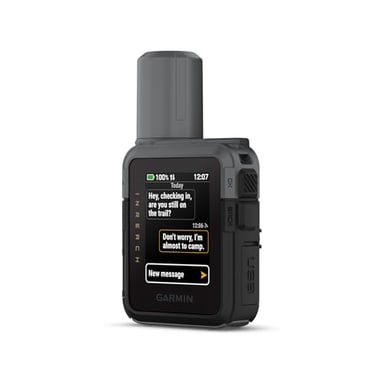
Garmin inReach Mini 3 Plus
Best for: Hikers who navigate with a phone or watch and want the lightest way to add two-way satellite messaging and SOS.
- Satellite texts, photos, voice, and SOS at 4.42 oz
- Not a standalone mapping GPS; it relies on your phone for maps
Kit Score 8.8/10 · $445.75 Price checked Oct 25, 3:41 PM CDT · how we score gear
Buy on AmazonProduct details
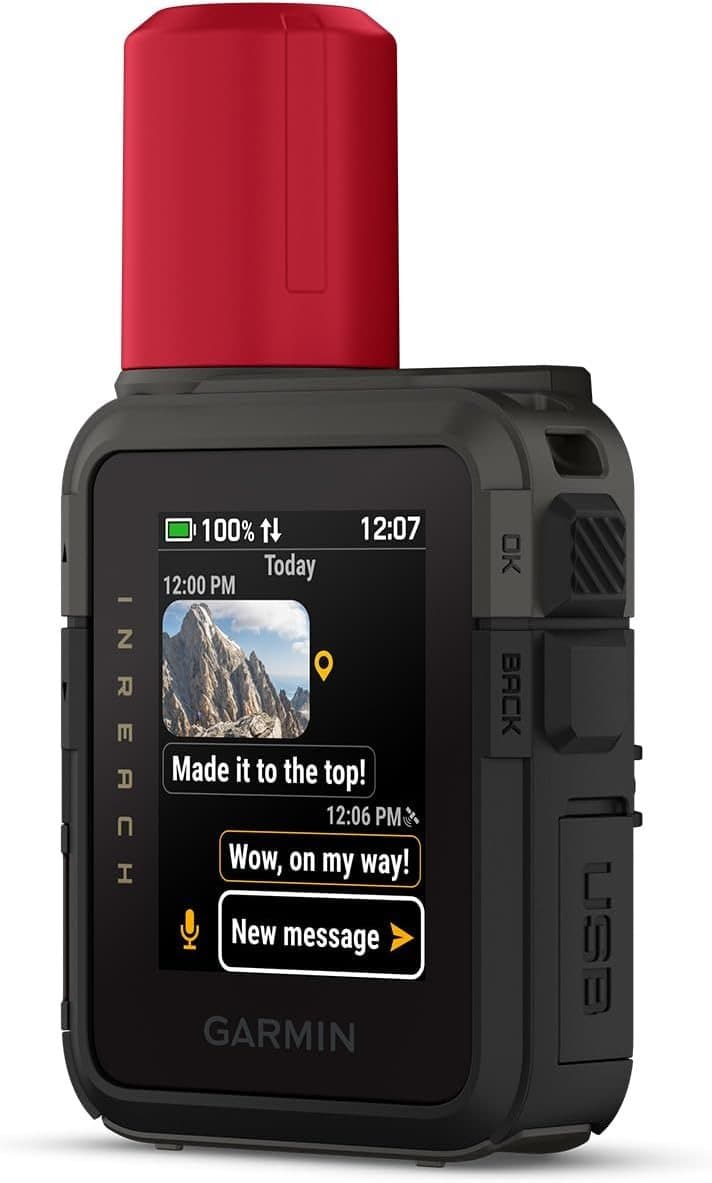
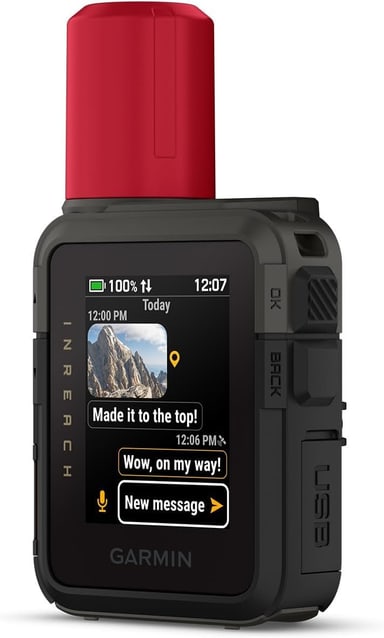
The inReach Mini 3 Plus replaces the Mini 2 as Garmin's smallest two-way satellite communicator. It adds a 1.9-inch color touchscreen and inReach Plus, so you can send photos and 30-second voice messages as well as texts and SOS, and Garmin rates it at up to 350 hours with 10-minute tracking. It pairs with your phone for maps.
- Display
- 1.9 in color MIP touchscreen, 306 x 230
- Battery
- Up to 350 hr with 10-min tracking; 95 hr in performance messaging mode
- Satellites
- Multi-band GPS, Galileo, QZSS, BeiDou
- Maps
- Basemap only; topo maps through the paired phone app
- Satellite comms
- inReach Plus: texts, photos, voice messages, interactive SOS (plan required)
- Build
- 4.42 oz, IP67, compass
More strengths
- Up to 350 hours with 10-minute tracking
- Picked by Treeline Review, Backpacker, Switchback Travel, and GearJunkie
Other tradeoffs
- Needs a monthly inReach plan, and photo and voice messages count against plan limits
The Mini 3 Plus is the newest small inReach and the one most reviewers now point to. Treeline Review names it its best overall satellite messenger, and Backpacker calls it the best standalone communicator. Garmin gives it a 1.9-inch color touchscreen with physical buttons, so you can read and type messages on the device itself, and the buttons still work with gloves on.
The "Plus" is inReach Plus messaging. Beyond texts and SOS, it can send and receive photos and voice messages over satellite with other Garmin Messenger app users, and its texts run up to 1,600 characters instead of 160. You record voice messages on the device; photos go through the paired phone app. It also adds voice commands and a safety siren that the Mini 3 lacks.
Garmin rates it at up to 350 hours with 10-minute tracking, or 95 hours in its default performance messaging mode. It weighs 4.42 oz, is rated IP67, and uses multi-band GPS, which Garmin says improves position accuracy. It has only a basemap, so your phone stays your map.
Best for: Hikers who want the most capable small messenger and will use photos or voice messages to keep family in the loop.
Best battery life: Garmin inReach Messenger
BEST BATTERY LIFE
Garmin inReach Messenger
Best for: Backpackers and remote-area travelers who want reliable two-way messaging and interactive SOS on a single charge for multi-week trips.
- Longest battery of any inReach here: up to 672 hours with 10-minute tracking, at 4 oz
- No onboard maps or navigation: best treated as a communicator paired with a separate GPS, not a standalone navigator
Kit Score 8.3/10 · Check current price · how we score gear
Buy on AmazonProduct details
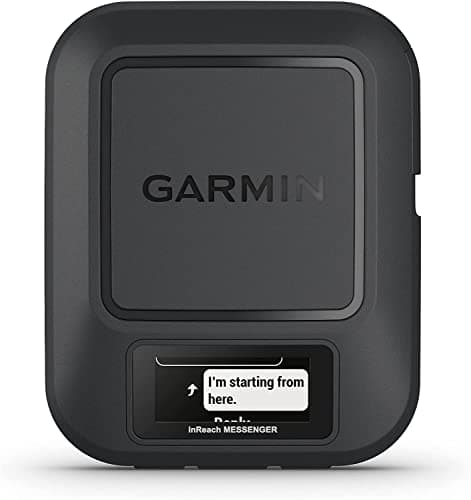
A compact, two-way Iridium satellite communicator that Garmin rates at up to 672 hours (28 days) with 10-minute tracking, with Safety Charging to top off a depleted phone. Paired with the Garmin Messenger app, it switches between satellite, cellular, and Wi-Fi to save satellite messages.
- Satellite network
- Iridium (global)
- Weight
- 4 oz (113.9 g)
- Battery life
- Up to 672 hours (28 days) with 10-min tracking
- Water resistance
- IPX7
- Subscription (entry)
- inReach plans from $7.99/month plus $39.99 activation
- Communication type
- Two-way text + SOS
More strengths
- Seamless network switching between satellite, cellular, and Wi-Fi reduces message costs on trips that pass through coverage
- Reverse USB-C charging lets it serve as an emergency power bank for a phone
Other tradeoffs
- Small screen and button-driven UI make composing long messages on the device itself cumbersome
The inReach Messenger is the lightest device in this guide at 4 oz (113.9 g), and Garmin rates it at up to 672 hours, about 28 days, with 10-minute tracking. That is nearly twice the Mini 3's rating, which is why Treeline Review gives it its best battery life award. Safety Charging lets it top off a dead phone in a pinch.
It runs on the same Iridium network and sends the same interactive SOS to Garmin Response, Garmin's 24/7-staffed coordination center. You can type a message on its small monochrome screen with a virtual keyboard, but the Garmin Messenger app on your phone is the easier way to write, and the app can switch between satellite, cellular, and Wi-Fi. It has no maps and does not record activities on the device, and texts are capped at 160 characters.
If you want photo and voice messages in this shape, Garmin's inReach Messenger Plus adds them at 4.1 oz and up to 600 hours in low-power mode, and Backpacker names it its best overall communicator. When we checked, Amazon's only listing for it was a single unit from a third-party seller, so it is not one of our picks.
Best for: Long trips away from power, and anyone who wants the lightest inReach and messages mostly from their phone.
Best touchscreen for less: Garmin inReach Mini 3
BEST TOUCHSCREEN FOR LESS
Garmin inReach Mini 3
Best for: Hikers who want a small inReach they can text from without a phone, and do not need photo or voice messages.
- Two-way satellite texts and interactive SOS at 4.31 oz
- No photo or voice messages; that needs the Mini 3 Plus
Kit Score 8.5/10 · $389.99 Price checked Oct 25, 3:41 PM CDT · how we score gear
Buy on AmazonProduct details
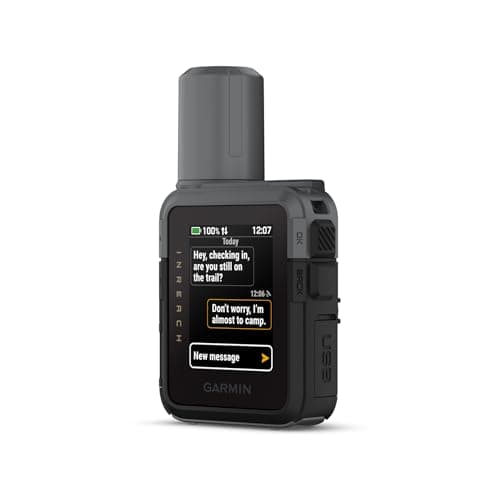
The inReach Mini 3 is the touchscreen successor to the Mini 2 without the Plus model's photo and voice messaging. Garmin gives it a 1.9-inch color touchscreen with physical buttons, multi-band GPS, an IP67 rating, and up to 350 hours with 10-minute tracking, and it sends two-way texts and an interactive SOS over Iridium. It pairs with your phone for maps.
- Display
- 1.9 in color MIP touchscreen plus buttons, 306 x 230
- Battery
- Up to 350 hr with 10-min tracking
- Satellites
- Multi-band GPS, Galileo, QZSS, BeiDou
- Maps
- Basemap only; topo maps through the paired phone app
- Satellite comms
- Two-way texts (160 characters) and interactive SOS over Iridium (plan required)
- Build
- 4.31 oz, IP67, MIL-STD-810, compass
More strengths
- Color touchscreen and on-screen keyboard, with physical buttons for gloves
- Up to 350 hours with 10-minute tracking, and it can top up a phone
Other tradeoffs
- Not a mapping GPS on its own, and it needs a monthly inReach plan
The Mini 3 is the Mini 3 Plus without photo and voice messaging. You keep the 1.9-inch color touchscreen and buttons, multi-band GPS, the IP67 rating, interactive SOS, two-way texts, and the 350-hour rating with 10-minute tracking, and it is slightly lighter at 4.31 oz. It also costs less to buy.
What you give up: no photos or voice messages, texts stay at 160 characters, and there is no voice command or safety siren. Garmin's plans cost the same for both models, so if you only send texts and check-ins, the Mini 3 saves money on the device without giving up any safety feature. It is the newer, larger-screened alternative to the inReach Mini 2, which Garmin still sells.
Best for: Hikers who want a touchscreen inReach they can text from without a phone and do not need photos or voice.
Best budget: ZOLEO Satellite Communicator
BEST BUDGET
ZOLEO Satellite Communicator
Best for: Budget-conscious hikers and travelers who want Iridium-network reliability and easy two-way messaging without paying Garmin prices.
- Lowest hardware cost of the two-way picks, and the unlimited Protect plan undercuts Garmin's unlimited plan
- No on-device message composition for custom text: all messaging requires a paired smartphone, which is a liability if the phone dies
Kit Score 8.0/10 · $199.00 Price checked Oct 25, 3:41 PM CDT · how we score gear
Buy on AmazonProduct details
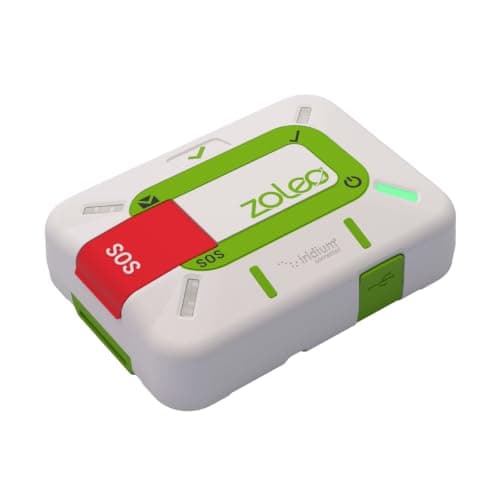
A phone-paired Iridium communicator that assigns you a real SMS number and email address, letting contacts reach you from any phone without a special app. It is the least expensive two-way device in our picks to buy, and every ZOLEO plan includes SOS with 24/7 monitoring.
- Satellite network
- Iridium (global)
- Weight
- 5.3 oz (150 g)
- Battery life
- 200+ hours with a message check every 12 minutes
- Water resistance
- IP68
- Subscription (entry)
- Prepare $19.99/month (50 satellite messages); Protect $34.99/month (unlimited); $19.99 activation
- Communication type
- Two-way text, email + SOS
More strengths
- Assigned SMS number and email let contacts reply from any phone: no Garmin app, no SPOT account needed on their end
- Medical Assist service included: consult a medical professional before committing to a full SOS activation
Other tradeoffs
- Battery failure reports after extended storage; ZOLEO support recommends charging every three months, which some owners find impractical
ZOLEO is the budget pick from both Treeline Review and Backpacker, and it costs the least to buy of the two-way devices here. It also runs on Iridium. Every plan gives you your own ZOLEO SMS number and email address, so family can text you from any phone, and messages go over cellular or Wi-Fi when you have a signal and satellite when you do not. SOS alerts go to 24/7 monitoring run by Global Rescue, and Medical Assist gives you a line for non-emergency help.
The trade-off is that ZOLEO is a phone companion. On its own, the device sends only check-ins and SOS; typing messages, reading replies, and weather all need the ZOLEO app on your phone. It weighs 5.3 oz (150 g), is rated IP68, and ZOLEO quotes 200+ hours with a message check every 12 minutes. The Amazon listing we link is the current Limestone version (ZL1500), which adds USB-C charging and Bluetooth LE 5.2.
Plans: Prepare is $19.99 a month for 50 satellite messages, and Protect is $34.99 a month for unlimited, with a $19.99 activation fee and a 3-month minimum. Garmin's $14.99 Essential plan also includes 50 texts, so ZOLEO's savings are in the hardware and the cheaper unlimited plan, not the entry plan.
Best for: Budget-minded hikers who always carry a phone and want Iridium messaging with a real phone number.
Best without a subscription: ACR ResQLink View RLS
BEST WITHOUT A SUBSCRIPTION
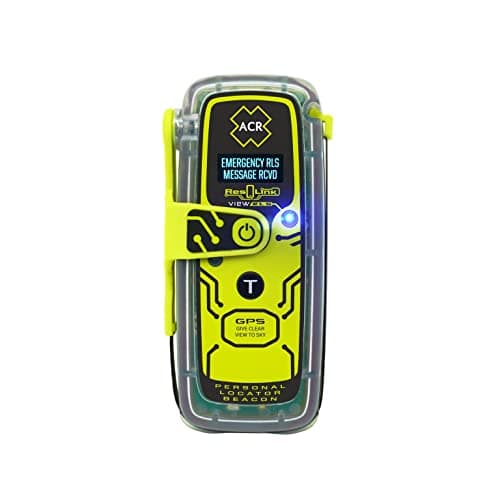
ACR ResQLink View RLS
Best for: Backcountry travelers who want a zero-subscription emergency backup with no monthly bill, and who accept that it does one job: summon a rescue.
- No subscription, no recurring cost: pay once, register free with NOAA, and the beacon is ready for 5 years
- SOS-only: no two-way messaging, no non-emergency check-ins, no GPS tracking for loved ones between activations
Kit Score 8.5/10 · $529.95 Price checked Oct 25, 3:41 PM CDT · how we score gear
Buy on AmazonProduct details
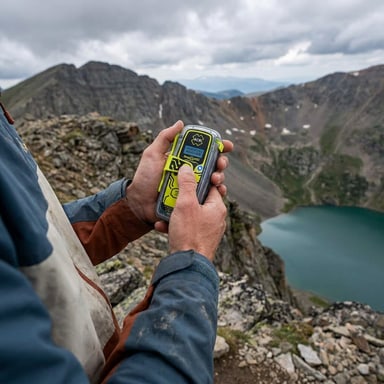
A COSPAS-SARSAT 406 MHz personal locator beacon with a digital display and Return Link Service, which flashes confirmation that search and rescue has received your distress signal. No subscription is ever required: register free with NOAA, and the 5-year battery is ready whenever you need it.
- Satellite network
- COSPAS-SARSAT 406 MHz (global)
- Weight
- 5.2 oz (148 g)
- Battery life
- 5-year shelf life; 28 hours operational
- Water resistance
- 5 m (16.4 ft) for 1 hour; 10 m (33 ft) for 10 minutes; buoyant
- Subscription
- None required (free NOAA registration)
- Communication type
- One-way SOS only; no two-way messaging
More strengths
- Return Link Service provides visible confirmation (blue LED flash) that rescue services have received the signal, reducing uncertainty during an emergency
- Government-run COSPAS-SARSAT network has a decades-long rescue record and does not depend on a commercial satellite service agreement
Other tradeoffs
- The battery must be replaced after 5 years or after any emergency use, whichever comes first
The ResQLink View RLS is a personal locator beacon, not a messenger. It cannot text and it does not track your route. When you activate it, it sends a 406 MHz distress signal with your GPS position through the government COSPAS-SARSAT system to search and rescue. There are no monthly or annual plans. Backpacker names the ResQLink View its best subscription-free device.
RLS stands for Return Link Service: a confirmation sent back to the beacon, shown on its display and a flashing blue light, that rescuers received your alert. ACR rates it for 28 hours of operation, and the battery must be replaced after 5 years or after any emergency use. It weighs 5.2 oz (148 g), floats, and is waterproof to 5 m for an hour.
It costs more up front than any messenger here, but the math flips over time: Garmin's cheapest Enabled plan alone is $7.99 a month. Some backcountry travelers carry both: the PLB as the failsafe and a messenger for daily check-ins.
Best for: Hikers who want a no-bill emergency backup and accept that it does one job: summon a rescue.
How to choose
The first question is whether you need to talk back and forth or only call for help. The second is how much you will rely on your phone.
Match a device to how you hike
Two-way vs SOS-only
To send and receive messages, pick an inReach or the ZOLEO. If your only goal is an emergency signal with no bill, the ACR ResQLink View RLS covers it.
Weight
The inReach Messenger is the lightest at 4 oz, then the Mini 3 at 4.31 oz and the Mini 3 Plus at 4.42 oz. The ACR weighs 5.2 oz and the ZOLEO 5.3 oz.
Battery
The Messenger leads at up to 672 hours with 10-minute tracking. The Mini 3 and Mini 3 Plus are rated for 350 hours, and the ZOLEO for 200+ hours with a message check every 12 minutes.
Phone or no phone
The Mini 3 and Mini 3 Plus have touchscreens and keyboards, so you can text without a phone. The Messenger can, but its small screen makes the app easier. The ZOLEO needs your phone for anything beyond check-ins and SOS.
Plan cost
Garmin plans run $7.99 to $49.99 a month plus a $39.99 activation, and you can suspend for up to 12 months at no cost. ZOLEO runs $19.99 or $34.99 a month with a 3-month minimum. The PLB has no plan.
A PLB and a two-way messenger solve different problems: the PLB calls for a helicopter, the messenger tells your partner you are running a day late.
Comparison
| Spec | inReach Mini 3 Plus | inReach Messenger | inReach Mini 3 | ZOLEO | ACR ResQLink View RLS |
|---|---|---|---|---|---|
| Kit Score | 8.8/10 | 8.3/10 | 8.5/10 | 8.0/10 | 8.5/10 |
| Price | $445.75 Price checked Oct 25, 3:41 PM CDT | Check current price | $389.99 Price checked Oct 25, 3:41 PM CDT | $199.00 Price checked Oct 25, 3:41 PM CDT | $529.95 Price checked Oct 25, 3:41 PM CDT |
| Best for | Hikers who navigate with a phone or watch and want the lightest way to add two-way satellite messaging and SOS. | Backpackers and remote-area travelers who want reliable two-way messaging and interactive SOS on a single charge for multi-week trips. | Hikers who want a small inReach they can text from without a phone, and do not need photo or voice messages. | Budget-conscious hikers and travelers who want Iridium-network reliability and easy two-way messaging without paying Garmin prices. | Backcountry travelers who want a zero-subscription emergency backup with no monthly bill, and who accept that it does one job: summon a rescue. |
| Why it stands out | Satellite texts, photos, voice, and SOS at 4.42 oz | Longest battery of any inReach here: up to 672 hours with 10-minute tracking, at 4 oz | Two-way satellite texts and interactive SOS at 4.31 oz | Lowest hardware cost of the two-way picks, and the unlimited Protect plan undercuts Garmin's unlimited plan | No subscription, no recurring cost: pay once, register free with NOAA, and the beacon is ready for 5 years |
| Tradeoff | Not a standalone mapping GPS; it relies on your phone for maps | No onboard maps or navigation: best treated as a communicator paired with a separate GPS, not a standalone navigator | No photo or voice messages; that needs the Mini 3 Plus | No on-device message composition for custom text: all messaging requires a paired smartphone, which is a liability if the phone dies | SOS-only: no two-way messaging, no non-emergency check-ins, no GPS tracking for loved ones between activations |
| Type | Two-way messenger | Two-way messenger | Two-way messenger | Two-way messenger (phone app) | Personal locator beacon |
| Network | Iridium | Iridium | Iridium | Iridium | COSPAS-SARSAT 406 MHz |
| Weight | 4.42 oz | 4 oz | 4.31 oz | 5.3 oz | 5.2 oz |
| Rated battery | 350 hr, 10-min tracking | 672 hr, 10-min tracking | 350 hr, 10-min tracking | 200+ hr, 12-min message checks | 28 hr operating |
| Screen | 1.9 in color touch plus buttons | Small monochrome, buttons | 1.9 in color touch plus buttons | None (LEDs) | Digital display |
| Text without a phone | Yes | Yes | Yes | No (check-in and SOS only) | No messaging |
| Photo and voice messages | Yes | No | No | No | No |
| Water rating | IP67 | IPX7 | IP67 | IP68 | Waterproof to 5 m for 1 hr |
| Subscription | Garmin inReach plan | Garmin inReach plan | Garmin inReach plan | ZOLEO plan | None |
Frequently asked questions
Do I need a satellite messenger if I already have a PLB?
A PLB covers the most critical case: you are hurt and need rescue. A satellite messenger covers everything else, including weather forecasts, itinerary changes, and two-way check-ins that can stop a search before it starts. Many experienced backcountry travelers carry both. If you can only buy one, a two-way messenger with interactive SOS, such as the inReach Mini 3 Plus or inReach Messenger, does both jobs reasonably well, while a PLB on the government COSPAS-SARSAT system is the more direct rescue alert with no plan to keep paid.
Which satellite network do these devices use?
Every Garmin inReach and the ZOLEO use the Iridium network, which Iridium describes as crosslinked satellites giving uninterrupted coverage from pole to pole. Garmin says its handheld inReach devices have global coverage on Iridium. The ACR ResQLink View RLS uses a different system: the government COSPAS-SARSAT 406 MHz network, which routes your alert to search and rescue without a commercial plan.
Is the Garmin inReach Mini 2 discontinued?
Not yet. Garmin's US site still sells the inReach Mini 2, but the inReach Mini 3 and Mini 3 Plus are its newer siblings. Compared with the Mini 2's 0.9-inch monochrome screen and buttons, they add a 1.9-inch color touchscreen, multi-band GPS, and an IP67 rating, and run up to 350 hours with 10-minute tracking versus 336 hours. The trade is weight: 4.31 oz and 4.42 oz versus 3.5 oz for the Mini 2. If you buy a Mini 2, buy it new from Garmin or an authorized US seller.
What plan do I need for a week-long backpacking trip?
Garmin bills inReach plans monthly, with a $39.99 activation fee. The $14.99 Essential plan includes unlimited check-ins and 50 texts, which covers daily updates on a one-week trip; the $7.99 Enabled plan keeps SOS active and charges per message. Between trips you can suspend service for up to 12 months at no cost. ZOLEO's Prepare plan is $19.99 a month for 50 satellite messages, with a 3-month minimum and an optional pause at $4.50 a month afterward, during which SOS is off. Check current rates on Garmin's and ZOLEO's plan pages before you activate.
Where these numbers come from
| Claim | Source | Checked |
|---|---|---|
| inReach Messenger 4 oz (113.9 g), up to 672 hr with 10-min tracking, IPX7, monochrome screen, virtual keyboard, Safety Charging, 160-character texts; Messenger Plus 4.1 oz (117.2 g), 600 hr low-power, 120 hr performance, photo and voice messages; Mini 3 4.31 oz (122.2 g) and Mini 3 Plus 4.42 oz (125.2 g), 1.9 in color touchscreen, IP67, multi-band, 350 hr with 10-min tracking, Mini 3 Plus 95 hr performance mode and 1,600-character texts; voice command and safety siren on the Mini 3 Plus only | Garmin: Comparing the inReach Messenger series and inReach Mini 3 series | 2026-10-03 |
| inReach Mini 2: 3.5 oz (100 g), 0.9 x 0.9 in monochrome screen, IPX7, no multi-band, up to 336 hr with 10-min tracking | Garmin: Comparing the inReach Mini 2, Mini 3, and Mini 3 Plus | 2026-10-03 |
| inReach Mini 3 and Mini 3 Plus IP67, operating -4 to 140 F | Garmin inReach Mini 3/3 Plus owner's manual, Specifications | 2026-10-03 |
| Garmin US sells the Mini 3, Mini 3 Plus, Messenger, Messenger Plus, and Mini 2; Garmin Messenger app smart switching between Wi-Fi, cellular, and satellite (Mini 2 spec sheet) | Mini 3, Mini 3 Plus, Messenger, Messenger Plus, Mini 2 | 2026-10-03 |
| Garmin plans: Enabled $7.99, Essential $14.99, Standard $29.99, Premium $49.99 a month; $39.99 activation; SOS on every plan; Essential 50 texts and 25 photo or voice messages; suspend up to 12 months at $0; Iridium global coverage; Garmin Response 24/7-staffed | Garmin inReach consumer plans | 2026-10-03 |
| ZOLEO plans: Prepare $19.99 (50 satellite messages), Protect $34.99 (unlimited); $19.99 activation; 3-month minimum; pause $4.50 a month with SOS off; own SMS number and email; Medical Assist | ZOLEO monthly plans | 2026-10-03 |
| ZOLEO: 150 g (5.3 oz), IP68, LED indicators and no screen, 200+ hr with a message check every 12 min, Iridium, device alone sends only check-in and SOS, SOS operator Global Rescue | ZOLEO 1500 features and technical specs, ZOLEO tech specs | 2026-10-03 |
| ACR ResQLink View RLS: 148 g, 28 hr operating, battery replaced after 5 years or emergency use, waterproof 5 m for 1 hr and 10 m for 10 min, buoyant, Return Link Service, no subscription | ACR ResQLink View RLS | 2026-10-03 |
| Iridium crosslinked network, uninterrupted coverage pole to pole | Iridium network | 2026-10-03 |
| U.S. 406 MHz beacons must be registered with NOAA; registration is free; verify every two years; Cospas-Sarsat 406 MHz beacons and worldwide SARSAT coverage | NOAA SARSAT: register your beacon, NOAA SARSAT FAQ, NOAA SARSAT | 2026-10-03 |
| Awards: Treeline Review (Mini 3 Plus best overall, Messenger best battery life, ZOLEO best budget); Backpacker (Messenger Plus best overall, Mini 3 Plus best standalone, ZOLEO best budget, ResQLink View best subscription-free) | Treeline Review, Backpacker | 2026-10-03 |
| Seller and stock: Mini 3 Plus, Mini 3, and Messenger sold by Amazon.com; ZOLEO sold by BlueCosmo; ACR sold by ACR Electronics; all new and in stock. Messenger Plus: one unit from a third-party seller | Amazon listings B0G4RST8LV, B0G4X5Q6Y1, B0BFBZR4KW, B0B4318FYC, B0DFHNGDGM | 2026-10-03 |
| ZOLEO Amazon listing: the Limestone ZL1500 refresh (new color, USB-C charging, Bluetooth LE 5.2; 150 g, 200+ hr, IP68), sold by BlueCosmo, in stock; the earlier Slate Grey listing is unavailable | Amazon listing B0GYSSG11K, GTC: Meet the new ZOLEO ZL1500 | 2026-10-10 |
A satellite communicator is the gear decision that pays off once, at the worst possible moment. Get it set up before you need it. For maps as well as messaging, see the best handheld GPS devices, or browse more hiking gear.
Keep going
Related guides
 Complete hike loadoutDay hike kitBuild the complete kit
Our recommendations draw on manufacturer documentation, retailer listings, owner feedback, and comparisons with alternatives.
As an Amazon Associate I earn from qualifying purchases. We may earn a commission from links here, at no extra cost to you. How we research →