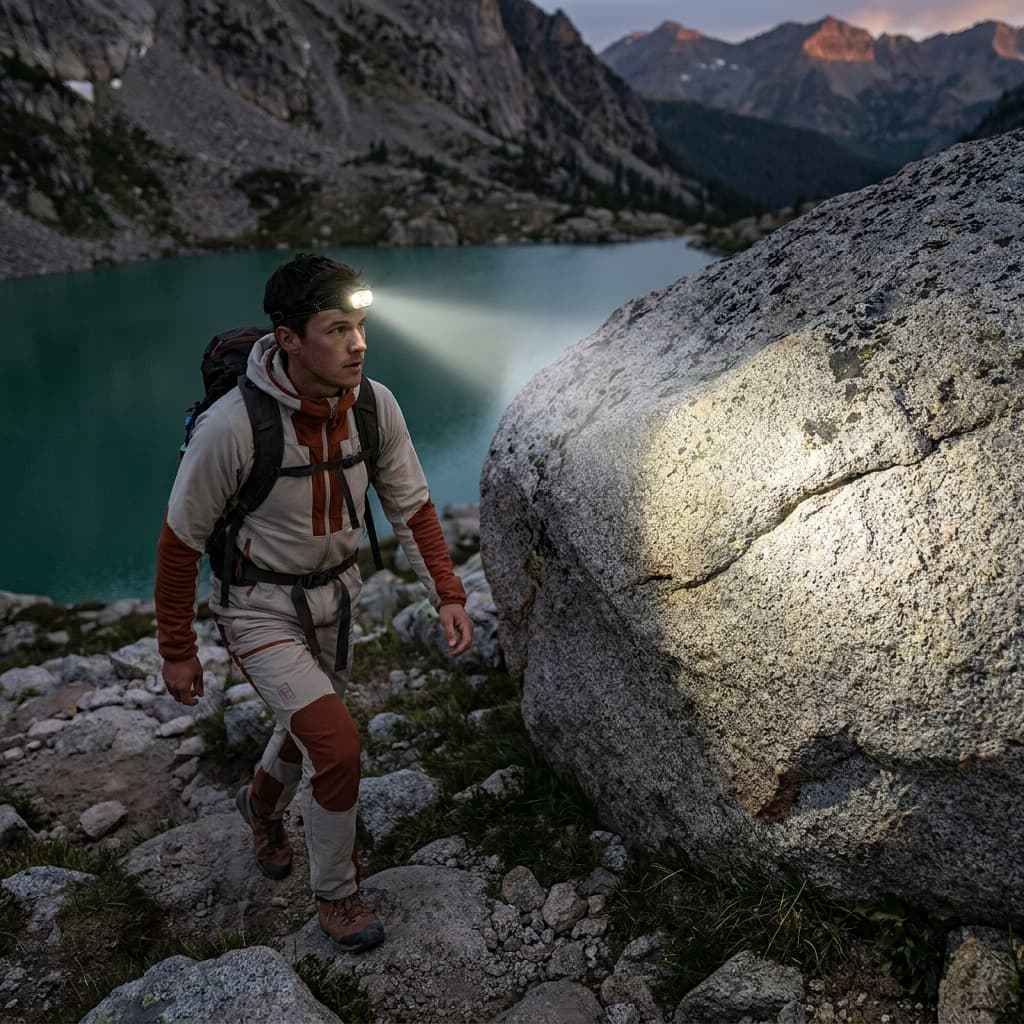
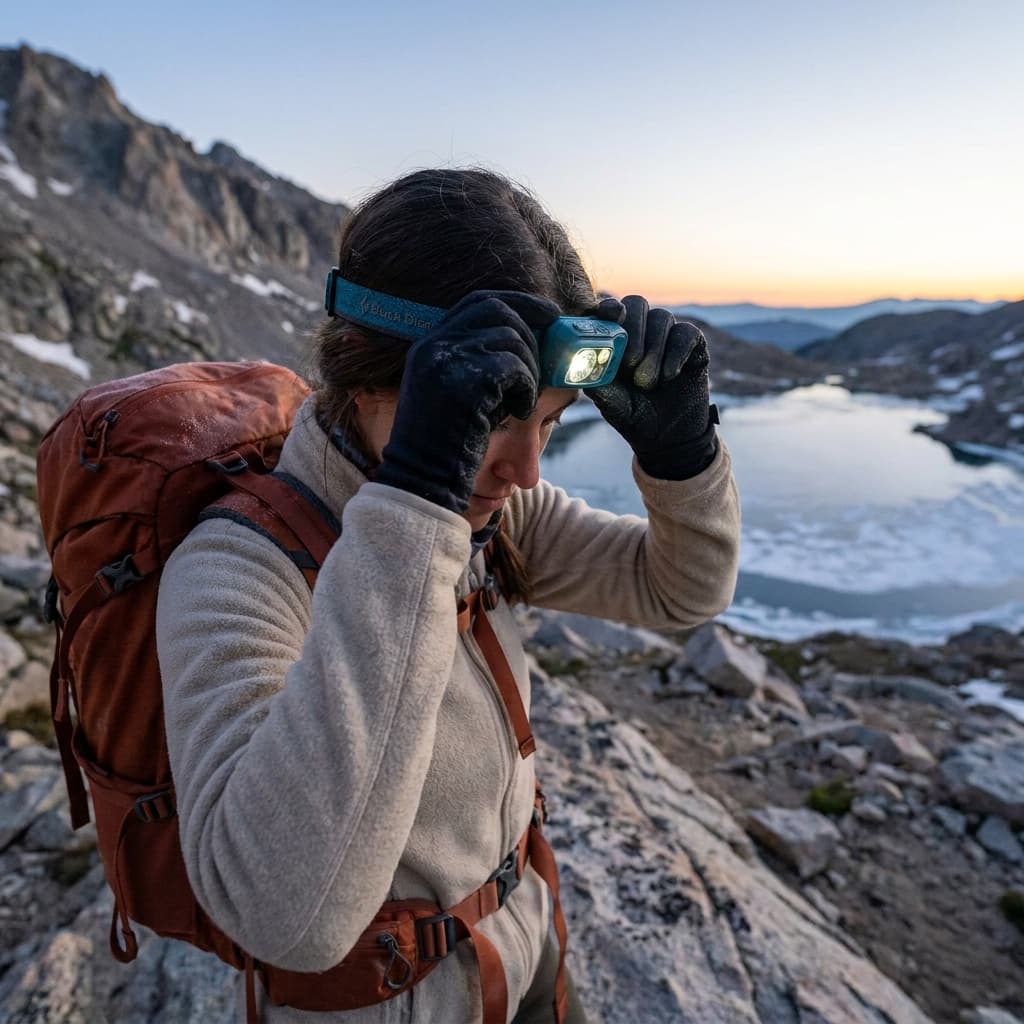
A good headlamp is the one piece of gear you never notice until it fails. These three picks cover most hikers, from the ultralight backpacker counting grams to the camper who wants a broad beam and dependable weather protection.
Our quick picks

How we picked
Every pick is scored on our Kit Score: lumens and beam distance, weight, battery type and runtime, IPX water rating, red-light mode, and verified owner satisfaction. No pick earns a spot on spec alone. We aggregate manufacturer data, independent lab tests, and hundreds of verified-owner reviews to separate marketing numbers from trail-worthy performance.
The picks
Best overall
BEST OVERALL
Black Diamond Spot 400-R Rechargeable Headlamp
Best for: All-purpose hikers and campers who want a dependable, waterproof rechargeable headlamp without overcomplicating the decision.
- IP67 submersible rating exceeds most competitors at this price, handling full submersion to 1 m
- Micro-USB charging port is outdated when rivals have moved to USB-C
Kit Score 8.5/10 · $64.88 Price checked Oct 23, 6:22 AM CDT · how we score gear
Buy on AmazonProduct details
The Spot 400-R is the benchmark mid-range headlamp: 400 lumens, a 100 m beam, and a soft recycled-fiber headband that stays put through long approaches. The PowerTap side panel jumps straight to full brightness with a tap, so you are never fumbling through modes on a tricky section of trail.
- Max output
- 400 lumens
- Beam distance
- 100 m (328 ft)
- Weight
- 3.0 oz (86 g)
- Battery
- Built-in 1500 mAh Li-ion rechargeable, micro-USB
- IPX rating
- IP67 (submersible to 1 m)
- Red light mode
- Yes, dimmable red
More strengths
- PowerTap instant-max feature and intuitive dual-button UI make it easy to operate with cold gloves
- Excellent battery longevity: rated 1,000+ charge cycles, with 4 hours on high and up to 225 hours on low
Other tradeoffs
- Integrated battery cannot be swapped out on a multi-day trip without a spare unit
The Black Diamond Spot 400-R has been the default recommendation for good reason. Its 400-lumen ceiling covers trail running, scrambling, and late-night camp chores without the overkill of a 1000-lumen search light that drains a battery in under an hour. The beam pattern is a smooth flood-to-spot hybrid: wide enough to light a cooking area, narrow enough to throw 80 meters down a trail.
The IPX8 rating (submersion to 1.1 m for 30 min) means you do not have to think about rain or a creek crossing. USB-C charging is a genuine quality-of-life upgrade over the older micro-USB Spot models. Runtime is rated at 200 hours on low, which covers most trips between charges.
It is the most balanced general-purpose choice here. Read our full Black Diamond Spot 400-R review.
Editor's choice
EDITOR'S CHOICE
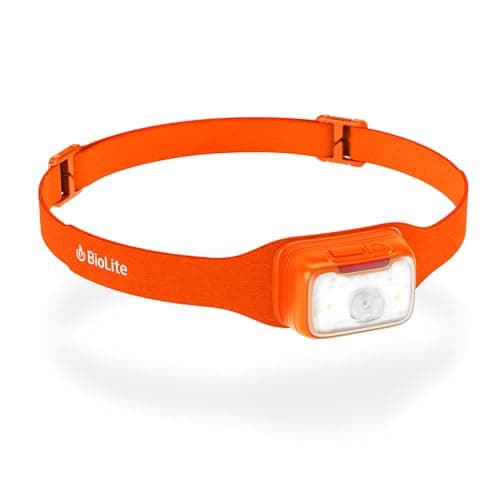
BioLite Range 500 Rechargeable Headlamp
Best for: Active hikers, trail runners, and campers who prioritize fit, comfort, and fast charging over raw lumen count.
- IP67 submersible waterproofing is among the best in class for this price range
- Red light is flood-only with no dimming, which limits usefulness for preserving night vision at close range
Kit Score 8.8/10 · $69.95 Price checked Oct 23, 6:22 AM CDT · how we score gear
Buy on AmazonProduct details
The Range 500 pairs 500 lumens and an IP67 submersible rating with BioLite's 3D SlimFit headband, which integrates the lamp body directly into the band so there is no separate mount bouncing against your forehead. Eight minutes on the charger adds a full hour of runtime, so a short top-up at camp is meaningful.
- Max output
- 500 lumens
- Beam distance
- 100 m (328 ft) spotlight
- Weight
- 2.6 oz (75 g)
- Battery
- Built-in 1634 mAh Li-ion rechargeable, USB-C fast charge
- IPX rating
- IP67 (submersible to 1 m)
- Red light mode
- Yes, red flood
More strengths
- USB-C fast charge adds 1 hour of run time in just 8 minutes, genuinely useful for quick camp top-ups
- 3D SlimFit no-bounce design is consistently praised as the most comfortable headlamp in owner reviews
Other tradeoffs
- Sealed non-removable battery means no AAA backup on longer wilderness trips
BioLite built the Range 500 around a problem most headlamps ignore: the band. The 360-degree moisture-wicking strap and low-profile battery placement mean the lamp does not bounce on a trail run or dig into your forehead on a long approach. That matters more than an extra 50 lumens once you are five miles in.
At 500 lumens and a 90-meter beam throw, the output numbers are strong. The 2-hour full charge via USB-C is the fastest in the group and useful on a hut-to-hut trip where you have one outlet and one hour. The red-light mode covers nighttime reading and navigation without killing your night vision.
The main trade-off is that its appeal rests heavily on the fit system. If the low-profile band does not solve a problem for you, the Spot 400-R is the more conventional choice.
Best ultralight
BEST ULTRALIGHT
Nitecore NU25 MCT UL Ultralight Headlamp
Best for: Ultralight backpackers and thru-hikers for whom every gram counts and who are comfortable with a nightly USB-C top-up.
- 50 g total weight including the bracket and headband makes it the lightest pick in this roundup
- Small 700 mAh battery limits manufacturer-rated high-mode runtime to 2 hours 40 minutes, so heavy users may need to recharge nightly
Kit Score 8.7/10 · Check current price · how we score gear
Buy at Nitecore StoreProduct details
At 50 g including its bracket and headband, the NU25 MCT UL is the lightest headlamp in this roundup, yet it still puts out 400 lumens and throws a beam 132 m. Three selectable color temperatures (warm 3000K, neutral 4500K, cool 6500K) make it versatile for close camp tasks and trail navigation.
- Max output
- 400 lumens
- Beam distance
- 132 m (433 ft)
- Weight
- 1.76 oz (50 g), including bracket and headband
- Battery
- Built-in 700 mAh Li-Po rechargeable, USB-C
- IPX rating
- IP66 (dust-tight, jet-water resistant)
- Red light mode
- Yes, red auxiliary LED
More strengths
- Three color temperatures (warm 3000K, neutral 4500K, cool 6500K) plus red light offer more output options than headlamps at three times the price
- USB-C charging and a 132 m beam distance that outreaches rivals with higher lumen claims
Other tradeoffs
- Thin shock-cord strap and small buttons can be frustrating to adjust and operate with winter gloves
The current Nitecore NU25 MCT UL weighs 50 g including its bracket and headband. It combines a 400-lumen ceiling with warm, neutral, and cool white modes, plus an auxiliary red light. That color-temperature choice is useful: warm light reduces glare in fog and rain, while cool light provides more apparent contrast on a clear trail.
The trade-offs are real: no removable battery tray, a 700 mAh internal battery, and IP66 protection rather than a submersion rating. Nitecore rates high mode at 2 hours 40 minutes and low at 13 hours. For a backpacker who can recharge from one of the ultralight power banks we compare, that may be enough. For remote winter travel, the Petzl's replaceable AAA fallback is easier to manage.
This placement is based on current manufacturer specifications and aggregated owner evidence, not a Kit Authority field test. Measured runtime, glove operation, and beam photographs will be added only after a first-party evaluation of the exact model.
Head-to-head comparison
| Product | Kit Score | Price | Best for |
|---|---|---|---|
| Black Diamond Spot 400-R Rechargeable Headlamp | 8.5 | $64.88 Price checked Oct 23, 6:22 AM CDT | Best for: All-purpose hikers and campers who want a dependable, waterproof rechargeable headlamp without overcomplicating the decision. Why it stands out: IP67 submersible rating exceeds most competitors at this price, handling full submersion to 1 m Tradeoff: Micro-USB charging port is outdated when rivals have moved to USB-C |
| BioLite Range 500 Rechargeable Headlamp | 8.8 | $69.95 Price checked Oct 23, 6:22 AM CDT | Best for: Active hikers, trail runners, and campers who prioritize fit, comfort, and fast charging over raw lumen count. Why it stands out: IP67 submersible waterproofing is among the best in class for this price range Tradeoff: Red light is flood-only with no dimming, which limits usefulness for preserving night vision at close range |
| Nitecore NU25 MCT UL Ultralight Headlamp | 8.7 | Check current price | Best for: Ultralight backpackers and thru-hikers for whom every gram counts and who are comfortable with a nightly USB-C top-up. Why it stands out: 50 g total weight including the bracket and headband makes it the lightest pick in this roundup Tradeoff: Small 700 mAh battery limits manufacturer-rated high-mode runtime to 2 hours 40 minutes, so heavy users may need to recharge nightly |
Black Diamond Spot 400-R Rechargeable Headlamp
- Best for
- All-purpose hikers and campers who want a dependable, waterproof rechargeable headlamp without overcomplicating the decision.
- Why it stands out
- IP67 submersible rating exceeds most competitors at this price, handling full submersion to 1 m
- Tradeoff
- Micro-USB charging port is outdated when rivals have moved to USB-C
BioLite Range 500 Rechargeable Headlamp
- Best for
- Active hikers, trail runners, and campers who prioritize fit, comfort, and fast charging over raw lumen count.
- Why it stands out
- IP67 submersible waterproofing is among the best in class for this price range
- Tradeoff
- Red light is flood-only with no dimming, which limits usefulness for preserving night vision at close range
Nitecore NU25 MCT UL Ultralight Headlamp
- Best for
- Ultralight backpackers and thru-hikers for whom every gram counts and who are comfortable with a nightly USB-C top-up.
- Why it stands out
- 50 g total weight including the bracket and headband makes it the lightest pick in this roundup
- Tradeoff
- Small 700 mAh battery limits manufacturer-rated high-mode runtime to 2 hours 40 minutes, so heavy users may need to recharge nightly
How to choose the right headlamp

Narrow your choice in four steps
Decide on battery type
Rechargeable-only is fine for most trips. If you travel to places without reliable power, pick the Petzl Actik Core 600 and its AAA fallback. Remote winter trips are the clearest case for hybrid power.
Match lumens to activity
200–400 lumens handles hiking, camping, and cooking. Trail running and technical climbing benefit from 400–600 lumens and a tighter beam. More lumens means shorter runtime on high mode; check the stated runtime at each level.
Weigh the complete setup
Ounces matter on a thru-hike; they matter less at a drive-in campsite. Compare the lamp, bracket, and headband together. The 50 g Nitecore is the lightest choice here, but a larger battery or replaceable-cell option can matter more on a long winter trip.
Check the IPX rating
IPX4 (splash-resistant) is the minimum for trail use. IPX6 handles heavy rain. IPX8 covers submersion. Coastal routes, river crossings, and wet-season hiking all benefit from IPX6 or better.
The right headlamp is the one you forget you are wearing until you need it.
Frequently asked questions
How many lumens do I need for hiking?
200–400 lumens is the practical range for most trail hikers. 200 lumens is enough for a maintained trail at a steady pace. 400 lumens handles rocky terrain, off-trail navigation, and faster movement. Above 400 lumens is mainly useful for technical climbing, scrambling, or trail running where you need to read terrain quickly at speed. Higher output also drains batteries faster, so more lumens is not always better. For campsite lighting rather than movement, the math changes: see how many lumens you need for camping for lantern and camp-task numbers.
What is the best headlamp for backpacking?
For most backpackers, the Black Diamond Spot 400-R is the balanced answer: 400 lumens, IPX8 protection, and USB-C charging. Gram-counters on established routes should consider the 50 g Nitecore NU25 MCT UL if nightly power-bank charging fits the trip. For trips longer than four or five nights without recharge access, the Petzl Actik Core 600's AAA fallback tray is the feature that matters most, because it converts any gas-station battery rack into a resupply point.
What should I look for when buying a headlamp?
Five specs decide most of the buying decision. Lumens: 200–400 covers hiking and camping. Beam distance: 60–90 meters is enough to read a trail junction at night. Battery: rechargeable lithium-ion for regular trips, a hybrid AAA option for expeditions. Water rating: IPX4 minimum, IPX6 or better for wet climates. Weight: 30–50 g for ultralight use, up to 100 g is fine for general hiking. Red-light mode and a lockout switch (which prevents the lamp turning on inside your pack) are the two small features owners most often say they would not give up.
Are rechargeable headlamps reliable in cold weather?
Lithium-ion batteries lose capacity in cold, typically 20–30 percent at 0 degrees Celsius versus room temperature. Rechargeable headlamps are still reliable in cold weather, but runtime will be shorter than rated. Keeping the headlamp inside your sleeping bag or jacket pocket until you need it mitigates most cold-weather loss. If you are planning extended winter use, the Petzl Actik Core 600's AAA fallback is the most direct solution: lithium AAA batteries hold capacity in cold far better than lithium-ion cells.
What is red-light mode and when should I use it?
Red-light mode emits red wavelength light instead of white. The human eye's rod cells, which handle low-light vision, are not sensitive to red light the way they are to white or blue light. Switching to red mode preserves night vision after your eyes have adjusted to the dark, which takes roughly 20–30 minutes to fully develop. Use it for reading a map, moving around camp at night, or any situation where you want to see without blinding your companions or resetting your own night vision.
Choosing a headlamp is a five-minute decision that pays off on every trip you take before sunrise or after dark. Any of these three can serve the right trip; the choice depends on how much you carry, where you go, and how often you can recharge.
Browse more gear picks on the hike hub, or learn more about how we research and rate every product on this site.
Keep going
Complete loadoutDay hike kitSeven slots for a full trail day, from the pack and water system to light and weather protection.Related guides

Our recommendations draw on manufacturer documentation, retailer listings, owner feedback, and comparisons with alternatives.
As an Amazon Associate I earn from qualifying purchases. We may earn a commission from links here, at no extra cost to you. How we research →