Your hiking boots are doing a hard job all day. The best thing you can do for your feet at camp is take them off, and what you slip into next matters more than most hikers expect.
Building out the rest of your footwear? The free outdoor shoe finder covers trail, walking, hiking, and water shoes too, in men's and women's models.
Our quick picks
How we picked
Every pick is scored on our Kit Score: packed weight and volume, sole grip on uneven campsite terrain, recovery properties (cushion type and arch support), warmth, and verified-owner satisfaction across multiple seasons of use. We aggregate manufacturer specs, podiatrist-cited research on foot recovery, and verified-owner reviews to separate genuine camp comfort from marketing copy.
The picks
Best overall
BEST OVERALL
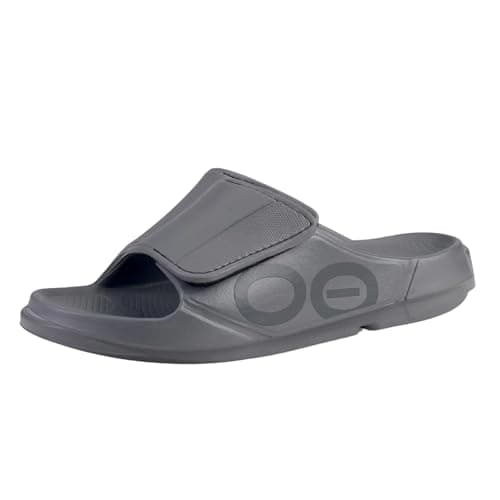
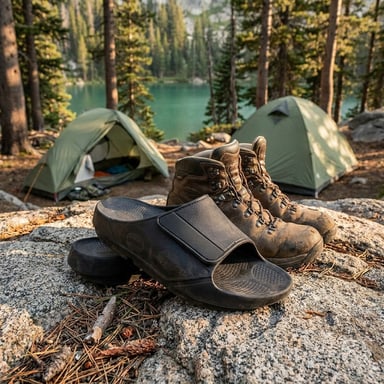
OOFOS OOahh Sport Flex Recovery Sandal
Best for: Backpackers and thru-hikers who prioritize genuine foot recovery at camp over minimum weight or grip.
- OOfoam delivers noticeably deeper cushioning and arch support compared to standard EVA slides, which owner reviews consistently flag as the defining difference after long hike days
- Outsole grip is modest on wet rock and loose gravel, limiting use beyond flat camp ground
Kit Score 8.4/10 · Check current price · how we score gear
Buy on AmazonProduct details
A purpose-built recovery slide with OOFOS' proprietary OOfoam footbed, which absorbs significantly more impact than standard EVA and reduces energy demand on ankles compared to conventional footwear. The adjustable strap improves fit range over the basic OOahh, making it a strong match for the end-of-day camp ritual of kicking off boots and letting tired feet recover.
- Weight (pair)
- 10.4 oz
- Upper
- Water-resistant rubber with adjustable Velcro strap
- Footbed
- OOfoam (absorbs 37% more impact vs traditional foam)
- Closure
- Slip-on with adjustable upper strap
- Machine washable
- Yes
- Unisex sizing
- Yes
More strengths
- Adjustable strap accommodates wider feet and swollen post-hike feet better than a fixed-band slide
- Machine washable and water-resistant: creek crossings and muddy campsites are not a problem
Other tradeoffs
- At ~$80 it costs noticeably more than Crocs for a shoe you carry purely as a camp extra
OOFOS built the OOahh Sport Flex around a proprietary foam compound called OOfoam, which the brand claims absorbs 37 percent more impact than standard EVA. Independent reviews and podiatrist sources consistently affirm that the arch geometry and rocker profile reduce stress on the plantar fascia and Achilles tendon compared to flat flip-flops or standard camp slides. That matters when you have covered 18 miles of rocky trail and your feet are reporting for overtime.
The Sport Flex variant adds a stretchy forefoot strap that adapts to foot swelling, which is a real concern after a long carry day. Weight is approximately 6 oz per pair depending on size, and the footprint packs flat into a pack side pocket or bags down to almost nothing.
Grip on camp terrain is adequate for flat to moderately uneven ground. These are not hiking sandals and the tread pattern will not save you on a slick granite slab in rain. Walk to the water source, walk to the bear box, do not sprint across a talus field.
At $75–$85 they are the most expensive slides here, and the case for the price is entirely in the foam technology. If foot recovery is a genuine priority after long days, the cost is easy to justify. If you are car camping once a summer and want a cheap slip-on, look at the Crocs below.
Best for: backpackers and thru-hikers who prioritize genuine foot recovery at camp over minimum weight or grip.
Best value
BEST VALUE
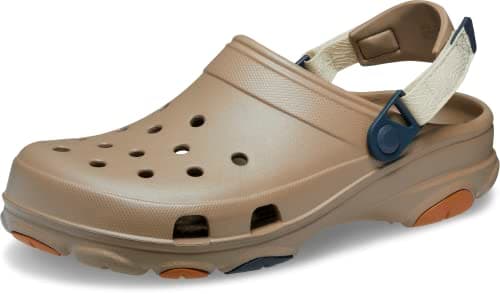
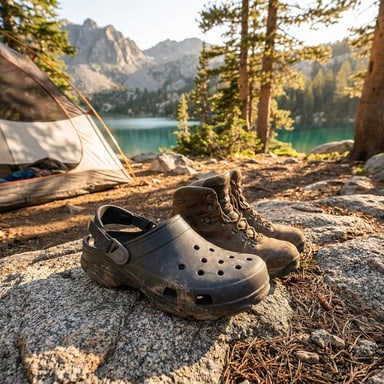
Crocs Classic All Terrain Clog
Best for: Hikers and campers who want a light, waterproof, packable shoe that doubles as a water shoe and does not break the gear budget.
- Lightest clog in class at around 10 oz per pair, with genuine all-terrain traction that the smooth-soled Classic Clog lacks
- Pivoting heel strap is either fully locked or fully in slide mode with no middle ground, and owner reviews note it can feel sloppy on uneven terrain
Kit Score 8.4/10 · Check current price · how we score gear
Buy on AmazonProduct details
The All-Terrain variant of the Classic Clog trades the smooth outsole for a lugged tread, making it a more capable around-camp shoe on dirt, gravel, and wet surfaces than the standard Crocs. Croslite foam keeps weight around 10 oz per pair while staying fully waterproof and easy to rinse clean.
- Weight (pair)
- ~10 oz
- Upper
- Croslite foam with ventilation ports
- Outsole
- Lugged all-terrain tread (vs smooth Classic sole)
- Heel strap
- Pivoting adjustable heel strap (locked or slide mode)
- Waterproof
- Yes, fully waterproof
- Unisex sizing
- Yes
More strengths
- Waterproof, drainage-ready, and wipeable: at camp after a stream crossing or a muddy approach, these need nothing more than a shake
- Retail price consistently in the $45-55 range makes this the lowest barrier to entry of any well-reviewed camp shoe
Other tradeoffs
- Croslite foam provides comfort but less arch support and impact absorption than purpose-built recovery foam like OOfoam
The Crocs Classic All Terrain Clog has earned a legitimate following in the backpacking community, and the reasons hold up. It is waterproof, which means it crosses a creek access trail without hesitation. The All Terrain outsole adds more aggressive tread than the standard Classic, giving it usable grip on gravel and uneven camp paths. And it costs $45–$55.
The closed-toe design protects against stubbed toes on rocks, tree roots, and tent stakes, which open-heel slides can never promise. The ventilation ports help in heat, though they let in water and pebbles on wet crossings. Croc's proprietary Croslite foam is lighter than it looks and genuinely cushioned.
Weight is higher than the OOFOS slide, typically around 10–11 oz per pair, and the boxy clog shape packs less efficiently than a flat slide. Most backpackers clip them to the outside of their pack or strap them under a hipbelt pocket rather than stuffing them inside.
The versatility case is real. In wet camp conditions, at a base with stream crossings, or on a backpacking trip that includes a water resupply wade, the Crocs do things the other slides here cannot.
Best for: hikers and campers who want a light, waterproof, packable shoe that doubles as a water shoe and does not break the gear budget.
Editor pick
EDITOR'S CHOICE
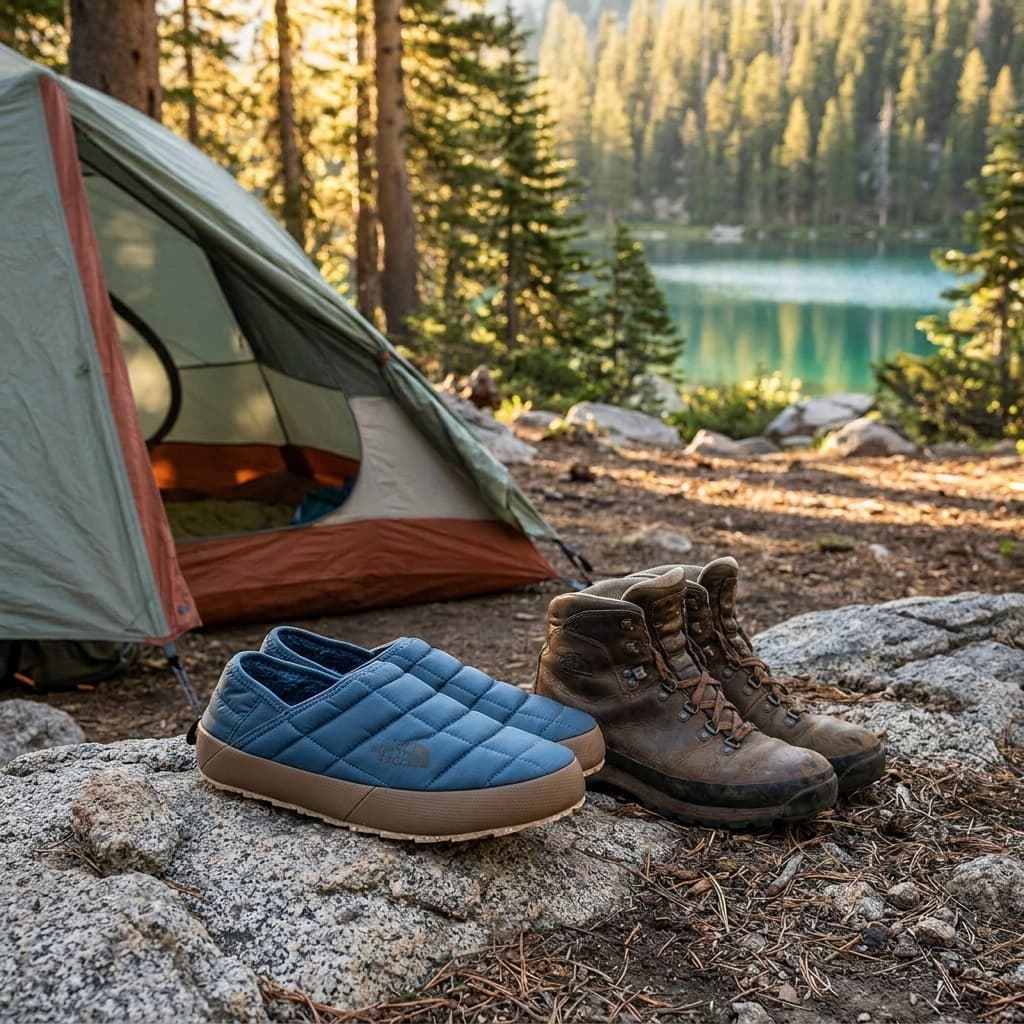
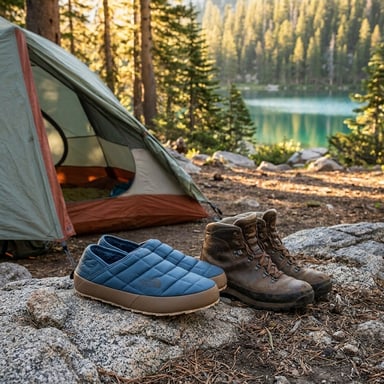
The North Face ThermoBall Traction Mule V
Best for: Three-season backpackers and alpine campers who expect cold mornings and evenings and want one shoe that handles both warmth and light camp walking.
- The only product in this group with real insulation: ThermoBall Eco loft keeps feet comfortable at temps where a slide or open clog becomes a poor choice at camp
- Fabric collar and ripstop upper stain readily and require spot-cleaning; not a rinse-and-go material like Croslite or rubber
Kit Score 7.8/10 · $70.00 Price checked Oct 23, 6:22 AM CDT · how we score gear
Buy on AmazonProduct details
A synthetic-insulated mule designed explicitly for the transition from trail to camp, with a DWR-treated ripstop upper, rubber outsole with real lug traction, and a collapsible heel for easy on/off. Unlike bare foam slides, it provides meaningful warmth in the 40-60 degree range that covers most three-season shoulder seasons in alpine and sub-alpine camps.
- Weight (pair)
- 14.2 oz
- Upper
- 100% recycled P.E.T. ripstop with DWR finish
- Insulation
- ThermoBall Eco synthetic loft
- Lining
- Oso fleece collar
- Outsole
- 40% recycled rubber with traction lug
- Heel
- Foldable with elastic side panels
More strengths
- Collapsible heel and elastic side panels make this genuinely fast to slip on after pulling off hiking boots, including with tired hands
- Rubber lug outsole handles dirt paths, roots, and gravel around camp better than any foam-only slide
Other tradeoffs
- Best comfort window is roughly 40-60 degrees Fahrenheit: feet overheat in summer camps and still get cold below freezing
The Editor's Choice goes to the North Face ThermoBall Traction Mule V because it solves the problem the other three picks do not: cold. ThermoBall synthetic insulation performs like 600-fill down even when damp, rated to approximately 20 degrees Fahrenheit in casual camp use. On an alpine start at 6 a.m. with frost on the fly, a recovery slide is not getting worn. The Mule V is.
The outsole is a full rubber Vibram sole, a genuine upgrade from the molded EVA on most camp shoes. It provides real traction on dewy grass, gravel, and the occasional quick trail walk to the permit box or the communal fire ring. The back strap folds under the sole for packing, which compresses the footprint meaningfully.
Total weight is higher than the slides, typically around 12–14 oz per pair, and the pair packs larger. This is the trade-off you accept for insulation. For three-season trips in the Sierra, the Rockies, or the Cascades where nighttime camp temps drop into the low 40s or below, that trade-off is straightforward.
At $65–$80, the ThermoBall Mule V sits at the mid-range of this roundup. For alpine backpackers, it earns its cost on every cold morning.
Best for: three-season backpackers and alpine campers who expect cold mornings and evenings and want one shoe that handles both warmth and light camp walking.
How they compare
| Product | Kit Score | Price | Best for |
|---|---|---|---|
| OOFOS OOahh Sport Flex Recovery Sandal | 8.4 | Check current price | Best for: Backpackers and thru-hikers who prioritize genuine foot recovery at camp over minimum weight or grip. Why it stands out: OOfoam delivers noticeably deeper cushioning and arch support compared to standard EVA slides, which owner reviews consistently flag as the defining difference after long hike days Tradeoff: Outsole grip is modest on wet rock and loose gravel, limiting use beyond flat camp ground |
| Crocs Classic All Terrain Clog | 8.4 | Check current price | Best for: Hikers and campers who want a light, waterproof, packable shoe that doubles as a water shoe and does not break the gear budget. Why it stands out: Lightest clog in class at around 10 oz per pair, with genuine all-terrain traction that the smooth-soled Classic Clog lacks Tradeoff: Pivoting heel strap is either fully locked or fully in slide mode with no middle ground, and owner reviews note it can feel sloppy on uneven terrain |
| The North Face ThermoBall Traction Mule V | 7.8 | $70.00 Price checked Oct 23, 6:22 AM CDT | Best for: Three-season backpackers and alpine campers who expect cold mornings and evenings and want one shoe that handles both warmth and light camp walking. Why it stands out: The only product in this group with real insulation: ThermoBall Eco loft keeps feet comfortable at temps where a slide or open clog becomes a poor choice at camp Tradeoff: Fabric collar and ripstop upper stain readily and require spot-cleaning; not a rinse-and-go material like Croslite or rubber |
OOFOS OOahh Sport Flex Recovery Sandal
- Best for
- Backpackers and thru-hikers who prioritize genuine foot recovery at camp over minimum weight or grip.
- Why it stands out
- OOfoam delivers noticeably deeper cushioning and arch support compared to standard EVA slides, which owner reviews consistently flag as the defining difference after long hike days
- Tradeoff
- Outsole grip is modest on wet rock and loose gravel, limiting use beyond flat camp ground
Crocs Classic All Terrain Clog
- Best for
- Hikers and campers who want a light, waterproof, packable shoe that doubles as a water shoe and does not break the gear budget.
- Why it stands out
- Lightest clog in class at around 10 oz per pair, with genuine all-terrain traction that the smooth-soled Classic Clog lacks
- Tradeoff
- Pivoting heel strap is either fully locked or fully in slide mode with no middle ground, and owner reviews note it can feel sloppy on uneven terrain
The North Face ThermoBall Traction Mule V
- Best for
- Three-season backpackers and alpine campers who expect cold mornings and evenings and want one shoe that handles both warmth and light camp walking.
- Why it stands out
- The only product in this group with real insulation: ThermoBall Eco loft keeps feet comfortable at temps where a slide or open clog becomes a poor choice at camp
- Tradeoff
- Fabric collar and ripstop upper stain readily and require spot-cleaning; not a rinse-and-go material like Croslite or rubber
How to choose the right camp shoe
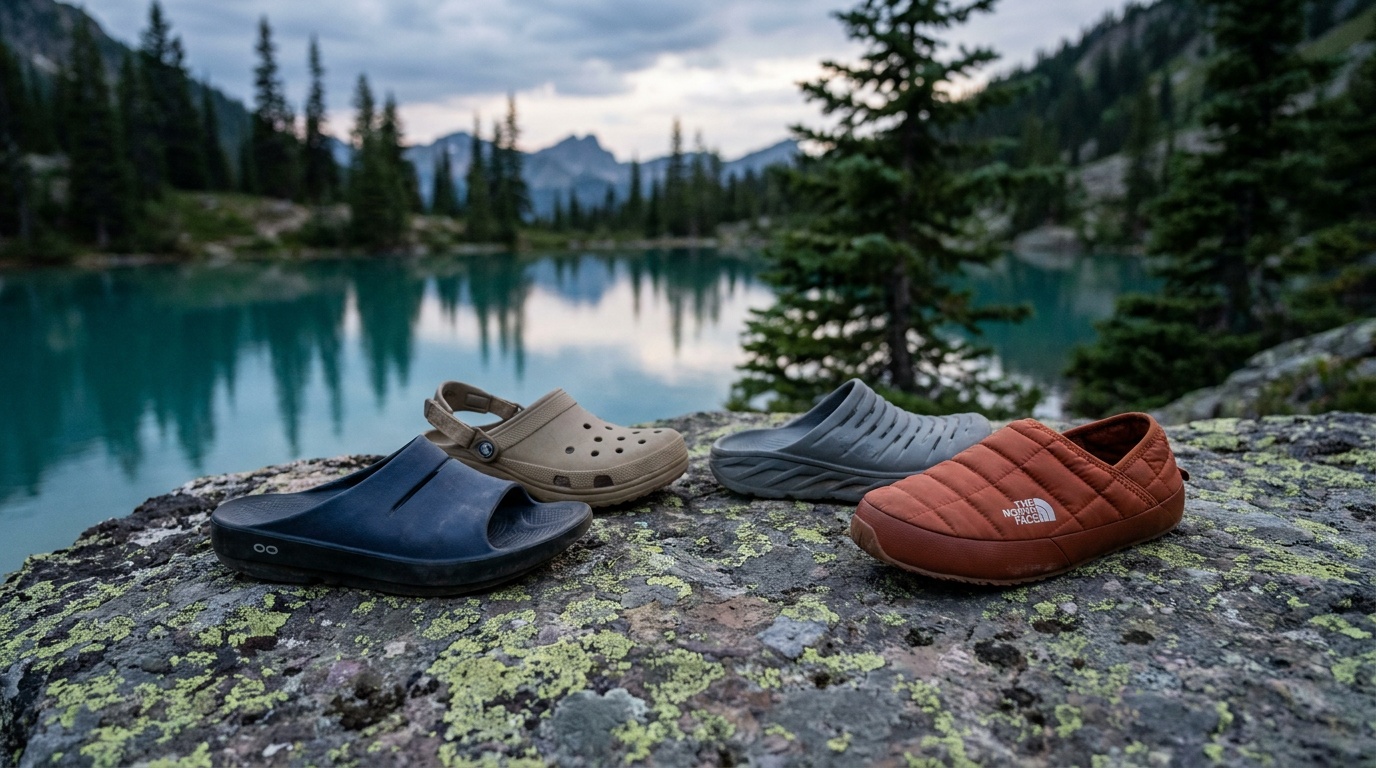
The wrong framework is asking which camp shoe is "best." The right question is which camp shoe matches your actual conditions. A thru-hiker in the desert and an alpine backpacker in September have opposite needs.
Four questions that narrow the choice
What are your camp temperatures?
If you regularly camp at elevation or in shoulder season where nighttime temps drop below 45 degrees Fahrenheit, insulation matters and the ThermoBall Mule is the pick. Slides are fine in summer conditions but punishing on cold mornings.
How far does the camp shoe actually walk?
A camp shoe that never leaves the tent vestibule can be a minimal slide. A camp shoe that walks to the water source, the vault toilet, and back through loose gravel in the dark needs real sole grip. The Crocs All Terrain and the ThermoBall Mule both handle that work.
Does weight and packed size matter on this trip?
The OOFOS slide packs flat and light. The Crocs clog and the ThermoBall Mule are bulkier. For a sub-20-lb ultralight kit, the slides win. For a car camping trip where the pack weight is irrelevant, bring what you prefer.
Do you have any foot issues?
Plantar fasciitis, Achilles tendinopathy, or general forefoot soreness after long days are legitimate reasons to pay more for better recovery foam. The OOFOS OOfoam and the HOKA dual-density EVA both address this better than generic slides or flat-soled clogs.
The best camp shoe is not the lightest one in the lineup: it is the one you actually bother to carry.
Frequently asked questions
Do I actually need camp shoes for backpacking?
Not every trip, but more trips than most hikers expect. After a long day, your feet benefit from being in a wide, cushioned shoe rather than remaining jammed in a hiking boot for another two hours. A recovery slide also reduces trailhead-to-trail contamination risk by keeping your hiking boots out of the camp footprint. For trips longer than two nights, the comfort and recovery benefit typically outweigh the weight cost of 6–12 oz.
Can I use camp shoes as water shoes for creek crossings?
The Crocs Classic All Terrain is well-suited for creek crossings: waterproof, drains quickly, and the All Terrain sole has enough grip for submerged rock. The OOFOS and HOKA slides are not designed for submersion and drain poorly. The ThermoBall Mule's insulation becomes a liability when wet and should not be used for crossings. If your route involves regular water crossings, the Crocs pulls double duty better than anything else in this roundup.
How much weight do camp shoes add to a backpacking kit?
The OOFOS OOahh Sport Flex runs around 6 oz. Crocs Classic All Terrain clogs are closer to 10–11 oz depending on size. The ThermoBall Mule V is 12–14 oz. For most backpackers, 6–10 oz is a reasonable budget for a genuine comfort upgrade that improves sleep quality and reduces cumulative foot fatigue over a multi-day trip.
A good camp shoe costs less than a single resupply box and fixes one of the most common sources of genuine misery on a long trip. Any of these four will earn their weight. The right one depends on your temperatures, your terrain, and how much you care about recovery versus minimum weight.
Browse more footwear picks and gear guides on the hike hub, or read more about how we research and rate every product on this site.
Keep going
Related guides
 Complete hike loadoutDay hike kitBuild the complete kit
Our recommendations draw on manufacturer documentation, retailer listings, owner feedback, and comparisons with alternatives.
As an Amazon Associate I earn from qualifying purchases. We may earn a commission from links here, at no extra cost to you. How we research →