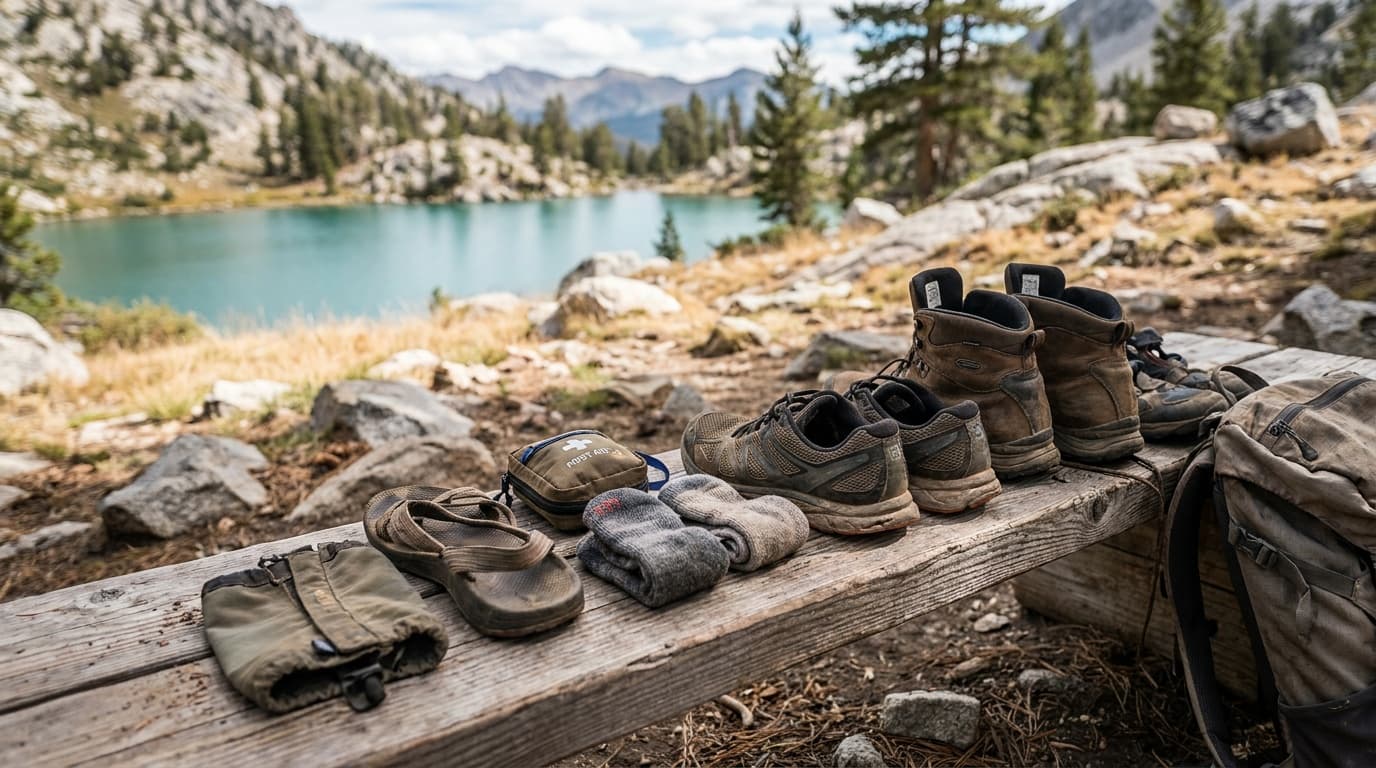
The footwear you pick shapes your entire day on trail, and the sandal-vs-shoe debate has a real answer once you know your terrain, load, and temperature.
Where sandals have a clear edge
On a hot day, a closed hiking shoe traps heat and sweat. Trail runners and leather hikers routinely raise internal foot temperature 5–8 °F above ambient inside a synthetic upper, which speeds blister formation on long days. Sandals eliminate that problem entirely: airflow keeps skin dry, and blisters caused by wet fabric rubbing disappear.
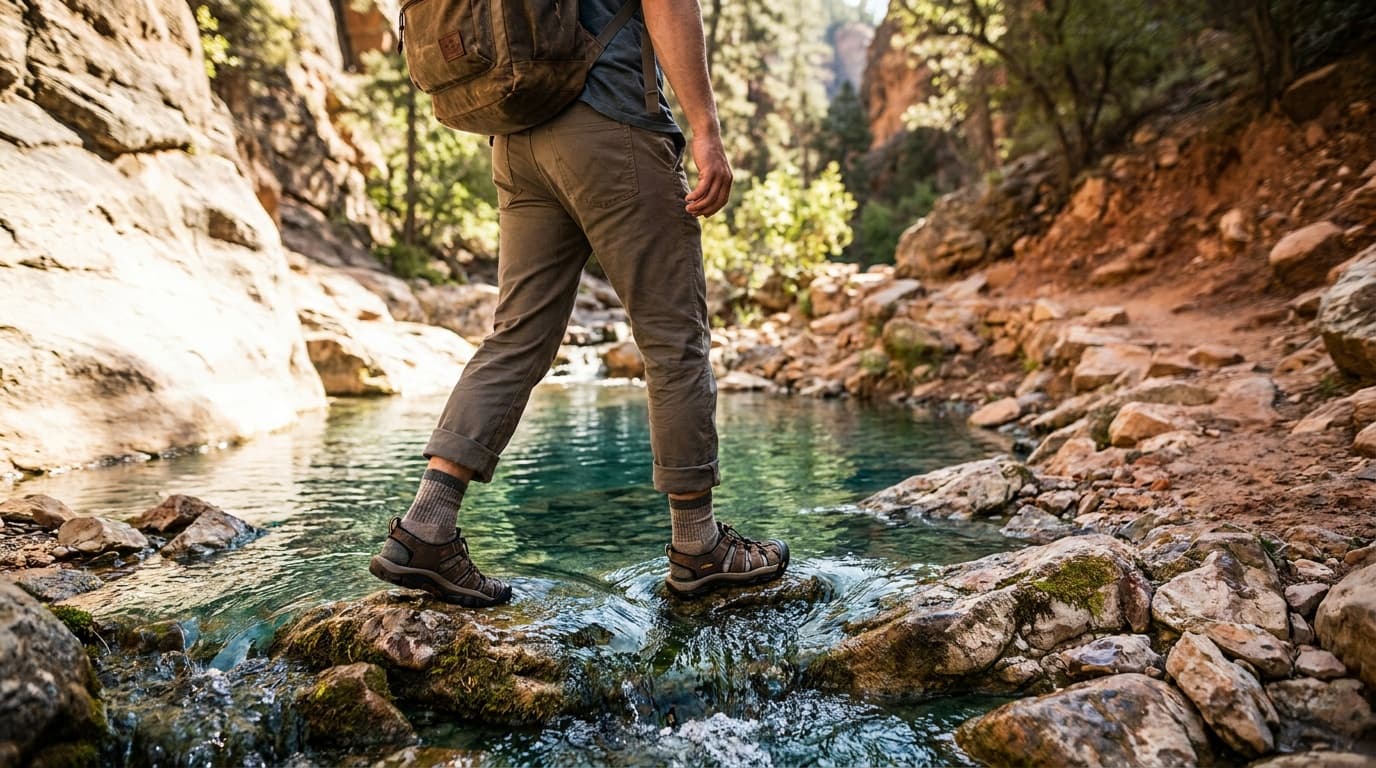
Water crossings are the other standout case. A waterproof shoe that gets submerged stays wet for hours, softening skin and raising blister risk for the miles that follow. A sandal drains in seconds and is fully functional again in under a minute. On canyon routes with dozens of crossings, that difference compounds into significant comfort and safety.
Where shoes have a clear edge
Protection is non-negotiable when the trail gets technical. A rigid or semi-rigid shoe wraps the foot in a protective shell that deflects rocks, roots, and sharp debris. Stubbing an unprotected toe on a granite block at mile 8 ends trips. Shoes also provide meaningful ankle structure: this matters most under load, when a 30 lb pack shifts your center of gravity and turns a small misstep into a rolled ankle.
Cold and wet conditions reverse the sandal advantage entirely. Below about 50 °F, exposed feet lose heat faster than movement generates it, and wet sandal straps accelerate that heat loss. Snow, mud, and scree also pack into open sandal footbeds, turning traction into a liability.
When to reach for shoes instead
Heavy pack
Anything over 20 lb shifts load stress onto the forefoot; closed-toe shoes distribute it better and reduce fatigue.
Technical terrain
Talus, scrambling, and narrow ridgelines need lateral stability and toe protection that sandals cannot match.
Cold temperatures
Below 50 °F, an open foot loses heat faster than effort replaces it, increasing cramping and fatigue risk.
Long mileage
Beyond 10–12 miles, the cumulative impact of debris ingress and reduced arch support in most sandals adds up.
Wet mud or snow
Sandal lugs fill with mud and compact; shoe outsoles self-clean and retain grip.
The blister and debris problem
Sandals eliminate sock-friction blisters but introduce strap-friction blisters in new locations, typically across the top of the foot and between the toes. The fix is to break sandals in on short walks before any multi-hour hike, and to wear them sockless only once the fit is confirmed.
Debris ingress is the other sandal tax on rocky trails. Every pebble that lands in a sandal footbed is a friction point. On clean paths this is a minor annoyance. On gravel or crushed granite, it becomes a regular maintenance stop every mile. If you find yourself stopping to shake debris more than once per hour, a low-cut trail runner like the Saucony Peregrine 16 would serve better.
A sandal is not a compromise shoe; it is the right tool for the conditions it was designed for, and the wrong one when those conditions change.
Temperature and season guidance
The practical temperature window for sandals runs from roughly 60 °F to 95 °F at trail level. Below 60 °F, most hikers find that heat loss at the foot outpaces the ventilation benefit. Above 95 °F, the heat protection of a sandal becomes significant and worth accepting the debris trade-off.
Season translates roughly as follows: sandals work well from late spring through early fall in most of the continental US, with a longer window in desert Southwest terrain (March through November for many routes). Spring shoulder season in the mountains typically means lingering snowpack and cold creek water, both of which favor shoes even on warm afternoons.
Who should pick which
Choose sandals if: you are day hiking in warm weather on well-maintained trail, your pack is under 10–15 lb, the route has creek crossings, or heat and humidity are the primary comfort concern.
Choose shoes if: you are carrying a full backpacking load, the terrain is rocky or rooted, temperatures are below 60 °F, or the trail has significant elevation with loose footing.
Choose both if: you are section-hiking or thru-hiking in mixed terrain. Many long-trail hikers carry a pair of sport sandals like the Teva Hurricane XLT2 as a secondary shoe for camp and water crossings, pairing them with trail runners for the miles that demand more structure.
Durability: which lasts longer?
On total lifespan, a quality sport sandal usually outlasts a trail shoe. Sandals have fewer parts to break down: the failure points are the straps, the buckles, and eventually the outsole, and brands like Chaco and KEEN offer resole or repair programs that can carry a single pair past 1,000 miles. A trail runner, by contrast, loses its cushioning to foam compression in roughly 300 to 500 miles even when the upper still looks new, and that midsole is not repairable.
The honest comparison depends on how you count. Per calendar year of occasional warm-weather use, the sandal is the more durable buy. Per hard trail mile on technical terrain, a shoe protects your foot better while it lasts, and its replaceable-by-repurchase cushioning is the point rather than a weakness. Neither wins durability in a way that outranks fit: a sandal that shreds your skin at mile 6 has failed you faster than any worn-out midsole.
Frequently asked questions
Can I wear hiking sandals with a heavy backpack?
Generally no. Above about 20 lb, the forces on your forefoot and arch during descent increase sharply. Most sport sandals lack the midsole stiffness and heel cup depth to manage that load comfortably over distance. A lightweight trail runner or low-cut boot is a better call once your pack crosses that threshold.
Are hiking sandals good for blister-prone hikers?
It depends on the blister cause. If your blisters come from hot, damp sock-to-skin friction inside a closed shoe, sandals worn sockless will likely eliminate the problem. If your blisters come from poor fit or excessive mileage, switching to sandals relocates the problem rather than solving it. Break any new sandal in gradually and confirm strap fit before committing to a long day.
What sandal features actually matter on trail?
Three things: lug depth of at least 3 mm for traction on loose surfaces, a toe post or toe loop that keeps the footbed from sliding forward on descents, and adjustable straps that let you lock the heel in place. A rubber rand or bumper over the toes adds meaningful protection without closing off airflow; the closed-toe KEEN Newport H2 takes this idea furthest. Avoid fashion sandals with flat EVA soles and no heel retention on anything beyond a paved path.
Are hiking sandals suitable for hiking trails?
Yes, on the right trails. Hiking sandals are well suited to warm, dry, and moderate trails: desert washes, groomed paths, and routes with frequent water crossings. They are not suitable for technical terrain with talus, roots, or scrambling, for loads over about 20 lb, or for temperatures below roughly 60 F, where toe protection, ankle support, and warmth matter more than ventilation. A closed-toe sport sandal with 3 mm lugs and locked heel straps handles far more trail than a flat fashion sandal.
Are hiking sandals or hiking shoes more durable?
A quality sport sandal usually lasts longer in calendar terms, because its failure points are repairable straps and outsoles, and brands like Chaco and KEEN resole them past 1,000 miles. A trail shoe loses non-repairable midsole cushioning in about 300 to 500 miles. On hard technical mileage a shoe protects the foot better while it lasts, so the right way to read durability is by use: sandals for occasional warm-weather trips, shoes when high mileage or rough terrain is the point.
Are hiking sandals good for river crossings? The pros and cons.
For water crossings, sandals are the better tool. The pros: they drain and are fully functional again in under a minute, they will not trap water against your skin the way a submerged shoe does for hours, and they eliminate the soaked-sock blistering that follows a wet shoe crossing. The cons: open footbeds let grit and small stones in on the gravel between crossings, straps can chafe wet skin until broken in, and below about 60 F the exposed foot loses heat fast. On a canyon route with dozens of crossings the sandal wins clearly; on a single cold creek at altitude, waterproof shoes or a quick barefoot crossing may serve better.
For specific picks, see our guide to the best hiking sandals. Browse all hike guides or read how we research and rate gear.
Recommended gear
Our current top picks from the Best hiking sandals in 2026: 4 picks for trails and water guide, if you are ready to buy.
KEEN
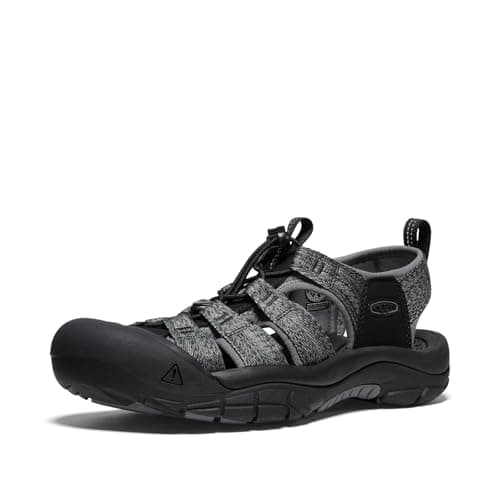
KEEN Newport H2 Closed-Toe Water Sandal
Best Overall
Kit Score 8.4/10
$94.10 Price checked Oct 24, 5:42 AM CDT
Best for: Hikers who want shoe-level toe protection on river trails, slot canyons, and creek crossings without giving up sandal breathability on the approach.
- Exceptional toe protection for rocky terrain and water crossings where open sandals leave feet exposed
- Heavier than open-toe alternatives at roughly 1 lb 10 oz per pair, which some hikers feel on longer miles
- Toe protection
- Full rubber toe cap
- Weight
- 13.4 oz (men's US 9)
- Outsole
- Non-marking carbon rubber, razor-siped, 4.1mm lug depth
- Closure
- Bungee lace with cinch lock + hook-and-loop heel strap
- Footbed
- Metatomical EVA with arch support, wide platform
- Quick-dry
- Polyester webbing upper with quick-dry lining
About this pick
The Newport H2 is KEEN's flagship closed-toe sandal: a rubber toe cap that rivals hiking boot protection, a bungee lace that cinches instantly at a water crossing, and a metatomical footbed that owners describe as day-one comfortable. Over 30,000 Amazon ratings and a consistent 4.6-star average confirm its place as the go-to closed-toe option for river trails and rocky day hikes.
Strengths
- Exceptional toe protection for rocky terrain and water crossings where open sandals leave feet exposed
- Razor-siped carbon rubber outsole grips wet dock boards and mossy river rocks reliably
- Roomy toe box and wide platform make it workable for wide feet without sizing up
Weaknesses
- Heavier than open-toe alternatives at roughly 1 lb 10 oz per pair, which some hikers feel on longer miles
- Enclosed upper traps debris like sand and gravel; requires removal to shake out on dusty trails
Kit Score breakdown
TEVA
Teva Men's Hurricane XLT2 Sport Sandal
Best Value
Kit Score 8.4/10
$33.71 Price checked Oct 24, 5:42 AM CDT
Best for: Summer day hikers, river trail travelers, and multi-sport adventurers who want a proven open-toe sandal with genuine traction at a sub-$80 price point.
- Three independently adjustable straps deliver a secure, customized fit that rivals sandals costing twice as much
- Open toe design offers no protection against trail rocks or roots, a meaningful tradeoff on technical terrain
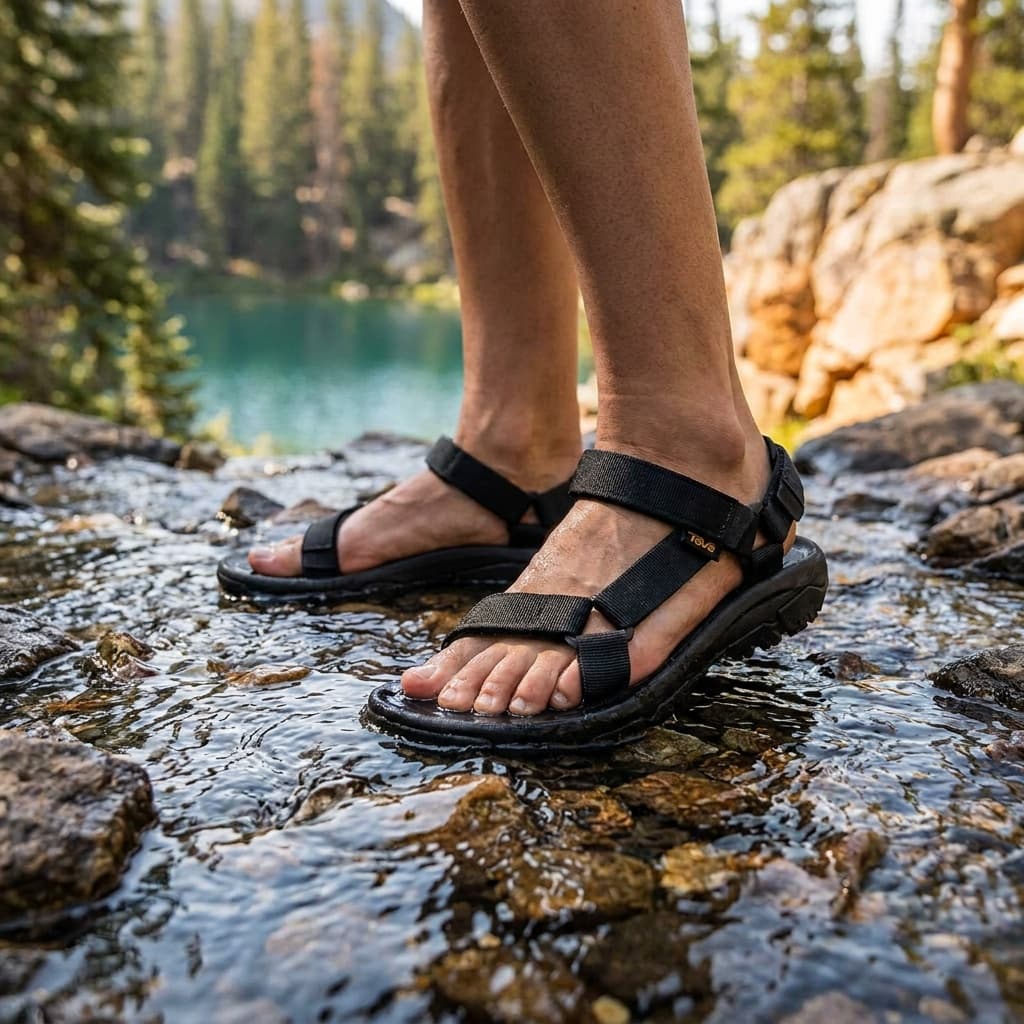
- Weight
- 10.7 oz (men's US 9)
- Outsole
- Durabrasion rubber, multidirectional lug pattern, 3.5mm lug depth
- Midsole
- Speckled EVA, 30.9mm heel stack
- Closure
- Three fully adjustable hook-and-loop straps
- Footbed
- Contoured EVA with cupped heel and raised arch
- Sustainability
- Straps made from 100% REPREVE recycled polyester
About this pick
The Hurricane XLT2 consistently earns the top value slot in multi-source roundups: three fully adjustable straps, a speckled EVA midsole, and Durabrasion rubber that holds grip on wet rocks, all for around $60–$70. It sits at 4.5 stars with over 5,700 Amazon ratings and has earned Best Buy recognition from Outdoor Gear Lab across multiple seasons of testing.
Strengths
- Three independently adjustable straps deliver a secure, customized fit that rivals sandals costing twice as much
- Durabrasion rubber outsole grips reliably on wet rocks and loose gravel without requiring break-in
- Quick-dry construction and 10.7 oz weight make it a strong choice for travel packing and river trail days
Weaknesses
- Open toe design offers no protection against trail rocks or roots, a meaningful tradeoff on technical terrain
- Velcro straps can loosen incrementally over a long day and may not suit users needing very high arch support
Kit Score breakdown
CHACO
Chaco Men's Z/2 Classic Sandal
Editor's Choice
Kit Score 8.8/10
$52.22 Price checked Oct 24, 5:42 AM CDT
Best for: Hikers who prioritize lasting arch support and want a sandal built to outlive multiple seasons of river trails, backpacking, and summer travel.
- LUVSEAT footbed provides structured arch support that owners with plantar fasciitis and high arches consistently single out
- Heavier than most competitors at around 1 lb 4 oz per sandal, which adds up on fast-paced or longer mileage days
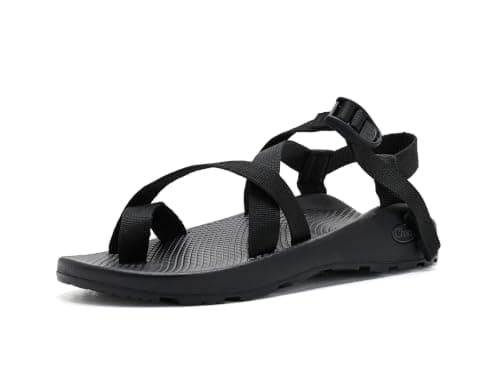
- Outsole
- ChacoGrip rubber, diamond lug pattern, 3.5mm lug depth, non-marking
- Footbed
- LUVSEAT polyurethane midsole, podiatrist-certified arch support
- Weight
- Approx. 1 lb 4 oz per sandal (men's size 9)
- Strap system
- Single continuous adjustable webbing with toe loop (the Z/2 toe post)
- Materials
- Polyester jacquard webbing, 100% vegan construction
- Repairability
- Sole resoleable; Chaco offers re-webbing service
About this pick
The Z/2 Classic has earned its cult following through durability that owners report lasting well past 1,000 miles and a LUVSEAT footbed that carries podiatrist certification for arch support. The toe loop adds forefoot control that open-strap sandals lack, and ChacoGrip rubber maintains traction in wet and dry conditions across rocky river terrain.
Strengths
- LUVSEAT footbed provides structured arch support that owners with plantar fasciitis and high arches consistently single out
- Resoleable and re-webbable construction means the sandal can outlast two or three replacement cycles, lowering cost over time
- ChacoGrip outsole and toe-loop combination delivers confident grip and forefoot control on wet river boulders
Weaknesses
- Heavier than most competitors at around 1 lb 4 oz per sandal, which adds up on fast-paced or longer mileage days
- The single continuous webbing system requires patience to dial in; new owners often need a full trip to nail the fit
Kit Score breakdown
See all picks in Best hiking sandals in 2026: 4 picks for trails and water
Keep going
Related guides
 Complete hike loadoutDay hike kitBuild the complete kit
Researched, not hands-on tested
Updated Jul 7, 2026Our recommendations draw on manufacturer documentation, retailer listings, owner feedback, and comparisons with alternatives.
As an Amazon Associate I earn from qualifying purchases. We may earn a commission from links here, at no extra cost to you. How we research →