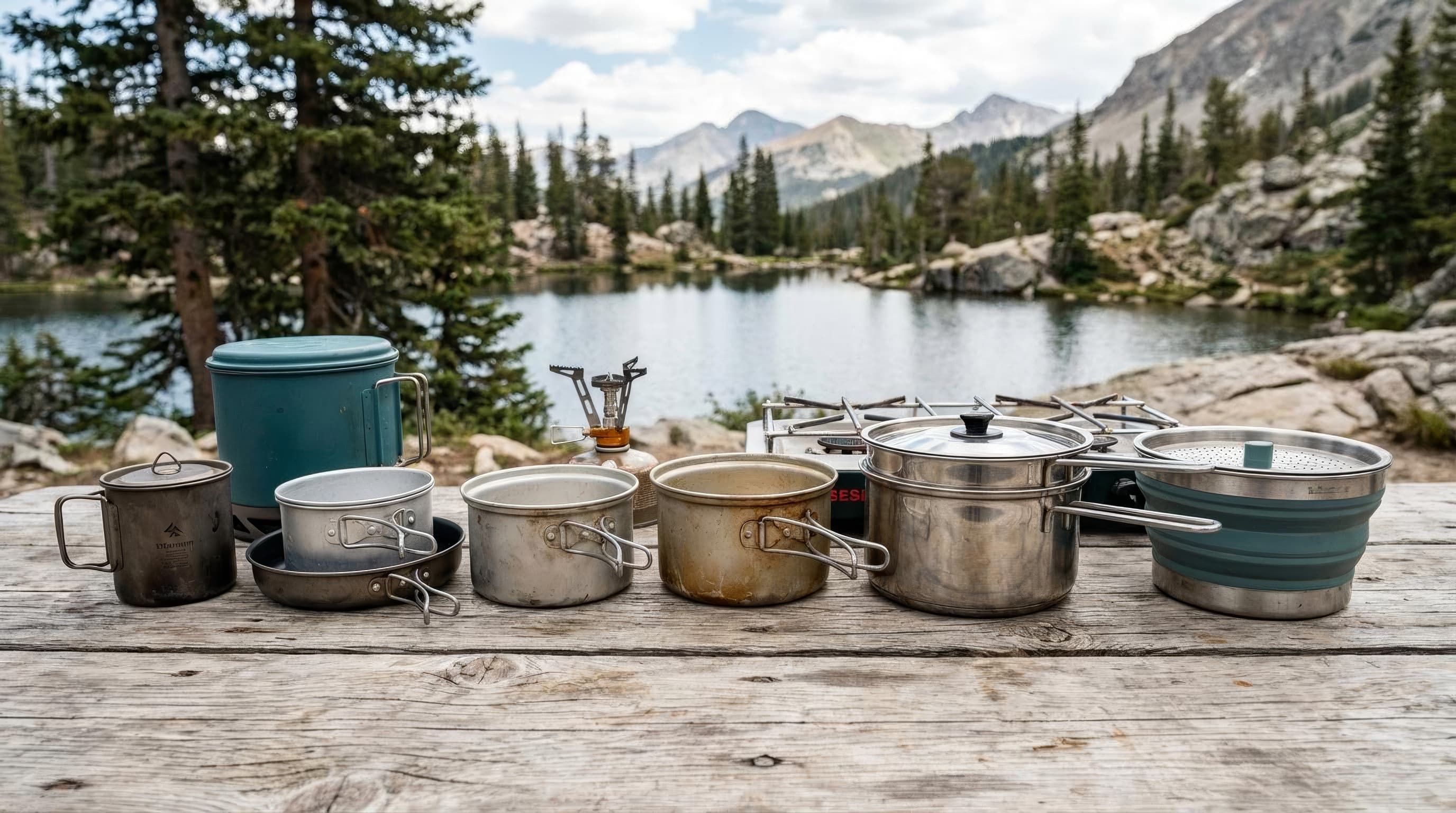
The Stanley Wildfare Core 26-Piece Camp Kitchen is the best camping cookware set for most people: a 4 qt stainless pot, an 8 inch tri-ply fry pan, prep tools, and four table settings nest into one 4.70 lb bundle, and it costs less than most premium coated sets. Independent testers agree: CleverHiker ranks it the best camping cookware overall, and Outdoor Gear Lab names it the best value cookset for groups. The other seven picks cover the jobs it cannot do: backpacking, cooking over a campfire, ultralight solo trips, a tight budget, nonstick cleanup, and van storage. All eight were in stock on Amazon, sold by Amazon or the brand's own store, when we checked on October 3, 2026.
Our quick picks
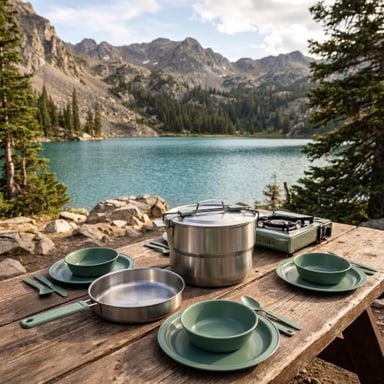
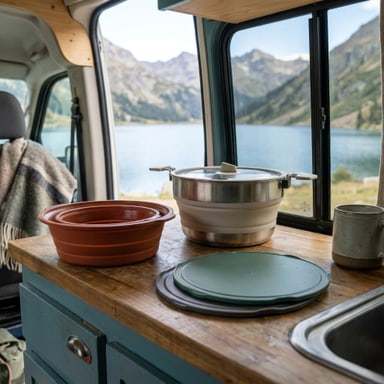
Best overall: Stanley Wildfare Core 26-Piece Camp Kitchen
BEST OVERALL
Stanley Wildfare Core 26-Piece Camp Kitchen
Best for: Families and groups who want a durable, complete car-camping kitchen for less than most premium coated sets.
- One purchase covers prep, cooking, serving, and tableware for four
- At 4.70 lb it belongs near a vehicle, not in a backpack
Kit Score 8.8/10 · Check current price · how we score gear
Buy on AmazonProduct details
A 26-piece stainless car-camping kitchen with a 4 qt pot, tri-ply fry pan, prep tools, and four complete table settings that nest into one durable package.
- Material
- 18/8 stainless steel and BPA-free tableware
- Weight
- 4.70 lb
- Packed size
- 8.52 x 10.65 x 6.14 in
- Cookware
- 4 qt pot and 8 in tri-ply fry pan
- Pieces
- 26
- Group size
- 4 people
More strengths
- Stainless steel tolerates metal utensils and more aggressive cleaning
- Tri-ply fry pan is more useful for browning than a thin stamped camp pan
Other tradeoffs
- The full set is excessive for couples who cook simple one-pot meals
Most people searching for camping cookware are stocking a car-camping kitchen, and this is the set that does that job completely without a premium price. The 4 qt (3.78 L) pot handles pasta, soup, or water for four; the 8 inch tri-ply fry pan gives you a real browning surface; and the rest of the 26 pieces cover prep, serving, and one table setting per person. Everything packs into a bundle about 8.5 by 10.7 by 6.1 inches.
The cookware is 18/8 stainless rather than coated aluminum. It weighs 4.70 lb and takes more technique with sticky food, but it tolerates hard scrubbing and metal utensils. Stanley's archived product page lists the set as induction compatible and dishwasher safe, useful when the same kit moves between a campsite, van, cabin, and home.
The independent verdict is consistent. CleverHiker puts it first among the ten sets it cooked with, and Outdoor Gear Lab calls it its best value cookset for groups. Outdoor Gear Lab's main complaint is the plastic tableware, which it describes as small and somewhat flimsy. The steel pot and pan are the part you are paying for.
Read the Stanley Wildfare Core review.
Best for: Families and groups of up to four who cook near the car and want one durable kit that covers cooking, serving, and eating.
Best premium set for four: GSI Pinnacle Ceramic Camper
BEST PREMIUM SET
GSI Outdoors Pinnacle Ceramic Camper Cookware Set
Best for: Car campers, paddlers, and van travelers who want a full four-person cook-and-eat system in one bag.
- One of the most comprehensive nesting camp kitchen sets available: pots, pan, and full dinnerware for four in one carry
- At 3.6 lbs it is car-camping gear, not a set to carry on your back
Kit Score 8.1/10 · $199.95 Price checked Oct 24, 3:33 PM CDT · how we score gear
Buy on AmazonProduct details
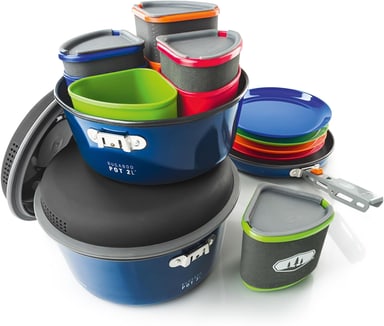
The Pinnacle Ceramic Camper is a complete kitchen-to-table system for groups of four, built around a ceramic-coated hard-anodized aluminum pot and pan set that nests with plates, bowls, and mugs into a single tight bundle.
- Material
- Hard-anodized aluminum, ceramic nonstick coating
- Weight
- 3.6 lbs (58.1 oz)
- Packed dimensions
- 9.1 x 9.1 x 5.8 in
- Capacity
- 3L pot, 2L pot, 9-inch frying pan
- Pieces
- 2 strainer pots, frypan, 4 plates, 4 bowls (14 oz), 4 mugs (14 oz) with sip-it lids, folding handle, welded stuff sack/wash basin
- Serves
- 2 to 4 people
More strengths
- Ceramic nonstick handles real cooking (eggs, fish, grains) with minimal sticking and simple cleanup
- Hard-anodized construction distributes heat evenly, reducing scorching on camp stoves with small burner heads
Other tradeoffs
- The ceramic coating requires plastic utensils to stay intact long-term
The Pinnacle Ceramic Camper replaces a kitchen bin. A 3 L pot, a 2 L pot, a 9 inch frying pan, a strainer lid, four plates, four bowls, four insulated mugs, and a removable handle nest into a 9.1 inch wide package. The carry sack becomes a wash basin, so the system handles cooking, eating, and cleanup for four.
Hard-anodized aluminum spreads a concentrated camp-stove flame better than thin stainless or titanium, and the ceramic surface makes eggs, grains, and sauces easier to release than the Stanley's bare steel. That convenience asks for discipline: use wood, silicone, or plastic utensils; avoid heating an empty pan on high; and skip abrasive pads.
GSI lists the Pinnacle Ceramic Camper at 9.1 by 9.1 by 5.8 inches and 3.63 lb, with four 14 oz mugs, four 14 oz bowls, and four plates in the nest. That is about a pound lighter than the Stanley for a set with two pots instead of one. It costs roughly twice as much, so buy it when four people will actually use the tableware and the lighter weight matters, such as on a canoe trip.
Read the GSI Pinnacle Ceramic Camper review.
Best for: Four-person car camps, paddling trips, and base camps where nonstick cooking and a lighter nest are worth paying for.
Best for backpacking: GSI Outdoors Halulite Dualist HS
BEST FOR BACKPACKING
GSI Outdoors Halulite Dualist HS
Best for: Two backpackers who share a stove and want fast boils, complete tableware, and a tidy nested system.
- Complete tableware for two nests with the pot rather than occupying separate pack space
- No frying pan is included
Kit Score 8.6/10 · $99.95 Price checked Oct 24, 3:33 PM CDT · how we score gear
Buy on AmazonProduct details
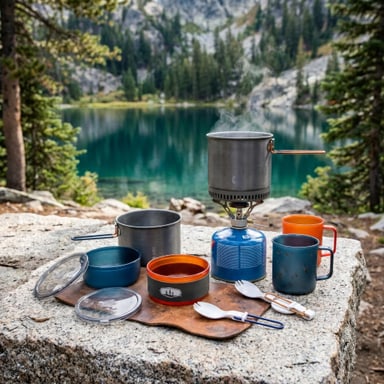
A two-person hard-anodized aluminum cook-and-eat system with a 1.8 L heat-exchanger pot, insulated mugs, bowls, folding sporks, and a sink bag packed into one compact cylinder.
- Material
- Hard-anodized aluminum
- Weight
- 23.1 oz (654 g)
- Packed size
- 6.2 x 5.8 x 5.9 in
- Pot capacity
- 1.8 L
- Included
- Pot, strainer lid, 2 mugs/bowls, 2 lids, 2 sporks, sink bag
- Group size
- 2 people
More strengths
- Heat-exchanger base is designed to reduce boil time and fuel use by about 30 percent
- Hard-anodized aluminum spreads heat better than a thin titanium pot for simple one-pot meals
Other tradeoffs
- Heavier and more expensive than a minimalist solo pot
Backpacker's current favorite pot set overall, the Halulite Dualist HS packs a 1.8 L heat-exchanger pot, two 20 fl oz bowls, two insulated 20 fl oz mugs with sip-it tops, two folding sporks, and a strainer lid into a 23.1 oz cylinder. The welded carry bag becomes a small wash basin, and a compact stove and fuel canister still fit inside.
The heat exchanger under the pot is the reason to choose it over a plain pot. GSI says the design heats 30 percent faster, saving both time and fuel. That describes the design, not a guaranteed boil time in wind, but the direction matters on a multi-day trip: less heat escapes around the pot, so a shared canister goes farther.
There is no flat pan, and a deep pot is not a substitute for one. If dinner means browning food, the MSR set below gives you a second pot, and the car-camping sets above add a pan.
Read the GSI Halulite Dualist HS review.
Best for: Two backpackers who share a canister stove and want the whole cook-and-eat system in one predictable space.
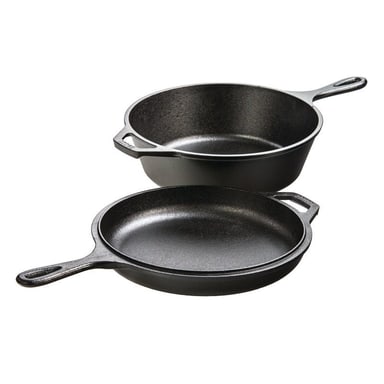
Best cast iron: Lodge 3.2 Quart Cast Iron Combo Cooker
BEST CAST IRON
Lodge 3.2 Quart Cast Iron Combo Cooker
Best for: Car campers who cook over a campfire or grill and want one pot and one skillet that will last decades.
- Lodge rates it for any stovetop, oven, grill, or campfire, so it handles open flame that coated sets cannot
- About 13 lb, so it is strictly car-camping or cabin cookware
Kit Score 8.7/10 · $59.90 Price checked Oct 24, 3:33 PM CDT · how we score gear
Buy on AmazonProduct details
A two-piece cast iron set from Lodge: a 3.2 qt deep pot and a 10.25 in skillet that flips over to become its lid. It goes straight onto a campfire grate or coals, sears and fries better than thin camp cookware, and doubles as a dutch oven for stews and bread.
- Material
- Cast iron, seasoned with vegetable oil
- Capacity
- 3.2 qt deep pot
- Skillet
- 10.25 in, doubles as the pot lid
- Weight
- 12.85 lb (Lodge)
- Size
- 16.56 x 10.5 x 4.56 in with handles, stacked
- Heat sources
- Any stovetop including induction, oven, grill, campfire
More strengths
- The skillet lid gives you a real frying pan and a lidded pot from one purchase
- No nonstick coating to wear out; the seasoning improves with use
Other tradeoffs
- Needs hand washing, drying, and oiling after every trip to prevent rust
Every other pick here is built for a stove. The Lodge Combo Cooker is the one to put directly on a campfire grate or a bed of coals. It is two pieces of cast iron: a 3.2 qt deep pot and a 10.25 inch skillet that flips over to become the pot's lid. Together they work as a small dutch oven for chili, stew, or bread; apart, you have a frying pan and a pot on the fire at once. Lodge rates it for any stovetop, including induction, plus oven, grill, or campfire.
Testers rate it the same way. Outdoor Gear Lab names it the best campfire-safe cookware it reviewed, and CleverHiker picks it as its best open-flame option. Cast iron holds heat evenly enough for real searing, and with no coating there is nothing for flames or a metal spatula to damage.
The trade is weight and care. Lodge lists it at 12.85 lb, and Outdoor Gear Lab calls the weight its biggest drawback. Lodge's care routine is hand wash, dry, and oil, every time, or it rusts. Pair it with a lighter pot for boiling water, and keep it in the vehicle.
Best for: Car campers who cook over a fire or grill and want a pot and skillet that should outlast everything else in the camp kitchen.
Best titanium ultralight: Snow Peak Trek 900 Titanium
BEST ULTRALIGHT
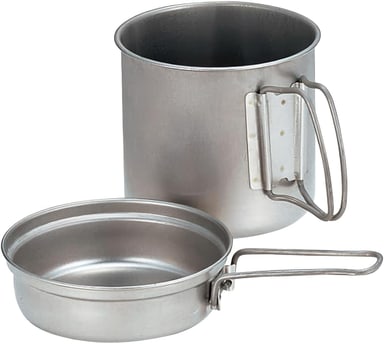
Snow Peak Trek 900 Titanium Cookset
Best for: Solo backpackers and ultralight hikers who prioritize the lowest possible carried weight and want cookware that lasts decades.
- At 6.2 oz for the full set, weight savings over stainless or aluminum are significant on multi-day trips
- No nonstick coating means food sticks more than on anodized or ceramic alternatives
Kit Score 8.8/10 · $54.95 Price checked Oct 24, 3:33 PM CDT · how we score gear
Buy on AmazonProduct details
Snow Peak's Trek 900 is a two-piece Japanese titanium pot-and-pan set that weighs a fraction of stainless alternatives while offering corrosion immunity and a lifetime durability guarantee. It is sized for one serious cook or two on simple meals.
- Material
- Japanese titanium (no coating)
- Weight
- (no change requested) note: Snow Peak's spec table did not render to fetch; 6.2 oz matches retailer and Amazon listings
- Capacity
- 30.4 fl oz (900ml) pot; 5-inch frying pan lid
- Packed dimensions
- Pot: 4.75 x 4.25 in; pan: 5 x 1.5 in
- Pieces
- Titanium pot, titanium frypan (doubles as lid), mesh stuff sack
- Fuel canister fit
- Stores 250g canister and GigaPower stove inside when packed
More strengths
- Titanium is inert: no metallic taste, no rust, no coating to chip or degrade over time
- Nests a stove and 250g canister inside for a clean single-unit kit
Other tradeoffs
- The frying pan is 5 inches across, which limits it to a lid or heating small portions rather than full cooking tasks
The Trek 900 is a 900 mL (30.4 fl oz) titanium pot and a shallow lid that doubles as a tiny fry pan, listed together at 6.2 oz (175 g). Snow Peak says the pot stows a 250 g fuel canister and a GigaPower stove, which keeps a solo cooking system in one quiet, rattle-free package.
Titanium earns its price when carried weight matters more than even heating. It is strong, corrosion resistant, and has no coating to scratch. It also spreads heat poorly across its base, so a narrow stove flame creates a hot spot. For boiling water, that barely matters. For simmering oatmeal or rice, lower the flame and stir.
The lid-pan is 5 inches across and 1.5 inches deep per the listing: enough to warm a tortilla or a small egg, not a reason to buy the set. Buy the Trek 900 for one durable pot that boils enough water for a meal and a hot drink while staying close to six ounces.
Read the Snow Peak Trek 900 review.
Best for: Solo hikers whose meals start with boiling water and whose gear has to justify every ounce.
Best budget: Stanley Wildfare Go Two Bowl Prep & Cook Set
BEST BUDGET
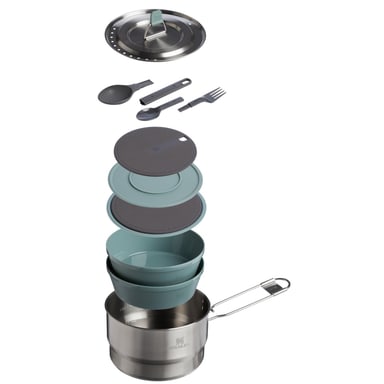
Stanley Wildfare Go Two Bowl Prep & Cook Set (14-Piece)
Best for: Couples who want a cheap, durable, complete cook-and-eat set for car camping, road trips, or short hikes.
- Everything two people need to cook and eat a simple meal nests inside one 6.26 in wide pot
- No frying pan, and a 1.65 qt pot is small for more than two
Kit Score 8.2/10 · $45.00 Price checked Oct 24, 3:33 PM CDT · how we score gear
Buy on AmazonProduct details
A 14-piece stainless cook-and-eat set for two from Stanley: a 1.65 qt saucepan with a fold-and-lock handle and a vented strainer lid, with two 16 oz bowls, two cutting boards that double as trivets, sporks, and a spatula nested inside. Stanley lists it as induction compatible and dishwasher safe.
- Material
- 18/8 stainless steel pot, BPA-free bowls and boards
- Pot capacity
- 1.65 qt (1.5 L)
- Included
- Saucepan, vented strainer lid, 2 cutting boards with trivets, 2 x 16 oz bowls, 2 sporks, spatula
- Weight
- 1.78 lb (Outdoor Gear Lab measured)
- Packed size
- 6.26 x 6.26 x 4.02 in
- Group size
- 2 people
More strengths
- Stainless steel tolerates metal utensils and hard scrubbing
- Induction compatible and dishwasher safe, so it doubles as apartment or travel cookware
Other tradeoffs
- Stainless steel is heavier and sticks more than coated aluminum on a backpacking stove
This is the cheapest way in this guide to cook and eat for two from one nest. Inside the 1.65 qt (1.5 L) stainless saucepan you get a vented strainer lid, two 16 oz bowls, two cutting boards with removable silicone trivets, two sporks, and a spatula. Stanley lists it as 18/8 stainless steel, induction compatible, and dishwasher safe, and the whole set packs to 6.26 by 6.26 by 4.02 inches.
Outdoor Gear Lab weighed it at 1.78 lb and calls it a great budget-friendly option for front-country cooking that is sufficient for two. That is the honest scope: a one-pot set for couples on car-camping weekends, road trips, or short hikes, not a family kitchen. There is no fry pan, and a 1.5 L pot limits you to pasta, soup, or rice for two.
Best for: Couples who want a cheap, durable, complete cook-and-eat set and mostly make one-pot meals.
Best nonstick: MSR Ceramic 2-Pot Set
BEST NONSTICK
MSR Ceramic 2-Pot Set
Best for: Two or three campers who prepare real meals and want low weight without giving up a second pot.
- Two capacities let a cook prepare a main and side without carrying a full dinnerware system
- Ceramic coating requires soft utensils and careful heat management
Kit Score 8.3/10 · $94.95 Price checked Oct 24, 3:33 PM CDT · how we score gear
Buy on AmazonProduct details
Two useful ceramic-coated aluminum pots, 2.5 L and 1.5 L, share a strainer lid and removable handle in a 15.6 oz nested package for meals beyond boiling water.
- Material
- Hard-anodized aluminum with ceramic nonstick
- Weight
- 15.6 oz (443 g)
- Packed size
- 7.2 x 7.7 x 5 in
- Capacity
- 2.5 L and 1.5 L pots
- Included
- 2 pots, strainer lid, Talon handle
- Coating
- PTFE- and PFOA-free ceramic
More strengths
- Ceramic surface makes rice, eggs, and sauces easier to release and clean
- At 15.6 oz, the set is unusually light for four liters of combined capacity
Other tradeoffs
- No frying pan, bowls, or eating utensils are included
MSR leaves out the bowls and plates and spends the weight on two useful pots. The 2.5 L pot handles a shared main; the 1.5 L pot handles a side, sauce, or hot drinks. Both nest with one strainer lid and a removable Talon handle for a listed 15.6 oz. Outdoor Life names it the best nonstick camping cookware, and it ranks third of eleven in Outdoor Gear Lab's test, which praises its nonstick performance.
The ceramic surface releases starch and sauce far more easily than bare titanium or stainless, and aluminum spreads a small burner flame across more of the base. MSR lists the coating as PTFE- and PFOA-free and the packed size at 7.2 by 7.7 by 5 inches.
The coating is consumable. Use a moderate flame, never heat a pot empty, and keep metal tools away. You will also need your own bowls and utensils. If that sounds fussy, the Stanley sets are the durable alternative.
Read the MSR Ceramic 2-Pot Set review.
Best for: Two or three campers making pasta, rice, curries, and eggs who want easy cleanup without carrying a family kitchen.
Best space-saving: Sea to Summit Detour Essentials Camp Kitchen
BEST SPACE-SAVING
Sea to Summit Detour Essentials Camp Kitchen
Best for: Van, overland, and compact car-camping kitchens where storage volume matters more than purchase price.
- Five-liter capacity collapses to a shallow stack that fits compact vehicle kitchens
- The highest price in this guide
Kit Score 8.4/10 · $168.95 Price checked Oct 24, 3:33 PM CDT · how we score gear
Buy on AmazonProduct details
A premium vehicle-camping kit built around a collapsible 5 L stainless-and-silicone pot, matching colander, and two cutting boards that pack to a three-inch-high stack.
- Material
- 304 stainless steel and food-grade silicone
- Weight
- 59.3 oz (1,681 g)
- Packed size
- 11 x 10 x 3 in
- Pot capacity
- 5 L
- Included
- Collapsible pot, colander, 2 cutting boards
- Cooktops
- Gas, radiant, and induction
More strengths
- Three-ply stainless base works on gas, radiant, and induction cooktops
- Click-Safe handles lock for transport and cooking
Other tradeoffs
- At 59.3 oz, the design saves volume rather than carried weight
The Detour solves cubic volume, not weight. Its 5 L pot and colander use rigid 304 stainless bases with collapsible silicone walls, then stack with two cutting boards into a package three inches high. A large pot that disappears into a shallow drawer is unusually valuable in a van, teardrop trailer, or packed family car. Outdoor Life picks it as the best collapsible camping cookware.
Sea to Summit lists the kit at 59.3 oz and 11 by 10 by 3 inches packed. The three-ply base works on gas, radiant, and induction heat, and Click-Safe handles lock during transport and cooking. The rigid base carries the heat and the load, so this is not soft silicone balanced over a flame.
It is one of the more expensive sets here and includes no fry pan or table settings. Buy it because a conventional five-liter stockpot eats the exact cabinet space you cannot spare.
Read the Sea to Summit Detour kitchen kit review.
Best for: Van life, overlanding, and compact vehicle kitchens where a big pot must pack almost flat.
Side-by-side comparison
| Spec | Stanley Wildfare Core | GSI Pinnacle Camper | GSI Halulite Dualist HS | Lodge Combo Cooker | Snow Peak Trek 900 | Stanley Wildfare Go | MSR Ceramic 2-Pot | Sea to Summit Detour |
|---|---|---|---|---|---|---|---|---|
| Kit Score | 8.8/10 | 8.1/10 | 8.6/10 | 8.7/10 | 8.8/10 | 8.2/10 | 8.3/10 | 8.4/10 |
| Price | Check current price | $199.95 Price checked Oct 24, 3:33 PM CDT | $99.95 Price checked Oct 24, 3:33 PM CDT | $59.90 Price checked Oct 24, 3:33 PM CDT | $54.95 Price checked Oct 24, 3:33 PM CDT | $45.00 Price checked Oct 24, 3:33 PM CDT | $94.95 Price checked Oct 24, 3:33 PM CDT | $168.95 Price checked Oct 24, 3:33 PM CDT |
| Best for | Families and groups who want a durable, complete car-camping kitchen for less than most premium coated sets. | Car campers, paddlers, and van travelers who want a full four-person cook-and-eat system in one bag. | Two backpackers who share a stove and want fast boils, complete tableware, and a tidy nested system. | Car campers who cook over a campfire or grill and want one pot and one skillet that will last decades. | Solo backpackers and ultralight hikers who prioritize the lowest possible carried weight and want cookware that lasts decades. | Couples who want a cheap, durable, complete cook-and-eat set for car camping, road trips, or short hikes. | Two or three campers who prepare real meals and want low weight without giving up a second pot. | Van, overland, and compact car-camping kitchens where storage volume matters more than purchase price. |
| Why it stands out | One purchase covers prep, cooking, serving, and tableware for four | One of the most comprehensive nesting camp kitchen sets available: pots, pan, and full dinnerware for four in one carry | Complete tableware for two nests with the pot rather than occupying separate pack space | Lodge rates it for any stovetop, oven, grill, or campfire, so it handles open flame that coated sets cannot | At 6.2 oz for the full set, weight savings over stainless or aluminum are significant on multi-day trips | Everything two people need to cook and eat a simple meal nests inside one 6.26 in wide pot | Two capacities let a cook prepare a main and side without carrying a full dinnerware system | Five-liter capacity collapses to a shallow stack that fits compact vehicle kitchens |
| Tradeoff | At 4.70 lb it belongs near a vehicle, not in a backpack | At 3.6 lbs it is car-camping gear, not a set to carry on your back | No frying pan is included | About 13 lb, so it is strictly car-camping or cabin cookware | No nonstick coating means food sticks more than on anodized or ceramic alternatives | No frying pan, and a 1.65 qt pot is small for more than two | Ceramic coating requires soft utensils and careful heat management | The highest price in this guide |
| Material | 18/8 stainless, tri-ply pan | Ceramic-coated hard-anodized aluminum | Hard-anodized aluminum | Seasoned cast iron | Titanium | 18/8 stainless | Ceramic-coated aluminum | Stainless base, silicone walls |
| Cookware | 4 qt pot, 8 in fry pan | 3 L and 2 L pots, 9 in pan | 1.8 L pot | 3.2 qt pot, 10.25 in skillet | 900 mL pot, lid-pan | 1.65 qt saucepan | 2.5 L and 1.5 L pots | 5 L pot, colander |
| Serves | 4 | 4 | 2 | 2 to 4 | 1 | 2 | 2 to 3 | 2 to 4 |
| Weight | 4.70 lb | 3.63 lb | 23.1 oz | 12.85 lb | 6.2 oz | 1.78 lb (measured by Outdoor Gear Lab) | 15.6 oz | 59.3 oz |
| Tableware | 4 settings | 4 plates, bowls, mugs | 2 bowls, 2 mugs | None | None | 2 bowls | None | None |
| Campfire rating | Not listed | Not listed | Not listed | Yes (Lodge) | Not listed | Not listed | Not listed | Not listed |
| Induction | Yes (Stanley) | Not listed | Not listed | Yes (Lodge) | Not listed | Yes (Stanley) | Not listed | Yes (Sea to Summit) |
"Not listed" means the maker's page we read does not rate the set for that heat source; it is not a claim that it will fail. Follow the instructions that ship with your exact set.
How to choose camping cookware
Material: match it to the meal
- Stainless steel (Stanley sets) is the durable car-camping material. It tolerates metal utensils, hard scrubbing, and dishwashers, but food sticks unless you preheat and use oil.
- Hard-anodized aluminum (GSI Halulite) spreads heat better than steel or titanium at a fraction of the weight, which suits one-pot backpacking meals.
- Ceramic nonstick (MSR, GSI Pinnacle) makes eggs, rice, and sauces easy to clean, in exchange for soft utensils and moderate heat for the life of the coating.
- Titanium (Snow Peak) is the lightest and toughest, and the worst at spreading heat. It is a boiling-water material.
- Cast iron (Lodge) is the campfire material: even heat, no coating, heavy, and it rusts if you put it away wet.
The full tradeoff is in titanium vs aluminum camping cookware.
Capacity: size the pot by person
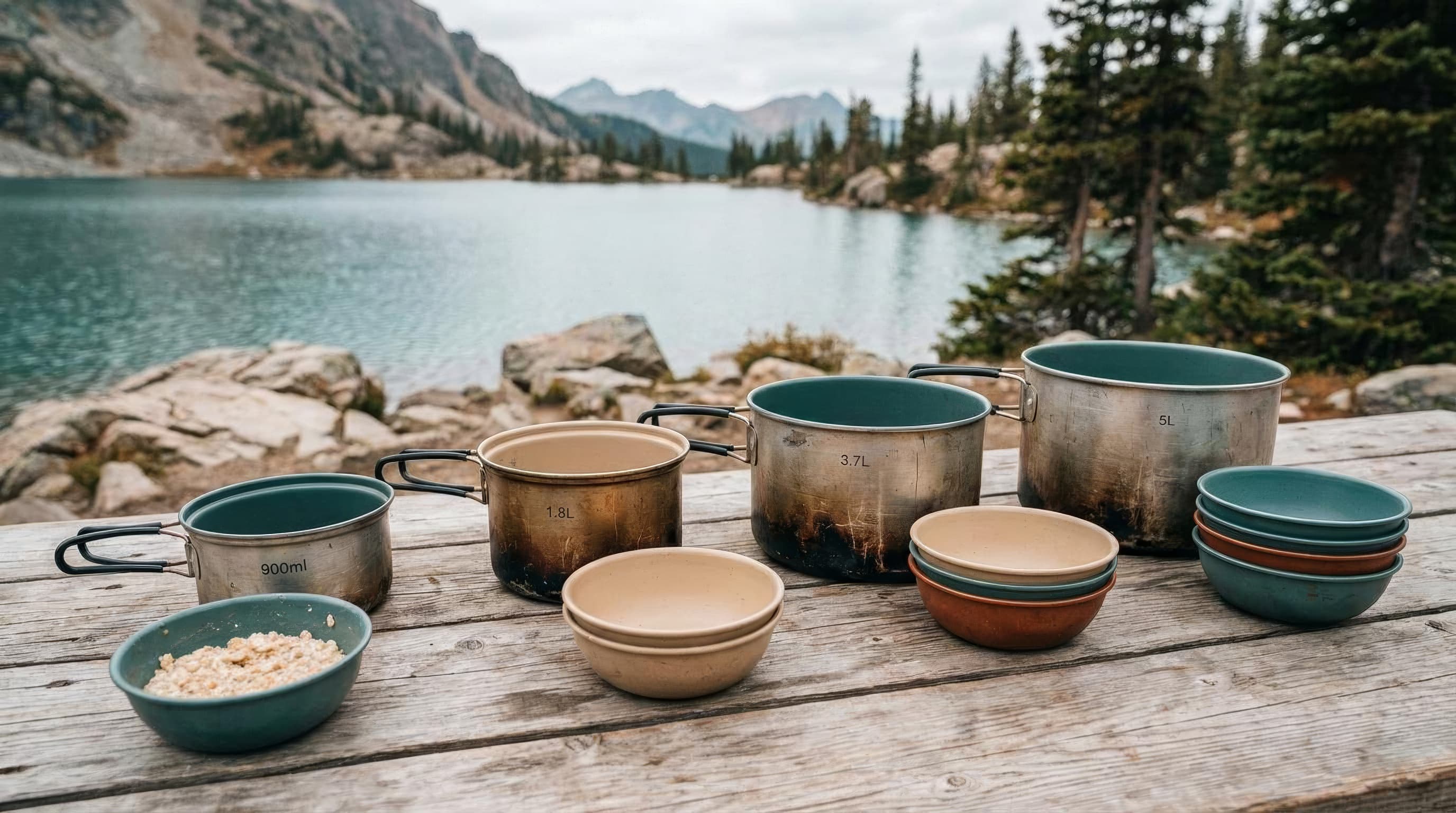
Start around 0.75 to 1 L for one person, 1.5 to 2 L for two, and at least 3 L for a group of three or four. Add room for pasta, rice, or melting snow, which need water to move. That is why the Trek 900 is a solo pot, the Halulite and Wildfare Go are two-person sets, and the Stanley Core, Pinnacle, and Detour are the group options. Menus and extra water are covered in what size camping pot do you need.
Weight: decide how far the cookware travels
If the cookware never goes farther than the picnic table, weight barely matters, and the 12.85 lb Lodge is fine. If it rides in a pack, compare the whole cook-and-eat system: the Halulite Dualist HS carries a pot plus tableware for two at 23.1 oz, while the Trek 900 carries one pot at 6.2 oz.
Nesting: count the pieces you will use
A nested set only saves space if you use what is inside it. A backpacker who eats from the pot needs no plate. A family serving four may value one set that accounts for every bowl. Check the packed dimensions against the bin, drawer, or pack pocket that will actually hold the set, and check whether your stove and fuel canister fit inside, as they do in the Halulite and the Trek 900.
Stove compatibility: check the base and the heat source
Small, light pots belong on canister stoves; wide pots and fry pans want a two-burner camp stove whose grate supports them. The Lodge is the only pick whose maker page we read rates it for a campfire. Coated aluminum and silicone-walled cookware are built for controlled stove flames, and open flames can damage handles and coatings. If you also cook at home on induction, the Stanley sets, the Lodge, and the Detour are listed as induction compatible. Match the cookware to your stove with our best camping stoves guide.
How we picked
Each set is scored through the Kit Score: fit for its stated job, owner sentiment, build quality, and value. We built the shortlist from independent test results at Outdoor Gear Lab, CleverHiker, Outdoor Life, and Backpacker, then checked each pick's capacities, weights, materials, included parts, care guidance, and approved heat sources against the maker's own product page. We confirmed every Amazon listing, its seller, and its stock through Amazon's Creators API on October 3, 2026.
We did not cook with these sets ourselves. Where a figure is a tester's measurement rather than a maker spec, such as Outdoor Gear Lab's 1.78 lb weight for the Wildfare Go, it says so. The eight picks cover eight different purchase decisions rather than eight near-identical pots, and ratings reflect the job each product claims: we do not mark a 13 lb cast iron set down for failing at backpacking.
Frequently asked questions
What is the best camping cookware for most people?
The Stanley Wildfare Core 26-Piece Camp Kitchen. Its 4 qt stainless pot, 8 inch tri-ply fry pan, prep tools, and four table settings nest into one 4.70 lb kit, and CleverHiker ranks it the best camping cookware overall. Backpackers should look at the GSI Halulite Dualist HS instead, and campfire cooks at the Lodge Combo Cooker.
What is the best cookware for cooking over a campfire?
Cast iron. The Lodge 3.2 Quart Combo Cooker is the pick here because Lodge rates it for campfires, grills, ovens, and any stovetop, and testers at Outdoor Gear Lab and CleverHiker both choose it for open-flame cooking. Most coated aluminum and silicone-walled camp cookware is designed for stove flames only, so check the maker's instructions before putting any other set on a fire.
Is titanium or aluminum better for camping cookware?
Titanium is better when minimum carried weight and durability matter more than cooking finesse. Aluminum spreads heat more evenly, costs less, and is more forgiving for real meals. Choose titanium for boiling water on solo backpacking trips and hard-anodized aluminum for shared or mixed-menu trips.
Is nonstick camping cookware worth it?
Yes, if you cook eggs, rice, pasta, or sauces and want fast cleanup with little water. The tradeoff is care: ceramic coatings like the MSR and GSI Pinnacle need soft utensils, moderate heat, and no empty preheating. If you want cookware you can scrub with anything, choose stainless steel like the Stanley sets.
How big should a camping pot be?
Roughly 0.75 to 1 L for one person, 1.5 to 2 L for two, and at least 3 L for a group of three or four. Add capacity for pasta, rice, snow melting, or meals that must be stirred without spilling. A large pot only helps if it fits your stove, your pack, or your storage bin.
Do I need a camping cookware set with plates and utensils?
Only when the nested system saves space or saves you assembling those pieces separately. A backpacker who eats from the pot needs no plate. A family serving four may value one set that accounts for every bowl and utensil. Count the pieces you will actually use before paying for a high piece count.
Where these numbers come from
| Claim | Source | Checked |
|---|---|---|
| Stanley Wildfare Core ranked best camping cookware overall among ten sets; Lodge Combo Cooker picked for open-flame cooking | CleverHiker, Best Camping Cookware of 2026 | 2026-10-03 |
| Wildfare Core named best value cookset for groups, with a flimsy-tableware complaint; Lodge Combo Cooker named best campfire-safe cookware, weight its biggest drawback; MSR Fusion Ceramic 2-Pot ranked third of eleven; Wildfare Go measured at 1.78 lb and called budget-friendly and sufficient for two | Outdoor Gear Lab, Best Camping Cookware Sets of 2026 (updated Sept 17, 2026) | 2026-10-03 |
| MSR Ceramic 2-Pot Set named best nonstick; Sea to Summit Detour named best collapsible | Outdoor Life, Best Camping Cookware of 2026 | 2026-10-03 |
| GSI Halulite Dualist HS named favorite pot set overall (May 2026) | Backpacker, The Best Pots and Pans for Backpacking | 2026-10-03 |
| Wildfare Core: 4 qt (3.78 L) pot, 8 in tri-ply fry pan, 26 pieces, 18/8 stainless, 4.70 lb, 8.52 x 10.65 x 6.14 in, induction compatible, dishwasher safe | Stanley, Wildfare Core Full Serve Cookset (archived May 24, 2026; no longer on Stanley's site) | 2026-10-10 |
| Pinnacle Ceramic Camper: 3.63 lb (1,647 g), 9.1 x 9.1 x 5.8 in, four 14 oz mugs, four 14 oz bowls, four plates, pot gripper, strainer lid, sink bag | GSI Outdoors, Pinnacle Ceramic Camper | Sep 2026 |
| Pinnacle Ceramic Camper: 3 L pot, 2 L pot, 9-inch frypan | GSI listing on Amazon, ASIN B0DJPSBDYN (GSI's own page does not list pot capacities) | Sep 2026 |
| Halulite Dualist HS: 1.8 L pot, 23.1 oz (655 g), 6.2 x 5.8 x 5.9 in, hard-anodized aluminum, included pieces, heat-sink base "heats 30% faster, saving both time and fuel" | GSI Outdoors, Halulite Dualist HS | Sep 2026 |
| Lodge Combo Cooker (LCC3): 3.2 qt deep pot, 10.25 in skillet lid, 12.85 lb, 16.56 x 10.5 x 4.56 in, seasoned with vegetable oil, any stovetop including induction, oven, grill, or campfire, hand wash, dry, oil | Lodge, 3.2 Quart Cast Iron Combo Cooker | 2026-10-03 |
| Trek 900: Japanese titanium, stows a 250 g canister and GigaPower stove | Snow Peak, Trek 900 Titanium | Sep 2026 |
| Trek 900: 6.2 oz (175 g), 900 mL (30.4 fl oz), pot 4.75 x 4.25 in, pan 5 x 1.5 in | Snow Peak listing on Amazon, ASIN B000AR2N3K (Snow Peak's spec table did not render to our fetch) | Sep 2026 |
| Wildfare Go: 1.65 qt (1.5 L) saucepan with fold-and-lock handle, vented strainer lid, 2 cutting boards with silicone trivets, 2 x 16 oz bowls, sporks, spatula, 18/8 stainless, induction compatible, dishwasher safe, 6.26 x 6.26 x 4.02 in | Stanley, Wildfare Go Two Bowl Prep & Cook Set | 2026-10-03 |
| Ceramic 2-Pot Set: 2.5 L and 1.5 L pots, 15.6 oz (443 g), 7.2 x 7.7 x 5 in, PTFE- and PFOA-free ceramic, strainer lid and Talon handle | MSR, Ceramic 2-Pot Set | Sep 2026 |
| Detour Essentials: 5 L pot, 59.3 oz (1,681 g), 11 x 10 x 3 in, 304 stainless three-ply base, Click Safe handles, induction, radiant, and gas | Sea to Summit, Detour Essential Kitchen Kit | Sep 2026 |
| All eight picks in stock on Amazon, sold by Amazon.com or the brand's own store | Amazon Creators API, ASINs B0CWPWGM2Y, B0DJPSBDYN, B0BW4YZ1BR, B0009JKG9M, B000AR2N3K, B0CYNWYHQ1, B07YWXRTVY, B0CWVSHB75 | 2026-10-03 |
Weights, capacities, and packed sizes are the makers' listed specs unless marked as a tester's measurement; the fuel and heat-up claims are the makers' own descriptions of their designs, not measured boil times.
Build the rest of the kitchen around the cookware with the camp kitchen kit, or use our broader how to choose camping cookware guide to decide material, size, and nesting before you shop.
Keep going
Complete loadoutCamp kitchen kitA durable base-camp cooking setup built around heat, cookware, coffee, cold storage, workspace, and water.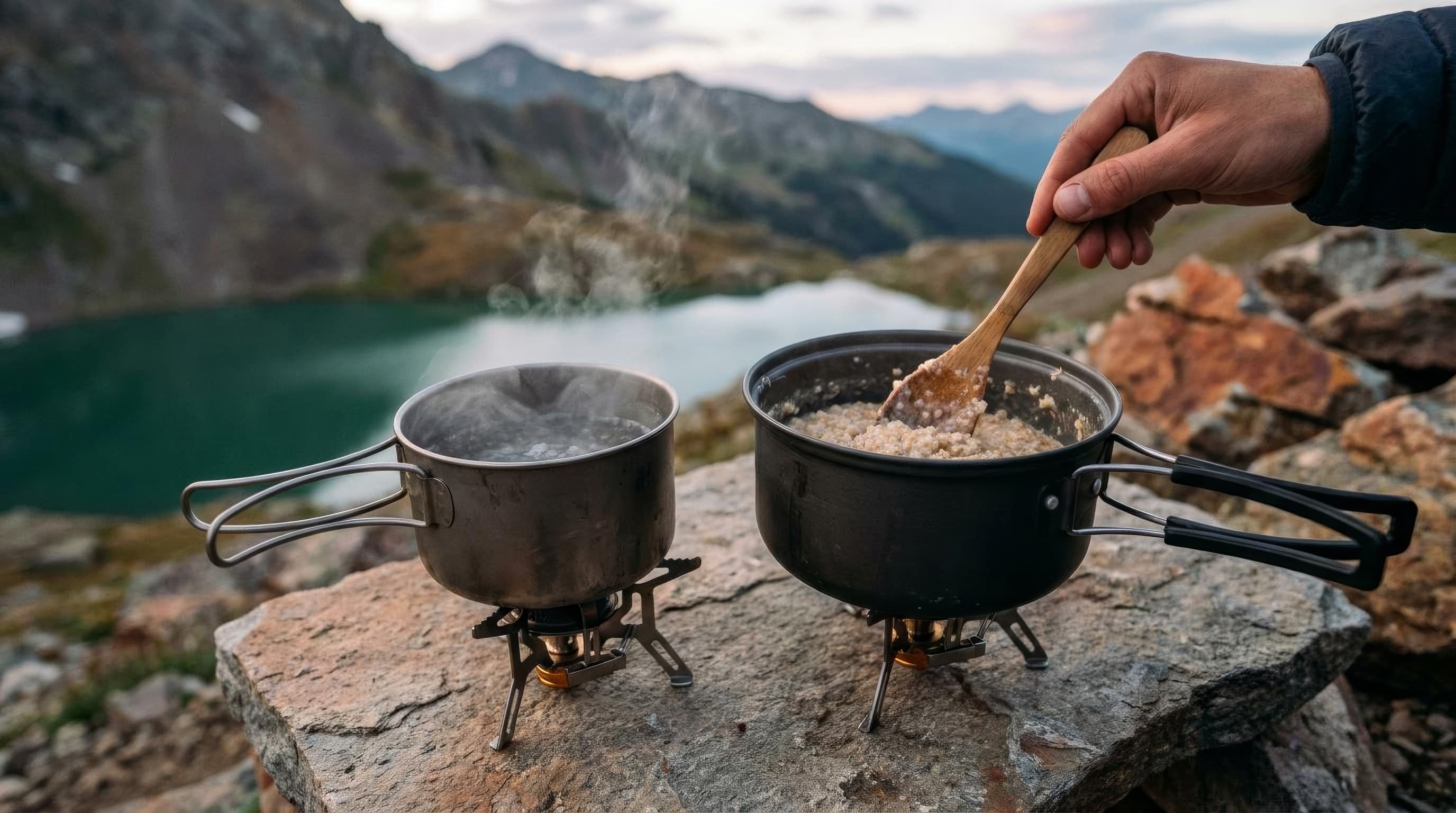
Our recommendations draw on manufacturer documentation, retailer listings, owner feedback, and comparisons with alternatives.
As an Amazon Associate I earn from qualifying purchases. We may earn a commission from links here, at no extra cost to you. How we research →
Top picks
 Best OverallStanley Wildfare Core 26-Piece Camp Kitchen8.8/10
 Best Premium SetGSI Outdoors Pinnacle Ceramic Camper Cookware Set8.1/10
 Best For BackpackingGSI Outdoors Halulite Dualist HS8.6/10
 Best Cast IronLodge 3.2 Quart Cast Iron Combo Cooker8.7/10
 Best UltralightSnow Peak Trek 900 Titanium Cookset8.8/10