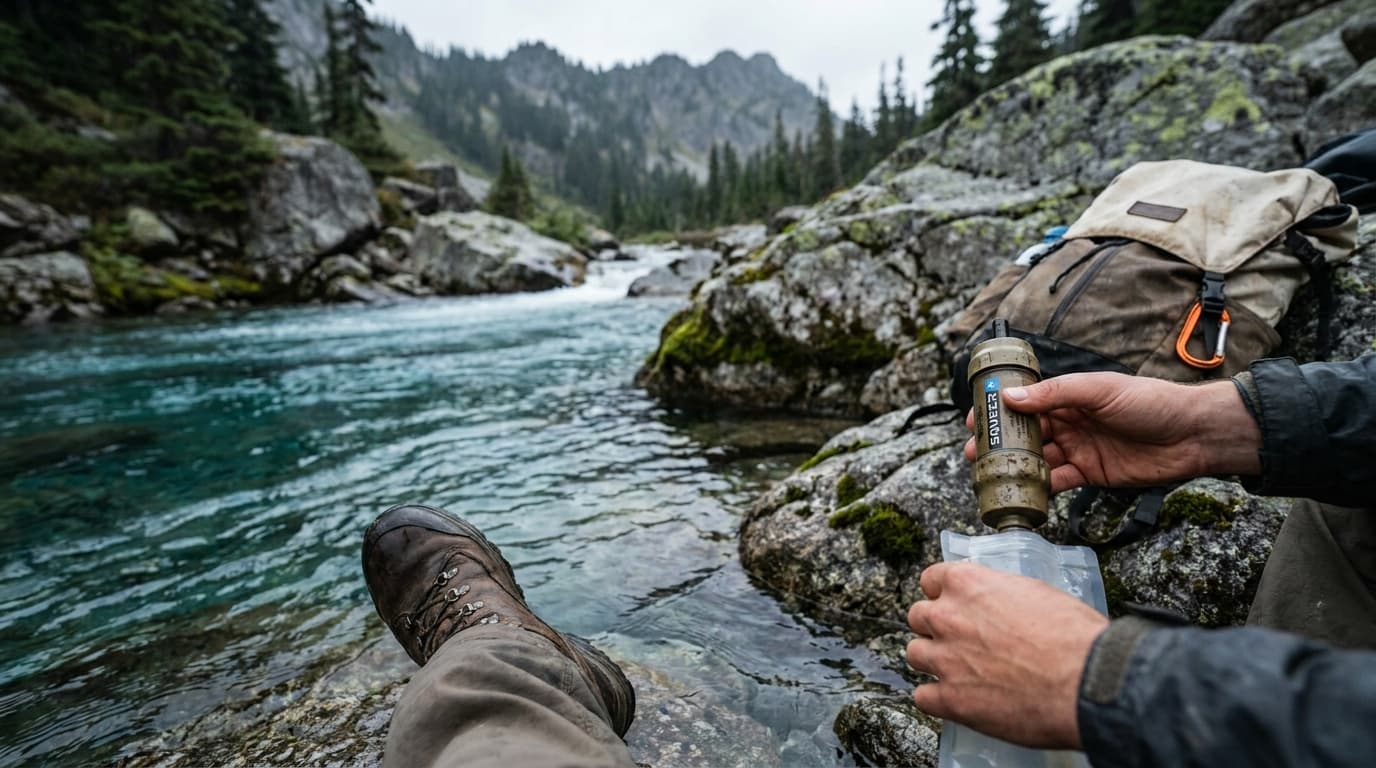
Dirty water is the one backpacking problem with a cheap, light, reliable fix. The hard part is choosing between the four filter types, each with a different speed and weight tradeoff. Here are the picks that cover every trip length and group size.
Our quick picks
How we picked
Every filter below was evaluated against the Kit Score: filtration type, verified flow rate, trail weight, rated capacity, ease of use, and price-to-performance ratio. We aggregate manufacturer specs, verified owner feedback across thousands of trips, and expert field sources to surface the consensus pick at each use case.
The picks
Best overall
BEST OVERALL
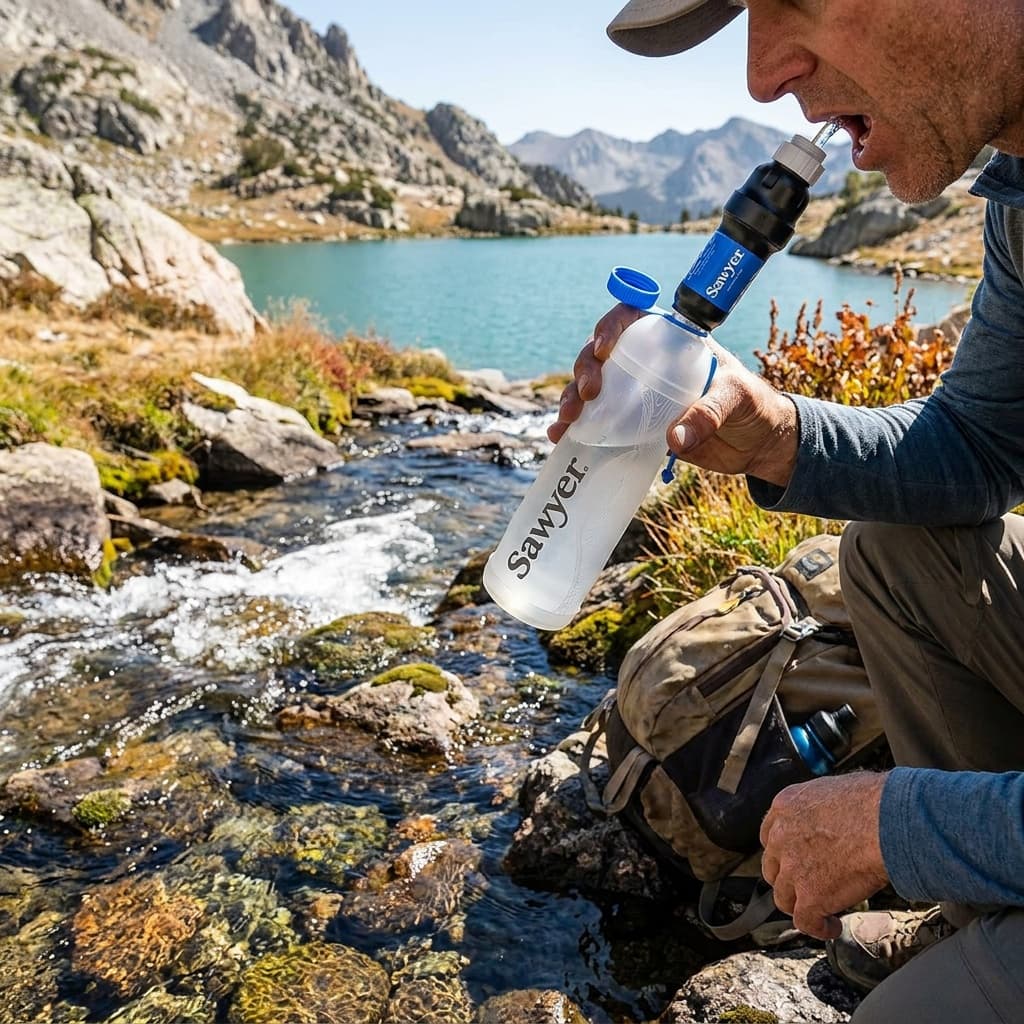
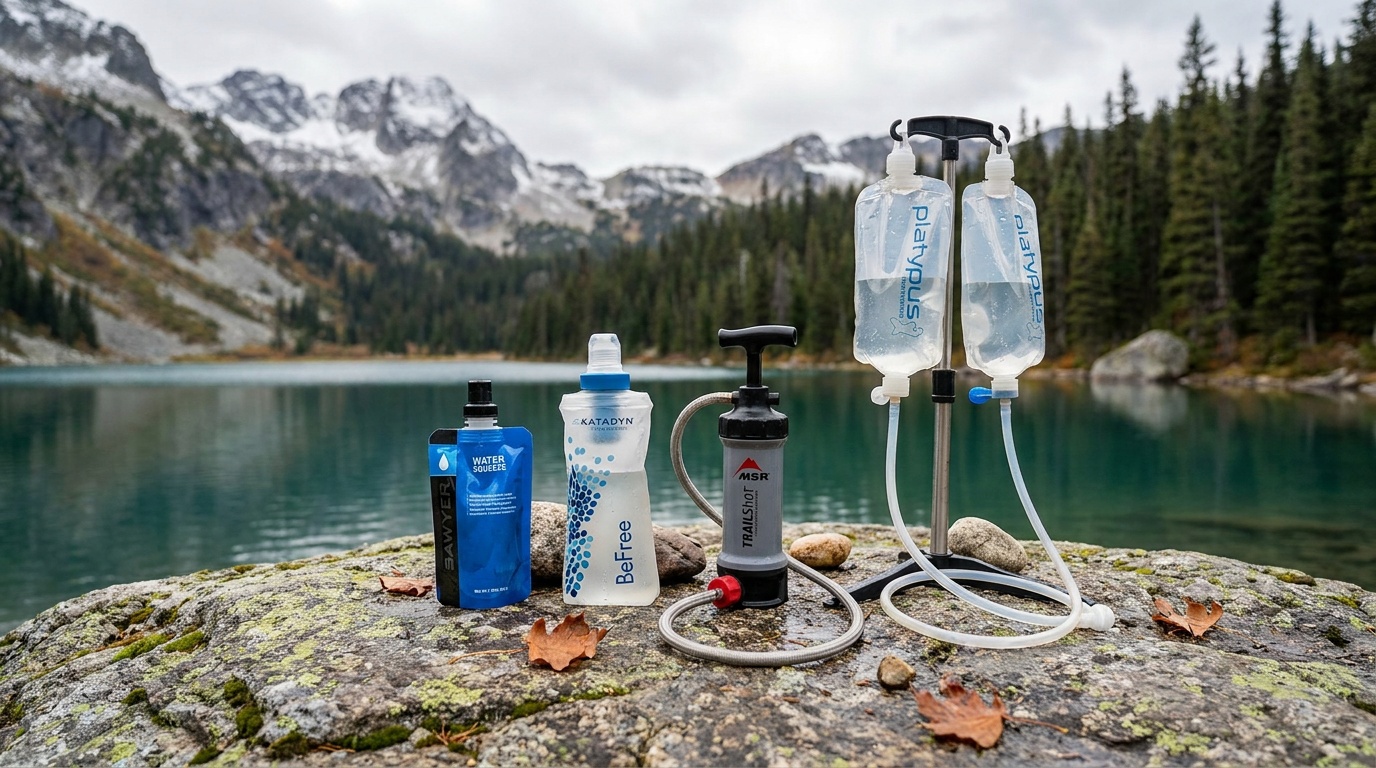
Sawyer Squeeze Water Filtration System
Best for: Thru-hikers, solo backpackers, and anyone who wants one filter that covers day trips through long-distance routes without worrying about filter replacement.
- 100,000-gallon rated lifespan with backflush cleaning means a single filter can last a decade of regular use
- The new SP302 and SP303 bundle SKUs have limited review history; the original SP131 (the basis for the large review corpus) is no longer available as a standalone purchase
Kit Score 8.7/10 · $59.95 Price checked Oct 25, 3:41 PM CDT · how we score gear
Buy on AmazonProduct details
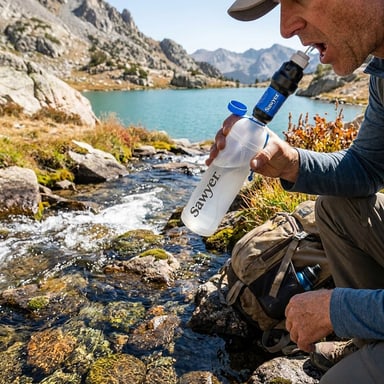
The Sawyer Squeeze is the most field-tested squeeze filter on the market, carried by a large share of PCT thru-hikers for its combination of fast flow, a practically unlimited lifespan, and three usable modes: squeeze, inline with a hydration bladder, or gravity-fed. It is the standard by which most other backpacking filters are measured.
- Filter type
- Hollow fiber squeeze
- Pore size
- 0.1 micron absolute
- Weight (filter only)
- 3 oz
- Flow rate
- 1.7 L/min
- Lifespan
- 100,000 gallons
- Removes
- Bacteria, protozoa, microplastics
More strengths
- Versatile three-mode operation: squeeze direct, attach inline to a hydration reservoir, or rig as a gravity system at camp
- Current SP302 kit ships with a CNOC TPU bottle rather than the flimsy standard pouches, addressing the most common long-term complaint about the original
Other tradeoffs
- Freezing temperatures permanently damage the hollow fiber membrane, requiring careful storage in three-season and winter conditions
The Sawyer Squeeze has become the default choice for thru-hikers and solo backpackers for a straightforward reason: it filters to 0.1 microns (bacteria and protozoa, not viruses), weighs about 3 oz with the included squeeze bag, and carries a rated capacity of 1,500 liters with no replacement cartridges required. You can backflush it with the included syringe to restore flow rate, which means one filter can realistically last years of regular use.
Flow rate starts at roughly 500 mL per minute on a new filter and drops as the hollow-fiber membrane loads with sediment. Backflushing recovers most of that. For solo trips or pairs, the squeeze-bag system is fast enough to keep pace with any itinerary. The filter also threads onto a standard 28mm water bottle mouth (most disposable smartwater bottles fit), so you can build a lighter system without the included bags.
At $45–$55, it costs less than almost any pump or gravity system and outlasts them by a wide margin if you maintain it.
One thing to know: the Squeeze does not filter viruses. In the US backcountry (streams fed by wilderness snowmelt, away from heavy human use), that is not a meaningful gap. On international routes or high-use corridors with upstream human or agricultural contamination, pair it with chemical treatment or upgrade to a purifier.
Editor's choice
EDITOR'S CHOICE
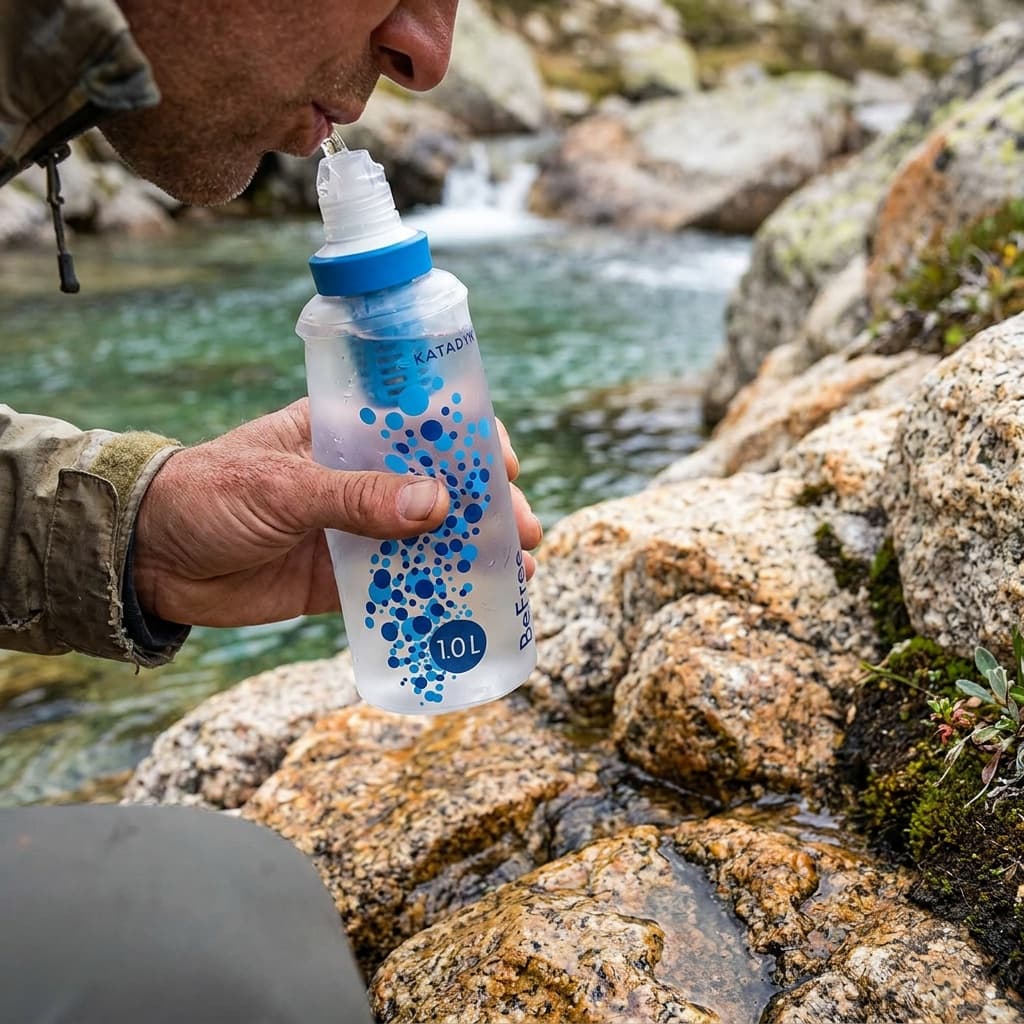
Katadyn BeFree 1.0L Collapsible Water Filter Bottle
Best for: Ultralight backpackers and fastpackers who prioritize the lightest possible setup and fastest fill time on clear mountain water sources.
- 2 L/min flow rate is the fastest in the personal-filter class, noticeably quicker than a Sawyer Squeeze in direct comparison
- Rated to 1,000 liters only (versus 100,000 gallons for the Sawyer Squeeze), making long-term cost higher for heavy users
Kit Score 7.6/10 · $42.95 Price checked Oct 25, 3:41 PM CDT · how we score gear
Buy on AmazonProduct details
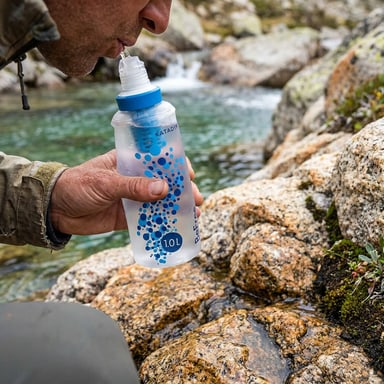
The Katadyn BeFree pairs a 0.1-micron hollow fiber membrane with a collapsible 1-liter soft flask and delivers the fastest out-of-the-box flow rate of any personal squeeze filter in this category. Cleaning requires nothing more than swishing or shaking the filter in clean water, with no syringe needed.
- Filter type
- Hollow fiber squeeze (EZ-Clean membrane)
- Pore size
- 0.1 micron
- Weight (full kit)
- 2.3 oz
- Flow rate
- 2.0 L/min
- Lifespan
- 1,000 liters
- Removes
- Bacteria, protozoa, sediment
More strengths
- Field cleaning is genuinely simple: swish in clean water, no backflush syringe to carry or lose
- Lightest full-kit option in this roundup at 2.3 oz total, including the collapsible bottle
Other tradeoffs
- Flow rate degrades noticeably in turbid or silty water; clogging in iron-heavy sources can be difficult to reverse without a syringe
The Katadyn BeFree integrates a 0.1-micron hollow-fiber filter into a 1.0L collapsible soft flask. The result is a system that weighs around 2.3 oz and flows at up to 1,000 mL per minute on a clean filter with clear source water, the fastest flow rate among squeeze-style filters. Fill the flask, give it one squeeze, and it is done.
The design earns its place for ultralight backpackers and fastpackers who move between water sources frequently on clear mountain routes. You fill and drink without sitting at a source waiting. The filter also cleans easily: swirl it in clean water and it resets.
The tradeoffs are real. The collapsible flask is the only vessel in the system, so you are carrying and drinking from the same 1L bag. Rated capacity is around 1,000 liters, lower than the Sawyer Squeeze, and the filter is not user-backflushable in the field (swirling is the maintenance method). For long trips on silty water, expect flow rate to degrade faster than the Squeeze, and plan around 1L of on-hand water versus the 2L+ you can carry with a separate dirty bag.
At $38–$48, it is the lightest, fastest option in this roundup.
Best value
BEST VALUE
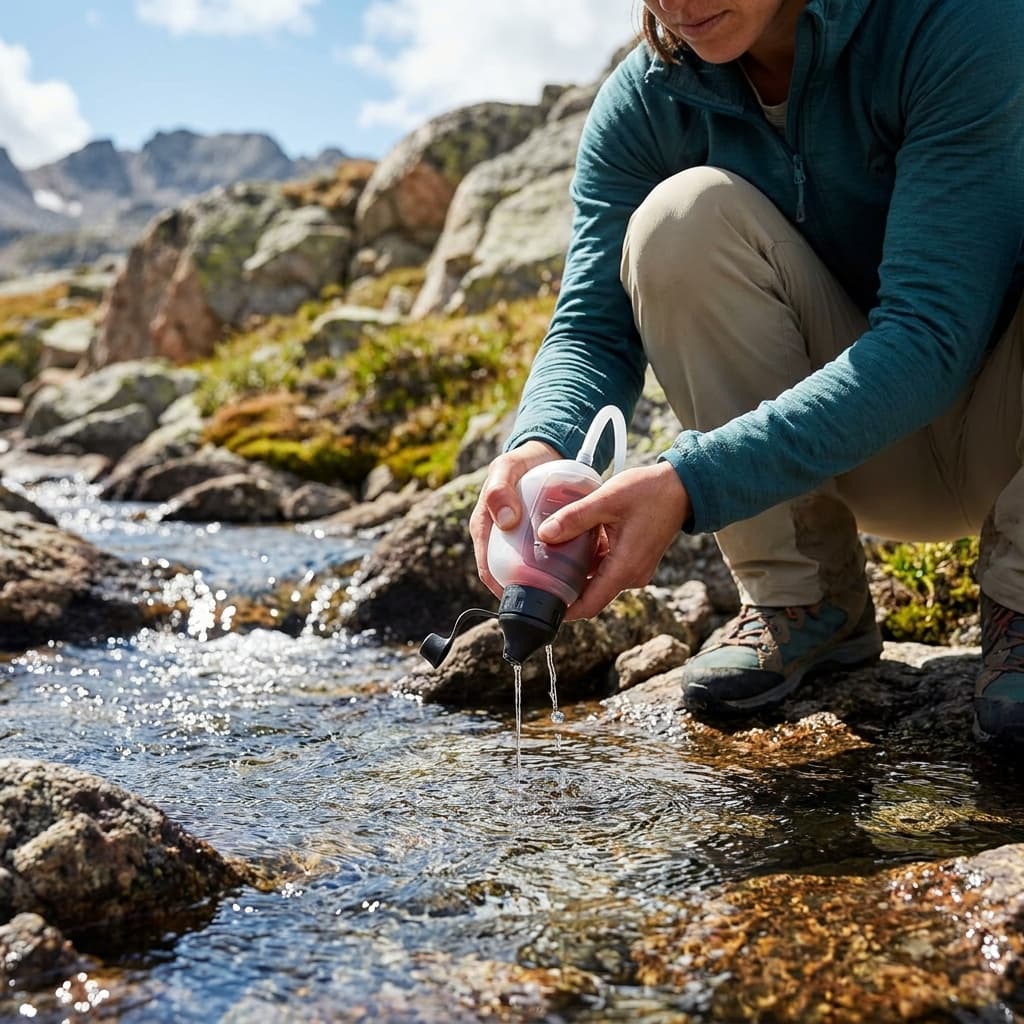
MSR TrailShot Pocket-Sized Water Filter
Best for: Trail runners, day hikers, and backpackers who want the fastest source-to-mouth setup without carrying or managing a separate dirty water container.
- Pickup tube means you can pull water from shallow sources, potholes, or trickle streams that squeeze-bottle filters struggle to reach
- Slower than squeeze filters (1 L/min) and the squeezing motion causes hand fatigue when filtering large volumes for groups or multi-day camps
Kit Score 8.0/10 · $62.99 Price checked Oct 25, 3:41 PM CDT · how we score gear
Buy on AmazonProduct details
The MSR TrailShot ditches the traditional pump handle in favor of a one-handed squeeze mechanism and an attached pickup tube, letting you drink directly from the source or fill any bottle without kneeling in the dirt or dismantling your pack. Its compact footprint fits a jacket pocket, and it requires no setup beyond uncapping.
- Filter type
- Hollow fiber squeeze-pump with intake tube
- Pore size
- 0.2 micron
- Weight
- 5.2 oz
- Flow rate
- 1.0 L/min
- Lifespan
- 2,000 liters
- Removes
- Bacteria (99.9999%), protozoa (99.9%), particulates
More strengths
- No dedicated dirty container required: draw directly from the source and fill any bottle, which simplifies the system for trail runners and day hikers
- Amazon 4.4-star rating; owners consistently praise the convenience and durability for high-mileage day use
Other tradeoffs
- Slightly heavier than personal squeeze filters at 5.2 oz, a noticeable difference for gram-counting ultralight hikers
The MSR TrailShot is a pocket-sized inline pump filter with a short intake hose. You dip the hose into a water source, squeeze the reservoir, and drink directly from the output. No dirty bag, no separate clean vessel required. Weight sits around 2.6 oz.
This design solves a specific problem: filtering water from small sources (puddles, tire tracks, shallow streams) where you cannot submerge a squeeze bag or gravity reservoir. The TrailShot works in an inch of standing water. That flexibility makes it the strongest choice for day hikers and trail runners who hit unpredictable water sources and want a backup system that fits in a vest pocket.
Filtration spec is 0.2 microns, which captures bacteria and protozoa. Flow rate is around 1 L per minute with consistent squeezing. It is not a fast system for filling a 2L reservoir at camp, but it is the fastest system for a 500 mL drink from a difficult source.
At $60–$75 it is priced above the Squeeze and BeFree, but the unique source access and the no-dirty-container workflow justify the premium for the use case it covers.
Best premium
BEST PREMIUM
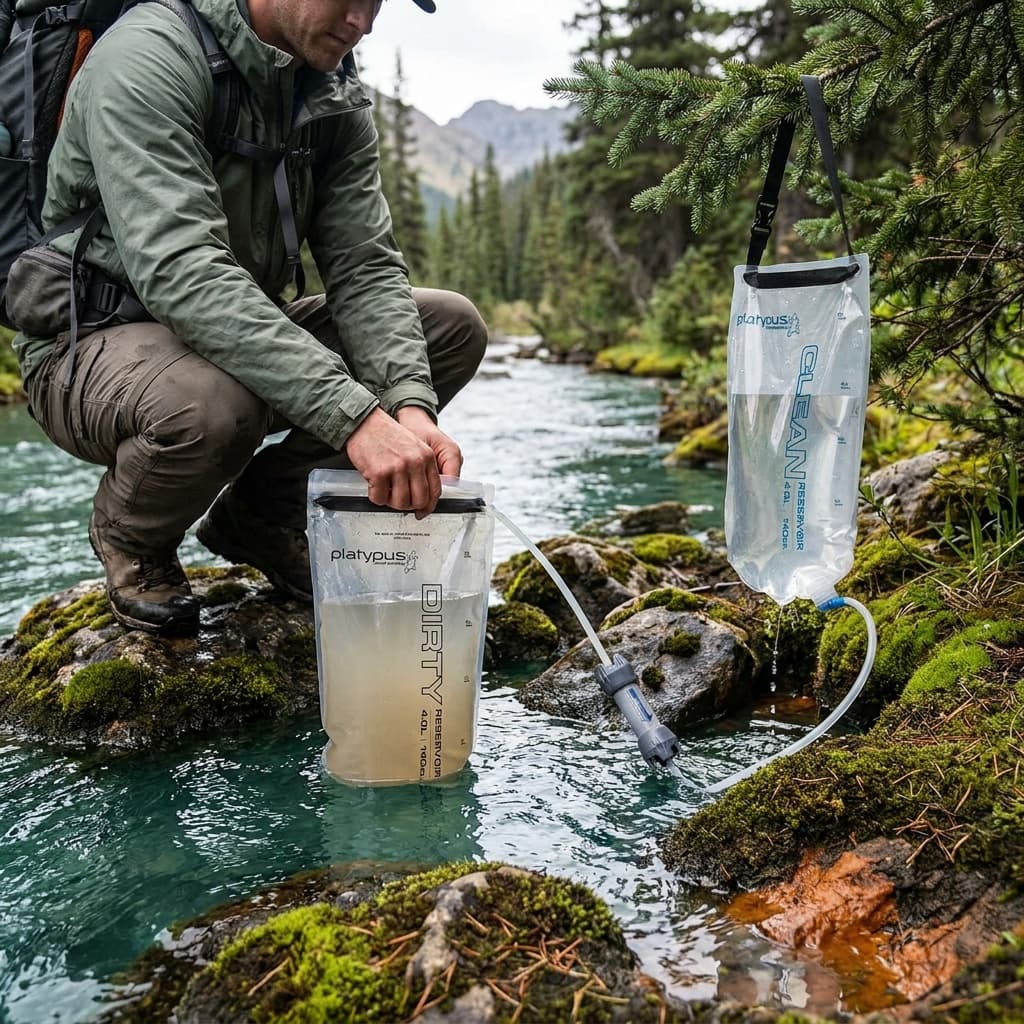
Platypus GravityWorks 4L Group Camping Water Filter System
Best for: Groups of two to four people on trips of two or more nights who want to fill large pots and hydration reservoirs at camp without anyone standing there squeezing.
- Fully hands-free operation frees you to set up camp, cook, or rest while 4 liters filters in approximately 2.5 minutes
- At 11.5 oz, it is the heaviest option in this roundup by a significant margin and requires a suitable hang point to function
Kit Score 8.4/10 · Check current price · how we score gear
Buy at REIProduct details
The Platypus GravityWorks is a complete gravity filtration system: hang the dirty reservoir from a tree or trekking pole, run the hose through the hollow fiber cartridge, and walk away while 4 liters filters hands-free into the clean bag. It is the standard recommendation for couples and small groups who want water production without squeezing or pumping.
- Filter type
- Gravity-fed hollow fiber
- Pore size
- 0.2 micron
- Weight (full system)
- 11.5 oz
- Flow rate
- 1.75 L/min (filters 4L in approx. 2.5 min)
- Lifespan
- 1,500 liters
- System capacity
- 4 liters per batch
More strengths
- Color-coded dirty and clean reservoirs eliminate cross-contamination risk, and the complete kit has everything included
- 4,500+ Amazon reviews at 4.5 stars; owners consistently call it the easiest high-volume filter they have used
Other tradeoffs
- Filter lifespan is 1,500 liters, and the gravity pace is slower per person than a squeeze filter when only one person is drinking
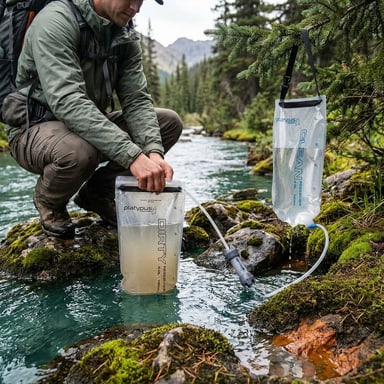
The Platypus GravityWorks is a gravity-fed dual-reservoir system: a 4L dirty bag, a hollow-fiber filter cartridge, and a 4L clean bag, connected in series. Hang the dirty bag, wait roughly two to three minutes, and the clean bag fills itself at around 1.5 L per minute. No squeezing, no pumping, no one standing at the source.
The case for gravity filtration at camp is simple: when you need to fill two 1L bottles, a 2L cookpot, and someone's hydration reservoir at the end of a long day, nobody wants to stand at the creek squeezing bags for ten minutes. The GravityWorks handles all of it while you set up the tent.
Filtration is 0.2 microns. The system weighs around 11.5 oz total, which is heavy compared to any individual squeeze or inline filter. The weight is shared across a group, which changes the math. For two people on a weekend trip, that is roughly 5.75 oz per person for unlimited hands-free water. For three or four people, it becomes one of the most efficient options per ounce on the list.
At $120–$145 it is the most expensive pick here. The cost is a one-time investment for a camp-water infrastructure that handles group trips without friction.
How to choose
Match your filter to your trip type
Solo day hike or trail run
The MSR TrailShot is your fastest drink-from-source option. Fits in any vest pocket, works in shallow puddles, no container management.
Thru-hike or multi-night solo
Start with the Sawyer Squeeze. The backflushable hollow-fiber design and 1,500 L capacity mean one filter handles a full trail season without any cartridge swaps.
Ultralight or fastpacking
The Katadyn BeFree saves roughly 0.7 oz over the Squeeze and flows faster. Worth the capacity tradeoff if your route has reliable, clear water sources.
Group camping (2–4 people)
The Platypus GravityWorks removes water chores from your camp routine entirely. Split the weight and let gravity do the work while you set up shelter.
International travel or high-human-use routes
None of these filters alone are purifiers. For virus coverage, pair any filter with a SteriPen UV purifier or iodine tablets, or switch to an MSR Guardian (a true purifier) as your primary system.
For most backpackers on most US wilderness routes, the Sawyer Squeeze is the last water filter they will ever buy.
Filtration types explained
Four types dominate the backpacking market. Understanding the tradeoff makes choosing much easier.
Hollow fiber (Sawyer Squeeze, Katadyn BeFree, Platypus GravityWorks): microscopic tubes with 0.1–0.2 micron pores. Water passes through the tube walls; bacteria and protozoa are physically blocked. No chemicals, no heat, no replacement cartridges. The technology behind nearly every recommended lightweight filter.
Inline/pump squeeze (MSR TrailShot): hollow fiber in a compact pump body with an intake hose. Pressure is user-applied via squeezing. The intake hose adds source flexibility that a soft flask or gravity bag cannot match in shallow water.
Gravity feed (Platypus GravityWorks): hollow fiber driven by hydrostatic head pressure. Slowest per-liter flow rate of the four types but requires zero ongoing effort. Optimal for camp use and group trips.
UV purifiers (SteriPen and others, not reviewed here): a fourth category that neutralizes viruses through UV-C light. No physical filtration, so protozoa and bacteria are neutralized but not removed. Often used as a second stage in international travel alongside a physical filter.
For the step-by-step technique with each system type, including source selection and avoiding cross-contamination between dirty and clean containers, see how to filter water while backpacking.
| Product | Kit Score | Price | Best for |
|---|---|---|---|
| Sawyer Squeeze Water Filtration System | 8.7 | $59.95 Price checked Oct 25, 3:41 PM CDT | Best for: Thru-hikers, solo backpackers, and anyone who wants one filter that covers day trips through long-distance routes without worrying about filter replacement. Why it stands out: 100,000-gallon rated lifespan with backflush cleaning means a single filter can last a decade of regular use Tradeoff: The new SP302 and SP303 bundle SKUs have limited review history; the original SP131 (the basis for the large review corpus) is no longer available as a standalone purchase |
| Katadyn BeFree 1.0L Collapsible Water Filter Bottle | 7.6 | $42.95 Price checked Oct 25, 3:41 PM CDT | Best for: Ultralight backpackers and fastpackers who prioritize the lightest possible setup and fastest fill time on clear mountain water sources. Why it stands out: 2 L/min flow rate is the fastest in the personal-filter class, noticeably quicker than a Sawyer Squeeze in direct comparison Tradeoff: Rated to 1,000 liters only (versus 100,000 gallons for the Sawyer Squeeze), making long-term cost higher for heavy users |
| MSR TrailShot Pocket-Sized Water Filter | 8.0 | $62.99 Price checked Oct 25, 3:41 PM CDT | Best for: Trail runners, day hikers, and backpackers who want the fastest source-to-mouth setup without carrying or managing a separate dirty water container. Why it stands out: Pickup tube means you can pull water from shallow sources, potholes, or trickle streams that squeeze-bottle filters struggle to reach Tradeoff: Slower than squeeze filters (1 L/min) and the squeezing motion causes hand fatigue when filtering large volumes for groups or multi-day camps |
| Platypus GravityWorks 4L Group Camping Water Filter System | 8.4 | Check current price | Best for: Groups of two to four people on trips of two or more nights who want to fill large pots and hydration reservoirs at camp without anyone standing there squeezing. Why it stands out: Fully hands-free operation frees you to set up camp, cook, or rest while 4 liters filters in approximately 2.5 minutes Tradeoff: At 11.5 oz, it is the heaviest option in this roundup by a significant margin and requires a suitable hang point to function |
Sawyer Squeeze Water Filtration System
- Best for
- Thru-hikers, solo backpackers, and anyone who wants one filter that covers day trips through long-distance routes without worrying about filter replacement.
- Why it stands out
- 100,000-gallon rated lifespan with backflush cleaning means a single filter can last a decade of regular use
- Tradeoff
- The new SP302 and SP303 bundle SKUs have limited review history; the original SP131 (the basis for the large review corpus) is no longer available as a standalone purchase
Katadyn BeFree 1.0L Collapsible Water Filter Bottle
- Best for
- Ultralight backpackers and fastpackers who prioritize the lightest possible setup and fastest fill time on clear mountain water sources.
- Why it stands out
- 2 L/min flow rate is the fastest in the personal-filter class, noticeably quicker than a Sawyer Squeeze in direct comparison
- Tradeoff
- Rated to 1,000 liters only (versus 100,000 gallons for the Sawyer Squeeze), making long-term cost higher for heavy users
MSR TrailShot Pocket-Sized Water Filter
- Best for
- Trail runners, day hikers, and backpackers who want the fastest source-to-mouth setup without carrying or managing a separate dirty water container.
- Why it stands out
- Pickup tube means you can pull water from shallow sources, potholes, or trickle streams that squeeze-bottle filters struggle to reach
- Tradeoff
- Slower than squeeze filters (1 L/min) and the squeezing motion causes hand fatigue when filtering large volumes for groups or multi-day camps
Platypus GravityWorks 4L Group Camping Water Filter System
- Best for
- Groups of two to four people on trips of two or more nights who want to fill large pots and hydration reservoirs at camp without anyone standing there squeezing.
- Why it stands out
- Fully hands-free operation frees you to set up camp, cook, or rest while 4 liters filters in approximately 2.5 minutes
- Tradeoff
- At 11.5 oz, it is the heaviest option in this roundup by a significant margin and requires a suitable hang point to function
Do you need virus protection?
In most of the US backcountry, no. Viruses require a human or animal host to survive long in the environment, and in remote wilderness watersheds above trail infrastructure, they are not a meaningful risk. Hollow-fiber filters at 0.1–0.2 microns are effective against bacteria (Giardia, Salmonella, E. coli) and protozoa (Cryptosporidium), which are the actual threats in US mountain water sources.
The calculation changes in three situations: international travel in regions with poor sanitation, high-use corridors with lots of upstream human activity (crowded national parks, popular alpine lakes), and agricultural runoff near trailheads. In those cases, add chemical treatment (Aquatabs, iodine) or switch to a purifier (MSR Guardian, LifeStraw Mission) that is certified to filter viruses as well.
FAQ
What is the best gravity water filter for backpacking?
The Platypus GravityWorks 4L is the consensus pick. The dual-reservoir design (4L dirty bag feeding a 4L clean bag through a hollow-fiber cartridge) fills at roughly 1.5 L per minute with no pumping or squeezing, and the 1,500 L element rating matches the Sawyer Squeeze. Its main competition, the Katadyn BeFree Gravity 3L, saves a few ounces by using a single bag with the filter at the outlet, but the Platypus clean-bag design lets you store filtered water for camp use, which is the point of choosing gravity in the first place. Gravity systems make sense for groups of two or more; solo hikers are better served by a squeeze filter.
What is the best ultralight water filter?
The Katadyn BeFree at roughly 2.3 oz including its 1L flask is the lightest complete filtering system in this roundup, and it flows at up to 1,000 mL per minute on clear water. The Sawyer Squeeze filter unit alone is comparable in weight (about 3 oz with a bag), and thru-hikers who pair it with a disposable 1L smartwater bottle build a system in the same weight class with triple the rated lifespan (1,500 L vs 1,000 L) and field backflushing. Choose the BeFree for speed on clear mountain water, the Squeeze for silty sources and long trails.
What is the best water filter for camping rather than backpacking?
At a car campsite or basecamp, weight stops mattering and volume takes over, which points straight at the Platypus GravityWorks 4L: hang the dirty bag from a tree or tailgate and it produces four liters of filtered water in under three minutes, enough for cooking, bottles, and dishwashing without repeated trips to the source. If your campground has potable taps, you do not need a filter at all; bring capacity instead (see our guide to camping water containers).
How often do I need to replace a hollow-fiber backpacking filter?
The Sawyer Squeeze is rated to 1,500 liters before the manufacturer recommends replacement, but many long-distance hikers report usable (if slower) flow well beyond that with regular backflushing. The Katadyn BeFree is rated to 1,000 liters. The Platypus GravityWorks filter element is rated to 1,500 liters. In practice, flow rate degradation is your signal: if backflushing or swirling no longer restores acceptable flow, replace the element. For a solo thru-hike of 2,000+ miles, one filter is typically sufficient for the whole trip.
Can I use a backpacking water filter in winter or below-freezing temperatures?
You can use hollow-fiber filters in cold conditions, but freezing is the main risk. Ice crystals can crack the hollow fibers and destroy the filter without any visible damage. A cracked filter passes the same flow as a working one but provides no protection. The rule: keep the filter at body temperature overnight in cold camps (sleep with it), never let a wet filter freeze, and if you suspect it froze, replace it. The Platypus GravityWorks gravity system is also not freeze-safe while wet.
What is the difference between a water filter and a water purifier?
A filter physically removes particles, bacteria, and protozoa by passing water through a membrane with very small pores (0.1–0.2 microns). A purifier adds virus protection on top of that, either through a finer membrane (MSR Guardian at 0.02 microns), UV-C radiation (SteriPen), or chemical treatment (iodine, chlorine dioxide). For US backcountry use, a filter is sufficient. For international travel or situations with confirmed viral contamination risk, a purifier is the safer choice.
The right filter is a function of who you are hiking with, how much you carry, and where your water comes from. For most routes, the Sawyer Squeeze resolves the question cleanly. For the edge cases, the other three picks each solve a specific problem the Squeeze does not.
Browse more backpacking and camping gear in the camp hub, or see how we research and rate gear to understand the sourcing and scoring behind every pick.
Keep going
Related guides
 Complete camp loadoutCar-camping starter kitBuild the complete kit
Our recommendations draw on manufacturer documentation, retailer listings, owner feedback, and comparisons with alternatives.
As an Amazon Associate I earn from qualifying purchases. We may earn a commission from links here, at no extra cost to you. How we research →