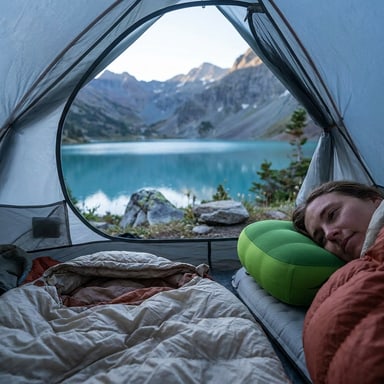
A bad pillow turns a good night in the backcountry into a stiff-necked slog. The four picks below cover every use case: stuffed foam comfort at camp, light inflatables for big miles, and a budget option that punches well above its price.
Our quick picks

How we picked
Every pick is scored against the Kit Score: packed volume, weight, surface feel, loft stability, price, and verified-owner consensus from hundreds of reviews aggregated across major retailers. No lab, no single tester opinion, pattern-weighted research across real-world reports and the makers' published specs.
Best overall: NEMO Fillo
BEST OVERALL
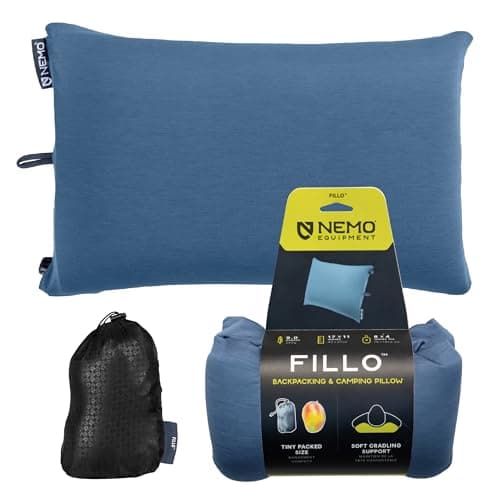
NEMO Fillo Backpacking and Camping Pillow
Best for: Car campers and occasional backpackers who want the closest-to-home sleep feel in a packable form.
- Top-tier comfort for the price: foam plus air combination works for back and side sleepers without the crinkle or rigidity of bare inflatables
- At 9.2 oz it is meaningfully heavier than pure inflatable rivals, which limits appeal for ultralight backpackers counting grams
Kit Score 8.5/10 · $49.95 Price checked Oct 23, 6:22 AM CDT · how we score gear
Buy on AmazonProduct details
The Fillo pairs an I-beam-baffled air cell with a foam topper, removing the balloon-like firmness of pure inflatables while keeping packed size reasonable. A machine-washable jersey cover and micro-adjusting valve round out a design that earns best-overall rankings across multiple independent review panels.
- Type
- Hybrid: inflatable air bladder with foam padding
- Weight
- 9.2 oz (260 g)
- Packed size
- 6 x 4 in (1.4 L)
- Inflated dimensions
- 17 x 11 x 4 in
- Loft
- 4 in
- Cover
- Machine-washable polyester jersey
More strengths
- Machine-washable jersey cover stays soft and cool against the face across multi-night trips
- Twist valve allows easy firmness tuning from plush to firm in seconds
Other tradeoffs
- Integrated stuff sack is tight and the twist-pull valve can be fiddly when packing in the dark
The NEMO Fillo is a hybrid: an I-beam-baffled air cell forms the structure, a layer of foam sits on top, and a removable, machine-washable fabric cover gives it a sleep feel that reads as "pillow" rather than "camping gear." NEMO describes the packed size as not much bigger than a russet potato; the listing puts it at about 6 by 4 inches in its integrated stuff sack, and 17 by 11 by 4 inches inflated.
The foam layer is the differentiator. Inflatables without it tend to migrate during sleep when the shell has no grip against a sleeping bag liner. The Fillo's cover stays put on most fabrics, and the air cell can be adjusted (more air for higher loft, less for a flatter, softer sink) to dial in support for side or back sleeping. Verified owner reviews consistently flag neck support and the absence of crinkling noise as the two reasons they buy it again.
At NEMO's $49.95 list it is not the cheapest hybrid on the market, and at 9.2 oz packed it is the heaviest pillow here by a wide margin. For car campers, it earns the "best overall" label because you are not trading comfort for packability the way you are with a pure inflatable; for occasional backpackers, the extra six ounces over the Aeros is the price of the sleep upgrade.
Best for: Car campers and occasional backpackers who want the closest-to-home sleep feel in a packable form.
Editor's choice: Sea to Summit Aeros Premium
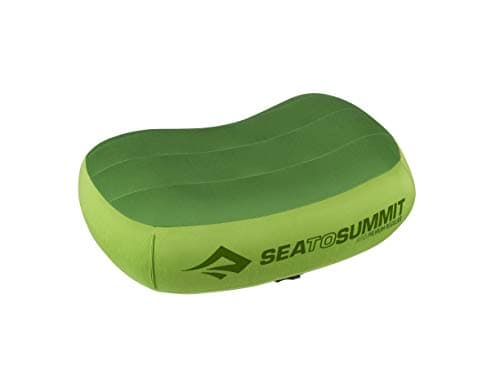
Sea to Summit's Aeros Premium is the pillow that convinced a generation of long-distance backpackers that an inflatable could be worth carrying. The design difference that matters: a 5 mm layer of memory foam under a brushed, stretch-knit polyester top, not the slick TPU or nylon that makes budget inflatables feel like sleeping on a zip-lock bag. That single change eliminates most of the face-stick and clamminess that earned early inflatables a bad reputation.
Sea to Summit lists the regular at 3.5 oz (99 g), 3.7 oz packed with its sack, 4 by 3 by 3 inches packed, and 13 by 9 by 4 inches inflated, with loft adjustable up to 12 cm (4.7 inches). The Mini XPRESS valve fills with a few breaths and lets you bleed air a puff at a time to fine-tune firmness, a practical detail at elevation where people get light-headed inflating gear. A large size (5.3 oz, 17 by 12 by 5 inches) exists for wider shoulders, and the Pillow Lock patches hold it to a Sea to Summit mat.
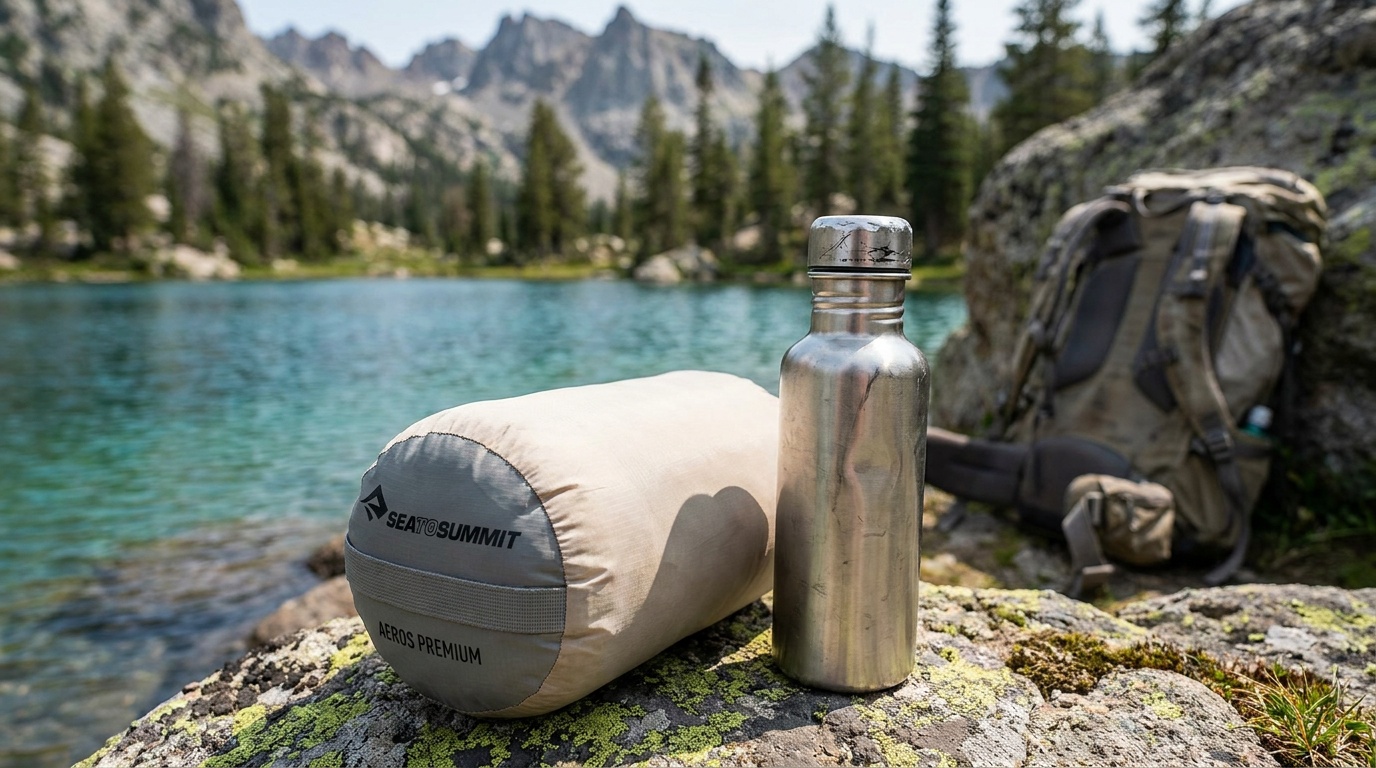
The tradeoff versus the Fillo is surface area and cloud-like softness: the Aeros Premium is firm and supportive, not plush. Side sleepers with wide shoulders sometimes want more loft than the regular's 4 inches at a comfortable fill, which is where the large size comes in. At $54.95 list it is the most expensive pick here on paper, though the Amazon listing has often sold for less.
Best for: Backpackers and thru-hikers who need every gram counted but still want a pillow that does not feel like a balloon against the face.
Best value: Therm-a-Rest Compressible Cinch
BEST VALUE
Therm-a-Rest Compressible Cinch Camping Pillow
Best for: Car campers and weekend trip car-to-tent campers who want the most home-like softness and adjustable firmness at an approachable price.
- Closest to home-pillow feel: foam construction cradles the head and does not press hard against the ear for side sleepers the way inflatable rivals can
- Heaviest and bulkiest option in this group: 8.6 oz and 2.6 L packed makes it a tough choice for backpackers watching base weight
Kit Score 8.2/10 · $39.95 Price checked Oct 23, 6:22 AM CDT · how we score gear
Buy on AmazonProduct details
The Compressible Cinch fills with upcycled foam scraps and adds a drawcord you tighten or loosen to dial in firmness, delivering genuine home-pillow softness at a price well below comparable camping options. It earns best-buy recognition across multiple independent testing panels for this comfort-to-cost ratio.
- Type
- Compressible upcycled foam with cinch adjustment
- Weight
- 11.5 oz regular (325 g); small 8 oz, large 16 oz
- Packed size
- Not published by Therm-a-Rest (compresses into itself)
- Expanded dimensions
- 18 x 13 x 6 in (regular)
- Cover
- 60% recycled polyester with built-in stuff sack
- Sizes available
- Small (15 x 11 x 5 in), Regular (18 x 13 x 6 in), Large (22 x 15 x 7 in)
More strengths
- Cinch cord lets you tune from soft and flat to lofted and firm without adding or releasing air
- Strong cost-to-comfort ratio at around $35 – $40 list makes it the clearest recommendation for car campers on a moderate budget
Other tradeoffs
- Internal foam fragments can shift during the night, creating minor lumps that some sleepers notice
The Therm-a-Rest Compressible Cinch is a foam-filled pillow with a cinch cord that compresses it down to a fraction of its loft for packing. When uncinched, it puffs up to a full, soft profile using urethane foam upcycled from Therm-a-Rest's sleeping pad production; the cinch lets you pre-set a firmness level before bed and locks it there. This is a genuinely useful feature: most foam camping pillows either pack compressed (and you live with that firmness) or loft fully (and you cannot adjust). The Cinch does both.
The shell is a polyester knit (60 percent recycled) that does not attract condensation the way inflatable shells can. Therm-a-Rest lists three sizes: small at 15 by 11 by 5 inches and 8 oz, regular at 18 by 13 by 6 inches and 11.5 oz, and large at 22 by 15 by 7 inches and 16 oz. The large approaches the footprint of a standard travel pillow without an air valve and without crinkling when you move.
The weight and packed volume are higher than the inflatables above: the regular is three times the Aeros Premium, and the large is a full pound. That makes this the car-camping and short-carry pick, not a thru-hiking choice. But for base camps, front-country sites, and weekends where pack weight is not the primary constraint, the Cinch delivers more home-bed feel per dollar than any inflatable in this roundup.
At $34.95 list in every size, it is the lowest price in the shortlist for the category of "pillow that actually feels like sleeping on foam."
Best for: Car campers and weekend trip car-to-tent campers who want the most home-like softness and adjustable firmness at an approachable price.
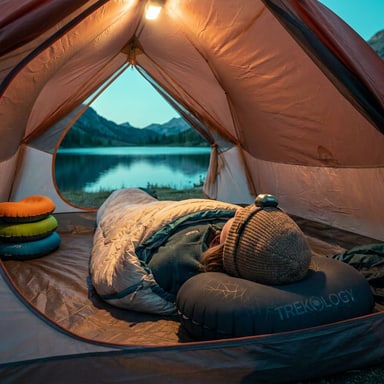
Best budget: Trekology ALUFT 2.0
BEST BUDGET
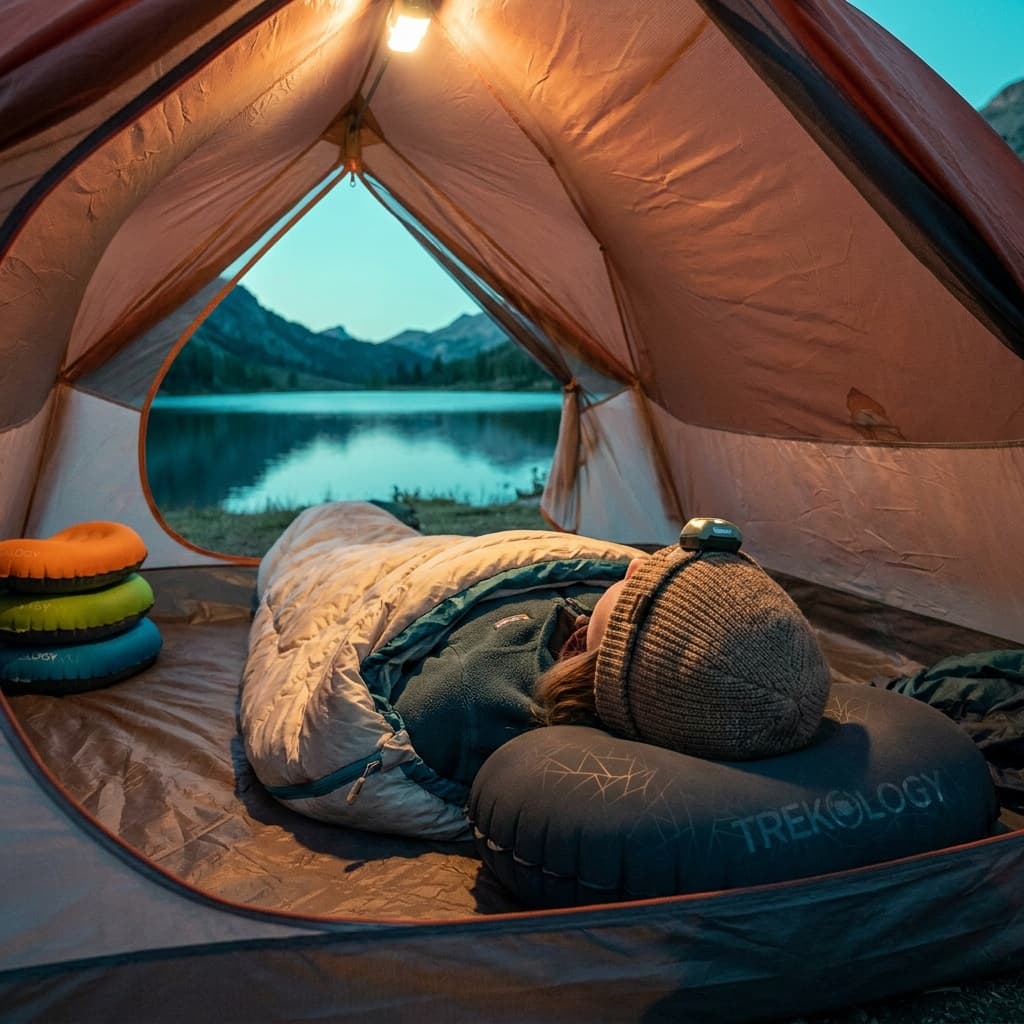
Trekology ALUFT 2.0 Ultralight Inflatable Camping Pillow
Best for: Gram-counting backpackers, festival-goers, and anyone who wants a capable inflatable pillow for under $25 and can accept replacing it every year or two.
- Exceptional pack-to-size ratio: compresses smaller than a soda can at under 4 oz, with an inflated footprint (16x12 in) larger than most budget rivals
- Roughly half of long-term owner reviews note valve leaks or TPU thinning after a full season of heavy use, suggesting a shorter usable life than premium inflatables
Kit Score 7.6/10 · $19.99 Price checked Oct 23, 6:22 AM CDT · how we score gear
Buy on AmazonProduct details
The ALUFT 2.0 packs to the size of a soda can and inflates in 5 – 8 button clicks, with rubber grip dots and a detachable elastic strap that lock it to a sleeping pad. It earns overwhelming positive owner sentiment for value, portability, and a click-button valve that competing budget pillows do not offer.
- Type
- Inflatable: fused TPU bladder and polyester shell
- Weight
- 3.9 oz (110 g)
- Packed size
- 5 x 2 in (smaller than a soda can)
- Inflated dimensions
- 16 x 12 x 4 in
- Valve
- Proprietary click-to-inflate / click-to-deflate button
- Anti-slip
- Rubber dot base plus detachable elastic pad strap
More strengths
- Rubber grip dots and included elastic pad strap solve the sliding-off-the-mat problem that plagues other inflatables at this price
- Click-button valve inflates and deflates faster and more reliably than twist or push-pull mechanisms found on comparable budget options
Other tradeoffs
- Fully inflated the pillow feels stiff for some sleepers; partial inflation is the standard fix but requires trial and error on the first night
The Trekology ALUFT 2.0 is the clearest value proposition in lightweight camping gear: a 3.9 oz, $19.99 inflatable that does everything a camping pillow needs to do, built from an 80 percent polyester, 20 percent TPU fabric with rubber anti-slip dots and a latch strap to hold it on a sleeping mat. It is not a premium product and does not claim to be.
The listing puts it at 16 by 12 by 4 inches inflated and about 5 by 2 inches folded. Four inches of loft works for back and moderate side sleeping but can fall short for broad-shouldered side sleepers. The surface is softer than older ALUFT models (the 2.0 designation refers to a shell update) but is still noticeably firmer and cooler to the touch than the foam-topped hybrids.
Owner reviews on the ALUFT 2.0 frequently mention valve leaks or thinning fabric after a season or two of frequent use. For the price, that is an acceptable lifespan: two replacements still cost less than the Fillo. For infrequent campers, festival attendees, and anyone building a first gear kit without committing to a premium inflatable, the ALUFT 2.0 is the right call.
Best for: Gram-counting backpackers, festival-goers, and anyone who wants a capable inflatable pillow for about $20 and can accept replacing it every year or two.
How they compare
| Product | Kit Score | Price | Best for |
|---|---|---|---|
| Sea to Summit Aeros Premium Inflatable Pillow | 8.3 | $38.46 Price checked Oct 23, 6:22 AM CDT | Best for: Backpackers and thru-hikers who need every gram counted but still want a pillow that does not feel like a balloon against the face. Why it stands out: Exceptional weight-to-comfort ratio: 2.8 oz and lime-sized packed volume with a cover that feels soft rather than plasticky Tradeoff: Smaller sleeping surface than compressible or hybrid rivals may cause the pillow to shift under the head for active sleepers |
| Therm-a-Rest Compressible Cinch Camping Pillow | 8.2 | $39.95 Price checked Oct 23, 6:22 AM CDT | Best for: Car campers and weekend trip car-to-tent campers who want the most home-like softness and adjustable firmness at an approachable price. Why it stands out: Closest to home-pillow feel: foam construction cradles the head and does not press hard against the ear for side sleepers the way inflatable rivals can Tradeoff: Heaviest and bulkiest option in this group: 8.6 oz and 2.6 L packed makes it a tough choice for backpackers watching base weight |
| Trekology ALUFT 2.0 Ultralight Inflatable Camping Pillow | 7.6 | $19.99 Price checked Oct 23, 6:22 AM CDT | Best for: Gram-counting backpackers, festival-goers, and anyone who wants a capable inflatable pillow for under $25 and can accept replacing it every year or two. Why it stands out: Exceptional pack-to-size ratio: compresses smaller than a soda can at under 4 oz, with an inflated footprint (16x12 in) larger than most budget rivals Tradeoff: Roughly half of long-term owner reviews note valve leaks or TPU thinning after a full season of heavy use, suggesting a shorter usable life than premium inflatables |
Sea to Summit Aeros Premium Inflatable Pillow
- Best for
- Backpackers and thru-hikers who need every gram counted but still want a pillow that does not feel like a balloon against the face.
- Why it stands out
- Exceptional weight-to-comfort ratio: 2.8 oz and lime-sized packed volume with a cover that feels soft rather than plasticky
- Tradeoff
- Smaller sleeping surface than compressible or hybrid rivals may cause the pillow to shift under the head for active sleepers
Therm-a-Rest Compressible Cinch Camping Pillow
- Best for
- Car campers and weekend trip car-to-tent campers who want the most home-like softness and adjustable firmness at an approachable price.
- Why it stands out
- Closest to home-pillow feel: foam construction cradles the head and does not press hard against the ear for side sleepers the way inflatable rivals can
- Tradeoff
- Heaviest and bulkiest option in this group: 8.6 oz and 2.6 L packed makes it a tough choice for backpackers watching base weight
Trekology ALUFT 2.0 Ultralight Inflatable Camping Pillow
- Best for
- Gram-counting backpackers, festival-goers, and anyone who wants a capable inflatable pillow for under $25 and can accept replacing it every year or two.
- Why it stands out
- Exceptional pack-to-size ratio: compresses smaller than a soda can at under 4 oz, with an inflated footprint (16x12 in) larger than most budget rivals
- Tradeoff
- Roughly half of long-term owner reviews note valve leaks or TPU thinning after a full season of heavy use, suggesting a shorter usable life than premium inflatables
How to choose a camping pillow
Match the pillow to your trip type
Identify your use case first
Car camper or backpacker changes almost every variable. Pack weight is only a constraint on multi-day carries; for car camping, prioritize comfort and packed volume in your kit bag.
Pick a fill type based on sleep style
Back sleepers can use any fill. Side sleepers need 3.5-plus inches of consistent loft, which foam hybrids and adjustable inflatables handle better than low-fill budget inflatables.
Check compressed size against your pack
A 3.5 oz inflatable that packs to 4 by 3 by 3 inches leaves room for everything else. A compressible foam pillow at 11.5 to 16 oz may not fit inside a 40 L pack alongside a sleeping bag and pad.
Test inflation comfort before the first trip
Inflatables let you pre-set loft. Do this at home with your sleeping bag and pad to find your preferred firmness. Adjust in half-breath increments; most people over-inflate on the first attempt and wake up with a stiff neck.
The biggest camping pillow mistake is not packing one at all, then spending two nights folding a fleece jacket into a lumpy substitute that shifts every time you roll over.
Frequently asked questions
Are inflatable camping pillows comfortable enough for side sleepers?
Yes, with the right loft setting. Side sleepers generally need 3.5 to 5 inches of loft to keep the neck in a neutral position. The Sea to Summit Aeros Premium (adjustable up to 4.7 inches per Sea to Summit, 5 inches in the large) and the NEMO Fillo (foam over a 4-inch air cell) both handle this well. The Trekology ALUFT 2.0 is listed at 4 inches inflated, which works for some side sleepers but not all.
How much do camping pillows weigh compared to a regular pillow?
A standard bed pillow weighs roughly 1 to 2 lb (16 to 32 oz). The lightest picks in this roundup are listed at 3.5 to 3.9 oz. Even the heaviest, the Therm-a-Rest Compressible Cinch large at 16 oz, is at the light end of what you left on your bed at home, and the regular Cinch at 11.5 oz is lighter still.
Can camping pillows go in a washing machine?
Compressible foam pillows (like the Therm-a-Rest Cinch) can typically be machine-washed on a gentle cycle and air-dried. The NEMO Fillo's cover is removable and machine-washable, but the air cell is not. Inflatable pillows should be spot-cleaned with a damp cloth and mild soap only: machine washing stresses the valve seams and can introduce moisture inside the bladder, which leads to mildew. Check the care tag for your specific model.
Where these numbers come from
| Claim | Source | Checked |
|---|---|---|
| NEMO Fillo: baffled air cell with a foam layer, removable machine-washable recycled-fabric cover, integrated stuff sack, regular and wide widths, "not much bigger than a russet potato" packed, $49.95 list | NEMO Equipment, Fillo Backpacking & Camping Pillow | Sep 2026 |
| NEMO Fillo: 9.2 oz packed, 6 x 4 in packed, 17 x 11 x 4 in inflated | NEMO listing on Amazon, linked from the pick above (NEMO's page does not list a weight; OutdoorGearLab weighed its sample at 8.8 oz) | Sep 2026 |
| Aeros Premium regular: 99 g (3.5 oz), 104 g packed, 11 x 8 x 8 cm packed, 34 x 24 x 11 cm inflated, up to 12 cm thick, 5 mm memory foam layer, Mini XPRESS valve, Pillow Lock, $54.95; large: 150 g, 43 x 30 x 12 cm | Sea to Summit, Aeros Premium Pillow | Sep 2026 |
| Compressible Cinch: small 8 oz and 15 x 11 x 5 in, regular 11.5 oz and 18 x 13 x 6 in, large 16 oz and 22 x 15 x 7 in, upcycled urethane foam, 60% recycled polyester shell, $34.95 | Therm-a-Rest, Compressible Pillow Cinch | Sep 2026 |
| ALUFT 2.0: anti-slip rubber dots, latch strap, $19.99 list | Trekology, Aluft 2.0 Inflatable Pillow | Sep 2026 |
| ALUFT 2.0: 3.9 oz (110 g), 16 x 12 x 4 in inflated, about 5 x 2 in folded, 80% polyester and 20% TPU | Trekology listing on Amazon, linked from the pick above (OutdoorGearLab weighed its sample at 3.8 oz) | Sep 2026 |
We did not sleep on these pillows ourselves. Weights and dimensions are the makers' listed specs; where a maker's own page omits a number, the table says which listing it came from.
Back at camp, a good pillow is the smallest gear decision with the biggest sleep return. Browse the rest of the camp gear hub for sleeping bags, pads, and shelter picks, or see how we research and rate every product in the Kit Authority shortlists.
Keep going
Complete loadoutCamp sleep systemFive coordinated pieces that solve shelter, insulation, cushioning, head support, and light for nights outside.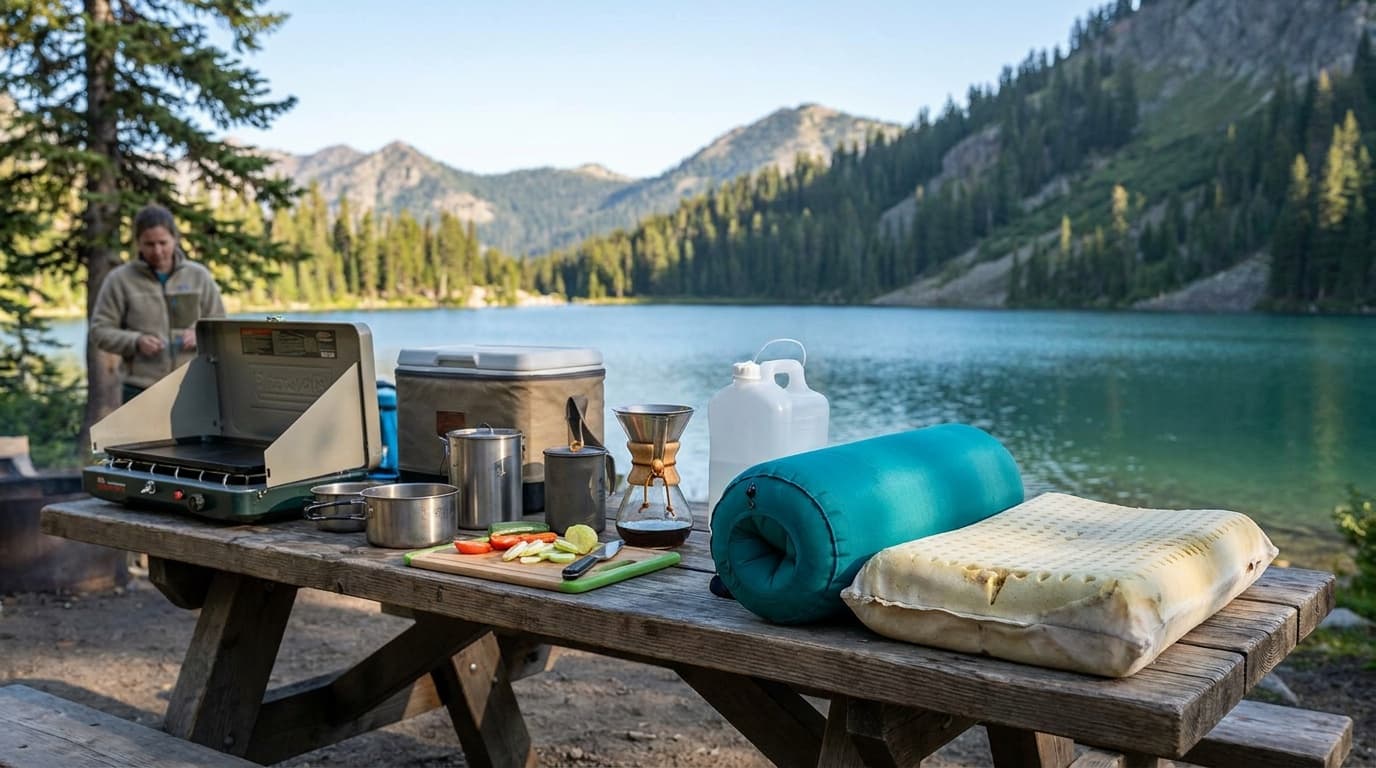
Our recommendations draw on manufacturer documentation, retailer listings, owner feedback, and comparisons with alternatives.
As an Amazon Associate I earn from qualifying purchases. We may earn a commission from links here, at no extra cost to you. How we research →