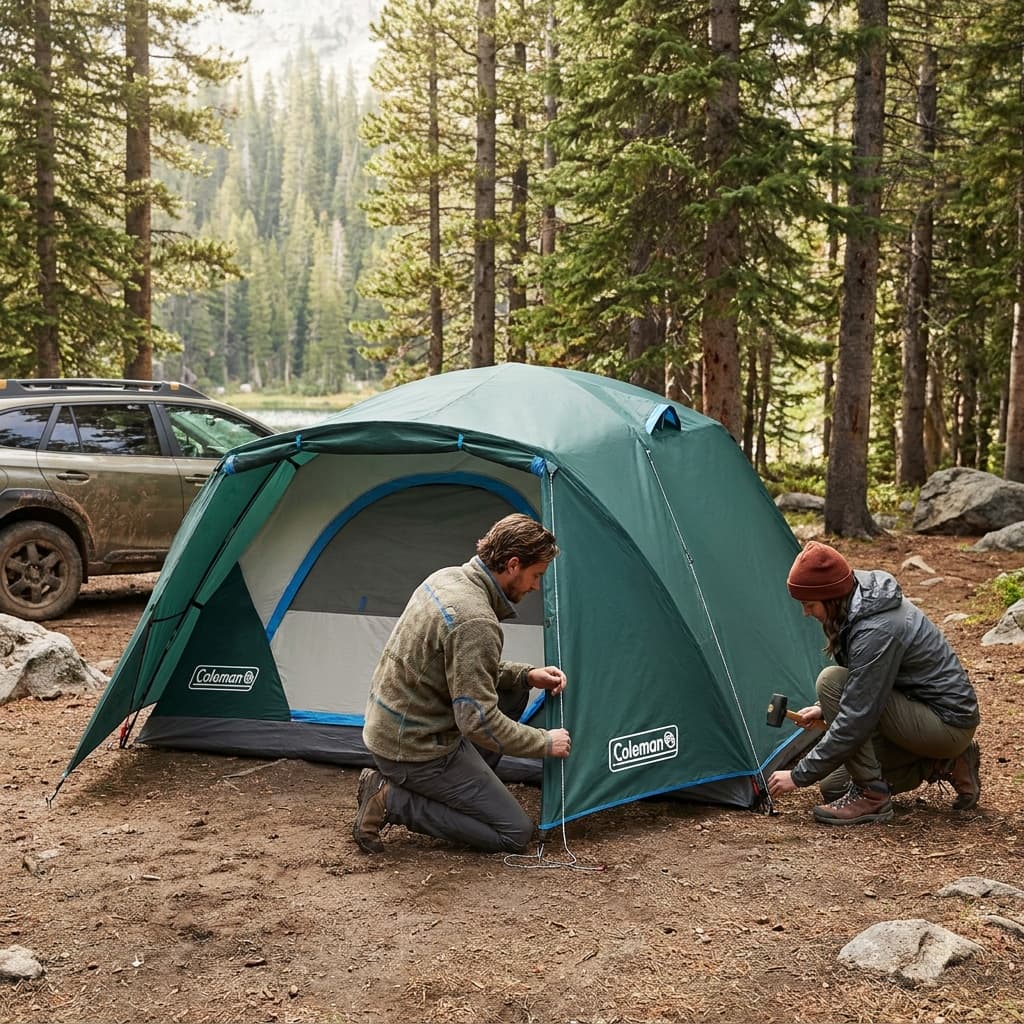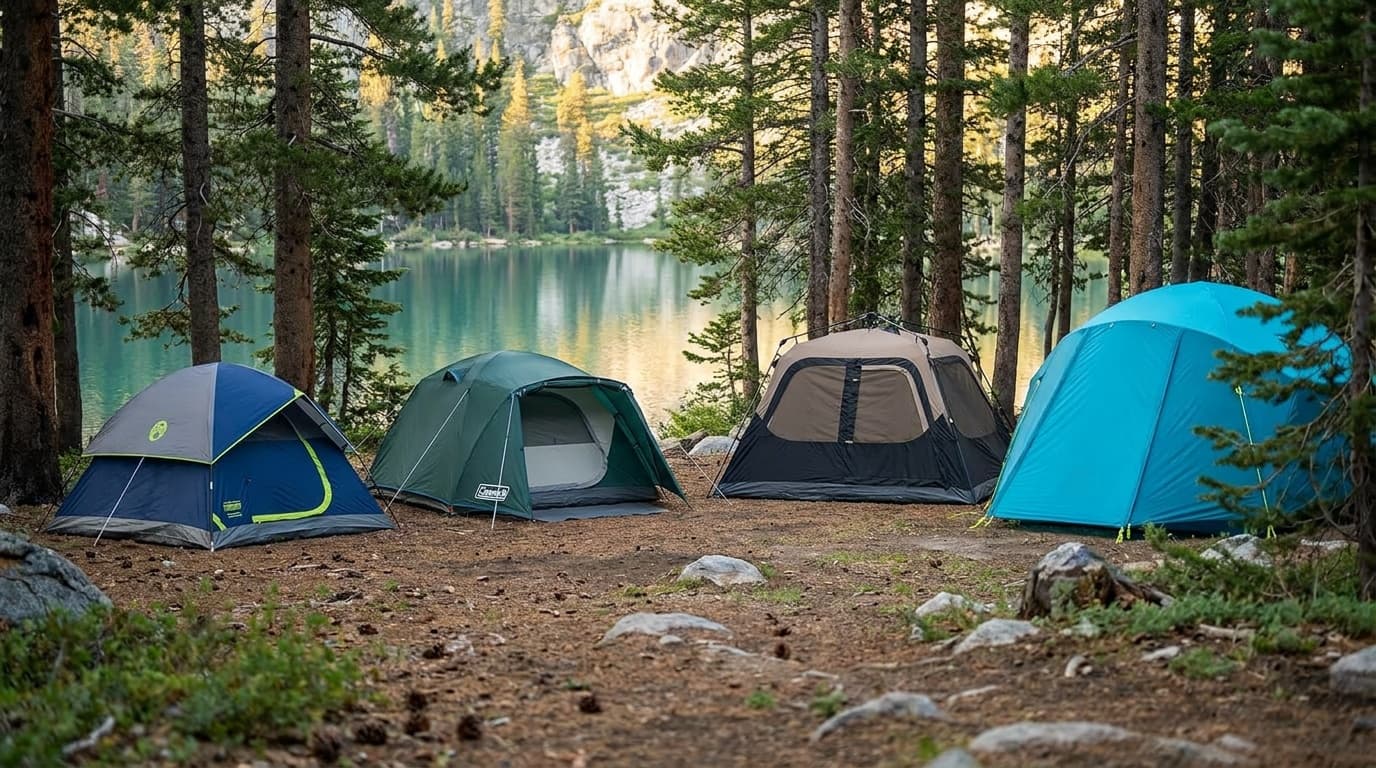
The Coleman Skydome 4 with Full-Fly Vestibule is the best camping tent for most beginners because it combines a simple pitch with useful rain coverage and protected storage: Coleman lists a setup time under five minutes, an 8 x 3.5 ft vestibule, and a frame tested to 35 mph winds. These six current car-camping tents cover the other common first-tent priorities: one-minute setup, family space, standing height, and stronger materials.
Decision snapshot
Best for
Couples and small families buying a first car-camping tent
Skip if
You need standing room, backpacking weight, or aluminum poles
Bottom line
The Skydome 4 solves more beginner problems than the other Coleman options.
First-tent matcher
Find the tent that removes your biggest camping problem
Capacity labels are optimistic. Start with your real group, then choose whether price, weather margin, setup speed or standing room matters most.
Best balanced first tent
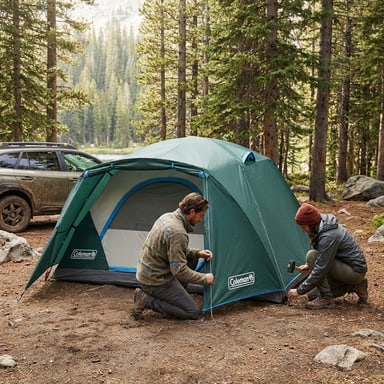
Coleman Skydome 4 with Full-Fly Vestibule
It combines a simple pitch, useful rain coverage and protected gear storage at a moderate price.
See this path →Best for setup speed
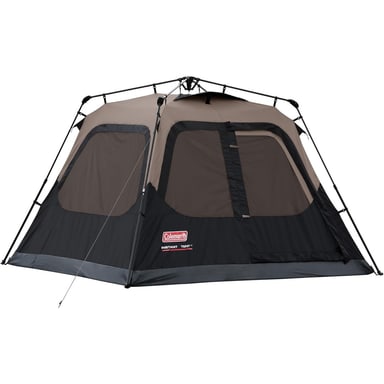
Coleman Instant Cabin 4
The attached telescoping frame removes pole sorting and can stand in about a minute.
See this path →Best premium base camp
NEMO Aurora Highrise 4P
Standing height, two doors, two large vestibules and aluminum poles make it the strongest long-term four-person option.
See this path →Best six-person value
Kelty Wireless 6
It moves a growing group into a more honest floor plan without jumping to premium cabin-tent pricing.
See this path →Best family space
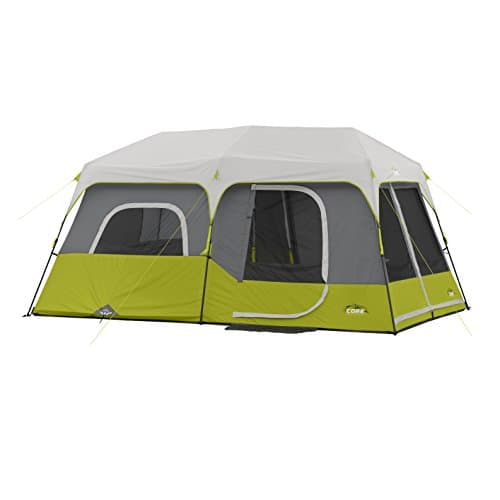
CORE 9 Person Instant Cabin
Cabin walls, a divider and a fast attached frame give families room to live rather than only sleep.
See this path →Best buy-once setup
Gazelle T4 Hub Tent
Its rigid hub frame makes setup repeatable and the removable floor simplifies cleanup for frequent car campers.
See this path →
Our quick picks
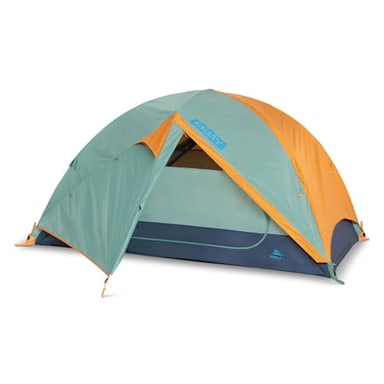
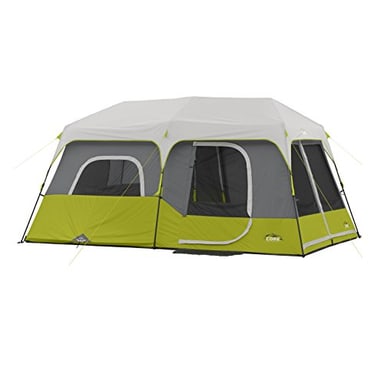
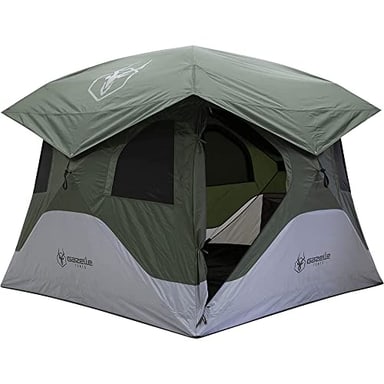
How we picked
This is a researched comparison, not a field test. We checked current manufacturer specifications, current retail availability, owner-reported failure patterns, and each product's fit for a first car-camping setup. The Kit Score weighs fit for purpose, owner sentiment, build quality, and value.
Beginner usability carries more weight here than trail weight. We favored a simple pitch, a forgiving floor plan, honest weather protection, and a price that makes sense for the expected trip frequency. Availability moves. When we rechecked on October 3, 2026, every pick was in stock on Amazon: the Skydome, Instant Cabin, and Gazelle T4 sold by Amazon.com, the Aurora Highrise by NEMO's own Amazon store, the CORE 9 by CORE's store, and the Kelty Wireless 6 by a third-party seller with only a few left. NEMO's and Kelty's own websites showed those two tents as sold out, so check the listing before you plan around either.
Best overall: Coleman Skydome 4 with Full-Fly Vestibule
BEST OVERALL
Coleman Skydome 4-Person Camping Tent with Full Fly Vestibule
Best for: Beginner couples or small families who want a reliable, fast-pitching shelter with solid rain coverage without spending more than $200.
- Pre-attached poles make solo setup straightforward
- 55-inch peak height means most adults cannot stand up inside
Kit Score 7.5/10 · $189.99 Price checked Oct 25, 6:06 AM CDT · how we score gear
Buy on AmazonProduct details
The Skydome's pre-attached poles fold out and lock into corner sleeves without guesswork, making it one of the most foolproof setups at any price. Nearly vertical walls add 20% more headroom than a traditional Coleman dome, and the full-coverage rainfly version includes an 8 x 3.5 ft vestibule for gear storage.
- Capacity
- 4 person
- Floor
- 8 x 7 ft (56 sq ft)
- Peak height
- 55.2 in (4 ft 7 in)
- Weight
- 13.7 lbs
- Wind rating
- Frame tested to 35 mph
- Setup
- Pre-attached poles, under 5 minutes
More strengths
- Full-coverage rainfly with integrated 8 x 3.5 ft vestibule for gear storage
- Nearly vertical walls maximize usable interior space for the footprint
Other tradeoffs
- Plastic fly clips and thin fabrics raise durability concerns with frequent use
The Skydome is the most complete beginner package in this group. Its 8 x 7 ft floor fits one queen air bed, the pre-attached poles remove most pole sorting, and the full fly creates an 8 x 3.5 ft vestibule. That covered entry gives wet shoes and small bags somewhere to go without consuming the 56 sq ft sleeping floor.
Coleman lists a pitch time under five minutes, nearly vertical walls with 20 percent more headroom than its traditional dome shape, and a frame tested to withstand winds up to 35 mph when correctly pitched and guyed. The wide door is another practical advantage when a queen air bed or bulky sleeping bags need to pass through.
The compromise is height. At about 4 ft 7 in (55 in) in the center, adults cannot stand inside. The fiberglass frame and plastic hardware also sit below the material quality of the NEMO. For ordinary campground trips, however, the Skydome gives a new camper the best balance of easy setup, covered storage, rain design, and price.
Read the full Coleman Skydome 4 review.
Fastest setup: Coleman Instant Cabin 4
FASTEST SETUP
Coleman 4-Person Instant Cabin Tent
Best for: Road trippers, solo parents, and mobility-limited campers who value a one-minute pitch more than compact storage or full-fly storm protection.
- Pre-attached frame removes pole sorting and can be pitched by one person in about a minute
- At 19.1 lb and almost 40 inches packed, it is a trunk-only shelter
Kit Score 7.4/10 · $179.99 Price checked Oct 25, 6:06 AM CDT · how we score gear
Buy on AmazonProduct details
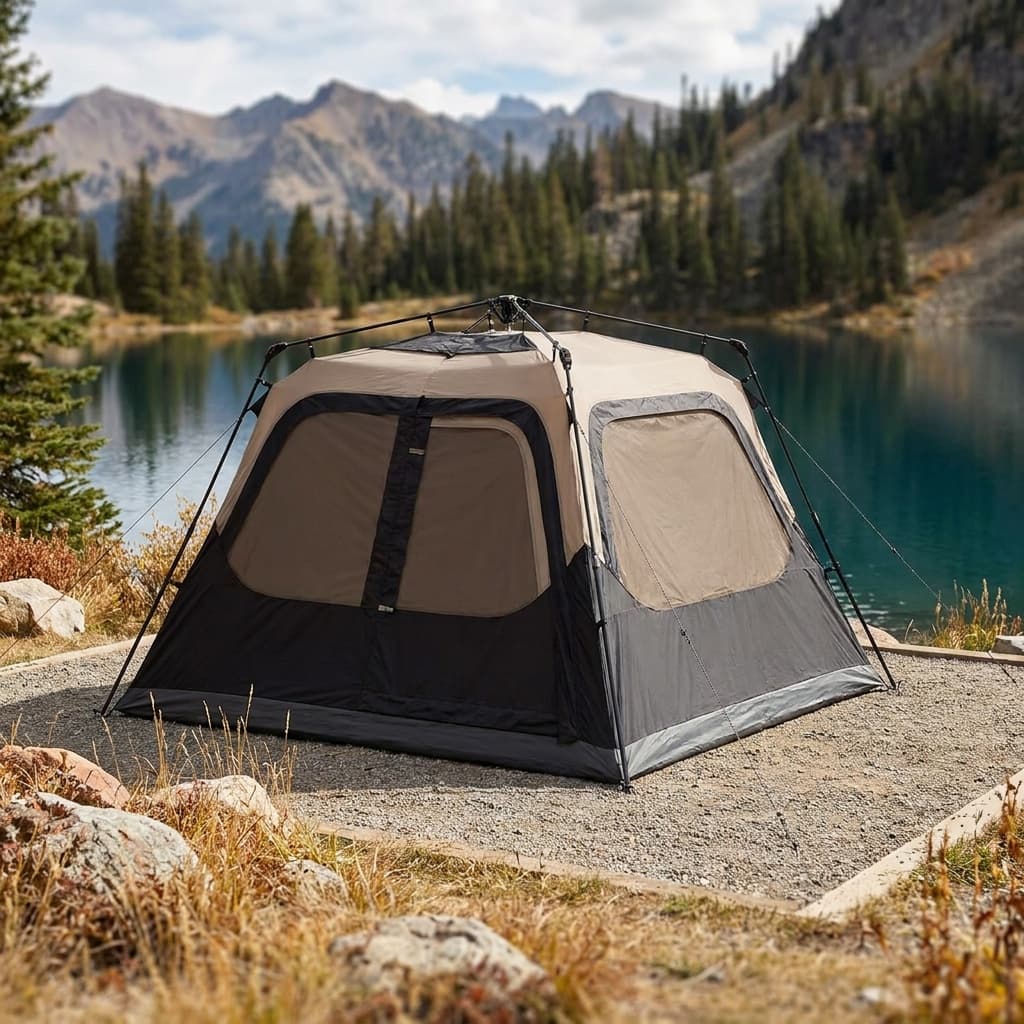
A four-person cabin tent with a pre-attached telescoping frame that unfolds in about a minute. It trades packed weight and full-fly storm coverage for the simplest setup in the beginner field.
- Capacity
- 4 person (best for 2 adults plus gear)
- Floor
- 8 x 7 ft (56 sq ft)
- Peak height
- 59 in (4 ft 11 in)
- Packed weight
- 19.1 lb
- Setup
- Pre-attached frame, about 60 seconds
- Packed length
- 39.95 in
More strengths
- Eight-by-seven-foot floor fits one queen air bed with a narrow gear margin
- Five windows and the vented top create better fair-weather airflow than a basic low dome
Other tradeoffs
- No vestibule, and the integrated top coverage offers less storm margin than a full rainfly
- A pre-attached frame is faster to use but harder to repair than separate poles
The Instant Cabin is for the camper who wants to park, unfold the shelter, extend the frame, and move on. Coleman specifies a setup as fast as 60 seconds because the telescoping poles remain attached to the tent. The 8 x 7 ft floor fits one queen air bed, while five windows and an integrated vented top improve fair-weather airflow.
That convenience has physical costs. The tent weighs 19.1 lb and packs to almost 40 inches long. It has no vestibule, and its integrated top coverage offers less storm margin than the Skydome's separate full fly. A pre-attached frame also has more connected parts to manage if a joint or pole is damaged.
Choose it for road trips with repeated one-night stops, solo parents managing camp while watching children, or anyone for whom loose-pole assembly is a genuine barrier. It is less convincing when trunk space is tight or rainy-weather margin matters more than speed.
Read the full Coleman Instant Cabin 4 review.
Best premium: NEMO Aurora Highrise 4P
BEST PREMIUM
NEMO Aurora Highrise 4-Person Camping Tent
Best for: Beginners who want to invest once in a tent that will perform in rain, last several years, and never require a YouTube tutorial to pitch solo.
- Aluminum poles and a full-coverage fly deliver genuine weather protection
- At $400, it is the largest upfront investment of the group
Kit Score 8.6/10 · $399.95 Price checked Oct 25, 6:06 AM CDT · how we score gear
Buy on AmazonProduct details
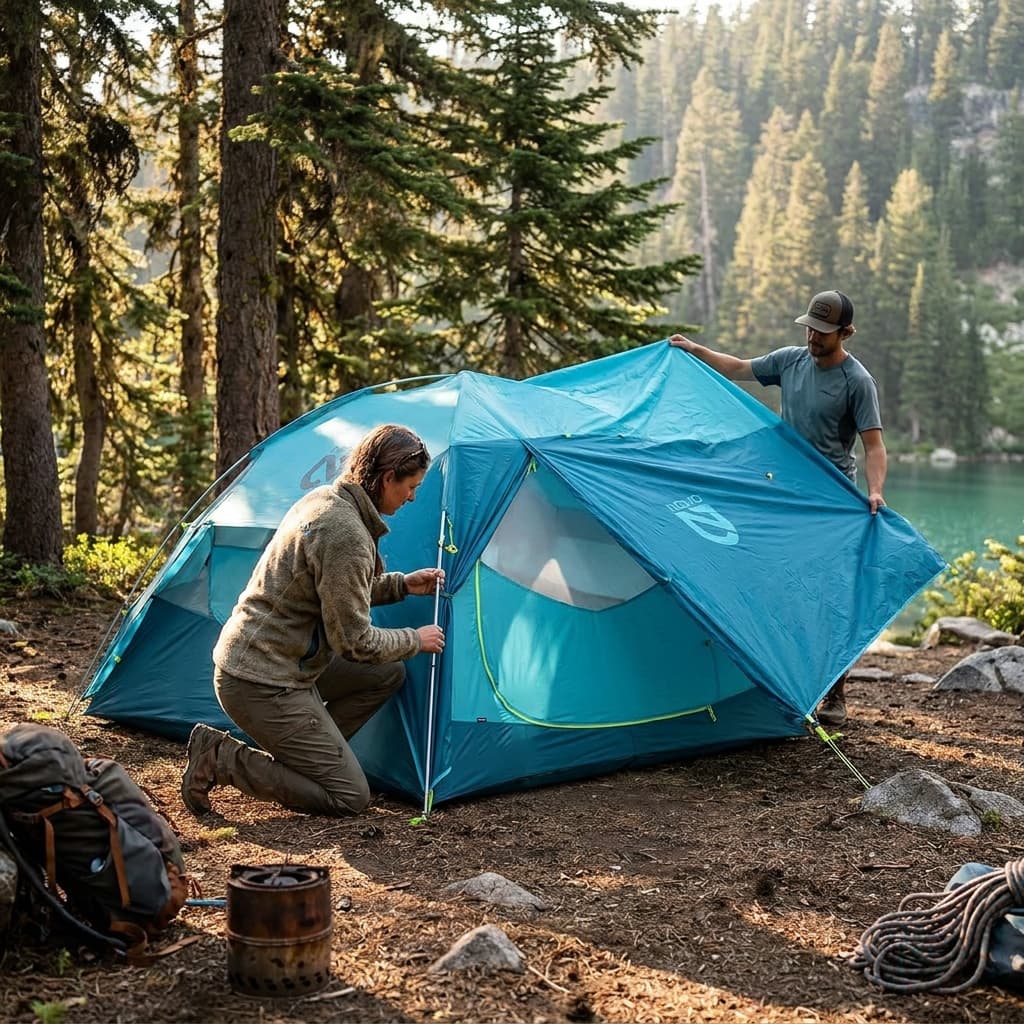
The Aurora Highrise is NEMO's take on the family car-camping tent: aluminum poles, a full-coverage fly, 75 inches (6 ft 3 in) of standing room, and a setup intuitive enough for first-timers without instructions. Aggregate owner sentiment on Reddit is 88% positive across 37 reviews, with setup speed and weather protection as the two most praised traits.
- Capacity
- 4 person
- Floor
- 100 x 90 in (62.5 sq ft)
- Peak height
- 75 in (6 ft 3 in)
- Weight
- 15 lbs 14 oz
- Poles
- Aluminum
- Rainfly
- Full-coverage, 1,200 mm polyester
More strengths
- Straightforward pole layout and an oversized duffel for easy packing
- 4-sided mesh windows with inside-operable controls keep condensation in check
Other tradeoffs
- Back door is a half-door only, which limits rear entry compared to the front
The Aurora Highrise is the substantial upgrade. Its 100 x 90 in floor provides 62.5 sq ft, its 75-inch peak height lets many adults stand, and steep sidewalls keep more of that height usable away from the center. Two large doors reduce traffic through a shared entrance, while two 19.5 sq ft vestibules create 39 sq ft of covered storage.
NEMO uses aluminum poles, a full-coverage fly, and a 150D polyester floor. The fly fabric is rated to 1,200 mm and the floor to 1,500 mm. A straightforward pole layout and an oversized duffel keep the design approachable even though it has more pieces than an instant tent.
At about $400 list, the Aurora Highrise only makes sense when camping is already likely to be a recurring activity. The reward is the best standing room, storage, entry layout, and material package in this group.
Read the full NEMO Aurora Highrise 4P review.
Best six person value: Kelty Wireless 6
BEST SIX PERSON VALUE
Kelty Wireless 6
Best for: Groups of four to six who want brand-name build without cabin-tent money.
- Six-person space from a long-running outdoor brand below premium-tent prices
- No instant or hub setup; this is a conventional pitch, just a well-designed one
Kit Score 8.3/10 · $279.95 Price checked Oct 25, 6:06 AM CDT · how we score gear
Buy on AmazonProduct details
The step between the budget four-person tents and the family cabins: a six-person from a real outdoor brand at a lower list price than the four-person NEMO, with the near-vertical walls that make a rating feel honest.
- Capacity
- 6 person
- Floor
- 117.5 x 10⁶ in (86.5 sq ft)
- Peak height
- 74 in
- Packed weight
- 19 lb
- Doors / vestibules
- 2 / 2 x 19.5 sq ft
- Poles
- 3 fiberglass, Quick Corners
More strengths
- Near-vertical walls make the interior feel bigger than the footprint suggests
- Simple freestanding pitch that two people manage without an argument
Other tradeoffs
- Stock of the 6-person size is thin: sold out on Kelty's site and sold on Amazon by a third-party seller in October 2026
The four-person tents above run out of room the moment a third sleeping pad appears. The Wireless 6 is the sensible next size: a six-person tent from Kelty, an outdoor brand since 1952, at a lower list price than the four-person NEMO. Kelty lists a 117.5 x 106 inch floor (86.5 sq ft), a 74-inch peak, two doors, and two 19.5 sq ft vestibules, with fully taped seams and a 19 lb packed weight.
It is a conventional pitch on three fiberglass poles rather than an instant one, and Kelty's Quick Corners help one person get it started. Outdoor Gear Lab calls it a budget-friendly option with good mesh. When buying on Amazon, confirm the listing is set to the 6-person size; it is currently sold by a third-party seller, not Amazon or Kelty.
Best for: Groups of four to six who want brand-name build without cabin-tent money.
Best for families: CORE 9 Person Instant Cabin
BEST FOR FAMILIES
CORE 9 Person Instant Cabin
Best for: Families of four or more who need rooms and standing height, not just floor space.
- Genuine family capacity: CORE rates it most comfortable for four people plus gear
- Big tents catch big wind; guy it out properly and skip exposed pitches
Kit Score 8.4/10 · $249.99 Price checked Oct 25, 6:06 AM CDT · how we score gear
Buy on AmazonProduct details
The family answer the four-person tents in this guide cannot give. Pre-attached poles stand it up in about two minutes, the divider makes a kids' room, and cabin walls mean adults actually stand up inside.
- Capacity
- 9 person rated; CORE says most comfortable for 4 plus gear
- Floor
- 14 x 9 ft
- Center height
- 78 in
- Weight
- 37 lb
- Setup
- About 2 minutes, pre-attached poles
- Rooms
- Removable divider splits it into two
More strengths
- Two-minute setup at a size where traditional tents take twenty
- Room divider and standing height turn camping into something closer to a cabin
Other tradeoffs
- Fabric and zips are built to the price, a tier below the NEMO and Gazelle
The family-scale answer. Nine-person rated, but CORE itself says it is most comfortable for four people plus gear, which is the honest arithmetic of airbeds and duffel bags. CORE lists a 14 x 9 ft floor, a 78-inch center height, pre-attached poles that stand it up in about two minutes, and a removable divider that makes a kids' room. Outdoor Gear Lab gives it a Best Buy as the best value in a bigger tent.
Two honest limits: big flat walls catch big wind, so guy it out and skip exposed pitches, and at 37 lb with a 48-inch packed length it needs a real trunk. The fabric and zips also sit a tier below the NEMO and Gazelle, which is where the price went.
Best for: Families of four or more who need rooms and standing height, not just floor area.
Best buy-once setup: Gazelle T4 Hub Tent
BEST BUY-ONCE
Gazelle T4 Hub Tent
Best for: Frequent car campers who are done fighting poles and sweeping floors.
- Fastest genuine setup in the guide, and takedown is nearly as quick
- Packs big and heavy: this is car camping kit with no pretence otherwise
Kit Score 8.7/10 · $377.93 Price checked Oct 25, 6:06 AM CDT · how we score gear
Buy on AmazonProduct details
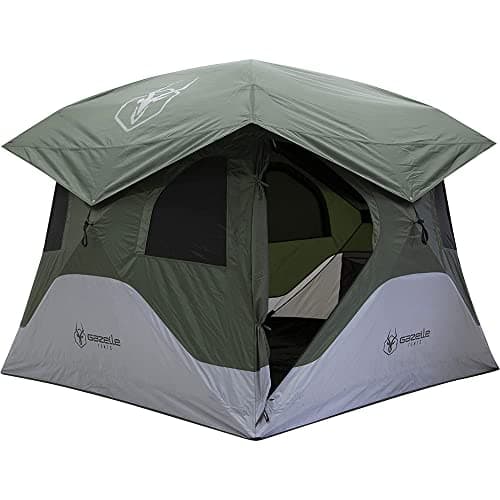
The hub tent that makes setup a non-event: pull the hubs, and a rigid cabin stands in about 90 seconds. The removable floor shakes clean in seconds, which anyone who has swept a tent with a dustpan will understand immediately.
- Setup
- About 90 seconds, hub pop-up
- Capacity
- 4 person
- Floor
- 94 x 94 in (61 sq ft), removable
- Peak height
- 78 in
- Weight
- 30 lb
- Weather
- 210D shell 2,000 mm, 300D floor 5,000 mm
More strengths
- Rigid hub frame once popped, with no loose poles to sort
- Removable floor unclips and shakes clean, the most underrated feature in family camping
Other tradeoffs
- The price of three budget tents, which only makes sense if you camp often
The T4 exists for people who have decided tent setup should be a non-event forever. Pull the hubs and a rigid cabin stands in about 90 seconds per Gazelle, with a 94 x 94 inch floor (61 sq ft) and a 78-inch peak. The floor unclips and shakes clean, which replaces the dustpan ritual entirely. Outdoor Gear Lab gives it a Top Pick as its favorite pop-up tent.
The costs are honest: Gazelle lists it at 30 lb and 66.5 inches packed, unapologetically car-camping kit, and it is the price of three budget tents. The arithmetic works if you camp often; it does not for two trips a summer.
Best for: Frequent car campers done with poles, sweeping, and setup arguments.
Why the Sundome 4 pick is paused
We removed the Coleman Sundome 4 purchase link on October 10, 2026. The Amazon listing we had linked showed "Currently unavailable" when checked, and the only four-person Sundome listing we found in stock came from a third-party seller at a price above the range our Sundome 4 review uses, so we did not swap it in. The review stays up for readers comparing tents. We will restore the pick when we can verify the same tent from Amazon or Coleman at a price that fits the budget slot.
Side-by-side comparison
| Spec | Coleman Skydome 4 | Coleman Instant Cabin 4 | NEMO Aurora Highrise 4P | Kelty Wireless 6 | CORE 9 Instant Cabin | Gazelle T4 |
|---|---|---|---|---|---|---|
| Kit Score | 7.5/10 | 7.4/10 | 8.6/10 | 8.3/10 | 8.4/10 | 8.7/10 |
| Price | $189.99 Price checked Oct 25, 6:06 AM CDT | $179.99 Price checked Oct 25, 6:06 AM CDT | $399.95 Price checked Oct 25, 6:06 AM CDT | $279.95 Price checked Oct 25, 6:06 AM CDT | $249.99 Price checked Oct 25, 6:06 AM CDT | $377.93 Price checked Oct 25, 6:06 AM CDT |
| Best for | Beginner couples or small families who want a reliable, fast-pitching shelter with solid rain coverage without spending more than $200. | Road trippers, solo parents, and mobility-limited campers who value a one-minute pitch more than compact storage or full-fly storm protection. | Beginners who want to invest once in a tent that will perform in rain, last several years, and never require a YouTube tutorial to pitch solo. | Groups of four to six who want brand-name build without cabin-tent money. | Families of four or more who need rooms and standing height, not just floor space. | Frequent car campers who are done fighting poles and sweeping floors. |
| Why it stands out | Pre-attached poles make solo setup straightforward | Pre-attached frame removes pole sorting and can be pitched by one person in about a minute | Aluminum poles and a full-coverage fly deliver genuine weather protection | Six-person space from a long-running outdoor brand below premium-tent prices | Genuine family capacity: CORE rates it most comfortable for four people plus gear | Fastest genuine setup in the guide, and takedown is nearly as quick |
| Tradeoff | 55-inch peak height means most adults cannot stand up inside | At 19.1 lb and almost 40 inches packed, it is a trunk-only shelter | At $400, it is the largest upfront investment of the group | No instant or hub setup; this is a conventional pitch, just a well-designed one | Big tents catch big wind; guy it out properly and skip exposed pitches | Packs big and heavy: this is car camping kit with no pretence otherwise |
| Rated capacity | 4 | 4 | 4 | 6 | 9 (4 plus gear, per CORE) | 4 |
| Floor | 8 x 7 ft | 8 x 7 ft | 100 x 90 in | 117.5 x 10⁶ in | 14 x 9 ft | 94 x 94 in |
| Peak height | 4 ft 7 in | 4 ft 11 in | 6 ft 3 in | 6 ft 2 in | 6 ft 6 in | 6 ft 6 in |
| Weight | 13.7 lb | 19.1 lb | 15 lb 14 oz | 19 lb packed | 37 lb | 30 lb |
| Setup | Pre-attached poles, under 5 min | Attached frame, about 1 min | Conventional poles | Conventional, three poles | Attached frame, about 2 min | Hub frame, about 90 sec |
| Weather layout | Full fly, 8 x 3.5 ft vestibule | Integrated vented top, no vestibule | Full fly, two 19.5 sq ft vestibules | Two 19.5 sq ft vestibules, taped seams | Rainfly, 1,200 mm | 2,000 mm shell, 5,000 mm floor |
Which one should you buy?
Match the tent to the trip
Buy the Skydome for a balanced first tent
It is the strongest default when you want a quick pitch, covered gear storage, and better rain coverage without entering the premium tier.
Buy the Instant Cabin to remove setup friction
Its attached telescoping frame is useful on road trips, late arrivals, and trips where one person handles the shelter.
Buy the Aurora Highrise for a long-term base camp
Its standing height, two doors, two vestibules, aluminum poles, and roomier geometry justify the spend for frequent campers.
Buy the Kelty Wireless 6 when the group outgrows four
Its 86.5 sq ft floor and 74-inch peak fit four to six people at a lower list price than the four-person NEMO.
Buy the CORE 9 for a family that wants rooms
The divider, 78-inch center height, and two-minute setup suit families, as long as the car can carry 37 lb.
Buy the Gazelle T4 if you camp often and hate setup
The hub frame stands in about 90 seconds, but it weighs 30 lb and costs the most here.
The two Coleman fast-pitch models look similar on price but solve different problems. See Coleman Skydome vs Instant Cabin for the direct weather-versus-speed decision. For capacity, fly, pole, and floor guidance before choosing any model, use our camping tent buying guide.
Frequently asked questions
What is the best camping tent for a beginner?
The Coleman Skydome 4 with Full-Fly Vestibule is the best default for one or two adults, or a small family packing efficiently. The pre-attached poles simplify setup, the separate full fly improves rain coverage, and the 8 x 3.5 ft vestibule keeps wet gear outside the sleeping floor.
What is the easiest beginner tent to set up?
The Coleman Instant Cabin 4 is the fastest in this group. Its frame stays attached, and Coleman specifies setup as fast as 60 seconds. The Skydome is the better choice when a separate full fly and vestibule matter more than saving a few minutes.
Is a 4-person tent comfortable for four adults?
Usually not. Four-person capacity means four sleeping positions can fit, not that four adults and their gear will have comfortable living space. A 4-person tent is generally comfortable for two adults with gear, workable for a couple with one or two children, and tight for four adults.
How much should a beginner spend on a camping tent?
Spend around $100 if camping is an experiment, around $180 to $200 for a fuller beginner package, or around $400 only if you already expect regular use and value standing room and premium materials. The best price depends more on trip frequency and weather exposure than on experience level.
Where these numbers come from
| Claim | Source | Checked |
|---|---|---|
| Skydome 4: under 5 minute setup, 8 x 7 ft, fits a queen air bed, 8 x 3.5 ft vestibule, 20% more headroom, tested to 35 mph winds, 4.6 ft center, 13.7 lb | Coleman, Skydome 4-Person with Full-Fly Vestibule | 2026-10-03 |
| Instant Cabin 4: setup as fast as 1 minute, 8 x 7 ft, 5 windows, 19.1 lb, about 40 in packed, no vestibule, 4 ft 11 in center | Coleman, 4-Person Cabin Tent with Instant Setup | Sep 2026 |
| Aurora Highrise 4P: 90 x 100 in floor, 62.5 sq ft, 75 in peak, two 19.5 sq ft vestibules, fly 1200 mm, 150D floor 1500 mm, 15 lb 14 oz, $399.95 list, sold out on NEMO's site | NEMO, Aurora Highrise | 2026-10-03 |
| Wireless 6P: $279.95 list, 117.5 x 10⁶ in floor, 86.5 sq ft, 74 in peak, two doors, two 19.5 sq ft vestibules, three fiberglass poles, 19 lb packed, fully taped seams, Quick Corners, sold out on Kelty's site | Kelty, Wireless 6P | 2026-10-03 |
| Kelty founded in 1952 | Kelty, who we are | Sep 2026 |
| CORE 9 Person Instant Cabin: setup in about 2 minutes, 14 x 9 ft floor, 78 in center, 37 lb, 48 x 11 x 11 in packed, removable divider, 1,200 mm rainfly, most comfortable for 4 plus gear | CORE Equipment, 9 Person Instant Cabin Tent | 2026-10-03 |
| Gazelle T4: 90-second setup, 94 x 94 in floor, 61 sq ft, 78 in peak, 30 lb, 66.5 in packed, removable 300D floor at 5,000 mm, 210D shell at 2,000 mm | Gazelle Tents, T4 Hub Tent | 2026-10-03 |
| Awards: CORE 9 Instant Cabin Best Buy (best value in a bigger tent); Gazelle T4 Top Pick (favorite pop-up); Coleman Instant Cabin top marks for ease of setup; Kelty Wireless 6 noted as a budget-friendly option | Outdoor Gear Lab, Best Camping Tents | 2026-10-03 |
| Seller and stock: Skydome, Instant Cabin, and Gazelle T4 sold by Amazon.com; Aurora Highrise by NEMO's Amazon store; CORE 9 by CORE's Amazon store; Kelty Wireless 6 (6P) by a third-party seller | Amazon listings B0D7QG7QS2, B0D7QK1N81, B08B2FGLV8, B0DF37K4TH, B00VFH1RQS, B0GDJ48QGR | 2026-10-03 |
Setup times and wind ratings are the makers' claims, not Kit Authority field tests.
Build the rest of the sleep system from the camp hub, or read how Kit Authority researches and scores gear.
Keep going
Complete loadoutCamp sleep systemFive coordinated pieces that solve shelter, insulation, cushioning, head support, and light for nights outside.Related guides
Our recommendations draw on manufacturer documentation, retailer listings, owner feedback, and comparisons with alternatives.
As an Amazon Associate I earn from qualifying purchases. We may earn a commission from links here, at no extra cost to you. How we research →