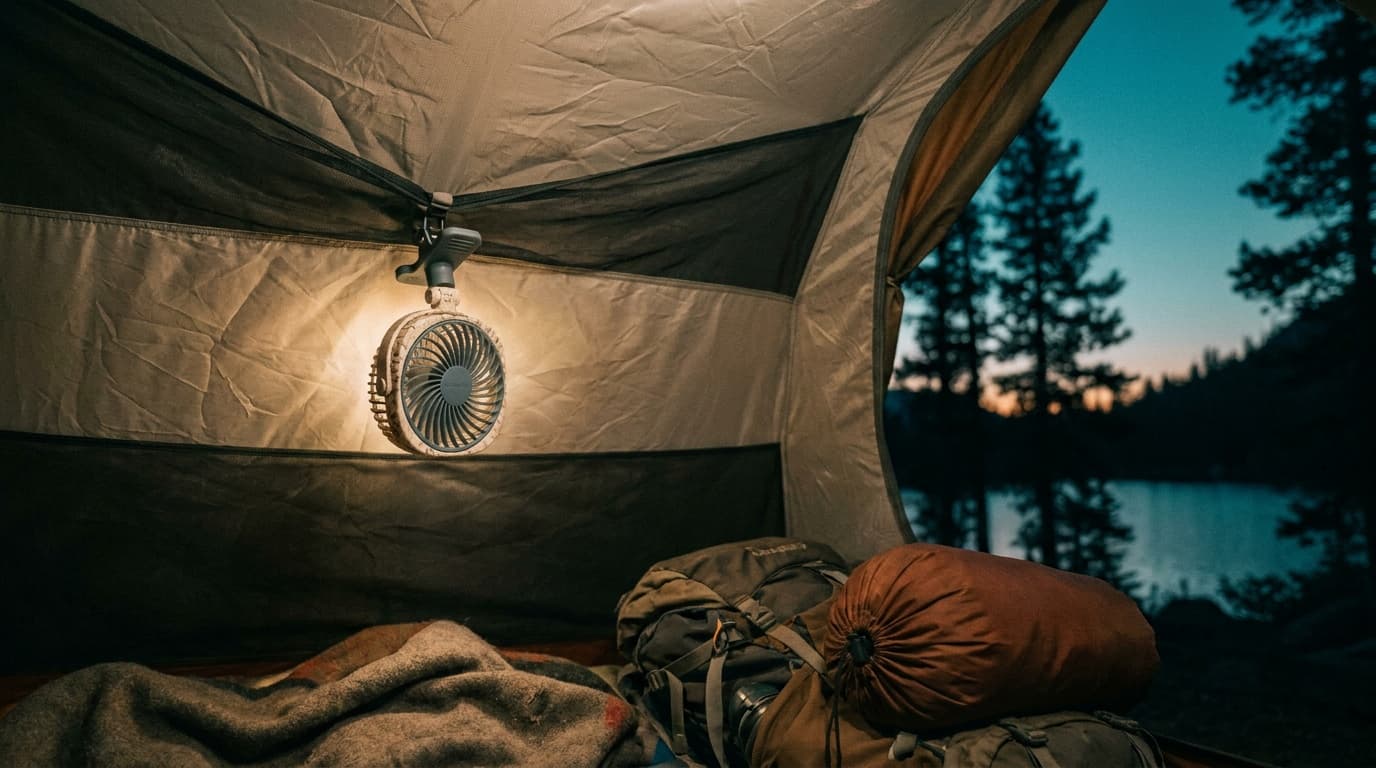
A hot tent is the fastest way to ruin an otherwise good camping trip. A good battery fan does not replace a cool evening breeze, but it makes the difference between sleeping and lying awake at 2 a.m. sweating through your pad. The four picks below are the ones worth buying in 2026.
Our quick picks
How we picked
Every fan here was evaluated against the Kit Score: verified airflow (CFM where published), battery capacity (mAh), stated runtime per charge, noise level at low and high settings, mounting options, recharge method, and value at street price. We aggregate manufacturer specs, third-party measurements where available, and verified-owner reviews across major retailers to surface the consensus performance picture.
The picks
Best overall
BEST OVERALL
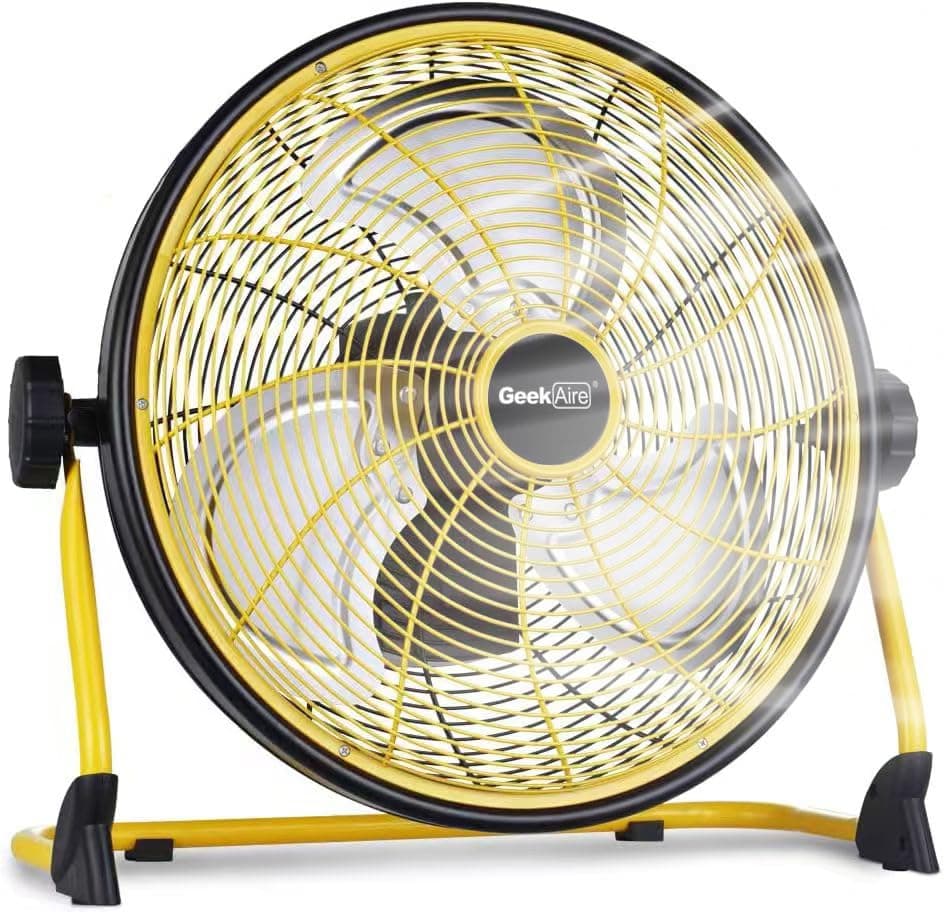
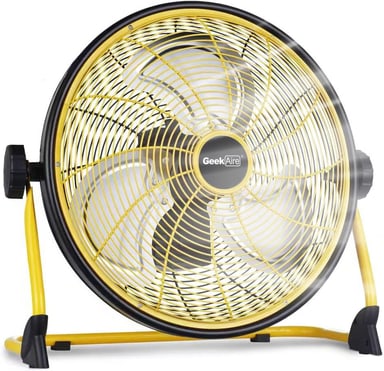
Geek Aire 16" Portable Battery Operated Floor Fan
Best for: Car campers, RV and van travellers who want the most airflow available from a rechargeable fan and have the space to carry it.
- 1,900 CFM is the highest airflow in this group, and metal blades move more air than plastic at the same diameter
- 22 by 22 inches is bulky: a car-camping and van fan, not one for a backpacking tent
Kit Score 8.2/10 · Check current price · how we score gear
Buy on AmazonProduct details
Geek Aire's 16-inch battery floor fan is the airflow pick for car campers and van builds: 1,900 CFM from metal blades on a brushless motor, a rated 24 hours on the lowest speed, and a full recharge in about three hours. The 360-degree tilt aims air directly at a sleeping pad, and IPX4 water resistance handles dew and light rain. It replaces the discontinued 12-inch CF1 in this guide. At 22 by 22 by 8 inches it is a genuinely large fan, which is the cost of the airflow.
- Airflow
- 1,900 CFM (manufacturer)
- Runtime
- Up to 24 hrs on the lowest speed (manufacturer)
- Charging
- Full charge in about 3 hrs
- Blade
- 16 in., metal, brushless motor
- Dimensions
- 22" W x 22" H x 8" D
- Placement
- Floor stand, 360-degree tilt, IPX4 water resistant
More strengths
- Rated 24 hours on low, so a multi-night trip does not need a recharge
- IPX4, non-slip feet and a carry handle suit real outdoor use
Other tradeoffs
- No LED light and no USB output, so it does not replace a lantern or a power bank
The Geek Aire 16-inch earns the top spot on raw airflow. Its 16-inch metal blades are the largest here, and metal moves more air per revolution than plastic at the same diameter. The listing rates it at 1,900 CFM, which is the outcome that matters when a tent is 95 degrees at 9 p.m.
The runtime is the other reason it leads: a rated 24 hours on the lowest speed, and a full recharge in about three hours. That covers several nights without a top-up. It stands on a floor base with 360-degree tilt to aim air at a sleeping bag or pad, and an IPX4 rating handles dew and light rain.
Two things to weigh before you buy. It is genuinely large at 22 by 22 by 8 inches, which makes it a car-camping, RV and van fan rather than one you carry to a backpacking site. And it does one job: no LED light, and the listing does not mention a USB output for charging a phone. If you want the multi-tool, the BougeRV F01 below is the better fit.
A note on this pick: the 12-inch Geek Aire CF1 held this slot until the listing we linked became unavailable. We re-picked within the same line rather than leaving a dead link, and every figure above is from the current 16-inch listing, checked September 9, 2026.
Best value
BEST VALUE
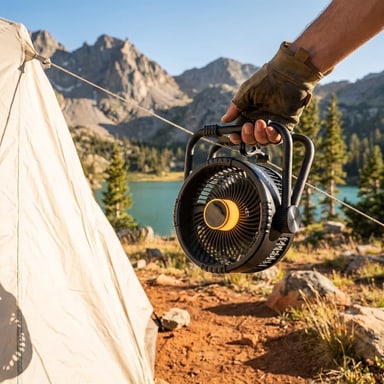
BougeRV F01 Portable Rechargeable Fan
Best for: Car campers and van-lifers who want multi-night battery life, a warm LED light, and phone-charging capability in one compact unit without crossing into premium pricing.
- 20,000 mAh battery covers three or more hot nights without a recharge
- App connectivity adds convenience but also complexity; some owners report occasional pairing drops
Kit Score 8.5/10 · $49.99 Price checked Oct 24, 3:33 PM CDT · how we score gear
Buy on AmazonProduct details
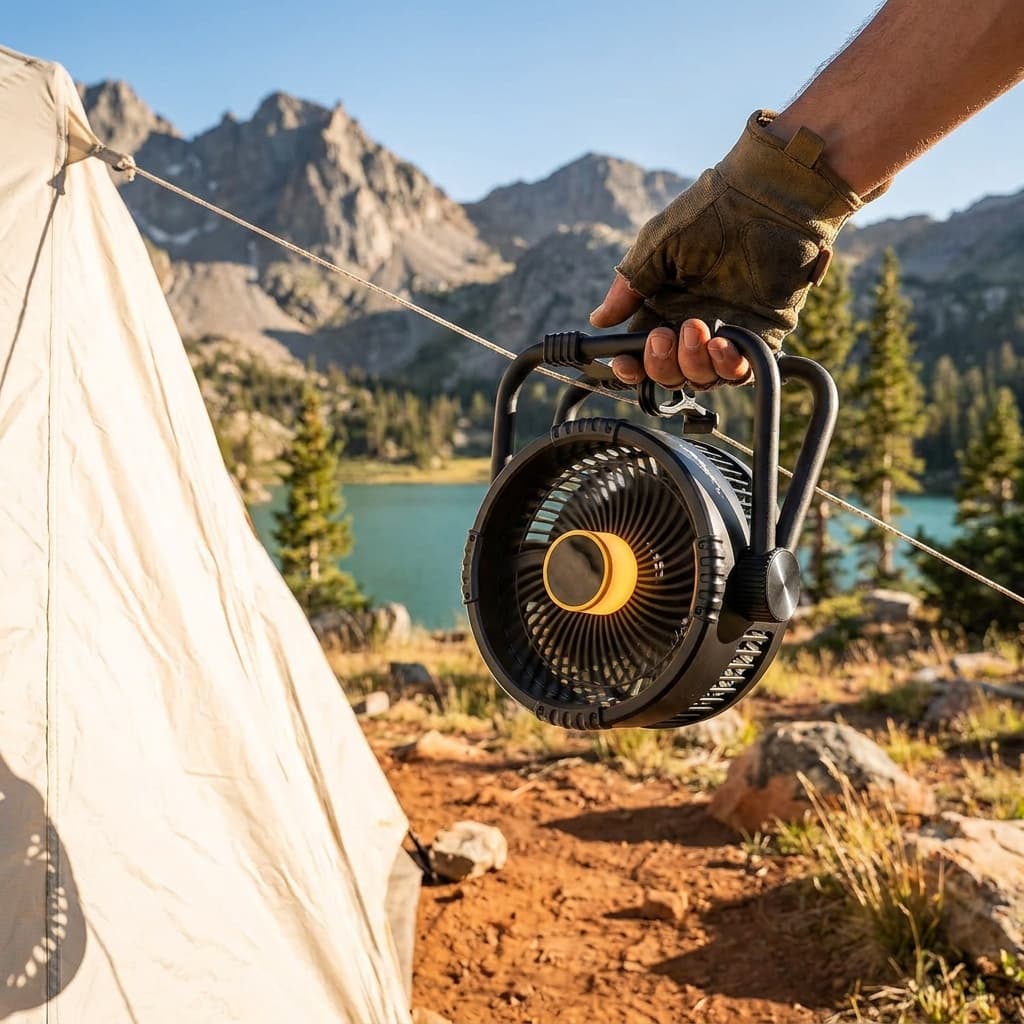
The BougeRV F01 pairs a 20,000 mAh battery with a quiet motor and full app control (49 ft Bluetooth range), covering multiple camping nights on one charge. The LCD display shows remaining runtime at a glance, and USB-C and USB-A outputs charge phones so you are not hunting for a separate power bank.
- Battery
- 20,000 mAh lithium-ion (built-in)
- Runtime
- Up to 33.5 hrs (low)
- Airflow
- Up to 5.4 m/s max wind speed
- LED Light
- 2-level warm LED; always-on or timed
- Charging
- USB-C and USB-A input; doubles as power bank
- Placement
- Hanging hook plus base stand; 270 tilt rotation
More strengths
- App and remote control with 1/2/4/6/8-hour timer means adjustments from your sleeping bag
- Built-in LED light and USB power-bank output add genuine multi-tool utility at this price
Other tradeoffs
- At 3.29 lbs it is not a backpacking choice, though it packs fine in a truck or van
The BougeRV F01 makes a case for itself with battery capacity alone. At low speed the F01 is rated for up to 33.5 hours from its 20,000 mAh battery, well past the Geek Aire's 24. That covers about four nights of eight-hour fan use at low speed. It is the most battery-efficient fan in this group for extended car-camping trips where you cannot plug in between nights.
The F01 also integrates a warm-toned LED light and USB-C and USB-A ports that can charge a phone. The light is not lantern-bright (it is ambient rather than task-level), but it handles the "I need to find my water bottle at 3 a.m. without a headlamp" situation cleanly. The phone-charging port means one fewer power bank in your kit.
Airflow is lower than the Geek Aire: the F01 uses a smaller blade and moves noticeably less air at high speed. For personal cooling in a two-person tent that is sufficient. For a large family tent or a van with poor cross-ventilation, the Geek Aire's 16-inch blade wins. The F01 also packs far smaller, sits below the Geek Aire on price, and does more jobs, which is the definition of value.
Editor's choice
EDITOR'S CHOICE
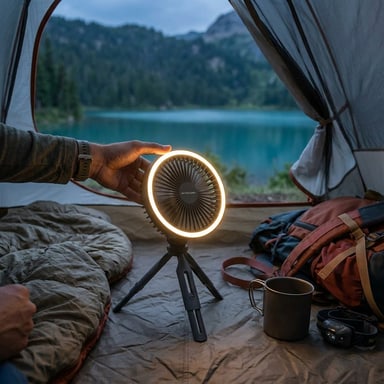
Nitecore NEF10 Multifunctional Portable Fan
Best for: Campers who prioritize quiet sleep comfort and need a dual-purpose fan and lantern that mounts on a tripod or carabiner with a reputation-backed build from Nitecore.
- Lowest noise floor of any rechargeable fan in this class (about 45 dBA on low in a third-party measurement), making overnight use genuinely unobtrusive
- Not waterproof: a long rain session can cause moisture ingress; keep it inside the tent or under a canopy
Kit Score 8.5/10 · $49.95 Price checked Oct 24, 3:33 PM CDT · how we score gear
Buy on AmazonProduct details
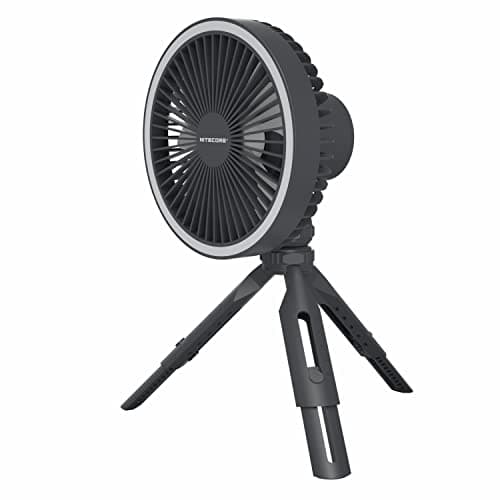
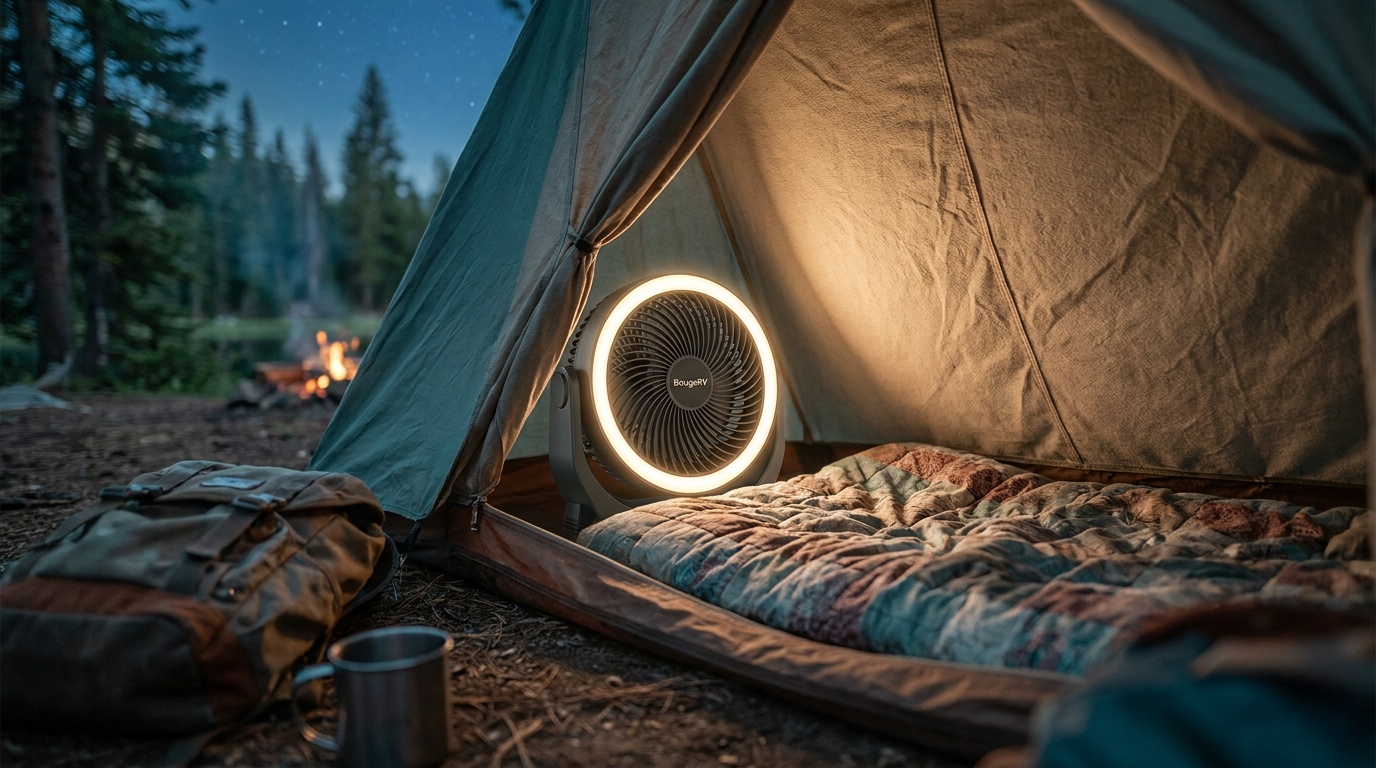
The Nitecore NEF10 wraps a brushless motor, a frosted LED ring light, and a 10-watt power bank into a single 23-ounce package that attaches to any standard camera tripod. It is the quietest fan in this roundup at comparable airflow speeds, making it the one to reach for when noise is the deciding factor.
- Battery
- 10,000 mAh lithium-ion (built-in)
- Runtime
- 8 hrs (high), 13 hrs (mid), 27 hrs (low fan); LED up to 100 hrs
- Airflow
- Up to 4.0 m/s (about 45 / 56 dBA low / high in a third-party measurement)
- LED Light
- Integrated ring light: 34 / 71 / 124 lm, 3 modes
- Charging
- USB-C input (4.5 hr); USB-A output (power bank, 10W)
- Placement
- 5-height ball-head tripod; carabiner hanging; 1/4" tripod thread
More strengths
- Frosted LED ring produces even, shadow-free tent light at three brightness levels with up to 100 hours of runtime
- Ball-head tripod with 1/4-inch thread mounts on any camera tripod, a useful option for van builds with existing mounts
Other tradeoffs
- 10,000 mAh battery is half the capacity of the BougeRV F01, limiting multi-night use to low-speed settings
The Nitecore NEF10 is the right pick for campers whose main complaint is not heat but noise. Most battery camping fans produce a low-frequency hum at any speed setting. Its low setting is the one owner reviews consistently describe as genuinely quiet: close to inaudible at sleeping distance. That is a meaningful differentiator for light sleepers, couples where one partner is heat-sensitive and the other is sound-sensitive, or backpackers using a smaller tent where the fan is physically closer to your head.
Nitecore is a flashlight and lighting brand, not a fan brand, and the NEF10 reflects that pedigree: the LED ring light (three brightness levels, up to 100 hours on low) is better-built and more evenly diffused than the ambient lights on competing combo units. The fan and light run independently or together. The unit attaches to a standard tripod thread, clips to a carabiner, or hangs from a tent loop, giving it more mounting flexibility than any other fan in this group.
The 10,000 mAh battery is half the BougeRV's, and Nitecore rates the fan at up to 27 hours, so multi-night runtime requires conservative speed settings. It can also charge a phone from its USB-A port. At street price of $55–$70, the NEF10 is competitive with the BougeRV F01. The trade-off is battery capacity and airflow for quiet operation and a more refined lamp. For anyone whose priority is sleeping well rather than maximum air volume, it is the correct choice.
Best budget
BEST BUDGET
Odoland Portable LED Camping Lantern with Ceiling Fan
Best for: Budget-first buyers, festival-goers, and anyone who wants a combined tent light and overhead fan under $20 and does not mind keeping D batteries on hand.
- Under $20 and available at virtually every outdoor retailer makes it an easy grab-and-go first fan
- D-cell dependency adds ongoing cost and inconvenience vs. rechargeable alternatives, especially for multi-week trips
Kit Score 6.9/10 · $19.99 Price checked Oct 24, 3:33 PM CDT · how we score gear
Buy on AmazonProduct details
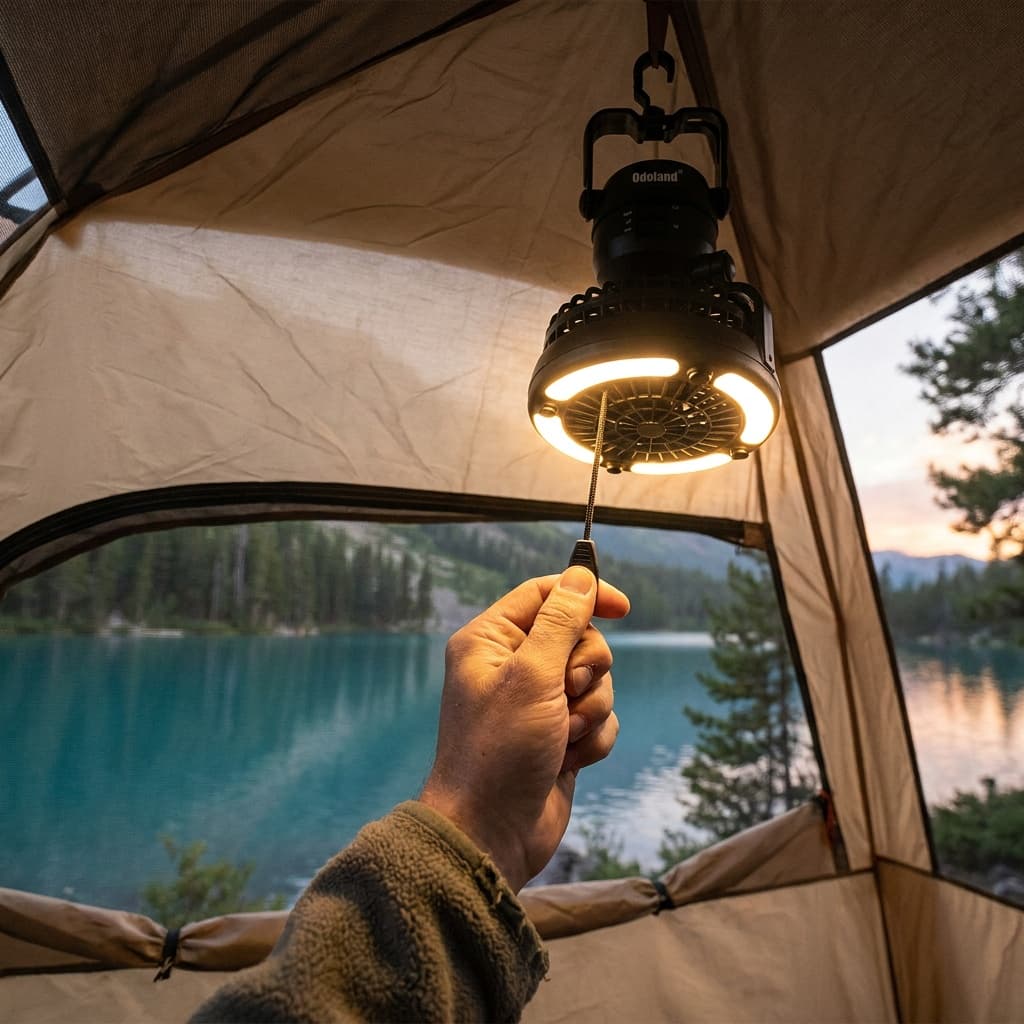
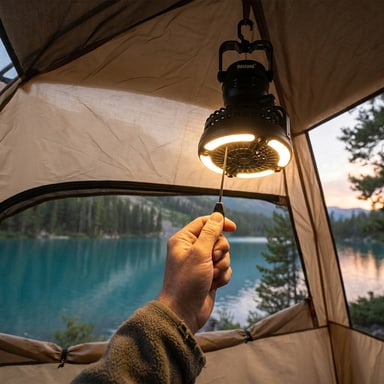
The Odoland is a hang-it-and-forget-it tent fan that collapses flat, weighs about a pound, and clips from any tent loop. The 18-LED array lights the tent while the fan circulates air overhead, all powered by two D cells that most camp stores carry.
- Power
- 2 D-cell batteries (not included)
- Runtime
- 5 hrs fan (high) / 15 hrs fan (low); up to 20 hrs light
- Airflow
- Up to 10 ft/s (about 3 m/s); 180 rotation; 70-inch reach
- LED Light
- 18 LEDs; 2 brightness modes
- Charging
- No recharge; D-cell replacement only
- Placement
- Hanging hook, folding stand; collapses flat for packing
More strengths
- Hanging design overhead circulates air throughout the tent rather than pushing it from one direction
- 18-LED lantern is bright enough to light a 4-person tent while the fan runs simultaneously
Other tradeoffs
- Plastic construction is fragile: owner reviews consistently flag cracking from minor drops and a hook that can fail under load
The Odoland lantern fan is a fundamentally different product from the other three: it runs on D batteries, hangs from a tent ceiling hook, and combines an LED lantern with an overhead fan in a unit that costs under $22. It is not trying to compete on airflow or battery capacity. It is trying to be the thing you clip above your head that makes a hot tent more tolerable while also lighting it, for less than the cost of a fast-food dinner for two.
The ceiling-mount format is the right form factor for certain campers. If you sleep in a tent with a central hang point and want both light and air movement overhead without routing anything across the floor, the Odoland works cleanly. It is also a natural fit for festival camping: lightweight, cheap enough to lose or replace, no charging cable to manage if you keep a spare pack of D cells.
The limits are real: D-cell batteries cost money over time, the airflow at any setting is gentle rather than powerful, and the fan noise is higher relative to its output than the rechargeable picks. Owner reviews flag runtime variability depending on battery brand. For buyers willing to accept those trade-offs for a sub-$22 price, there is nothing closer to this feature set at this cost.
Comparison
| Product | Kit Score | Price | Best for |
|---|---|---|---|
| Geek Aire 16" Portable Battery Operated Floor Fan | 8.2 | Check current price | Best for: Car campers, RV and van travellers who want the most airflow available from a rechargeable fan and have the space to carry it. Why it stands out: 1,900 CFM is the highest airflow in this group, and metal blades move more air than plastic at the same diameter Tradeoff: 22 by 22 inches is bulky: a car-camping and van fan, not one for a backpacking tent |
| BougeRV F01 Portable Rechargeable Fan | 8.5 | $49.99 Price checked Oct 24, 3:33 PM CDT | Best for: Car campers and van-lifers who want multi-night battery life, a warm LED light, and phone-charging capability in one compact unit without crossing into premium pricing. Why it stands out: 20,000 mAh battery covers three or more hot nights without a recharge Tradeoff: App connectivity adds convenience but also complexity; some owners report occasional pairing drops |
| Nitecore NEF10 Multifunctional Portable Fan | 8.5 | $49.95 Price checked Oct 24, 3:33 PM CDT | Best for: Campers who prioritize quiet sleep comfort and need a dual-purpose fan and lantern that mounts on a tripod or carabiner with a reputation-backed build from Nitecore. Why it stands out: Lowest noise floor of any rechargeable fan in this class (about 45 dBA on low in a third-party measurement), making overnight use genuinely unobtrusive Tradeoff: Not waterproof: a long rain session can cause moisture ingress; keep it inside the tent or under a canopy |
| Odoland Portable LED Camping Lantern with Ceiling Fan | 6.9 | $19.99 Price checked Oct 24, 3:33 PM CDT | Best for: Budget-first buyers, festival-goers, and anyone who wants a combined tent light and overhead fan under $20 and does not mind keeping D batteries on hand. Why it stands out: Under $20 and available at virtually every outdoor retailer makes it an easy grab-and-go first fan Tradeoff: D-cell dependency adds ongoing cost and inconvenience vs. rechargeable alternatives, especially for multi-week trips |
Geek Aire 16" Portable Battery Operated Floor Fan
- Best for
- Car campers, RV and van travellers who want the most airflow available from a rechargeable fan and have the space to carry it.
- Why it stands out
- 1,900 CFM is the highest airflow in this group, and metal blades move more air than plastic at the same diameter
- Tradeoff
- 22 by 22 inches is bulky: a car-camping and van fan, not one for a backpacking tent
BougeRV F01 Portable Rechargeable Fan
- Best for
- Car campers and van-lifers who want multi-night battery life, a warm LED light, and phone-charging capability in one compact unit without crossing into premium pricing.
- Why it stands out
- 20,000 mAh battery covers three or more hot nights without a recharge
- Tradeoff
- App connectivity adds convenience but also complexity; some owners report occasional pairing drops
Nitecore NEF10 Multifunctional Portable Fan
- Best for
- Campers who prioritize quiet sleep comfort and need a dual-purpose fan and lantern that mounts on a tripod or carabiner with a reputation-backed build from Nitecore.
- Why it stands out
- Lowest noise floor of any rechargeable fan in this class (about 45 dBA on low in a third-party measurement), making overnight use genuinely unobtrusive
- Tradeoff
- Not waterproof: a long rain session can cause moisture ingress; keep it inside the tent or under a canopy
Odoland Portable LED Camping Lantern with Ceiling Fan
- Best for
- Budget-first buyers, festival-goers, and anyone who wants a combined tent light and overhead fan under $20 and does not mind keeping D batteries on hand.
- Why it stands out
- Under $20 and available at virtually every outdoor retailer makes it an easy grab-and-go first fan
- Tradeoff
- D-cell dependency adds ongoing cost and inconvenience vs. rechargeable alternatives, especially for multi-week trips
How to choose the right camping fan
Match the fan form factor to your shelter
Floor fans (Geek Aire 16-inch, BougeRV F01) direct airflow at a specific angle and are easiest to position for direct personal cooling. They work well in tents, van builds, and cabin camping where there is floor space. Ceiling/hanging fans (Odoland, Nitecore NEF10 on a hook) circulate air across the whole tent interior, which is better for ambient cooling than targeted airflow. Clip fans attach to tent poles or mesh pockets and are the lightest option, though none of the picks in this group are clip format. If you are in a small solo tent, any floor fan pointed at your sleeping bag is effective. If you are in a large family tent, a hanging or ceiling fan covers more of the space.
Battery capacity versus airflow
Higher CFM (cubic feet per minute of air moved) and longer battery life pull against each other: a larger blade moving more air draws more current and drains the battery faster. The Geek Aire 16-inch resolves this with a big cell and a brushless motor: it is rated for 24 hours on low, though high-speed runtime is far shorter and Geek Aire does not publish that figure. The BougeRV F01 extends runtime by moving less air per unit time. If you are camping in extreme heat (above 95 F) and need the fan at high speed all night, a power bank or a campsite electrical hookup changes the calculus: the CFM number matters more, battery life less. A fan helps with comfort, but the CDC notes that when temperatures are really hot, fans will not prevent heat-related illness, so plan shade, water, and a cooler place to retreat to.
USB recharge versus D batteries
Rechargeable fans (Geek Aire, BougeRV, Nitecore) cost less per hour of runtime over time, are lighter when the cell is built in, and fit the existing charging ecosystem of a modern camp kit. The risk is forgetting to charge before you leave. D-cell fans (Odoland) are recoverable at any gas station or camp store, which matters for unplanned trips or festival camping where charging infrastructure is unreliable.
Built-in LED: when it matters
Combo fan-lights (BougeRV F01, Nitecore NEF10, Odoland) reduce the number of separate items in your kit. The Nitecore's light is the most capable of the three: it is designed by a lighting company and shows. The BougeRV's light is warm-toned and ambient: useful for finding gear at night, not for reading. The Odoland's light is the primary function of the unit and is adequate for small-tent illumination. If you already carry a dedicated lantern (see our best camping lanterns guide), a combo light is a bonus. If the fan is the only lighting source in your shelter, the Nitecore or Odoland is worth the consideration.
Noise in practice
Fan noise matters most for light sleepers and for situations where two people have different temperature preferences. Stated dB numbers from manufacturers are inconsistently measured and not comparable across brands. The more reliable signal is verified owner reviews filtered for comments about sleep disruption. The Nitecore NEF10 has the strongest consistent signal for quiet operation in this group. The Geek Aire 16-inch is the loudest at high speed. The BougeRV F01 sits between them.
How to get the most from a battery camping fan
Charge before you leave
The rechargeable picks here need about 3 to 5 hours to reach full charge from empty. Build a charge step into your gear-prep day, not the morning of departure.
Pick the right speed for the temperature
High speed drains the battery three to six times faster than low, going by these fans' rated runtimes. Start at medium, adjust up only if needed. You preserve battery and reduce noise without sacrificing much perceived airflow.
Position for flow, not proximity
A fan blowing across your body from the foot of the sleeping bag is more effective than one aimed directly at your face. It moves air over a larger surface area and is less disruptive to sleep.
Vent the tent
A fan circulating stale hot air inside a sealed tent is less effective than a fan drawing in cooler outside air. Unzip mesh panels on the opposite side of the tent from the fan intake to create cross-flow.
Pair with a power bank on hot trips
On nights above 85 F you may need the fan at medium-high for six or more hours. A 10,000 mAh power bank adds roughly half a charge to the 20,000 mAh BougeRV and most of a charge to the 10,000 mAh Nitecore, and covers phone charging too.
The best camping fan is the one you charged at home, not the most powerful one in the catalog.
Complete the hot-weather sleep setup
Airflow works best when the shelter can release heat. Start with how to keep a tent cool, then get your body off the warm ground with a camping cot or a camping air mattress. If you already own a fan, these changes usually improve sleep more than buying a second one.
Where these numbers come from
| Claim | Source | Checked |
|---|---|---|
| Geek Aire 16-inch: 1,900 CFM, brushless motor, aluminum blades, up to 24 hr on lowest speed, about 3 hr to charge, IPX4, 360-degree tilt, 22 x 22 x 8 in | Geek Aire 16-inch listing on Amazon, ASIN B0GQG8N88T | Sep 2026 |
| BougeRV F01: 20,000 mAh battery, up to 33.5 hr on low, 5.4 m/s airflow, 3.29 lb, USB-C and USB-A output | BougeRV, F01 portable fan | Sep 2026 |
| Nitecore NEF10: 10,000 mAh, fan runtime 27 hr max, 4.0 m/s max wind, LED ring light with 3 levels and 100 hr max, 655 g, 4.5 hr charge, USB-A power bank output | Nitecore, NEF10 | Sep 2026 |
| Nitecore NEF10 fan runtime by speed: 8 / 13 / 27 hr | Nitecore Store, NEF10 | Sep 2026 |
| Odoland lantern fan: runs on D cells, about 15 hr fan on low, 5 hr on high, up to 20 hr LED, 18 LEDs | Odoland listing on Amazon, ASIN B016HM7QRE | Sep 2026 |
| Fans may provide comfort but won't prevent heat-related illness when temperatures are really hot | CDC, heat and people without air conditioning | Sep 2026 |
We have not run these fans in a tent. Airflow, battery, and runtime figures are the makers' ratings; noise notes summarize owner feedback.
Frequently asked questions
What is the best camping fan for a tent?
For car campers with room to pack it, the Geek Aire 16-inch delivers the highest raw airflow here at a rated 1,900 CFM. If you want multi-night battery life without carrying a separate power bank, the BougeRV F01's 20,000 mAh battery is rated for up to 33.5 hours on low, about four nights. Light sleepers should prioritize the Nitecore NEF10 for its quiet low setting. The right answer depends on whether your priority is maximum airflow, extended runtime, or quiet operation.
How long does a battery-powered camping fan last on one charge?
Runtime varies widely by fan size, speed setting, and battery capacity. At low speed, the BougeRV F01 (20,000 mAh) is rated for up to 33.5 hours. The Geek Aire 16-inch is rated up to 24 hours on its lowest speed; the manufacturer does not publish a high-speed figure. The Nitecore NEF10 (10,000 mAh) is rated for 8 hours on high and up to 27 on low. Expect real-world runtime to come in under the ratings, which assume ideal conditions. Plan on two to three nights of use from a full charge at medium speed for most rechargeable fans, and bring a 10,000 mAh power bank for trips longer than three nights.
Can I use a camping fan in a van or car camping setup?
Yes, all four picks here work in van or car camping contexts. Floor fans (Geek Aire 16-inch, BougeRV F01) sit on a surface and direct airflow toward a sleeping platform. The BougeRV F01 is a common recommendation in van-life forums because its 20,000 mAh battery, USB-C and USB-A output ports, and compact size fit well in tight spaces. For permanent van builds with 12V electrical systems, a dedicated 12V fan (not covered in this guide) will outperform any USB-battery fan on sustained runtime, but for occasional or weekend van use, the rechargeable picks here are a practical starting point.
The four fans above cover the full range from maximum airflow to budget tent combo to quiet sleep performance. Browse the full camp gear guides or read more about how we research and rate gear.
Keep going
Related guides

 Complete camp loadoutCar-camping starter kitBuild the complete kit
Our recommendations draw on manufacturer documentation, retailer listings, owner feedback, and comparisons with alternatives.
As an Amazon Associate I earn from qualifying purchases. We may earn a commission from links here, at no extra cost to you. How we research →