We may earn a commission from links on this page, at no extra cost to you.
An air mattress is the fastest way to make a tent sleep like a bedroom, and the specs that matter are not the ones on the front of the box. Height, pump type, and sizing against your tent floor decide whether you sleep well or wake up on the ground at 3 a.m.
The two families: tent-floor mattresses vs in-vehicle beds
The first decision is where the mattress goes, because the two categories do not interchange.
Tent-floor mattresses are the familiar rectangles: twin, queen, and occasionally king, in single height (8–10 inches) or double height (17–22 inches). They assume a flat tent floor and room to walk around. This is what most people mean by a car camping mattress, and it is what our roundup of the best camping air mattresses covers pick by pick.
SUV and back-seat mattresses are shaped for vehicle interiors: tapered blocks that fill a cargo area with the rear seats folded, or segmented cushions that bridge the footwell behind the front seats. They run smaller (roughly 54–60 inches wide and 70–75 inches long for SUV models) and often inflate in sections so you can tune the fit around wheel wells. If you sleep in the vehicle for road trips or trailhead nights, buy this shape; a standard queen is 60 by 80 inches of rectangle that will bow against the walls of almost any cargo area and leave gaps at the corners.
Pump types: 120V vs 12V vs rechargeable
Pump choice determines where you can actually inflate the thing, and it is the spec most buyers skip.
Built-in 120V pumps are the most convenient and the most common on household-brand queens: plug in, hold a button, and the bed inflates in 3–5 minutes. The catch is the outlet. At a campground with electrical hookups or with a portable power station in the trunk, they are effortless. At a primitive site with neither, a 120V-only mattress is a pool float.
12V pumps plug into a vehicle's accessory socket, which makes them genuinely self-sufficient for car camping. Inflation is slower (5–8 minutes is typical) and you need the vehicle within cord reach of the tent.
Rechargeable pumps (standalone USB-charged units) are the most flexible: charge at home, inflate anywhere, and most will top up a softening mattress several times per charge. They also double for pool toys and paddleboard bags. The tradeoff is one more battery to keep charged and a pump you can forget at home.
Whatever the pump, arrive-and-inflate discipline matters: inflate the mattress when you pitch the tent, then top it up before bed. Air compresses as evening temperatures drop, and a mattress that felt firm at 4 p.m. feels half-flat at 10 p.m. That sag is physics, not a leak.
Height: comfort, cold, and tent headroom
Double-height mattresses (17–22 inches) are dramatically easier to get in and out of, especially for anyone with hip or knee issues, and they feel the most like a real bed. Single-height mattresses (8–10 inches) are lighter, pack smaller, inflate faster, and sit lower in tents with limited headroom.
Height has a hidden cost: more air volume means more cold air under you and longer inflation times. A 22-inch queen can hold well over twice the air of a 9-inch model, which matters both to your pump and to nighttime heat loss.
The insulation problem: air is cold
This is the spec nobody prints on the box. An air mattress is a giant pocket of circulating air, and circulating air strips body heat. Most air mattresses have an effective R-value near zero, compared to R-2 to R-7 for purpose-built sleeping pads. Below about 60°F, an uninsulated air mattress will feel cold through any sleeping bag, because the bag's underside insulation compresses flat under your weight.
The fixes are cheap: a closed-cell foam pad or an insulated sleeping pad on top of the mattress, a wool blanket between mattress and sleeping bag, or a fitted foam topper. Our guides on what sleeping pad R-value you need and how to keep an air mattress warm while camping cover the numbers and the layering order. If you are still deciding between the two sleep systems entirely, the tradeoffs are laid out in our air mattress vs sleeping pad comparison.
Size it against your tent floor, not your bed at home
A queen air mattress is 60 by 80 inches, and double-height models flare slightly wider at the base. Measure your tent floor before buying:
- A typical "4-person" dome tent has a floor around 8 by 7 feet: a queen fits, but it owns the tent, leaving a narrow strip for gear and shoes.
- A 6-person cabin tent (roughly 10 by 9 feet) fits a queen plus walking room, or two twins side by side.
- Sloped tent walls steal usable floor space. A double-height queen pushed against a dome wall will press into the fabric, wicking condensation onto your bedding.
Two twins are often smarter than one queen for couples: no motion transfer when one person rolls over, independent firmness, and more flexible tent layouts.
Quick sizing checklist before you buy
Measure the tent floor
Compare against the mattress footprint plus 6 inches of margin on the door side for entry and exit.
Check the height against tent walls
Double-height mattresses plus a seated adult need roughly 48 inches of headroom at the mattress location.
Confirm your power plan
Hookup site or power station means 120V is fine; primitive sites mean 12V or rechargeable.
Weigh capacity honestly
Two adults plus a dog on a 500 lb rated mattress is fine; the same load on a 300 lb budget twin is a slow leak waiting to happen.
Durability and puncture care
Most car camping mattresses are PVC with a flocked top; better models add internal coil or beam structures that keep the surface flat as pressure drops. Owner-reported failures are rarely dramatic blowouts. They are slow leaks at seams and valves, and ground debris punctures.
The prevention habits that show up consistently in long-term owner feedback:
- Lay a ground sheet, moving blanket, or the tent's own footprint under the mattress, even inside the tent. Grit gets tracked in.
- Sweep the tent floor before inflating, and keep dogs' nails and boot heels off the mattress.
- Store the mattress loosely folded and fully dry; PVC creased hard in a stuff sack for months cracks along the fold lines.
- Pack the patch kit, and add a tube of vinyl cement. Cold-weather patches without cement lift at the edges. A leak you can find with soapy water is a five-minute fix at camp.
New PVC mattresses also stretch during the first two or three nights of use, which reads as a leak but is not; expect to top up nightly at first.
What the good ones cost
The car camping air mattress market clusters into three honest tiers. Budget models ($30–$80) get you a basic queen, usually with thinner PVC and a louder pump; the Intex Dura-Beam Comfort Plush is the standout here, delivering 22 inches of height for under $80. The midrange ($80–$150) buys internal coil structures, better air retention, and quieter pumps; the SoundAsleep Dream Series has been the category benchmark for years on exactly those grounds. Camping-specific models in the same band trade some plushness for materials that tolerate outdoor humidity and temperature swings. Above $150 you are paying for pillow-top fabrics and faster pumps, worth it for frequent use, unnecessary for two trips a year.
For the full field with head-to-head specs, see the best camping air mattresses roundup.
FAQ
What size air mattress fits in a car or SUV?
Standard rectangular mattresses generally do not fit vehicle interiors well. Purpose-built SUV mattresses run roughly 54–60 inches wide and 70–75 inches long with tapered or segmented shapes that work around wheel wells, and back-seat mattresses inflate in sections to bridge the footwell. Measure your cargo area with the seats folded (length at the floor, width between wheel wells) and compare against the mattress's deflated-fit diagram before buying.
Why does my air mattress feel deflated in the morning?
Usually it is not a leak. Air contracts as overnight temperatures drop, so a mattress inflated in a warm afternoon loses noticeable firmness by dawn, and new PVC also stretches over its first few nights. Top up before bed for the first several uses. If it still sags after warm nights and a break-in period, check the valve first, then spray seams with soapy water and watch for bubbles.
Do I need a sleeping pad on top of an air mattress?
In warm weather, no. Below about 60°F, yes: an air mattress has an R-value near zero, and the circulating air inside pulls heat through your compressed sleeping bag. A foam pad, insulated sleeping pad, or wool blanket layered on top of the mattress blocks that loss. A pad rated around R-2 to R-3 covers most three-season car camping.
How high should a car camping air mattress be?
Double height (17–22 inches) is the comfortable default for tent camping: easier to get up from, more bed-like, and more tolerant of gradual air loss. Choose single height (8–10 inches) when tent headroom is tight, when you want faster inflation with less pump capacity, or when packed size matters. Anyone with knee, hip, or back issues should default to double height.
Are air mattresses worth it over sleeping pads for car camping?
If you drive to your site and sleep warm-season, an air mattress delivers more comfort per dollar than any pad. Pads win on insulation, reliability, and packed size, which is why they own backpacking and cold-weather trips. Many car campers end up using both together: mattress for comfort, pad on top for warmth.
For specific picks by budget and use, start with the best camping air mattresses. Browse more camp gear guides, or read how we research and rate.
Recommended gear
Our current top picks from the Best camping air mattresses for car camping (2026) guide, if you are ready to buy.
SOUNDASLEEP PRODUCTS
SoundAsleep Dream Series Luxury Air Mattress (Queen)
Best Overall
Kit Score 7.8/10
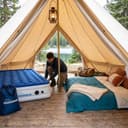
The Dream Series uses 40 internal ComfortCoil air coils and a 1-click built-in pump to deliver consistent, level support and inflate in under 4 minutes. Its multilayer puncture-resistant PVC and SureGrip bottom make it a dependable pick for tent-floor car camping.
Best for: Car campers who want a coil-supported, bed-like feel and the convenience of an integrated pump, at a mid-range price.
- 40 internal air coils distribute weight evenly and prevent the hammock sag common on cheaper mattresses
- Built-in 1-click pump inflates fully in under 4 minutes with no separate hardware needed
- Some owners report air leaks or seam failures within the first year of regular use
- Inflated dimensions
- 80 x 60 x 19 in (queen)
- Height
- 19 in (double-high)
- Pump
- Built-in 1-click AC pump
- Materials
- Multilayer eco-friendly PVC, flocked top
- Chambers
- Dual-chamber, SureGrip bottom
- Included
- Carry bag
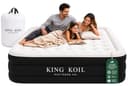
King Koil's coil-beam queen inflates in 90 seconds to 2 minutes (King Koil's own figures) via its high-speed built-in 120V pump and sits at a chair-friendly 20 inches. A raised built-in pillow, fully flocked top and sides, and a 600 lb rating make it a well-regarded pick for campers and guests alike.
Best for: Campers who want a well-supported, easy-entry double-high with fast inflation and have reliable AC access at their site.
- Fastest inflation in this roundup: King Koil quotes 90 seconds for the queen, and the Amazon listing says 2 minutes
- Air-filled coil-beam construction spreads weight across the surface; separate inflation and deflation valves speed teardown
- Some owners report internal coil separation on units after months of frequent use

- Inflated dimensions
- 80 x 60 x 20 in (queen)
- Height
- 20 in (double-high)
- Pump
- Built-in 120V/210W high-speed pump (90 sec to 2 min quoted)
- Weight capacity
- 600 lbs
- Materials
- Waterproof PVC, fully flocked top and sides
- Warranty
- 1 year
At 22 inches, the Dura-Beam Comfort Plush is the tallest option in this roundup and uses Fiber-Tech construction (thousands of high-strength polyester fibers replacing traditional beams), which Intex credits for its durability. A built-in electric pump handles inflation in about 4.5 minutes, and it is rated for 600 lb.
Best for: Budget-focused car campers who want a tall, easy-entry queen mattress with Fiber-Tech durability and a built-in pump under $80.
- At 22 inches, it delivers the easiest bed entry and exit of any mattress in this roundup, useful for older campers or anyone with knee or hip stiffness
- Fiber-Tech construction uses thousands of high-strength polyester fibers inside in place of traditional vinyl beams
- Some owners report gradual air loss over several nights, so plan to top it off on longer trips
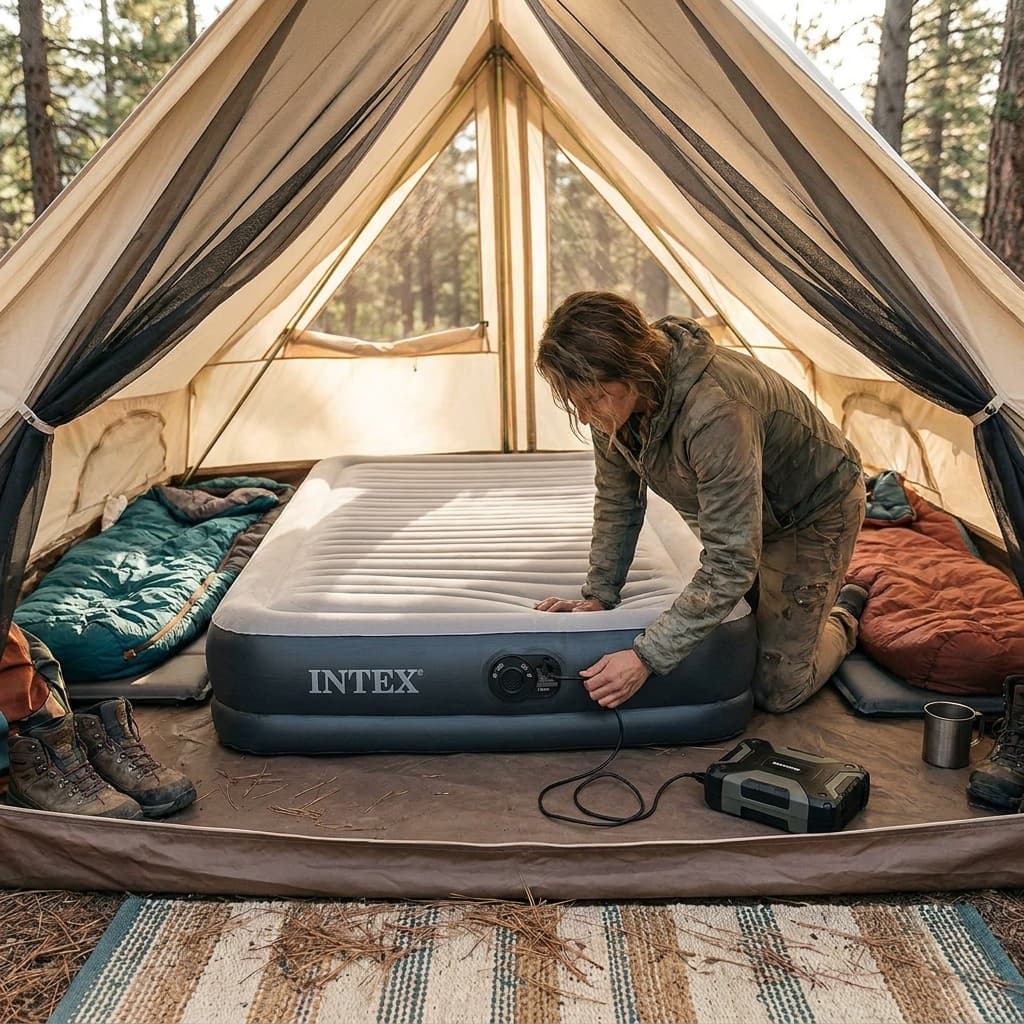
- Inflated dimensions
- 80 x 60 x 22 in (queen)
- Height
- 22 in (tallest in this roundup)
- Pump
- Built-in electric pump (approx. 4.5 min inflate)
- Materials
- Fiber-Tech polyester-reinforced PVC, waterproof flocked top
- Weight capacity
- 600 lbs
- Weight
- 21 lbs
See all picks in Best camping air mattresses for car camping (2026)
Keep going
Complete loadoutCar-camping starter kitThe first-trip essentials across shelter, sleep, cooking, lighting, seating, and water, with the extras left out.


Researched, not hands-on tested
Updated Sep 13, 2026Our recommendations draw on manufacturer documentation, retailer listings, owner feedback, and comparisons with alternatives.
As an Amazon Associate I earn from qualifying purchases. We may earn a commission from links here, at no extra cost to you. How we research →