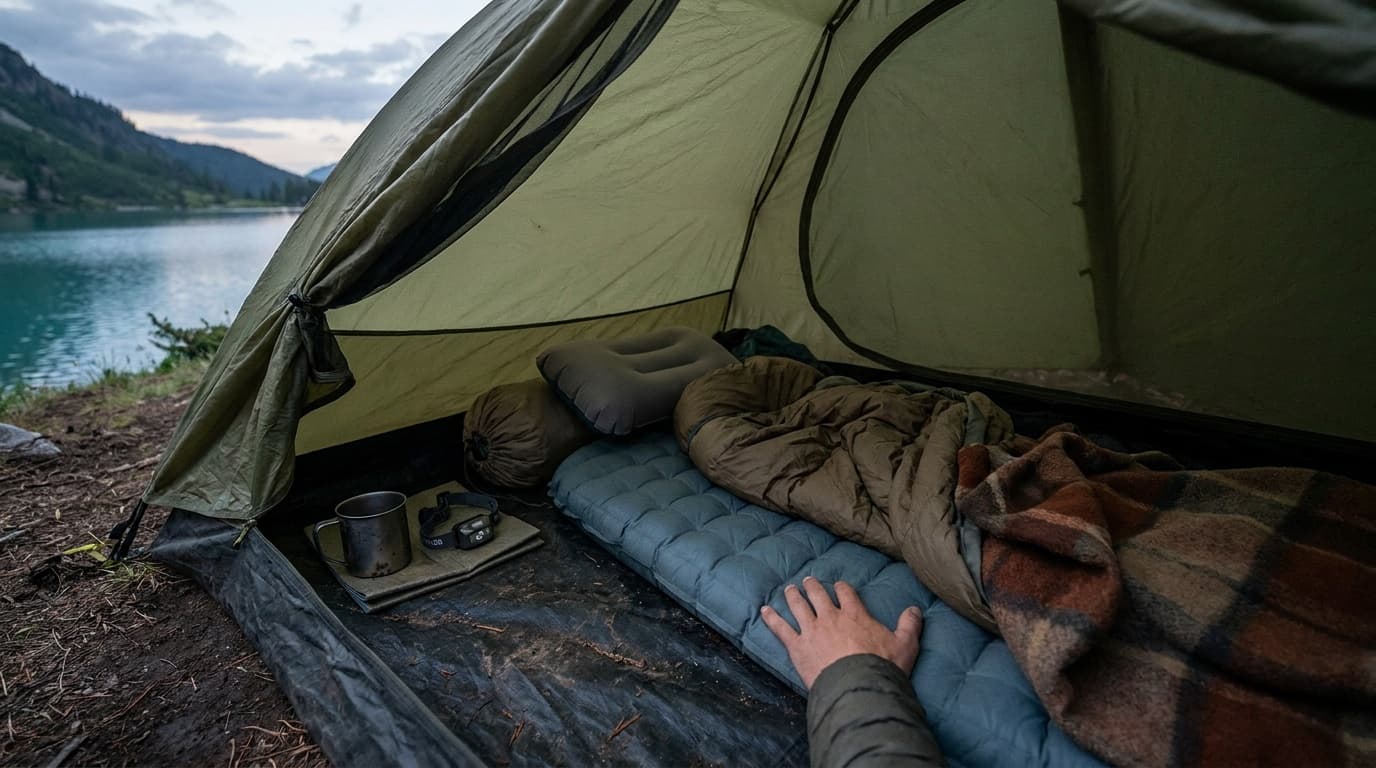
Most campers need an R-value of about 2 for summer, 3 to 4.5 for three-season trips, and 5 or more for winter, with 6-plus for sleeping on snow. R-value measures how well a pad resists heat flowing from your body into the ground, and since 2020 the major brands rate pads with the same ASTM F3340 lab test, so a 4 from one brand means the same as a 4 from another. Here is how to match the number to your trips, and when to size up.
What R-value actually measures
R-value is a thermal resistance rating: it tells you how hard your pad works to keep body heat from escaping into the ground. A higher number means more resistance and more warmth. The scale is linear, so R-4 insulates twice as well as R-2.
The ground is almost always the bigger cold threat on a camping trip than the air around you, especially in shoulder seasons when the earth holds cold long after temperatures rise. An R-3 pad in a well-vented shelter on a 40°F night can leave you colder than expected if the ground underneath is wet or frost-hardened.
The ASTM standard: why numbers are finally comparable
Before 2020, each manufacturer tested pads differently. One brand's R-3 was another brand's R-4.5 because the test methods were entirely different. That changed with the ASTM F3340 standard, ratified in fall 2019. From the 2020 season, REI and MEC required an ASTM R-value on every pad they carry. The test presses the pad between a heated plate held near body temperature and a cold plate standing in for the ground, then measures how much energy it takes to keep the top plate warm. Less energy means a higher R-value. Every brand using this standard produces numbers you can compare directly, which was not true before.
Seasonal R-value bands
These bands sit close to published guidance (Switchback Travel, for example, uses R-1 to 3 for summer, R-3 to 5 for three-season, and R-5-plus for winter) and are a reliable starting point for most campers:
Match R-value to season
Summer (nights above 50°F)
R-1 to R-2.5. An ultralight inflatable or a basic foam pad is enough. Weight and packability matter more than insulation here.
Three-season (20–50°F)
R-2.5 to R-4.5. This is the widest range and covers the most campgrounds. A solid mid-range inflatable handles it comfortably.
Cold weather (0–20°F)
R-4.5 to R-6. Nights consistently below freezing and shoulder-season snow. Expect a heavier pad, more baffling, or a foam underlayer.
Winter and snow camping (below 0°F)
R-6 and above. Snow travel, mountaineering base camps, and extended cold expeditions. The Therm-a-Rest NeoAir XTherm NXT (R-7.3), Sea to Summit Ether Light XR Pro (R-7.4), and NEMO Tensor Extreme Conditions (R-8.5) are the upper end of the consumer market.
R-value to temperature chart
The quick-reference version of the seasonal bands, with the adjustments most people need. Expected nighttime low means ground-level air temperature; on snow or saturated soil, use the next colder row.
| Expected nighttime low | Minimum R-value | Season | Side or cold sleepers |
|---|---|---|---|
| 50°F and above | R-1 | Summer | R-1.5 to R-2 |
| 40–50°F | R-2 | Warm three-season | R-2.5 to R-3 |
| 30–40°F | R-3 | Three-season | R-3.5 to R-4 |
| 20–30°F | R-4 | Shoulder season | R-4.5 to R-5 |
| 0–20°F | R-5 to R-6 | Cold weather | R-6 to R-7 |
| Below 0°F / snow camping | R-6.5+ | Winter | R-7.5+ or stacked pads |
These pairings assume a sleeping bag rated appropriately for the same temperature; an R-6 pad cannot rescue a 40°F bag on a 10°F night. Pad and bag work as a system.
Stacking pads: additive math, real-world benefit
R-values add directly when you stack pads. A closed-cell foam pad rated R-2.0 (the Therm-a-Rest Z Lite Sol exactly) placed under an inflatable rated R-3.5 gives a combined R-5.5. This is the reason many winter campers pair a thin foam sheet under their inflatable rather than buying a dedicated cold-weather pad: the foam costs less, weighs little, and does double duty as puncture protection for the inflatable.
A foam pad under your inflatable does two things at once: it adds R-value through direct addition, and it protects the inflatable from sharp debris on the ground.
For backpacking, the weight penalty of carrying two pads needs to balance against the cost of a single high-R pad. For car camping, stacking is almost always the right call when you are extending a three-season pad into colder conditions.
Side sleepers: size up by at least 0.5
Side sleepers compress the pad more at the hips and shoulders than back or stomach sleepers. That compression reduces the insulation at exactly the points where body mass is greatest, which means effective warmth is lower than the rated number suggests. The practical fix:
- Add at least 0.5 to 1.0 R-value above the seasonal baseline for your conditions.
- Look for a pad at least 3 inches thick. Thinner pads can bottom out at pressure points, leaving only the shell fabric between you and the ground.
- If you are also a cold sleeper, stack both adjustments: cold sleeper plus side sleeper in three-season conditions might call for R-4.5 to R-5 (the Therm-a-Rest NeoAir XLite NXT hits exactly that) rather than the R-3 baseline.
Cold sleepers and other reasons to size up
The seasonal bands assume an average sleeper in a standard shelter. Several factors push toward the higher end or above the band:
- Cold sleepers. If you reliably run cold or have noticed you sleep colder than companions in the same conditions, add 1 to 2 R-value points above the seasonal baseline.
- Wet or frozen ground. Moisture and frost dramatically increase ground conductivity. A shoulder-season camp on saturated soil or early frost behaves more like the lower end of the next colder band.
- Snow camping. If you are camping on snow, treat the surface as frozen ground regardless of air temperature.
- Uncertain conditions. A pad that is slightly too warm is a minor inconvenience. A pad that is slightly too cold is a real problem. When in doubt, go higher; an all-season pad like the NEMO Tensor All-Season at R-5.4 covers everything short of snow camping.
Where these numbers come from
| Claim | Source | Checked |
|---|---|---|
| ASTM F3340 finalized and published in 2019; major outdoor retailers now require ASTM ratings | Therm-a-Rest, ASTM R-value standard | 2026-09-25 |
| Standard ratified fall 2019; test measures energy needed to hold the hot plate at body temperature; R-values of two pads can be added together | NEMO, ASTM F3340 and standardized R-value | 2026-09-25 |
| REI and MEC require an ASTM R-value on every pad they carry; R-values are additive; seasonal guidance of R-1 to 3 summer, R-3 to 5 three-season, R-5+ winter | Switchback Travel, sleeping pad R-value explained | 2026-09-25 |
| Therm-a-Rest Z Lite Sol: R-2.0; adds 2.0 R-value and puncture protection when layered under another pad | Therm-a-Rest, Z Lite Sol | 2026-09-25 |
| Therm-a-Rest NeoAir XLite NXT: R-4.5 across all sizes, 3 in thick, 13 oz Regular | Therm-a-Rest, NeoAir XLite NXT | 2026-09-25 |
| Therm-a-Rest NeoAir XTherm NXT: R-7.3, 3 in thick | Therm-a-Rest, NeoAir XTherm NXT | 2026-09-25 |
| Sea to Summit Ether Light XR Pro Insulated: ASTM R-7.4, four-season | Sea to Summit, Ether Light XR Pro Insulated | 2026-09-25 |
| NEMO Tensor Extreme Conditions: R-8.5 | NEMO, Tensor Extreme Conditions | 2026-09-25 |
| NEMO Tensor All-Season: R-5.4 | NEMO, Tensor All-Season | 2026-09-25 |
The temperature chart and side-sleeper adjustments are our guidance built from these published ranges, not a lab rating. We have not slept on these pads ourselves.
FAQ
Do R-values stack?
Yes. R-values are roughly additive when you stack pads: an R-2 closed-cell foam pad under an R-3.5 inflatable gives a combined value of approximately R-5.5. This works because thermal resistance in series adds, the same principle used for layered home insulation. The ASTM F3340 standard tests single pads, so the stacked figure is an engineering estimate rather than a certified rating, but both NEMO and Therm-a-Rest publish the additive rule (Therm-a-Rest says the Z Lite Sol adds 2.0 R-value when layered under another pad). Put the foam pad on the bottom: it protects the inflatable from punctures and keeps working even if the air pad fails.
What is a good R-value for a sleeping pad?
For a single do-most-things pad, R-4 to R-4.5 is the sweet spot: warm enough for three-season use down to roughly 20°F, without the weight, bulk, and crinkle of a dedicated winter pad. Summer-only campers can drop to R-2. Anyone camping on snow needs R-6 or higher, reached either with one high-R pad or by stacking a foam pad under a three-season inflatable. The chart above maps expected nighttime lows to minimum values.
Can I use a summer pad (R-2) in fall by adding a layer?
Yes. R-values stack directly, so placing a closed-cell foam pad rated R-2 under a summer inflatable gives a combined R-4, which covers most three-season shoulder-season use down to around 25–30°F. The foam pad also protects the inflatable from punctures. The trade-off is bulk and extra weight, which matters more for backpacking than car camping.
I sleep hot. Can I go lower than the recommended R-value?
Yes, within reason. The seasonal bands assume an average sleeper. If you genuinely run warm, dropping half a point to one point below the guideline is usually fine. The risk is that air temperature varies night to night, and ground conditions such as moisture or frost can amplify cold unexpectedly. A pad that is slightly too warm is far less of a problem than one that is slightly too cold, so err conservative if you are unsure.
Do R-values apply to foam pads and air pads the same way?
Yes. The ASTM F3340 standard tests both types with the same method, so a foam pad rated R-2 and an air pad rated R-2 offer the same measured thermal resistance. In practice, foam pads retain their rating even if compressed over years, while air pads with reflective internal layers can degrade if those layers shift or develop pinholes. Both types are directly comparable at purchase.
For pad recommendations at every R-value tier, see our guide to the best sleeping pads for camping. Browse the full camp gear hub, or read how we research and rate.
Recommended gear
Our current top picks from the Best sleeping pads for camping in 2026 guide, if you are ready to buy.

THERM-A-REST
Therm-a-Rest NeoAir XLite NXT Ultralight Sleeping Pad
Editor's Choice
Kit Score 8.8/10
$182.51 Price checked Oct 23, 4:16 PM CDT
Best for: Weight-conscious backpackers and thru-hikers who need four-season-adjacent warmth in the smallest, lightest package possible.
- Best-in-class warmth-to-weight ratio: 4.5 R-value at just 13 oz
- Still slightly louder than the NEMO Tensor on movement, per independent reviewers
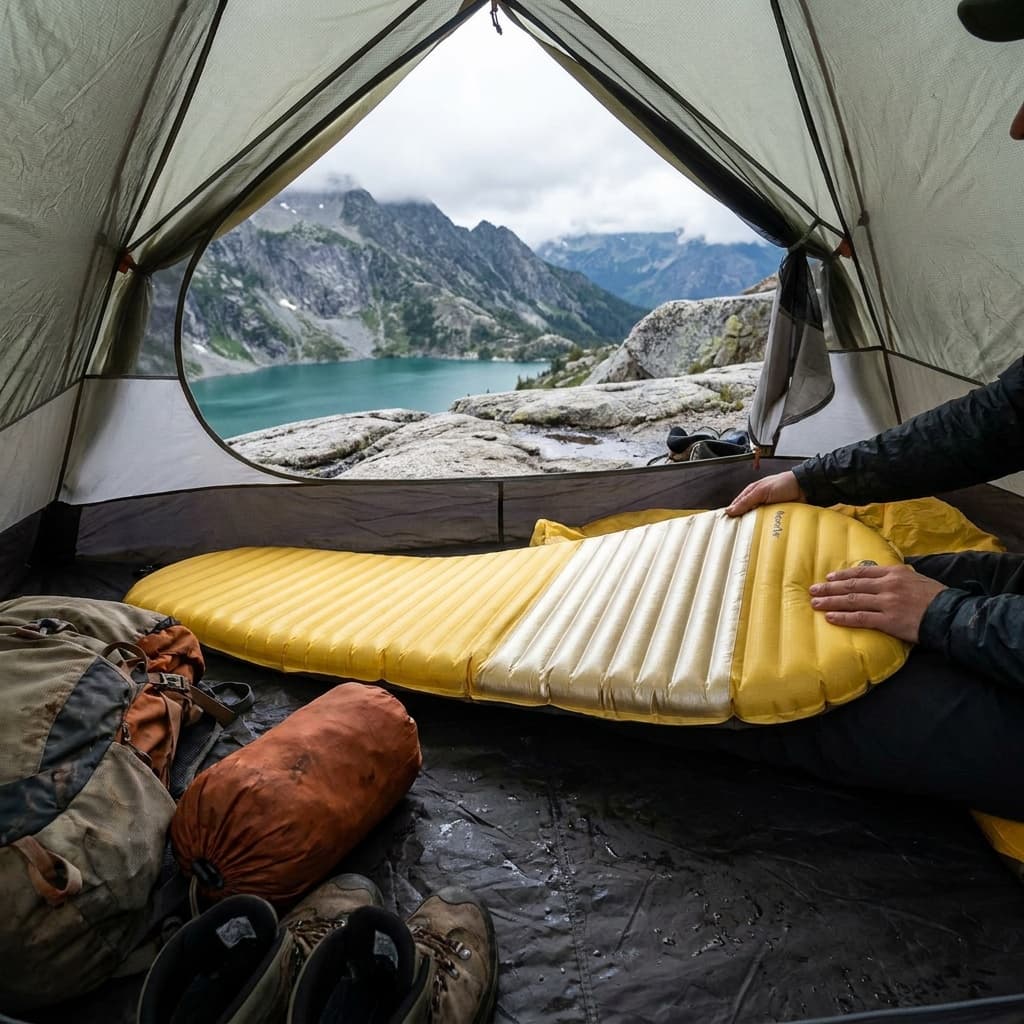
- Type
- Air pad (inflatable)
- R-Value
- 4.5
- Weight
- 13 oz (370 g), Regular
- Packed Size
- 9 x 4.1 in
- Thickness (inflated)
- 3 in
- Dimensions (inflated)
- 72 x 20 in, Regular
About this pick
At 13 oz with a 4.5 R-value, the NeoAir XLite NXT has one of the tightest warmth-to-weight ratios available and packs to roughly the size of a 1-liter water bottle. The NXT generation cut noise by 83% versus its predecessor through revised Triangular Core Matrix construction, addressing the one complaint that had followed the XLite line for years.
Strengths
- Best-in-class warmth-to-weight ratio: 4.5 R-value at just 13 oz
- Packs to 1-liter bottle size, the smallest footprint among insulated 3-inch air pads
- 83% quieter than the previous XLite generation according to Therm-a-Rest testing
Weaknesses
- Still slightly louder than the NEMO Tensor on movement, per independent reviewers
- WingLock valve takes more technique to deflate fully and roll tightly compared to dump-style valves
Kit Score breakdown

THERM-A-REST
Therm-a-Rest Trail Pro Self-Inflating Sleeping Pad
Best Value
Kit Score 8.5/10
$171.50 Price checked Oct 23, 4:16 PM CDT
Best for: Car campers and comfort-focused backpackers who want solid three-season warmth and a stable, firm sleep surface without learning to manage an air pad valve system.
- Self-inflates on unroll with no pump required: open the valve, lay it out, done
- At 1 lb 13 oz, it is nearly double the weight of the NeoAir XLite NXT for the same warmth rating
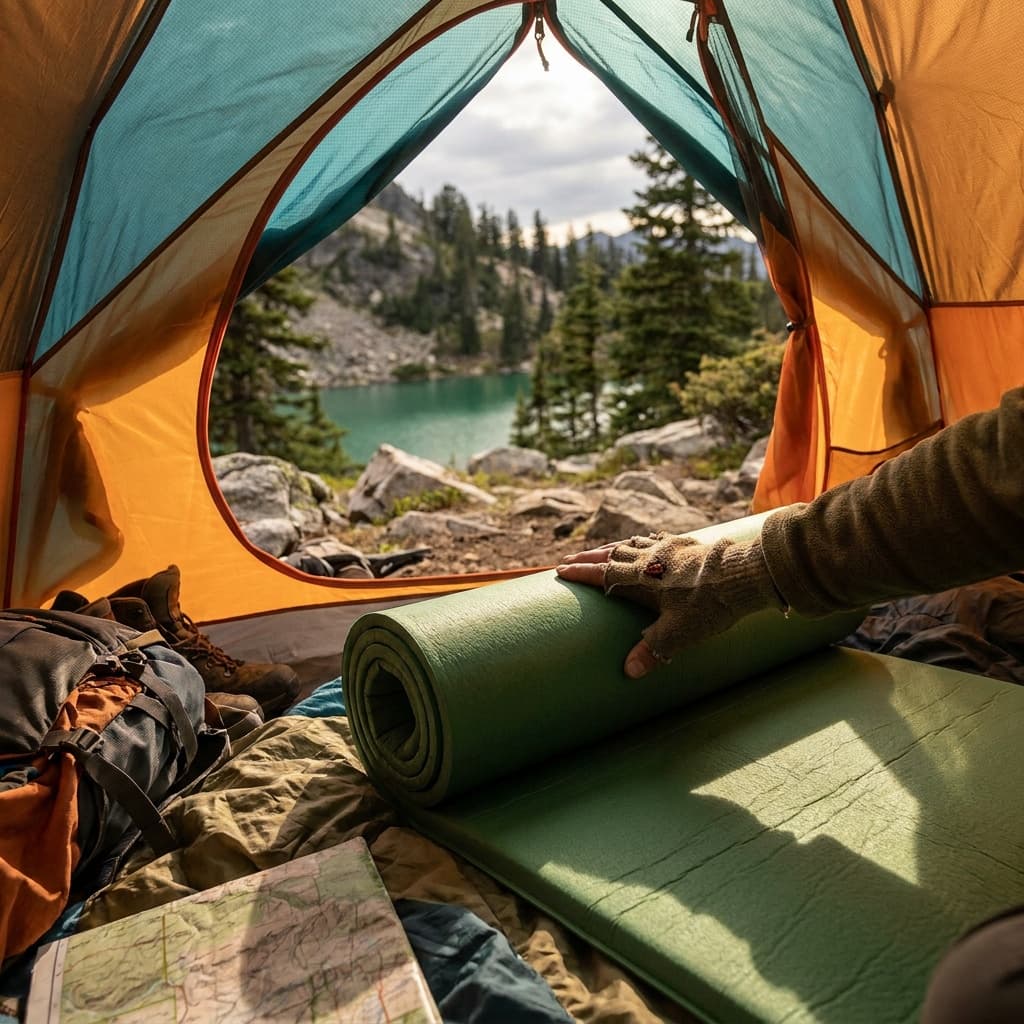
- Type
- Self-inflating (foam + air)
- R-Value
- 4.4
- Weight
- 1 lb 13 oz (822 g), Regular
- Packed Size
- 11 x 8.8 in
- Thickness (inflated)
- 3 in
- Dimensions (inflated)
- 72 x 20 in, Regular
About this pick
The Trail Pro uses StrataCore construction, pairing insulating compressible foam with air pockets to deliver mattress-like stability and a 4.4 R-value without requiring a pump sack or lung power. It is substantially heavier than air-only pads at the same price, but owners who prioritize a stable, no-fuss sleep surface rate it among the most comfortable self-inflating options in this price range.
Strengths
- Self-inflates on unroll with no pump required: open the valve, lay it out, done
- 4.4 R-value covers three seasons; foam core eliminates the instability of pure air pads
- Foam construction tolerates repeated packing cycles better than most air pads over multi-year use
Weaknesses
- At 1 lb 13 oz, it is nearly double the weight of the NeoAir XLite NXT for the same warmth rating
- Packed size (11 x 8.8 in) is bulkier than air pads, limiting its appeal for ultralight trips
Kit Score breakdown

THERM-A-REST
Therm-a-Rest Z Lite Sol Foam Sleeping Pad
Best Budget
Kit Score 8.6/10
$59.95 Price checked Oct 23, 4:16 PM CDT
Best for: Warm-weather campers and backpackers who want a bulletproof, no-inflation pad for summer trips, or anyone building a layered cold-weather system by combining it with a second insulating pad.
- Zero inflation and zero failure modes: unfold and lie down, no valves or puncture risk
- R-value of 2.0 is adequate only for warm-weather camping above roughly 40 degrees Fahrenheit without a layered setup
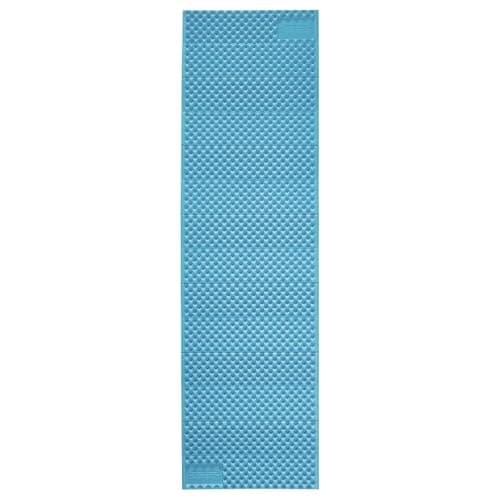
- Type
- Closed-cell foam
- R-Value
- 2.0
- Weight
- 14 oz (397 g), Regular
- Packed Size
- 20 x 5.5 x 5 in (accordion-folded)
- Thickness
- 0.75 in
- Dimensions
- 72 x 20 in, Regular
About this pick
The Z Lite Sol is a closed-cell foam pad with a ThermaCapture reflective surface that adds roughly 20% warmth over the standard Z Lite, accordion-folds for fast setup, and is effectively indestructible. The trade-off is a 2.0 R-value that limits it to warm-weather camping on its own and less cushion than any inflatable option.
Strengths
- Zero inflation and zero failure modes: unfold and lie down, no valves or puncture risk
- ThermaCapture reflective coating boosts warmth by about 20% over standard foam at no weight penalty
- Doubles as a sit pad, snow platform, or pack frame; many backpackers keep it as a warm-season standalone or a cold-season base layer under an air pad
Weaknesses
- R-value of 2.0 is adequate only for warm-weather camping above roughly 40 degrees Fahrenheit without a layered setup
- Accordion bulk (20 x 5.5 x 5 in folded) straps to the outside of a pack; does not compress into a stuff sack
Kit Score breakdown
Keep going
Complete loadoutCamp sleep systemFive coordinated pieces that solve shelter, insulation, cushioning, head support, and light for nights outside.Free tool: Sleeping-Bag Warmth

Researched, not hands-on tested
Updated Sep 25, 2026Our recommendations draw on manufacturer documentation, retailer listings, owner feedback, and comparisons with alternatives.
As an Amazon Associate I earn from qualifying purchases. We may earn a commission from links here, at no extra cost to you. How we research →