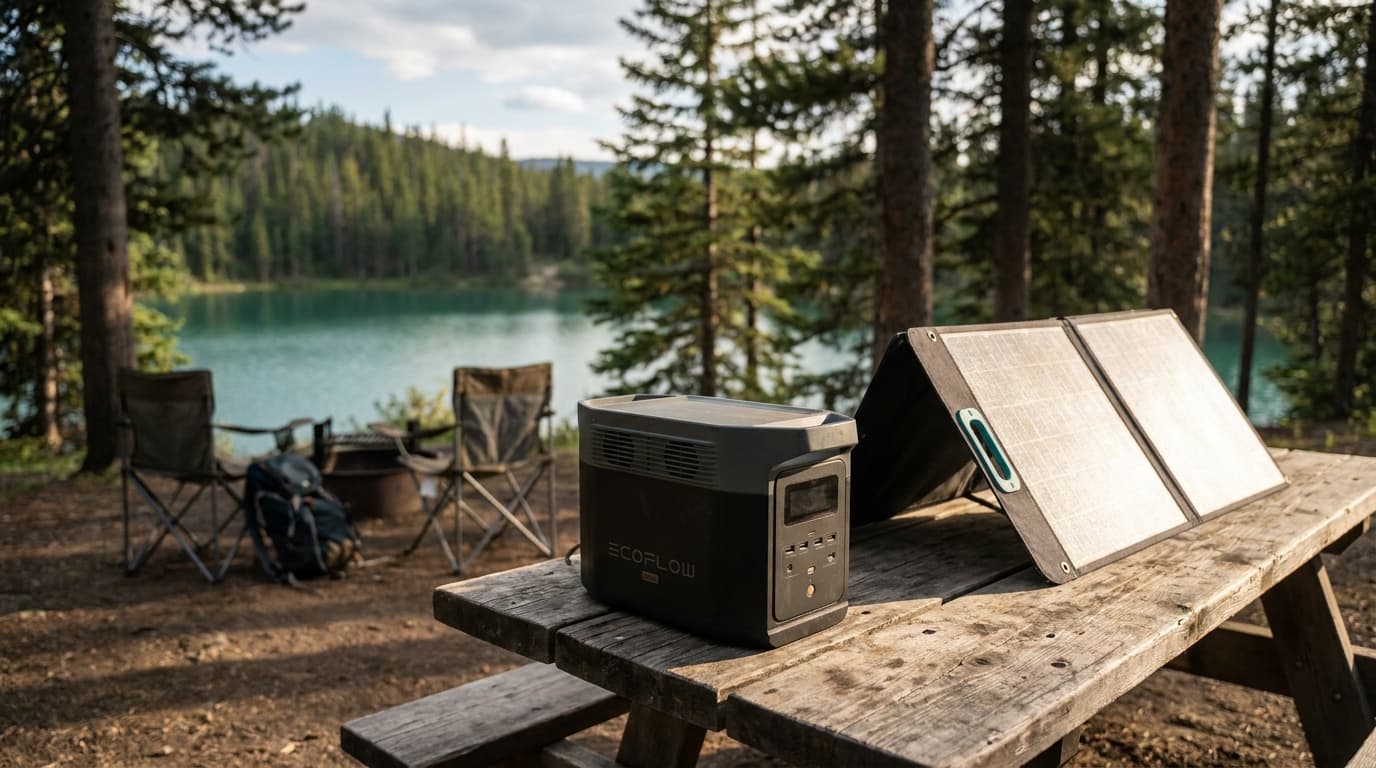
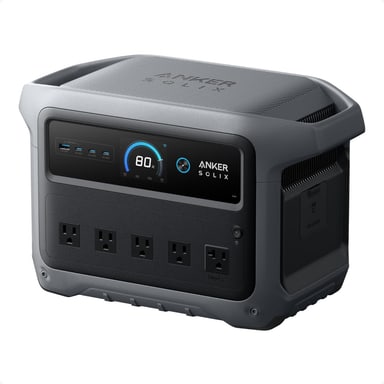
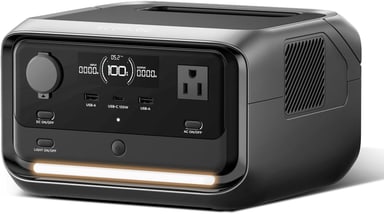
The Anker SOLIX C1000 Gen 2 is the best portable power station for most people: Outdoor Gear Lab names it the best value for most buyers, and Anker rates its 1,024 Wh LiFePO4 battery for 2,000W of output and a full wall recharge in 49 minutes. For multi-day off-grid trips, step up to the 2 kWh Jackery Explorer 2000 v2. For a winter outage at home, the EcoFlow DELTA Pro 3 runs 120V and 240V circuits from 4,096 Wh and expands to 48 kWh.
Our quick picks
How we picked
Every station is scored with our Kit Score: usable capacity, continuous output, recharge speed from the wall and from solar, weight per watt-hour, battery chemistry and cycle rating, outage features such as UPS switchover, and warranty. We started from the 2026 picks of Outdoor Gear Lab, Popular Science, and Outdoor Life, checked every spec against the maker's own spec page or manual, and confirmed each station is in stock on Amazon from Amazon or the brand's own store. Every pick uses LiFePO4 (LFP) cells. We did not run these stations ourselves; the sources table at the end shows where each number comes from.
The picks
Best overall: Anker SOLIX C1000 Gen 2
BEST OVERALL
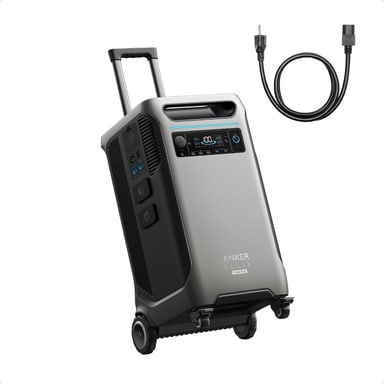
Anker SOLIX C1000 Gen 2 Portable Power Station
Best for: Most households and campers who want one 1 kWh station that recharges fast and can back up a fridge, router, or CPAP.
- Fastest full recharge here: 49 minutes on AC in UltraFast mode
- Not expandable; Anker points buyers who want an add-on battery to the original C1000
Kit Score 8.8/10 · $699.99 Price checked Oct 25, 3:41 PM CDT · how we score gear
Buy on AmazonProduct details
The C1000 Gen 2 packs 1,024 Wh of LiFePO4 into a 24.9 lb case with 2,000W of output, five AC outlets, and a 140W USB-C port. Anker rates a full AC recharge at 49 minutes and the battery at 4,000 cycles to 80% capacity. Unlike the original C1000, it cannot take an expansion battery.
- Capacity
- 1,024 Wh LiFePO4, 4,000 cycles to 80%
- AC output
- 2,000W continuous, 3,000W peak, 5 outlets
- Recharge
- 100% in 49 min on AC (1,600W UltraFast mode); up to 600W solar, 11 to 60V
- Weight
- 24.9 lb; 15.1 x 8.2 x 9.6 in
- Backup
- 10 ms UPS switchover; not expandable
- Warranty
- 5 years
More strengths
- 2,000W output and five AC outlets in a 24.9 lb case
- 10 ms UPS switchover and a 5-year warranty
Other tradeoffs
- Charging is limited to 32 to 104 F, so it cannot recharge in a cold garage or car
The C1000 Gen 2 is the station most buyers should start with. Outdoor Gear Lab gives it its Best Buy award for most people, Popular Science names it the best budget station, and Outdoor Life picks it for solar generator setups. Anker rates it at 1,024 Wh with 2,000W of continuous output (3,000W peak) across five AC outlets, plus a 140W USB-C port for a laptop.
The headline is charging speed. In UltraFast mode it pulls 1,600W from the wall and refills in 49 minutes, so an outage warning in the evening is enough time to top it off. It takes up to 600W of solar at 11 to 60V and switches to battery in 10 ms when the grid drops. Anker rates the cells for 4,000 cycles to 80% and backs it with a 5-year warranty. The catch: unlike the original C1000, the Gen 2 cannot take an expansion battery.
Capacity: 1,024 Wh | Output: 2,000W | Recharge: 49 min AC, 600W solar | Weight: 24.9 lb
Best lightweight: Jackery Explorer 1000 v2
BEST LIGHTWEIGHT
Jackery Explorer 1000 v2 Portable Power Station
Best for: Campers who move sites frequently and want a sub-24-lb 1 kWh station that handles a fridge, CPAP, and device charging without being a chore to carry.
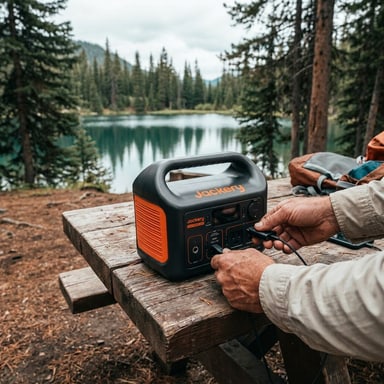
- Lightest of the 1 kWh picks here at about 23.8 lb, manageable for one person
- No battery expansion option, so 1,070 Wh is the ceiling; rivals like the DELTA 2 can grow beyond that
Kit Score 8.5/10 · $499.00 Price checked Oct 25, 3:41 PM CDT · how we score gear
Buy on AmazonProduct details
The Explorer 1000 v2 packs 1,070 Wh of LiFePO4 into about 23.8 lb, the lightest of the 1 kWh picks here, and Jackery rates the battery for 4,000 cycles to 70 percent capacity. It recharges in about 1.7 hours from the wall (Jackery advertises one hour in its Emergency Charge mode) and switches to battery within 20 ms in an outage.
- Capacity
- 1,070 Wh (LiFePO4)
- AC output
- 1,500W continuous, 3,000W surge
- Solar input
- Up to 400W (two 200W inputs, 16 to 60V)
- Fast charge
- About 1.7 hr on AC; Jackery advertises a 1 hr Emergency Charge
- Weight
- 23.8 lbs (10.8 kg)
- Ports
- 3x AC, 2x USB-C (100W and 30W), 1x USB-A (18W), 1x 12V car
More strengths
- 4,000-cycle LFP battery; 3-year warranty, extendable to 5
- Jackery rates the cooling fan at 22 dB or less
Other tradeoffs
- 400W solar input is lower than the Anker SOLIX C1000, meaning longer solar-only recharge times
At about 23.8 lb for 1,070 Wh, the Explorer 1000 v2 is the lightest of the 1 kWh picks and the easiest to carry from the car to a campsite. Jackery rates it for 1,500W continuous (3,000W peak) across three AC outlets, a full wall recharge in about 1.7 hours (Jackery advertises one hour in its Emergency Charge mode), and up to 400W of solar through two 200W inputs.
Jackery's spec sheet lists a 20 ms UPS switchover and a fan rated at 22 dB or less. Cycle life is 4,000 cycles to 70%, a looser standard than the 80% most rivals quote, and the warranty is 3 years, extendable to 5. It cannot take an expansion battery. Jackery also sells it as the Solar Generator 1000 v2 with a 200W SolarSaga panel.
Capacity: 1,070 Wh | Output: 1,500W | Recharge: about 1.7 hr AC, 400W solar | Weight: about 23.8 lb
Best expandable: EcoFlow DELTA 3
BEST EXPANDABLE
EcoFlow DELTA 3 Portable Power Station
Best for: Buyers who want a 1 kWh station now and the option to add a second battery for longer outages later.
- Expandable to 5 kWh with an add-on battery, unlike most 1 kWh stations
- At 27.6 lb it is the heaviest of the 1 kWh picks
Kit Score 8.3/10 · $629.00 Price checked Oct 25, 3:41 PM CDT · how we score gear
Buy on AmazonProduct details
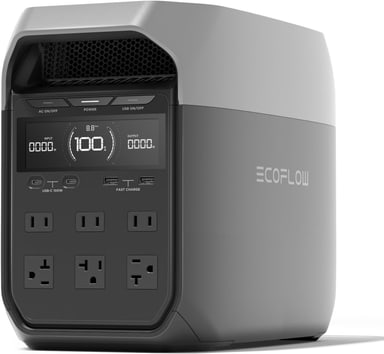
The DELTA 3 is EcoFlow's 1 kWh station with the most room to grow. It has six AC outlets, 1,800W of output (3,600W surge), a full AC recharge in about 56 minutes, and an expansion port that takes DELTA 3, DELTA 2, DELTA 2 Max, or DELTA Pro 3 extra batteries for up to 5 kWh.
- Capacity
- 1,024 Wh LiFePO4, expandable to 5 kWh; 4,000 cycles to 80%
- AC output
- 1,800W continuous, 3,600W surge, 6 outlets (13 outputs total)
- Recharge
- Full in about 56 min on 1,500W AC; up to 500W solar, 11 to 60V
- Weight
- 27.6 lb; 15.7 x 8.0 x 11.2 in
- Backup
- Under 10 ms UPS switchover
- Warranty
- 5 years
More strengths
- Six AC outlets and 13 outputs in total
- Under 10 ms UPS switchover and a 5-year warranty
Other tradeoffs
- Extra batteries add cost and weight; price the full system before you buy
The DELTA 3 is the 1 kWh station that can grow into a bigger backup system. EcoFlow lists 1,024 Wh, 1,800W continuous (3,600W surge), six AC outlets among 13 outputs, and a full recharge in about 56 minutes on 1,500W of AC. Its expansion port takes DELTA 3, DELTA 2, DELTA 2 Max, or DELTA Pro 3 extra batteries for up to 5 kWh total.
It takes up to 500W of solar at 11 to 60V, switches over in under 10 ms, and EcoFlow rates it for 4,000 cycles to 80% with a 5-year warranty. At 27.6 lb it is the heaviest of the 1 kWh picks. Its predecessor, the DELTA 2, is Outdoor Life's best overall station; if you already own DELTA 2 extra batteries, the DELTA 3 accepts them.
Capacity: 1,024 Wh, expandable to 5 kWh | Output: 1,800W | Recharge: about 56 min AC, 500W solar | Weight: 27.6 lb
Best small: EcoFlow RIVER 3 Plus
BEST SMALL
EcoFlow RIVER 3 Plus Portable Power Station
Best for: Weekend campers and apartment dwellers who need phones, lights, a laptop, or a router running through a short outage.
- 10.4 lb and small enough for a car footwell or a desk
- 286 Wh runs out fast on anything with a compressor or heater
Kit Score 7.9/10 · $299.00 Price checked Oct 25, 3:41 PM CDT · how we score gear
Buy on AmazonProduct details
The RIVER 3 Plus replaces the RIVER 2 as EcoFlow's small, inexpensive station. It holds 286 Wh of LiFePO4, runs 600W (1,200W with X-Boost for heating loads), recharges in an hour from the wall, and takes an add-on battery up to 858 Wh. A sub-10 ms UPS mode makes it a good router and modem backup at home.
- Capacity
- 286 Wh LiFePO4, expandable to 858 Wh; 3,000 cycles to 80%
- AC output
- 600W continuous, 1,200W surge and X-Boost, 3 outlets
- Recharge
- 0 to 100% in 60 min on 380W AC; up to 220W solar
- Weight
- 10.4 lb; 9.2 x 9.1 x 5.8 in
- Ports
- 3 AC, 2 USB-A, 1 USB-C
- Backup
- Under 10 ms UPS switchover
More strengths
- One-hour wall recharge and a sub-10 ms UPS mode for a router or CPAP
- Expandable to 858 Wh with an extra battery
Other tradeoffs
- 220W solar input is the lowest here
The RIVER 3 Plus replaces the RIVER 2 as EcoFlow's small, inexpensive station. It holds 286 Wh, runs 600W across three AC outlets (1,200W surge, and X-Boost for heating loads), and recharges from 0 to 100% in an hour on 380W of AC. It weighs 10.4 lb and measures about 9 by 9 by 6 inches.
That is enough for phones, lights, a laptop, a fan, or a Wi-Fi router through a short outage, and its sub-10 ms UPS mode keeps a modem online when the power blinks. EcoFlow rates the cells for 3,000 cycles to 80%, and an add-on battery takes it to 858 Wh. Its 220W solar input is the lowest here, and 286 Wh will not run a fridge for long.
Capacity: 286 Wh, expandable to 858 Wh | Output: 600W | Recharge: 60 min AC, 220W solar | Weight: 10.4 lb
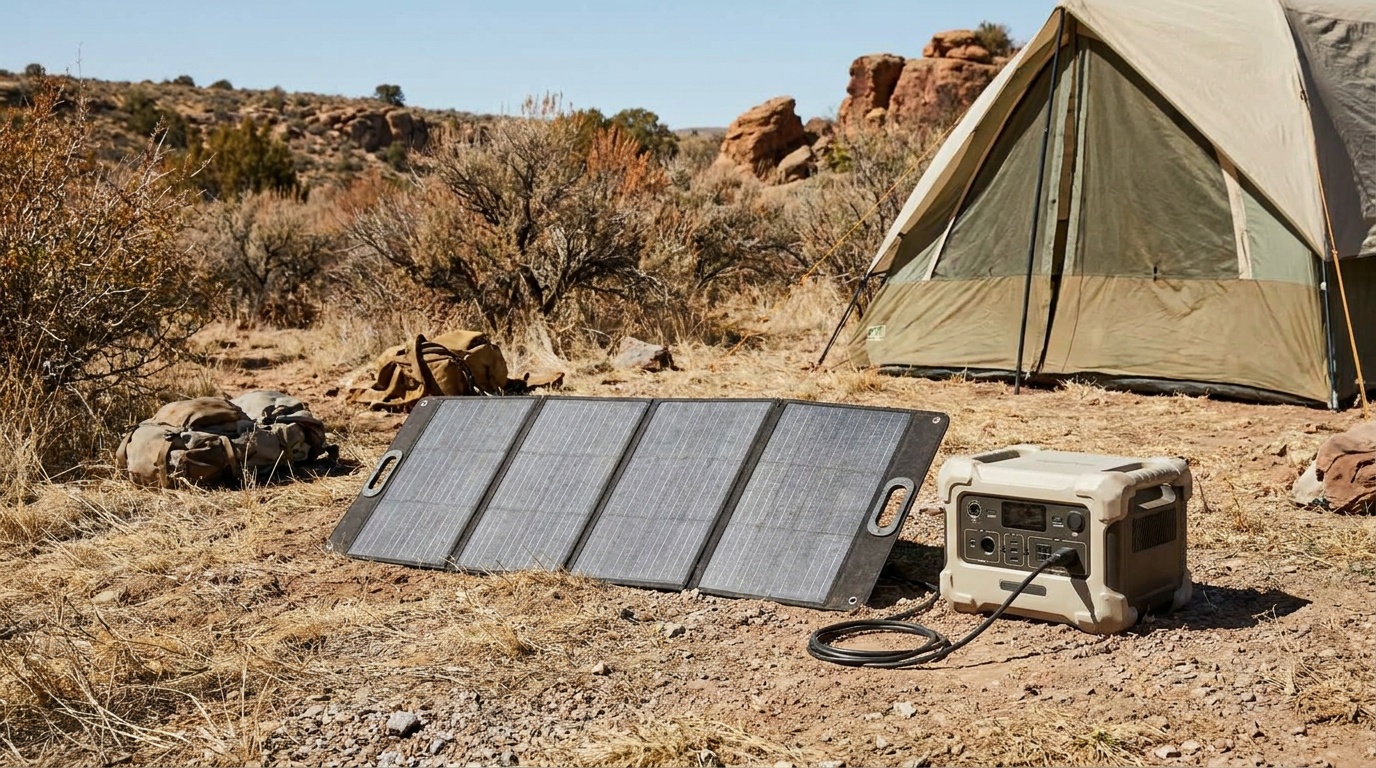
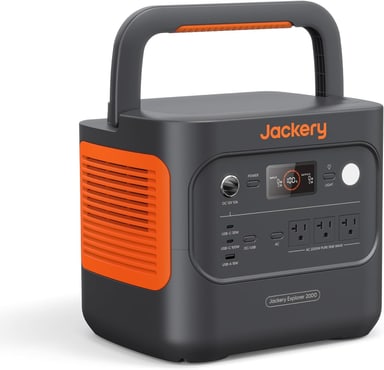
Best for off-grid camping: Jackery Explorer 2000 v2
BEST FOR OFF-GRID CAMPING
Jackery Explorer 2000 v2 Portable Power Station
Best for: Multi-day off-grid trips and van builds that need 2 kWh without a 50-plus pound unit, plus a solid fridge-and-lights outage backup.
- Most watt-hours per pound of any pick here
- Only three AC outlets for a 2 kWh station
Kit Score 8.5/10 · $899.00 Price checked Oct 25, 3:41 PM CDT · how we score gear
Buy on AmazonProduct details
The Explorer 2000 v2 doubles the Explorer 1000 v2's capacity to 2,042 Wh while weighing about 39.5 lb, which makes it the most energy per pound among these picks. It runs 2,200W across three AC outlets, recharges in about two hours from the wall, and switches to battery within 20 ms when the power drops.
- Capacity
- 2,042 Wh LiFePO4, 4,000 cycles to 70%
- AC output
- 2,200W continuous, 4,400W peak, 3 outlets
- Recharge
- About 2 hr on 1,800W AC; up to 400W solar, 16 to 60V
- Weight
- About 39.5 lb (17.9 kg)
- Backup
- UPS switchover within 20 ms; not expandable
- Warranty
- 3 years, extendable to 5
More strengths
- 2,200W output handles a microwave, coffee maker, or space heater on low
- Quiet fan, rated 30 dB or less by Jackery
Other tradeoffs
- No expansion battery and only 400W of solar input, so a full solar recharge takes most of a sunny day
Outdoor Gear Lab makes the Explorer 2000 v2 its Editors' Choice for multi-day off-grid camping, and it measured 1,710 Wh of usable output from the 2,042 Wh battery. Jackery puts that capacity in a case of about 39.5 lb, which works out to about 52 Wh per pound, the best ratio of any pick here.
It runs 2,200W continuous (4,400W peak) from three AC outlets, recharges in about 2 hours from the wall (Jackery advertises 1.3 hours in Emergency Charge mode), and takes up to 400W of solar. That solar ceiling is its weak spot: Jackery's own chart puts a full charge from two 200W panels at about 7.5 hours. Like the 1000 v2, it has a 20 ms UPS switchover, a 4,000-cycle rating to 70%, and no expansion port.
Capacity: 2,042 Wh | Output: 2,200W | Recharge: about 2 hr AC, 400W solar | Weight: about 39.5 lb
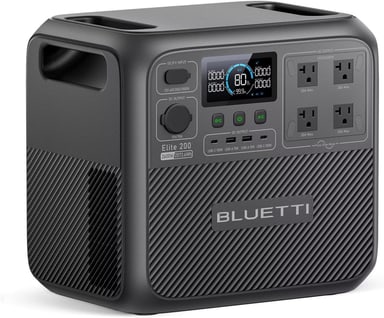
Longest cycle life: BLUETTI Elite 200 V2
LONGEST CYCLE LIFE
BLUETTI Elite 200 V2 Portable Power Station
Best for: Home backup and RV owners who want 2 kWh, strong solar input, and the longest-rated battery life.
- Longest cycle rating here: 6,000-plus cycles to 80%
- 53.4 lb, about 14 lb heavier than the Jackery 2000 v2
Kit Score 8.3/10 · $1,399.00 Price checked Oct 25, 3:41 PM CDT · how we score gear
Buy on AmazonProduct details
The Elite 200 V2 holds 2,073.6 Wh and runs 2,600W, with a Power Lifting mode for resistive loads up to 3,900W such as kettles and hair dryers. Its 1,000W solar input is the highest among the 2 kWh picks, and BLUETTI rates the cells for more than 6,000 cycles to 80% capacity.
- Capacity
- 2,073.6 Wh LiFePO4, 6,000+ cycles to 80%
- AC output
- 2,600W continuous; Power Lifting runs resistive loads up to 3,900W
- Recharge
- 1.6 hr on 1,440W AC (Turbo: 80% in 1 hr); up to 1,000W solar, 12 to 60V
- Weight
- 53.4 lb; 13.8 x 9.8 x 12.7 in
- Backup
- Switches to battery within 15 ms; not expandable
- Warranty
- 5 years
More strengths
- 2,600W output and 1,000W of solar input
- Silent charging mode (800W) for overnight recharges indoors
Other tradeoffs
- Turbo charging must be unlocked through BLUETTI support, per the manual
Popular Science names the Elite 200 V2 its best overall portable power station. BLUETTI rates its 2,073.6 Wh LiFePO4 pack for more than 6,000 cycles to 80%, the longest rating here, and backs it with a 5-year warranty. It runs 2,600W continuous, and a Power Lifting mode runs resistive loads such as kettles and hair dryers up to 3,900W.
Solar input tops out at 1,000W (12 to 60V), the most among the 2 kWh picks. BLUETTI's manual lists a 1.6 hour wall recharge in standard mode, 80% in an hour in Turbo mode (which you activate through BLUETTI support), and a quiet 800W mode that takes about 3 hours. It switches to battery within 15 ms. The trade-off is weight: 53.4 lb, about 14 lb more than the Jackery 2000 v2, and it cannot be expanded.
Capacity: 2,073.6 Wh | Output: 2,600W | Recharge: 1.6 hr AC, 1,000W solar | Weight: 53.4 lb
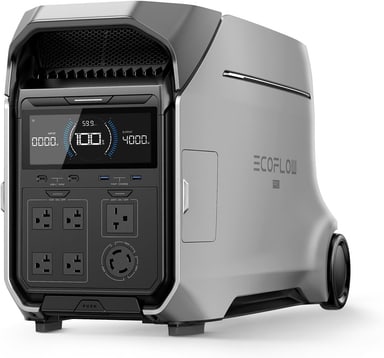
Best home backup: EcoFlow DELTA Pro 3
BEST HOME BACKUP
EcoFlow DELTA Pro 3 Portable Power Station
Best for: Homes that want to run the fridge, furnace blower, well pump, and lights through a multi-day winter outage without a fuel generator.
- 120V and 240V output can run a well pump or a transfer-switch circuit
- 113.5 lb: it rolls, but stairs need two people
Kit Score 8.6/10 · $2,799.00 Price checked Oct 25, 3:41 PM CDT · how we score gear
Buy on AmazonProduct details
The DELTA Pro 3 is a wheeled home battery: 4,096 Wh of LFP, 4,000W at 120V or 240V, and outlets that include an L14-30R for a transfer switch or generator inlet. It takes up to 2,600W of solar across two inputs and expands to 48 kWh with extra batteries. EcoFlow says it suits well-ventilated indoor spaces.
- Capacity
- 4,096 Wh LFP, expandable to 48 kWh; 4,000 cycles to 80%
- AC output
- 4,000W at 120/240V (6,000W X-Boost, 8,000W surge); 4x NEMA 5-20R, TT-30R, 6-20R, L14-30R
- Recharge
- 0 to 80% in 50 min on AC; up to 2,600W solar (1,600W high-voltage + 1,000W low-voltage)
- Weight
- 113.5 lb with wheels; 16.2 x 13.4 x 27.3 in
- Backup
- 10 ms UPS switchover
- Warranty
- 5 years with app registration
More strengths
- 2,600W of solar input across high- and low-voltage ports
- Expands to 48 kWh with extra batteries
Other tradeoffs
- The most expensive pick, and a transfer switch or inlet adds installation cost
The DELTA Pro 3 is Outdoor Gear Lab's top pick for home backup, and it measured 3,790 Wh of usable output from the 4,096 Wh battery. EcoFlow rates it for 4,000W at 120V or 240V (6,000W with X-Boost, 8,000W surge), with four 20A household outlets, a TT-30R for an RV, a 6-20R, and an L14-30R that can feed a transfer switch or generator inlet. That 240V output is what runs a well pump.
It refills from 0 to 80% in about 50 minutes on AC, takes up to 2,600W of solar across a high-voltage and a low-voltage input, and expands to 48 kWh with extra batteries. It rolls on wheels, but at 113.5 lb it is not something you carry up stairs alone. EcoFlow says it suits well-ventilated indoor spaces, rates it for 4,000 cycles to 80%, and covers it for 5 years once registered in the app.
Capacity: 4,096 Wh, expandable to 48 kWh | Output: 4,000W at 120/240V | Recharge: 80% in 50 min AC, 2,600W solar | Weight: 113.5 lb
Most output: Anker SOLIX F3800 Plus
MOST OUTPUT
Anker SOLIX F3800 Plus Portable Power Station
Best for: Homes with 240V loads such as a well pump that want the most output and solar input in one unit.
- 6,000W output, the most here, at 120V or 240V
- 136.7 lb, the heaviest pick, on wheels
Kit Score 8.3/10 · $2,599.99 Price checked Oct 25, 3:41 PM CDT · how we score gear
Buy on AmazonProduct details
The F3800 Plus is Anker's whole-home portable: 3,840 Wh of LFP, 6,000W at 120V or 240V, six 20A household outlets plus TT-30R and L14-30R, and up to 3,200W of solar input. Anker says it expands with up to six 3.84 kWh batteries for long outages.
- Capacity
- 3,840 Wh LFP; expandable with up to six 3.84 kWh batteries; 3,000+ cycles
- AC output
- 6,000W at 120/240V; 6x NEMA 5-20R, TT-30R, L14-30R
- Recharge
- Under 3 hr on 1,800W AC; up to 3,200W solar (two 1,600W inputs, 11 to 165V)
- Weight
- 136.7 lb; 27.6 x 15.3 x 15.6 in with wheels
- Backup
- 20 ms switchover when plugged into a 120V wall outlet
- Warranty
- 5 years
More strengths
- 3,200W of solar input, the most here
- Six 20A household outlets plus RV and 240V twist-lock outlets
Other tradeoffs
- Recharge from the wall takes up to 3 hours, slower than the DELTA Pro 3
The F3800 Plus is the pick when a 240V appliance or a long list of loads matters more than weight. Anker rates it at 3,840 Wh and 6,000W at 120V or 240V, with six 20A household outlets, a TT-30R, and an L14-30R. Its 3,200W of solar input across two inputs (11 to 165V) is the most here, and Anker says it takes up to six 3.84 kWh expansion batteries.
It is also the heaviest pick at 136.7 lb on wheels, and a full wall recharge on 1,800W takes up to 3 hours, slower than the DELTA Pro 3. When plugged into a 120V wall outlet, Anker lists a 20 ms switchover. LFP cells are rated for more than 3,000 cycles, with a 5-year warranty. We could not find an independent tester award for the Plus, so it ranks behind the DELTA Pro 3.
Capacity: 3,840 Wh, expandable | Output: 6,000W at 120/240V | Recharge: under 3 hr AC, 3,200W solar | Weight: 136.7 lb
Buy for the outage you will actually have: list what must stay on, add up the watt-hours per day, then pick the station that covers it with room to spare.
Compare the picks
| Spec | Anker C1000 Gen 2 | Jackery 1000 v2 | EcoFlow DELTA 3 | EcoFlow RIVER 3 Plus | Jackery 2000 v2 | BLUETTI Elite 200 V2 | EcoFlow DELTA Pro 3 | Anker F3800 Plus |
|---|---|---|---|---|---|---|---|---|
| Kit Score | 8.8/10 | 8.5/10 | 8.3/10 | 7.9/10 | 8.5/10 | 8.3/10 | 8.6/10 | 8.3/10 |
| Price | $699.99 Price checked Oct 25, 3:41 PM CDT | $499.00 Price checked Oct 25, 3:41 PM CDT | $629.00 Price checked Oct 25, 3:41 PM CDT | $299.00 Price checked Oct 25, 3:41 PM CDT | $899.00 Price checked Oct 25, 3:41 PM CDT | $1,399.00 Price checked Oct 25, 3:41 PM CDT | $2,799.00 Price checked Oct 25, 3:41 PM CDT | $2,599.99 Price checked Oct 25, 3:41 PM CDT |
| Best for | Most households and campers who want one 1 kWh station that recharges fast and can back up a fridge, router, or CPAP. | Campers who move sites frequently and want a sub-24-lb 1 kWh station that handles a fridge, CPAP, and device charging without being a chore to carry. | Buyers who want a 1 kWh station now and the option to add a second battery for longer outages later. | Weekend campers and apartment dwellers who need phones, lights, a laptop, or a router running through a short outage. | Multi-day off-grid trips and van builds that need 2 kWh without a 50-plus pound unit, plus a solid fridge-and-lights outage backup. | Home backup and RV owners who want 2 kWh, strong solar input, and the longest-rated battery life. | Homes that want to run the fridge, furnace blower, well pump, and lights through a multi-day winter outage without a fuel generator. | Homes with 240V loads such as a well pump that want the most output and solar input in one unit. |
| Why it stands out | Fastest full recharge here: 49 minutes on AC in UltraFast mode | Lightest of the 1 kWh picks here at about 23.8 lb, manageable for one person | Expandable to 5 kWh with an add-on battery, unlike most 1 kWh stations | 10.4 lb and small enough for a car footwell or a desk | Most watt-hours per pound of any pick here | Longest cycle rating here: 6,000-plus cycles to 80% | 120V and 240V output can run a well pump or a transfer-switch circuit | 6,000W output, the most here, at 120V or 240V |
| Tradeoff | Not expandable; Anker points buyers who want an add-on battery to the original C1000 | No battery expansion option, so 1,070 Wh is the ceiling; rivals like the DELTA 2 can grow beyond that | At 27.6 lb it is the heaviest of the 1 kWh picks | 286 Wh runs out fast on anything with a compressor or heater | Only three AC outlets for a 2 kWh station | 53.4 lb, about 14 lb heavier than the Jackery 2000 v2 | 113.5 lb: it rolls, but stairs need two people | 136.7 lb, the heaviest pick, on wheels |
| Capacity | 1,024 Wh | 1,070 Wh | 1,024 Wh | 286 Wh | 2,042 Wh | 2,073.6 Wh | 4,096 Wh | 3,840 Wh |
| Expandable | No | No | To 5 kWh | To 858 Wh | No | No | To 48 kWh | Up to 6 batteries |
| Continuous AC output | 2,000W | 1,500W | 1,800W | 600W | 2,200W | 2,600W | 4,000W, 120/240V | 6,000W, 120/240V |
| AC outlets | 5 | 3 | 6 | 3 | 3 | Not published | 7 (incl. TT-30R, L14-30R) | 8 (incl. TT-30R, L14-30R) |
| Wall recharge | 49 min | About 1.7 hr | About 56 min | 60 min | About 2 hr | 1.6 hr | 80% in 50 min | Under 3 hr |
| Max solar input | 600W | 400W | 500W | 220W | 400W | 1,000W | 2,600W | 3,200W |
| Weight | 24.9 lb | About 23.8 lb | 27.6 lb | 10.4 lb | About 39.5 lb | 53.4 lb | 113.5 lb | 136.7 lb |
| Cycle rating | 4,000 to 80% | 4,000 to 70% | 4,000 to 80% | 3,000 to 80% | 4,000 to 70% | 6,000+ to 80% | 4,000 to 80% | 3,000+ |
| UPS switchover | 10 ms | 20 ms | Under 10 ms | Under 10 ms | 20 ms | 15 ms | 10 ms | 20 ms (wall) |
| Warranty | 5 years | 3 years, extendable to 5 | 5 years | Not listed on spec page | 3 years, extendable to 5 | 5 years | 5 years with app registration | 5 years |
Winter outage backup: what a power station can and cannot do
A battery power station has no engine and no exhaust, which is why it can sit inside the house during an outage where a fuel generator never can. EcoFlow says the DELTA Pro 3 suits well-ventilated indoor spaces. Fuel generators are a different story: Ready.gov says to run generators and store fuel outdoors at least 20 feet from windows, doors, and attached garages, and to put a working carbon monoxide detector on every level of the home.
Cold is the other limit. Jackery and EcoFlow list a charging range of 32 to 113 F and a discharge range down to 14 F; Anker lists charging at 32 to 104 F for the C1000 Gen 2. In practice, keep the station in a heated room, and do not plan to recharge it from solar panels in an unheated garage or a car overnight. If it has been sitting in the cold, let it warm up before you plug it in.
Plan a winter outage in four steps
List what must stay on
Usually the refrigerator, a furnace blower or a pellet stove's fan (the burner runs on gas or pellets, the fan on electricity), a router, phone chargers, a few lights, and any medical device. [Ready.gov](https://www.ready.gov/power-outages) recommends talking with your doctor about backup power for powered medical devices and refrigerated medicine.
Turn watts into watt-hours
Multiply each device's running watts by the hours a day it runs. For a fridge, divide the yearly kWh on its EnergyGuide label by 365: a 600 kWh per year label works out to about 1.6 kWh a day.
Leave a margin
Usable energy is less than the label. Outdoor Gear Lab measured 3,790 Wh from the DELTA Pro 3's 4,096 Wh and 1,710 Wh from the Jackery 2000 v2's 2,042 Wh. BLUETTI's runtime formula uses 90% depth of discharge and an inverter that is over 85% efficient.
Check what plugs in where
A well pump or other 240V load needs a 240V station (DELTA Pro 3 or F3800 Plus) and usually an electrician-installed transfer switch or inlet. Everything else can run from household outlets with extension cords.
Ready.gov also says a closed refrigerator keeps food cold for about 4 hours and a full freezer holds its temperature for about 48 hours, so you do not need to run the fridge nonstop. Cycling it on for part of each hour stretches a 1 or 2 kWh station much further. For a camping load list, our camp power calculator does the watt-hour math, and what size power station do I need for camping walks through common setups.
How to choose a portable power station
The numbers that matter
Capacity (Wh)
How much energy is stored. A weekend of phones, lights, and a fan fits in about 300 Wh; a 12V camping fridge for a long weekend or a home fridge for a day needs 1 to 2 kWh; a multi-day home outage needs 4 kWh or more, or a station you can expand.
Continuous output (W)
The most the inverter can run at once. Add up everything that runs at the same time. Motors and compressors pull several times their running watts to start, so leave headroom; BLUETTI's manual puts that start-up draw at 2 to 4 times rated power.
Recharge speed
Wall charging ranges from 49 minutes (Anker C1000 Gen 2) to about 3 hours (Anker F3800 Plus). For solar, check the input watts and the voltage range so your panels match; [why won't my power station charge from solar](/camp/why-wont-my-portable-power-station-charge-from-solar) covers the common mismatches.
Weight per watt-hour
The Jackery 2000 v2 stores about 52 Wh per pound; the F3800 Plus about 28. If you carry the station to a campsite, that ratio matters more than the total.
Cycle rating and warranty
Every pick uses LiFePO4 cells. Compare cycle ratings at the same end point: 80% is stricter than Jackery's 70%. Warranties run 3 to 5 years.
UPS switchover
For a router or CPAP, a station that switches in 10 to 20 ms keeps most devices running through a blackout. Jackery notes this is not a true zero-interruption UPS, so do not rely on it for servers or workstations.
Comparing the two biggest brands head to head? Read Jackery vs EcoFlow.
Frequently asked questions
What is the best portable power station in 2026?
The Anker SOLIX C1000 Gen 2 is the best for most people. Outdoor Gear Lab names it the best value for most buyers, and Anker rates it at 1,024 Wh with 2,000W of output, a 49-minute wall recharge, and a 10 ms UPS switchover. For whole-home backup, Outdoor Gear Lab's top pick is the EcoFlow DELTA Pro 3.
Can I use a portable power station indoors during a power outage?
Yes. A battery power station has no engine and no exhaust, and EcoFlow says the DELTA Pro 3 suits well-ventilated indoor spaces. That is different from a gas generator, which Ready.gov says must run outdoors at least 20 feet from windows, doors, and attached garages. Keep the station on a hard, dry surface with its vents clear.
Can a portable power station charge in the cold?
Not below freezing. Jackery and EcoFlow list a charging range that starts at 32 F, and Anker lists 32 to 104 F for the C1000 Gen 2. Most will still discharge down to about 14 F (Jackery, EcoFlow) or -4 F (Anker C1000 Gen 2). Keep the station in a heated room in winter and let a cold unit warm up before you recharge it.
What size power station do I need to run a refrigerator in an outage?
Divide the yearly kWh on the fridge's EnergyGuide label by 365 to get its daily use; a 600 kWh per year fridge uses about 1.6 kWh a day. A 2 kWh station such as the Jackery Explorer 2000 v2 or BLUETTI Elite 200 V2 covers about a day of that with a margin, and keeping the door closed stretches it further. For several days, look at the DELTA Pro 3 or F3800 Plus, or plan to recharge from solar.
Can I take a portable power station on a plane?
No. The FAA limits spare lithium-ion batteries to 100 Wh each in carry-on bags, or up to 160 Wh with airline approval. The smallest station here holds 286 Wh. If you need power at a destination, ship a station by ground or rent one there.
Why do some stations rate cycles to 70% and others to 80%?
The percentage is the capacity left after the rated number of cycles. Jackery rates its stations for 4,000 cycles to 70%; Anker, EcoFlow, and BLUETTI rate theirs to 80%, which is the stricter standard. At one full cycle a day, 4,000 cycles is more than ten years of use, so for most owners either rating outlasts the warranty.
Where these numbers come from
| Claim | Source | Checked |
|---|---|---|
| Anker SOLIX C1000 Gen 2: 1,024 Wh, 2,000W (3,000W peak), 5 AC outlets, 140W USB-C, 49 min recharge at 1,600W, 600W solar at 11 to 60V, 10 ms UPS, 24.9 lb, 15.12 x 8.19 x 9.61 in, charge 32 to 104 F, discharge -4 to 104 F, 4,000 cycles to 80%, 5-year warranty, not expandable | Anker SOLIX C1000 Gen 2 | 2026-10-03 |
| Jackery Explorer 1000 v2 (JE-1000D): 1,070 Wh LiFePO4, 4,000 cycles to 70%, about 10.8 kg, 1,500W (3,000W peak), 3 AC, USB-C 100W and 30W, about 1.7 hr AC charge, 400W solar at 16 to 60V, charge 0 to 45 C, discharge -10 to 45 C, 20 ms UPS, fan 22 dB or less, 3-year warranty extendable to 5, no battery packs | Jackery Explorer 1000 V2 Basic Information | 2026-10-03 |
| Jackery Explorer 2000 v2 (JE-2000D): 2,042 Wh LiFePO4, 4,000 cycles to 70%, about 17.9 kg, 2,200W (4,400W peak), 3 AC, about 2 hr AC charge, 400W solar, about 7.5 hr on two SolarSaga 200 panels, 20 ms UPS, charge 0 to 45 C, 3-year warranty extendable to 5, no battery packs | Jackery Explorer 2000 V2 Basic Information | 2026-10-03 |
| Jackery Emergency Charge claims (1 hr for the 1000 v2, 1.3 hr for the 2000 v2) | Jackery Explorer 1000 v2 and Explorer 2000 v2 | 2026-10-03 |
| EcoFlow DELTA 3: 1,024 Wh LFP, 4,000 cycles to 80%, 6 AC outlets and 13 outputs, 1,800W (3,600W surge), 1,500W AC charging, 500W solar at 11 to 60V, 27.6 lb, under 10 ms UPS, IP65 battery pack, 5-year warranty, expandable to 5 kWh with DELTA 3, DELTA 2, DELTA 2 Max, or DELTA Pro 3 extra batteries, full in 56 min | EcoFlow DELTA 3 | 2026-10-03 |
| EcoFlow RIVER 3 Plus: 286 Wh LiFePO4, 3,000 cycles to 80%, 10.4 lb, 9.2 x 9.1 x 5.8 in, 600W (1,200W surge and X-Boost), 3 AC, 2 USB-A, 1 USB-C, 0 to 100% in 60 min at 380W, 220W solar, under 10 ms UPS, charge 32 to 113 F, discharge 14 to 113 F, expandable to 858 Wh | EcoFlow RIVER 3 Plus | 2026-10-03 |
| EcoFlow DELTA Pro 3: 4,096 Wh LFP, expandable to 48 kWh, 4,000W at 120/240V (6,000W X-Boost, 8,000W surge), 4x NEMA 5-20R, TT-30R, 6-20R, L14-30R, 0 to 80% in 50 min, 2,600W solar (1,600W high-voltage, 1,000W low-voltage), 113.54 lb, 10 ms UPS, 4,000 cycles to 80%, charge 32 to 113 F, discharge 14 to 113 F, 5-year warranty with app registration, suitable for well-ventilated indoor use | EcoFlow DELTA Pro 3 | 2026-10-03 |
| BLUETTI Elite 200 V2: 2,073.6 Wh LiFePO4, 6,000+ cycles to 80%, 2,600W, 53.4 lb, 13.78 x 9.84 x 12.74 in, 5-year warranty, not expandable, operating -4 to 104 F | BLUETTI Elite 200 V2 | 2026-10-03 |
| BLUETTI Elite 200 V2 manual: 1.6 hr standard AC charge, Turbo 80% in 1 hr (activated through BLUETTI support), Silent 800W mode about 3 hr, 1,000W solar at 12 to 60V, Power Lifting to 3,900W resistive loads, 15 ms switchover, motor start-up at 2 to 4 times rated power, 90% depth of discharge and over 85% inverter efficiency | BLUETTI Elite 200 V2 user manual (PDF) | 2026-10-03 |
| Anker SOLIX F3800 Plus: 3,840 Wh LFP, 3,000+ cycles, up to six 3.84 kWh expansion batteries, 6,000W at 120/240V, NEMA 5-20R x6, TT-30R, L14-30R, 1,800W AC charging in under 3 hr, 3,200W solar at 11 to 165V, 136.7 lb, 27.6 x 15.3 x 15.6 in, 20 ms switchover on a 120V wall outlet, 5-year warranty | Anker SOLIX F3800 Plus | 2026-10-03 |
| Awards and measured output: Outdoor Gear Lab (Jackery 2000 v2 Editors' Choice, 1,710 Wh measured; Anker C1000 Gen 2 Best Buy; EcoFlow DELTA Pro 3 Top Pick for home backup, 3,790 Wh measured); Popular Science (BLUETTI Elite 200 V2 best overall; Anker C1000 Gen 2 best budget); Outdoor Life (EcoFlow DELTA 2 best overall; Anker C1000 Gen 2 best for solar generators) | Outdoor Gear Lab, Popular Science, Outdoor Life | 2026-10-03 |
| Generators outdoors at least 20 ft from windows, doors, and attached garages; CO detectors on every level; fridge cold about 4 hr and full freezer about 48 hr when closed; ask your doctor about powered medical devices | Ready.gov, Power Outages | 2026-10-03 |
| Spare lithium-ion batteries limited to 100 Wh, or up to 160 Wh with airline approval | FAA PackSafe, Lithium Batteries | 2026-10-03 |
| Seller and stock: every pick in stock on Amazon, sold by Amazon.com (DELTA 3, Explorer 2000 v2) or the brand's own Amazon store (Anker, Jackery, EcoFlow, BLUETTI) | Amazon listings B0FN7MSY4L, B0D7PPG25F, B0DCBYMC9D, B0DCCB657J, B0DFG2WDQH, B0DCJV9LTB, B0D14FMFZD, B0DTSSCHG6 | 2026-10-03 |
We did not run these stations ourselves. Capacity, output, charge time, and weight are the makers' published specs; the usable-energy figures are Outdoor Gear Lab's measurements. Where a maker does not publish a number, the table says so.
The right station turns a campsite into a basecamp and a winter blackout into an inconvenience. Browse more gear in the camp hub, or read how we research and rate every pick on this site.
Keep going
Related guides

 Complete camp loadoutCamp kitchen kitBuild the complete kit
Our recommendations draw on manufacturer documentation, retailer listings, owner feedback, and comparisons with alternatives.
As an Amazon Associate I earn from qualifying purchases. We may earn a commission from links here, at no extra cost to you. How we research →
Top picks
 Best OverallAnker SOLIX C1000 Gen 2 Portable Power Station8.8/10
 Best LightweightJackery Explorer 1000 v2 Portable Power Station8.5/10
 Best ExpandableEcoFlow DELTA 3 Portable Power Station8.3/10
 Best SmallEcoFlow RIVER 3 Plus Portable Power Station7.9/10
 Best For Off-grid CampingJackery Explorer 2000 v2 Portable Power Station8.5/10