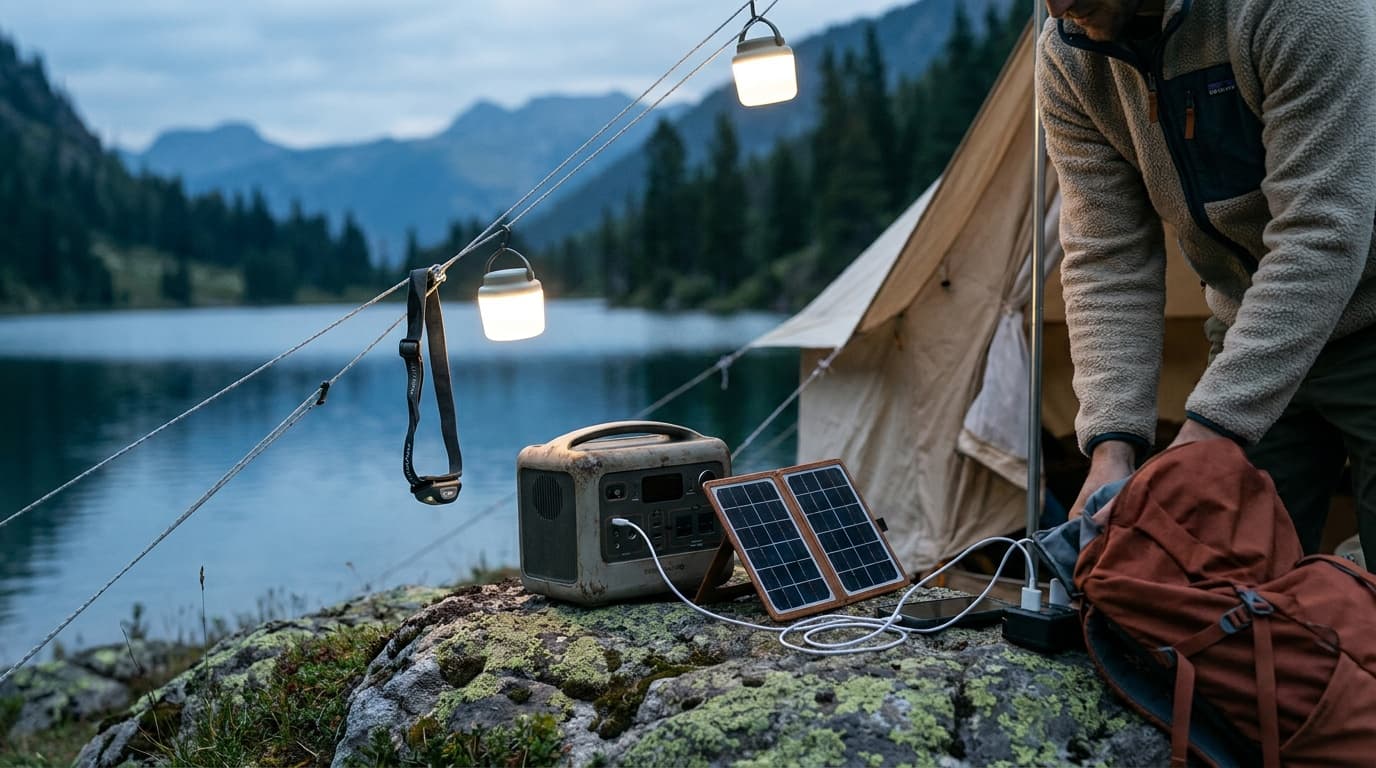
Sizing a portable power station comes down to two numbers: how much energy you need to store, and how fast you need to release it. Get both right and you have exactly the unit you need. Get one wrong and you are either stranded with a dead station or hauling 28 lbs of battery you never used.
The two-number problem
Every power station spec sheet lists two figures that mean completely different things:
Capacity (watt-hours, Wh) tells you how much total energy is stored. A 1,000 Wh station holds roughly the same energy as ten 100 Wh laptop batteries.
Continuous output (watts, W) tells you how much power the station can deliver at once. A 1,000 Wh station with a 500 W inverter cannot run a 1,200 W coffee maker, full stop, regardless of how much energy is stored.
Most people focus only on capacity and miss the output trap. A coffee maker needs 600–1,200 W of continuous output. An electric kettle or space heater needs 1,500 W. An induction burner needs 1,800 W. If those are on your list, match the output spec first, then confirm the capacity covers your runtime.
How to calculate your daily watt-hour need
This is a five-minute exercise. Do it before you buy anything.
Calculate your daily Wh budget
List every device
Write down everything you plan to run: phone, fridge, fan, CPAP, laptop, lights. Be specific.
Find each device's wattage
Check the label on the device. If it only shows amps, multiply by voltage (watts = volts x amps). A device drawing 2 A at 12 V draws 24 W.
Multiply watts by daily hours
For each device, estimate realistic daily runtime. A 50 W compressor fridge cycling half the time = 50 W x 12 hrs = 600 Wh. A laptop at 65 W for 2 hrs = 130 Wh.
Add everything up
Total all device-hours. This is your raw daily consumption.
Multiply by 1.25
Inverter conversion loses 10–15% of stored DC to AC. The battery management system reserves another 5%. A 25% buffer covers both. This result is your minimum daily capacity target.
Multiply by trip days (if not recharging)
Going three days with no solar? Multiply your buffered daily figure by 3. That is your minimum station capacity.
Worked example: portable fridge (50 W x 12 hrs cycling = 600 Wh) plus phone charging (20 W x 2 hrs = 40 Wh) plus LED light (10 W x 4 hrs = 40 Wh) plus laptop (65 W x 2 hrs = 130 Wh) = 810 Wh raw daily total. Multiply by 1.25 = roughly 1,010 Wh minimum. For a two-night trip without solar, you need around 2,000 Wh.
Capacity tiers by camping style
If your only loads are a few phones, a headlamp, and a speaker, a 300 Wh station weighs 7–10 lbs and does the job. Stepping up to 1,000 Wh to run nothing extra adds 15–20 lbs and real cost for zero practical benefit.
300–500 Wh: phones, LED lights, a small Bluetooth speaker. One to two nights, no fridge. This tier weighs 7–10 lbs and is genuinely enough for minimalist camping (the EcoFlow RIVER 2 sits just under it at 256 Wh). Ultralight backpackers are often better served by a high-capacity USB battery bank plus a small foldable panel.
800–1,200 Wh: a portable fridge, phone and laptop charging, a box fan. The practical weekend camping tier for one or two people, anchored by units like the Anker SOLIX C1000. A 12V compressor fridge draws 30–60 W and consumes roughly 400–600 Wh over 24 hours of cycling, which is the single biggest draw for most car campers.
2,000 Wh+: multi-day glamping, multiple users, CPAP every night plus a fridge, or any setup with high-draw appliances. CPAP without humidifier draws 20–40 W (60–90 W with heated humidifier), adding 60–90 Wh per night. Add a fridge and you are already at 500–700 Wh before anything else. Van life and extended base camp setups typically need 2,000 Wh or more.
Output wattage: the spec most buyers miss
Capacity gets the headline. Output wattage is what determines whether you can actually run your gear.
| Appliance | Continuous draw needed |
|---|---|
| Phones, laptops, fans, LED lights | 100–500 W |
| Portable 12V compressor fridge | 150–200 W surge, 30–60 W running |
| Coffee maker | 600–1,200 W |
| Electric kettle | 1,500 W |
| Space heater | 1,500 W |
| Induction burner | 1,800 W |
A station with 1,000 W continuous output handles everything in the top two rows comfortably. For a kettle, heater, or induction burner, you need a unit rated at 1,500–2,000 W continuous, and you should expect those appliances to drain the battery quickly. A 1,500 W kettle running for 10 minutes uses about 250 Wh from a single boil.
Buy output spec based on your heaviest single load. Buy capacity based on total daily consumption.
Solar recharge: how to size panels correctly
Solar extends a trip significantly, but it does not replace battery sizing. Size the battery to survive at least one full night and one overcast day without any solar input. Then add panels to recover that energy during daylight.
The practical formula: panel watts needed = daily Wh target / (peak sun hours x 0.75). The 0.75 factor accounts for real-world panel inefficiency, heat, angle, and wiring losses. For a 640 Wh daily need with 4 peak sun hours: 640 / (4 x 0.75) = roughly 213 W of panels.
A 100 W panel recovers about 400–500 Wh on a clear day. For a 1,000 Wh station running a fridge and multiple devices, 200–400 W of panels is more realistic than a single 100 W panel.
A 200 W solar input port is a practical minimum for a 1,000 Wh class station; the Jackery Explorer 1000 v2 accepts up to 400 W. Most mid-range stations in that tier now ship with at least that.
When bigger is overkill
More capacity is not always better. The main costs of oversizing:
- Weight: 300 Wh class units typically weigh 7–10 lbs. 1,000 Wh class units typically weigh 22–28 lbs. 2,000 Wh class units often exceed 40 lbs.
- Cost: mid-range 1,000 Wh stations run $700–$1,000. 2,000 Wh stations run $1,500–$2,500. Paying for storage you never discharge is a bad trade.
- Cycle life: if you only discharge 10% of a large unit each trip, you are still accumulating charge cycles. LiFePO4 chemistry (3,000–4,000 cycles) matters far more than oversizing for longevity.
The sanity check: take your estimated daily Wh, multiply by trip days, divide by 0.80 (conservative usable-capacity factor). Under 600 Wh, a compact unit works. 600–1,500 Wh, a mid-size unit paired with 100–200 W of solar covers most trips. Above 1,500 Wh per day, or for multi-day trips without reliable sun, step up to a 2,000 Wh class station.
LiFePO4 vs. NMC lithium-ion: the chemistry decision
If you camp regularly, LiFePO4 battery chemistry is worth the price premium. LiFePO4 units last 3,000–4,000 charge cycles before meaningful capacity loss. Standard NMC lithium-ion units typically last around 800 cycles. At one cycle per week, a LiFePO4 unit stays above 80% capacity for roughly a decade. An NMC unit may degrade noticeably within two to three years of regular use.
For occasional campers (fewer than 20 trips per year), the cycle life difference is less urgent and the lower price of NMC units may make more sense. For anyone camping weekly or using a power station for van life or overlanding, LiFePO4 is the better long-term investment.
For specific model recommendations at each capacity tier, see our guide to the best portable power stations.
Browse more camp gear or read how we research and rate products at Kit Authority.
How do I calculate how many watt-hours I actually need?
List every device you plan to use. Find its wattage (printed on a label; if you see only amps, multiply by voltage: watts = volts x amps). Multiply each device's watts by the hours per day you will run it. Add those numbers together for your raw daily total. Multiply by 1.25 to account for inverter losses and the battery management reserve. Then multiply by your trip length in days if you are not planning to recharge with solar. That final number is your minimum capacity in watt-hours. Example: portable fridge (50 W x 12 hrs cycling = 600 Wh) plus phone charging (20 W x 2 hrs = 40 Wh) plus LED light (10 W x 4 hrs = 40 Wh) plus laptop (65 W x 2 hrs = 130 Wh) = 810 Wh daily, times 1.25 = roughly 1,010 Wh minimum.
Can solar panels fully recharge a power station during a camping trip?
Yes, under good conditions, but you need to match panel wattage to both your station's maximum solar input rating and your actual daily consumption. A 100 W panel can recover roughly 400–500 Wh on a sunny day (panel watts x peak sun hours x 0.75 for real-world efficiency). If your campsite gets 4–5 peak sun hours and your daily need is around 500 Wh, one 100 W panel can keep pace. For a 1,000 Wh station running a fridge and multiple devices, 200–400 W of panels is more realistic. Never connect panels that exceed your station's rated solar input limit: the controller caps the intake, and you will have paid for capacity you cannot use.
Does continuous output wattage matter more than capacity?
Both matter, but for different reasons. Capacity (Wh) determines how long you can run devices. Output (W) determines which devices you can power at all. For phones, laptops, fans, and a portable fridge, 500–1,000 W of continuous AC output is sufficient. If you want to run a coffee maker (600–1,200 W), an electric kettle (1,500 W), or an induction burner (1,800 W), your station's rated continuous output has to meet or exceed that draw. High-draw appliances also deplete stored energy fast: a 1,500 W kettle running for 10 minutes uses about 250 Wh per boil. Choose output wattage based on your heaviest single load; choose capacity based on your total daily usage.
Recommended gear
Our current top picks from the Best portable power stations for camping in 2026 guide, if you are ready to buy.
ANKER
Anker SOLIX C1000 Gen 2 Portable Power Station
BEST OVERALL
Kit Score 8.8/10
$699.99 Price checked Oct 23, 4:16 PM CDT
Best for: Most households and campers who want one 1 kWh station that recharges fast and can back up a fridge, router, or CPAP.
- Fastest full recharge here: 49 minutes on AC in UltraFast mode
- Not expandable; Anker points buyers who want an add-on battery to the original C1000
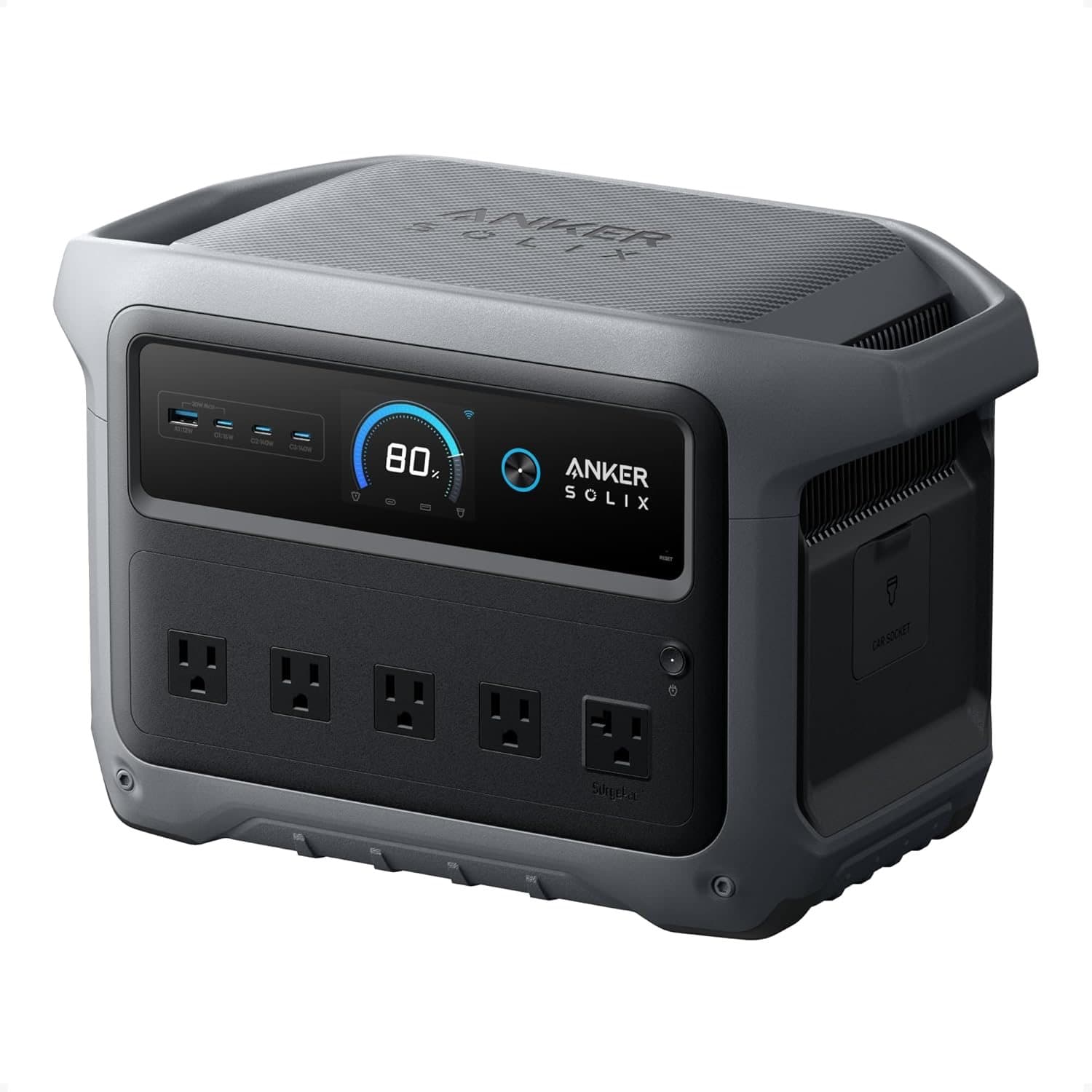
- Capacity
- 1,024 Wh LiFePO4, 4,000 cycles to 80%
- AC output
- 2,000W continuous, 3,000W peak, 5 outlets
- Recharge
- 100% in 49 min on AC (1,600W UltraFast mode); up to 600W solar, 11 to 60V
- Weight
- 24.9 lb; 15.1 x 8.2 x 9.6 in
- Backup
- 10 ms UPS switchover; not expandable
- Warranty
- 5 years
About this pick
The C1000 Gen 2 packs 1,024 Wh of LiFePO4 into a 24.9 lb case with 2,000W of output, five AC outlets, and a 140W USB-C port. Anker rates a full AC recharge at 49 minutes and the battery at 4,000 cycles to 80% capacity. Unlike the original C1000, it cannot take an expansion battery.
Strengths
- Fastest full recharge here: 49 minutes on AC in UltraFast mode
- 2,000W output and five AC outlets in a 24.9 lb case
- 10 ms UPS switchover and a 5-year warranty
Weaknesses
- Not expandable; Anker points buyers who want an add-on battery to the original C1000
- Charging is limited to 32 to 104 F, so it cannot recharge in a cold garage or car
Kit Score breakdown
JACKERY
Jackery Explorer 1000 v2 Portable Power Station
BEST LIGHTWEIGHT
Kit Score 8.5/10
$499.00 Price checked Oct 23, 4:16 PM CDT
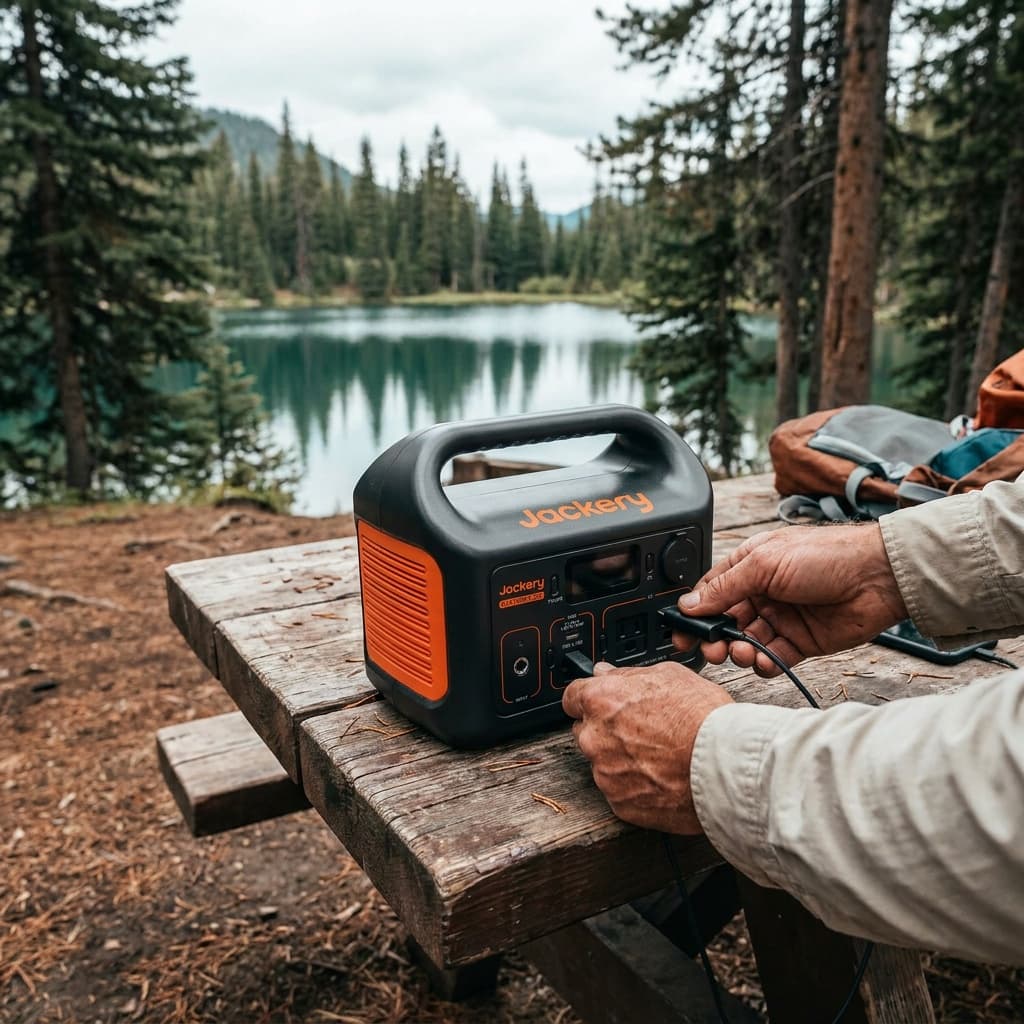
Best for: Campers who move sites frequently and want a sub-24-lb 1 kWh station that handles a fridge, CPAP, and device charging without being a chore to carry.
- Lightest of the 1 kWh picks here at about 23.8 lb, manageable for one person
- No battery expansion option, so 1,070 Wh is the ceiling; rivals like the DELTA 2 can grow beyond that
- Capacity
- 1,070 Wh (LiFePO4)
- AC output
- 1,500W continuous, 3,000W surge
- Solar input
- Up to 400W (two 200W inputs, 16 to 60V)
- Fast charge
- About 1.7 hr on AC; Jackery advertises a 1 hr Emergency Charge
- Weight
- 23.8 lbs (10.8 kg)
- Ports
- 3x AC, 2x USB-C (100W and 30W), 1x USB-A (18W), 1x 12V car
About this pick
The Explorer 1000 v2 packs 1,070 Wh of LiFePO4 into about 23.8 lb, the lightest of the 1 kWh picks here, and Jackery rates the battery for 4,000 cycles to 70 percent capacity. It recharges in about 1.7 hours from the wall (Jackery advertises one hour in its Emergency Charge mode) and switches to battery within 20 ms in an outage.
Strengths
- Lightest of the 1 kWh picks here at about 23.8 lb, manageable for one person
- 4,000-cycle LFP battery; 3-year warranty, extendable to 5
- Jackery rates the cooling fan at 22 dB or less
Weaknesses
- No battery expansion option, so 1,070 Wh is the ceiling; rivals like the DELTA 2 can grow beyond that
- 400W solar input is lower than the Anker SOLIX C1000, meaning longer solar-only recharge times
Kit Score breakdown
ECOFLOW
EcoFlow DELTA 3 Portable Power Station
BEST EXPANDABLE
Kit Score 8.3/10
$629.00 Price checked Oct 23, 4:16 PM CDT
Best for: Buyers who want a 1 kWh station now and the option to add a second battery for longer outages later.
- Expandable to 5 kWh with an add-on battery, unlike most 1 kWh stations
- At 27.6 lb it is the heaviest of the 1 kWh picks
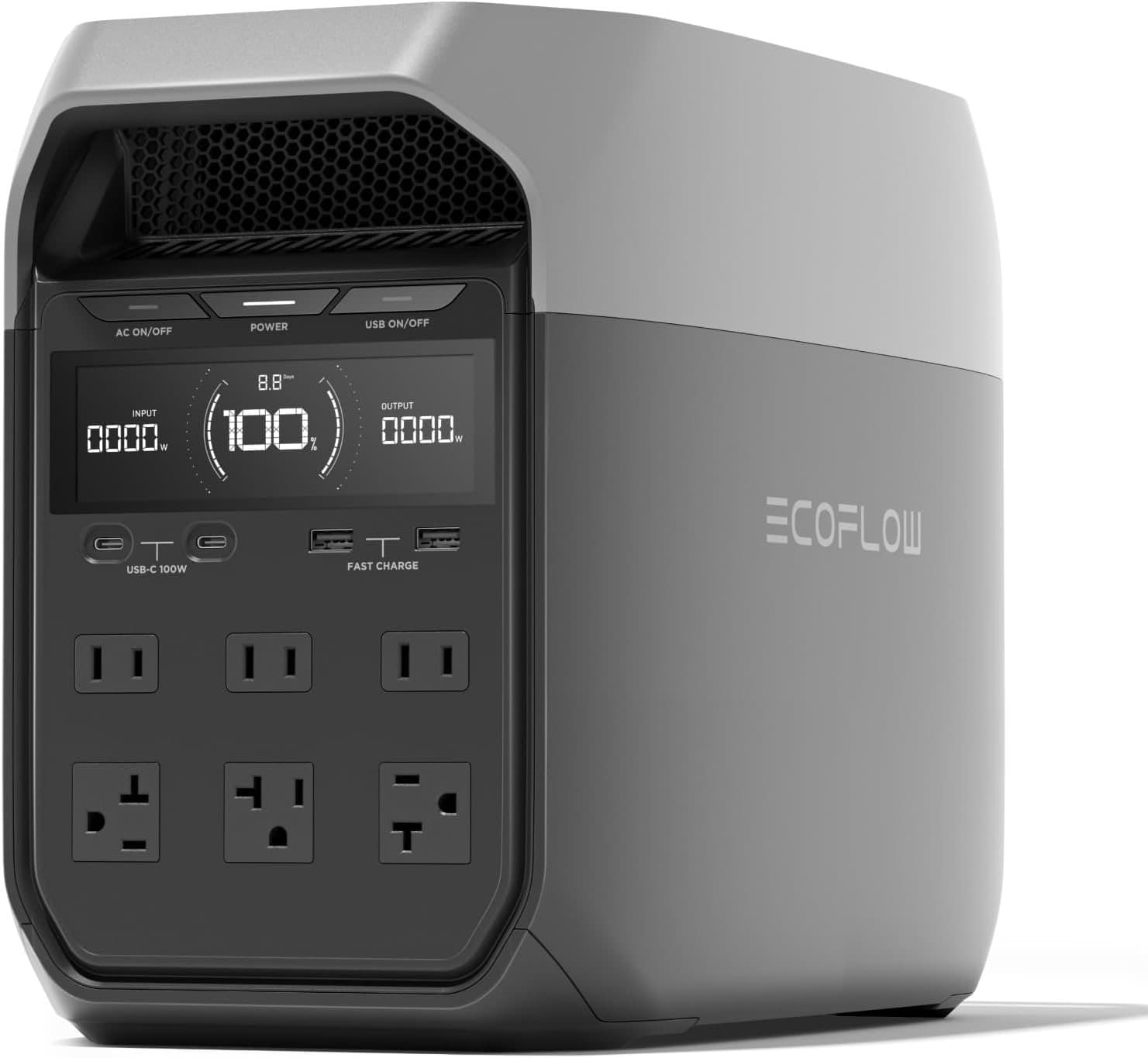
- Capacity
- 1,024 Wh LiFePO4, expandable to 5 kWh; 4,000 cycles to 80%
- AC output
- 1,800W continuous, 3,600W surge, 6 outlets (13 outputs total)
- Recharge
- Full in about 56 min on 1,500W AC; up to 500W solar, 11 to 60V
- Weight
- 27.6 lb; 15.7 x 8.0 x 11.2 in
- Backup
- Under 10 ms UPS switchover
- Warranty
- 5 years
About this pick
The DELTA 3 is EcoFlow's 1 kWh station with the most room to grow. It has six AC outlets, 1,800W of output (3,600W surge), a full AC recharge in about 56 minutes, and an expansion port that takes DELTA 3, DELTA 2, DELTA 2 Max, or DELTA Pro 3 extra batteries for up to 5 kWh.
Strengths
- Expandable to 5 kWh with an add-on battery, unlike most 1 kWh stations
- Six AC outlets and 13 outputs in total
- Under 10 ms UPS switchover and a 5-year warranty
Weaknesses
- At 27.6 lb it is the heaviest of the 1 kWh picks
- Extra batteries add cost and weight; price the full system before you buy
Kit Score breakdown
See all picks in Best portable power stations for camping in 2026
Keep going
Related guides

 Complete camp loadoutCar-camping starter kitBuild the complete kit
Researched, not hands-on tested
Updated Jun 3, 2026Our recommendations draw on manufacturer documentation, retailer listings, owner feedback, and comparisons with alternatives.
As an Amazon Associate I earn from qualifying purchases. We may earn a commission from links here, at no extra cost to you. How we research →