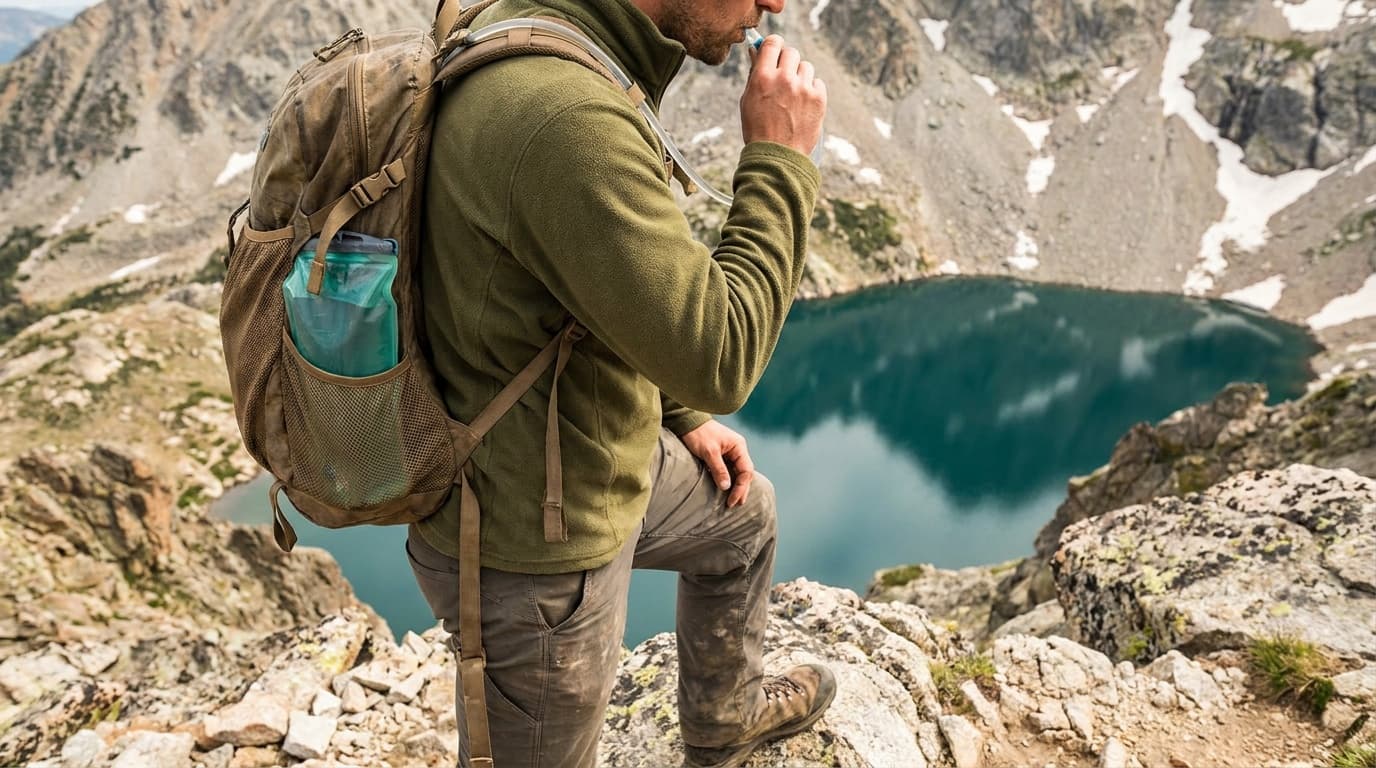
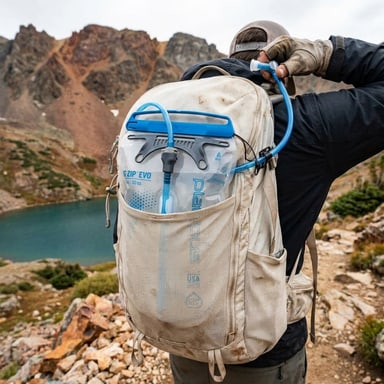
Staying hydrated on the trail is non-negotiable, and the reservoir you carry matters more than most hikers expect. The right bladder stays leak-free when stuffed under a lid pocket, flows fast enough that you actually drink enough, and dries clean between trips without a PhD in bottle-brush technique.
Our quick picks
How we picked
Every pick below is scored against our Kit Score: a weighted rubric that pulls from verified owner reviews, manufacturer specs, and independent gear reporting. We research and aggregate; we do not claim hands-on lab testing. Factors weighted for this category: leak-proof closure design, flow rate, clean-and-dry ease, bite-valve quality, pack compatibility, and value per liter.
Best overall: HydraPak Contour
BEST OVERALL
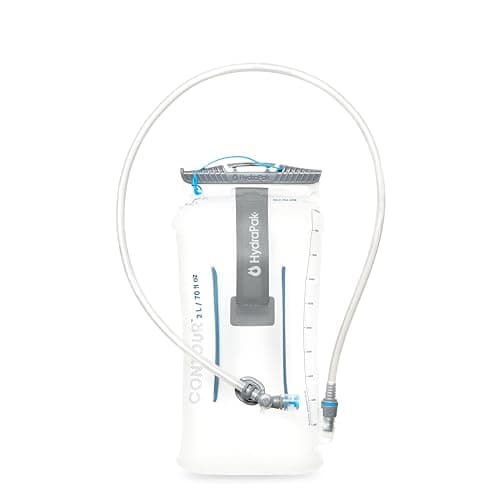
HydraPak Contour Hydration Reservoir (1.5L, 2L, or 3L)
Best for: Weight-conscious day hikers and backpackers who want the fastest, easiest clean-and-dry routine.
- Reverses inside-out for thorough drying in under 90 minutes, far faster than twist-cap designs
- Slide-Seal opening can be harder to fill from shallow water sources than a wide-mouth screw cap
Kit Score 8.5/10 · $39.95 Price checked Oct 23, 6:22 AM CDT · how we score gear
Buy on AmazonProduct details
The Contour's 3D-welded shell and internal Shape-Loc baffles keep it flat and slim so it slides into a loaded pack without fighting the sleeve. Its fully reversible body and dishwasher-compatible materials make it the easiest bladder on the market to clean and dry completely.
- Capacity
- 1.5L / 2L / 3L
- Weight (3L)
- 5.5 oz (155 g)
- Closure
- Zip Slide-Seal, fully reversible
- Bite valve
- Comet self-sealing, thumb shutoff
- Dishwasher safe
- Yes (top rack)
- Hose connection
- Quick-disconnect, magnetic clip
More strengths
- 3D-welded slim profile slides into stuffed pack sleeves where other bladders bind
- Lightweight at 5.4 oz for 3L while still including a shutoff bite valve and magnetic hose clip
Other tradeoffs
- Bite valve rubber wears over extended use; keep a replacement on longer trips
The Contour's signature is its wide slide-seal top: the opening folds over and a plastic slider locks it, and pulling the slider off lets the reservoir open fully and turn inside out for washing and drying. No screw cap to fight, no damp interior that never fully airs out. Owners consistently report the seal holds after hundreds of fills.
HydraPak lists the 3L at 5.5 oz (155 g) and 16.9 by 7.5 inches, with a 3D-welded bottom and Shape-Loc baffles that keep it flat and low-profile in a loaded pack, a side exit port, the Plug-N-Play tube connector with an auto shut-off so you can pull the hose to refill without a drip, and the Comet bite valve, which self-seals after each sip and locks with one hand. A magnet clip on the hose pairs with most packs. It comes in 2L and 3L, plus a 1.5L Lumbar version, and carries HydraPak's Beyond Lifetime Guarantee.
At HydraPak's $49 list, it is priced in line with the CamelBak Crux but buys you a noticeably faster post-trip dry time. For anyone who has ever left a bladder damp in a gear bag, that difference compounds fast.
Best for: weight-conscious day hikers and backpackers who want the fastest, easiest clean-and-dry routine.
Best value: CamelBak Crux 3L
BEST VALUE
CamelBak Crux 3L Water Reservoir
Best for: Day hikers and weekend backpackers who want a reliable, fast-flowing bladder at a wallet-friendly price.
- Best-in-class flow rate delivers noticeably more water per sip than competing designs
- Heavier and bulkier than ultralight alternatives; the rigid handle reduces packability
Kit Score 8.2/10 · $41.49 Price checked Oct 23, 6:22 AM CDT · how we score gear
Buy on AmazonProduct details
The Crux is a proven performer with the highest measured flow rate among major bladders tested, a large ergonomic handle that simplifies stream fills, and clean-tasting water straight out of the packaging. At around $42, it delivers genuine all-around reliability at an honest price.
- Capacity
- 1.5L / 2L / 3L
- Weight (2L)
- 7 oz
- Closure
- Twist screw-cap with ergonomic handle
- Bite valve
- Big Bite Valve, on/off lever
- Flow rate
- Highest tested: 1.25 cups per 10 sec
- BPA/BPS/BPF
- Free
More strengths
- Large twist handle makes one-handed stream and sink fills straightforward
- Clean water taste with minimal plastic off-notes, backed by a lifetime guarantee
Other tradeoffs
- Twist-cap body cannot be inverted, leading to longer drying times of 7 or more hours
CamelBak invented the category, and the Crux is the most recent version of that legacy. CamelBak's headline claim is that the Crux delivers 20 percent more water per sip than the previous generation, and owner reviews back that up: this bladder drinks fast and the on/off lever at the bite valve closes cleanly with one hand.
The 3L Crux (100 fl oz, about 18 by 9 inches) uses a center baffle that keeps it flat, a leak-proof screw cap with an ergonomic handle that makes one-handed stream fills easy, and Hydroguard, CamelBak's antimicrobial treatment inside the reservoir and tube. The screw-cap body cannot be turned inside out the way the HydraPak can, so drying takes a cleaning kit (sold separately) and an overnight hang. Retail listings put it at about 235 g (8.3 oz) empty. CamelBak's Got Your Bak lifetime guarantee covers the reservoir against defects.
Priced close to the Contour, it matches it on cost but is more widely available across outdoor retailers, easier to find as a replacement part (tubes, bite valves), and the closest thing to a universal trail standard.
Best for: day hikers and weekend backpackers who want a reliable, fast-flowing bladder at a wallet-friendly price.
Editor's choice: SOURCE Widepac 2L
EDITOR'S CHOICE
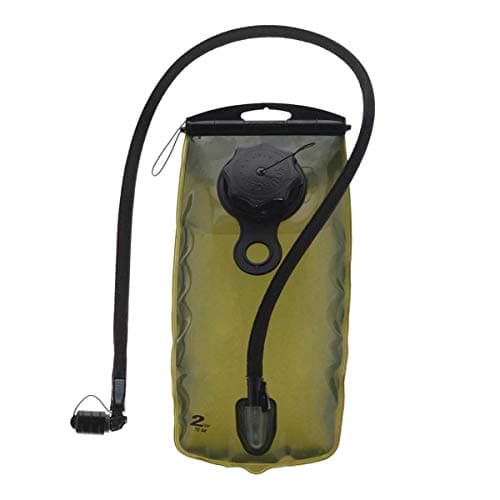
SOURCE Widepac 2L Hydration Bladder
Best for: Hikers who prioritize neutral-tasting water and want a durable, easy-to-clean bladder that works well in any season.
- Glass-Like PE film technology delivers genuinely taste-free water over the long term, outperforming most TPU-based competitors
- Wider body profile can conflict with narrow pack sleeves designed for slimmer bladders
Kit Score 8.7/10 · $34.58 Price checked Oct 23, 6:22 AM CDT · how we score gear
Buy on AmazonProduct details
SOURCE's co-extruded polyethylene film is 2,000% smoother than standard TPU and adds zero plastic taste to water, even after months of use. The wide-mouth Slide Closure opens wide enough for ice cubes and makes cleaning and draining fast and mess-free.
- Capacity
- 1.5L / 2L / 3L
- Closure
- Widepac Slide Closure (wide-mouth)
- Film technology
- Multi-layer PE, Glass-Like coating
- Bite valve
- Helix high-flow self-sealing
- Antimicrobial
- Yes, built into film
- BPA/Phthalates
- Free
More strengths
- Wide Slide Closure opens fully for easy ice filling, cleaning, and draining
- Built-in antimicrobial protection reduces mold growth between uses
Other tradeoffs
- Some hoses from early production batches showed plastic taste inconsistency; check the hose at first fill
SOURCE's Widepac uses the patented Wideslide closure: the entire top edge opens, so you can reach a hand inside to wipe it out, fill it from a wide-mouth Nalgene, drop ice cubes in, or let it stand open on a counter to dry. SOURCE calls the sealed bag 100 percent leakproof. Retailer listings of SOURCE's spec sheet put the 2L (70 oz) at 108 g empty and 35.5 by 19.2 cm.
The film is SOURCE's co-extruded polyethylene, which the company markets as GlassLike, a surface it says is far smoother than standard TPU, paired with GrungeGuard, an additive that inhibits bacteria growth. The taste claim holds up in owner reviews: hikers who switched from other brands consistently flag the lack of plastic taste as the headline benefit. The Helix bite valve is large-bore and self-sealing.
At $25 to $35, it undercuts the field on price while offering one of the most durable constructions here, and the antimicrobial film extends the useful life between deep cleans.
Best for: hikers who prioritize neutral-tasting water and want a durable, easy-to-clean bladder that works well in any season.
Best premium: Platypus Big Zip EVO 2L
BEST PREMIUM
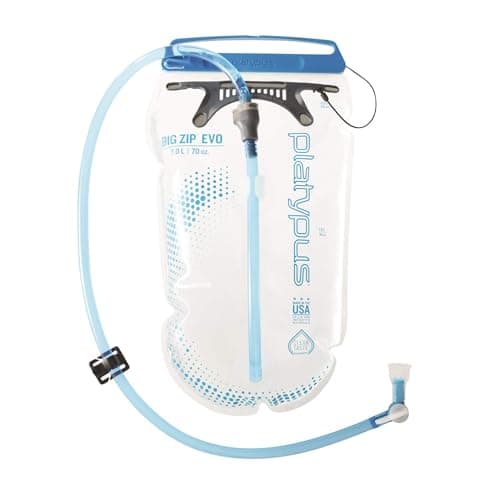
Platypus Big Zip EVO Water Reservoir, 2L
Best for: Multi-day backpackers who refill frequently from streams and want a complete, no-compromise system that stays clean between long trips.
- HyFLO bite valve delivers 50% more flow than the Platypus standard valve, minimizing suction effort on uphills
- Wider profile limits compatibility with some compact or frameless pack hydration sleeves
Kit Score 8.1/10 · $54.95 Price checked Oct 23, 6:22 AM CDT · how we score gear
Buy on AmazonProduct details
The Big Zip EVO combines a high-flow HyFLO bite valve, embedded silver-ion protection, and a wide SlideLock closure into one complete system that handles multi-day backcountry trips without complaint. The quick-disconnect keeps the hose routed in the pack while you refill at a stream.
- Capacity
- 1.5L / 2L / 3L
- Weight (2L)
- 6 oz
- Closure
- Zip SlideLock with wide-mouth opening
- Bite valve
- HyFLO self-sealing, 50% higher flow than standard
- Silver-ion antimicrobial
- Yes, embedded in film
- Quick-disconnect hose
- Yes
More strengths
- Quick-disconnect hose stays routed in the pack during refills, eliminating re-threading on multi-day trips
- Embedded silver-ion antimicrobial keeps the interior clean during extended back-to-back use without washing
Other tradeoffs
- SlideLock closure stiffens in temperatures below freezing, making opening more difficult with gloved hands
The Big Zip EVO earns its price with a wide-mouth top and Platypus's SlideLock closure, which slides both directions to open, close, and fill. Open, the bladder lies flat enough that every interior surface is reachable and visible. For backpackers who refill from streams and need to inspect for grit or scrub after treatment tablets, this is not a convenience feature, it is a hygiene feature.
The EVO adds a high-mount quick-disconnect so the hose stays routed in the pack while you fill, a HyFLO self-sealing bite valve on a larger 5/16-inch tube for easier draw, a leak-proof shut-off valve, a semi-rigid center baffle that keeps the profile low, and silver-ion protection embedded in the polyurethane and polyethylene film. Platypus lists the 2L at 6.0 oz (171 g) and 15 by 8.7 inches; the 1.5L is 5.6 oz and the 3L is 6.5 oz.
At Platypus's $59.95 list, you are paying for the SlideLock top and the quick-disconnect system. If you are doing single-day loops, the premium is hard to justify. If you are doing 4-plus-day trips with natural water sources, it is one of the most defensible gear investments on the list.
Best for: multi-day backpackers who refill frequently from streams and want a complete, no-compromise system that stays clean between long trips.
The closure design is the most important spec on a hydration bladder: it determines how fast you can fill it, how thoroughly you can dry it, and how long it stays clean.
Comparison
| Product | Kit Score | Price | Best for |
|---|---|---|---|
| HydraPak Contour Hydration Reservoir (1.5L, 2L, or 3L) | 8.5 | $39.95 Price checked Oct 23, 6:22 AM CDT | Best for: Weight-conscious day hikers and backpackers who want the fastest, easiest clean-and-dry routine. Why it stands out: Reverses inside-out for thorough drying in under 90 minutes, far faster than twist-cap designs Tradeoff: Slide-Seal opening can be harder to fill from shallow water sources than a wide-mouth screw cap |
| CamelBak Crux 3L Water Reservoir | 8.2 | $41.49 Price checked Oct 23, 6:22 AM CDT | Best for: Day hikers and weekend backpackers who want a reliable, fast-flowing bladder at a wallet-friendly price. Why it stands out: Best-in-class flow rate delivers noticeably more water per sip than competing designs Tradeoff: Heavier and bulkier than ultralight alternatives; the rigid handle reduces packability |
| SOURCE Widepac 2L Hydration Bladder | 8.7 | $34.58 Price checked Oct 23, 6:22 AM CDT | Best for: Hikers who prioritize neutral-tasting water and want a durable, easy-to-clean bladder that works well in any season. Why it stands out: Glass-Like PE film technology delivers genuinely taste-free water over the long term, outperforming most TPU-based competitors Tradeoff: Wider body profile can conflict with narrow pack sleeves designed for slimmer bladders |
| Platypus Big Zip EVO Water Reservoir, 2L | 8.1 | $54.95 Price checked Oct 23, 6:22 AM CDT | Best for: Multi-day backpackers who refill frequently from streams and want a complete, no-compromise system that stays clean between long trips. Why it stands out: HyFLO bite valve delivers 50% more flow than the Platypus standard valve, minimizing suction effort on uphills Tradeoff: Wider profile limits compatibility with some compact or frameless pack hydration sleeves |
HydraPak Contour Hydration Reservoir (1.5L, 2L, or 3L)
- Best for
- Weight-conscious day hikers and backpackers who want the fastest, easiest clean-and-dry routine.
- Why it stands out
- Reverses inside-out for thorough drying in under 90 minutes, far faster than twist-cap designs
- Tradeoff
- Slide-Seal opening can be harder to fill from shallow water sources than a wide-mouth screw cap
CamelBak Crux 3L Water Reservoir
- Best for
- Day hikers and weekend backpackers who want a reliable, fast-flowing bladder at a wallet-friendly price.
- Why it stands out
- Best-in-class flow rate delivers noticeably more water per sip than competing designs
- Tradeoff
- Heavier and bulkier than ultralight alternatives; the rigid handle reduces packability
SOURCE Widepac 2L Hydration Bladder
- Best for
- Hikers who prioritize neutral-tasting water and want a durable, easy-to-clean bladder that works well in any season.
- Why it stands out
- Glass-Like PE film technology delivers genuinely taste-free water over the long term, outperforming most TPU-based competitors
- Tradeoff
- Wider body profile can conflict with narrow pack sleeves designed for slimmer bladders
Platypus Big Zip EVO Water Reservoir, 2L
- Best for
- Multi-day backpackers who refill frequently from streams and want a complete, no-compromise system that stays clean between long trips.
- Why it stands out
- HyFLO bite valve delivers 50% more flow than the Platypus standard valve, minimizing suction effort on uphills
- Tradeoff
- Wider profile limits compatibility with some compact or frameless pack hydration sleeves
How to choose the right hydration bladder
How to match a bladder to your trip
Decide your capacity first
1.5L covers a short morning hike near water sources; 2L handles most full-day hikes; 3L is for long days, hot weather, or anywhere refills are scarce. Carrying dead weight is its own problem, so size to your actual route.
Check pack compatibility before buying
Most reservoirs are designed to fit standard hydration sleeves (vertical, with a hang loop), but width and baffle shape vary. Wide flat reservoirs sit better in frameless packs; baffled center-load designs (like the Crux and the Big Zip EVO) distribute weight better in framed packs.
Match the closure to your cleaning habit
If you are diligent about post-trip cleaning, a screw cap is fine. If you know you will skip the deep clean sometimes, a slide-seal top that opens wide or turns inside out will extend the bladder's hygienic life.
Prioritize bite-valve shutoff if you pack in a horizontal lid
Bladders stored on their side in a hip-belt pocket or stuffed under a lid benefit from a shutoff valve. Without one, a compressed reservoir can push water up the tube and drip from the mouthpiece.
Consider taste sensitivity
Budget TPU can off-gas a plastic taste, especially when new. SOURCE's polyethylene film and HydraPak's TPU draw the fewest taste complaints in owner reviews. If taste is a dealbreaker, start there.
Frequently asked questions
How often should I clean my hydration bladder?
After every use, at minimum. Rinse it out with clean water immediately after a hike while residue is still loose. Do a soap-and-water clean once a week during active use, and a tablet or diluted bleach soak (follow manufacturer guidance) once a month or any time you notice taste changes or visible residue. The number one cause of early bladder failure is infrequent cleaning leading to biofilm buildup that etches the interior.
Can I put sports drinks or electrolyte mixes in a hydration bladder?
Yes, but rinse it out the same day. Sugary or electrolyte drinks accelerate mold growth if left to sit. Some manufacturers (notably CamelBak and SOURCE) explicitly allow drinks other than water but recommend a thorough clean immediately after. Avoid carbonated drinks: pressure can stress seams and closures not designed for it.
What is the best way to dry a hydration bladder without a drying rack?
Stuff a clean paper towel loosely inside to wick moisture, then prop the opening over a bottle neck or the neck of a large mug to hold it open. Leave it somewhere with airflow overnight. Slide-top designs (the HydraPak Contour and SOURCE Widepac in particular) can be turned inside out or propped fully open, which makes this easier. Drying racks ($5 to $10) are a worthwhile add-on if you use your bladder weekly.
Where these numbers come from
| Claim | Source | Checked |
|---|---|---|
| Contour 3L: 155 g (5.5 oz), 429 x 190 mm, TPU body, 3D bottom and Shape-Loc baffles, side exit port, Plug-N-Play connector with auto shut-off, Comet bite valve, tube magnet, Beyond Lifetime Guarantee, $49 list | HydraPak, Contour 3L | Sep 2026 |
| Contour opening: slider pulls off, top unfolds and opens wide; turns inside out for cleaning | HydraPak Help Center, How do I open, close, and fill my HydraPak reservoir? | Sep 2026 |
| Crux 3L: 100 fl oz, about 46 x 23 x 8 cm, "20% more water per sip", leak-proof cap with ergonomic handle, on/off lever, Hydroguard, BPA/BPS/BPF free | CamelBak, Crux 3L Reservoir (the page renders its specs in-browser only; claims confirmed from CamelBak's page summary and the listing on Amazon, linked from the pick above) | Sep 2026 |
| Crux 3L: about 235 g (8.3 oz) empty | Retailer listings of CamelBak's spec sheet; CamelBak's own page does not show a weight to our fetch | Sep 2026 |
| Widepac: patented Wideslide opening, GlassLike film, GrungeGuard, Helix bite valve, "100% leakproof" | SOURCE, Widepac features | Sep 2026 |
| Widepac 2L: 108 g, 35.5 x 19.2 cm, 70 oz | Retailer listings of SOURCE's spec sheet (SOURCE's own product page returned 404 to our fetch); SOURCE listing on Amazon, linked from the pick above | Sep 2026 |
| Big Zip EVO: 2L at 6.0 oz (171 g) and 15 x 8.7 in, 1.5L at 5.6 oz, 3L at 6.5 oz, polyurethane/polyethylene film, silicone bite valve, SlideLock top, high-mount quick-disconnect, HyFLO valve with 5/16 in tube, shut-off valve, center baffle, silver-ion protection, $59.95 | Platypus, Big Zip EVO Reservoir | Sep 2026 |
| Amazon street prices ran at or below list price for the Contour, Crux, Widepac and Big Zip EVO | Listings on Amazon, linked from the picks above | Sep 2026 |
We did not test these reservoirs ourselves. Weights and dimensions are the makers' listed specs; the flow and taste claims are the makers' own, backed here only by the pattern in owner reviews.
Any of these four will keep you hydrated and leak-free on the trail. The HydraPak Contour is the one we would put in a new hiker's pack first. For more gear built around moving well in the outdoors, browse the full hike hub or read how we research and rate gear.
Keep going
Complete loadoutDay hike kitSeven slots for a full trail day, from the pack and water system to light and weather protection.Free tool: Hiking Water CalculatorRelated guides
Our recommendations draw on manufacturer documentation, retailer listings, owner feedback, and comparisons with alternatives.
As an Amazon Associate I earn from qualifying purchases. We may earn a commission from links here, at no extra cost to you. How we research →