The right hydration vest disappears on your back. The wrong one bounces, chafes, and has you thinking about the gear instead of the trail. These four vests cover the full range from budget-friendly day hikes to UTMB-distance fastpacking, with capacity, weight, and fit figures taken from the makers' own spec sheets and listings (sources at the end).
Our quick picks




How we picked
Every vest here is scored on capacity, bounce control, chest pocket access, ventilation, and fit adjustability using the Kit Score framework. We research aggregate specs, manufacturer data, and verified-owner reviews across thousands of logged miles.
The picks
Best overall
BEST OVERALL
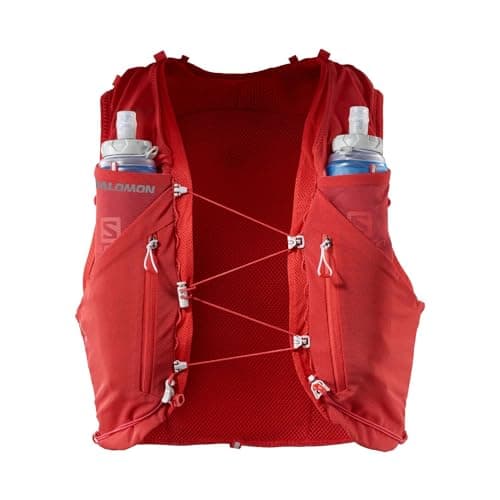
Salomon ADV Skin 12
Best for: Ultramarathon runners and fastpackers who need maximum storage, proven bounce control, and all-day comfort on technical terrain.
- Zero bounce even when fully loaded, thanks to the body-hugging SensiFit harness
- Rear panel fit is structured and precise, meaning you cannot overstuff it the way older more pliable versions allowed
Kit Score 8.8/10 · Check current price · how we score gear
Buy at SalomonProduct details
The ADV Skin 12 is the vest most often spotted at ultramarathon start lines, and gear-review consensus built over a decade of iterations is clear: it sets the standard for all-day running comfort. The current model features a back panel designed for moisture evacuation paired with Salomon's SensiFit harness that locks the vest to your body without restricting movement.
- Capacity
- 12 L
- Weight
- 9 oz; 11.4 oz with flasks (Salomon spec)
- Hydration system
- 2 x 500 ml ULTRA soft flasks included; reservoir-compatible up to 2 L
- Pocket count
- 10+ pockets including front zip, stretch, and rear pass-through
- Fit system
- SensiFit with adjustable front sternum strap
- Best use
- Trail running, ultramarathons, fastpacking up to 100+ miles
More strengths
- Intuitive 10-pocket layout keeps gels, phone, and layers accessible mid-run without stopping
- Two ULTRA soft flasks included and reservoir-compatible, so you can configure hydration for any distance
Other tradeoffs
- Snug, close-to-body fit runs warm for runners who overheat easily
The Salomon ADV Skin 12 is the vest that experienced ultramarathon runners and fastpackers keep coming back to. At 12 liters of total storage it handles everything from a big training day to a multi-day fastpack (Salomon's own recommended distance is ultra, over 80 km), while the sensiFIT stretch construction and quickLINK sternum adjusters keep the load pressed close enough that bounce is largely a non-issue even on technical downhills. Salomon lists it at 9 oz, or 11.4 oz with the two 500 ml soft flasks that ship in the box.
Those flasks sit in chest pockets with a wide 42 mm opening, so you drink and refill without breaking stride. The main compartment fits a 2 L reservoir (not included) if you prefer a bladder for longer efforts, plus poles, a shell, and emergency layers via the tunnel pocket. Trail runners commonly note that the vest fits true to size and does not need much break-in time, which matters for race prep.
Where it asks for a compromise: ventilation. The mesh backing breathes reasonably well but it sits against your back, so expect warmth on hot days. For alpine or shoulder-season running that tradeoff is irrelevant. For a sweltering summer 50K it is worth knowing.
Capacity: 12 L total, 2 front soft-flask pockets (500 ml each), rear main compartment
Hydration system: two 500 ml soft flasks included; 2 L reservoir compatible
Weight: 9 oz; 11.4 oz with flasks (Salomon spec)
Price: $165 direct from Salomon; Amazon's listing is currently unavailable
Best for race day (minimalist)
BEST VALUE
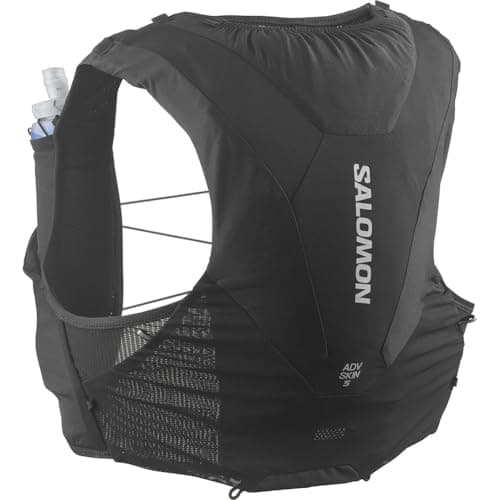
Salomon ADV Skin 5
Best for: Trail runners who want a race-ready, minimal-bounce vest for distances up to 60 km and do not need the extra storage of a 12 L pack.
- SensiFit Y-harness delivers a locked-in, no-bounce ride across light and heavy loads, confirmed across iRunFar and Road Trail Run long-term testing
- Unisex sizing may not fit petite runners well; occasional neck chafing reported when carrying a single flask
Kit Score 8.8/10 · Check current price · how we score gear
Buy at SalomonProduct details
The ADV Skin 5 is Salomon's highest-volume seller in the vest category for good reason: it delivers the same second-skin SensiFit comfort as the larger 12 at a lighter weight and lower price, with enough storage for a marathon trail race or a fast half-day in the mountains. The current model features tighter-weave mesh on the shoulder straps for durability and redesigned top pockets.
- Capacity
- 5 L
- Weight
- 7 oz; 9.9 oz with flasks (Salomon spec)
- Hydration system
- 2 x 500 ml soft flasks included; 2 L reservoir-compatible (not included)
- Dimensions
- 38 x 28 x 1 cm
- Fit system
- Y-shaped SensiFit harness with quick-link sternum strap
- Best use
- Trail races, marathon-distance runs, and supported day outings up to 60 km
More strengths
- Front zip pocket fits an iPhone 16 Pro and is reachable without removing a flask, making mid-run access practical
- Ships with two 500 ml soft flasks at a $145 retail price, offering strong all-in value compared to vests that sell flasks separately
Other tradeoffs
- 5 L rear capacity is tight for overnight or multi-day fastpacking
If you race distances up to about a marathon (Salomon's recommended distance for it is 42 km or less) and aid stations handle your resupply, the Salomon ADV Skin 5 is the cleaner tool. Same sensiFIT construction as the 12, same bounce-control geometry, but trimmed to 5 liters and 7 oz (9.9 oz with flasks) so the vest practically vanishes. Runners frequently mention that it is the first vest they owned that did not shift on climbs.
The chest layout carries two 500 ml soft flasks and leaves room for gels, a phone, and a mandatory-gear layer. That is enough for most trail races with aid stations every 10 to 15 km. For ultras, a slim 10,000mAh bank such as the 143 g Nitecore NB10000 Gen4 fits a chest pocket alongside the phone. Salomon says the 5 is also 2 L reservoir compatible, but with 5 L of total space a full bladder leaves little room for anything else, so treat it as a soft-flask vest in practice.
At $145 direct the price drop relative to the 12 makes it genuinely good value for a purpose-built race vest. Runners who own both often reach for the 5 for anything under a marathon distance. Skip Amazon for this one: the only listing there in September 2026 is a third-party seller at $231.
Capacity: 5 L total, 2 front soft-flask pockets (500 ml each)
Hydration system: two 500 ml soft flasks included; 2 L reservoir compatible on paper
Weight: 7 oz; 9.9 oz with flasks (Salomon spec)
Price: $145 direct from Salomon
Editor's choice (mid-run adjustability)
EDITOR'S CHOICE
Nathan VaporAir 4 8L
Best for: Runners who want mid-run fit adjustability, bladder-based hydration, and the durability to handle regular high-mileage training without babying the gear.
- Quick-Fit cord system lets you dial in compression across your ribs mid-run, a feature no other vest at this price offers
- Front adjustment tabs can flap loose after pulling if not re-tucked, a minor but recurring complaint in the Road Trail Run review
Kit Score 8.3/10 · $149.99 Price checked Oct 23, 4:16 PM CDT · how we score gear
Buy on AmazonProduct details
The VaporAir 4 adds 1 L of storage and an improved trekking pole carry over its predecessor, and it is the only vest in this tier that lets you fine-tune torso tension with front adjustments while moving. At 7.7 oz for an 8 L vest with a 2 L bladder included, the weight-to-capacity ratio stands out among competitors at this price.
- Capacity
- 8 L
- Weight
- 13.6 oz listed with 2 L bladder (Amazon listing)
- Hydration system
- 2 L Nathan x HydraPak bladder included; front pockets fit two 20 oz soft flasks (sold separately)
- Sizing
- Four unisex sizes (XXS/XS, S/M, L/XL, XXL); women's VaporAiress version also available
- Fit system
- Quick-Fit internal cord wraps; front sternum straps adjustable while running
- Best use
- Trail races, long training runs, and fast-and-light day hikes
More strengths
- Stays stable on aggressive descents with a full bladder, as confirmed in Road Trail Run race-condition testing
- Rugged ripstop and two-layer mesh construction rated as the most durable of four vests compared in head-to-head testing
Other tradeoffs
- Only four size options may not accommodate runners at the extremes of the size range
Nathan's VaporAir 4 8L earns its place here on adjustability: the Quick-Fit system pairs an interior wraparound panel with exposed front toggles and sternum straps you can tune while moving, which is more range than the Salomon quickLINK offers. For runners whose fit shifts across a long effort, or who train in multiple layers across seasons, that adjustability is meaningful rather than a spec-sheet footnote.
The vest ships with a 2 L bladder and quick-release hose, and the back sleeve keeps it centered so the weight sits high and close. Bounce control is solid on flatter terrain; on very technical downhill sections some runners note slightly more movement than the Salomon chassis. Four expandable front pockets take flasks up to 20 oz (not included), phone, and nutrition, with a zippered valuables pocket, side pass-through pockets, a rear compartment, a gear bungee, and pole keepers. The listing weight is 13.6 oz with the bladder.
Build quality is a consistent theme in long-term owner reviews. This vest holds up to high training mileage without delaminating seams or failing buckles, which matters if you are running 60 to 80 miles a week.
Capacity: 8 L total, 4 front pockets, side pass-throughs, rear main compartment
Hydration system: 2 L bladder with quick-release hose included; front pockets fit flasks to 20 oz
Weight: 13.6 oz listed with bladder (Amazon listing)
Price: $160
Best budget
BEST BUDGET
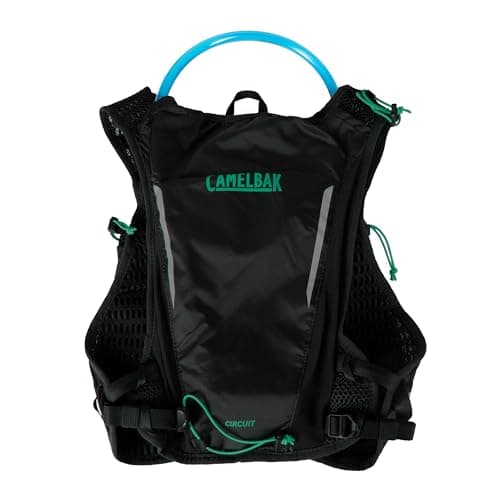
CamelBak Circuit Run Vest
Best for: Beginner trail runners and road runners transitioning to trails who want proven hydration and breathability for efforts under 3 hours without paying premium-vest prices.
- 3D Micro Mesh is among the most breathable constructions tested across multiple expert reviews, an important factor on hot-weather trail runs
- 1.5 L reservoir is undersized for runs beyond 3 hours or hot conditions requiring more than 1 L per hour
Kit Score 7.1/10 · $99.00 Price checked Oct 23, 4:16 PM CDT · how we score gear
Buy on AmazonProduct details
The Circuit is CamelBak's entry-level running vest and it delivers where it counts for shorter efforts: exceptional ventilation via 3D Micro Mesh, a reliable 1.5 L Crux reservoir with a locking bite valve, and a zippered chest pocket that fits most smartphones. It is the most affordable fully functional hydration vest on this list.
- Capacity
- 5.5 L total (1.5 L reservoir + front flask pockets)
- Weight
- 5.9 oz listed, vest only (Amazon listing)
- Hydration system
- 1.5 L CamelBak Crux reservoir included; front harness pockets fit Quick Stow flasks
- Ventilation
- 3D Micro Mesh throughout for breathability
- Fit system
- Side compression straps, adjustable sternum strap
- Best use
- Training runs up to 3 hours, 5Ks through half-marathon trail events, beginner trail runners
More strengths
- Simplified design means fewer straps to manage; straightforward sternum and side compression system works well for first-time vest users
- Under $100 street price makes it accessible for runners who want to try vest-based hydration before committing to a premium option
Other tradeoffs
- Vest can ride up on the torso during fast running, a fit issue noted by OutdoorGearLab and other reviewers
At $99 the CamelBak Circuit Run Vest 50 oz is the practical entry point for runners who are not yet sure how much vest they need. The 50 oz (1.5 L) Crux reservoir is a proven, leak-free bladder that has been refined over more than a decade, and a Tube Trap keeps the hose where you can reach it. CamelBak's 3D Vent Mesh is generous, and the back panel breathes better than most vests at this price. The listing weight is 5.9 oz for the vest itself.
The fit is less sculpted than a Salomon or Nathan chassis, with dual adjustable chest straps doing the work, so some runners with narrow or very athletic builds find it rides a little looser. For efforts under three hours on non-technical terrain that is rarely a problem. A dedicated phone pocket is reachable on the move; the other pockets are sized for gels and small essentials rather than true on-the-run flask access.
This is the right choice if you want to try running with a vest before committing to a premium option, or if you primarily hike and want packable hydration for day trips. The Circuit regularly earns high marks for value in long-term reviews.
Capacity: small-essentials pockets plus the reservoir sleeve
Hydration system: 50 oz (1.5 L) Crux reservoir included, Tube Trap hose keeper
Weight: 5.9 oz listed, vest only (Amazon listing)
Price: $99
Head-to-head comparison
| Product | Kit Score | Price | Best for |
|---|---|---|---|
| Salomon ADV Skin 12 | 8.8 | Check current price | Best for: Ultramarathon runners and fastpackers who need maximum storage, proven bounce control, and all-day comfort on technical terrain. Why it stands out: Zero bounce even when fully loaded, thanks to the body-hugging SensiFit harness Tradeoff: Rear panel fit is structured and precise, meaning you cannot overstuff it the way older more pliable versions allowed |
| Salomon ADV Skin 5 | 8.8 | Check current price | Best for: Trail runners who want a race-ready, minimal-bounce vest for distances up to 60 km and do not need the extra storage of a 12 L pack. Why it stands out: SensiFit Y-harness delivers a locked-in, no-bounce ride across light and heavy loads, confirmed across iRunFar and Road Trail Run long-term testing Tradeoff: Unisex sizing may not fit petite runners well; occasional neck chafing reported when carrying a single flask |
| Nathan VaporAir 4 8L | 8.3 | $149.99 Price checked Oct 23, 4:16 PM CDT | Best for: Runners who want mid-run fit adjustability, bladder-based hydration, and the durability to handle regular high-mileage training without babying the gear. Why it stands out: Quick-Fit cord system lets you dial in compression across your ribs mid-run, a feature no other vest at this price offers Tradeoff: Front adjustment tabs can flap loose after pulling if not re-tucked, a minor but recurring complaint in the Road Trail Run review |
| CamelBak Circuit Run Vest | 7.1 | $99.00 Price checked Oct 23, 4:16 PM CDT | Best for: Beginner trail runners and road runners transitioning to trails who want proven hydration and breathability for efforts under 3 hours without paying premium-vest prices. Why it stands out: 3D Micro Mesh is among the most breathable constructions tested across multiple expert reviews, an important factor on hot-weather trail runs Tradeoff: 1.5 L reservoir is undersized for runs beyond 3 hours or hot conditions requiring more than 1 L per hour |
Salomon ADV Skin 12
- Best for
- Ultramarathon runners and fastpackers who need maximum storage, proven bounce control, and all-day comfort on technical terrain.
- Why it stands out
- Zero bounce even when fully loaded, thanks to the body-hugging SensiFit harness
- Tradeoff
- Rear panel fit is structured and precise, meaning you cannot overstuff it the way older more pliable versions allowed
Salomon ADV Skin 5
- Best for
- Trail runners who want a race-ready, minimal-bounce vest for distances up to 60 km and do not need the extra storage of a 12 L pack.
- Why it stands out
- SensiFit Y-harness delivers a locked-in, no-bounce ride across light and heavy loads, confirmed across iRunFar and Road Trail Run long-term testing
- Tradeoff
- Unisex sizing may not fit petite runners well; occasional neck chafing reported when carrying a single flask
Nathan VaporAir 4 8L
- Best for
- Runners who want mid-run fit adjustability, bladder-based hydration, and the durability to handle regular high-mileage training without babying the gear.
- Why it stands out
- Quick-Fit cord system lets you dial in compression across your ribs mid-run, a feature no other vest at this price offers
- Tradeoff
- Front adjustment tabs can flap loose after pulling if not re-tucked, a minor but recurring complaint in the Road Trail Run review
CamelBak Circuit Run Vest
- Best for
- Beginner trail runners and road runners transitioning to trails who want proven hydration and breathability for efforts under 3 hours without paying premium-vest prices.
- Why it stands out
- 3D Micro Mesh is among the most breathable constructions tested across multiple expert reviews, an important factor on hot-weather trail runs
- Tradeoff
- 1.5 L reservoir is undersized for runs beyond 3 hours or hot conditions requiring more than 1 L per hour
How to choose a hydration vest

Match the vest to the effort
Estimate your total distance and resupply access
Short races with frequent aid stations (under 30 km) need 0.5 to 1 L of carry capacity. Day hikes and long training runs need 1.5 to 2 L. Fastpacking or remote ultras need 2 L plus storage for food and layers.
Choose soft flasks or a bladder
Soft flasks at the chest let you monitor intake and are faster to refill. Bladders work well for steady-state efforts where you do not need to track volume. Both Salomons ship flasks and take a 2 L reservoir; the Nathan and CamelBak ship a bladder and take flasks.
Get the fit right before you buy
Hydration vests are sized differently from other trail gear. Measure your chest circumference and check the brand fit guide. A vest that fits at the sternum but gaps at the shoulders will bounce regardless of how tight you run the straps.
Consider terrain and temperature
Technical descents reward a tighter, closer-to-body chassis (Salomon SensiFit or equivalent). Hot summer running rewards aggressive mesh ventilation even if it costs a little bounce control.
Factor in mandatory gear requirements
If your race has a mandatory gear list (emergency blanket, headlamp, packable shell), confirm the vest's main compartment volume against that list before you buy.
A vest that fits perfectly at the store but bounces on a downhill usually fits wrong at the chest, not wrong at the waist.
Where these numbers come from
| Claim | Source | Checked |
|---|---|---|
| ADV Skin 12: 12 L, 9 oz (11.4 oz with accessories), two 500 ml flasks included, 2 L reservoir compatible, recommended for ultra distance over 80 km, $165 | Salomon, ADV SKIN 12 Unisex Running Vest | Sep 2026 |
| ADV Skin 5: 5 L, 7 oz (9.9 oz with accessories), two 500 ml flasks included, 2 L reservoir compatible, recommended for marathon distance or less, $145 | Salomon, ADV SKIN 5 Unisex Running Vest | Sep 2026 |
| VaporAir 4 8L: 2 L bladder with quick-release hose, Quick-Fit wraparound panel and front toggles, four front pockets for flasks to 20 oz, 13.6 oz listed, $160 | Nathan listing on Amazon, linked from the pick above (nathansports.com did not render for us) | Sep 2026 |
| Circuit Run Vest 50 oz: 3D Vent Mesh, dual adjustable chest straps, Tube Trap, phone pocket, 5.9 oz listed, $99 | CamelBak listing on Amazon, linked from the pick above | Sep 2026 |
| Amazon stock: ADV Skin 12 listing currently unavailable; ADV Skin 5 only from a third-party seller at $231 | Amazon listing checks | Sep 2026 |
We did not run in these vests ourselves. Weights are the makers' listed figures, and the two Salomon weights are quoted both ways (vest alone, and with the flasks in the box) because most sites quote only one and they differ by nearly 3 oz.
Frequently asked questions
Soft flasks vs bladder: which is better for trail running?
Soft flasks win on most trail runs because they sit at your chest, let you drink without stopping, and collapse as they empty so the vest stays snug throughout the effort. Bladders are better if you prefer drinking from a hose without reaching into pockets, or if you are covering very remote ground and want to carry 2 L or more in one vessel. Many vests support both, so you can experiment.
How do I stop my hydration vest from bouncing?
Bounce comes from fit, not brand. Start with the correct size for your chest measurement. Then tighten the sternum straps until the vest sits flush against your chest without restricting breathing. If you are using soft flasks, fill them to 80 percent capacity so they press firmly against the chest pockets. Finally, load the heaviest items (bladder, food, layers) as close to your spine as possible in the main compartment.
Can I use a trail running vest for day hiking?
Yes, and it works well. Trail running vests are lighter than traditional hiking packs and breathe better on sustained climbs. The tradeoff is storage: a 5 to 12 L vest carries less than a 20 to 30 L daypack, so check your kit list first. For half-day hikes in good conditions a trail vest is often the better choice. For full-day hikes with extra layers, a stove, or technical gear, a larger pack may serve you better.
Choosing the right vest is the first step toward running further and more comfortably on trail. Browse the full hike gear hub for layering, footwear, and navigation guides, or read more about how we research and rate gear at Kit Authority.
Keep going
Free toolHiking Water CalculatorHow much water to carry for the distance and the heat.Related guides



 Complete hike loadoutDay hike kitBuild the complete kit
Our recommendations draw on manufacturer documentation, retailer listings, owner feedback, and comparisons with alternatives.
As an Amazon Associate I earn from qualifying purchases. We may earn a commission from links here, at no extra cost to you. How we research →