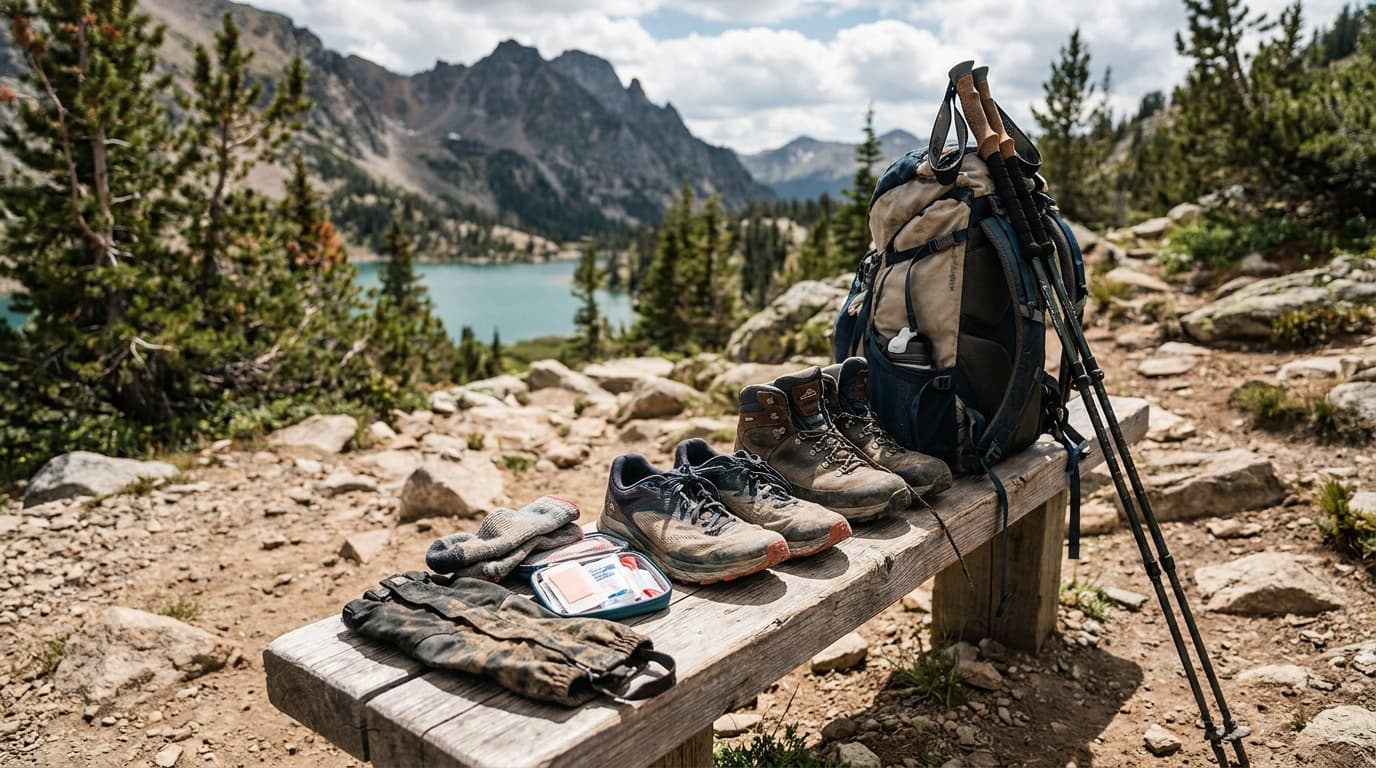
The footwear question comes up before almost every trip: trail runners or hiking boots? The answer depends on your pack weight, terrain, and how far you walk in a season.
Weight: the biggest practical difference
Trail runners typically weigh 20–25 oz per pair. Hiking boots come in at 2.5–3+ lbs per pair. That gap matters because foot weight costs roughly five times more in energy than the same weight in your pack. For current model options, see our trail running shoe picks.
A 2021 study published in the International Journal of Sports Physiology put a number on it: each extra pound on the foot increases metabolic cost by roughly 6%. Switching from 3-lb boots to 1.5-lb trail runners saves energy equivalent to dropping 9 lbs from your pack. That is not a marginal difference on a 15-mile day.
Pack weight: the clearest decision lever
If you are trying to pick between the two, start here. Under 25–30 lbs, a supportive trail runner or low-cut hiking shoe handles most terrain well. The shoe's lighter weight and flexibility work in your favor.
Once your pack climbs past 30–35 lbs, the stiffer midsole and structure of a boot start earning their extra weight. Load transfer improves, your foot sits more firmly on the platform underfoot, and the added stability becomes genuinely useful rather than just extra bulk.
Terrain layers on top of that threshold. A 30-lb pack on a maintained trail is different from the same load on a rugged, uneven route with loose rock. When both variables push toward boots, that is a clear signal.
Breathability: trail runners by a wide margin
Mesh uppers dry fast and keep feet cooler on warm, dry days. Most waterproof options in either category use a Gore-Tex liner that reduces breathability significantly. On high-output hiking in summer conditions, waterproof footwear of any kind can create swampy feet regardless of how good the membrane is.
A waterproof boot keeps rain out in a downpour, but on a 75-degree day with a hard climb, the enemy is the moisture your own feet generate.
If your conditions are genuinely wet and cold, waterproof boots make sense. For most three-season hiking on dry terrain, a non-waterproof trail runner that can drain and dry is the more comfortable choice.
Ankle support: what actually matters
A stiff-soled boot does provide a more stable platform underfoot, especially under a heavy load. But many hikers overestimate how much a high collar alone does for them. Foot and ankle strength training is a longer-term fix that pays dividends regardless of what you wear.
Durability: boots win on cost-per-mile
Trail runners are typically done at 300–500 miles, after which the cushioning and outsole rubber have worn down enough to affect performance and protection. Quality hiking boots, particularly leather models like the KEEN Targhee III, are built for thousands of trail miles across multiple seasons.
If you hike 500+ miles a year, you may go through two or three pairs of trail runners in the time one pair of boots lasts. The upfront cost of a quality boot looks different when you factor in replacement cycles.
Technical terrain: when boots make sense
Scrambles, boulder fields, heavy brush, and ankle-deep mud reward the added structure of a boot like the Salomon Quest 4 GTX. A stiffer sole performs better when you are edging on rock or pushing through vegetation that batters the upper. The more your route departs from maintained trail, the more the boot's protection and rigidity justify its weight.
How to choose between trail runners and boots
Pack weight first
If your pack stays under 25–30 lbs, trail runners handle the majority of terrain. Over 30–35 lbs, move toward stiffer-soled boots.
Check your terrain
Maintained trail and moderate grade favor trail runners. Technical scrambles, off-trail travel, and loose boulder fields favor boots.
Consider season length
If you hike 500+ miles a year, factor in replacement cost. Boots may run cheaper per mile over a multi-year horizon.
Think about conditions
Non-waterproof trail runners are cooler and dry faster in three-season dry conditions. Waterproof boots make sense for sustained cold, wet, or shoulder-season use.
Factor in injury history
Prior ankle sprains or known instability are a reason to look closely at midsole stiffness, and to consult a professional if the history is significant.
What thru-hikers chose
A 2019 AMC survey of Appalachian Trail thru-hikers found roughly three-quarters wore trail runners for their journey, while fewer than 10 percent used hiking boots. Daily mileage at that scale makes energy efficiency and foot recovery the dominant factors, and lighter footwear consistently won.
That is a specific use case. A thru-hiker doing 20-mile days with a 20-lb ultralight pack is optimizing differently than a backpacker doing 10-mile days with a 40-lb family load. But the trend reflects how much the calculus has shifted as trail runner construction has improved.
For specific model recommendations, see our guide to the best trail running shoes.
Do hiking boots actually protect your ankles better than trail runners?
Ankle stability comes primarily from torsional rigidity, the sole's resistance to side-to-side flex, not from collar height. A stiff-soled boot does provide a more stable platform underfoot, especially under load. But a high-cut collar on a soft midsole offers limited real protection. If ankle support is your concern, look at midsole stiffness first, and consider whether strengthening ankles and feet is a longer-term fix.
At what pack weight should I switch from trail runners to boots?
The common practical threshold is around 25–30 lbs. Under 25 lbs, a supportive trail runner or low-cut hiking shoe handles most terrain. Once your pack climbs past 30–35 lbs, the stiffer midsole and structure of a boot start earning their extra weight in load transfer and stability. Terrain matters too: that same 30-lb pack on a flat trail feels different than on a rugged, uneven route.
How much longer do hiking boots last compared to trail runners?
Trail runners typically reach the end of their useful life at 300–500 miles, after which the cushioning and outsole rubber are worn down enough to affect performance and protection. Quality hiking boots, especially leather models, are built for thousands of trail miles across multiple seasons. If you hike 500+ miles a year, you may burn through two or three pairs of trail runners in the time a good pair of boots lasts. Factor that into the cost comparison.
Browse all hike gear for more footwear and kit guidance, and see how we research and rate to understand what goes into every recommendation on this site.
Recommended gear
Our current top picks from the Best trail running shoes: top picks for grip, cushion, and protection guide, if you are ready to buy.
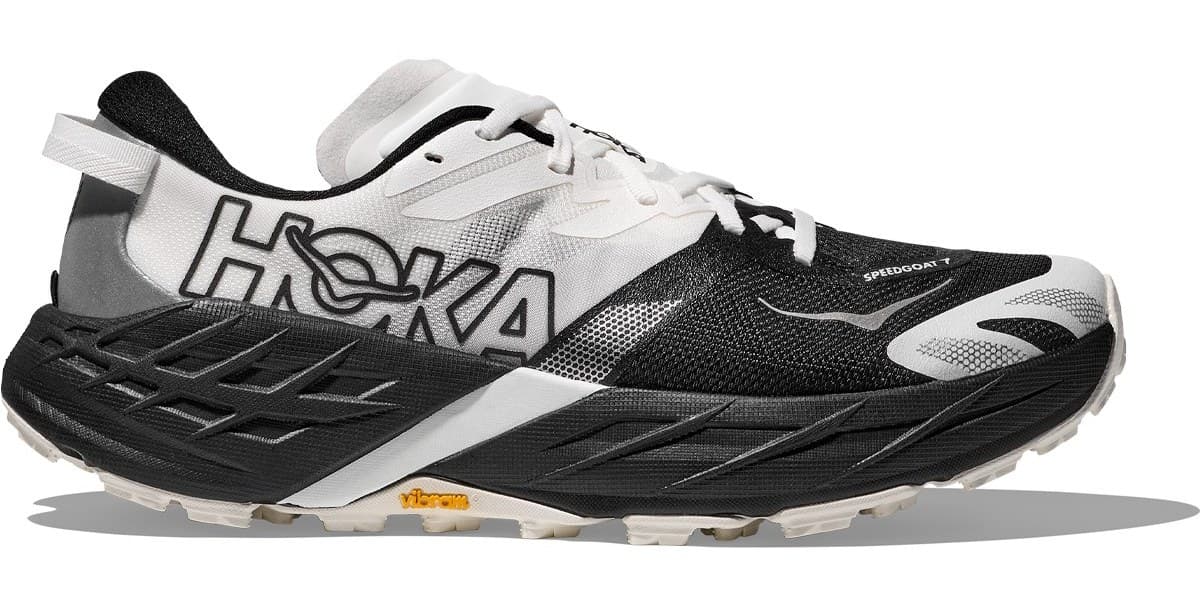
Best for: Runners logging big mountain days on mixed terrain who want max cushion and reliable grip without sacrificing too much agility.
- Vibram Megagrip with 5 mm Traction Lugs grips wet rock, loose dirt, and scree
- Fits smaller than earlier Speedgoats, so many runners need to size up
- Drop
- 4 mm listed; 7.4 mm lab-measured
- Stack height
- 37 mm heel / 33 mm forefoot (men's)
- Lug depth
- 5 mm (Vibram Megagrip with Traction Lug)
- Midsole
- Supercritical EVA foam
- Weight
- 9.7 oz / 275 g (men's)
- Widths
- Regular and wide
About this pick
The Speedgoat 7 keeps the line's high-cushion platform and Vibram Megagrip outsole, and moves to a springier supercritical foam in place of the firmer midsole of the Speedgoat 6. A redesigned upper locks the foot down better, and the lugs are rearranged with Vibram's Traction Lug texture for more grip on rock and packed dirt.
Strengths
- Vibram Megagrip with 5 mm Traction Lugs grips wet rock, loose dirt, and scree
- Supercritical foam feels livelier than the Speedgoat 6's firmer midsole
- Redesigned upper holds the foot more securely on descents and off-camber trail
Weaknesses
- Fits smaller than earlier Speedgoats, so many runners need to size up
- Not sold on Amazon; buy from HOKA or a running retailer
Kit Score breakdown
Best for: Midfoot and forefoot strikers who want a versatile all-mountain shoe with sticky grip, a rock plate, and a price that leaves room in the budget for other gear.
- Full Vibram Megagrip outsole replaces the Peregrine 15's PWRTRAC rubber
- RunRepeat's lab measures a tapered toe box; wide feet may want the Lone Peak
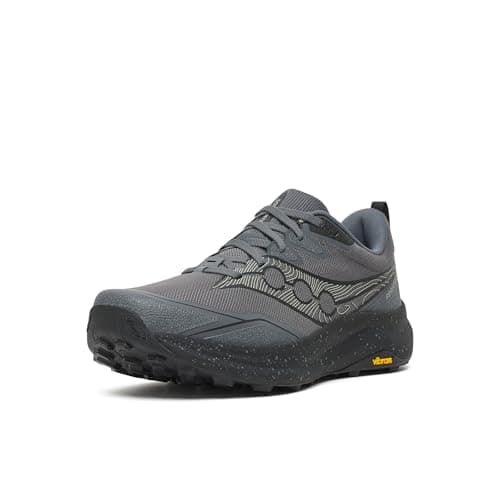
- Drop
- 4 mm (brand) / 4.8 mm lab-measured
- Stack height
- 32 mm heel / 28 mm forefoot
- Lug depth
- 4 mm Vibram Megagrip (3.5 mm lab-measured)
- Rock plate
- Yes, woven forefoot plate
- Weight
- 9.5 oz / 269 g (men's 9)
- Also available
- Women's: ASIN B0F9LLNLW9
About this pick
The Peregrine 16 is Saucony's all-mountain workhorse, now on a full Vibram Megagrip outsole with 4 mm Traction Lugs. Saucony added 4 mm of PWRRUN foam over the Peregrine 15 and a slightly wider base, while keeping the 4 mm drop and forefoot rock plate that give it ground feel on technical trail.
Strengths
- Full Vibram Megagrip outsole replaces the Peregrine 15's PWRTRAC rubber
- 4 mm more cushion than the Peregrine 15 with the same 4 mm drop and ground feel
- Forefoot rock plate at one of the lowest list prices in this roundup
Weaknesses
- RunRepeat's lab measures a tapered toe box; wide feet may want the Lone Peak
- Low drop can fatigue heel strikers on longer runs
Kit Score breakdown

Best for: Trail runners who regularly face mud, loose dirt, wet grass, or packed snow and need a shoe that claws in where others spin out.
- Industry-leading 5.5+ mm Mud Contagrip lugs are unmatched for soft, wet, and muddy terrain
- Deep lugs create a cleat-like, disconnected feel on hardpack and pavement
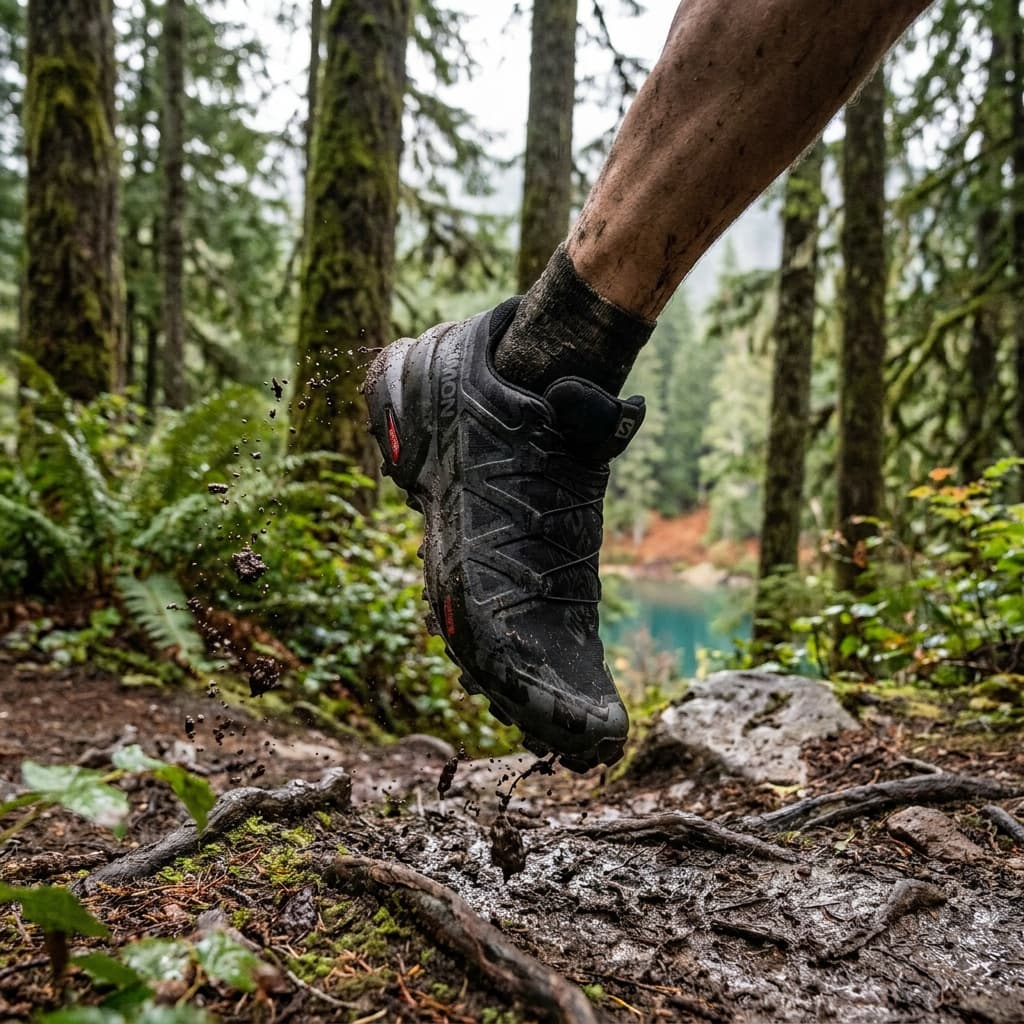
- Drop
- 10 mm (brand) / ~14 mm lab-measured
- Stack height
- 36.5 mm heel / 22.4 mm forefoot
- Lug depth
- 5.5–5.8 mm Mud Contagrip (deepest in class)
- Rock plate
- None
- Weight
- 10.4 oz / 296 g (men); 9.2 oz / 262 g (women)
- Also available
- Women's: ASIN B0DCSCSTWH
About this pick
The Speedcross 6 is the benchmark for soft-terrain grip: its 5.5 mm chevron Mud Contagrip lugs claw into mud, loose soil, wet grass, and snow with no real rival. The Sensifit upper and QuickLace system create a precise, secure hold that handles steep descents and off-camber roots confidently.
Strengths
- Industry-leading 5.5+ mm Mud Contagrip lugs are unmatched for soft, wet, and muddy terrain
- Quicklace system delivers a dialed, consistent fit with no mid-run lace adjustments
- High owner satisfaction score of 89/100, with durability and mud-shedding frequently cited by long-term users
Weaknesses
- Deep lugs create a cleat-like, disconnected feel on hardpack and pavement
- Dense upper runs hot in summer and limits breathability in warm conditions
Kit Score breakdown
See all picks in Best trail running shoes: top picks for grip, cushion, and protection
Keep going
Free toolBase-Weight BuilderAdd up your pack base weight and see where to cut.Related guides
 Complete hike loadoutDay hike kitBuild the complete kit
Researched, not hands-on tested
Updated Oct 5, 2026Our recommendations draw on manufacturer documentation, retailer listings, owner feedback, and comparisons with alternatives.
As an Amazon Associate I earn from qualifying purchases. We may earn a commission from links here, at no extra cost to you. How we research →