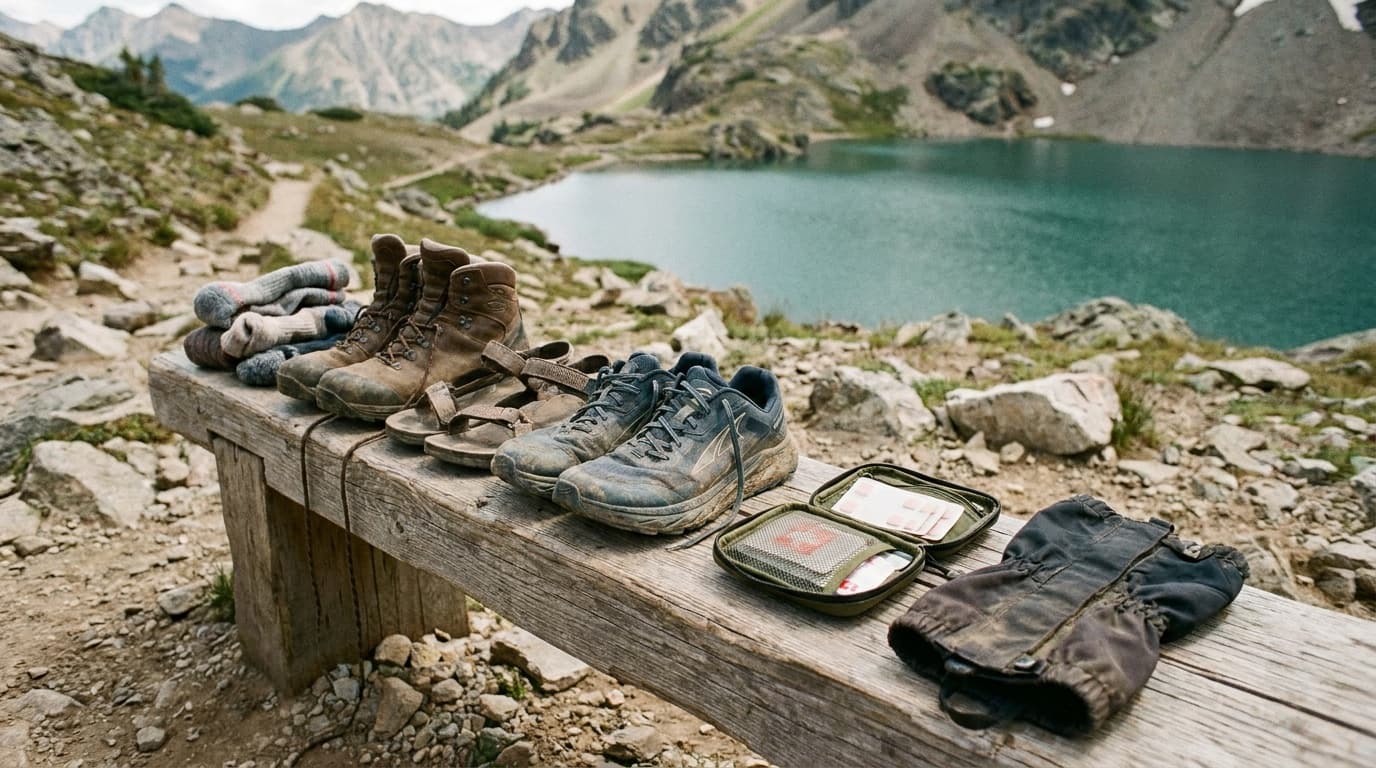
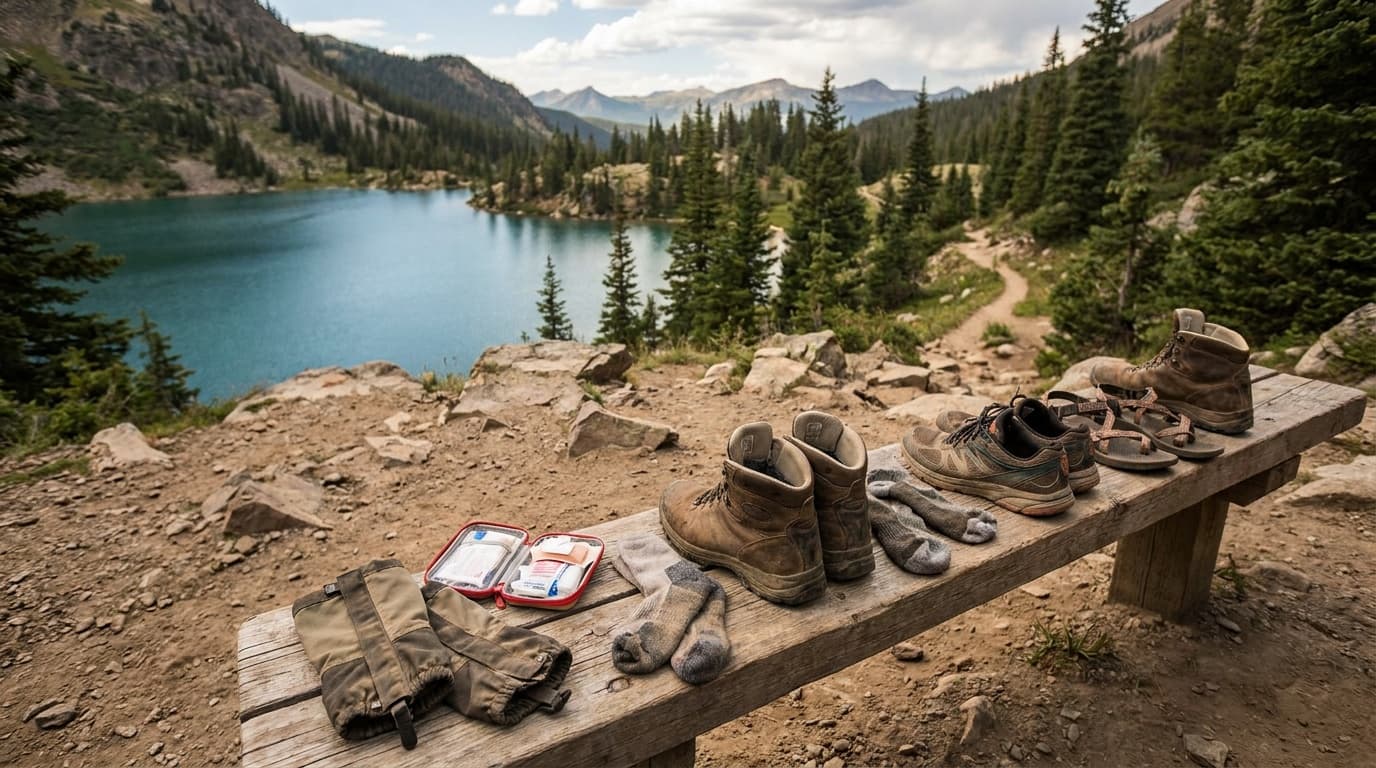
Choose trail runners for most day hikes, maintained trails, warm weather, and packs below roughly 25 lb. Choose hiking boots for heavier loads, sustained rocky terrain, wet brush, and greater underfoot stiffness and coverage. Collar height alone does not decide ankle protection; fit, midsole stability, terrain, and experience matter more.
Compare current picks in the best trail running shoes and best hiking boots guides.
The weight gap is real and cumulative
Trail runners like the Hoka Speedgoat 7 average 20–25 oz (567–709 g) per pair. Traditional hiking boots average 2.5–3.5 lbs (40–56 oz) per pair. That is roughly 40–50% more weight on your feet with boots.
One pound on your foot costs roughly the same energy as five pounds in your pack, which means a 1.5 lb weight difference in footwear compounds into meaningful fatigue over a full day of hiking, especially when you are already carrying a loaded pack on longer routes (deliberate load carrying is its own discipline, and rucking vs. hiking explains where the two overlap).
The ankle support case for boots is overstated
This is the most persistent myth in hiking footwear. Research including military personnel studies and basketball injury studies found no statistically significant difference in ankle sprain rates between high-top and low-cut footwear.
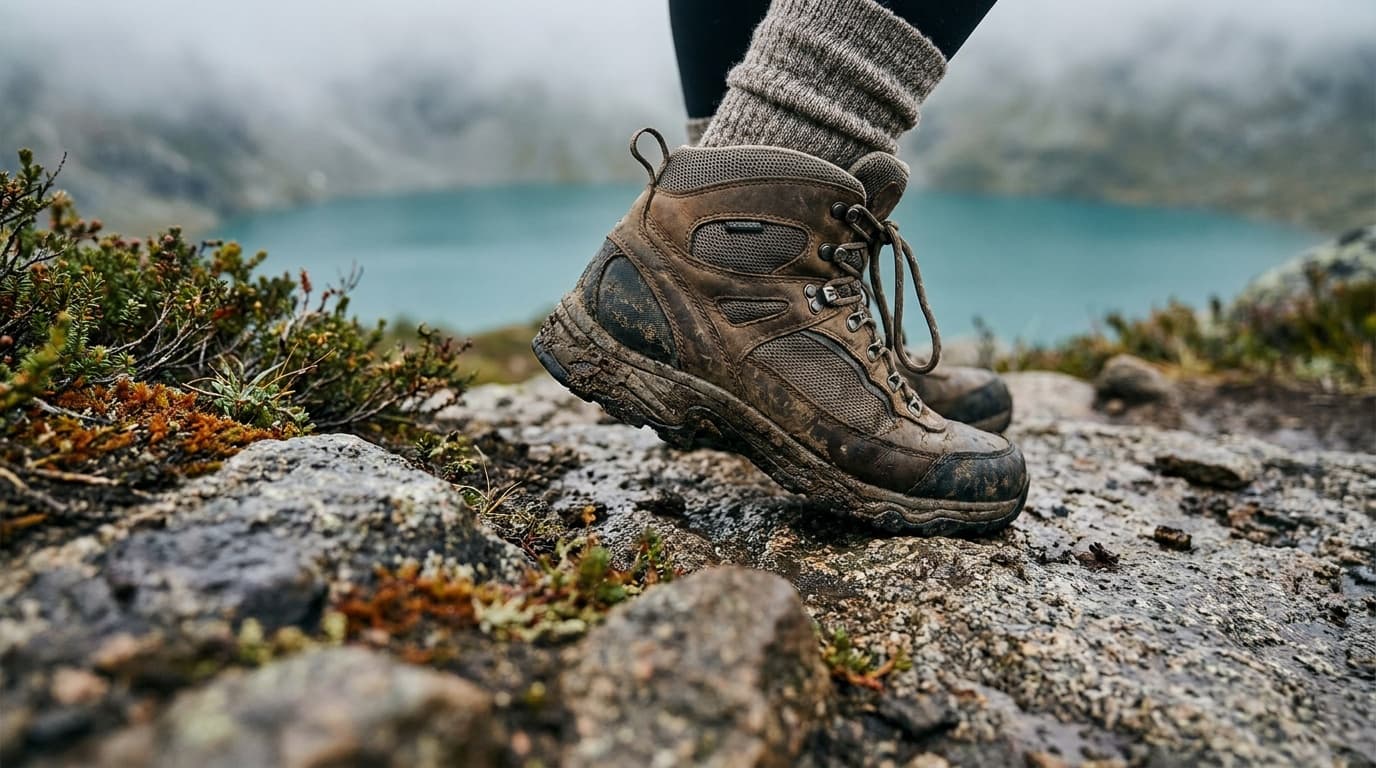
What boots actually provide is torsional rigidity and lateral coverage together. On technical terrain, a stiff midsole limits how much the entire foot platform rotates under a heavy load. That is a meaningful advantage on talus and scree, but it comes from the midsole stiffness, not the collar height alone.
The most effective ankle protection is not in the boot. It is in the ankle strength and trail experience you build over time.
Pack weight is your clearest decision trigger
Most sources and outfitters converge on the same practical threshold: 25–30 lbs.
How to choose based on your load and terrain
Under 25 lbs on moderate trail
A supportive, well-fitting trail runner handles this adequately for most hikers. You get the weight savings without meaningful stability compromise.
25–30 lbs on mixed terrain
This is the gray zone. An aggressive trail runner with a firm midsole still works, but you will notice the difference on rocky or off-camber sections by the end of a long day.
Over 30 lbs, or sustained technical terrain
A stiffer hiking shoe or boot like the [Salomon Quest 4 GTX](/api/go?product=salomon-quest-4-gtx&retailer=great-outdoor-provision&article=hiking-boots-vs-trail-runners) earns its extra weight here. The stiffer platform reduces lateral load risk when the terrain is uneven and your pack is pulling you off-balance.
Talus, scree, or scrambling
Boot stiffness and higher coverage matter regardless of pack weight. A soft trail runner sole offers less edge control and less protection from sharp rock impacts.
Durability: boots win, but the gap costs upfront
A quality leather hiking boot, cared for properly, can last thousands of trail miles. Trail runners typically need replacing every 500–750 miles of use. On midsole compression alone, most trail runners lose meaningful cushioning and support well before the upper shows obvious wear.
The math is not as one-sided as it first appears. Trail runners cost $100–$150 on average versus $150–$250 for quality boots, but the replacement cycle is two to four times shorter. Over five years of regular hiking, the total cost of ownership converges.
The more important practical point: if you hike 300–400 miles per year, a pair of trail runners needs replacing every 18 months or so. If you forget to track mileage, you may be hiking in footwear that has lost its protective structure without knowing it.
Waterproofing cuts both ways
A mid- or high-cut boot like the Merrell Moab 3 Mid Waterproof keeps more water out in sustained rain, stream crossings, and wet brush. The coverage advantage over a low-cut trail runner is real and significant in those conditions.
The tradeoff is the same in both categories: any waterproof membrane (Gore-Tex or equivalent) compromises breathability. During sustained hard effort on warm days, that means swampy feet regardless of which type of shoe you are wearing.
For consistently wet hiking, sustained rain, or hiking with pants tucked in or gaiters, the boot wins. For primarily dry conditions, the membrane's breathability penalty often outweighs its benefit.
Break-in time is a practical factor, not a marketing note
Leather hiking boots typically require 30–50 miles of wear before reaching full comfort. That is several dedicated break-in hikes before you trust them on a long trip. Skipping this step is the most common cause of blisters on a first major hike with new boots.
Trail runners require little or no break-in. Most hikers find them comfortable from the first day on trail.
If you are buying footwear close to a trip deadline, this matters. A pair of trail runners you buy two weeks before a long hike is ready to wear. A leather boot bought on the same timeline is a blister risk.
The hybrid option worth considering
High-top trail runners occupy useful middle ground: they use trail-shoe construction (lighter weight, flexible, faster-drying) with a higher collar for more ankle coverage. They are not boots and do not match the stiffness or durability of leather footwear, but for hikers who primarily do moderate terrain with occasional technical sections, they offer a reasonable compromise without the weight or break-in penalty of a traditional boot.
Frequently asked questions
Are trail shoes the same as hiking boots?
No. "Trail shoes" (also called trail runners or trail running shoes) are low-cut footwear built on running-shoe construction: flexible midsoles, mesh uppers, 20–25 oz per pair, no break-in. Hiking boots are mid- or high-cut, built with stiffer midsoles, heavier materials (often leather), and reinforced structure, typically 40–56 oz per pair. A third category, "hiking shoes," splits the difference: boot-style construction in a low-cut silhouette. The categories overlap at the edges, but a trail runner and a hiking boot are distinct designs with different strengths, not the same product at different heights.
Should I get hiking boots or trail runners?
Use pack weight and terrain as your triggers. Choose trail runners if you carry under 25 lbs on maintained or moderate trails: you get roughly 40–50% less weight on your feet, zero break-in, and faster drying. Choose boots if you regularly carry over 30 lbs, hike talus, scree, or off-trail terrain, or hike in sustained wet conditions where high-cut waterproof coverage earns its keep. In the 25–30 lb gray zone, a firm-midsole trail runner works for most people; move to boots if you notice foot fatigue or rolling on rocky ground by day's end.
Do hiking boots actually prevent ankle sprains?
Only modestly, and the evidence is less convincing than most people expect. Research including military and basketball studies found no significant difference in ankle sprain rates between high-top and low-cut footwear. A boot collar can limit how far the ankle rolls once a sprain starts, but the initial inversion happens in milliseconds, faster than any external support can mechanically react. The most effective prevention is building ankle strength and trail experience over time.
Can I use trail runners for backpacking with a heavy pack?
Yes, with a load caveat. Most sources converge on 25–30 lbs as the practical threshold. Below that, a well-fitting, supportive trail runner handles most backpacking terrain adequately. Above 30 lbs, especially on uneven or rocky ground, the softer midsole foam in a trail runner compresses more under lateral load, increasing the chance of a roll. At that load range, a stiff hiking shoe or boot earns its extra weight.
Are waterproof trail runners worth it, or should I just get a waterproof boot?
It depends on your primary conditions. Waterproof trail runners keep feet dry in light rain and dewy grass but are still vulnerable to water entering through the lower ankle opening. A mid- or high-cut waterproof boot provides significantly more coverage. The tradeoff in both categories is the same: the membrane traps heat during hard effort, which means swampy feet on warm dry days. If you regularly cross streams or hike in sustained rain, a waterproof boot wins. If your conditions are mostly dry with occasional wet patches, a non-waterproof trail runner that dries fast may be more comfortable overall.
Once you know which direction fits your hiking, see our guide to the best hiking boots for specific models across terrain types and budgets. Browse all hike gear or learn how we research and rate every piece of kit on this site.
Recommended gear
Our current top picks from the Best hiking boots for day hikes and light backpacking guide, if you are ready to buy.
MERRELL
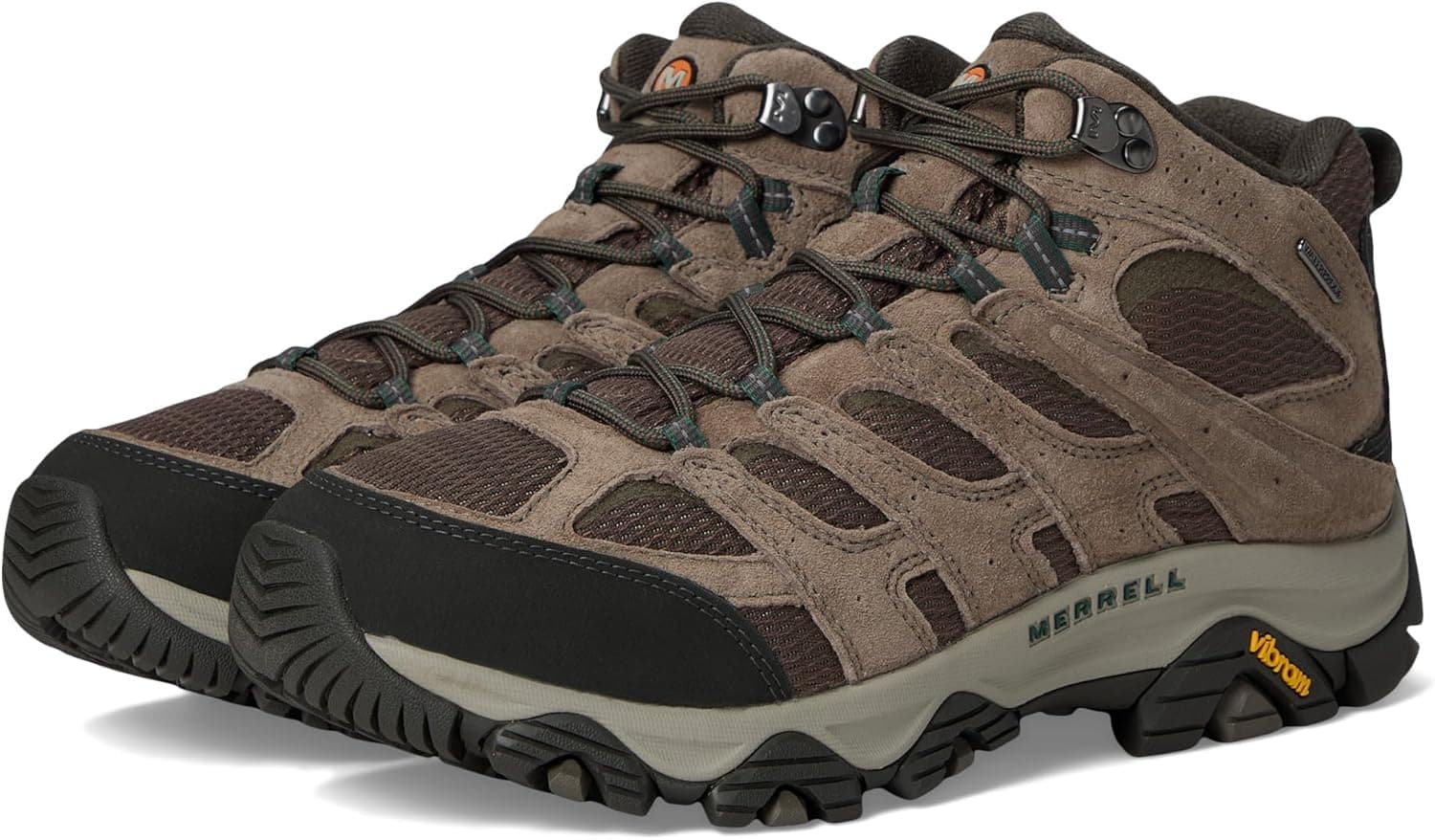
Merrell Men's Moab 3 Mid Waterproof Hiking Boot
Best Value
Kit Score 8.0/10
$131.42 Price checked Oct 23, 4:16 PM CDT
Best for: Hikers who want a dependable, comfortable mid boot for regular day hikes and easy overnight trips without paying a Gore-Tex premium.
- Near-zero break-in period: wide toe box and cushy collar are comfortable from mile one
- Proprietary waterproofing is less breathable than Gore-Tex, so feet can warm up on long summer days
- Weight (men's, per shoe)
- 1 lb 6 oz approx.
- Waterproofing
- M.Select Dry membrane
- Outsole
- Vibram TC5+, 5mm lugs
- Heel-to-toe drop
- 11.5mm
- Midsole
- Lightweight EVA + Merrell Air Cushion heel
- Women's version
- Available (B0988BDSG7)
About this pick
The Moab 3 Mid Waterproof is Merrell's workhorse day-hike boot: pigskin leather and mesh upper, M.Select Dry waterproofing, and a Vibram TC5+ outsole with 5mm lugs. Owners consistently praise the out-of-the-box comfort and wide toe box with near-zero break-in required.
Strengths
- Near-zero break-in period: wide toe box and cushy collar are comfortable from mile one
- Vibram TC5+ outsole provides reliable grip across most trail surfaces
- Broad size range and proven durability across the long-running Moab line
Weaknesses
- Proprietary waterproofing is less breathable than Gore-Tex, so feet can warm up on long summer days
- Traction weakens on wet or mossy rock compared to softer-compound outsoles
Kit Score breakdown
KEEN
KEEN Men's Targhee III Mid Waterproof Hiking Boot
Editor's Choice
Kit Score 8.2/10
$175.42 Price checked Oct 23, 4:16 PM CDT
Best for: Hikers with average to wide feet who want a comfortable, waterproof mid boot for day hikes at a below-average price, and don't need the current-generation Targhee IV improvements.
- Generous KEEN toe box fits wide and high-volume feet comfortably from the first wear
- Keen.Dry breathes less than Gore-Tex, which can lead to warmer feet on long warm-weather hikes
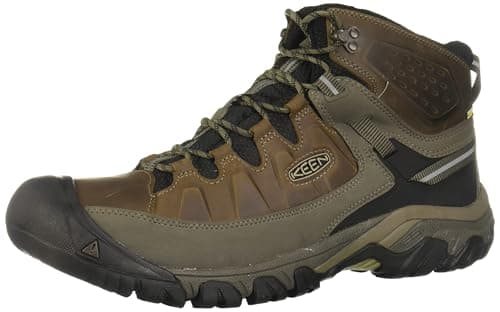
- Weight (men's, per shoe)
- Approx. 1 lb 1.5 oz
- Waterproofing
- Keen.Dry waterproof/breathable membrane
- Outsole
- KEEN All-Terrain rubber, 4mm multidirectional lugs
- Upper
- Durable leather with mesh paneling
- Toe protection
- Large rubber bumper cap
- Women's version
- Available (separate ASIN)
About this pick
KEEN's Targhee III Mid pairs a roomy toe box (KEEN's signature fit) with Keen.Dry waterproofing and an all-terrain rubber outsole. It stands out for wide-foot comfort and multi-season durability. Note: the Targhee IV is the current-generation model; the III is now available at a reduced price as legacy inventory, making it a sharp value pick for budget-focused buyers.
Strengths
- Generous KEEN toe box fits wide and high-volume feet comfortably from the first wear
- Keen.Dry membrane keeps feet dry in creek crossings and wet grass
- Durable leather and rubber toe cap withstand sustained use on rocky trails
Weaknesses
- Keen.Dry breathes less than Gore-Tex, which can lead to warmer feet on long warm-weather hikes
- Previous-generation model: the Targhee IV is KEEN's current offering and adds improved breathability and traction
- Not designed for technical terrain or heavy pack loads above 35 lbs
Kit Score breakdown
Best for: Backpackers and strong day hikers who carry heavier loads on technical terrain and want a boot that stays stable and dry across multiple days.
- 4D Advanced Chassis delivers torsional control that reduces ankle fatigue under a loaded pack
- Heavier than most day-hike-focused boots at roughly 2 lbs 14 oz per pair
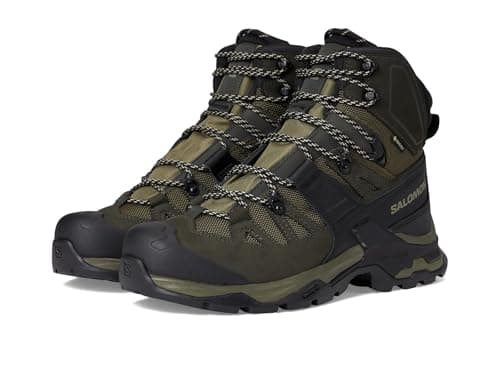
- Weight (men's, per pair)
- Approx. 2 lbs 14 oz
- Waterproofing
- Gore-Tex Performance Comfort
- Outsole
- Contagrip TA rubber
- Midsole
- EnergyCell EVA + 4D Advanced Chassis
- Collar height
- Mid-cut, approx. 5.5 inch flood height
- Women's version
- Available (Quest Echo GTX)
About this pick
The Quest 4 Gore-Tex is Salomon's dedicated backpacking boot: a full-grain leather and mesh upper with Gore-Tex waterproofing, an EnergyCell EVA midsole, and Salomon's 4D Advanced Chassis for torsional stability under load. Weighing in at about 2 lbs 14 oz per pair, it is built for multi-day trips and technical terrain rather than speed.
Strengths
- 4D Advanced Chassis delivers torsional control that reduces ankle fatigue under a loaded pack
- Contagrip TA outsole is slow to wear and grips reliably on hard and loose surfaces
- Gore-Tex Performance Comfort membrane keeps feet dry in sustained rain and stream crossings
Weaknesses
- Heavier than most day-hike-focused boots at roughly 2 lbs 14 oz per pair
- Leather upper requires a break-in period of 10-20 miles before reaching peak comfort
Kit Score breakdown
See all picks in Best hiking boots for day hikes and light backpacking
Keep going
Related guides
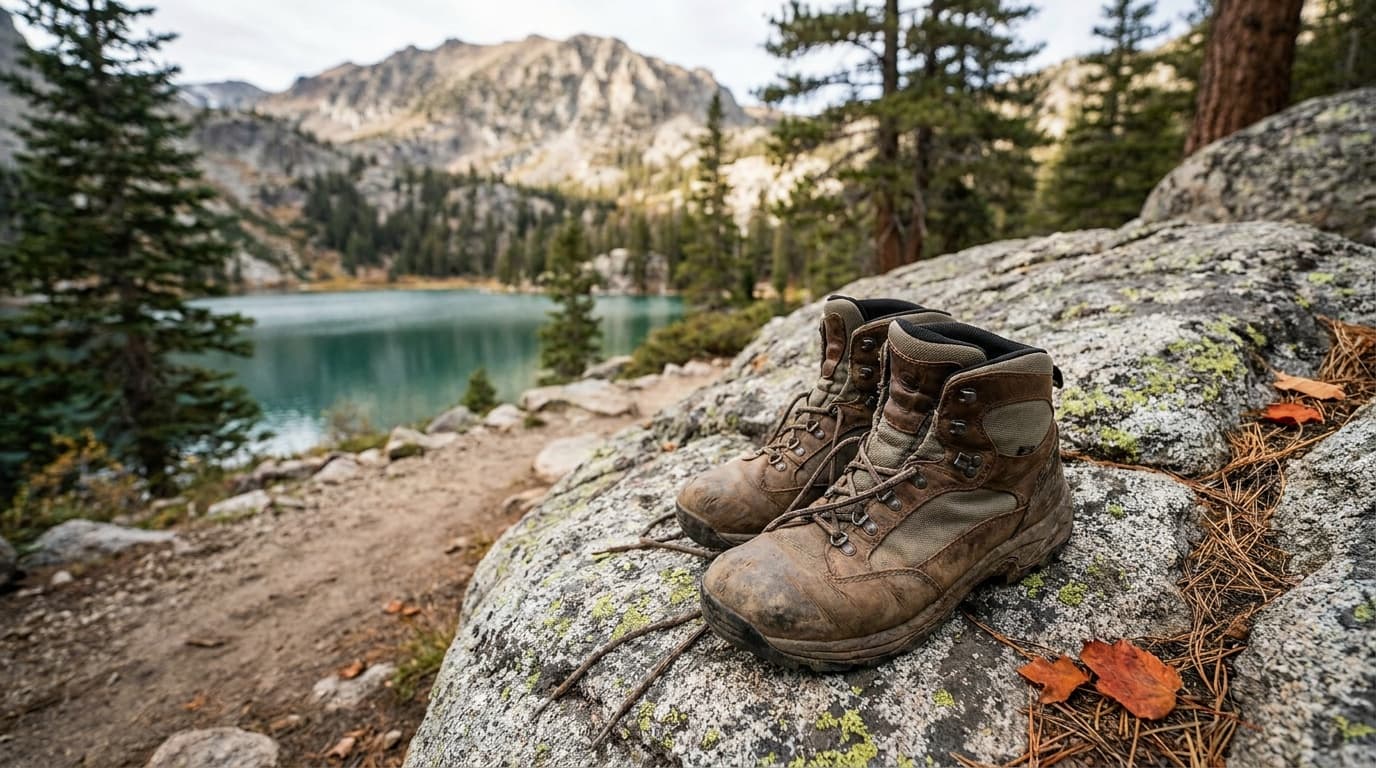
 Complete hike loadoutDay hike kitBuild the complete kit
Researched, not hands-on tested
Updated Sep 26, 2026Our recommendations draw on manufacturer documentation, retailer listings, owner feedback, and comparisons with alternatives.
As an Amazon Associate I earn from qualifying purchases. We may earn a commission from links here, at no extra cost to you. How we research →