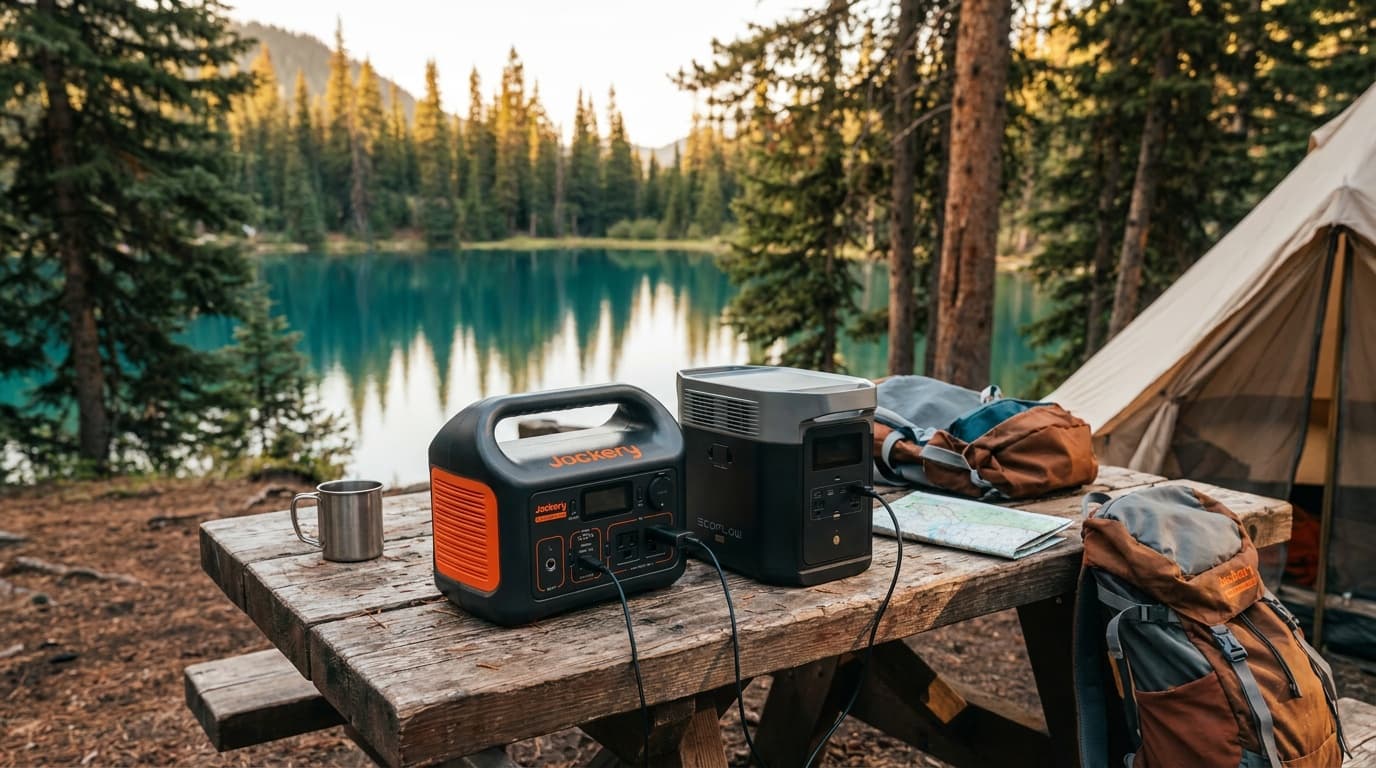
Jackery and EcoFlow are the two names most people consider when buying a portable power station for camping. The real choice comes down to four things: battery chemistry, charge speed, app depth, and whether you want to expand capacity later.
Battery chemistry: the most important decision variable
This is the spec that determines how long your power station actually lasts over years of use, not just how it performs on day one.
Jackery's older Classic and Pro series use NMC (nickel manganese cobalt) cells rated for 500 to 1,000 full charge cycles. At daily use, that can mean meaningful capacity loss within one to two years. Jackery's newer Plus-series and all current EcoFlow Delta models use LiFePO4 (lithium iron phosphate), which is more stable, handles heat better, and lasts far longer before degrading.
The cycle gap between Jackery Plus and EcoFlow LiFePO4 models is real (4,000 vs 3,000), though for most camping use patterns both will outlast the useful life of the unit before degradation becomes noticeable. The more important takeaway is to avoid NMC Jackery models entirely for regular use. Always verify the specific model before buying, not just the brand name.
Charge speed: EcoFlow leads by a meaningful margin
EcoFlow's X-Stream charging technology puts the Delta 3 Plus from flat to full in 56 minutes via a standard AC wall outlet. Jackery's ChargeShield 2.0 on Plus-series models closes the gap compared to older Jackery hardware, but the Jackery Explorer 1000 v2 still takes 1.7 hours standard (or about an hour in emergency mode).
For purely solar-dependent camping where you are rarely near an outlet, AC charge speed matters less day-to-day. But EcoFlow also accepts higher solar input: the EcoFlow DELTA 2 handles up to 500W through standard MC4 connectors, while the Explorer 1000 v2 caps at 400W through proprietary connectors. That gap compounds when an overcast afternoon is your only solar window.
For base-camp setups where a cloudy afternoon may be the only charging window, the ability to recover faster from partial solar days is a real practical advantage.
The proprietary connector issue on Jackery has a downstream cost: if you want to use third-party panels, you may need an adapter or be limited to Jackery-branded panels, which can increase total system cost. EcoFlow's MC4 standard works with any compatible solar panel on the market.
App and controls: EcoFlow for serious solar management
The two apps are genuinely different in capability, not just polish.
EcoFlow's app supports charge scheduling, adjustable input limits, solar automation, remote outlet control, and real-time per-port watt tracking. If you are managing a solar-dependent setup across a multi-day trip, that level of control lets you plan around charging windows, cap input to protect certain devices, and see exactly which port is drawing what.
Jackery's app shows battery level, basic outlet status, and firmware update notifications. It works fine for straightforward monitoring, but it does not offer the same level of control over how the unit charges or distributes power.
When each app level actually matters
Weekend car camping, one or two devices
Jackery's simpler app is plenty. You check the percentage, charge what you need, you are done.
Multi-day basecamp with a solar panel
EcoFlow's charge scheduling and input controls pay off. You can set a charge window, cap input for sensitive gear, and see which port is pulling the most draw.
Off-grid cabin or extended overlanding
EcoFlow's expandable system plus per-port monitoring gives you real operational visibility as load complexity grows.
Occasional day use with no solar
Either app works. The difference is invisible for this use case.
Expandability: EcoFlow's ecosystem scales, most Jackery models do not
If your power needs grow over time, adding compatible battery packs to an EcoFlow unit is straightforward. The Delta 3 Plus expands to 5,120Wh with additional packs. EcoFlow states around 50% of their lineup is expandable. On the Jackery side, the Explorer 1000 v2 has no expansion option, and only the larger Explorer 2000 v2 and above accept expansion batteries. Jackery's expandable share is roughly 20% of their lineup.
For occasional weekend campers who want a fixed unit, this difference is irrelevant. For anyone planning to grow a camp power setup over multiple seasons, adding a fridge, or serving a larger group, EcoFlow's ecosystem is the more future-proof investment.
Weight and portability: Jackery is easier to carry
At comparable capacity, the Explorer 1000 v2 weighs 22 lb versus 28 lb for the Delta 3 Plus. Six pounds of difference across a campsite or in and out of a vehicle adds up quickly. Jackery also uses a single integrated top handle that makes one-handed carry natural. EcoFlow's dual end-handles work well for two-person lifts and vehicle loading but feel less natural for one-handed moves around a site.
For lightweight weekend camping where the unit moves frequently, Jackery's ergonomics are a genuine advantage.
Price and value
Both brands price mid-range 1,000Wh-class units in roughly the same range, typically $399 to $599 depending on sales. At equivalent list prices, EcoFlow's faster charging and expandable ecosystem make it the stronger value for frequent or extended camping. Jackery's edge is simplicity, lighter weight, and a lower learning curve for first-time buyers.
How to choose between them
Occasional weekend camping, moderate devices
Jackery Plus-series. Lighter, simpler, easier to pick up and move. Confirm the model uses LiFePO4.
Base-camp or extended trips, solar-dependent
EcoFlow Delta series. Faster recovery, higher solar input, better app controls for managing charging windows.
Growing your setup over time
EcoFlow. The expandable ecosystem means you add capacity without buying a new unit.
Strict weight limit or one-handed portability
Jackery. The 6 lb advantage and single top handle matter if the unit moves often.
Pairing with third-party solar panels
EcoFlow. Standard MC4 connectors work with any compatible panel; Jackery's proprietary connector limits your options.
FAQ
Is LiFePO4 actually worth paying more for compared to NMC?
Yes, for camping use. LiFePO4 cells handle 3,000 to 4,000 full cycles before dropping to around 70% capacity. NMC cells in older Jackery Classic and Pro models are rated for 500 to 1,000 cycles, meaning a unit used regularly could lose meaningful capacity within two years. LiFePO4 also handles heat better, which matters when a power station sits in a sun-exposed camp setup. If you are buying a Jackery, confirm the specific model is from the Plus series to get LiFePO4 cells.
EcoFlow charges faster, but does charging speed matter for camping?
It depends on your setup. If you rely primarily on solar, AC recharge speed matters less day-to-day. But EcoFlow's higher maximum solar input (500W on the Delta 2 vs 400W on comparable Jackery models) means faster solar recovery too. For car-camping trips where you drive to a site and then go off-grid, the ability to top up from AC in under an hour before leaving the trailhead is a real practical benefit. On a cloudy day with limited solar, the faster recharge rate from any source can mean the difference between a full unit and an anxious one.
Which brand is better for a first-time camper buying their first power station?
For a simple weekend setup with moderate power needs (phone charging, a small fan, LED lighting, a portable fridge), Jackery's Explorer Plus-series is the easier starting point. The interface is simpler, the handle design makes one-handed carry natural, and the unit is lighter. If you plan to expand your setup over time, add solar panels from different brands, or want more app control over charging, EcoFlow's Delta series scales better and justifies the extra weight and complexity.
For more on what to look for, see our guide to the best portable power stations. Browse more camp gear, or read how we research and rate.
Recommended gear
Our current top picks from the Best portable power stations for camping in 2026 guide, if you are ready to buy.
ANKER
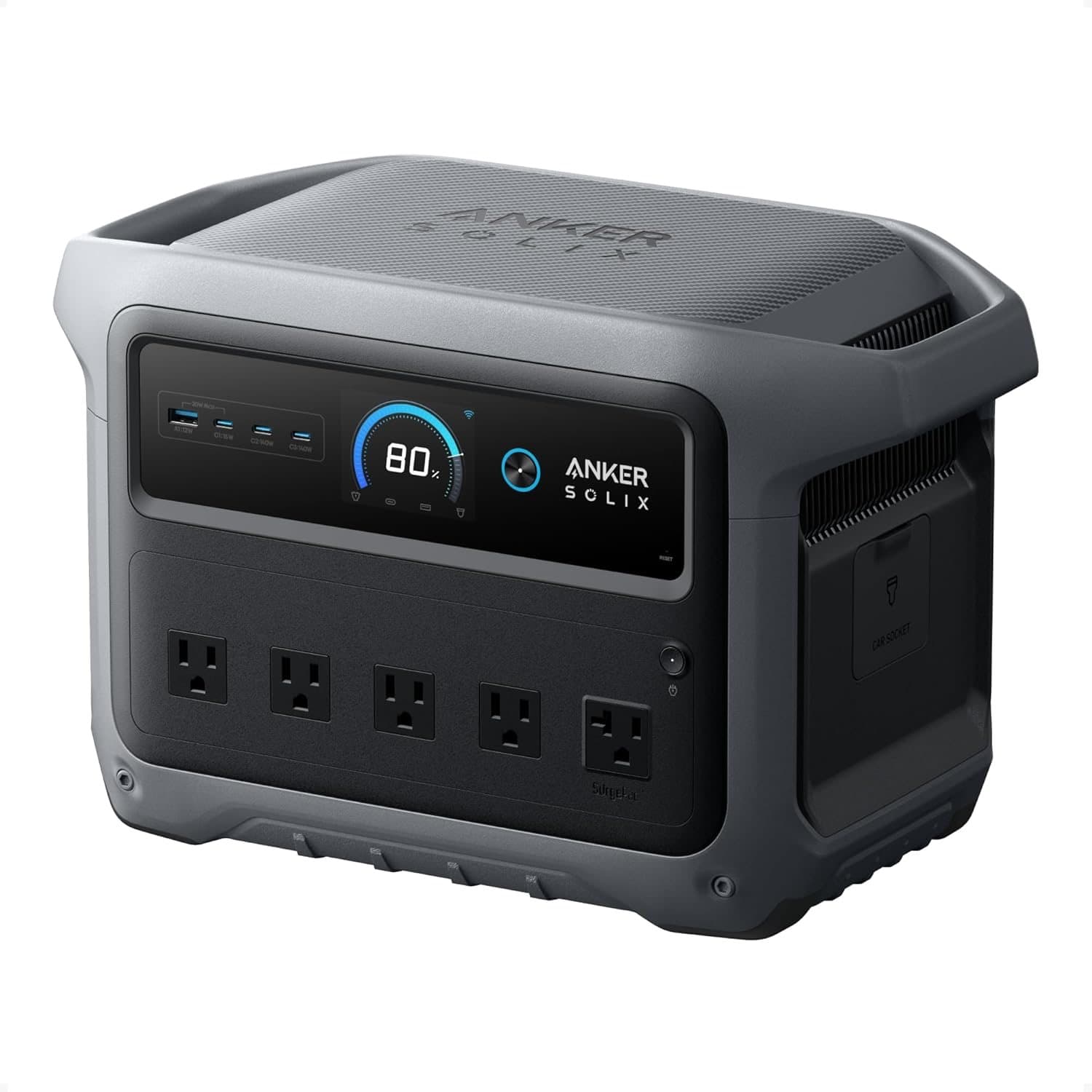
Anker SOLIX C1000 Gen 2 Portable Power Station
BEST OVERALL
Kit Score 8.8/10
$699.99 Price checked Oct 23, 6:22 AM CDT
Best for: Most households and campers who want one 1 kWh station that recharges fast and can back up a fridge, router, or CPAP.
- Fastest full recharge here: 49 minutes on AC in UltraFast mode
- Not expandable; Anker points buyers who want an add-on battery to the original C1000
- Capacity
- 1,024 Wh LiFePO4, 4,000 cycles to 80%
- AC output
- 2,000W continuous, 3,000W peak, 5 outlets
- Recharge
- 100% in 49 min on AC (1,600W UltraFast mode); up to 600W solar, 11 to 60V
- Weight
- 24.9 lb; 15.1 x 8.2 x 9.6 in
- Backup
- 10 ms UPS switchover; not expandable
- Warranty
- 5 years
About this pick
The C1000 Gen 2 packs 1,024 Wh of LiFePO4 into a 24.9 lb case with 2,000W of output, five AC outlets, and a 140W USB-C port. Anker rates a full AC recharge at 49 minutes and the battery at 4,000 cycles to 80% capacity. Unlike the original C1000, it cannot take an expansion battery.
Strengths
- Fastest full recharge here: 49 minutes on AC in UltraFast mode
- 2,000W output and five AC outlets in a 24.9 lb case
- 10 ms UPS switchover and a 5-year warranty
Weaknesses
- Not expandable; Anker points buyers who want an add-on battery to the original C1000
- Charging is limited to 32 to 104 F, so it cannot recharge in a cold garage or car
Kit Score breakdown
JACKERY
Jackery Explorer 1000 v2 Portable Power Station
BEST LIGHTWEIGHT
Kit Score 8.5/10
$499.00 Price checked Oct 23, 6:22 AM CDT
Best for: Campers who move sites frequently and want a sub-24-lb 1 kWh station that handles a fridge, CPAP, and device charging without being a chore to carry.
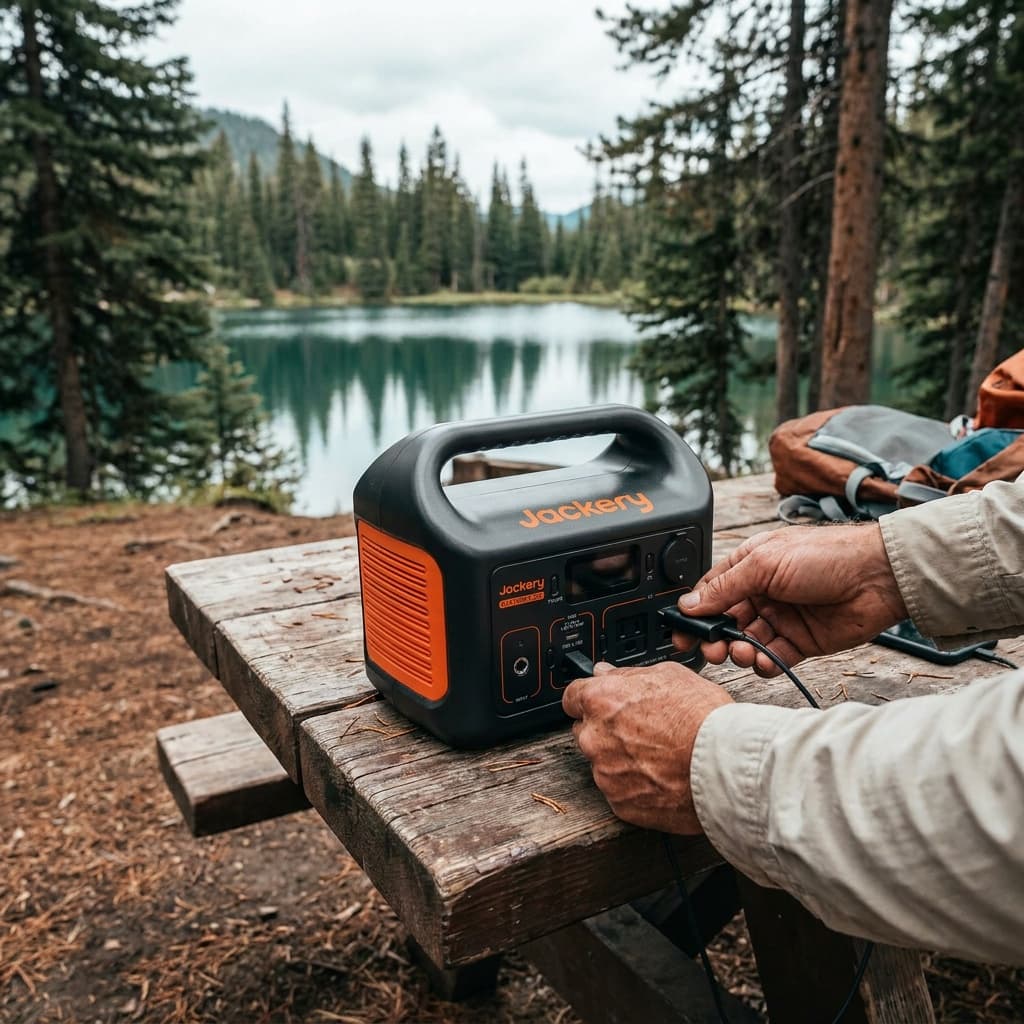
- Lightest of the 1 kWh picks here at about 23.8 lb, manageable for one person
- No battery expansion option, so 1,070 Wh is the ceiling; rivals like the DELTA 2 can grow beyond that
- Capacity
- 1,070 Wh (LiFePO4)
- AC output
- 1,500W continuous, 3,000W surge
- Solar input
- Up to 400W (two 200W inputs, 16 to 60V)
- Fast charge
- About 1.7 hr on AC; Jackery advertises a 1 hr Emergency Charge
- Weight
- 23.8 lbs (10.8 kg)
- Ports
- 3x AC, 2x USB-C (100W and 30W), 1x USB-A (18W), 1x 12V car
About this pick
The Explorer 1000 v2 packs 1,070 Wh of LiFePO4 into about 23.8 lb, the lightest of the 1 kWh picks here, and Jackery rates the battery for 4,000 cycles to 70 percent capacity. It recharges in about 1.7 hours from the wall (Jackery advertises one hour in its Emergency Charge mode) and switches to battery within 20 ms in an outage.
Strengths
- Lightest of the 1 kWh picks here at about 23.8 lb, manageable for one person
- 4,000-cycle LFP battery; 3-year warranty, extendable to 5
- Jackery rates the cooling fan at 22 dB or less
Weaknesses
- No battery expansion option, so 1,070 Wh is the ceiling; rivals like the DELTA 2 can grow beyond that
- 400W solar input is lower than the Anker SOLIX C1000, meaning longer solar-only recharge times
Kit Score breakdown
ECOFLOW
EcoFlow DELTA 3 Portable Power Station
BEST EXPANDABLE
Kit Score 8.3/10
$629.00 Price checked Oct 23, 6:22 AM CDT
Best for: Buyers who want a 1 kWh station now and the option to add a second battery for longer outages later.
- Expandable to 5 kWh with an add-on battery, unlike most 1 kWh stations
- At 27.6 lb it is the heaviest of the 1 kWh picks
- Capacity
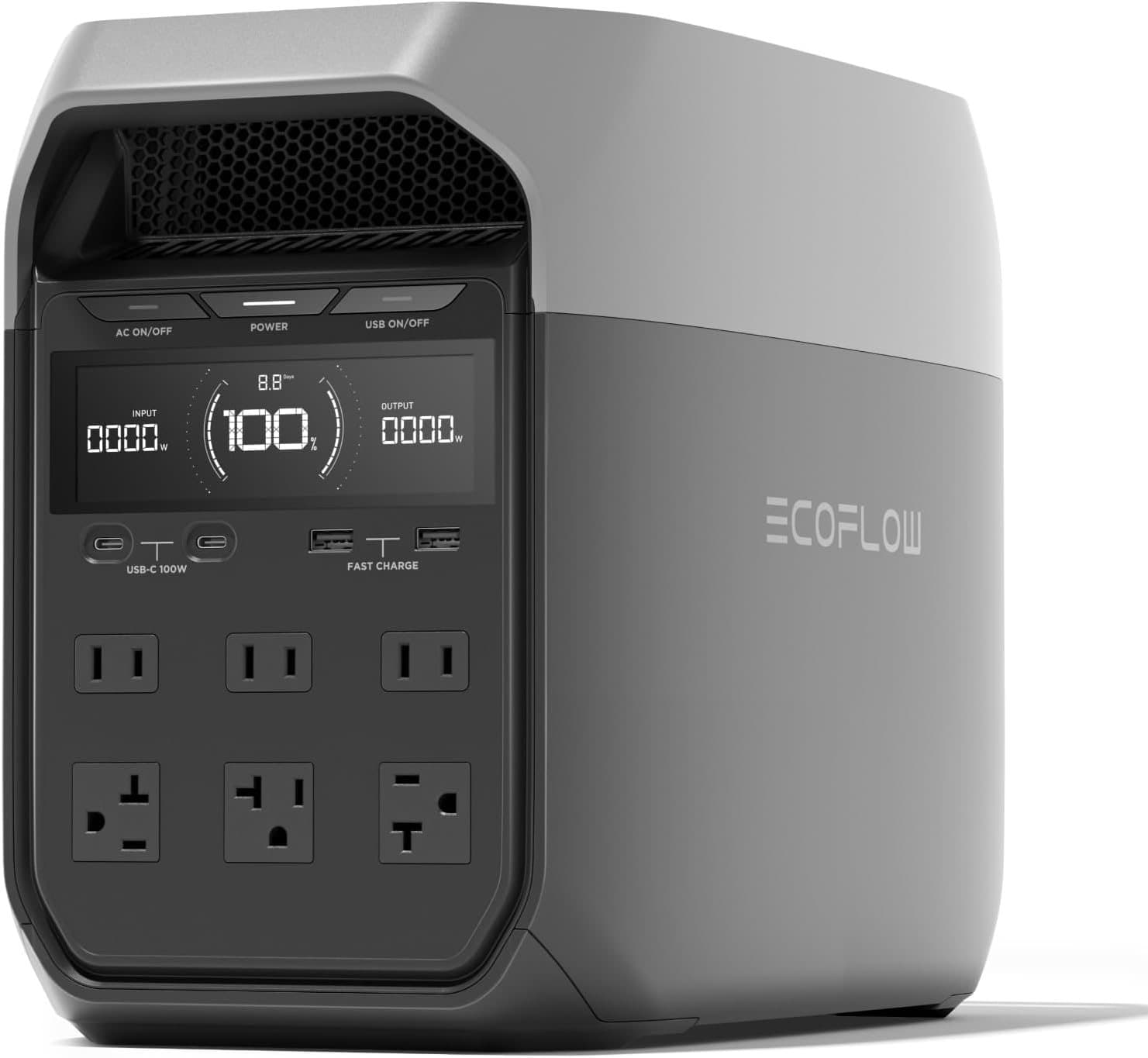
- 1,024 Wh LiFePO4, expandable to 5 kWh; 4,000 cycles to 80%
- AC output
- 1,800W continuous, 3,600W surge, 6 outlets (13 outputs total)
- Recharge
- Full in about 56 min on 1,500W AC; up to 500W solar, 11 to 60V
- Weight
- 27.6 lb; 15.7 x 8.0 x 11.2 in
- Backup
- Under 10 ms UPS switchover
- Warranty
- 5 years
About this pick
The DELTA 3 is EcoFlow's 1 kWh station with the most room to grow. It has six AC outlets, 1,800W of output (3,600W surge), a full AC recharge in about 56 minutes, and an expansion port that takes DELTA 3, DELTA 2, DELTA 2 Max, or DELTA Pro 3 extra batteries for up to 5 kWh.
Strengths
- Expandable to 5 kWh with an add-on battery, unlike most 1 kWh stations
- Six AC outlets and 13 outputs in total
- Under 10 ms UPS switchover and a 5-year warranty
Weaknesses
- At 27.6 lb it is the heaviest of the 1 kWh picks
- Extra batteries add cost and weight; price the full system before you buy
Kit Score breakdown
See all picks in Best portable power stations for camping in 2026
Keep going
Related guides

 Complete camp loadoutCar-camping starter kitBuild the complete kit
Researched, not hands-on tested
Updated Jun 4, 2026Our recommendations draw on manufacturer documentation, retailer listings, owner feedback, and comparisons with alternatives.
As an Amazon Associate I earn from qualifying purchases. We may earn a commission from links here, at no extra cost to you. How we research →