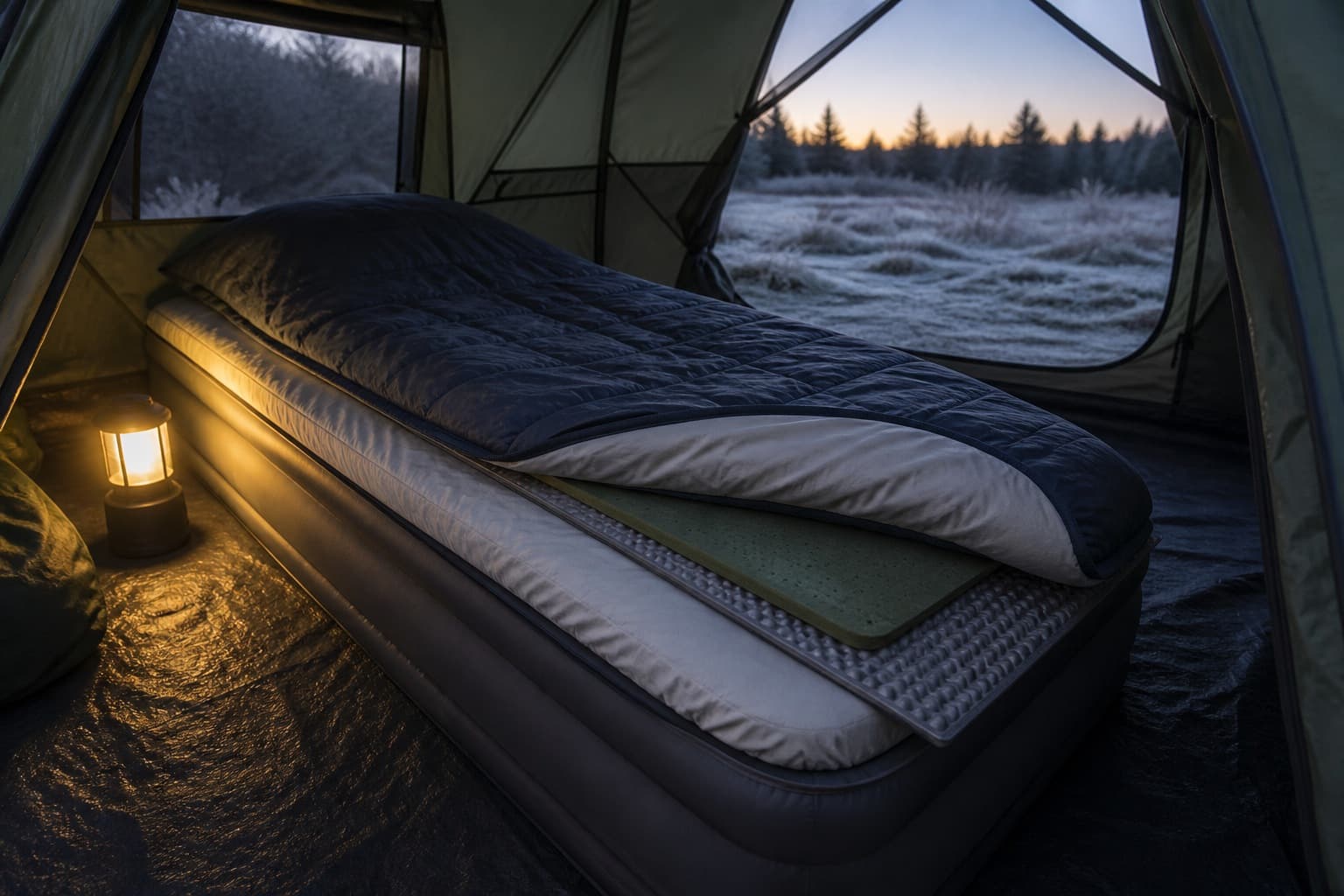
An air mattress can be the most comfortable bed in camp, or the coldest night of your trip. The difference is almost entirely about insulation strategy, not the mattress itself.
Why air mattresses feel so cold
Sleeping pads are rated for insulation with a standardized ASTM F3340 R-value, and higher numbers resist ground cold better. A household-style air bed usually has no R-value listed at all, because it is not built as an insulator: it is a large chamber of air with nothing inside to stop that air from moving. Air near your body warms, air near the ground cools, and the mattress keeps circulating heat toward the cold side all night.
That is why a thicker air bed is not automatically warmer. More air is more room for that circulation, not more insulation. Insulated camping pads solve it with foam, fill, or baffles inside; a plain air bed needs the insulation added from outside.
If your air bed lists no ASTM R-value, assume it adds little insulation and build the warmth in with the layers below.
The closed-cell pad trick
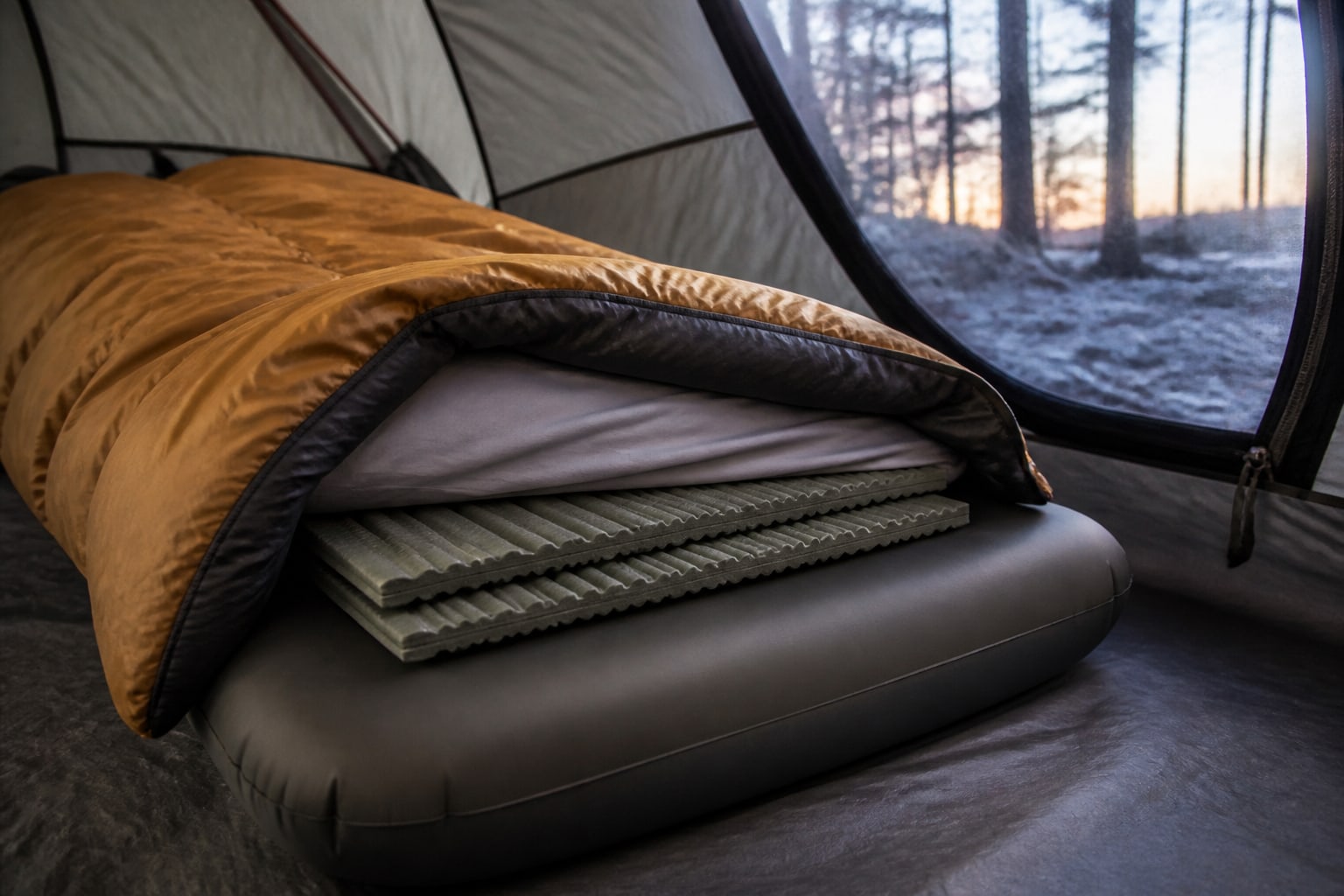
The most effective and affordable fix is to place a closed-cell foam pad (the kind that looks like a camping yoga mat, such as the Therm-a-Rest Z Lite Sol) directly under your air mattress, between the mattress and the tent floor. It puts a layer that does not circulate air between the mattress and the cold ground.
The Z Lite Sol is R 2.0 and comes in two lengths: the 51-inch Small weighs 10 oz and the 72-inch Regular weighs 14 oz. Because it goes under the air mattress, you never feel its firmness. A full-length pad covers your entire sleep surface; a shorter one is enough if your torso and hips are covered, since that is where most of your body's contact with the mattress is.
Insulating the top side
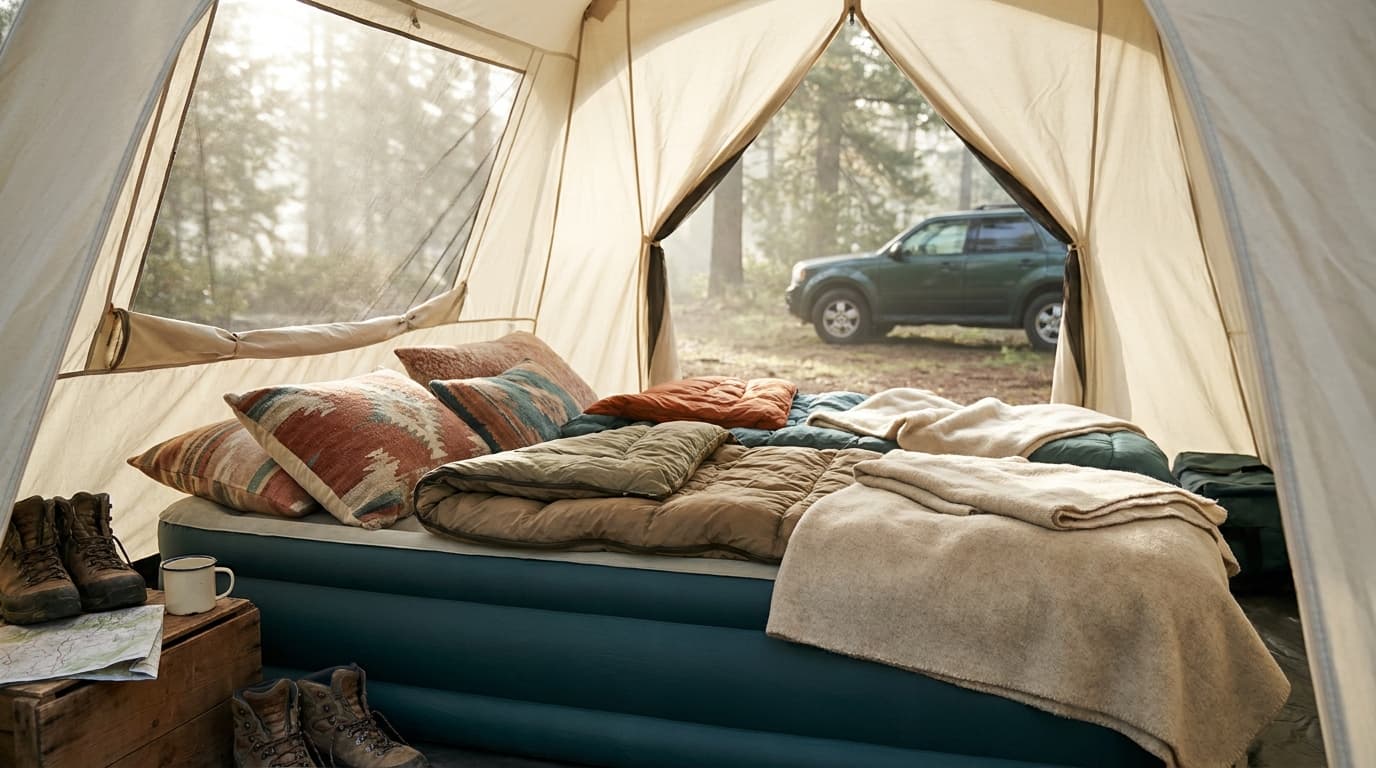
Once the underside is handled, address the surface you actually sleep on. The top of an air bed sits on that circulating air, and a sleeping bag's insulation underneath you is crushed flat by your weight, so the layer between you and the mattress does most of the work.
Options from best to simplest:
Top-side insulation options
Sleeping pad on top
A self-inflating or insulated pad with a listed R-value is the most dependable top layer, and its R-value adds to anything underneath. Place it on top of the air mattress, under your sleeping bag.
Wool blanket
A medium-weight wool blanket folded between you and the mattress surface adds some insulation and costs nothing if you already own one. It has no rated R-value, so treat it as a help rather than the whole fix.
Fleece sheet
A fleece sleeping bag liner doubles as a topper layer and adds warmth inside the bag on colder nights.
Down throw
Lighter than wool and compressible, though it needs a shell to prevent sliding off the mattress during the night.
Inflation level and ambient temperature
Inflation matters mostly for comfort and for keeping you off the ground. Inflate so you sink in slightly but your hips never touch the floor; bottoming out puts your body directly on the cold tent floor.
Expect the mattress to soften overnight. Air contracts as it cools, so a mattress inflated in a warm afternoon will lose pressure as the night gets colder even with no leak. Inflate it after sunset if you can, and keep the pump handy for a top-off before you settle in.
Most air bed "leaks" on a cold night are just cold air shrinking. Top it off after dark, not in the afternoon sun.
Sleeping bag rating and the ground insulation assumption
Sleeping bag temperature ratings today follow ISO 23537, which replaced the older EN 13537. The test uses a heated manikin lying on a foam mattress with a thermal resistance of 0.85 m²K/W, roughly R 4.8 in the units pad makers use. If your ground insulation is well below that, your bag will sleep colder than its rating suggests.
A plain air bed has no rated insulation, so a bag on top of it is starting well short of that test pad. Stacking helps close the gap: an R 2.0 foam pad underneath plus an R 3 insulated pad on top gets you to about R 5, above the test pad. Also check which rating your bag lists: the number in a bag's name is often closer to its lower limit than its comfort figure. The men's Kelty Cosmic Down 20, for example, has a 31°F ISO comfort rating.
For fall car camping with lows in the 40s°F, a bag with a comfort rating near that low plus a foam pad underneath and a blanket or pad on top is a reliable, affordable system. As lows drop toward freezing, add R-value before you add bag: Therm-a-Rest's winter pad range is R 5 to 8. The sleeping bag warmth calculator can check a specific bag and pad combination.
Frequently asked questions
Can I use a regular blanket under my air mattress instead of a foam pad?
A folded blanket under the mattress helps, but not as much as a closed-cell foam pad. Blankets compress under the weight of the mattress and a person, which flattens the loft that does the insulating. A closed-cell foam pad keeps its thickness and has a tested R-value (R 2.0 for the Z Lite Sol). Use a blanket as a supplement on top of the pad rather than a replacement for it.
Does an electric blanket or heated mattress pad work for car camping?
Yes, for car camping with power access. A 12V heated mattress pad draws from a car battery or a portable power station and can warm the mattress surface directly. Pre-warm the bed before you get in, then turn it down or off once you are in your sleeping bag to save battery. A 120V household electric blanket needs a power station or inverter that can supply its wattage; check the blanket's rating against the station's output. Follow the heated pad's own instructions, and never use a propane or other fuel-burning heater inside the tent: heater manuals warn against using them in any enclosed space, including tents, because of carbon monoxide.
Does tent size affect how cold the air mattress feels?
Yes, indirectly. A large tent with lots of unoccupied volume is harder to warm with body heat alone, and cold air circulates more freely around the mattress. A smaller tent or one shared by two or more people retains body heat better, which raises the ambient air temperature inside the tent by several degrees. That ambient warmth does not replace under-mattress insulation, but it reduces the temperature differential the mattress has to fight.
Where these numbers come from
| Claim | Source | Checked |
|---|---|---|
| Z Lite Sol: R 2.0, 0.75 in thick, 10 oz Small (51 in), 14 oz Regular (72 in) | Therm-a-Rest, Z Lite Sol | Sep 2026 |
| R-values are additive; three-season pads about R 2 to 4, winter R 5 to 8 | Therm-a-Rest, Ultimate guide to sleeping pads | Sep 2026 |
| ISO bag ratings measured on a foam mattress of Rct 0.85 m²K/W (about R 4.8 converted) | ISO 23537-1:2022 preview | Sep 2026 |
| Kelty Cosmic 20 (men's): 31°F ISO comfort, 21°F ISO limit | Treeline Review, Kelty Cosmic 20 review | Sep 2026 |
| Never use a fuel-burning heater in an enclosed space such as a tent | EAST OAK patio heater owner's manual | Sep 2026 |
For more on the whole overnight system, see how to stay warm while camping. For specific picks, see our guide to the best camping air mattresses. Browse all camp guides or read how we research and rate gear.
Recommended gear
Our current top picks from the Best camping air mattresses for car camping (2026) guide, if you are ready to buy.
SOUNDASLEEP PRODUCTS
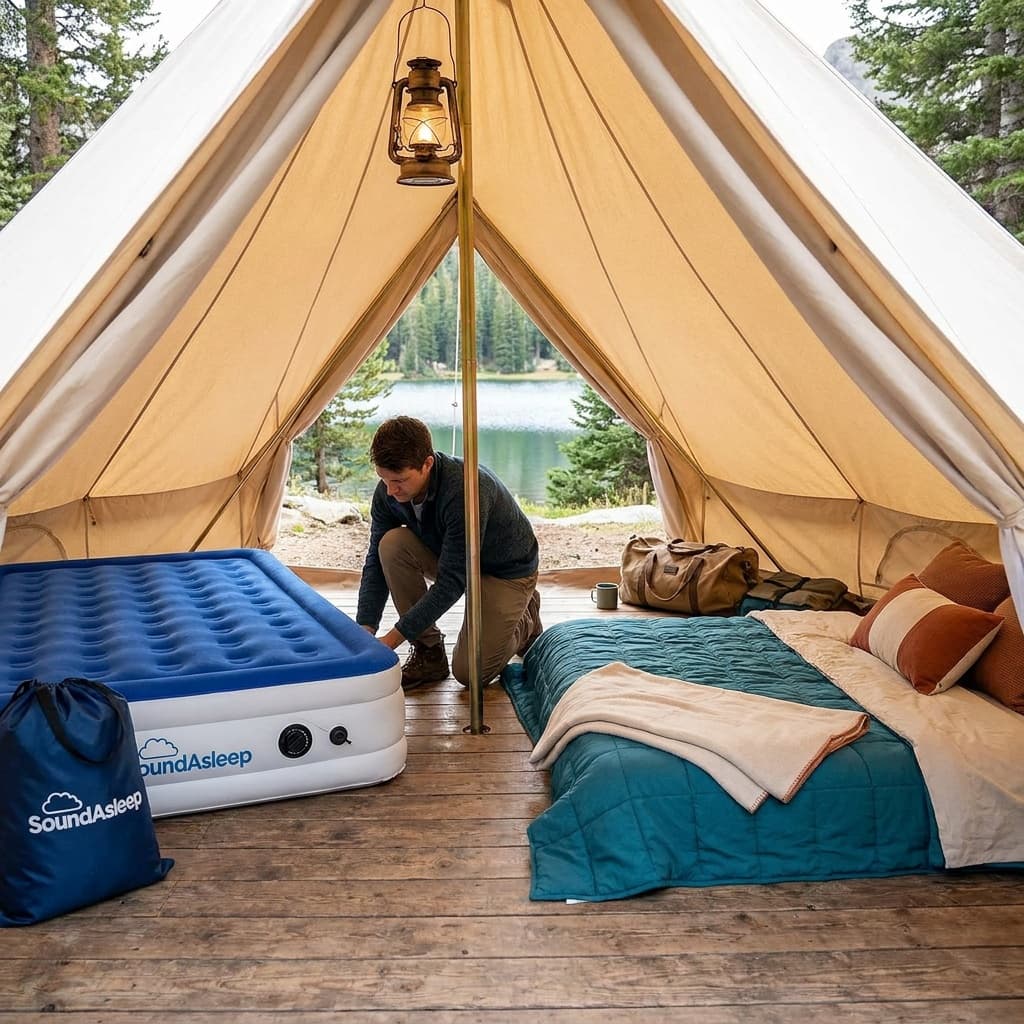
SoundAsleep Dream Series Luxury Air Mattress (Queen)
Best Overall
Kit Score 7.8/10
$149.95 Price checked Oct 23, 4:16 PM CDT
Best for: Car campers who want a coil-supported, bed-like feel and the convenience of an integrated pump, at a mid-range price.
- 40 internal air coils distribute weight evenly and prevent the hammock sag common on cheaper mattresses
- Some owners report air leaks or seam failures within the first year of regular use
- Inflated dimensions
- 80 x 60 x 19 in (queen)
- Height
- 19 in (double-high)
- Pump
- Built-in 1-click AC pump
- Materials
- Multilayer eco-friendly PVC, flocked top
- Chambers
- Dual-chamber, SureGrip bottom
- Included
- Carry bag
About this pick
The Dream Series uses 40 internal ComfortCoil air coils and a 1-click built-in pump to deliver consistent, level support and inflate in under 4 minutes. Its multilayer puncture-resistant PVC and SureGrip bottom make it a dependable pick for tent-floor car camping.
Strengths
- 40 internal air coils distribute weight evenly and prevent the hammock sag common on cheaper mattresses
- Built-in 1-click pump inflates fully in under 4 minutes with no separate hardware needed
- Textured SureGrip bottom helps keep it from sliding on a tent floor, and a carry bag is included
Weaknesses
- Some owners report air leaks or seam failures within the first year of regular use
- Pump requires an AC outlet, so a power source or car inverter is needed at the campsite
Kit Score breakdown
Best for: Campers who want a well-supported, easy-entry double-high with fast inflation and have reliable AC access at their site.
- Fastest inflation in this roundup: King Koil quotes 90 seconds for the queen, and the Amazon listing says 2 minutes
- Some owners report internal coil separation on units after months of frequent use
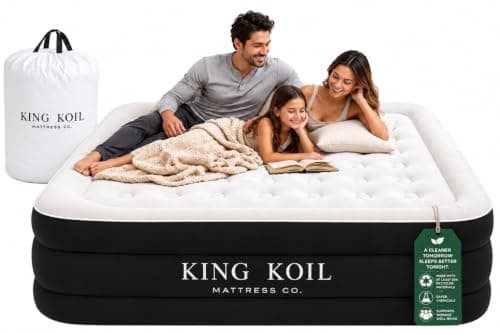
- Inflated dimensions
- 80 x 60 x 20 in (queen)
- Height
- 20 in (double-high)
- Pump
- Built-in 120V/210W high-speed pump (90 sec to 2 min quoted)
- Weight capacity
- 600 lbs
- Materials
- Waterproof PVC, fully flocked top and sides
- Warranty
- 1 year
About this pick
King Koil's coil-beam queen inflates in 90 seconds to 2 minutes (King Koil's own figures) via its high-speed built-in 120V pump and sits at a chair-friendly 20 inches. A raised built-in pillow, fully flocked top and sides, and a 600 lb rating make it a well-regarded pick for campers and guests alike.
Strengths
- Fastest inflation in this roundup: King Koil quotes 90 seconds for the queen, and the Amazon listing says 2 minutes
- Air-filled coil-beam construction spreads weight across the surface; separate inflation and deflation valves speed teardown
- Raised pillow zone integrated into the mattress surface keeps head and neck supported without a separate pillow
Weaknesses
- Some owners report internal coil separation on units after months of frequent use
- Pump is AC-only; a car inverter or camp power station is needed for remote sites
Kit Score breakdown
INTEX
Intex Dura-Beam Comfort Plush Elevated Airbed (Queen, 22 in)
Best Budget
Kit Score 7.4/10
$70.20 Price checked Oct 23, 4:16 PM CDT
Best for: Budget-focused car campers who want a tall, easy-entry queen mattress with Fiber-Tech durability and a built-in pump under $80.
- At 22 inches, it delivers the easiest bed entry and exit of any mattress in this roundup, useful for older campers or anyone with knee or hip stiffness
- Some owners report gradual air loss over several nights, so plan to top it off on longer trips
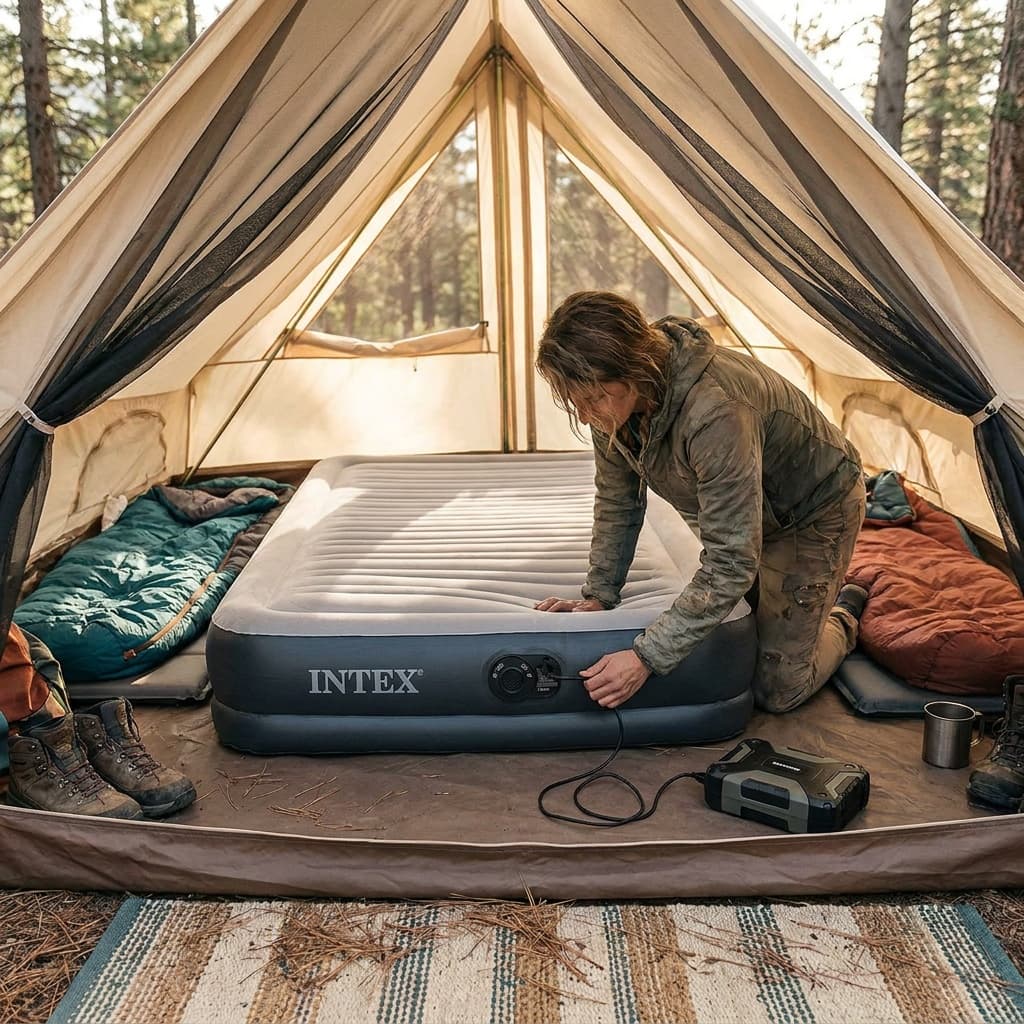
- Inflated dimensions
- 80 x 60 x 22 in (queen)
- Height
- 22 in (tallest in this roundup)
- Pump
- Built-in electric pump (approx. 4.5 min inflate)
- Materials
- Fiber-Tech polyester-reinforced PVC, waterproof flocked top
- Weight capacity
- 600 lbs
- Weight
- 21 lbs
About this pick
At 22 inches, the Dura-Beam Comfort Plush is the tallest option in this roundup and uses Fiber-Tech construction (thousands of high-strength polyester fibers replacing traditional beams), which Intex credits for its durability. A built-in electric pump handles inflation in about 4.5 minutes, and it is rated for 600 lb.
Strengths
- At 22 inches, it delivers the easiest bed entry and exit of any mattress in this roundup, useful for older campers or anyone with knee or hip stiffness
- Fiber-Tech construction uses thousands of high-strength polyester fibers inside in place of traditional vinyl beams
- Under $80 street price makes it accessible for occasional campers who want a real double-high without a major investment
Weaknesses
- Some owners report gradual air loss over several nights, so plan to top it off on longer trips
- At about 4.5 minutes it is the slowest to inflate here, and the pump needs an AC outlet
Kit Score breakdown
See all picks in Best camping air mattresses for car camping (2026)
Keep going
Free toolSleeping-Bag WarmthWill you be warm enough? Bag rating plus pad and clothing.Related guides


 Complete camp loadoutCar-camping starter kitBuild the complete kit
Researched, not hands-on tested
Updated Sep 25, 2026Our recommendations draw on manufacturer documentation, retailer listings, owner feedback, and comparisons with alternatives.
As an Amazon Associate I earn from qualifying purchases. We may earn a commission from links here, at no extra cost to you. How we research →