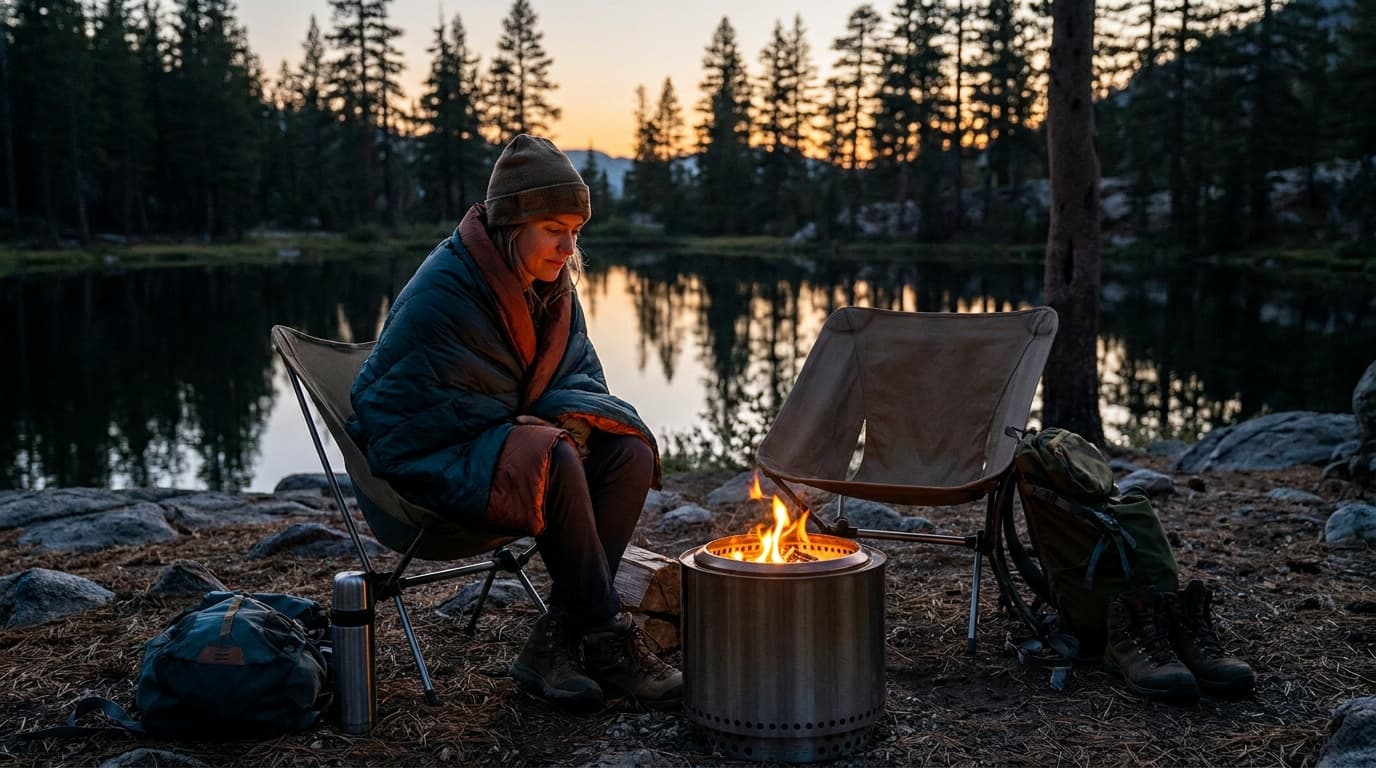
A good camp blanket earns its keep from the moment you park to the last cup of coffee in the morning. We researched synthetic puffy blankets, fleece, and wool across verified owner reviews, published specifications, and outdoor-gear editorial sources to find the four worth buying.
Our quick picks
How we picked
Every blanket below earned a score via our Kit Score: fill type and warmth-to-packability ratio, shell weather resistance (DWR or natural water resistance), packed size and weight, machine-washability, and size for shared use. Price was normalized so a budget pick earns fair credit on value, not just cost.
The picks
Best overall
BEST OVERALL
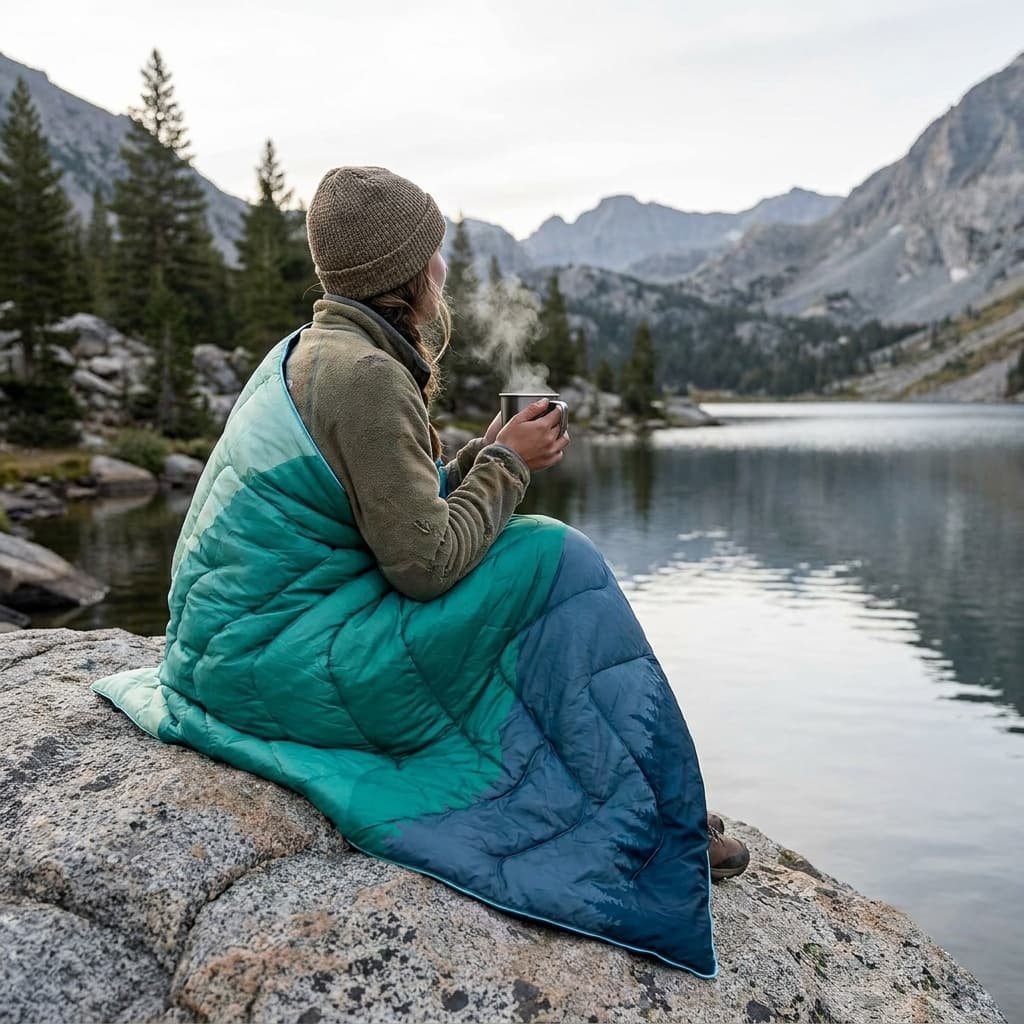
Rumpl Original Puffy Blanket
Best for: Car campers, festival-goers, and van travelers who want a single blanket that handles cool nights, morning damp, and stadium seating equally well.
- Hands-free Cape Clip and paracord corner loops make it genuinely versatile at the campsite, stadium, or tailgate
- Roll-top stuff sack has a tight opening that can be frustrating in cold conditions
Kit Score 8.4/10 · Check current price · how we score gear
Buy on AmazonProduct details
The Rumpl Original Puffy is a packable synthetic camping blanket built from fully recycled materials, with a ripstop polyester shell treated with a PFAS-free DWR finish. It works as a lap blanket, campfire throw, stadium wrap, or car camping layer down to around 45 F.
- Material
- 100% recycled 30D ripstop polyester shell, RenewaLoft synthetic insulation (240 gsm)
- Dimensions (1-person)
- 52" x 75"
- Weight (1-person)
- approx. 2.2 lb
- Packed Size
- 7" x 16"
- Water Resistance
- PFAS-free DWR coating
- Care
- Machine washable
More strengths
- Ranked among the warmest synthetic camping blankets in independent lab testing, outperforming many pricier alternatives
- Made from 100+ post-consumer recycled plastic bottles, with a soft yet water-shedding outer shell
Other tradeoffs
- Packs bulkier than premium down options at the same warmth level
The Rumpl Original Puffy Blanket has been the camp-blanket category benchmark since Rumpl introduced it, and the core design holds up because the fundamentals are right: a recycled ripstop nylon shell with a DWR finish, 80 grams of synthetic fill per square meter (single size), and a stuff sack that compresses to roughly the size of a Nalgene. It fits under a truck seat, in a daypack side pocket, or in a festival bag without negotiation.
The DWR shell is what separates it from fleece in a dewy morning or a light drizzle. Moisture beads off rather than wicking through to the insulation. Once you've had a fleece blanket go clammy at a weekend campsite, you understand why this matters. Rumpl's fill is synthetic, which means it retains most of its loft and warmth when it does get wet, unlike down.
Warmth range: comfortable for most people in the low 50s Fahrenheit, with a hood or a second layer needed once temps drop into the 40s. It is not a sleeping bag replacement. It is an exceptional campsite layer for cool-to-cold nights when you're sitting, standing, or lounging rather than sleeping.
Machine washable, tumble dry low. The DWR eventually needs refreshing (a low-heat dryer cycle reactivates it; a DWR spray does the job when that stops working). The snap closure at the corner lets you wrap it around your shoulders like a cape without holding it shut.
Available in single (50 x 70 in) and double (60 x 80 in) sizes. The double is the practical choice if you share a blanket at a campfire or use it on a stadium seat for two.
Best for: Car campers, festival-goers, and van travelers who want a single blanket that handles cool nights, morning damp, and stadium seating equally well.
Price: $90 – $110
Best value
BEST VALUE
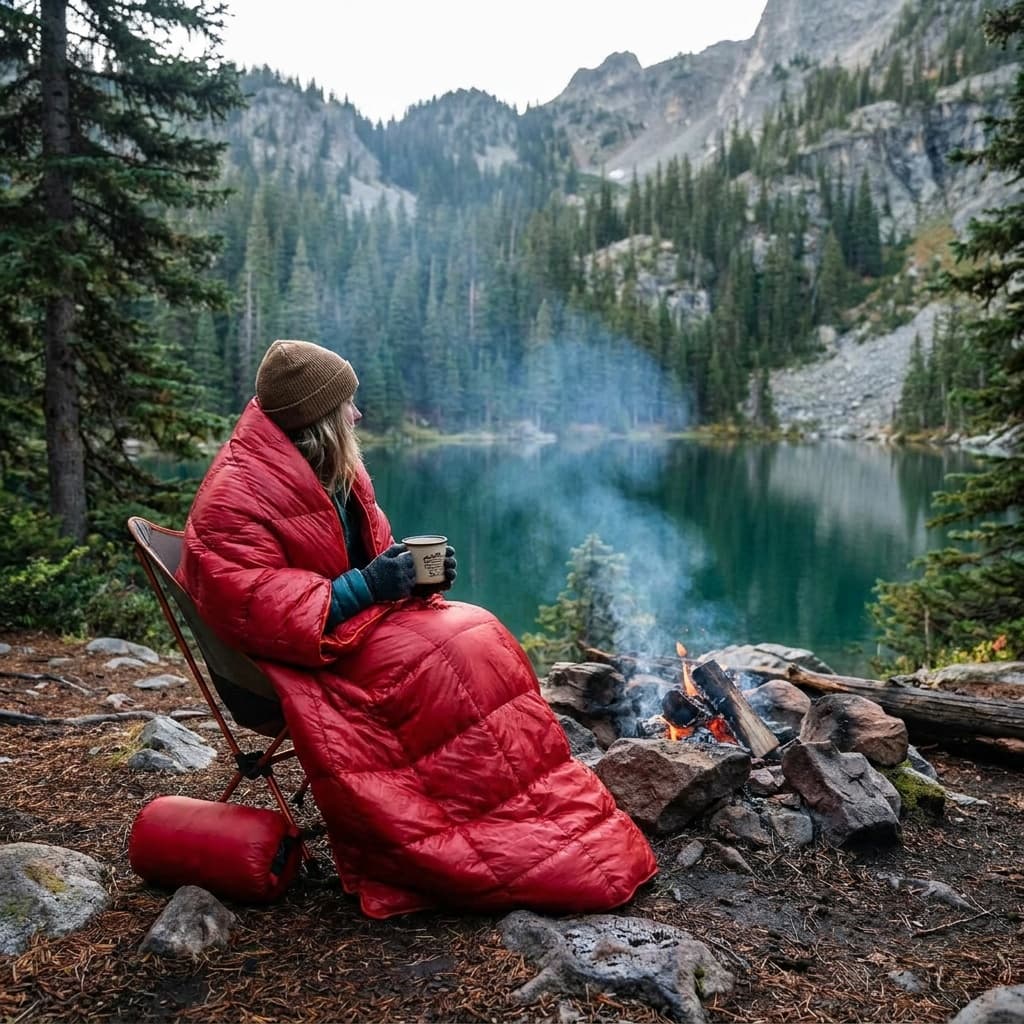
Kelty Biggie Blanket
Best for: Families and couples doing car camping, glamping, or hammock hangs where weight is not a concern and sharing a blanket around the fire is the whole point.
- Genuine two-person coverage at 82" x 80" with CloudLoft insulation that outperformed pricier competitors in warmth retention testing
- Heavy and bulky relative to its insulation level, making it impractical for any trip where pack weight matters
Kit Score 8.2/10 · $54.95 Price checked Oct 23, 4:16 PM CDT · how we score gear
Buy on AmazonProduct details
The Kelty Biggie is an oversized two-person camping blanket with CloudLoft ECO insulation sandwiched between a PFAS-free DWR-coated recycled polyester shell and a soft brushed liner. It is big enough to cover a queen airbed and comes with a stuff sack for easy transport.
- Material
- 68D recycled polyester taffeta shell with PFAS-free DWR, 75D recycled polyester pongee liner, CloudLoft ECO synthetic insulation
- Dimensions
- 82" x 80" (fits two adults)
- Weight
- 1 lb 15.2 oz
- Packed Size
- 8.75" x 16"
- Water Resistance
- PFAS-free DWR-coated outer shell
- Care
- Machine washable
More strengths
- Soft brushed liner is noticeably plusher than other budget options, and the DWR outer shell handles light spills and morning dew
- Machine washable and affordably priced, making it a practical pick for families and frequent car campers
Other tradeoffs
- No cape clip, corner loops, or other features found on premium blankets at twice the price
The Kelty Biggie Blanket solves a specific problem: some blankets feel stingy when two people try to share them around a fire. The Biggie is 60 x 90 inches, which is noticeably larger than most camp blankets at this price point, and Kelty's synthetic fill keeps it lofted and warm without weighing the blanket down.
The shell is polyester rather than the ripstop nylon you get on the Rumpl, which means it is softer against skin but less water-resistant. There is no DWR finish on the standard Biggie. That is the honest trade-off: you get more size and softness for less money, and you give up the weather resistance that makes the Rumpl a confident choice in variable conditions. For most car camping and glamping use, this trade is fine. You're sitting around a fire, not hiking in drizzle.
Packed size is larger than a puffy blanket's stuff sack. The Biggie packs down to something roughly the size of a football, which is compact enough for a car camping bin but too bulky for a daypack. Machine washable, which matters for a blanket that gets shared, sat on, and dragged across camp chairs.
The warmth-to-price ratio is where it earns the value badge. At $45 – $60, you get enough blanket to keep two people reasonably warm on a 50-degree evening, which is the actual use case for most campsite blankets. Kelty has strong owner review scores for this product, with consistent praise for the size and the softness.
Best for: Families and couples doing car camping, glamping, or hammock hangs where weight is not a concern and sharing a blanket around the fire is the whole point.
Price: $45 – $60
Best budget
BEST BUDGET
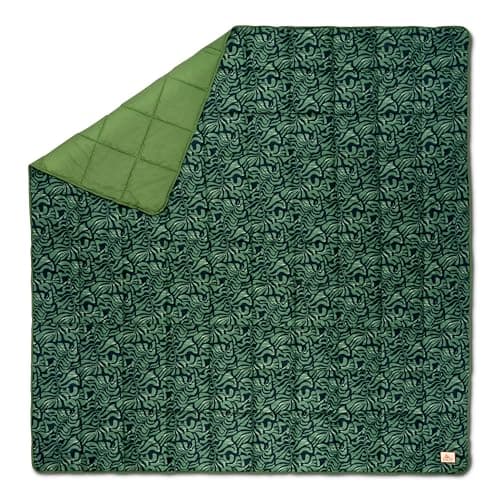
GLORSIGN Outdoor Puffy Camping Blanket
Best for: Budget-conscious car campers and tailgaters who want the puffy-blanket experience with DWR protection for casual cool-weather outings.
- Cape clip and corner staking loops are features usually reserved for blankets costing two to three times as much
- Noticeably thinner insulation than premium synthetic options; comfort floor is around 50 F rather than true three-season use
Kit Score 6.8/10 · $32.29 Price checked Oct 23, 4:16 PM CDT · how we score gear
Buy on AmazonProduct details
The GLORSIGN Outdoor Puffy Blanket is a budget-friendly recycled polyester throw with a DWR-coated shell, a cape clip for hands-free wearing, and corner loops for staking down. It delivers the core puffy-blanket format at roughly a third of the Rumpl price.
- Material
- 100% recycled polyester shell and insulation, DWR coating
- Dimensions
- 80" x 60"
- Weight
- 1 lb 10.2 oz
- Packed Size
- 15" x 10"
- Water Resistance
- DWR-coated outer shell
- Care
- Machine washable
More strengths
- DWR coating sheds light rain and spills effectively for the price tier
- Made from recycled materials and available in mountain-print patterns that look sharp at the campsite or stadium
Other tradeoffs
- Material feel and long-term durability are rated meaningfully lower than Rumpl or Kelty in side-by-side comparisons
The GLORSIGN Outdoor Puffy Camping Blanket brings the puffy-blanket format, including a ripstop nylon outer shell and DWR coating, to under $40. For buyers who want weather resistance and compact packability but are not ready to pay Rumpl prices, this is the logical starting point.
The construction mirrors the Rumpl concept: a quilted synthetic-insulated shell that compresses into its own stuff sack and maintains insulating loft when damp. Owner review aggregates confirm the DWR coating performs well for the first season with proper care (tumble dry low to reactivate) and the stuff-sack compression is genuinely useful.
Where the GLORSIGN trails the Rumpl is in long-term durability and fill consistency. Owners on extended use report the fill shifting after repeated washing more than Rumpl's does. The shell fabric is lighter and less abrasion-resistant. For occasional car camping, tailgating, or stadium use, this is not a meaningful concern. For daily van-life or heavy-rotation festival use, the Rumpl's construction quality is worth the price gap.
Available in multiple sizes. The standard single size (approximately 50 x 60 in) is the most commonly reviewed. Machine washable, which is expected in this category.
Best for: Budget-conscious car campers and tailgaters who want the puffy-blanket experience with DWR protection for casual cool-weather outings.
Price: $28 – $38
Best premium
BEST PREMIUM
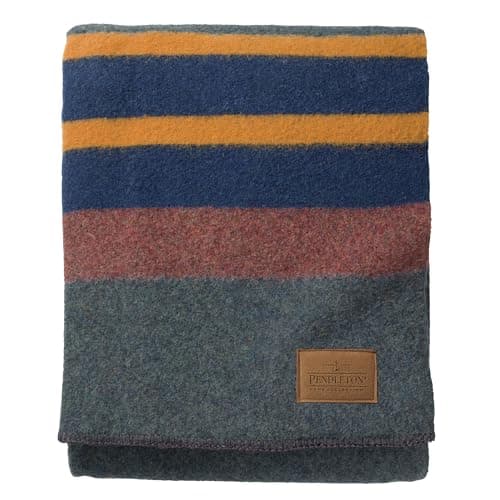
Pendleton Yakima Camp Blanket
Best for: Car campers and overlanders who sit around wood fires regularly and want a heirloom-grade blanket that improves with decades of use.
- Naturally fire-resistant wool is the only safe choice around an open campfire or wood stove, where synthetic blankets can melt or ignite
- Absorbs moisture readily and takes a long time to dry, making it a poor choice for wet-weather camping or any trip where rain is likely
Kit Score 7.6/10 · $228.00 Price checked Oct 23, 4:16 PM CDT · how we score gear
Buy on AmazonProduct details
The Pendleton Yakima is a wool camp blanket woven in American mills, finished with reinforced whipstitch binding and the classic ombre camp stripe pattern. Wool's natural fire resistance, moisture regulation, and decades-long lifespan make it a fundamentally different material choice from synthetic options.
- Material
- 86% wool, 14% cotton blend (American mills)
- Dimensions (Twin)
- 66" x 84"
- Weight (Twin)
- 4.5 lb
- Packed Size
- 14" x 18"
- Fire Resistance
- Naturally flame-resistant wool construction
- Care
- Dry clean recommended
More strengths
- Wool retains meaningful warmth even when damp, regulates temperature in a range from cool evenings to cold nights, and improves with age
- American-made construction with reinforced binding; owners report decades of regular use without structural failure
Other tradeoffs
- Dry-clean recommended care adds ongoing cost and inconvenience; heavy and bulky for any trip beyond base camp or car access
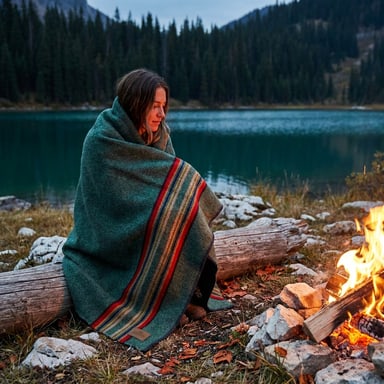
The Pendleton Yakima Camp Blanket occupies a completely different category from the synthetic options above. It is 100% pure virgin wool, woven at Pendleton's Oregon mills, and it behaves the way wool has always behaved around campfires: it resists embers, self-extinguishes rather than melting, and gets softer with each wash rather than wearing down.
Wool's warmth-to-weight profile is different from synthetic insulation. A wool blanket does not loft the way a puffy does. It drapes. That drape is why it wraps around shoulders naturally and why it has been campsite and trail gear for well over a century. Wool absorbs up to 30% of its weight in moisture before it feels wet, and it continues insulating even when damp, which is a genuine advantage in the variable conditions of a real campsite.
The Yakima pattern is a Pendleton classic: bold stripes in colorways that reference the Pacific Northwest. Size is approximately 64 x 80 inches for the throw, large enough for two adults. Weight is meaningful, around 4 pounds, which is heavier than any of the synthetic options. This is not a blanket you'll carry in a daypack. It is a blanket you pull from the back of the truck or the back seat of the overlander.
Machine wash cold, tumble dry low. The fire-resistance is real: wool char-tests reliably in gear reviews and in textile safety testing. If sitting around a wood fire, where embers and sparks are part of the evening, a wool blanket is a materially safer choice than a synthetic one.
The Yakima's $220 – $250 price reflects both the domestic manufacturing and the material. Pendleton's camp blankets routinely appear in estate sales and vintage markets still in use after decades. That is not marketing language: it is a documented pattern in owner communities and resale platforms.
Best for: Car campers and overlanders who sit around wood fires regularly and want a heirloom-grade blanket that improves with decades of use.
Price: $220 – $250
Comparison
| Product | Kit Score | Price | Best for |
|---|---|---|---|
| Rumpl Original Puffy Blanket | 8.4 | Check current price | Best for: Car campers, festival-goers, and van travelers who want a single blanket that handles cool nights, morning damp, and stadium seating equally well. Why it stands out: Hands-free Cape Clip and paracord corner loops make it genuinely versatile at the campsite, stadium, or tailgate Tradeoff: Roll-top stuff sack has a tight opening that can be frustrating in cold conditions |
| Kelty Biggie Blanket | 8.2 | $54.95 Price checked Oct 23, 4:16 PM CDT | Best for: Families and couples doing car camping, glamping, or hammock hangs where weight is not a concern and sharing a blanket around the fire is the whole point. Why it stands out: Genuine two-person coverage at 82" x 80" with CloudLoft insulation that outperformed pricier competitors in warmth retention testing Tradeoff: Heavy and bulky relative to its insulation level, making it impractical for any trip where pack weight matters |
| GLORSIGN Outdoor Puffy Camping Blanket | 6.8 | $32.29 Price checked Oct 23, 4:16 PM CDT | Best for: Budget-conscious car campers and tailgaters who want the puffy-blanket experience with DWR protection for casual cool-weather outings. Why it stands out: Cape clip and corner staking loops are features usually reserved for blankets costing two to three times as much Tradeoff: Noticeably thinner insulation than premium synthetic options; comfort floor is around 50 F rather than true three-season use |
| Pendleton Yakima Camp Blanket | 7.6 | $228.00 Price checked Oct 23, 4:16 PM CDT | Best for: Car campers and overlanders who sit around wood fires regularly and want a heirloom-grade blanket that improves with decades of use. Why it stands out: Naturally fire-resistant wool is the only safe choice around an open campfire or wood stove, where synthetic blankets can melt or ignite Tradeoff: Absorbs moisture readily and takes a long time to dry, making it a poor choice for wet-weather camping or any trip where rain is likely |
Rumpl Original Puffy Blanket
- Best for
- Car campers, festival-goers, and van travelers who want a single blanket that handles cool nights, morning damp, and stadium seating equally well.
- Why it stands out
- Hands-free Cape Clip and paracord corner loops make it genuinely versatile at the campsite, stadium, or tailgate
- Tradeoff
- Roll-top stuff sack has a tight opening that can be frustrating in cold conditions
Kelty Biggie Blanket
- Best for
- Families and couples doing car camping, glamping, or hammock hangs where weight is not a concern and sharing a blanket around the fire is the whole point.
- Why it stands out
- Genuine two-person coverage at 82" x 80" with CloudLoft insulation that outperformed pricier competitors in warmth retention testing
- Tradeoff
- Heavy and bulky relative to its insulation level, making it impractical for any trip where pack weight matters
GLORSIGN Outdoor Puffy Camping Blanket
- Best for
- Budget-conscious car campers and tailgaters who want the puffy-blanket experience with DWR protection for casual cool-weather outings.
- Why it stands out
- Cape clip and corner staking loops are features usually reserved for blankets costing two to three times as much
- Tradeoff
- Noticeably thinner insulation than premium synthetic options; comfort floor is around 50 F rather than true three-season use
Pendleton Yakima Camp Blanket
- Best for
- Car campers and overlanders who sit around wood fires regularly and want a heirloom-grade blanket that improves with decades of use.
- Why it stands out
- Naturally fire-resistant wool is the only safe choice around an open campfire or wood stove, where synthetic blankets can melt or ignite
- Tradeoff
- Absorbs moisture readily and takes a long time to dry, making it a poor choice for wet-weather camping or any trip where rain is likely
How to choose a camp blanket
Match the blanket to your use
Pick your fill type first
Synthetic puffy blankets (Rumpl, GLORSIGN) pack small, resist moisture, and dry fast. Fleece is soft and breathable but holds water and packs larger. Wool (Pendleton) is fire-safe and durable but heavy. If you have one campsite blanket to buy, synthetic puffy covers the widest range of conditions.
Size for how you use it
A single (50 x 70 in) is fine for one person sitting in a camp chair. If two people share the blanket or you wrap it around your shoulders cape-style, get a double or a larger throw. The Kelty Biggie's 60 x 90 in dimensions are genuinely generous; the standard Rumpl single is efficient but not spacious for two.
Check weather resistance if dew and drizzle are common
A DWR shell makes the difference on a Pacific Northwest or Great Lakes campsite where morning damp is the norm. No DWR finish means the outer fabric absorbs moisture. Wool is naturally water-repellent but heavy; the Pendleton handles dew well and handles direct rain poorly, like any blanket.
Factor in fire proximity
Synthetic shells can melt and ignite from a stray ember. If you sit close to a wood fire, a wool blanket is the safer choice regardless of cost. At minimum, keep synthetic blankets away from open sparks and never lay them across a camp chair positioned directly beside the fire ring.
Machine-washability matters more than it seems
Every blanket in this list is machine washable, which is not universal in this category. Use cold water and a gentle cycle for wool; a low-heat dryer cycle reactivates DWR on synthetic shells. Blankets that go on ground tarps, chairs, and muddy camp tables need to be easy to clean.
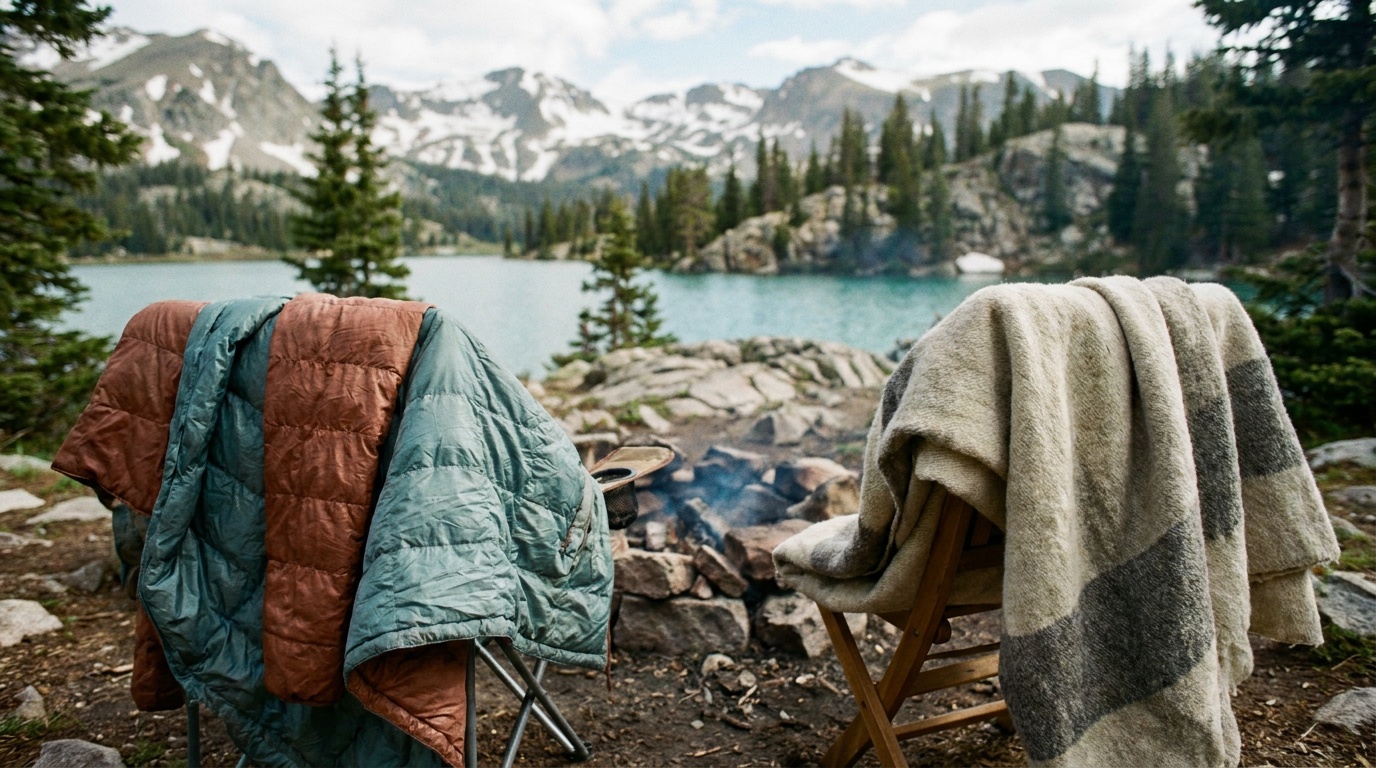
The best camp blanket is the one you actually grab every trip, not the one that stays in the closet because it's too nice to risk around a fire.
Frequently asked questions
What is the difference between a puffy blanket and a regular camp blanket?
A puffy blanket uses quilted synthetic insulation inside a nylon shell, the same construction logic as a puffy jacket. This gives it a high warmth-to-packed-size ratio and water resistance from the DWR shell. A regular camp blanket is typically fleece, cotton, or wool: simpler construction, no stuff sack compression, usually heavier packed. Puffy blankets are better for variable weather and limited pack space. Fleece and wool are better when softness, breathability, or fire resistance is the priority.
Can I use a camp blanket as a sleeping bag in an emergency?
A camp blanket can extend the warmth of a sleeping bag or serve as an emergency layer if a sleeping bag is unavailable, but it is not a sleeping bag substitute for planned overnight use below about 55 degrees Fahrenheit. Blankets leave gaps at the sides and bottom. A 40-degree campsite night with only a camp blanket is uncomfortable and potentially unsafe depending on body size, clothing layers, and wind. Use a blanket as a supplement to a sleeping bag, not a replacement.
Are camp blankets safe to use near a campfire?
Synthetic camp blankets with nylon shells can melt or ignite from a stray ember at close range. They are designed for campsite use but not for draping directly over a fire ring or sitting close enough for regular ember contact. Wool blankets, including the Pendleton Yakima, are naturally flame-retardant: wool chars and self-extinguishes rather than melting. If proximity to an open wood fire is a routine part of your camp setup, wool is the materially safer choice. Keep any blanket, synthetic or natural, away from active flames.
The right camp blanket earns a spot in every car-camping kit and stays there for years. Browse more gear in the camp hub, or read about how we research and rate every product we cover.
Keep going
Complete loadoutCar-camping starter kitThe first-trip essentials across shelter, sleep, cooking, lighting, seating, and water, with the extras left out.Related guides
Our recommendations draw on manufacturer documentation, retailer listings, owner feedback, and comparisons with alternatives.
As an Amazon Associate I earn from qualifying purchases. We may earn a commission from links here, at no extra cost to you. How we research →