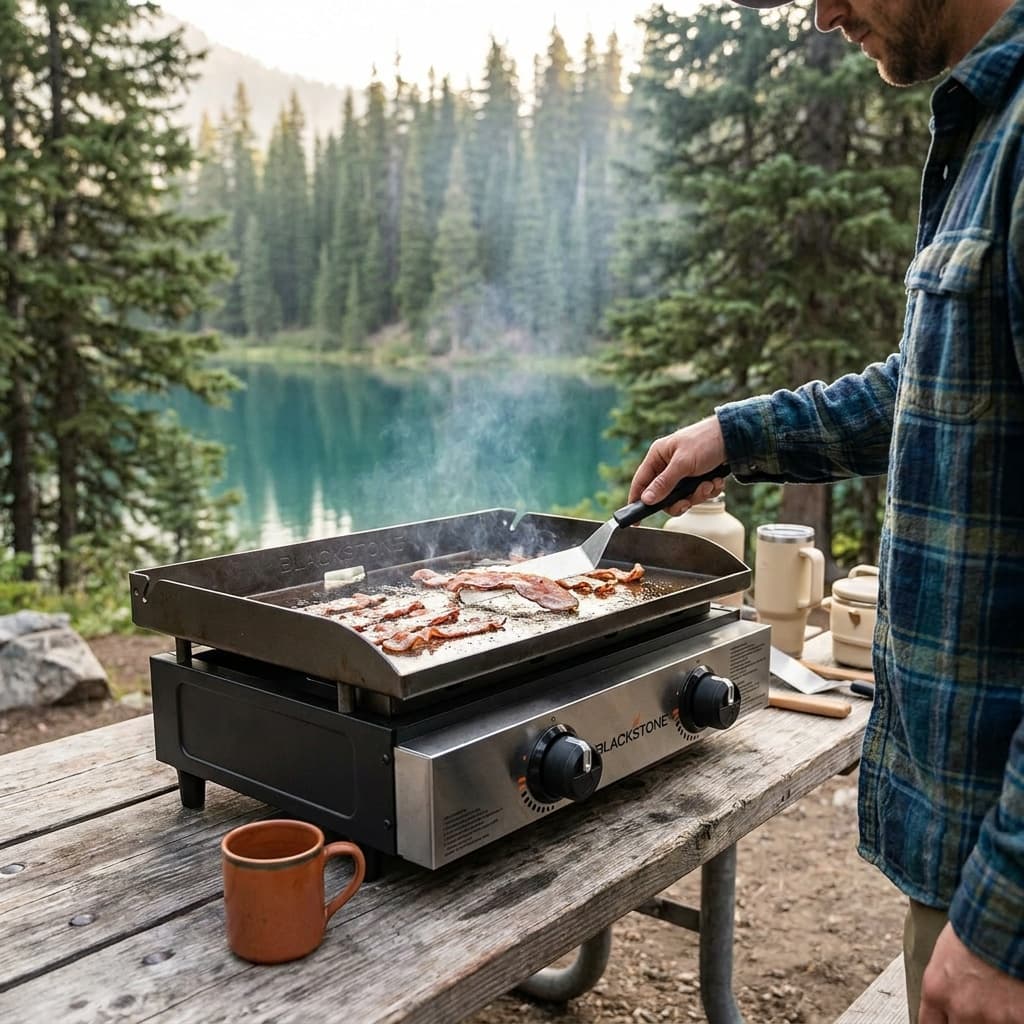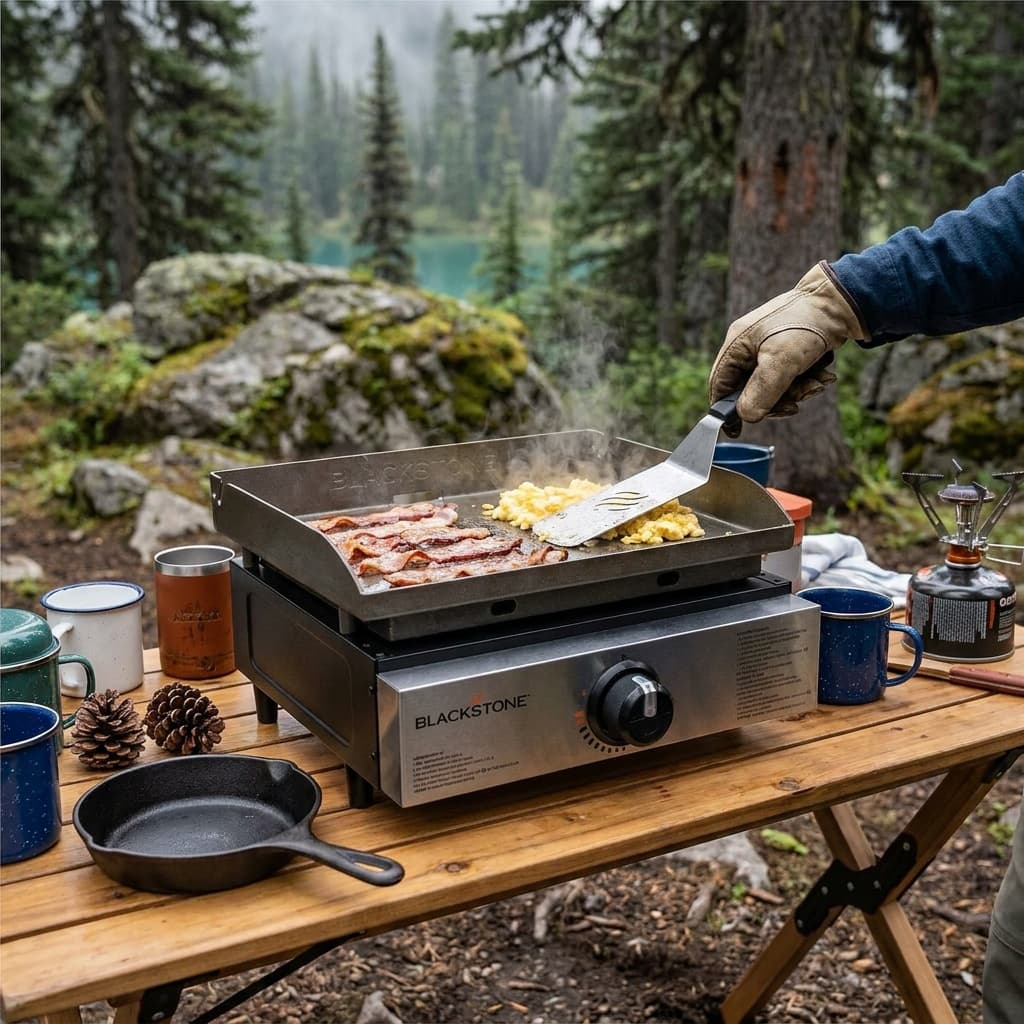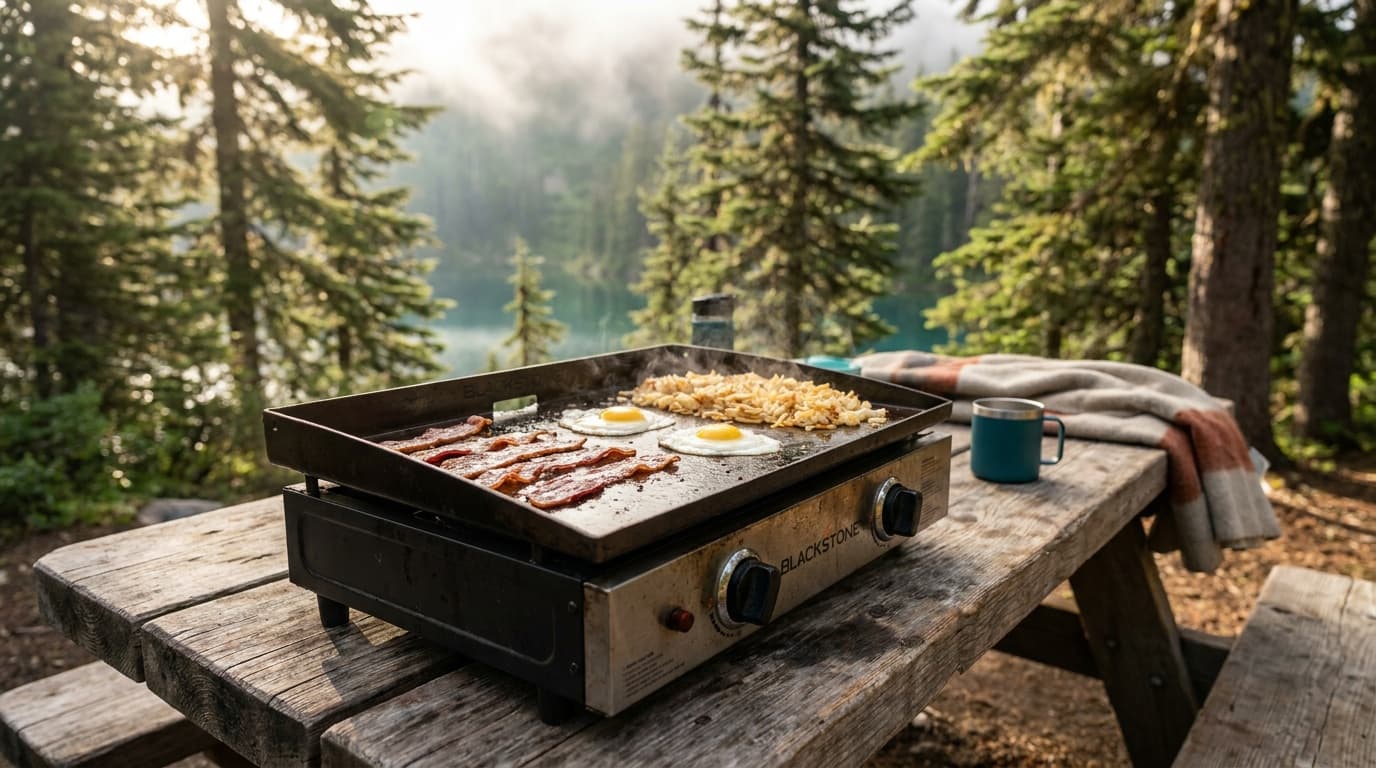
A proper flat-top at camp turns a weekend breakfast into the meal everyone remembers. Whether you are feeding two people or six, the right camping griddle comes down to cooking area, heat zone control, and how little you regret lugging it to the site.
Our quick picks
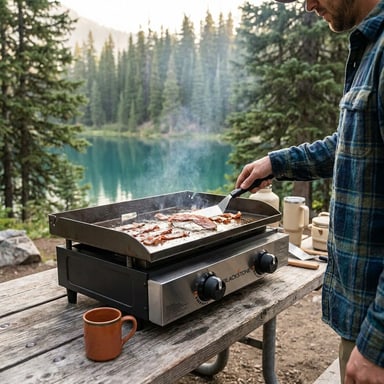
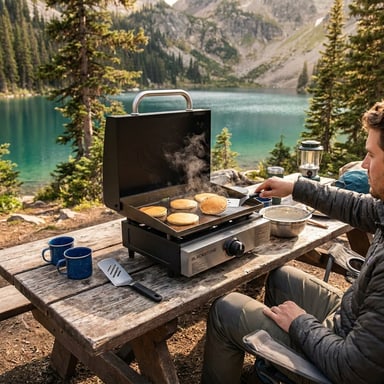
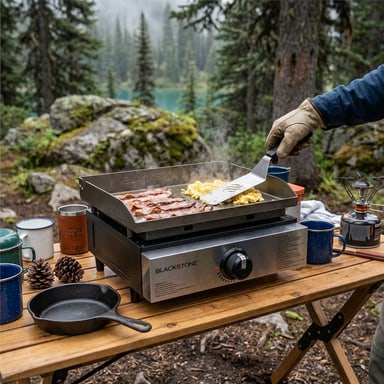
How we picked
Every pick is scored against the Kit Score: we aggregate manufacturer specs, verified-owner reviews, and expert sources, then weight for cooking surface area, BTU output, grease management design, portability, and long-term seasoning durability. No single metric wins alone.
Best overall: Blackstone 1666 22" Tabletop Griddle
BEST OVERALL
Blackstone 1666 22" Tabletop Griddle
Best for: Car camping groups of 3 to 6 who want a proven flat-top for full breakfasts and smash burgers with two cooking zones.
- 24,000 BTU across two independent heat zones gives real cooking flexibility for 3 to 6 people
- No lid included despite product images suggesting otherwise, a consistent owner complaint
Kit Score 8.3/10 · $178.99 Price checked Oct 24, 3:33 PM CDT · how we score gear
Buy on AmazonProduct details
The 22" dual-burner Blackstone 1666 gives you 361 sq in of seasoned cold-rolled steel and 24,000 BTU, enough to run pancakes and eggs on one side while bacon sizzles on the other. Dual independent controls let you set two heat zones, which is the defining feature for group car-camp breakfasts.
- BTU output
- 24,000 BTU (dual H-burners)
- Cooking surface
- 361 sq in cold-rolled steel
- Burners
- 2 independently controlled
- Weight
- 25.3 lbs
- Fuel
- Propane (1 lb canister or 20 lb tank with adapter)
- Grease management
- Rear grease management system with removable cup
More strengths
- Cold-rolled steel surface seasons into a natural non-stick finish that improves with use
- Rear grease management system channels runoff cleanly away from the cooking surface
Other tradeoffs
- At 25 lbs without a stand it requires a stable camp table and is not self-supporting out of the box
The 1666 is the most-copied format in camp cooking for a reason. Its 330 square inches of cold-rolled steel runs two independent 12,000 BTU burners, so you can hold eggs at low heat on one side while you blast smash burgers on the other. Cold-rolled steel heats faster and more evenly than cast iron at this size, and it seasons the same way: thin layers of high-smoke-point oil, let it polymerize, repeat.
The rear grease management channel is the detail that earns its keep on a campsite. Grease drains to a rear cup rather than forward onto the table or the ground, which means faster cleanup and fewer fire-safety headaches. Folding legs pop out to working height and lock back flat for transport.
At roughly 34 lbs assembled, this is a car camping griddle, not a backpacking one. Load it into a tote with a cover (sold separately or included in some bundles) and it travels without complaint.
Best for: car camping groups of 3 to 6 who want a proven flat-top for full breakfasts and smash burgers with two cooking zones.
Price: $165 – $185
Editor's choice: Blackstone 1900 On The Go 17" Tabletop Griddle with Hood
EDITOR'S CHOICE
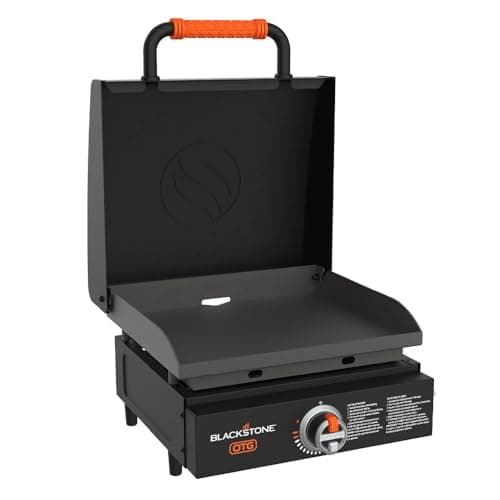
Blackstone 1900 On The Go 17" Tabletop Griddle with Hood
Best for: Couples and small families who want the full Blackstone flat-top experience at camp, including a hood, without stepping up to a 22" dual-burner setup.
- Integrated hood retains heat, helps in windy conditions, and keeps the surface protected during transport
- At 34.4 lbs with the hood it is roughly twice the weight of the no-hood 1971 model
Kit Score 8.1/10 · Check current price · how we score gear
Buy on AmazonProduct details
The 1900 takes the proven 17" rolled-steel surface and adds a painted hood that retains heat, keeps rain off the cooking surface between batches, and makes the griddle feel more complete for a camping kitchen. At 4.7 stars across thousands of ratings it consistently outperforms the no-hood 1971 in owner satisfaction.
- BTU output
- 12,500 BTU (single H-burner)
- Cooking surface
- 267 sq in rolled steel
- Burners
- 1
- Weight
- 34.4 lbs (with hood)
- Ignition
- Piezo push-and-turn
- Fuel
- Propane (1 lb canister or 20 lb tank with optional adapter)
More strengths
- 4.7-star owner rating reflects a noticeably more polished camp cooking experience than the no-hood variant
- Patented rear grease management system makes cleanup at a campsite genuinely fast
Other tradeoffs
- Single burner limits you to one heat zone; not the right tool for a group of 5 or more
The 1900 is the 17-inch format done right. The built-in hood is the upgrade that matters: it traps heat for thicker cuts of meat, holds food warm between batches, and keeps wind off the surface on exposed sites. Most griddles at this price point ship without any lid at all.
The cooking surface is the same cold-rolled steel as the 1666, seasoned and maintained identically. The single burner runs at around 12,000 BTU, which is enough for two people cooking at a pace that does not pile up cold food on one end of the griddle. Folding legs and an integrated latch keep the whole unit compact for transport.
If you are a couple who wants the full Blackstone flat-top experience at camp, including a hood, without stepping into a 22-inch dual-burner setup that is harder to justify carrying, this is the right call.
Best for: couples and small families who want the full Blackstone flat-top experience at camp, including a hood, without stepping up to a 22-inch dual-burner setup.
Price: $175 – $200
Best budget: Blackstone 1971 17" Original Tabletop Griddle
BEST BUDGET
Blackstone 1971 17" Original Tabletop Griddle
Best for: Couples or solo car campers who want a proper flat-top breakfast without carrying more than 18 lbs of cooking gear.
- At 17.5 lbs it is genuinely packable into a mid-size SUV without cargo planning
- Single burner means one heat zone across the whole surface, limiting multi-food cooking
Kit Score 7.7/10 · $176.61 Price checked Oct 24, 3:33 PM CDT · how we score gear
Buy on AmazonProduct details
Blackstone's entry-level 17" griddle is the lightest propane flat-top in the lineup at 17.5 lbs, with a cold-rolled steel cooking surface and a single 12,500 BTU H-burner. It fits on any camp table and runs off a standard 1 lb canister, making it the low-friction way to get into flat-top camp cooking.
- BTU output
- 12,500 BTU (single H-burner)
- Cooking surface
- 267 sq in cold-rolled steel
- Burners
- 1
- Weight
- 17.5 lbs
- Dimensions
- 17.3" D x 21.7" W x 8.6" H
- Fuel
- Propane (1 lb canister or 20 lb tank with optional adapter)
More strengths
- Cold-rolled steel surface responds well to seasoning and handles eggs cleanly once broken in
- The established Blackstone parts and accessory ecosystem means replacement bits are easy to find
Other tradeoffs
- 267 sq in is tight for more than 2 people cooking a full breakfast simultaneously
The 1971 is the no-frills version of the same 17-inch cold-rolled steel flat-top. No hood, no extras, just the surface and a single 12,000 BTU burner. At 18 lbs it is the lightest griddle in this lineup, and its lower price makes it the easiest entry into the Blackstone ecosystem.
The trade-off against the 1900 is the absence of a hood and a slightly more basic grease management channel. Both of those are real limitations if you cook thicker proteins at camp, but for pancakes, eggs, bacon, and toast they are irrelevant. Owners consistently note that the 1971 seasons well after two to three uses and holds its seasoning as long as it is stored dry.
At under $135, this is the right tool for a solo camper or a couple who wants a real flat-top without paying for features they will not use.
Best for: couples or solo car campers who want a proper flat-top breakfast without carrying more than 18 lbs of cooking gear.
Price: $110 – $135
Comparison
| Product | Kit Score | Price | Best for |
|---|---|---|---|
| Blackstone 1666 22" Tabletop Griddle | 8.3 | $178.99 Price checked Oct 24, 3:33 PM CDT | Best for: Car camping groups of 3 to 6 who want a proven flat-top for full breakfasts and smash burgers with two cooking zones. Why it stands out: 24,000 BTU across two independent heat zones gives real cooking flexibility for 3 to 6 people Tradeoff: No lid included despite product images suggesting otherwise, a consistent owner complaint |
| Blackstone 1900 On The Go 17" Tabletop Griddle with Hood | 8.1 | Check current price | Best for: Couples and small families who want the full Blackstone flat-top experience at camp, including a hood, without stepping up to a 22" dual-burner setup. Why it stands out: Integrated hood retains heat, helps in windy conditions, and keeps the surface protected during transport Tradeoff: At 34.4 lbs with the hood it is roughly twice the weight of the no-hood 1971 model |
| Blackstone 1971 17" Original Tabletop Griddle | 7.7 | $176.61 Price checked Oct 24, 3:33 PM CDT | Best for: Couples or solo car campers who want a proper flat-top breakfast without carrying more than 18 lbs of cooking gear. Why it stands out: At 17.5 lbs it is genuinely packable into a mid-size SUV without cargo planning Tradeoff: Single burner means one heat zone across the whole surface, limiting multi-food cooking |
Blackstone 1666 22" Tabletop Griddle
- Best for
- Car camping groups of 3 to 6 who want a proven flat-top for full breakfasts and smash burgers with two cooking zones.
- Why it stands out
- 24,000 BTU across two independent heat zones gives real cooking flexibility for 3 to 6 people
- Tradeoff
- No lid included despite product images suggesting otherwise, a consistent owner complaint
Blackstone 1900 On The Go 17" Tabletop Griddle with Hood
- Best for
- Couples and small families who want the full Blackstone flat-top experience at camp, including a hood, without stepping up to a 22" dual-burner setup.
- Why it stands out
- Integrated hood retains heat, helps in windy conditions, and keeps the surface protected during transport
- Tradeoff
- At 34.4 lbs with the hood it is roughly twice the weight of the no-hood 1971 model
Blackstone 1971 17" Original Tabletop Griddle
- Best for
- Couples or solo car campers who want a proper flat-top breakfast without carrying more than 18 lbs of cooking gear.
- Why it stands out
- At 17.5 lbs it is genuinely packable into a mid-size SUV without cargo planning
- Tradeoff
- Single burner means one heat zone across the whole surface, limiting multi-food cooking
How to choose a camping griddle
Cooking area and group size
The rule of thumb most camp cooks land on: allow roughly 50 to 60 square inches of cooking surface per person for a breakfast cook. That puts the 1666 (330 sq in) comfortably at six people, and the 17-inch models (around 260 to 268 sq in) at four. If you are cooking in shifts for a large group, a smaller surface works fine; if you want to serve everyone at once, size up.
BTU output and heat zones
Higher BTU output means faster preheat and better high-heat searing capacity. Dual-burner setups let you run two independent temperatures at once, which is genuinely useful when you want a hot sear zone for meat and a cooler zone for eggs or toast. Single-burner 17-inch griddles still produce good results; you just manage the cook differently, working the cooler perimeter as a warm-hold zone.
Cold-rolled steel vs. cast iron
Every griddle in this lineup uses cold-rolled steel, not cast iron. Cold-rolled steel heats faster, has better thermal consistency across a large surface, and is significantly lighter than a comparable cast iron plate. The trade-off is that cold-rolled steel requires the same seasoning discipline as cast iron: thin oil layers, high heat, polymerized coating. Skip the seasoning and you get rust; maintain it and you get a near-nonstick surface that improves with every use.
Grease management
Channel design varies. The Blackstone 1666 rear-channel system drains grease cleanly away from the cook surface into a removable cup. More basic designs drain forward or to the side. At a campsite where you cannot just hose down the table, a well-designed rear channel saves real time and reduces mess.
Portability and legs
All four griddles here use folding legs and are car camping tools. None of them are suitable for backpacking. Weight ranges from 18 lbs (Blackstone 1971) to around 34 lbs assembled (Blackstone 1666). A storage bag or fitted cover is worth buying at the same time as the griddle: the seasoned surface needs to be protected from dust and moisture between uses.
Hood or no hood
A hood adds flexibility for thicker proteins and doubles as a wind block, but it adds weight and cost. If your camp cooking is primarily breakfast foods, pancakes, and smash burgers, you will not miss it. If you cook chicken thighs, sausages, or anything that benefits from indirect heat retention, the 1900 with hood is a meaningful upgrade.
Cold-rolled steel seasons just like cast iron, heats more evenly across a wide surface, and weighs noticeably less: for a camping griddle, it is the smarter material choice.
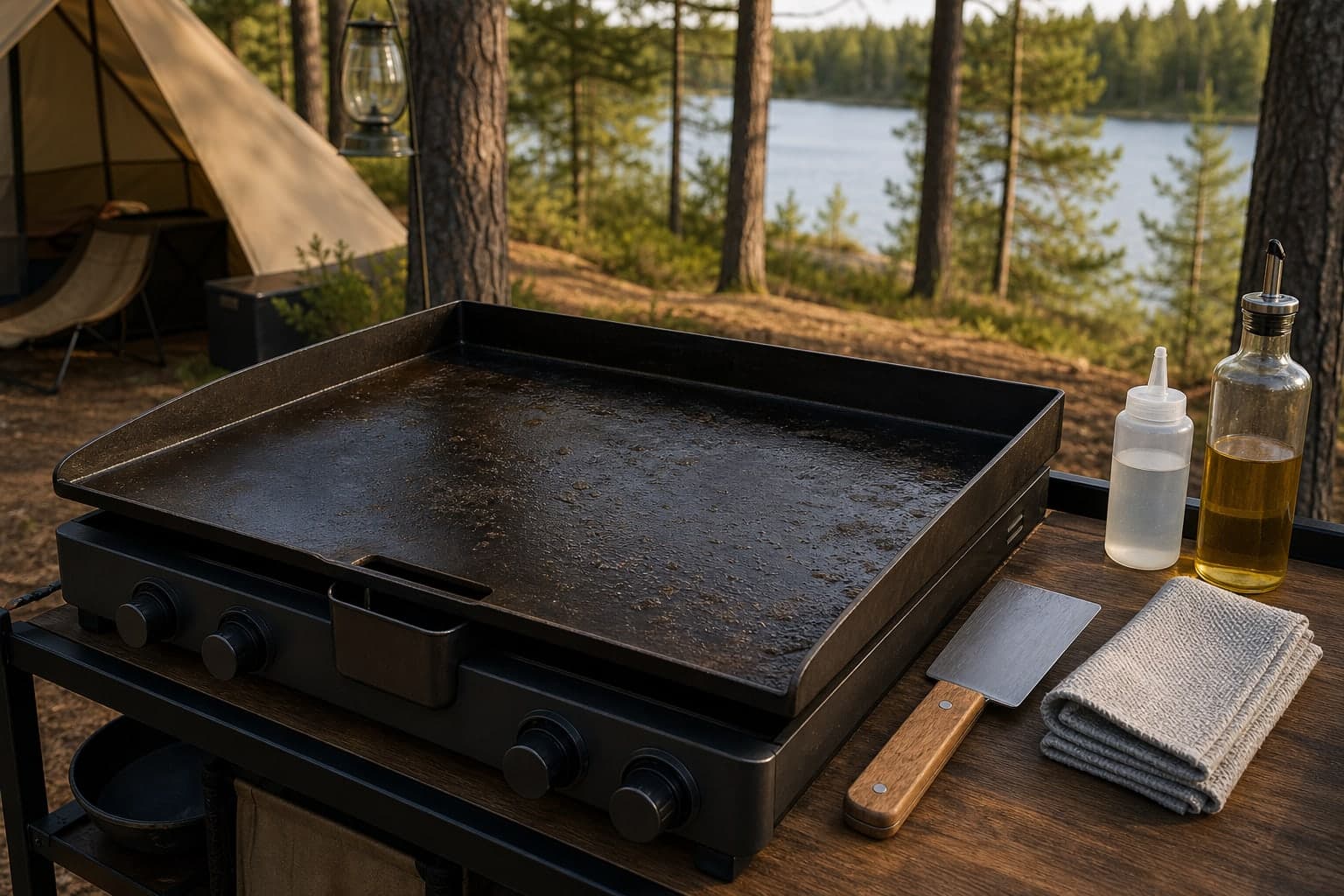
Seasoning a new camping griddle
Heat the surface
Turn all burners to medium-high and let the griddle heat for 10 to 15 minutes until it starts to darken and smoke slightly. This burns off factory coatings.
Apply the first oil layer
Spread a thin coat of flaxseed, avocado, or canola oil across the entire surface using a paper towel held with tongs. Thin is the key word: a visible slick is too much.
Let it smoke off
Leave the burners on medium-high until the oil stops smoking and the surface darkens further, about 10 to 15 minutes. This is the polymerization that builds the seasoning.
Repeat three to four times
Each layer adds depth. After three or four cycles the surface will be dark brown to black and noticeably less sticky. Do this before your first camp cook, not at the campsite.
After each cook, scrape and oil
While still hot, scrape residue with a bench scraper, wipe with a lightly oiled paper towel, and let it cool. Do not use soap. Store dry with the cover on.
Frequently asked questions
Can I use a camping griddle on a picnic table?
Yes, but check the table surface. Folding legs on all four griddles here lift the unit clear of the table, but picnic tables can still absorb radiant heat. Keep a folding camp table dedicated to cooking if you use your griddle frequently, or place the griddle on the concrete pad or a metal camp table rather than a wood picnic table. Wind is the bigger practical concern: position the griddle so the flame is shielded from the prevailing wind, or output and preheat times will suffer.
How do I clean a camping griddle without running water?
You do not need running water. While the griddle is still hot (but not scorching), scrape all food residue to the grease channel using a bench scraper or spatula. Pour a small amount of water onto the surface to steam-loosen any stuck bits, scrape again, and wipe with paper towels held with tongs. Finish with a very thin oil wipe. The whole process takes about three minutes and leaves a clean, protected surface. Never use soap on a seasoned flat-top: it strips the polymerized oil coating.
What is the difference between a camping griddle and a camp stove with a griddle plate?
A purpose-built camping griddle uses a single large cold-rolled steel surface spanning its own dedicated burner configuration, with engineered heat distribution and grease management built in. A griddle plate resting on a two-burner camp stove works in a pinch but produces uneven heat (the burner rings create hot spots), poor grease drainage, and usually a thinner cooking surface that loses heat faster. For anything beyond occasional use, a purpose-built griddle produces noticeably better results.
A flat-top griddle earns its place in the car camping kit faster than almost any other cooking tool. Pick the size that matches your group, commit to the seasoning routine, and breakfast at camp becomes the best meal of the trip.
Explore more gear guides in the camp hub or read about how we research and rate every product we recommend.
Keep going
Free toolStove Fuel CalculatorHow much fuel to pack for the trip, by meals and people.Related guides
 Complete camp loadoutCamp kitchen kitBuild the complete kit
Our recommendations draw on manufacturer documentation, retailer listings, owner feedback, and comparisons with alternatives.
As an Amazon Associate I earn from qualifying purchases. We may earn a commission from links here, at no extra cost to you. How we research →