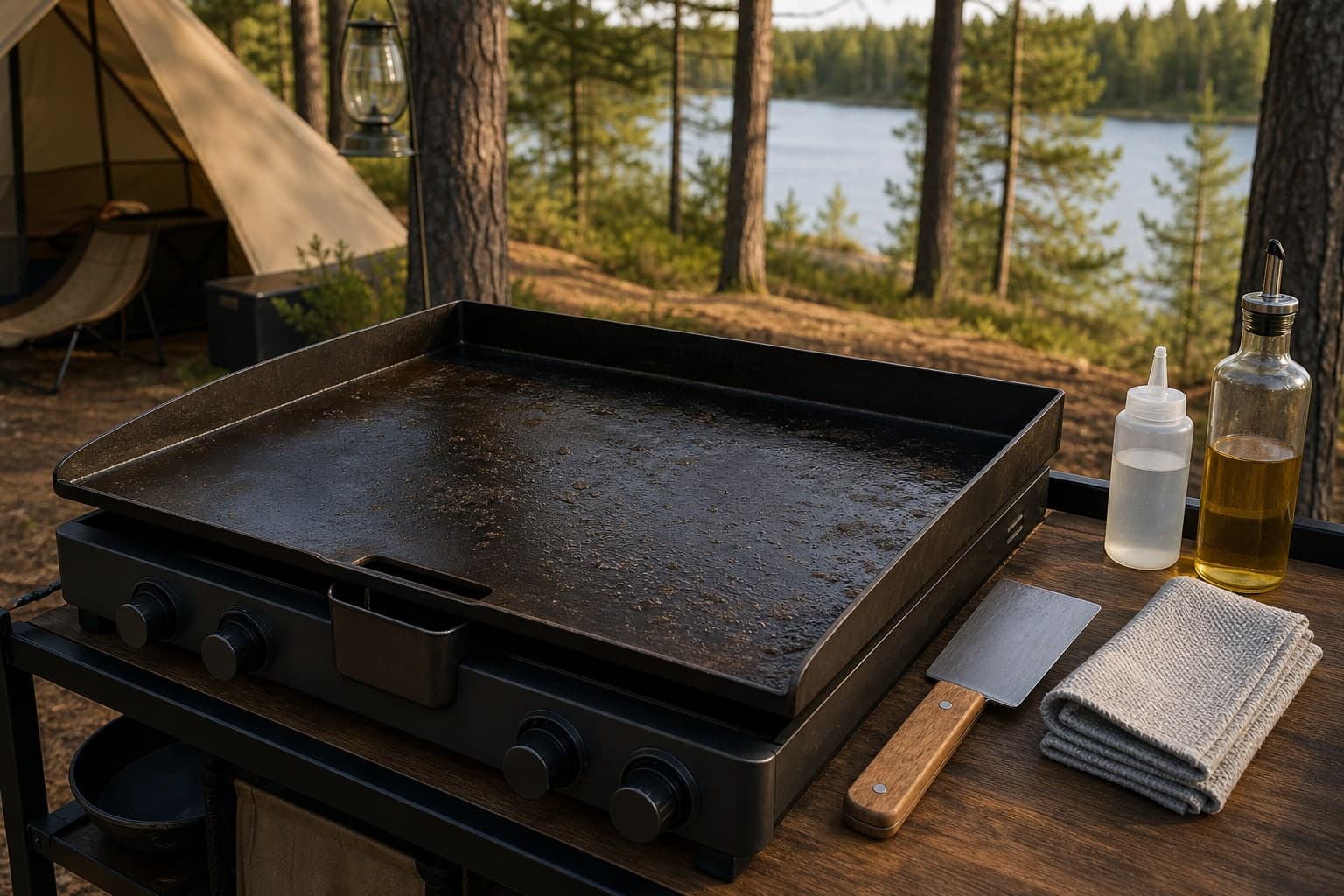
A dirty griddle left overnight turns tomorrow's breakfast into a scrubbing session and invites rust. Clean it while it is still warm and the whole process takes under five minutes.
The hot scrape: your first move every time
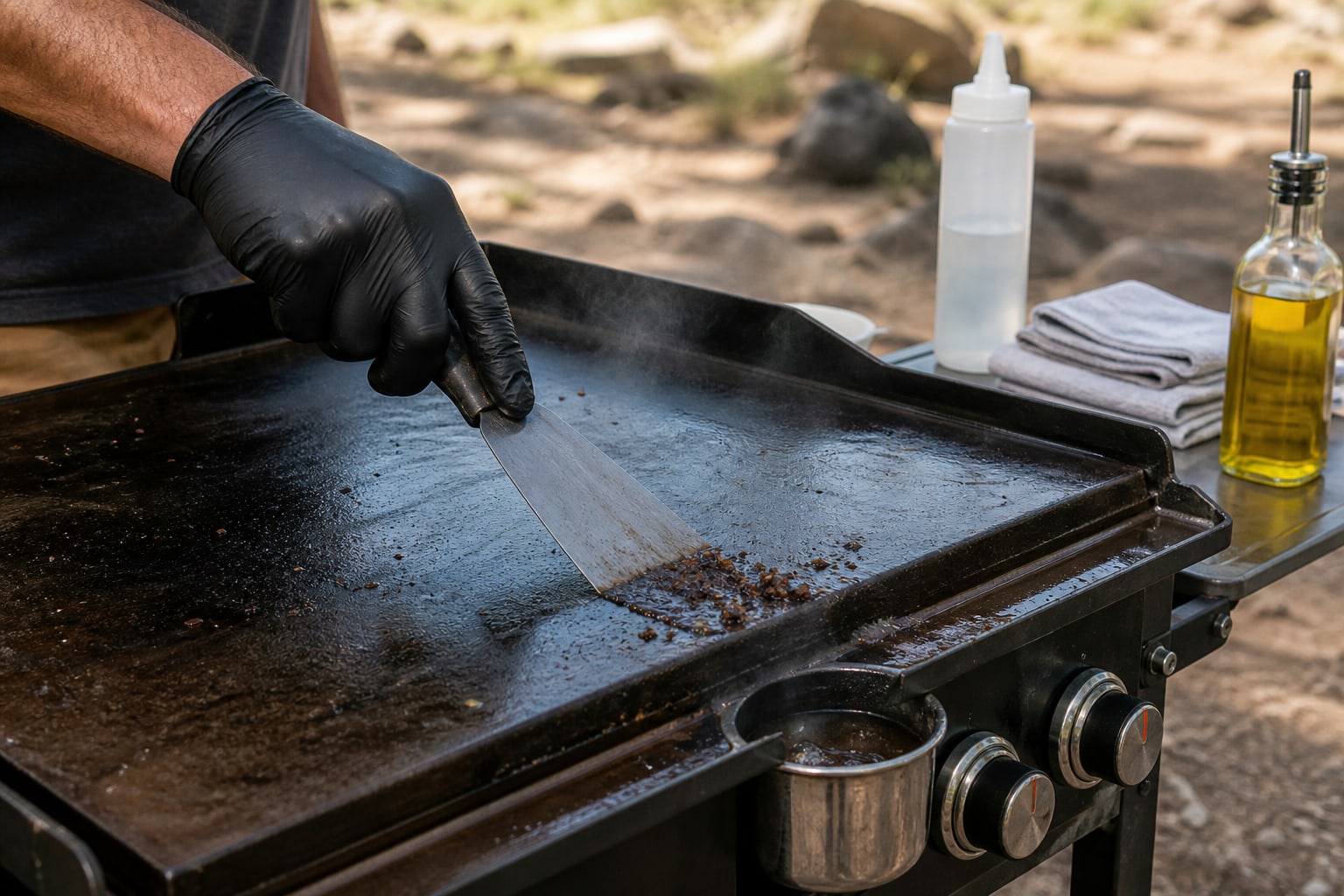
As soon as you pull the last piece of food off the griddle, go straight to the scraper. At 300–400°F the residue is still soft and lifts cleanly. Let the griddle cool below 100°F and that grease bonds harder to the surface.
Push debris to the grease trap or to the edge of the griddle and wipe it into a trash bag. For stubborn spots, pour a small amount of water, maybe two tablespoons, onto the surface while it is still hot. The steam loosens stuck bits and the water evaporates quickly. Scrape again immediately after the sizzle dies down.
Water and scraper method (no soap needed)
For a thorough daily clean after the hot scrape, this two-step approach handles virtually any residue:
Daily cleanup routine
Pour a small amount of water
Add 2–3 tablespoons of water to the warm (not scorching) griddle to loosen remaining residue.
Scrape in straight lines
Use a flat metal scraper to push water and loosened debris toward the edge; avoid circular motions that spread grease back.
Wipe with paper towel
Use a folded paper towel held with tongs to wipe the surface dry; discard the towel in your trash bag.
Inspect the surface
Check for any dull, gray, or rough patches that signal rust starting or seasoning loss.
Apply a thin oil coat
While the griddle is still warm (around 200°F), wipe on a thin layer of flaxseed, grapeseed, or vegetable oil with a paper towel.
Avoid dish soap unless you are doing a full re-season. Dish soap is formulated to break down fats, which is exactly what your seasoning layer is. One soapy wash can strip weeks of built-up polymerized oil.
Drying to prevent rust
Raw carbon steel griddles (the popular Blackstone 22 Inch Tabletop Griddle included) and cast iron rust fast. A surface left with any moisture, even just from air humidity after water cleaning, can show orange spots within 12–24 hours in humid conditions.
After wiping, place the griddle over low heat for two to three minutes to drive off any remaining moisture. You want the surface visibly dry with no steaming before you store it. Then apply your oil coat and let it cool before packing.
The re-oil step is not optional: it is what separates a griddle that lasts a decade from one that needs replacing after a season.
For storage, slip the griddle into a cloth bag or wrap it in a paper bag rather than sealing it in plastic. Trapped moisture is the enemy. Some campers stash a small desiccant packet inside the storage bag for multi-week trips.
Deep cleaning a rusty griddle and re-seasoning
If you pull out your griddle and find rust, do not panic. Surface rust on carbon steel or cast iron is fully recoverable.
For light rust (orange spots, not pitting), scrub with coarse salt and half a cut potato or a chain mail scrubber. The abrasive lifts the oxidation without gouging the metal. Rinse with water, then dry immediately and completely over heat.
For heavier rust covering most of the surface, use a steel wool pad or 60-grit sandpaper, scrubbing in circles until you reach bare metal. Rinse, dry over heat until bone dry, then re-season:
- Apply a very thin coat of high-smoke-point oil (flaxseed, grapeseed, or Crisco work well) across the entire surface including the edges and underside.
- Wipe off most of it so only a barely visible film remains; too thick a coat creates a sticky, uneven layer.
- Heat the griddle to 400–450°F and hold that temperature for 30–45 minutes. The oil polymerizes and bonds to the metal.
- Repeat three to five times for a solid base layer.
At-camp cleanup without running water
In a dispersed camping situation with no water source nearby, or when you are conserving every drop, the dry method works well:
While the griddle is still warm, scrape thoroughly. Use a dry paper towel to wipe down the surface, then apply your re-oil coat. That is it. The heat and the oil do the sanitation and protection work. You do not need water for every clean.
When you do use water at camp, follow Leave No Trace guidance: dispose of greasy wash water in a trash bag or grease container rather than dumping it on the ground or into a water source. Griddle grease and food scraps attract wildlife and contaminate soil and streams. Pack it out.
Frequently asked questions
Can I use dish soap on a carbon steel griddle?
Occasionally and sparingly, yes, but not as part of your regular routine. Dish soap strips the seasoning layer. Reserve it for a full strip-and-re-season when the surface has gone rancid or is heavily contaminated. For daily cleanup, water, a scraper, and a dry wipe are sufficient.
How do I know when my griddle is clean enough?
The surface should look uniformly dark, feel smooth when you run a paper towel across it, and leave no brown or black residue on the towel after wiping. A light sheen from the oil coat is correct. Any rough, gray, or orange patches need attention before your next cook.
My griddle smells rancid after storage. What happened?
The oil coat went bad, usually because too thick a layer was applied before storage or the griddle was stored in a warm, sealed container. Scrub off the rancid layer with coarse salt or a chain mail scrubber, wash once with soap and hot water, dry completely over heat, and re-season from scratch with very thin oil coats.
For specific picks, see our guide to the best camping griddles. Browse all camp guides or read how we research and rate gear.
Recommended gear
Our current top picks from the Best camping griddles in 2026: flat-top picks for camp cooking guide, if you are ready to buy.
BLACKSTONE
Blackstone 1666 22" Tabletop Griddle
Best Overall
Kit Score 8.3/10
$178.99 Price checked Oct 23, 4:16 PM CDT
Best for: Car camping groups of 3 to 6 who want a proven flat-top for full breakfasts and smash burgers with two cooking zones.
- 24,000 BTU across two independent heat zones gives real cooking flexibility for 3 to 6 people
- No lid included despite product images suggesting otherwise, a consistent owner complaint
- BTU output
- 24,000 BTU (dual H-burners)
- Cooking surface
- 361 sq in cold-rolled steel
- Burners
- 2 independently controlled
- Weight
- 25.3 lbs
- Fuel
- Propane (1 lb canister or 20 lb tank with adapter)
- Grease management
- Rear grease management system with removable cup
About this pick
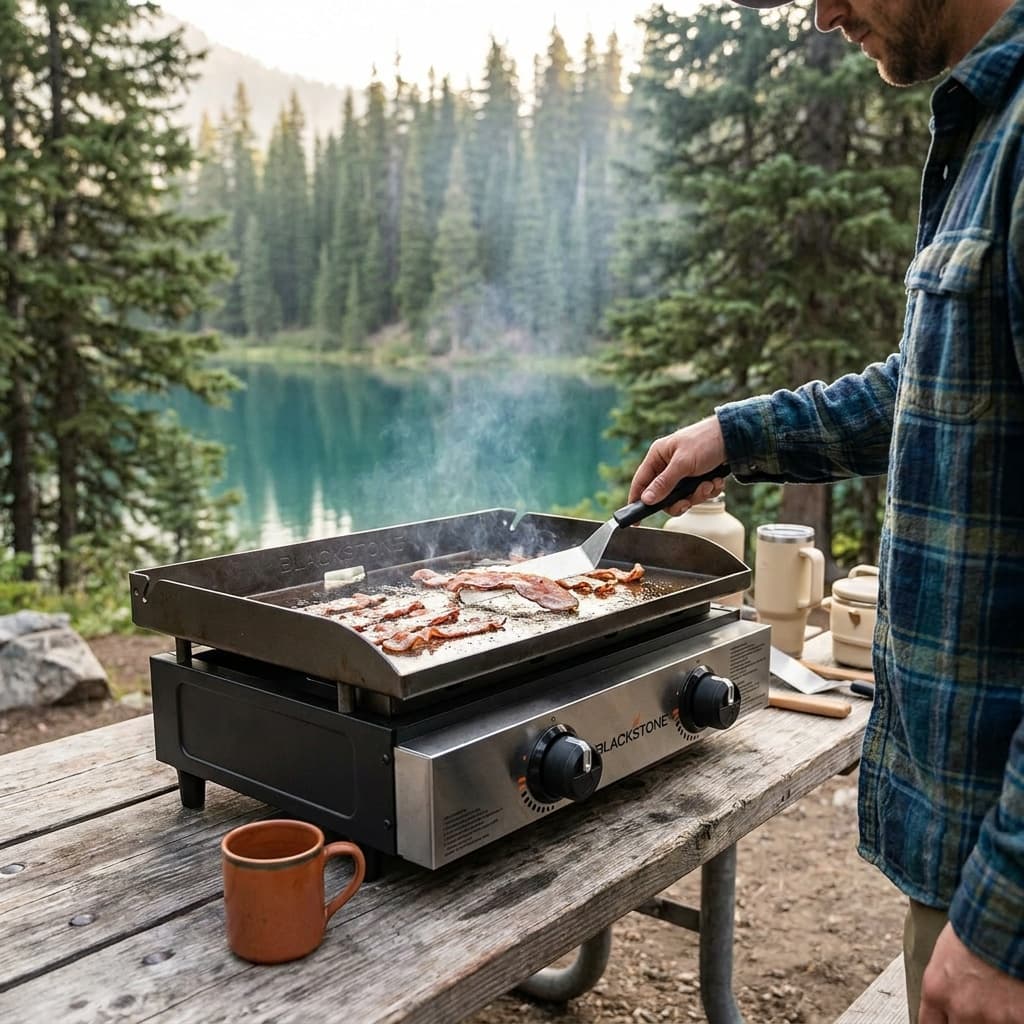
The 22" dual-burner Blackstone 1666 gives you 361 sq in of seasoned cold-rolled steel and 24,000 BTU, enough to run pancakes and eggs on one side while bacon sizzles on the other. Dual independent controls let you set two heat zones, which is the defining feature for group car-camp breakfasts.
Strengths
- 24,000 BTU across two independent heat zones gives real cooking flexibility for 3 to 6 people
- Cold-rolled steel surface seasons into a natural non-stick finish that improves with use
- Rear grease management system channels runoff cleanly away from the cooking surface
Weaknesses
- No lid included despite product images suggesting otherwise, a consistent owner complaint
- At 25 lbs without a stand it requires a stable camp table and is not self-supporting out of the box
Kit Score breakdown
BLACKSTONE
Blackstone 1971 17" Original Tabletop Griddle
Best Budget
Kit Score 7.7/10
$167.09 Price checked Oct 23, 4:16 PM CDT
Best for: Couples or solo car campers who want a proper flat-top breakfast without carrying more than 18 lbs of cooking gear.
- At 17.5 lbs it is genuinely packable into a mid-size SUV without cargo planning
- Single burner means one heat zone across the whole surface, limiting multi-food cooking
- BTU output
- 12,500 BTU (single H-burner)
- Cooking surface
- 267 sq in cold-rolled steel
- Burners
- 1
- Weight
- 17.5 lbs
- Dimensions
- 17.3" D x 21.7" W x 8.6" H
- Fuel
- Propane (1 lb canister or 20 lb tank with optional adapter)
About this pick
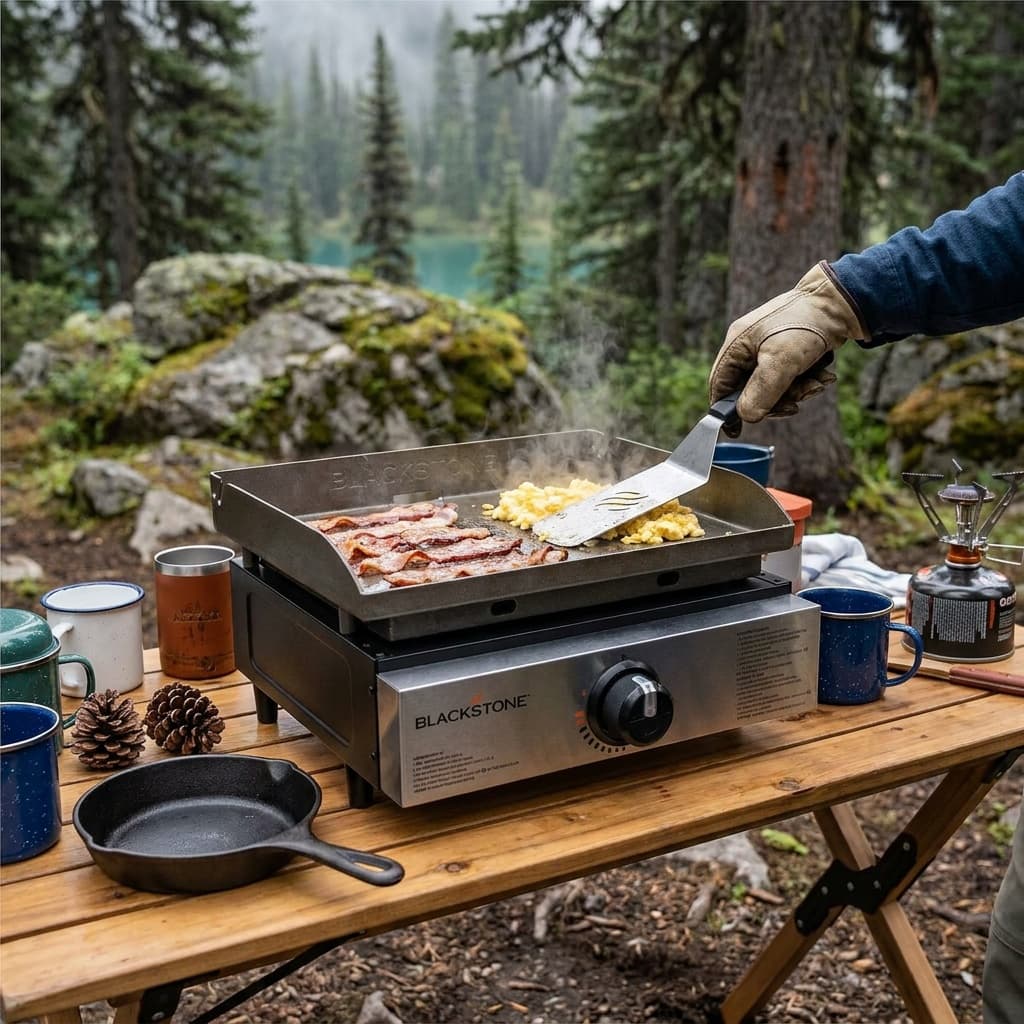
Blackstone's entry-level 17" griddle is the lightest propane flat-top in the lineup at 17.5 lbs, with a cold-rolled steel cooking surface and a single 12,500 BTU H-burner. It fits on any camp table and runs off a standard 1 lb canister, making it the low-friction way to get into flat-top camp cooking.
Strengths
- At 17.5 lbs it is genuinely packable into a mid-size SUV without cargo planning
- Cold-rolled steel surface responds well to seasoning and handles eggs cleanly once broken in
- The established Blackstone parts and accessory ecosystem means replacement bits are easy to find
Weaknesses
- Single burner means one heat zone across the whole surface, limiting multi-food cooking
- 267 sq in is tight for more than 2 people cooking a full breakfast simultaneously
Kit Score breakdown
Best for: Couples and small families who want the full Blackstone flat-top experience at camp, including a hood, without stepping up to a 22" dual-burner setup.
- Integrated hood retains heat, helps in windy conditions, and keeps the surface protected during transport
- At 34.4 lbs with the hood it is roughly twice the weight of the no-hood 1971 model
- BTU output
- 12,500 BTU (single H-burner)
- Cooking surface
- 267 sq in rolled steel
- Burners
- 1
- Weight
- 34.4 lbs (with hood)
- Ignition
- Piezo push-and-turn
- Fuel
- Propane (1 lb canister or 20 lb tank with optional adapter)
About this pick
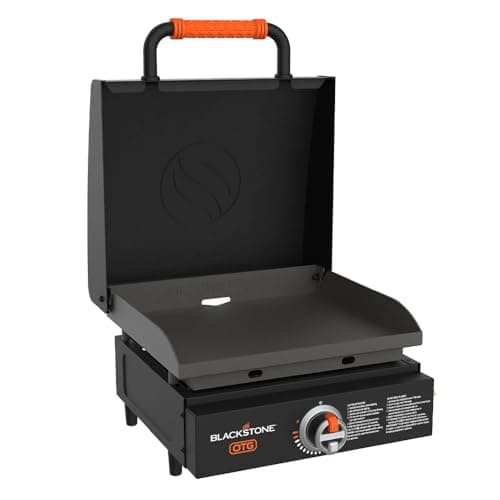
The 1900 takes the proven 17" rolled-steel surface and adds a painted hood that retains heat, keeps rain off the cooking surface between batches, and makes the griddle feel more complete for a camping kitchen. At 4.7 stars across thousands of ratings it consistently outperforms the no-hood 1971 in owner satisfaction.
Strengths
- Integrated hood retains heat, helps in windy conditions, and keeps the surface protected during transport
- 4.7-star owner rating reflects a noticeably more polished camp cooking experience than the no-hood variant
- Patented rear grease management system makes cleanup at a campsite genuinely fast
Weaknesses
- At 34.4 lbs with the hood it is roughly twice the weight of the no-hood 1971 model
- Single burner limits you to one heat zone; not the right tool for a group of 5 or more
Kit Score breakdown
See all picks in Best camping griddles in 2026: flat-top picks for camp cooking
Keep going
Free toolStove Fuel CalculatorHow much fuel to pack for the trip, by meals and people.Related guides
 Complete camp loadoutCamp kitchen kitBuild the complete kit
Researched, not hands-on tested
Updated Jun 4, 2026Our recommendations draw on manufacturer documentation, retailer listings, owner feedback, and comparisons with alternatives.
As an Amazon Associate I earn from qualifying purchases. We may earn a commission from links here, at no extra cost to you. How we research →