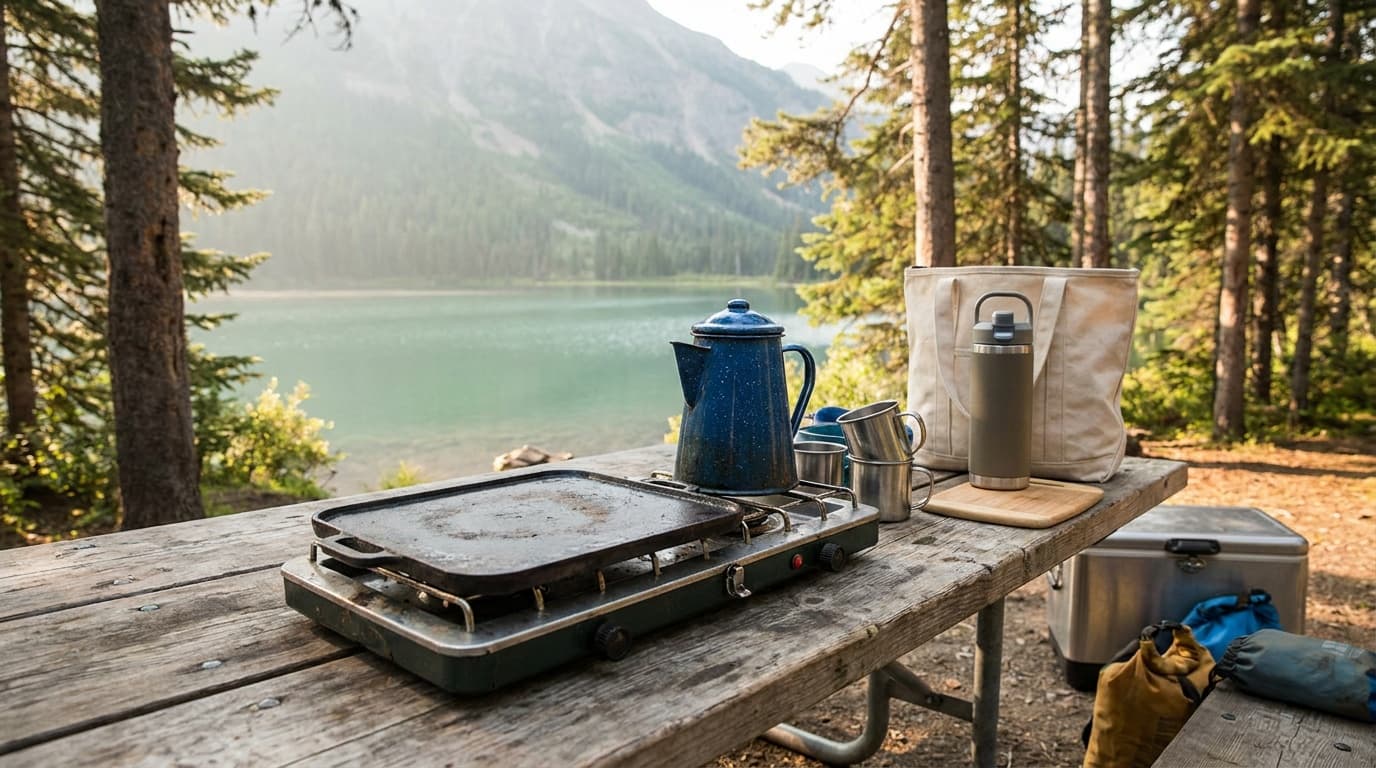
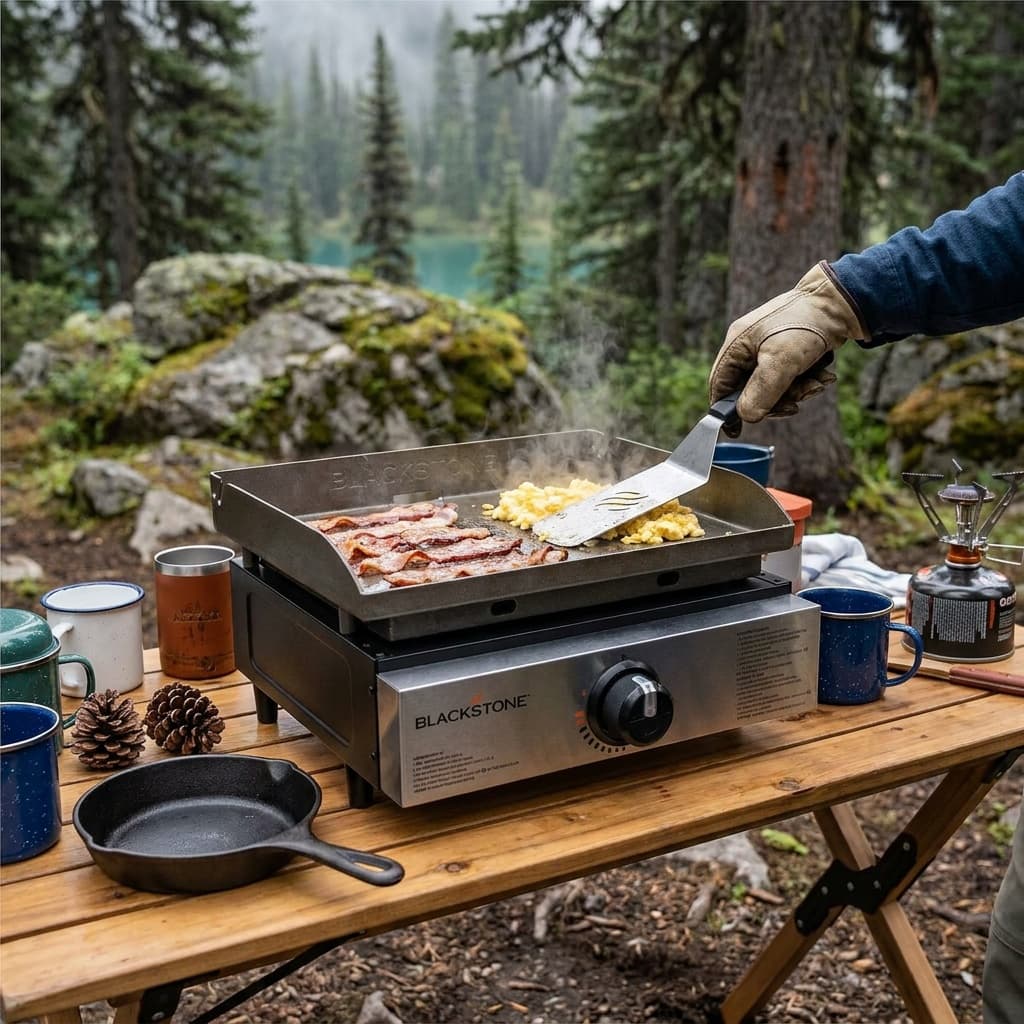
A well-seasoned griddle is the difference between eggs that release cleanly and eggs that weld themselves to bare metal at 6 a.m. in the backcountry. Seasoning builds a thin, polymerized oil layer that protects against rust and gives you a genuinely non-stick surface, and it costs almost nothing to do right.
Why seasoning works
Griddle seasoning is polymerization: oil heated past its smoke point breaks down and bonds to the metal as a hard, slick polymer. Each layer is roughly a molecule thick. Stack enough layers and you have a non-stick coating you built yourself, one that repairs easily and never chips the way factory coatings do.
The rust-protection side is equally important for camp use. A bare steel or cast iron griddle, including the cold-rolled steel surface on a Blackstone 17 Inch Tabletop Griddle, left in a humid camp bag will show surface rust within days. A properly seasoned surface seals the metal from moisture and oxygen.
Choosing the right oil
The single most important variable is smoke point. You need an oil that smokes and polymerizes at the temperatures your griddle reaches. Oils with low smoke points (butter, extra-virgin olive oil) will never fully polymerize at lower temps and can go rancid inside the seasoning layer.
The three best options for griddle seasoning:
Flaxseed oil has the lowest smoke point of the high-polymerization options (around 225 °F), but it polymerizes exceptionally hard and bonds well to iron. It works best for the early foundational layers on new cast iron or steel.
Canola oil is the practical field choice: inexpensive, widely available, smoke point around 400 °F, and it builds durable layers quickly. It is the most common recommendation from griddle manufacturers.
Avocado oil has one of the highest smoke points available (around 520 °F), which makes it ideal for very high-heat seasoning on steel griddles. It is more expensive but excellent for maintenance seasoning when you cook at high heat.
Avoid anything labeled "cold-pressed" or "extra virgin." Those retain flavor compounds that burn unclean and inhibit proper polymerization.
First-use seasoning: step by step
Do this before cooking on a new griddle. A clean, bare surface is the starting point: wash the griddle once with warm soapy water to remove the factory protective coating (this is the only time soap is acceptable), then dry it completely over low heat.
First-use seasoning process
Wash and dry
Wash with mild soap and warm water, rinse fully, then heat on low until all moisture evaporates and the surface is bone dry.
Apply oil
Put a small amount of your chosen oil on a folded paper towel. Coat the entire cooking surface, the sides, and the underside in a thin, even film.
Buff it down
Use a clean dry towel to wipe the surface almost completely dry. You are aiming for a film so thin it is nearly invisible.
Heat to temperature
Bring the griddle to 400–500 °F on a burner or in an oven. Hold there for 10–15 minutes, until smoke stops. The surface will darken.
Repeat
Let the griddle cool to warm (not fully cold, but handleable). Apply another thin layer and repeat. Do three to four full rounds minimum.
After the final round, let the griddle cool completely before storing. The surface should look dark bronze to black and feel smooth, not tacky.
Maintenance seasoning after every cook
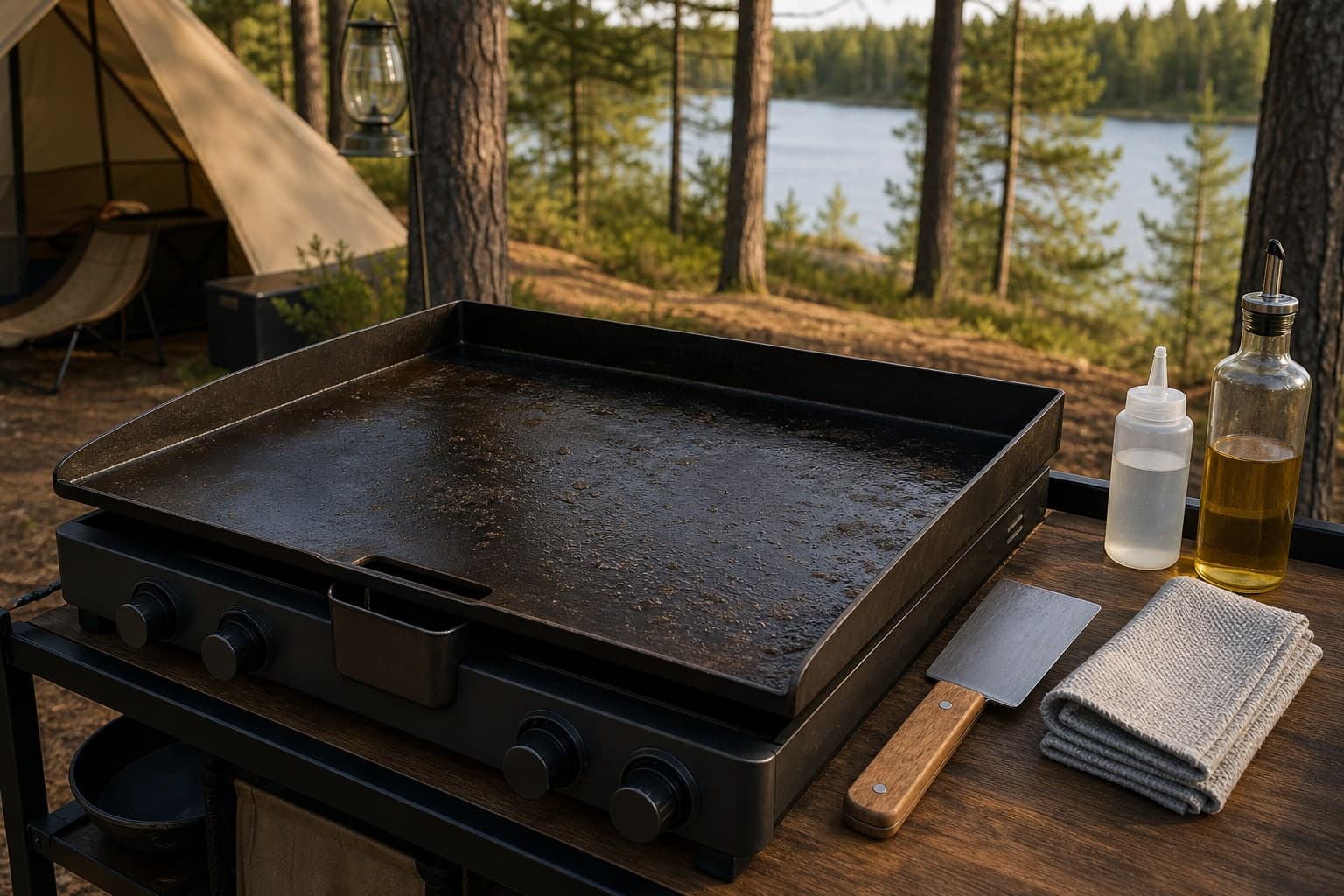
After each cook, while the griddle is still warm, scrape off food debris with a metal scraper, wipe the surface with a dry cloth, and apply a very thin coat of oil. That is the entire maintenance routine. The goal is to replace whatever seasoning the cooking session stripped and to prevent rust during storage.
Consistent thin-layer maintenance after every cook builds a better surface than any number of intensive re-seasoning sessions done infrequently.
For camp use specifically: pack the griddle in a breathable cloth bag or wrap it loosely in a camp towel. Sealed plastic bags trap moisture against the surface. If you are camping in wet conditions, a light oil coat before packing is worth the extra minute.
Fixing a sticky or uneven season
A sticky surface means you applied too much oil per round and it did not fully polymerize. An uneven, blotchy surface usually means inconsistent heat or oil distribution.
Neither requires starting over. For a sticky surface: heat the griddle well past the sticking temperature, scrape the surface clean, and apply one very thin layer correctly. Repeat once or twice. The existing seasoning re-bonds and the sticky layer burns off.
For significant rust, flaking, or a surface that is genuinely compromised: strip the griddle back to bare metal using a stiff wire brush or coarse salt scrub, wash, dry completely over heat, and re-season from scratch with three to four fresh rounds. This takes an hour but fully restores the surface.
Never soak a griddle in water or run it through a dishwasher. Water penetrates any gaps in the seasoning layer and accelerates rust from underneath.
Frequently asked questions
Can I use olive oil to season my camping griddle?
Regular olive oil (not extra-virgin) has a smoke point around 375–400 °F and can work for light maintenance seasoning, but it is not ideal for building foundational layers. Extra-virgin olive oil should be avoided entirely: its low smoke point and flavor compounds produce an uneven, sometimes bitter seasoning layer. Canola or avocado oil are more reliable choices for both initial seasoning and maintenance.
How do I know when my griddle is properly seasoned?
A properly seasoned griddle is dark (bronze to near-black depending on the metal), smooth to the touch, and non-tacky when cool. A quick test: lay a paper towel on the surface and press lightly. It should not pick up visible oil or feel sticky. On the grill, a well-seasoned surface will release eggs and proteins without sticking at normal cooking temperatures.
Does seasoning work the same way on steel griddles as on cast iron?
The chemistry is identical: oil polymerizes onto the metal surface regardless of the base material. Steel griddles typically heat faster and respond more quickly to temperature changes, which means each seasoning round may complete faster. Cast iron holds heat longer and evenly, which makes it more forgiving if you move the oil coat unevenly. The oil selection, layer thickness, and process are the same for both.
For specific picks across griddle styles and sizes, see our guide to the best camping griddles. Browse all camp guides or read how we research and rate gear.
Recommended gear
Our current top picks from the Best camping griddles in 2026: flat-top picks for camp cooking guide, if you are ready to buy.
BLACKSTONE
Blackstone 1666 22" Tabletop Griddle
Best Overall
Kit Score 8.3/10
$178.99 Price checked Oct 23, 4:16 PM CDT
Best for: Car camping groups of 3 to 6 who want a proven flat-top for full breakfasts and smash burgers with two cooking zones.
- 24,000 BTU across two independent heat zones gives real cooking flexibility for 3 to 6 people
- No lid included despite product images suggesting otherwise, a consistent owner complaint
- BTU output
- 24,000 BTU (dual H-burners)
- Cooking surface
- 361 sq in cold-rolled steel
- Burners
- 2 independently controlled
- Weight
- 25.3 lbs
- Fuel
- Propane (1 lb canister or 20 lb tank with adapter)
- Grease management
- Rear grease management system with removable cup
About this pick
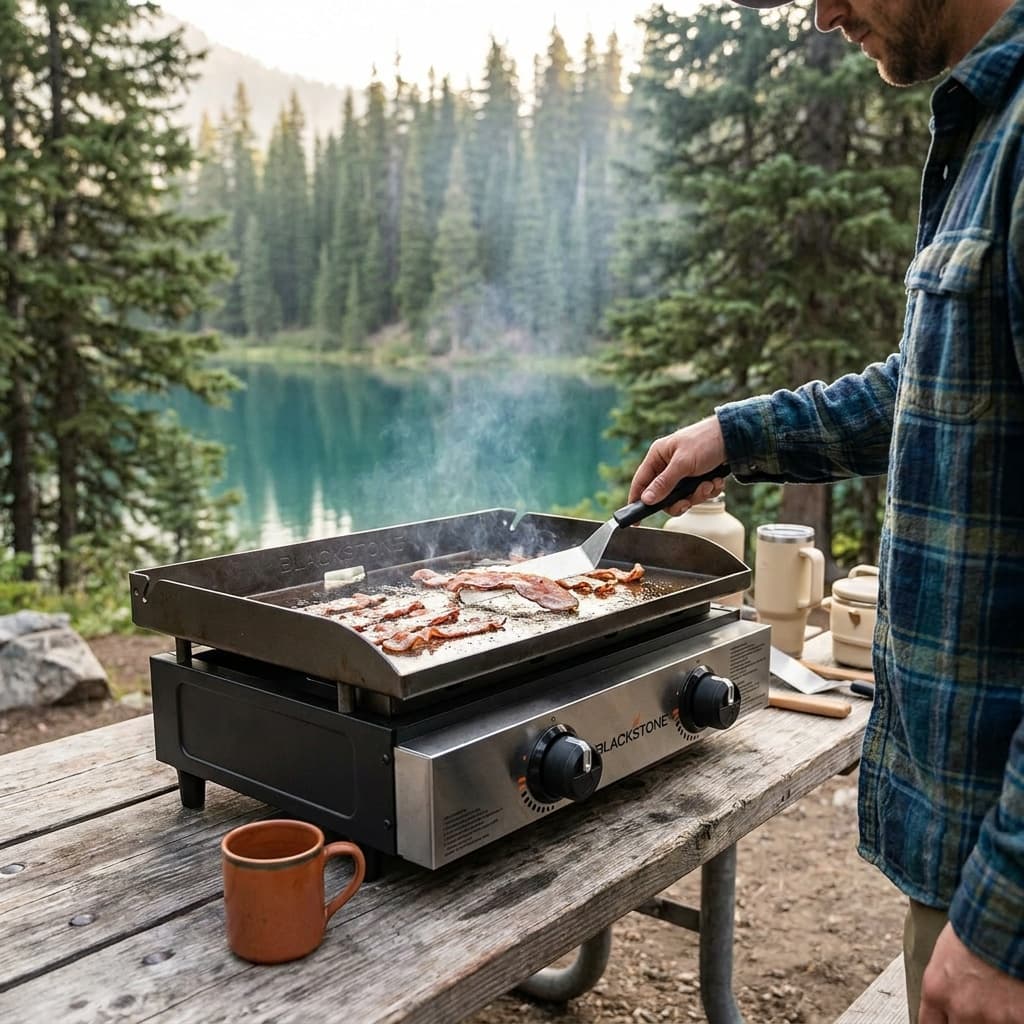
The 22" dual-burner Blackstone 1666 gives you 361 sq in of seasoned cold-rolled steel and 24,000 BTU, enough to run pancakes and eggs on one side while bacon sizzles on the other. Dual independent controls let you set two heat zones, which is the defining feature for group car-camp breakfasts.
Strengths
- 24,000 BTU across two independent heat zones gives real cooking flexibility for 3 to 6 people
- Cold-rolled steel surface seasons into a natural non-stick finish that improves with use
- Rear grease management system channels runoff cleanly away from the cooking surface
Weaknesses
- No lid included despite product images suggesting otherwise, a consistent owner complaint
- At 25 lbs without a stand it requires a stable camp table and is not self-supporting out of the box
Kit Score breakdown
BLACKSTONE
Blackstone 1971 17" Original Tabletop Griddle
Best Budget
Kit Score 7.7/10
$167.09 Price checked Oct 23, 4:16 PM CDT
Best for: Couples or solo car campers who want a proper flat-top breakfast without carrying more than 18 lbs of cooking gear.
- At 17.5 lbs it is genuinely packable into a mid-size SUV without cargo planning
- Single burner means one heat zone across the whole surface, limiting multi-food cooking
- BTU output
- 12,500 BTU (single H-burner)
- Cooking surface
- 267 sq in cold-rolled steel
- Burners
- 1
- Weight
- 17.5 lbs
- Dimensions
- 17.3" D x 21.7" W x 8.6" H
- Fuel
- Propane (1 lb canister or 20 lb tank with optional adapter)
About this pick
Blackstone's entry-level 17" griddle is the lightest propane flat-top in the lineup at 17.5 lbs, with a cold-rolled steel cooking surface and a single 12,500 BTU H-burner. It fits on any camp table and runs off a standard 1 lb canister, making it the low-friction way to get into flat-top camp cooking.
Strengths
- At 17.5 lbs it is genuinely packable into a mid-size SUV without cargo planning
- Cold-rolled steel surface responds well to seasoning and handles eggs cleanly once broken in
- The established Blackstone parts and accessory ecosystem means replacement bits are easy to find
Weaknesses
- Single burner means one heat zone across the whole surface, limiting multi-food cooking
- 267 sq in is tight for more than 2 people cooking a full breakfast simultaneously
Kit Score breakdown
Best for: Couples and small families who want the full Blackstone flat-top experience at camp, including a hood, without stepping up to a 22" dual-burner setup.
- Integrated hood retains heat, helps in windy conditions, and keeps the surface protected during transport
- At 34.4 lbs with the hood it is roughly twice the weight of the no-hood 1971 model
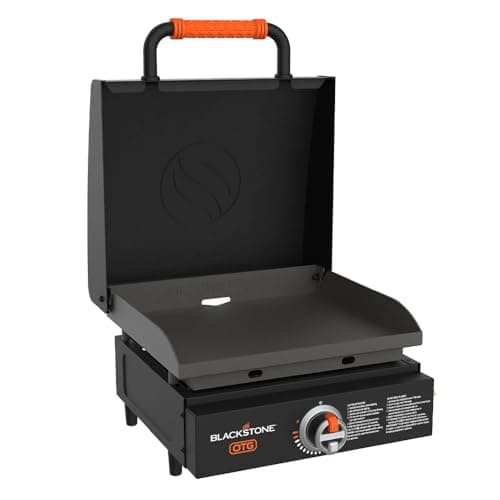
- BTU output
- 12,500 BTU (single H-burner)
- Cooking surface
- 267 sq in rolled steel
- Burners
- 1
- Weight
- 34.4 lbs (with hood)
- Ignition
- Piezo push-and-turn
- Fuel
- Propane (1 lb canister or 20 lb tank with optional adapter)
About this pick
The 1900 takes the proven 17" rolled-steel surface and adds a painted hood that retains heat, keeps rain off the cooking surface between batches, and makes the griddle feel more complete for a camping kitchen. At 4.7 stars across thousands of ratings it consistently outperforms the no-hood 1971 in owner satisfaction.
Strengths
- Integrated hood retains heat, helps in windy conditions, and keeps the surface protected during transport
- 4.7-star owner rating reflects a noticeably more polished camp cooking experience than the no-hood variant
- Patented rear grease management system makes cleanup at a campsite genuinely fast
Weaknesses
- At 34.4 lbs with the hood it is roughly twice the weight of the no-hood 1971 model
- Single burner limits you to one heat zone; not the right tool for a group of 5 or more
Kit Score breakdown
See all picks in Best camping griddles in 2026: flat-top picks for camp cooking
Keep going
Free toolStove Fuel CalculatorHow much fuel to pack for the trip, by meals and people.Related guides
 Complete camp loadoutCamp kitchen kitBuild the complete kit
Researched, not hands-on tested
Updated Jun 4, 2026Our recommendations draw on manufacturer documentation, retailer listings, owner feedback, and comparisons with alternatives.
As an Amazon Associate I earn from qualifying purchases. We may earn a commission from links here, at no extra cost to you. How we research →