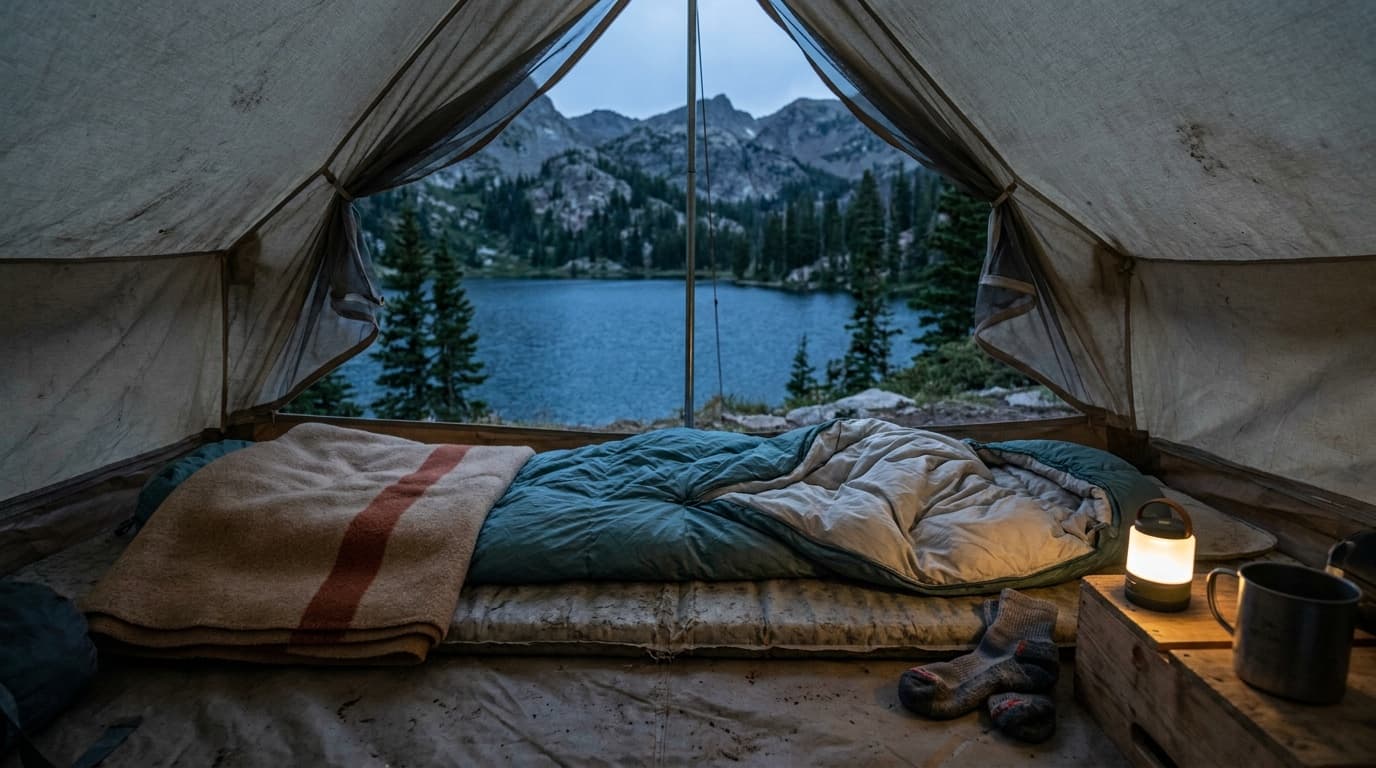
Summer camping heat is manageable once you understand that the real strategy is prevention, not reaction: choose your site well, drink before you feel thirsty, and set up your sleep system for the actual temperatures you'll face.
Hydration: the numbers that actually matter
The standard advice is eight glasses a day, but in hot weather with physical activity, your needs climb fast. A person hiking in 90°F heat can lose 1–1.5 liters of sweat per hour. The practical target on an active summer day is 500 ml (about 17 oz) of water per hour of activity, plus baseline intake of 2–3 liters at rest.
Water alone is not enough past the two-hour mark of sustained effort. Sweat carries sodium, potassium, and magnesium, and replacing fluid without electrolytes dilutes blood sodium, which causes hyponatremia: headache, nausea, and in serious cases, confusion. Carry electrolyte tablets or powder and use them after any sweaty stretch longer than 90 minutes. Simple food works too: salty crackers, nut butter packets, or a handful of trail mix with pretzels all help.
Start drinking water before you feel hot. Cold water from an insulated bottle like the Hydro Flask 32 oz Wide Mouth cools core temperature slightly and is more palatable in heat, which means you'll actually drink it.
Campsite selection and shade strategy
The best cooling tool at a summer campsite is free: a tree canopy on the southwest side of your tent. Direct sun on a dark tent between 10 am and 4 pm can push interior temperatures 20–40°F above ambient. A shaded tent stays within a few degrees of the air around it.
When shade is limited, orient your tent door toward the prevailing breeze. A two-door tent with both vestibule doors open becomes a flow-through channel that moves air continuously. Avoid low spots and valley floors on calm nights: cold air drains downhill while heat settles in depressions, and still air makes any temperature feel worse.
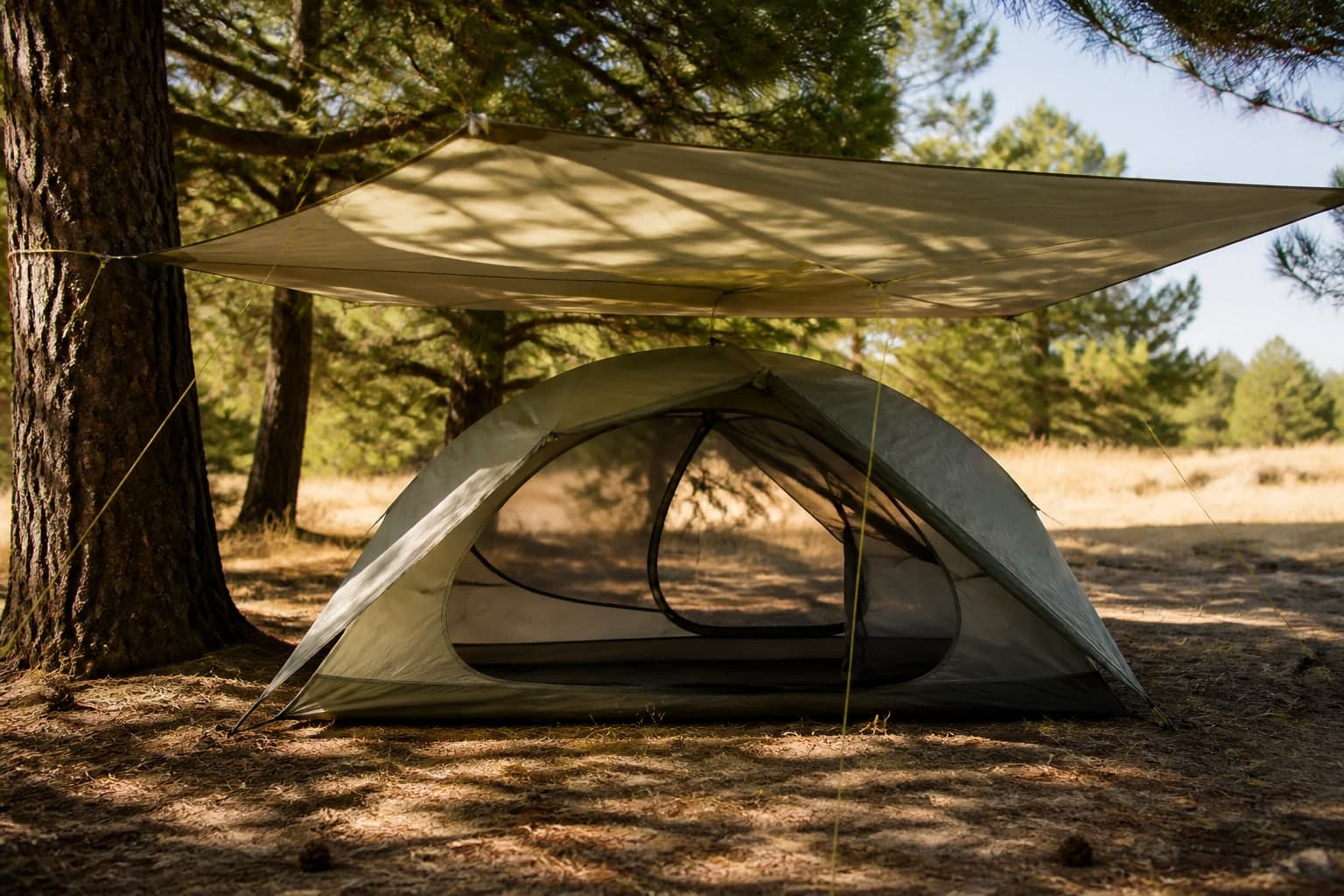
If you're on an exposed site with no natural shade, a reflective tarp pitched above your tent (not touching it) blocks radiant heat before it reaches the fabric. A silver-side-up tarp over the tent can reduce interior temperature by 10–15°F compared to an unshaded tent.
Sleep system for hot weather
A sleeping bag's temperature rating is the point at which a standard sleeper survives, not the point at which they sleep comfortably. A bag rated to 20°F on a 65°F night is miserable: you'll wake up damp, overheated, and unrested.
For summer camping above 5,000 feet elevation or in the desert Southwest, a quilt or sleeping bag rated 40–50°F is the right tool. Quilts allow you to vent legs and regulate temperature dynamically in ways a mummy bag cannot. If you already own a cold-weather bag, fully unzip it and use it as a blanket, or add a single-layer cotton or silk liner rated to 50°F.
Your sleep surface matters as much as your bag. Closed-cell foam pads trap heat beneath you; a cot or hammock that lets air circulate underneath your body keeps you dramatically cooler than ground sleeping.
Managing a hot tent at night
Even after sunset, a tent that absorbed heat all day can stay significantly warmer than the outside air for one to two hours. The fix is airflow, not just waiting.
Evening tent cool-down sequence
Open everything at sunset
Unzip all doors and vents the moment direct sun leaves the tent to start flushing trapped heat.
Wipe down interior surfaces
A damp cooling towel run over the tent floor and inner walls removes the surface heat absorbed during the day.
Position a fan at the door
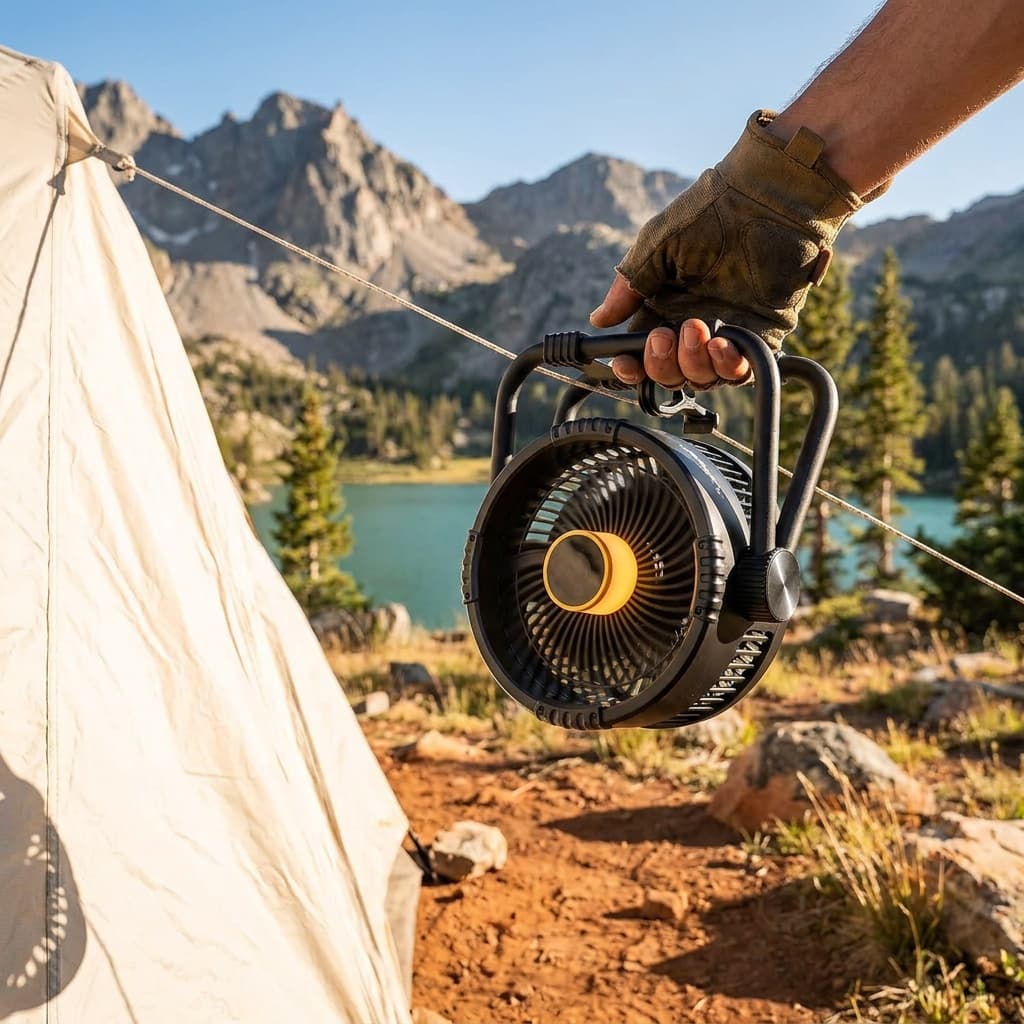
A small battery or USB fan aimed inward at floor level pushes cooler ground-level air through and out the roof vent.
Sleep lightly clothed
Moisture-wicking synthetic or merino base layers move sweat away from skin more effectively than cotton, which stays wet.
Keep a cooling towel within reach
A damp towel on the back of the neck or wrists provides fast relief if you wake overheated in the night.
A battery-powered camping fan like the Geek Aire 12 Inch Rechargeable Floor Fan is one of the highest-value items in a summer kit. Small fans designed for camping run 8–20 hours on a set of D-cells or a USB battery pack and cost under $30–$50 for reliable models.
Timing activity to avoid peak heat
Body temperature regulation under sustained effort in heat above 90°F becomes genuinely taxing. The physiological reality is that your cardiovascular system works harder to shunt blood to the skin for cooling, leaving less capacity for muscles. Heat index (which combines temperature and humidity) is a more accurate guide than air temperature alone: 88°F at 80% humidity feels like 99°F and carries the same risk.
The single highest-leverage change most summer campers can make costs nothing: move strenuous activity to before 9 am and after 5 pm.
Midday hours are best spent in shade, swimming if water is available, or doing low-effort camp tasks. If you must hike in midday heat, slow your pace by 20–30%, take shade breaks every 30–45 minutes, and monitor yourself and any children or older adults for heat exhaustion signs: heavy sweating, pale skin, fast and weak pulse, nausea, or dizziness. Heat exhaustion requires moving to shade, sipping cool water with electrolytes, and resting. Heat stroke (hot dry skin, confusion, high body temperature) is an emergency requiring immediate cooling and evacuation.
Frequently asked questions
How do I know if I'm drinking enough water while camping in summer?
The simplest field check is urine color: pale yellow means well-hydrated; dark yellow or amber means you need to drink more. Clear urine can indicate overhydration, which matters if you've been drinking large amounts without electrolytes. Aim for pale lemonade color. Weigh yourself before and after a long hike if you have a scale: every pound lost is roughly 16 oz of fluid to replace.
What's the coolest tent material or style for summer?
Mesh-heavy single-wall tents and ultralight double-wall tents with large mesh inners maximize airflow. Polyester reflects slightly more radiant heat than nylon. Color matters less than most people expect once the tent is shaded, but lighter colors do absorb less solar radiation on exposed sites. A freestanding tent with a full-coverage rainfly pitched high off the ground (using extension loops) creates a ventilated air gap that helps significantly.
Do cooling towels actually work?
Yes, within limits. Cooling towels work through evaporative cooling: water evaporating from the towel surface pulls heat away from skin. They work best in low-humidity environments where evaporation is fast and work less well in humid conditions above 70% relative humidity. Applied to pulse points (wrists, neck, inner elbows), they provide real short-term relief. Re-wet and wring them every 20–30 minutes to maintain effectiveness.
For specific picks, see our guide to the best camping fans. Browse all camp guides or read how we research and rate gear.
Recommended gear
Our current top picks from the Best camping fans: battery and rechargeable picks for hot tents guide, if you are ready to buy.
Best for: Car campers, RV and van travellers who want the most airflow available from a rechargeable fan and have the space to carry it.
- 1,900 CFM is the highest airflow in this group, and metal blades move more air than plastic at the same diameter
- 22 by 22 inches is bulky: a car-camping and van fan, not one for a backpacking tent
- Airflow
- 1,900 CFM (manufacturer)
- Runtime
- Up to 24 hrs on the lowest speed (manufacturer)
- Charging
- Full charge in about 3 hrs
- Blade
- 16 in., metal, brushless motor
- Dimensions
- 22" W x 22" H x 8" D
- Placement
- Floor stand, 360-degree tilt, IPX4 water resistant
About this pick
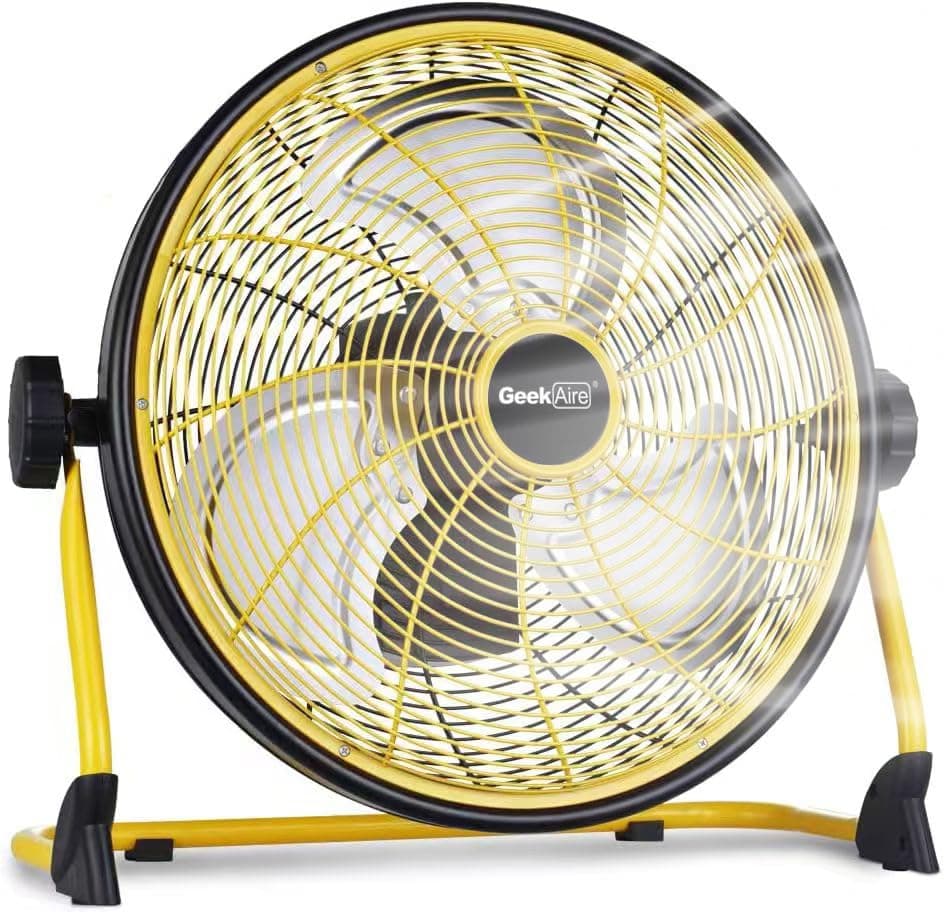
Geek Aire's 16-inch battery floor fan is the airflow pick for car campers and van builds: 1,900 CFM from metal blades on a brushless motor, a rated 24 hours on the lowest speed, and a full recharge in about three hours. The 360-degree tilt aims air directly at a sleeping pad, and IPX4 water resistance handles dew and light rain. It replaces the discontinued 12-inch CF1 in this guide. At 22 by 22 by 8 inches it is a genuinely large fan, which is the cost of the airflow.
Strengths
- 1,900 CFM is the highest airflow in this group, and metal blades move more air than plastic at the same diameter
- Rated 24 hours on low, so a multi-night trip does not need a recharge
- IPX4, non-slip feet and a carry handle suit real outdoor use
Weaknesses
- 22 by 22 inches is bulky: a car-camping and van fan, not one for a backpacking tent
- No LED light and no USB output, so it does not replace a lantern or a power bank
Kit Score breakdown
BOUGERV
BougeRV F01 Portable Rechargeable Fan
Best Value
Kit Score 8.5/10
$49.99 Price checked Oct 23, 6:22 AM CDT
Best for: Car campers and van-lifers who want multi-night battery life, a warm LED light, and phone-charging capability in one compact unit without crossing into premium pricing.
- 20,000 mAh battery covers three or more hot nights without a recharge
- App connectivity adds convenience but also complexity; some owners report occasional pairing drops
- Battery
- 20,000 mAh lithium-ion (built-in)
- Runtime
- Up to 33.5 hrs (low)
- Airflow
- Up to 5.4 m/s max wind speed
- LED Light
- 2-level warm LED; always-on or timed
- Charging
- USB-C and USB-A input; doubles as power bank
- Placement
- Hanging hook plus base stand; 270 tilt rotation
About this pick
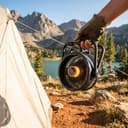
The BougeRV F01 pairs a 20,000 mAh battery with a quiet motor and full app control (49 ft Bluetooth range), covering multiple camping nights on one charge. The LCD display shows remaining runtime at a glance, and USB-C and USB-A outputs charge phones so you are not hunting for a separate power bank.
Strengths
- 20,000 mAh battery covers three or more hot nights without a recharge
- App and remote control with 1/2/4/6/8-hour timer means adjustments from your sleeping bag
- Built-in LED light and USB power-bank output add genuine multi-tool utility at this price
Weaknesses
- App connectivity adds convenience but also complexity; some owners report occasional pairing drops
- At 3.29 lbs it is not a backpacking choice, though it packs fine in a truck or van
Kit Score breakdown
NITECORE
Nitecore NEF10 Multifunctional Portable Fan
Editor's Choice
Kit Score 8.5/10
$49.95 Price checked Oct 23, 6:22 AM CDT
Best for: Campers who prioritize quiet sleep comfort and need a dual-purpose fan and lantern that mounts on a tripod or carabiner with a reputation-backed build from Nitecore.
- Lowest noise floor of any rechargeable fan in this class (about 45 dBA on low in a third-party measurement), making overnight use genuinely unobtrusive
- Not waterproof: a long rain session can cause moisture ingress; keep it inside the tent or under a canopy
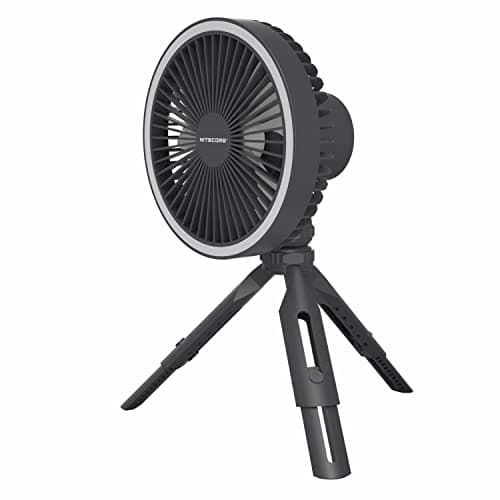
- Battery
- 10,000 mAh lithium-ion (built-in)
- Runtime
- 8 hrs (high), 13 hrs (mid), 27 hrs (low fan); LED up to 100 hrs
- Airflow
- Up to 4.0 m/s (about 45 / 56 dBA low / high in a third-party measurement)
- LED Light
- Integrated ring light: 34 / 71 / 124 lm, 3 modes
- Charging
- USB-C input (4.5 hr); USB-A output (power bank, 10W)
- Placement
- 5-height ball-head tripod; carabiner hanging; 1/4" tripod thread
About this pick
The Nitecore NEF10 wraps a brushless motor, a frosted LED ring light, and a 10-watt power bank into a single 23-ounce package that attaches to any standard camera tripod. It is the quietest fan in this roundup at comparable airflow speeds, making it the one to reach for when noise is the deciding factor.
Strengths
- Lowest noise floor of any rechargeable fan in this class (about 45 dBA on low in a third-party measurement), making overnight use genuinely unobtrusive
- Frosted LED ring produces even, shadow-free tent light at three brightness levels with up to 100 hours of runtime
- Ball-head tripod with 1/4-inch thread mounts on any camera tripod, a useful option for van builds with existing mounts
Weaknesses
- Not waterproof: a long rain session can cause moisture ingress; keep it inside the tent or under a canopy
- 10,000 mAh battery is half the capacity of the BougeRV F01, limiting multi-night use to low-speed settings
Kit Score breakdown
See all picks in Best camping fans: battery and rechargeable picks for hot tents
Keep going
Complete loadoutCar-camping starter kitThe first-trip essentials across shelter, sleep, cooking, lighting, seating, and water, with the extras left out.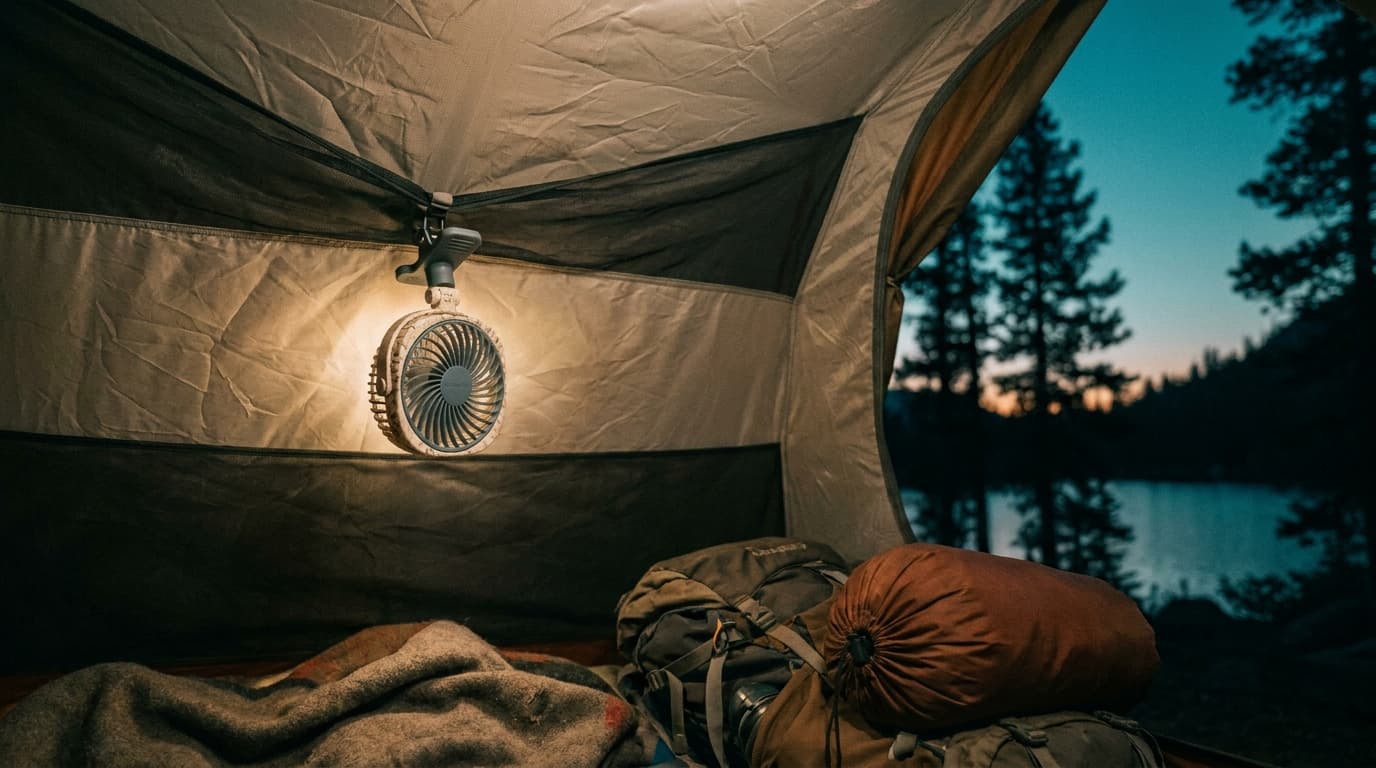
Researched, not hands-on tested
Updated Jun 4, 2026Our recommendations draw on manufacturer documentation, retailer listings, owner feedback, and comparisons with alternatives.
As an Amazon Associate I earn from qualifying purchases. We may earn a commission from links here, at no extra cost to you. How we research →