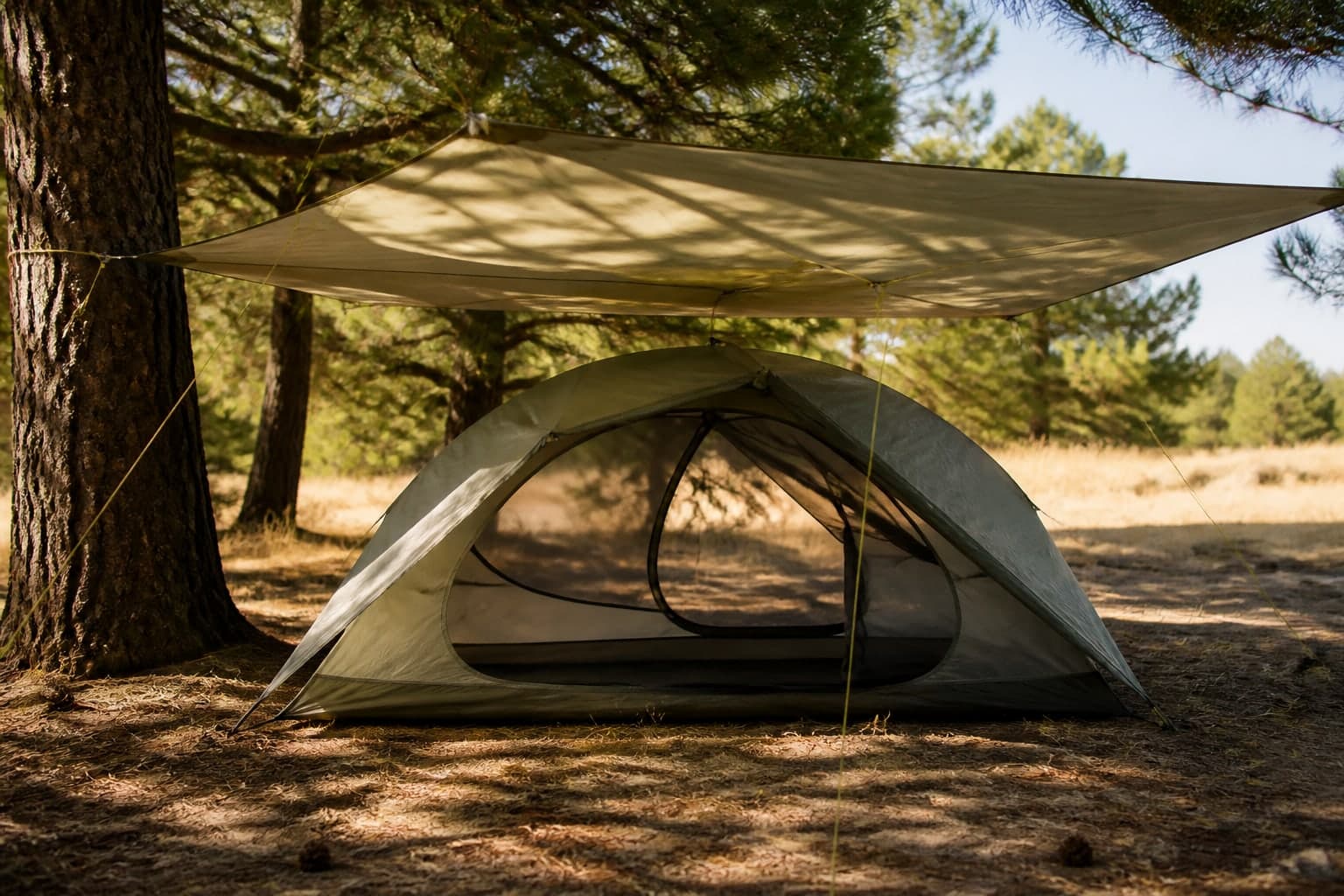
A hot tent is one of the fastest ways to ruin a summer camping trip, and the fix rarely involves buying anything new. The biggest gains come from where you pitch, when you open up, and how you manage airflow.
Site selection: shade and breeze first
The single highest-leverage decision you make is where you pitch. A tent in direct afternoon sun can reach interior temperatures 20–30°F above ambient, even with the doors open. Your priority order:
- Shade from 11 a.m. to 4 p.m. East-facing pitches get morning sun and afternoon shade. A tree canopy or rock wall to the west does more for tent temperature than almost any gear upgrade.
- Exposure to wind. Open meadows and ridgelines funnel breeze. Dense tree clusters can block it entirely, so look for spots that have shade overhead but airflow through the sides.
- Distance from radiant heat. Rocks, pavement, and bare soil store heat and re-radiate it through the night. Grass or forest duff stays noticeably cooler.
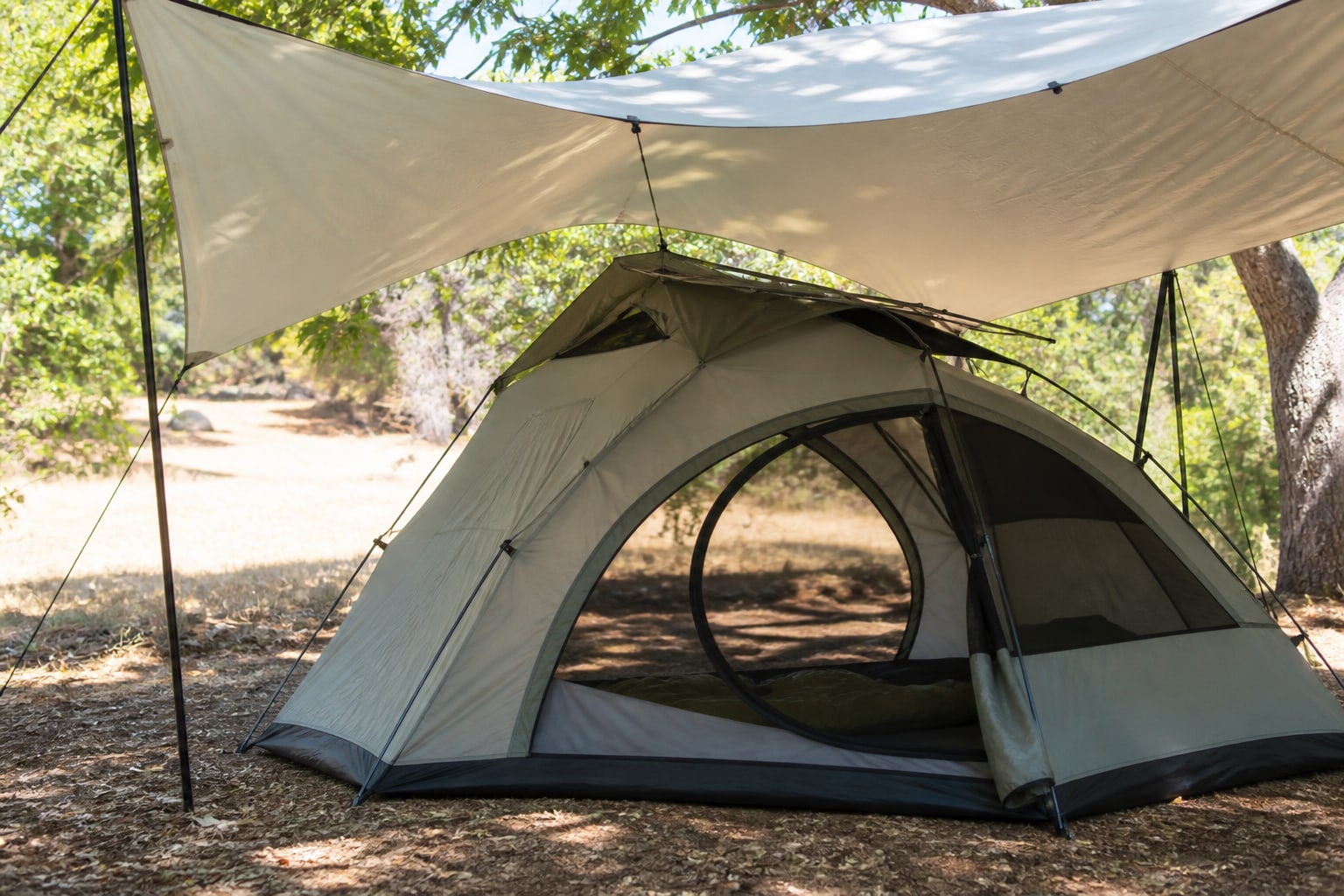
When established sites give you no choice, rig a reflective tarp above the tent with a 12–18 inch air gap. That gap is what makes the tarp work: it intercepts direct radiation and lets heat escape sideways rather than conducting straight through to the tent body.
Maximize cross-ventilation and mesh
Most three-season tents have enough mesh to ventilate well, but only if you use it correctly. Cross-ventilation requires openings on at least two sides that are not directly opposite each other at the same height. Air flows in low and out high, or in one side and out another.
- Unzip every vent, door, and window that doesn't expose you to insects or rain. A single open door creates a dead pocket; two open doors or a door plus a roof vent creates a draft.
- Orient door to prevailing breeze. Check wind direction before you pitch. In many mountain and coastal environments, afternoon thermals are predictable.
- Stake out the fly away from the inner tent. Many tents allow you to angle the vestibule poles outward to create a scoop that channels air in. Even a few inches of gap between the fly hem and the ground dramatically improves flow.
- Remove the rainfly entirely when the forecast is clear. The inner tent body is almost always full mesh, and sleeping under open sky with bug protection is the coolest possible configuration.
Battery fans: the most reliable upgrade
A small battery-powered fan does two things: it moves air across your skin (evaporative cooling) and it keeps air circulating through the tent when there's no natural breeze. You don't need a powerful fan, just a consistent one positioned well.
Clip or hang the fan near the door so it pulls outside air in and pushes it across your sleeping area. At the lowest setting, most tent fans like the BougeRV F01 Portable Rechargeable Fan run 8–15 hours on a charge, which covers a full night. Many campers pair a fan with a small USB power bank rather than AA batteries for recharging flexibility.
For specific models worth considering, see our guide to the best camping fans.
Even a light, consistent airflow across bare skin can make a humid 80°F tent feel 10 degrees cooler.
Reflective tarps and rainfly strategy
If you're car camping in exposed terrain, a reflective emergency tarp (the silver mylar type) rigged above your tent is a genuine heat blocker. Emergency tarps are cheap and lightweight; purpose-made reflective shade tarps are more durable and easier to rig with guylines.
Key details:
- Pitch it higher rather than lower. A low tarp traps heat under it; a high tarp with good air gap lets convection carry the heat away.
- Angle it so the low edge faces the afternoon sun. This intercepts direct radiation while letting airflow pass through underneath.
- If you're using your tent's rainfly and it's not raining, prop the fly hem up with trekking poles or extra stakes so air moves freely under it. A fly pinned tight to the ground blocks ventilation completely.
Rainfly management by conditions
Clear and dry
Remove the fly entirely for maximum mesh ventilation and star exposure.
Humid but no rain
Keep fly on but stake vestibules wide open and prop hem up 4–6 inches.
Thunderstorm risk
Close the fly fully, prioritize the roof vents for any possible airflow.
High wind
Stake fly tight to reduce flapping noise but keep door vents open as much as possible.
Direct afternoon sun
Add a reflective tarp above with a 12–18 inch gap before pitching the fly.
Timing and pre-cooling
Heat management is as much about timing as equipment.
Don't nap in the tent during peak heat. Between noon and 4 p.m., the tent is at its hottest. Spend that time under a shade structure, in water, or in a vehicle with air conditioning if you have one. Reserve the tent for sleeping.
Pre-cool your sleeping bag and pad. Synthetic sleeping bags and closed-cell foam pads trap body heat. If you can hang your quilt or bag in the shade for 20–30 minutes before bed, it enters the night cooler. A lightly dampened bandana on your forehead or wrists helps in dry climates (be cautious in humid climates where evaporation is limited).
Open up at night, close in the morning. Nighttime air in most summer environments drops significantly, sometimes by 20°F or more. Get all that cool air in. Then close the tent in the morning before the sun hits it. A closed tent with cool air inside stays cooler longer than an open tent that lets the hot morning air pour in.
Frequently asked questions
Does a tent footprint or ground cloth make the tent hotter?
A footprint has a negligible effect on interior temperature. The ground conducts some heat but far less than solar radiation through the tent roof and walls. Focus on shade and ventilation rather than the footprint.
What's the best tent color for staying cool?
Light-colored and reflective tent fabrics absorb less radiation than dark fabrics, so white, tan, or silver outer flies run cooler in direct sun. That said, site selection and ventilation have a much larger effect than fabric color. A tan tent in full sun is still much hotter than a dark tent in shade.
Is it safe to sleep in a tent in very hot weather?
Heat exhaustion and heat stroke are real risks when sleeping in a hot, unventilated tent. Prioritize shade, ventilation, and hydration. Stay aware of warning signs: heavy sweating, weakness, headache, nausea, or confusion. If you can't cool the tent adequately, sleep outside the tent on a cot or pad under a tarp, or seek a cooler shelter.
For specific fan picks to pair with these strategies, see our guide to the best camping fans. Browse all camp guides or read how we research and rate gear.
Recommended gear
Our current top picks from the Best camping fans: battery and rechargeable picks for hot tents guide, if you are ready to buy.
Best for: Car campers, RV and van travellers who want the most airflow available from a rechargeable fan and have the space to carry it.
- 1,900 CFM is the highest airflow in this group, and metal blades move more air than plastic at the same diameter
- 22 by 22 inches is bulky: a car-camping and van fan, not one for a backpacking tent
- Airflow
- 1,900 CFM (manufacturer)
- Runtime
- Up to 24 hrs on the lowest speed (manufacturer)
- Charging
- Full charge in about 3 hrs
- Blade
- 16 in., metal, brushless motor
- Dimensions
- 22" W x 22" H x 8" D
- Placement
- Floor stand, 360-degree tilt, IPX4 water resistant
About this pick
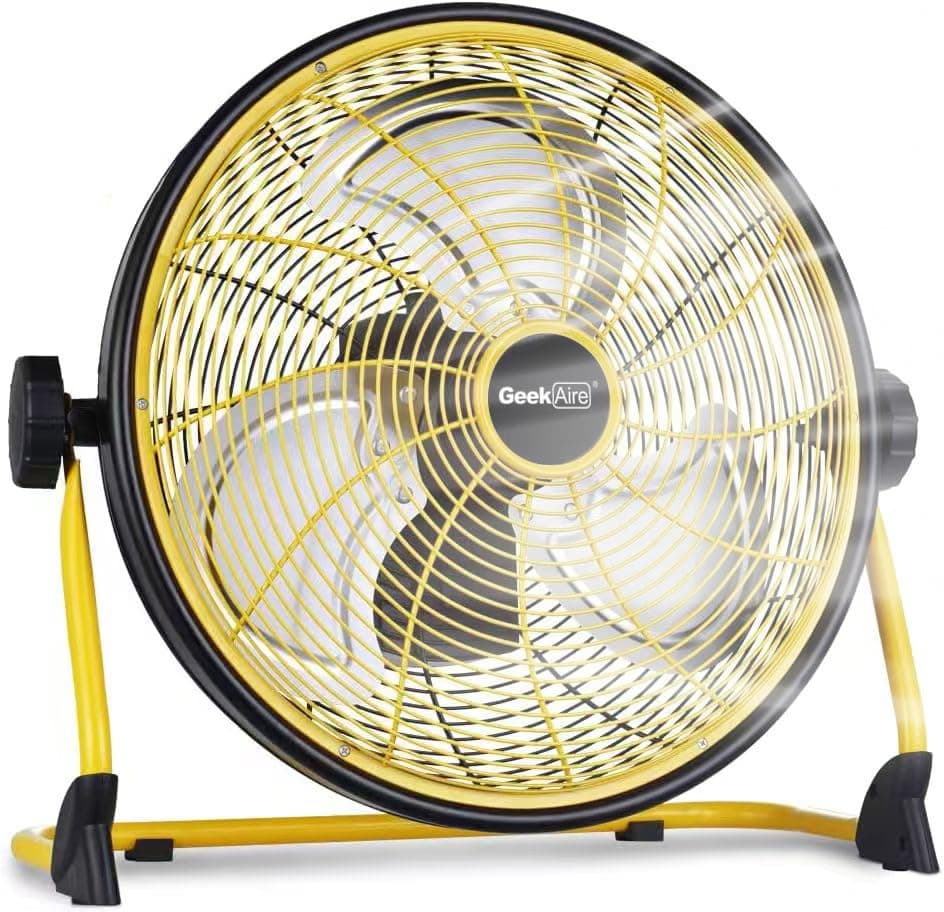
Geek Aire's 16-inch battery floor fan is the airflow pick for car campers and van builds: 1,900 CFM from metal blades on a brushless motor, a rated 24 hours on the lowest speed, and a full recharge in about three hours. The 360-degree tilt aims air directly at a sleeping pad, and IPX4 water resistance handles dew and light rain. It replaces the discontinued 12-inch CF1 in this guide. At 22 by 22 by 8 inches it is a genuinely large fan, which is the cost of the airflow.
Strengths
- 1,900 CFM is the highest airflow in this group, and metal blades move more air than plastic at the same diameter
- Rated 24 hours on low, so a multi-night trip does not need a recharge
- IPX4, non-slip feet and a carry handle suit real outdoor use
Weaknesses
- 22 by 22 inches is bulky: a car-camping and van fan, not one for a backpacking tent
- No LED light and no USB output, so it does not replace a lantern or a power bank
Kit Score breakdown
BOUGERV
BougeRV F01 Portable Rechargeable Fan
Best Value
Kit Score 8.5/10
$49.99 Price checked Oct 24, 5:42 AM CDT
Best for: Car campers and van-lifers who want multi-night battery life, a warm LED light, and phone-charging capability in one compact unit without crossing into premium pricing.
- 20,000 mAh battery covers three or more hot nights without a recharge
- App connectivity adds convenience but also complexity; some owners report occasional pairing drops
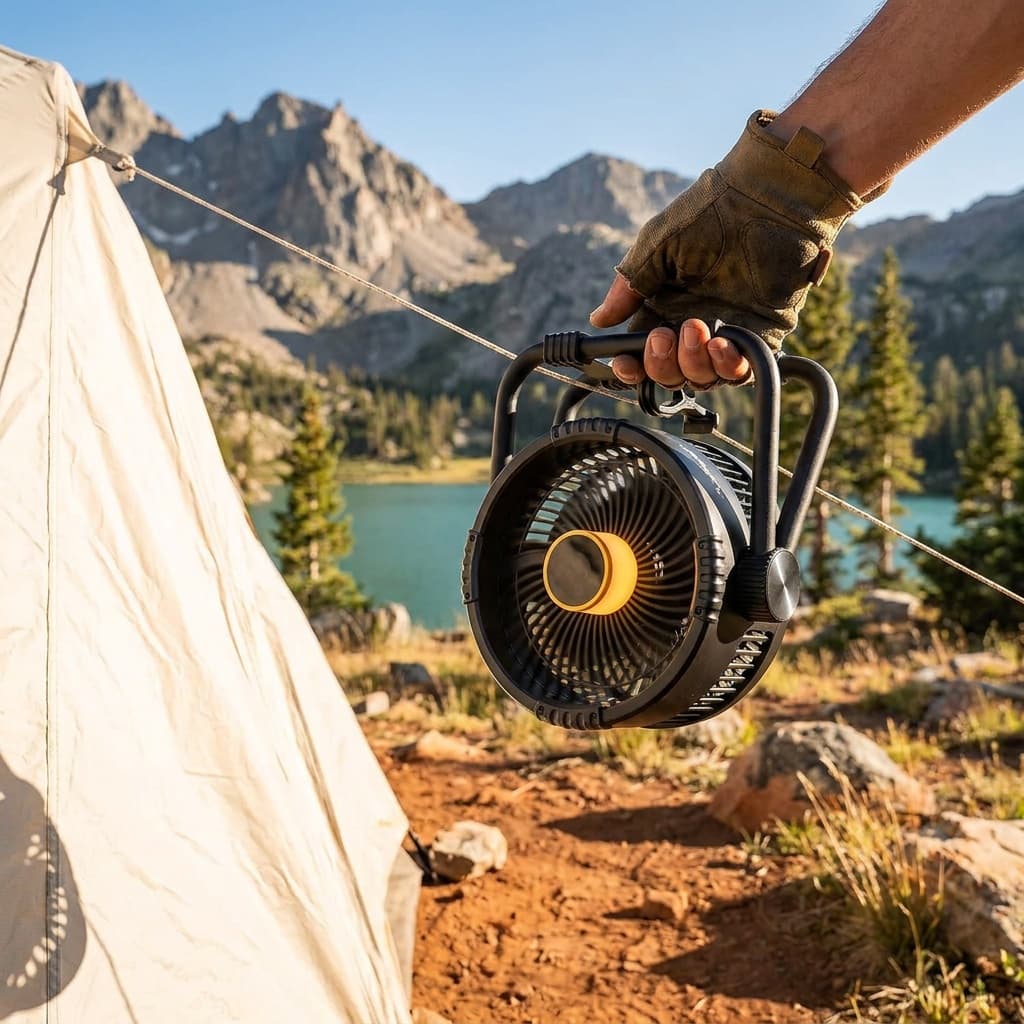
- Battery
- 20,000 mAh lithium-ion (built-in)
- Runtime
- Up to 33.5 hrs (low)
- Airflow
- Up to 5.4 m/s max wind speed
- LED Light
- 2-level warm LED; always-on or timed
- Charging
- USB-C and USB-A input; doubles as power bank
- Placement
- Hanging hook plus base stand; 270 tilt rotation
About this pick
The BougeRV F01 pairs a 20,000 mAh battery with a quiet motor and full app control (49 ft Bluetooth range), covering multiple camping nights on one charge. The LCD display shows remaining runtime at a glance, and USB-C and USB-A outputs charge phones so you are not hunting for a separate power bank.
Strengths
- 20,000 mAh battery covers three or more hot nights without a recharge
- App and remote control with 1/2/4/6/8-hour timer means adjustments from your sleeping bag
- Built-in LED light and USB power-bank output add genuine multi-tool utility at this price
Weaknesses
- App connectivity adds convenience but also complexity; some owners report occasional pairing drops
- At 3.29 lbs it is not a backpacking choice, though it packs fine in a truck or van
Kit Score breakdown
NITECORE
Nitecore NEF10 Multifunctional Portable Fan
Editor's Choice
Kit Score 8.5/10
$49.95 Price checked Oct 24, 5:42 AM CDT
Best for: Campers who prioritize quiet sleep comfort and need a dual-purpose fan and lantern that mounts on a tripod or carabiner with a reputation-backed build from Nitecore.
- Lowest noise floor of any rechargeable fan in this class (about 45 dBA on low in a third-party measurement), making overnight use genuinely unobtrusive
- Not waterproof: a long rain session can cause moisture ingress; keep it inside the tent or under a canopy
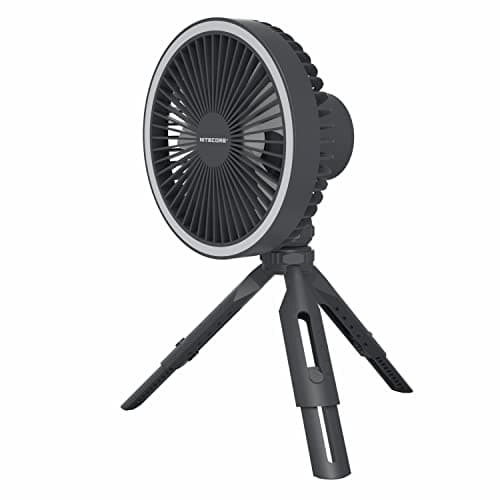
- Battery
- 10,000 mAh lithium-ion (built-in)
- Runtime
- 8 hrs (high), 13 hrs (mid), 27 hrs (low fan); LED up to 100 hrs
- Airflow
- Up to 4.0 m/s (about 45 / 56 dBA low / high in a third-party measurement)
- LED Light
- Integrated ring light: 34 / 71 / 124 lm, 3 modes
- Charging
- USB-C input (4.5 hr); USB-A output (power bank, 10W)
- Placement
- 5-height ball-head tripod; carabiner hanging; 1/4" tripod thread
About this pick
The Nitecore NEF10 wraps a brushless motor, a frosted LED ring light, and a 10-watt power bank into a single 23-ounce package that attaches to any standard camera tripod. It is the quietest fan in this roundup at comparable airflow speeds, making it the one to reach for when noise is the deciding factor.
Strengths
- Lowest noise floor of any rechargeable fan in this class (about 45 dBA on low in a third-party measurement), making overnight use genuinely unobtrusive
- Frosted LED ring produces even, shadow-free tent light at three brightness levels with up to 100 hours of runtime
- Ball-head tripod with 1/4-inch thread mounts on any camera tripod, a useful option for van builds with existing mounts
Weaknesses
- Not waterproof: a long rain session can cause moisture ingress; keep it inside the tent or under a canopy
- 10,000 mAh battery is half the capacity of the BougeRV F01, limiting multi-night use to low-speed settings
Kit Score breakdown
See all picks in Best camping fans: battery and rechargeable picks for hot tents
Keep going
Complete loadoutCamp sleep systemFive coordinated pieces that solve shelter, insulation, cushioning, head support, and light for nights outside.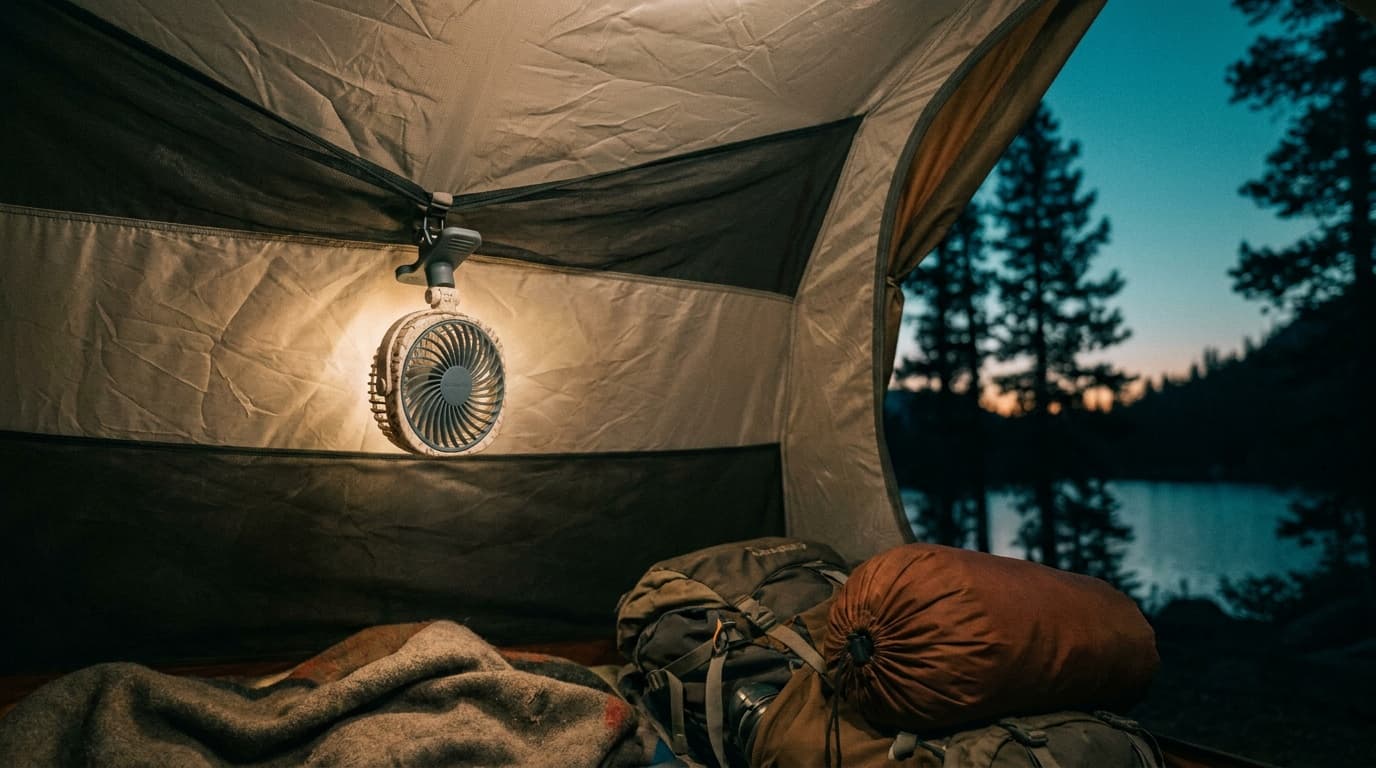
Researched, not hands-on tested
Updated Jun 4, 2026Our recommendations draw on manufacturer documentation, retailer listings, owner feedback, and comparisons with alternatives.
As an Amazon Associate I earn from qualifying purchases. We may earn a commission from links here, at no extra cost to you. How we research →