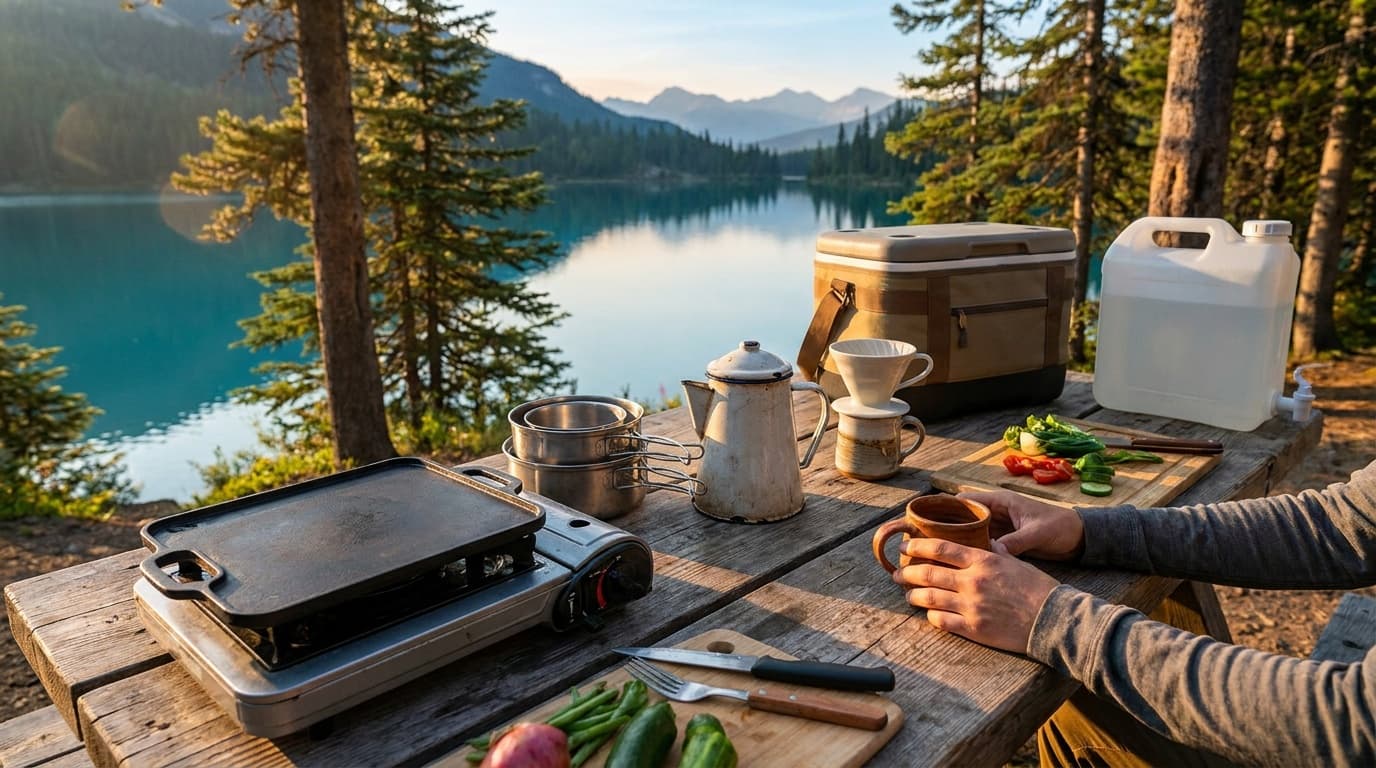
The right camp cookware comes down to four questions: what material, what size, how it packs, and whether you actually need a nonstick coating. Get those four right and everything else is noise.
Materials: what actually matters
Four materials dominate camp cookware. None is universally best. Each trades weight against durability, cooking performance, and price.
Plain aluminum is inexpensive, light, and thermally responsive, but it dents more easily and is less common in premium current sets than hard-anodized aluminum.
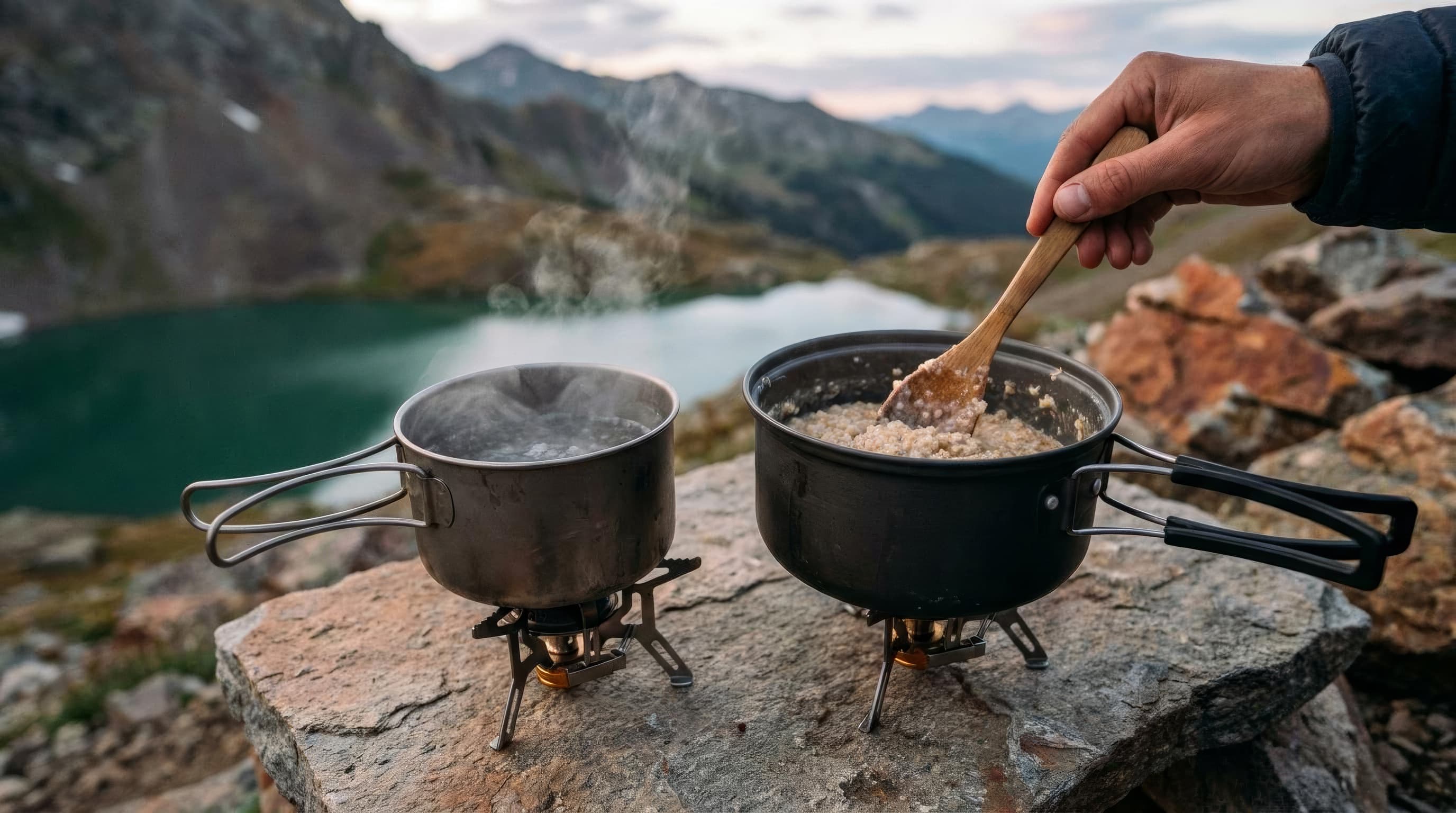
Hard-anodized aluminum spreads a concentrated stove flame across more of the pot base than titanium. It is the practical all-round choice for shared meals, rice, oatmeal, and sauce. A separate ceramic or PTFE surface may be applied on top, and that coating has its own heat and utensil restrictions.
Stainless steel tolerates harder tools and cleaning. The weight makes it a vehicle-camping material, and a thin single-wall pan can still create a central hot spot. A tri-ply base, such as the one in the Stanley Wildfare Core, improves browning and expands cooktop compatibility.
Titanium enables an extremely light, durable uncoated pot. It transfers heat poorly across its base, so a small stove flame can scorch thick food in the center. A set such as the Snow Peak Trek 900 Titanium makes sense for solo boil-and-eat trips; aluminum is more forgiving for real cooking.
Titanium wins on weight. Hard-anodized aluminum wins on cooking. Choose based on what you actually plan to put in the pot.
The full material decision is in titanium vs aluminum camping cookware.
Sizing: match the pot to your group
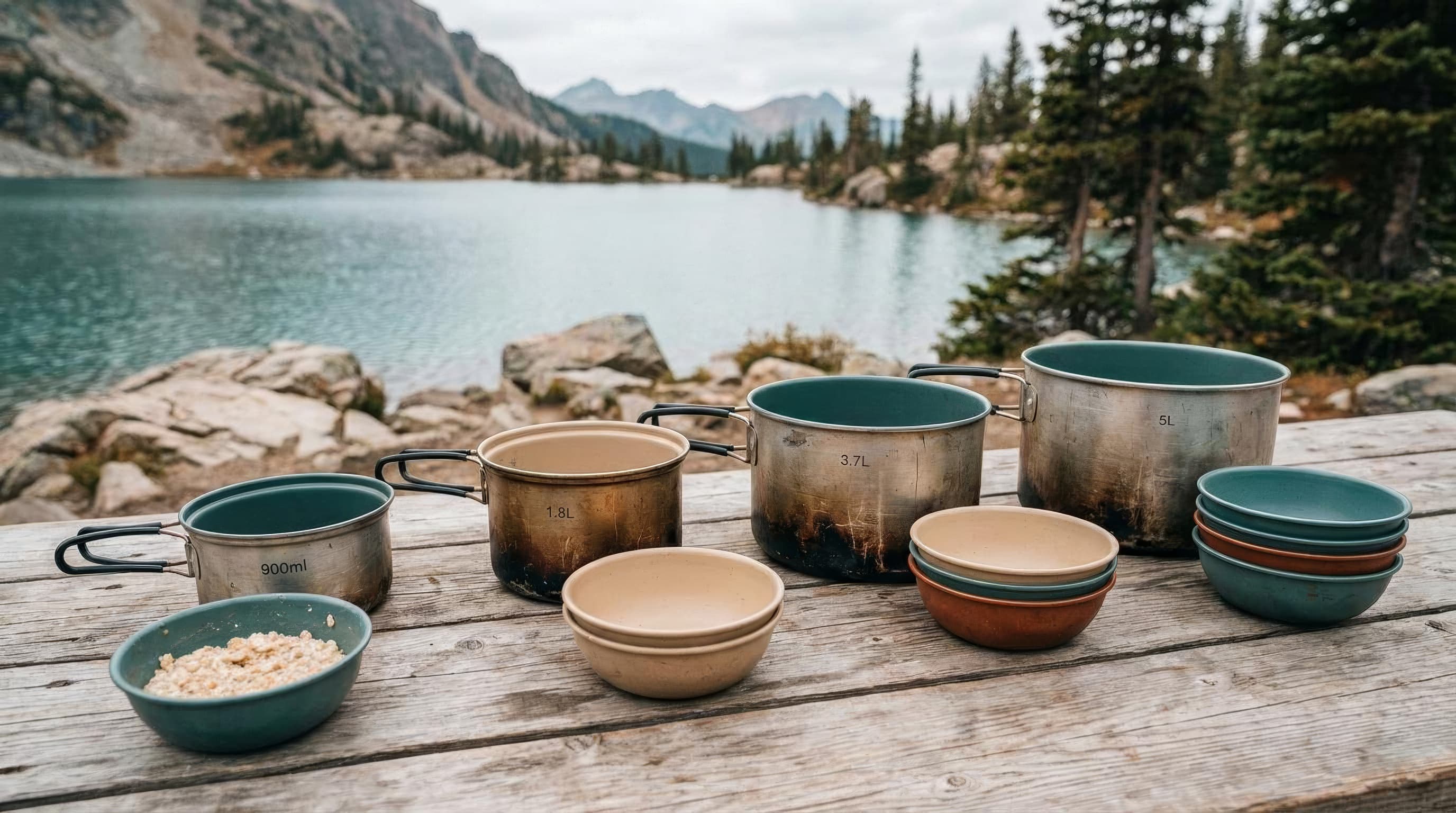
Carrying more capacity than the menu needs adds weight and packed volume with no benefit. Start with the group, then add room for food expansion, stirring, and shared hot drinks.
Sizing your cookware to group size
Solo, boil-only
One pot in the 0.75–1 L range is sufficient. You are rehydrating meals and making coffee, not simmering.
Two to three people
A 1.5–2 L pot covers this range. Most two-person backpacking sets are built around a 1.5 L pot for this reason.
Groups of three or more
Step up to a 3 L pot, or bring two pots. REI recommends a 3 L minimum for groups of three or more.
Car camping for four
Two pots: one 2–3 L for the main dish, one 1.5 L for sides, coffee, or oatmeal. Frying pan optional based on what you cook.
Pot shape and heat efficiency
Volume is not the only size variable. A wide, squat pot boils faster and distributes heat more evenly than a tall, narrow pot of equal volume. Wide pots expose more surface area to the flame, and pot bottoms with a darker finish absorb radiant heat better than shiny ones.
Tall, narrow pots are better suited to liquids and soups where you need depth without a wide footprint. If you plan to fry or saute, a wide base is more useful.
Some integrated stove systems (Jetboil, MSR Reactor) add heat exchanger fins to the pot base. These fins can cut boil time and fuel use significantly. The catch: they add weight and only work with the matched stove. Worth considering for frequent boil-and-eat trips. Overkill for an occasional camper.
Nesting and pack size
A good nesting set minimizes the volume the cookware occupies in your pack. The practical benchmark: a well-designed two-person set like the GSI Outdoors Halulite Dualist HS fits in roughly the volume of a 1-liter water bottle.
What makes nesting work:
- Lids that double as frying pans or plates collapse the system by one item
- Folding or removable handles let pots stack inside each other
- Sets designed to swallow a canister stove or a fuel canister inside the largest pot save loose items in your pack
Before buying a set, check whether the stove you use fits inside the pot. Many integrated systems are designed around this, but standalone pot sets vary.
Nonstick coatings: care and lifespan
Nonstick coatings make camp cooking easier and cleanup faster. They also require more care than uncoated cookware.
Different PTFE and ceramic surfaces carry different temperature and care limits. The reliable rule is simpler: follow the exact manufacturer's instructions, never heat a coated pot empty, keep the flame under the base, and retire cookware whose surface is deeply damaged.
What you actually need
Most cookware sets suggest more than you need. Work backward from what will actually touch heat.
Solo or duo, boil-and-eat trips: one pot (0.75–1.5 L depending on group), one lid, one long-handled spoon per person. That is a complete kit.
If you cook real meals (eggs, stir-fry, pancakes): add a small frying pan. A lid that doubles as a pan saves weight and an item.
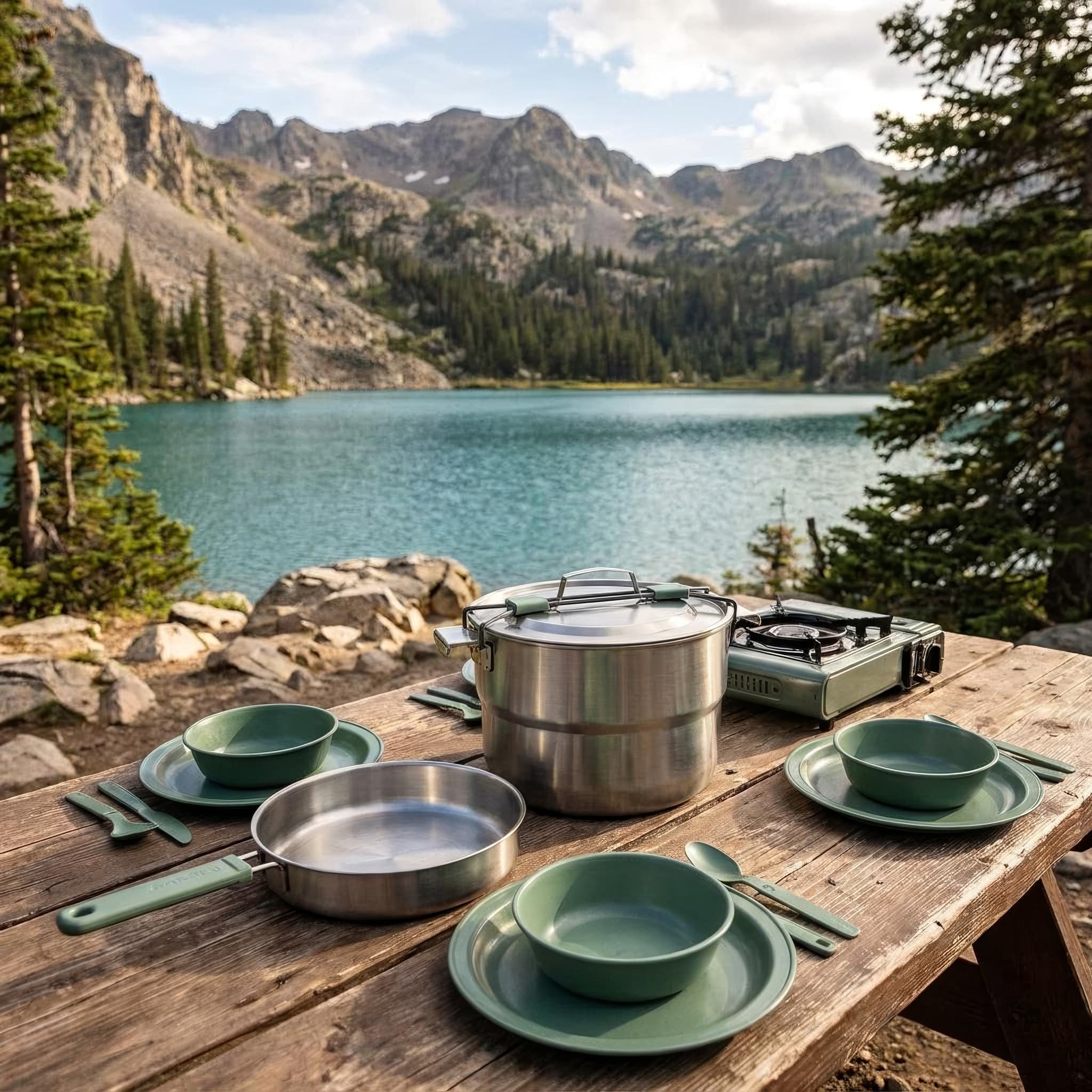
Car camping for four: a 3 to 4 L main pot, a frying pan, and the prep and serving pieces the menu uses. The Stanley Wildfare Core supplies a 4 qt pot, tri-ply pan, and table settings for four. Leave any piece without an assigned job at home.
Building a kit from first principles
List what you will cook
Not what you might cook. Boiling water, rehydrating meals, and making coffee do not require a frying pan.
Count items that touch heat
Lids count only if they double as a pan. Extra bowls and a cutting board do not count toward cookware.
Check nesting before buying
Fit your stove system inside the pot before committing to a set. An integrated kit that nests together is worth more than two pieces that rattle loose in your pack.
Match material to trip type
Boil-only backpacking: titanium or hard-anodized aluminum. Real cooking: hard-anodized aluminum. Car camping with rough use: stainless or hard-anodized aluminum.
When you are ready to shop, see our guide to the best camping cookware for specific sets vetted across these criteria.
For more on what to bring to camp, browse camp gear. If you want to understand how we evaluate and rate gear, read how we research and rate.
Frequently asked questions
Is titanium cookware worth the extra cost for camping?
Only if weight is your primary constraint. Titanium pots run two to four times the price of comparable hard-anodized aluminum and develop hot spots that scorch real meals. For boil-and-eat backpacking trips where every gram counts, titanium makes sense. For car camping or any cooking beyond rehydrating, hard-anodized aluminum gives better cooking performance at a much lower price.
Can I use metal utensils in my camping cookware?
Only with uncoated stainless steel or titanium. Metal utensils will scratch both PTFE and ceramic nonstick coatings. Once a PTFE coating is scratched through, the underlying aluminum is exposed and the coating can flake. Use silicone, wood, or plastic utensils with any coated pot or pan, and the coating will last far longer.
How do I know if my cookware set has too many pieces?
Ask how many items will actually touch heat. Lids, a cutting board, and extra bowls do not count. A workable backpacking kit for two people is one 1.5–2 L pot, one lid, and one spoon per person. A car-camping kit for four adds a frying pan, a second pot for sides, and utensils. If the set includes pieces you cannot assign a specific job to, leave them home.
Recommended gear
Our current top picks from the Best camping cookware sets 2026: 8 picks, cast iron to titanium guide, if you are ready to buy.
Best for: Families and groups who want a durable, complete car-camping kitchen for less than most premium coated sets.
- One purchase covers prep, cooking, serving, and tableware for four
- At 4.70 lb it belongs near a vehicle, not in a backpack
- Material
- 18/8 stainless steel and BPA-free tableware
- Weight
- 4.70 lb
- Packed size
- 8.52 x 10.65 x 6.14 in
- Cookware
- 4 qt pot and 8 in tri-ply fry pan
- Pieces
- 26
- Group size
- 4 people
About this pick
A 26-piece stainless car-camping kitchen with a 4 qt pot, tri-ply fry pan, prep tools, and four complete table settings that nest into one durable package.
Strengths
- One purchase covers prep, cooking, serving, and tableware for four
- Stainless steel tolerates metal utensils and more aggressive cleaning
- Tri-ply fry pan is more useful for browning than a thin stamped camp pan
Weaknesses
- At 4.70 lb it belongs near a vehicle, not in a backpack
- The full set is excessive for couples who cook simple one-pot meals
Kit Score breakdown
GSI OUTDOORS
GSI Outdoors Pinnacle Ceramic Camper Cookware Set
Editor's Choice
Kit Score 8.1/10
$199.95 Price checked Oct 23, 6:22 AM CDT
Best for: Car campers, paddlers, and van travelers who want a full four-person cook-and-eat system in one bag.
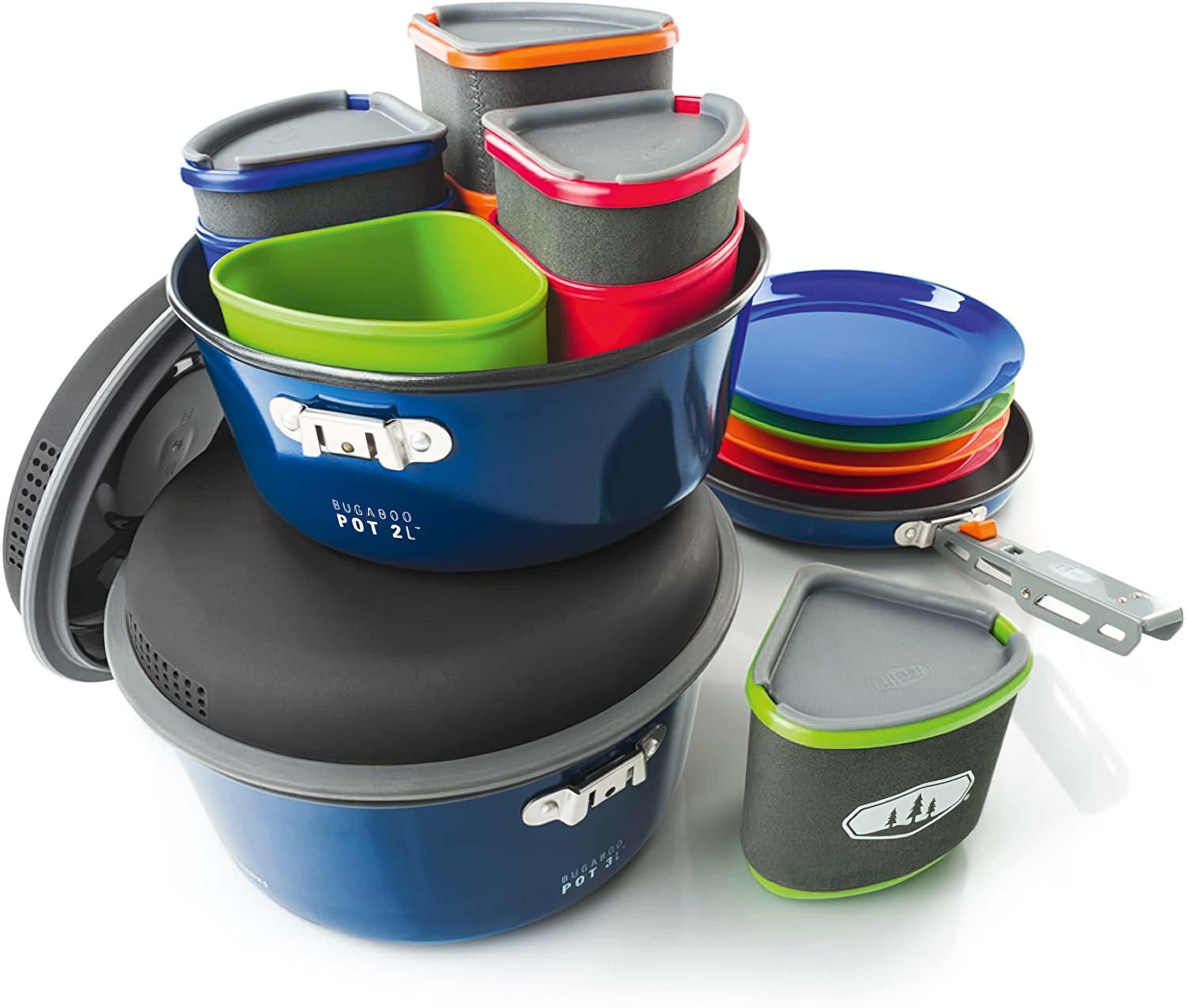
- One of the most comprehensive nesting camp kitchen sets available: pots, pan, and full dinnerware for four in one carry
- At 3.6 lbs it is car-camping gear, not a set to carry on your back
- Material
- Hard-anodized aluminum, ceramic nonstick coating
- Weight
- 3.6 lbs (58.1 oz)
- Packed dimensions
- 9.1 x 9.1 x 5.8 in
- Capacity
- 3L pot, 2L pot, 9-inch frying pan
- Pieces
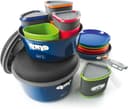
- 2 strainer pots, frypan, 4 plates, 4 bowls (14 oz), 4 mugs (14 oz) with sip-it lids, folding handle, welded stuff sack/wash basin
- Serves
- 2 to 4 people
About this pick
The Pinnacle Ceramic Camper is a complete kitchen-to-table system for groups of four, built around a ceramic-coated hard-anodized aluminum pot and pan set that nests with plates, bowls, and mugs into a single tight bundle.
Strengths
- One of the most comprehensive nesting camp kitchen sets available: pots, pan, and full dinnerware for four in one carry
- Ceramic nonstick handles real cooking (eggs, fish, grains) with minimal sticking and simple cleanup
- Hard-anodized construction distributes heat evenly, reducing scorching on camp stoves with small burner heads
Weaknesses
- At 3.6 lbs it is car-camping gear, not a set to carry on your back
- The ceramic coating requires plastic utensils to stay intact long-term
Kit Score breakdown
GSI OUTDOORS
GSI Outdoors Halulite Dualist HS
Best Overall
Kit Score 8.6/10
$99.95 Price checked Oct 23, 6:22 AM CDT
Best for: Two backpackers who share a stove and want fast boils, complete tableware, and a tidy nested system.
- Complete tableware for two nests with the pot rather than occupying separate pack space
- No frying pan is included
- Material
- Hard-anodized aluminum
- Weight
- 23.1 oz (654 g)
- Packed size
- 6.2 x 5.8 x 5.9 in
- Pot capacity
- 1.8 L
- Included
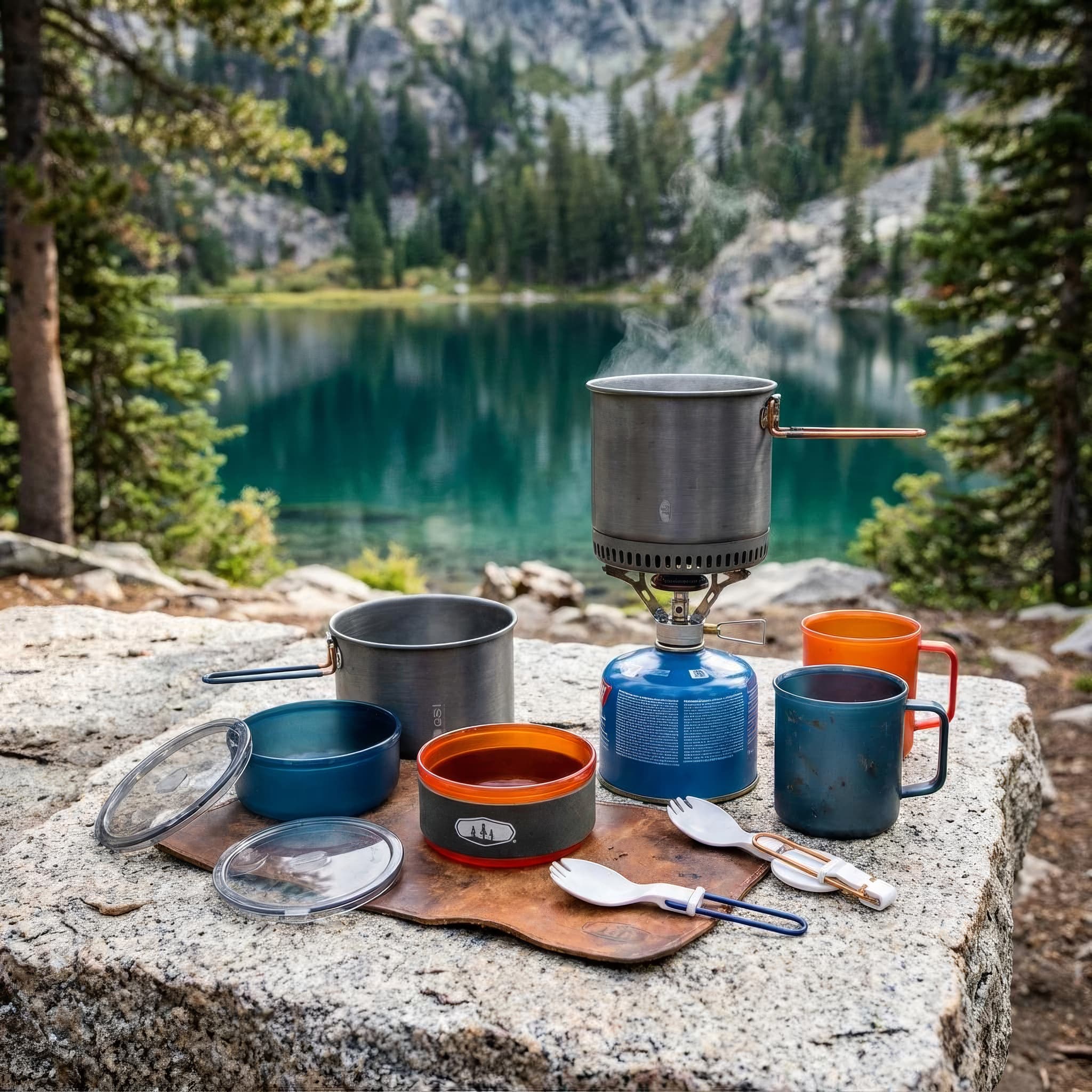
- Pot, strainer lid, 2 mugs/bowls, 2 lids, 2 sporks, sink bag
- Group size
- 2 people
About this pick
A two-person hard-anodized aluminum cook-and-eat system with a 1.8 L heat-exchanger pot, insulated mugs, bowls, folding sporks, and a sink bag packed into one compact cylinder.
Strengths
- Complete tableware for two nests with the pot rather than occupying separate pack space
- Heat-exchanger base is designed to reduce boil time and fuel use by about 30 percent
- Hard-anodized aluminum spreads heat better than a thin titanium pot for simple one-pot meals
Weaknesses
- No frying pan is included
- Heavier and more expensive than a minimalist solo pot
Kit Score breakdown
See all picks in Best camping cookware sets 2026: 8 picks, cast iron to titanium
Keep going
Complete loadoutCamp kitchen kitA durable base-camp cooking setup built around heat, cookware, coffee, cold storage, workspace, and water.Free tool: Stove Fuel Calculator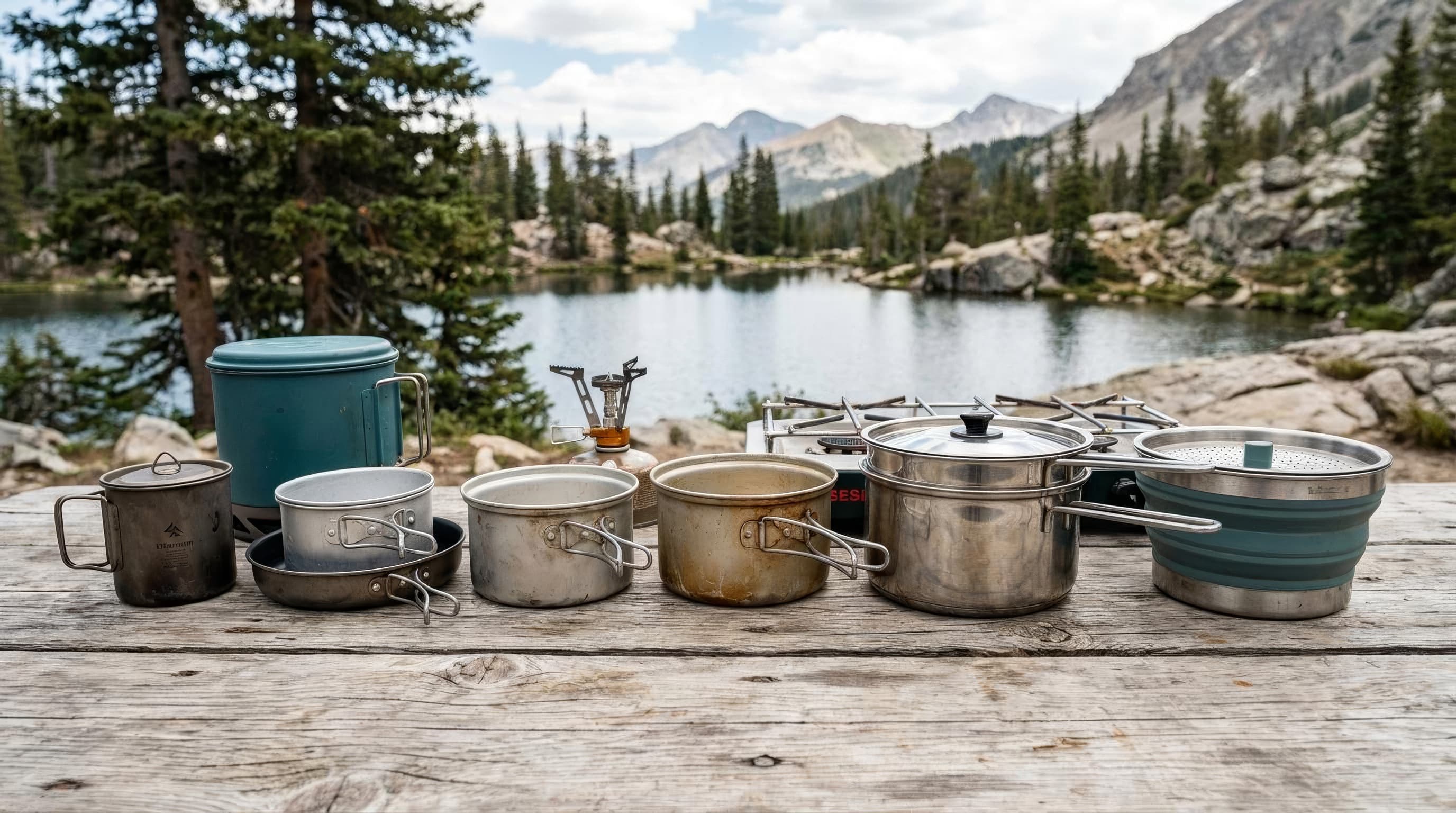
Researched, not hands-on tested
Updated Jul 28, 2026Our recommendations draw on manufacturer documentation, retailer listings, owner feedback, and comparisons with alternatives.
As an Amazon Associate I earn from qualifying purchases. We may earn a commission from links here, at no extra cost to you. How we research →