
Picking a headlamp sounds simple until you're staring at a wall of specs and wondering whether 400 lumens is overkill or barely enough. This guide cuts through the noise and tells you exactly what each number means for real trail use.
Lumens: how bright is bright enough?
Lumens measure raw light output. More is not always better; what matters is having the right amount for the pace and terrain.
Under 100 lumens, trail navigation requires moving very slowly. The 250–500 lumen range, where models like the Black Diamond Spot 400-R sit, gives you enough throw to react to obstacles at a walking or jogging pace. Anything above 500 lumens is genuinely useful for technical scrambles, search scenarios, or scanning wide terrain, but it drains batteries fast and is not the mode you run all night.
The mode you use 90% of the time will be a mid or low setting. A headlamp with a good regulated mid-mode (more on that below) beats one with an impressive but battery-burning maximum.
Beam type: spot vs. flood
A spot (focused) beam throws light in a narrow cone far down the trail. That distance is what you need when moving, because it gives you time to see and react to roots, rocks, and turns ahead.
A flood (wide) beam lights a broad area close up. It is better for camp chores, cooking, reading a map, or any task where you want to see what your hands are doing.
Most headlamps worth buying offer both on a single unit, either as separate modes or a zoom function. If you do only one thing with a headlamp guide, check that a model gives you both a flood and a spot option before you buy.
Regulated output: the spec the box hides
This is the most underrated spec in headlamp shopping.
A regulated headlamp uses a circuit that feeds constant power to the LED. Brightness stays consistent from full battery down to nearly empty.
An unregulated headlamp dims as the battery drains. Some unregulated models drop to 75% of their rated brightness within 45 minutes of continuous use on high. The spec sheet shows the first-minute peak, not what you get after an hour on the trail.
For navigation and safety, regulated output means the light you start a night hike with is the light you rely on for the duration.
Regulated output is not a premium feature. It is a safety feature. An unregulated headlamp that dims to 75% within the first hour can leave you short-sighted at exactly the wrong moment.
One trade-off: regulated lights tend to cut off more abruptly when the battery finally empties, rather than fading gradually. On long trips, carry a known-good spare battery or a fully charged backup pack so you are not caught by the sudden cutoff.
Rechargeable vs. AAA: which power source is right for you?
Matching power source to trip type
USB-C rechargeable
Best for day hikes, weekend trips, and any outing where you can top off before heading out. Saves money over time, reduces battery waste, and most modern models charge in 2–3 hours.
Standard AAA or AA
Best for trips where you can resupply at a gas station or drop a set in your resupply box. Simple, universal, no cables required. Less convenient day to day but never stranded by a dead port.
Hybrid (USB-C + AAA backup)
Best for multi-day backcountry trips. Charges at home or from a power bank on trail. If the pack runs low, swap in a set of AAA batteries from any convenience store. Many modern headlamps, including the Petzl Actik Core, offer this configuration.
Dedicated power bank
Some high-output headlamps ship with a proprietary lithium pack. Higher capacity, but you can only recharge it, not replace it in the field. Fine for trips with reliable charging; limiting for remote expeditions.
The hybrid option solves the main objection to rechargeable headlamps for backcountry use. If you are planning any trip longer than two or three days away from power, look specifically for a model that accepts both its own rechargeable pack and standard AAA cells.
Weight: it matters more than you think
Weight on your forehead for several hours is different from weight in your pack. A headlamp that feels trivially light at the trailhead starts to feel like a helmet strap by hour four.
Ultralight rechargeable models like the Nitecore NU25 MCT UL now combine 400-lumen output with complete weights around 50 grams. Emergency backup headlamps can go as low as 26 grams. For a standard kit, targeting under 60 grams is a reasonable threshold. For a dedicated ultralight setup, compare the complete lamp, bracket, and headband rather than a lamp-only number.
Red light: why it belongs on your headlamp
Red light at wavelengths around 660 nm does not significantly deplete rhodopsin, the photopigment in the eye's rod cells that enables low-light vision. White light resets dark adaptation; red light does not.
In practice: switch to red mode for camp tasks, map reading, and any situation where you need to look at something close up and then return your eyes to the dark. You will hold your night vision instead of rebuilding it from scratch each time.
Red light also has two useful side effects: it avoids waking tent-mates, and it attracts fewer insects than white light. Not a deal-breaker spec, but one you will use regularly once you have it.
IPX water rating: what the numbers actually mean
IPX ratings measure water resistance. The number tells you how much exposure the headlamp is tested to withstand.
IPX-4 handles sweat and steady rain without issue. For most day hiking, it is sufficient. IPX-6 adds margin for sustained downpours and heavy spray. IPX-7, which covers immersion at 1 meter for 30 minutes, is worth the small premium if your hiking involves river crossings, kayaking, or reliably wet conditions. The jump from IPX-4 to IPX-7 is rarely expensive and adds real-world reliability.
A headlamp with no IPX rating should not be your primary light on any hike where weather is a variable.
Tilt adjustment: the small detail worth checking
A headlamp that can angle its beam independently of the headband lets you aim at the trail without dropping your chin to your chest. After a long night of hiking, the ability to look straight ahead while your beam points slightly downward is a comfort difference you will notice.
Check that the tilt joint is firm enough to hold position and does not sag under the weight of the lamp. Loose tilt joints are a common weak point on cheaper models.
How to choose: a practical checklist
Choosing the right headlamp in five steps
Set your lumen target
If you hike at a relaxed pace on groomed trails, 200 lumens is workable. For regular night hiking or technical trails, start at 250 lumens and prefer a model with a regulated mid-mode.
Check for regulated output
Look for "regulated" or "constant brightness" in the spec sheet or reviews. If the spec sheet only lists max lumens and runtime at max, that is often a sign the output is unregulated.
Match power source to trip length
Day hikes and weekend trips: USB-C rechargeable. Multi-day backcountry: hybrid (USB-C plus AAA). Remote expeditions with no power: AAA-primary or hybrid.
Confirm IPX-4 or higher
IPX-4 is the floor for any hiking use. If you hike in wet climates or cross streams, target IPX-7. Do not buy an unrated headlamp as your primary light.
Verify weight and tilt
For long nights or trail running, keep total weight under 60 grams. Check that the tilt joint holds its angle under load.
Frequently asked questions
How many lumens do I actually need for night hiking?
For well-maintained trails at a relaxed pace, 100–200 lumens is workable. For regular night hiking, technical trails, or any pace faster than a stroll, 250–400 lumens gives you the reaction time and sight distance to step safely. Max-output specs above 500 lumens are mostly marketing for most hikers; a good regulated low-to-mid mode is what you will actually use 90% of the time.
Is IPX-4 enough, or should I hold out for IPX-7?
IPX-4 handles sweat and steady rain without issue, which covers most hiking conditions. IPX-7 (rated for 1 meter of submersion for 30 minutes) adds real margin for river crossings, kayak trips, or heavy storms. If your hiking involves any water crossings or you hike in reliably wet conditions, IPX-7 is worth the small premium. For fair-weather day hikes, IPX-4 is adequate.
What is regulated output and why does it matter?
A regulated headlamp uses a circuit that feeds constant power to the LED, so brightness stays consistent until the battery is nearly empty. An unregulated light dims as the battery drains; it may be rated at 300 lumens new but drop to 75% output within an hour on high. For navigation and safety, regulated output means the light you start with is the light you count on for the duration. The trade-off: regulated lights may cut off more abruptly when the battery empties, so carry a spare on long trips.
For specific model picks across budget and use-case categories, see our guide to the best headlamps for hiking.
Browse all hike gear guides or learn more about how we research and rate gear.
Recommended gear
Our current top picks from the Best headlamps for hiking and camping (2026) guide, if you are ready to buy.

BLACK DIAMOND
Black Diamond Spot 400-R Rechargeable Headlamp
Best Overall
Kit Score 8.5/10
$64.88 Price checked Oct 23, 4:16 PM CDT
Best for: All-purpose hikers and campers who want a dependable, waterproof rechargeable headlamp without overcomplicating the decision.
- IP67 submersible rating exceeds most competitors at this price, handling full submersion to 1 m
- Micro-USB charging port is outdated when rivals have moved to USB-C

- Max output
- 400 lumens
- Beam distance
- 100 m (328 ft)
- Weight
- 3.0 oz (86 g)
- Battery
- Built-in 1500 mAh Li-ion rechargeable, micro-USB
- IPX rating
- IP67 (submersible to 1 m)
- Red light mode
- Yes, dimmable red
About this pick
The Spot 400-R is the benchmark mid-range headlamp: 400 lumens, a 100 m beam, and a soft recycled-fiber headband that stays put through long approaches. The PowerTap side panel jumps straight to full brightness with a tap, so you are never fumbling through modes on a tricky section of trail.
Strengths
- IP67 submersible rating exceeds most competitors at this price, handling full submersion to 1 m
- PowerTap instant-max feature and intuitive dual-button UI make it easy to operate with cold gloves
- Excellent battery longevity: rated 1,000+ charge cycles, with 4 hours on high and up to 225 hours on low
Weaknesses
- Micro-USB charging port is outdated when rivals have moved to USB-C
- Integrated battery cannot be swapped out on a multi-day trip without a spare unit
Kit Score breakdown
BIOLITE
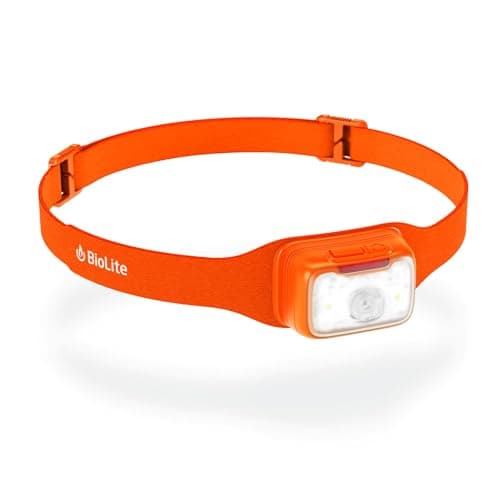
BioLite Range 500 Rechargeable Headlamp
Editor's Choice
Kit Score 8.8/10
$69.95 Price checked Oct 23, 4:16 PM CDT
Best for: Active hikers, trail runners, and campers who prioritize fit, comfort, and fast charging over raw lumen count.
- IP67 submersible waterproofing is among the best in class for this price range
- Red light is flood-only with no dimming, which limits usefulness for preserving night vision at close range
- Max output
- 500 lumens
- Beam distance
- 100 m (328 ft) spotlight
- Weight
- 2.6 oz (75 g)
- Battery
- Built-in 1634 mAh Li-ion rechargeable, USB-C fast charge
- IPX rating
- IP67 (submersible to 1 m)
- Red light mode
- Yes, red flood
About this pick
The Range 500 pairs 500 lumens and an IP67 submersible rating with BioLite's 3D SlimFit headband, which integrates the lamp body directly into the band so there is no separate mount bouncing against your forehead. Eight minutes on the charger adds a full hour of runtime, so a short top-up at camp is meaningful.
Strengths
- IP67 submersible waterproofing is among the best in class for this price range
- USB-C fast charge adds 1 hour of run time in just 8 minutes, genuinely useful for quick camp top-ups
- 3D SlimFit no-bounce design is consistently praised as the most comfortable headlamp in owner reviews
Weaknesses
- Red light is flood-only with no dimming, which limits usefulness for preserving night vision at close range
- Sealed non-removable battery means no AAA backup on longer wilderness trips
Kit Score breakdown

Best for: Ultralight backpackers and thru-hikers for whom every gram counts and who are comfortable with a nightly USB-C top-up.
- 50 g total weight including the bracket and headband makes it the lightest pick in this roundup
- Small 700 mAh battery limits manufacturer-rated high-mode runtime to 2 hours 40 minutes, so heavy users may need to recharge nightly

- Max output
- 400 lumens
- Beam distance
- 132 m (433 ft)
- Weight
- 1.76 oz (50 g), including bracket and headband
- Battery
- Built-in 700 mAh Li-Po rechargeable, USB-C
- IPX rating
- IP66 (dust-tight, jet-water resistant)
- Red light mode
- Yes, red auxiliary LED
About this pick
At 50 g including its bracket and headband, the NU25 MCT UL is the lightest headlamp in this roundup, yet it still puts out 400 lumens and throws a beam 132 m. Three selectable color temperatures (warm 3000K, neutral 4500K, cool 6500K) make it versatile for close camp tasks and trail navigation.
Strengths
- 50 g total weight including the bracket and headband makes it the lightest pick in this roundup
- Three color temperatures (warm 3000K, neutral 4500K, cool 6500K) plus red light offer more output options than headlamps at three times the price
- USB-C charging and a 132 m beam distance that outreaches rivals with higher lumen claims
Weaknesses
- Small 700 mAh battery limits manufacturer-rated high-mode runtime to 2 hours 40 minutes, so heavy users may need to recharge nightly
- Thin shock-cord strap and small buttons can be frustrating to adjust and operate with winter gloves
Kit Score breakdown
See all picks in Best headlamps for hiking and camping (2026)
Keep going
Complete loadoutDay hike kitSeven slots for a full trail day, from the pack and water system to light and weather protection.

Researched, not hands-on tested
Updated Sep 24, 2026Our recommendations draw on manufacturer documentation, retailer listings, owner feedback, and comparisons with alternatives.
As an Amazon Associate I earn from qualifying purchases. We may earn a commission from links here, at no extra cost to you. How we research →