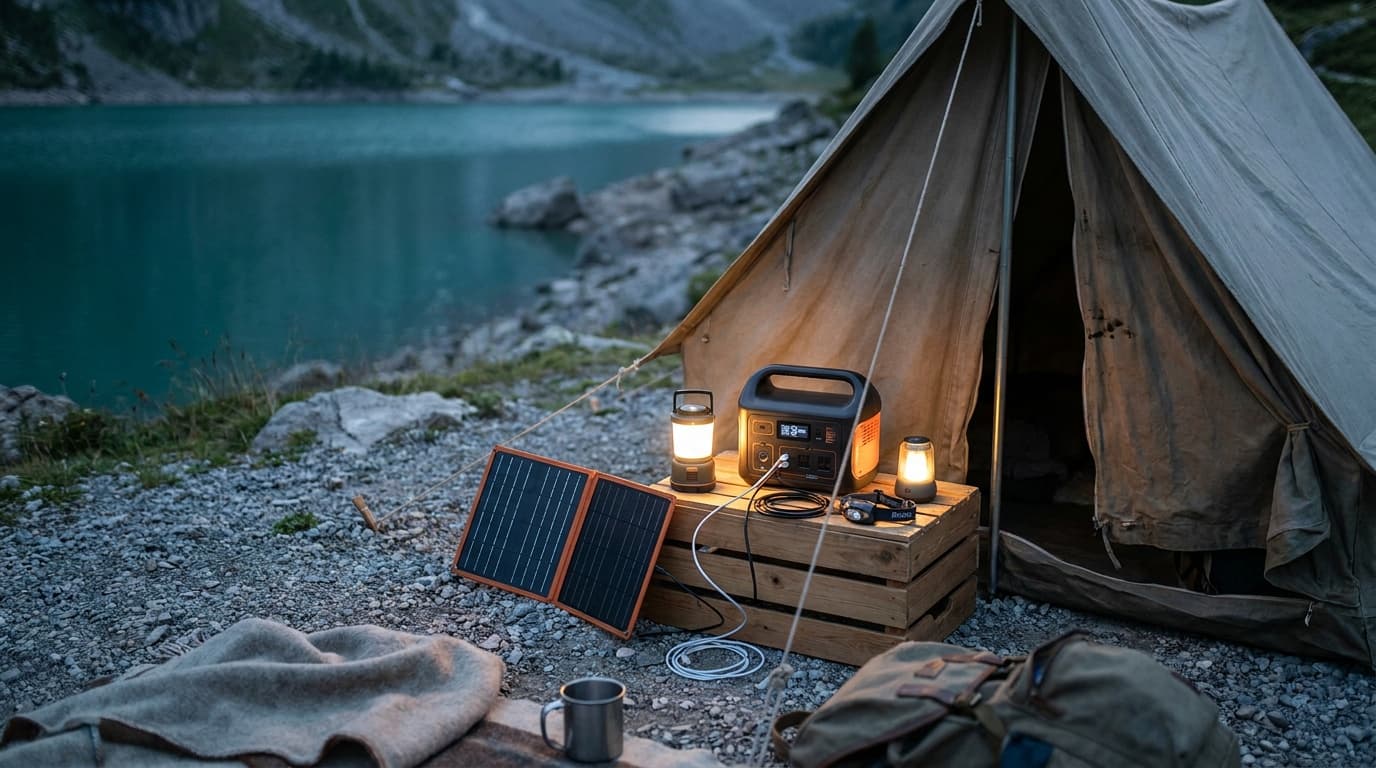
The short answer: 75 to 150 lumens inside the tent, 200 to 400 on the picnic table, and 500 to 1,000 total across a full campsite. The longer answer is about why the headline number on the box almost never reflects what you will actually use.
Why peak lumens mislead
Under the ANSI/PLATO FL 1 standard, the lumen spec on a camping lantern is measured exactly 30 seconds after turn-on using an integrating sphere. That 30-second burst is the highest the LED can sustain before heat and battery draw force a step-down. Most lanterns reduce output within the first few minutes of use.
The same standard defines runtime as the point when output drops to 10% of initial brightness, not when the light actually goes dark. So a lantern advertised as running 50 hours at 65 lumens and 1.5 hours at 3,000 lumens is technically meeting the spec on both claims. Neither number tells you what the lantern actually does across a five-hour evening around camp.
ANSI FL 1 is also voluntary. Brands that do not comply can print any number they choose with no penalty.
Buy range, not peak. A lantern that dims smoothly from 10 to 300 lumens is more useful on a trip than a two-mode light with a 1,500-lumen high and a 150-lumen low.
Lumens by scenario
The numbers below come from gear guides and lighting research, not one-size-fits-all specs. Your eyes adapt to ambient light around the campfire, so "enough" changes depending on what else is lit.
Tent interior: 75 to 150 lumens
A standard four-person tent is a small, enclosed, reflective nylon space. At 75 to 150 lumens (the range a compact lantern like the LuminAID PackLite Nova is built for) you can read, play cards, organize gear, and find what you dropped. Above 200 lumens the light bounces off every surface and creates uncomfortable glare. Going above that threshold does not make the task easier; it just bleaches the space.
Picnic table and cooking area: 200 to 400 lumens
A 300-lumen lantern centered on a picnic table fills the cooking and eating zone without lighting up neighboring sites. That range covers meal prep, card games, and any camp task that requires seeing both hands at once. You do not need more than 400 lumens for a table, and running a lantern at its lowest comfortable setting extends battery life substantially.
Full campsite: 500 to 1,000 lumens total
A campsite with a fire pit, cook station, and gear area needs 500 to 1,000 lumens, and that total is best distributed across two or three lanterns at table height rather than one fixture at full output overhead. Two 500-lumen lanterns like the BioLite AlpenGlow 500 placed at the cook zone and the seating area cover even a large site more evenly than one 1,000-lumen lantern hung from a branch.
Group base camp (six or more people, multi-tent layout): 1,000 to 1,500 lumens
Larger groups benefit from more total output, but the same principle applies: spread the sources across the site. Three lanterns at 400 lumens each outperform one at 1,200 for coverage, glare control, and the practical reason that a single lantern failure does not go dark on the whole group.
Headlamp for camp tasks: 100 to 150 lumens
A camp headlamp like the Petzl Actik Core covers cooking, dish washing, and nighttime trips to the bear box at 100 to 150 lumens. The 300-to-1,000-lumen range on a headlamp is for trail use where the beam needs to reach 50 feet or more. Running a 600-lumen headlamp on full blast inside a tent is the same problem as the 400-lumen lantern: too much for the space.
Match output to the task
Sleeping and reading in the tent
75 to 150 lumens, aim for a warm-tinted low mode to help your eyes wind down.
Cooking and eating at a table
200 to 400 lumens from a lantern placed at table height, not overhead.
Moving around the campsite at night
100 to 150 lumens on a headlamp; full output only if you are navigating trail.
Full base camp, multiple activity zones
500 to 1,000 lumens total, split across two to three sources.
Group camp with six or more people
1,000 to 1,500 lumens distributed, one lantern per activity zone.
How to read runtime specs before you buy
The headline runtime on a lantern box almost always refers to the lowest mode, which may be so dim it is impractical. The useful number is runtime at a mid setting close to what you will actually use.
Reading runtime specs honestly
Find the mode you will actually use
Identify the output level closest to 200 to 300 lumens, the realistic evening setting.
Check runtime at that mode
If the spec sheet only lists high and low, the mid-mode runtime is usually not on the box. Look for it on the manufacturer site or in gear reviews.
Apply the 10% rule
Remember that ANSI-rated runtime ends at 10% of initial brightness, not zero. A "20-hour" lantern at 250 lumens may dim noticeably before hour 20.
Plan battery for multi-night trips
For two or more nights, choose a lantern with a usable low mode at 50 to 100 lumens with a long rated runtime at that setting, and bring a backup source.
FAQ
How many lumens do I need for a camping lantern?
It depends on what you are lighting. A tent interior is comfortable at 75 to 150 lumens. A campsite table needs 200 to 400. A full base camp with a cooking area and fire circle is covered by 500 to 1,000 lumens spread across two or three lights. Most car campers do fine with one 400-to-500-lumen lantern on a mid setting and a 100-lumen backup inside the tent.
Why do camping lanterns advertise 1,000 or 2,000 lumens if you only need a few hundred?
The headline lumen number is measured at 30 seconds after turn-on, which is the peak the LED can sustain briefly. Most lanterns step down after a few minutes because the battery cannot maintain that draw and because the heat would damage the LED over time. The practical brightness you use all evening is almost always the mid or low mode, which is a fraction of the advertised number. Check the runtime at medium mode, not the turbo spec.
Does a higher-lumen lantern mean longer battery life?
No, higher output drains the battery faster. A lantern running at 3,000 lumens might last 1.5 hours; the same lantern at 250 lumens can run 20 hours. Under the ANSI FL 1 standard, published runtime ends when the light drops to 10% of initial brightness, so even those numbers favor the manufacturer. For multi-night trips, choose a lantern with a usable low mode at 50 to 150 lumens and a long rated runtime at that setting.
For specific models across every price range, see our guide to the best camping lanterns. Browse the full camp gear hub, or read how we research and rate.
Recommended gear
Our current top picks from the Best camping lanterns 2026: 5 picks by budget and use guide, if you are ready to buy.
BIOLITE
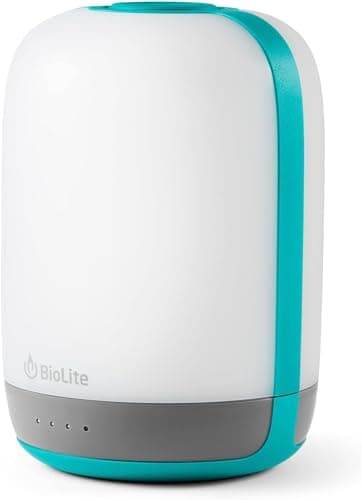
BioLite AlpenGlow 500 Lantern
Best Overall
Kit Score 8.5/10
$79.95 Price checked Oct 23, 4:16 PM CDT
Best for: Car campers and tent campers who want versatile ambiance lighting, a reliable power bank backup, and the widest set of modes in a mid-size package.
- Dims from 500 lumens down to 5, so one lantern covers cooking light and a soft in-tent glow
- Micro-USB charge port is outdated compared to competitors moving to USB-C, and the port seal has shown minor water ingress in heavy rain
- Max Lumens
- 500 (manufacturer rating)
- Runtime
- 5 hrs (high) / 200 hrs (low)
- Battery
- 6,400 mAh Li-Ion, micro-USB charge-in
- Weight
- 13.4 oz (380 g)
- Water Resistance
- IPX4
- Charge Out
- USB-A 5V/2.4A (device charging)
About this pick
The AlpenGlow 500 balances genuine campsite brightness with a wide range of lighting modes, from dimmable cool and warm white down to candle flicker and full multicolor cycling. Its 6,400 mAh battery doubles as a power bank and the ChromaReal LEDs (CRI 90) render colors accurately in low-light conditions.
Strengths
- Dims from 500 lumens down to 5, so one lantern covers cooking light and a soft in-tent glow
- 200-hour low-end runtime means you can run it at ambient brightness for a full weekend trip without recharging
- ChromaReal broad-spectrum LEDs produce warmer, more natural light than most lanterns at this price
Weaknesses
- Micro-USB charge port is outdated compared to competitors moving to USB-C, and the port seal has shown minor water ingress in heavy rain
- Single-button interface with shake activation has a learning curve and occasionally requires a repeat shake to change modes
Kit Score breakdown

Best for: Backpackers and weight-conscious campers who want USB-C recharging, IP66 protection, and enough output for a campsite without carrying a heavy lantern.
- IP66 rating is the strongest weatherproofing here: it handles direct water spray, not just splashes, which matters on exposed campsites
- High mode steps down to roughly 50% brightness after 20 minutes due to thermal management, so peak output is not sustained
- Max Lumens
- 650 (combined 360 and downward modes)
- Runtime
- About 5 hrs on high (independent test; Fenix rates 10) / up to 408 hrs (lowest)
- Battery
- 21700 Li-Ion 5,000 mAh, USB-C charge-in
- Weight
- 7.02 oz without battery (273 g with battery)
- Water Resistance
- IP66
- Power Bank
- USB-A 5V/2A output; 5,000 mAh capacity
About this pick
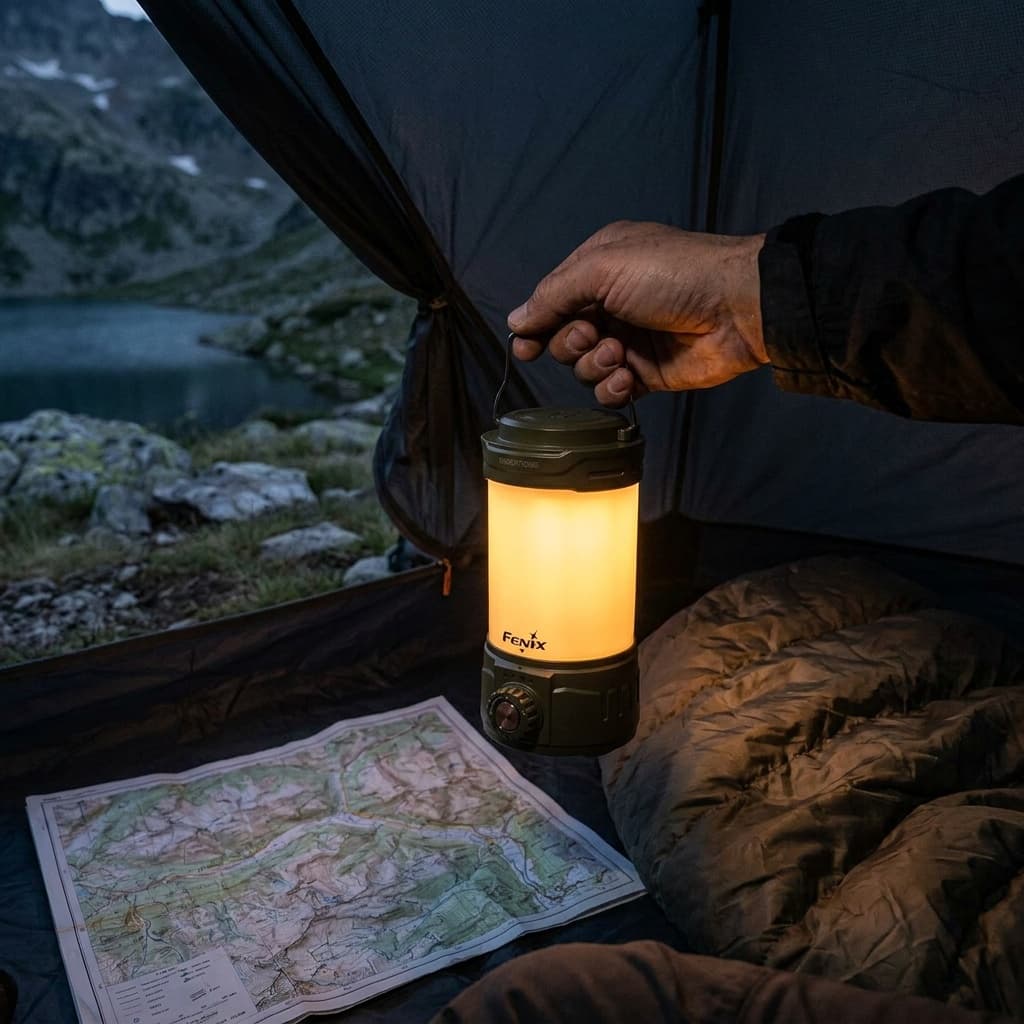
The CL26R Pro is the most compact high-output lantern in this group: it weighs 199 g before its battery goes in, runs on a single included 21700 cell, and carries IP66 dust-and-water protection. Nine modes (seven white, two red) include separate 360-degree ambient levels and a forward-facing beam.
Strengths
- IP66 rating is the strongest weatherproofing here: it handles direct water spray, not just splashes, which matters on exposed campsites
- Rotary knob plus single button gives the most intuitive one-handed control of any lantern in this group, no mode memorization required
- 408-hour low-end runtime on one included 5,000 mAh cell: a week-long trip on low mode is realistic without a recharge
Weaknesses
- High mode steps down to roughly 50% brightness after 20 minutes due to thermal management, so peak output is not sustained
- The folding handle has raised durability questions in independent testing, though it holds up under normal camping use
Kit Score breakdown
LUMINAID
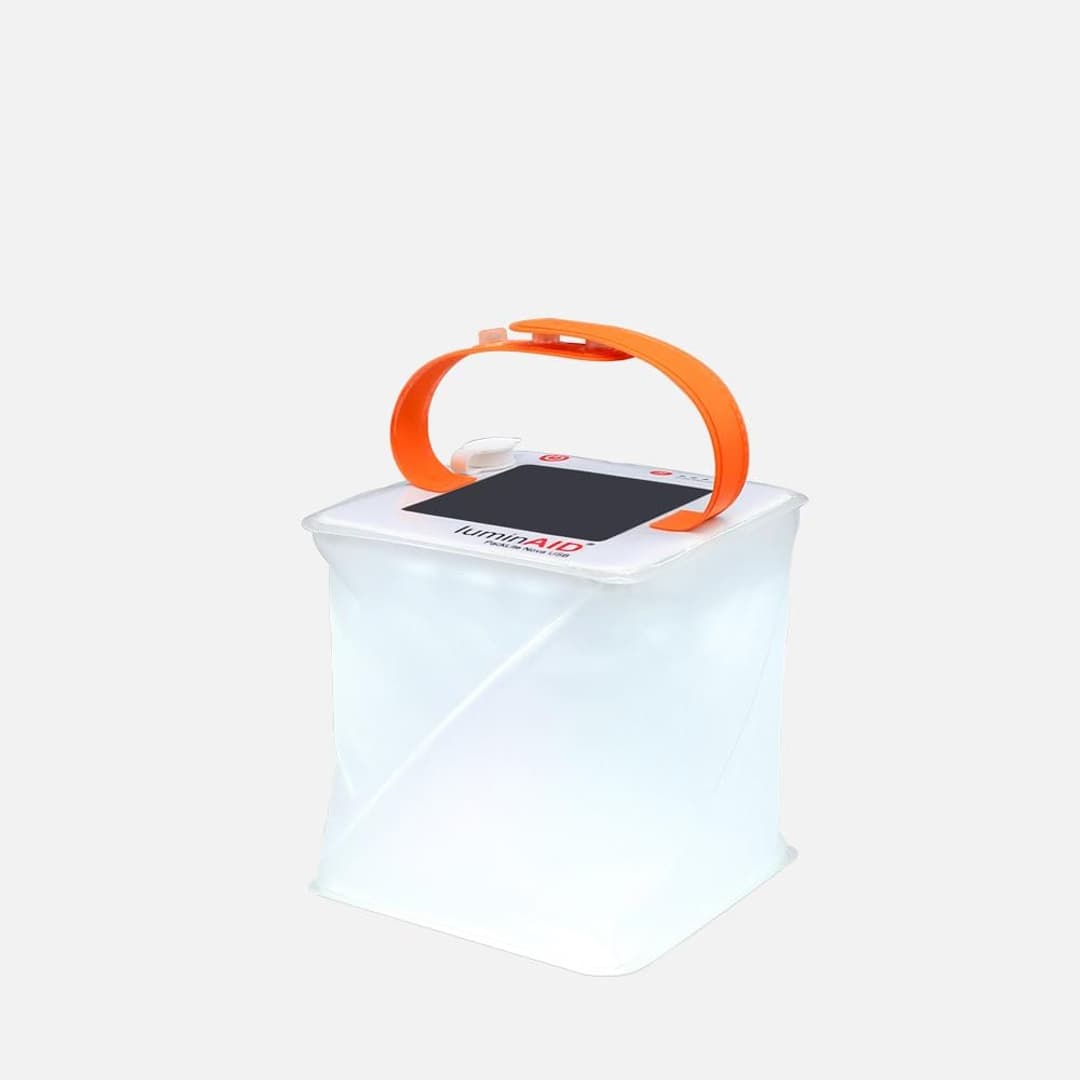
LuminAID PackLite Nova USB Solar Lantern
Best Budget
Kit Score 8.2/10
$32.99 Price checked Oct 23, 4:16 PM CDT
Best for: Backpackers, families, travelers, and emergency-kit builders who want a light, inexpensive lantern that can recharge itself in daylight.
- Compresses to one inch thick and weighs 5 ounces, so it disappears into a pack or emergency kit
- The 75-lumen ceiling is for a tent or close-range task, not a group cooking area
- Max Lumens
- 75
- Runtime
- Up to 24 hrs on low
- Charging
- About 10 hrs solar; 1–2 hrs by micro-USB
- Weight
- 5 oz (142 g)
- Water Resistance
- IP67 waterproof; floats
- Packed Size
- 4.75 x 4.75 x 1 in
About this pick
The PackLite Nova is a 5-ounce inflatable lantern that compresses to one inch thick, charges from the sun or USB, and produces up to 75 lumens through a soft cube-shaped diffuser. It is waterproof, floats, and runs for up to 24 hours on low, making it a practical personal light for tents, emergency bins, and travel.
Strengths
- Compresses to one inch thick and weighs 5 ounces, so it disappears into a pack or emergency kit
- Solar charging works without a separate panel, while micro-USB can refill it in 1 to 2 hours before a trip
- The waterproof inflatable body floats and spreads light more evenly than a bare flashlight beam
Weaknesses
- The 75-lumen ceiling is for a tent or close-range task, not a group cooking area
- This Nova model does not charge a phone, and its soft body should be kept away from sharp tools
Kit Score breakdown
See all picks in Best camping lanterns 2026: 5 picks by budget and use
Keep going
Related guides
 Complete camp loadoutCar-camping starter kitBuild the complete kit
Researched, not hands-on tested
Updated Jul 29, 2026Our recommendations draw on manufacturer documentation, retailer listings, owner feedback, and comparisons with alternatives.
As an Amazon Associate I earn from qualifying purchases. We may earn a commission from links here, at no extra cost to you. How we research →