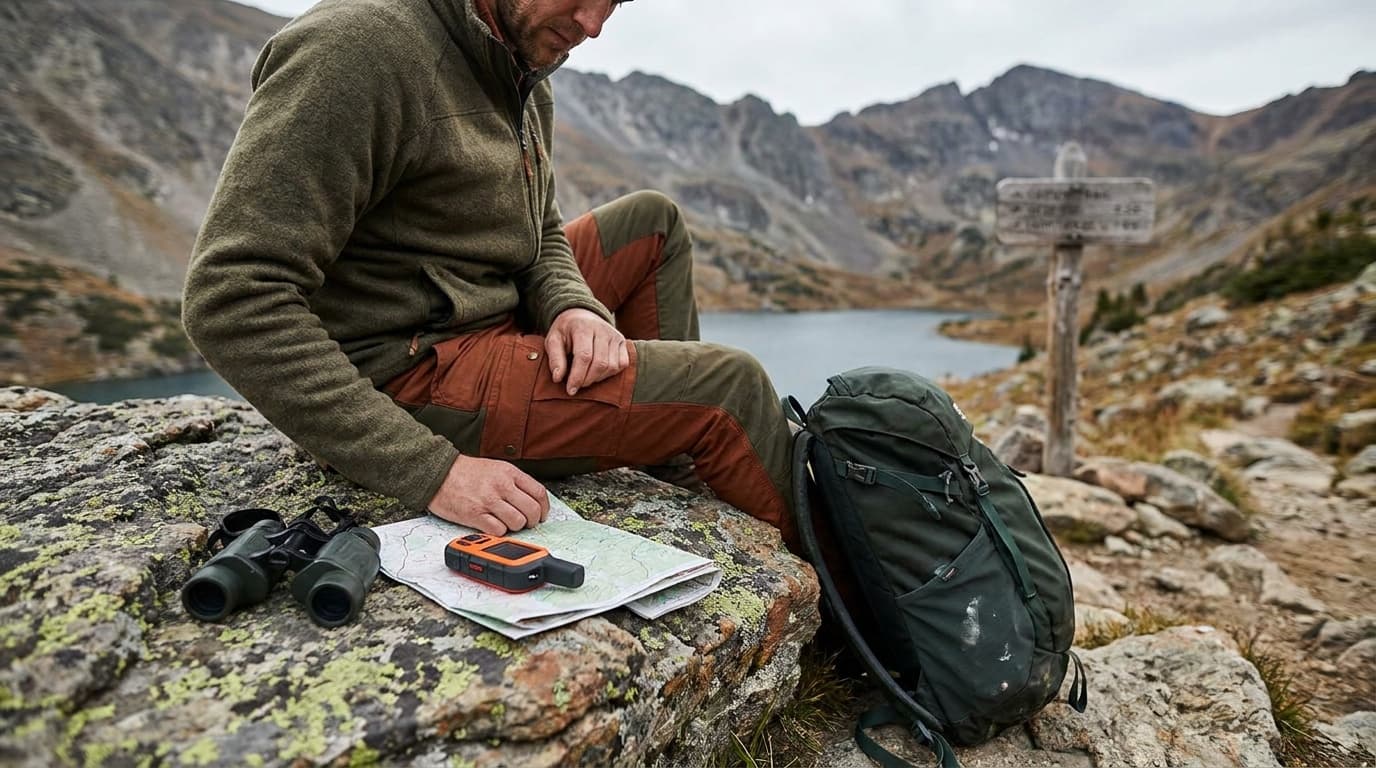
Cell coverage ends well before the trailhead on most serious backcountry routes, and a twisted ankle three miles from the nearest road can turn a bad day into a life-threatening one. Understanding what satellite communication actually buys you, and what it doesn't, is the starting point for making a clear-eyed decision.
When a satellite messenger is genuinely worth it
The honest answer is that most day hikers on well-trafficked trails with a reliable turnaround plan do not need one. But several situations tip the scale clearly toward yes.
Solo travel is the most straightforward case. When you are alone, a fall or medical event leaves no one to go for help. A messenger means rescue services know your location the moment you trigger SOS, not six hours later when you fail to return.
Remote backcountry, defined as routes where cell service is absent and other parties are unlikely, raises the stakes similarly. Trips into the Wind Rivers, the Alaska Range, the Sierra Nevada high country, or any international expedition fall into this category. At that distance from infrastructure, the window between an injury and a treatable injury closes faster than most people expect.
Hunting is a strong use case that often goes unmentioned in hiking-focused coverage. Hunters frequently split from their group, cover dense terrain without marked trails, and carry firearms and heavy loads that increase the risk of a serious fall. Two-way messaging also lets you coordinate pack-out logistics without cell service.
Overlanding on remote forest roads and desert tracks follows the same logic. Vehicle recovery is a separate skill set, but knowing you can call for help, share your location, and stay in contact with a party at base is exactly what these devices are built for.
Two-way messenger vs SOS-only vs phone satellite SOS
These three categories solve different problems at different price points.
Two-way satellite messengers like the Garmin inReach Mini 3, inReach Messenger, and SPOT X send and receive short text messages over satellite networks, share a live GPS track, and trigger a monitored SOS that connects to a 24/7 response center. The response center can coordinate with local SAR, relay messages to family, and request specific resources. This two-way loop is genuinely useful: rescuers can tell you help is four hours out, or ask whether you need a helicopter or a ground team.
SOS-only devices (older SPOT Gen4) send a distress signal and a GPS coordinate but cannot receive a reply. You trigger it and wait. They are cheaper and simpler, but you are operating blind after you push the button.
PLBs (Personal Locator Beacons) like the ACR ResQLink View RLS transmit on 406 MHz directly to the COSPAS-SARSAT government satellite system, which routes the alert to the appropriate rescue coordination center at no cost beyond the device. No subscription ever. The trade-off: no two-way messaging, no tracking, and activation puts a rescue operation in motion immediately, so PLBs are strictly for true emergencies, not "I'm delayed, don't worry" check-ins.
Phone satellite SOS (Apple Emergency SOS via Satellite on iPhone 14 and later, Google's equivalent on Pixel 9 and later) is a meaningful safety net for casual outdoor users. It is genuinely useful on a day hike where conditions change unexpectedly. It is not a substitute for a dedicated device on multi-day backcountry trips: battery life is constrained, the messaging is limited, and it depends on the phone surviving the same event that prompted you to call for help.
A satellite messenger is not about being reckless in the backcountry with a safety net. It is about being serious enough about remote travel to close the one gap that skill and preparation cannot cover.
The subscription reality
Garmin bills inReach plans monthly. The Enabled plan is $7.99 a month and keeps SOS active while charging per message; Essential ($14.99) adds unlimited check-ins and 50 texts; Standard ($29.99) and Premium ($49.99) add more messages and tracking. Every plan carries a one-time $39.99 activation fee.
For occasional users, Garmin lets you suspend service for up to 12 months at no cost, so you can pay only for the months you are out. ZOLEO's plans run $19.99 or $34.99 a month with a 3-month minimum, and a $4.50 monthly pause after that.
PLBs are a one-time purchase with no plan. U.S.-coded beacons must be registered with NOAA, which is free (other countries have their own registries). That is the full cost. If you primarily want an emergency-only backstop with zero recurring expense, a PLB is the most cost-efficient answer.
Choosing the right device for your situation
Solo day hiker, established trails
Phone satellite SOS (iPhone 14+ or Pixel 9+) is a reasonable baseline at no added cost.
Weekend backcountry trips, occasional
PLB for pure emergency coverage with no subscription; accept the lack of tracking and two-way messaging.
Frequent backcountry, solo or remote
Garmin inReach Mini 3 or inReach Messenger, or a budget-friendly [ZOLEO Satellite Communicator](/api/go?product=zoleo-satellite-communicator&retailer=amazon&article=do-you-need-a-satellite-messenger); tracking and two-way messaging justify the monthly plan.
Guides, hunters, overlanders, expedition
Full two-way messenger plus a satellite-capable phone as backup; consider Iridium-based devices such as inReach and ZOLEO for polar or remote travel, since Iridium covers the globe pole to pole.
International travel, polar or maritime
PLB registered in the relevant country plus a two-way messenger; verify which satellite network has coverage in your specific region.
Who can reasonably skip it
A satellite messenger is not for everyone. If you hike on well-marked trails within a national park, stick to a defined itinerary filed with someone reliable, travel with a group of two or more, and stay within a region where SAR response is measured in hours rather than days, the risk calculus is genuinely different.
The honest version of skipping it is not "nothing bad will happen" but rather "other safety measures (trip plan, group size, trail traffic, cell coverage at the trailhead) reduce my exposure enough that the subscription cost doesn't pay." That is a defensible position for many hikers.
What is not defensible is assuming that a smartphone with maps is equivalent to a satellite communicator. Maps do not call for help.
Frequently asked questions
Does a satellite messenger work everywhere in the world?
Coverage depends on the satellite network. Garmin inReach uses the Iridium constellation, which provides true global coverage including polar regions. SPOT uses the Globalstar network, which has gaps above roughly 70 degrees latitude and in some canyon environments. Check the specific network map for your destination before travel, particularly for international or high-latitude trips.
Can I use my satellite messenger instead of filing a trip plan?
No. A messenger is a recovery tool, not a prevention tool. Filing a trip plan with a reliable contact ensures someone will initiate a search if you don't return, even if your messenger is damaged, lost, or its battery dies before you can trigger SOS. Use both.
Is a PLB or a two-way messenger better for solo backcountry travel?
For most solo backcountry users who go out more than once or twice a year, a two-way messenger is worth the subscription cost. The ability to send a non-emergency check-in, share a live track with family, and receive confirmation that help is coming after an SOS activation makes the device meaningfully more useful than a PLB. A PLB is the right answer for rare trips or for travelers who want the lowest possible long-term cost and are comfortable with SOS-only capability.
Where these numbers come from
| Claim | Source | Checked |
|---|---|---|
| Garmin inReach plans: Enabled $7.99, Essential $14.99 (unlimited check-ins, 50 texts), Standard $29.99, Premium $49.99 a month; $39.99 activation; SOS on every plan; suspend up to 12 months at $0 | Garmin inReach consumer plans | 2026-10-03 |
| ZOLEO plans: $19.99 and $34.99 a month, 3-month minimum, $4.50 monthly pause | ZOLEO monthly plans | 2026-10-03 |
| U.S.-coded 406 MHz beacons must be registered with NOAA; registration is free | NOAA SARSAT: register your beacon, NOAA SARSAT FAQ | 2026-10-03 |
| Iridium network covers the globe pole to pole | Iridium network | 2026-10-03 |
| inReach Mini 3 and inReach Messenger are current Garmin models with two-way messaging and interactive SOS | Garmin: Comparing the inReach Messenger series and inReach Mini 3 series | 2026-10-03 |
For specific picks across budget and use-case categories, see our guide to the best satellite messengers. Browse all hike guides or read how we research and rate gear.
Recommended gear
Our current top picks from the Best satellite messengers for backcountry hiking 2026 guide, if you are ready to buy.
GARMIN
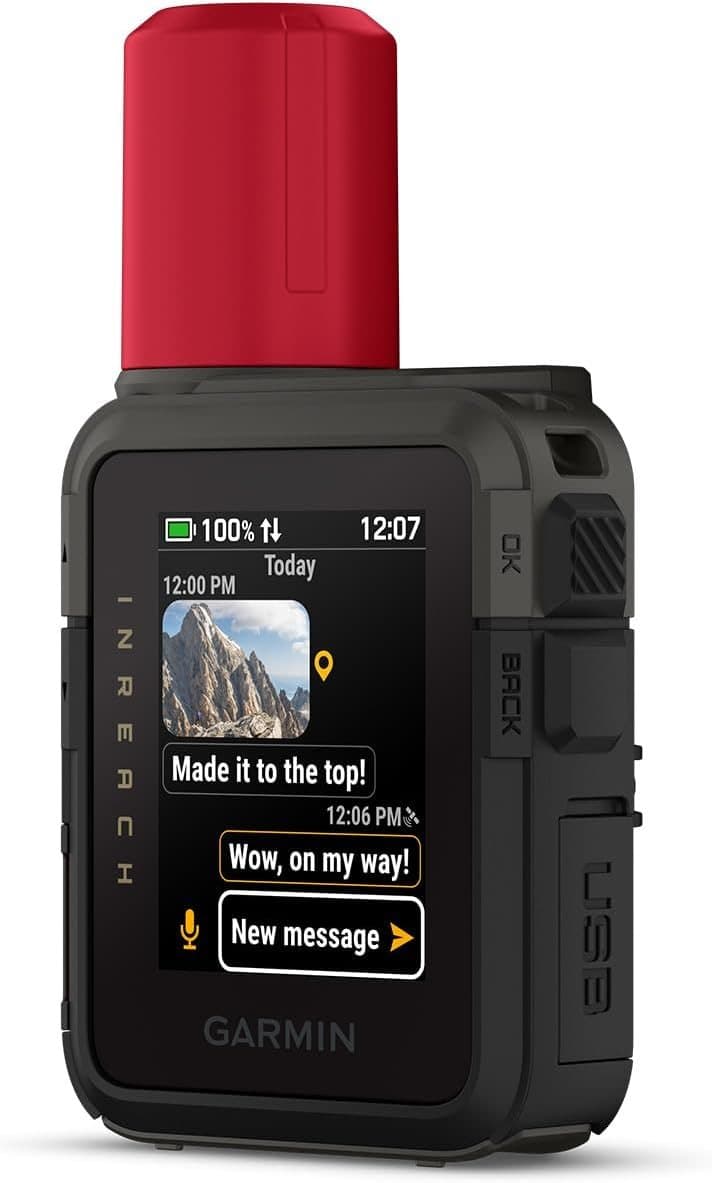
Garmin inReach Mini 3 Plus
BEST SATELLITE MESSENGER
Kit Score 8.8/10
$445.75 Price checked Oct 23, 4:16 PM CDT
Best for: Hikers who navigate with a phone or watch and want the lightest way to add two-way satellite messaging and SOS.
- Satellite texts, photos, voice, and SOS at 4.42 oz
- Not a standalone mapping GPS; it relies on your phone for maps
- Display
- 1.9 in color MIP touchscreen, 306 x 230
- Battery
- Up to 350 hr with 10-min tracking; 95 hr in performance messaging mode
- Satellites
- Multi-band GPS, Galileo, QZSS, BeiDou
- Maps
- Basemap only; topo maps through the paired phone app
- Satellite comms
- inReach Plus: texts, photos, voice messages, interactive SOS (plan required)
- Build
- 4.42 oz, IP67, compass
About this pick
The inReach Mini 3 Plus replaces the Mini 2 as Garmin's smallest two-way satellite communicator. It adds a 1.9-inch color touchscreen and inReach Plus, so you can send photos and 30-second voice messages as well as texts and SOS, and Garmin rates it at up to 350 hours with 10-minute tracking. It pairs with your phone for maps.
Strengths
- Satellite texts, photos, voice, and SOS at 4.42 oz
- Up to 350 hours with 10-minute tracking
- Picked by Treeline Review, Backpacker, Switchback Travel, and GearJunkie
Weaknesses
- Not a standalone mapping GPS; it relies on your phone for maps
- Needs a monthly inReach plan, and photo and voice messages count against plan limits
Kit Score breakdown
Best for: Backpackers and remote-area travelers who want reliable two-way messaging and interactive SOS on a single charge for multi-week trips.
- Longest battery of any inReach here: up to 672 hours with 10-minute tracking, at 4 oz
- No onboard maps or navigation: best treated as a communicator paired with a separate GPS, not a standalone navigator
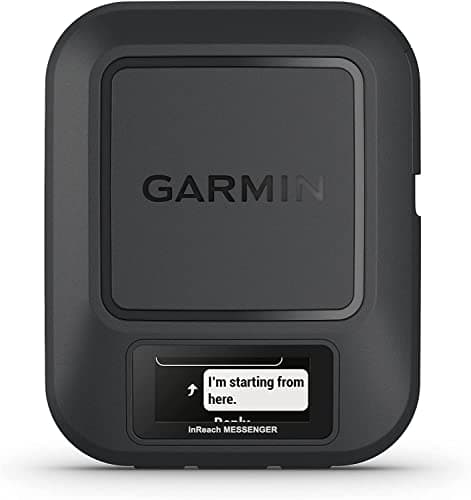
- Satellite network
- Iridium (global)
- Weight
- 4 oz (113.9 g)
- Battery life
- Up to 672 hours (28 days) with 10-min tracking
- Water resistance
- IPX7
- Subscription (entry)
- inReach plans from $7.99/month plus $39.99 activation
- Communication type
- Two-way text + SOS
About this pick
A compact, two-way Iridium satellite communicator that Garmin rates at up to 672 hours (28 days) with 10-minute tracking, with Safety Charging to top off a depleted phone. Paired with the Garmin Messenger app, it switches between satellite, cellular, and Wi-Fi to save satellite messages.
Strengths
- Longest battery of any inReach here: up to 672 hours with 10-minute tracking, at 4 oz
- Seamless network switching between satellite, cellular, and Wi-Fi reduces message costs on trips that pass through coverage
- Reverse USB-C charging lets it serve as an emergency power bank for a phone
Weaknesses
- No onboard maps or navigation: best treated as a communicator paired with a separate GPS, not a standalone navigator
- Small screen and button-driven UI make composing long messages on the device itself cumbersome
Kit Score breakdown
GARMIN
Garmin inReach Mini 3
BEST TOUCHSCREEN MESSENGER
Kit Score 8.5/10
$389.99 Price checked Oct 23, 4:16 PM CDT
Best for: Hikers who want a small inReach they can text from without a phone, and do not need photo or voice messages.
- Two-way satellite texts and interactive SOS at 4.31 oz
- No photo or voice messages; that needs the Mini 3 Plus
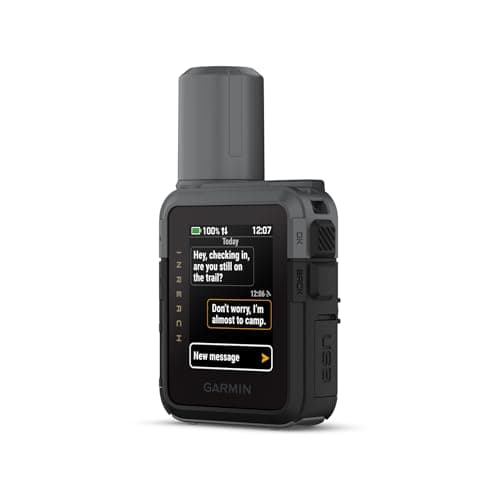
- Display
- 1.9 in color MIP touchscreen plus buttons, 306 x 230
- Battery
- Up to 350 hr with 10-min tracking
- Satellites
- Multi-band GPS, Galileo, QZSS, BeiDou
- Maps
- Basemap only; topo maps through the paired phone app
- Satellite comms
- Two-way texts (160 characters) and interactive SOS over Iridium (plan required)
- Build
- 4.31 oz, IP67, MIL-STD-810, compass
About this pick
The inReach Mini 3 is the touchscreen successor to the Mini 2 without the Plus model's photo and voice messaging. Garmin gives it a 1.9-inch color touchscreen with physical buttons, multi-band GPS, an IP67 rating, and up to 350 hours with 10-minute tracking, and it sends two-way texts and an interactive SOS over Iridium. It pairs with your phone for maps.
Strengths
- Two-way satellite texts and interactive SOS at 4.31 oz
- Color touchscreen and on-screen keyboard, with physical buttons for gloves
- Up to 350 hours with 10-minute tracking, and it can top up a phone
Weaknesses
- No photo or voice messages; that needs the Mini 3 Plus
- Not a mapping GPS on its own, and it needs a monthly inReach plan
Kit Score breakdown
See all picks in Best satellite messengers for backcountry hiking 2026
Keep going
Related guides
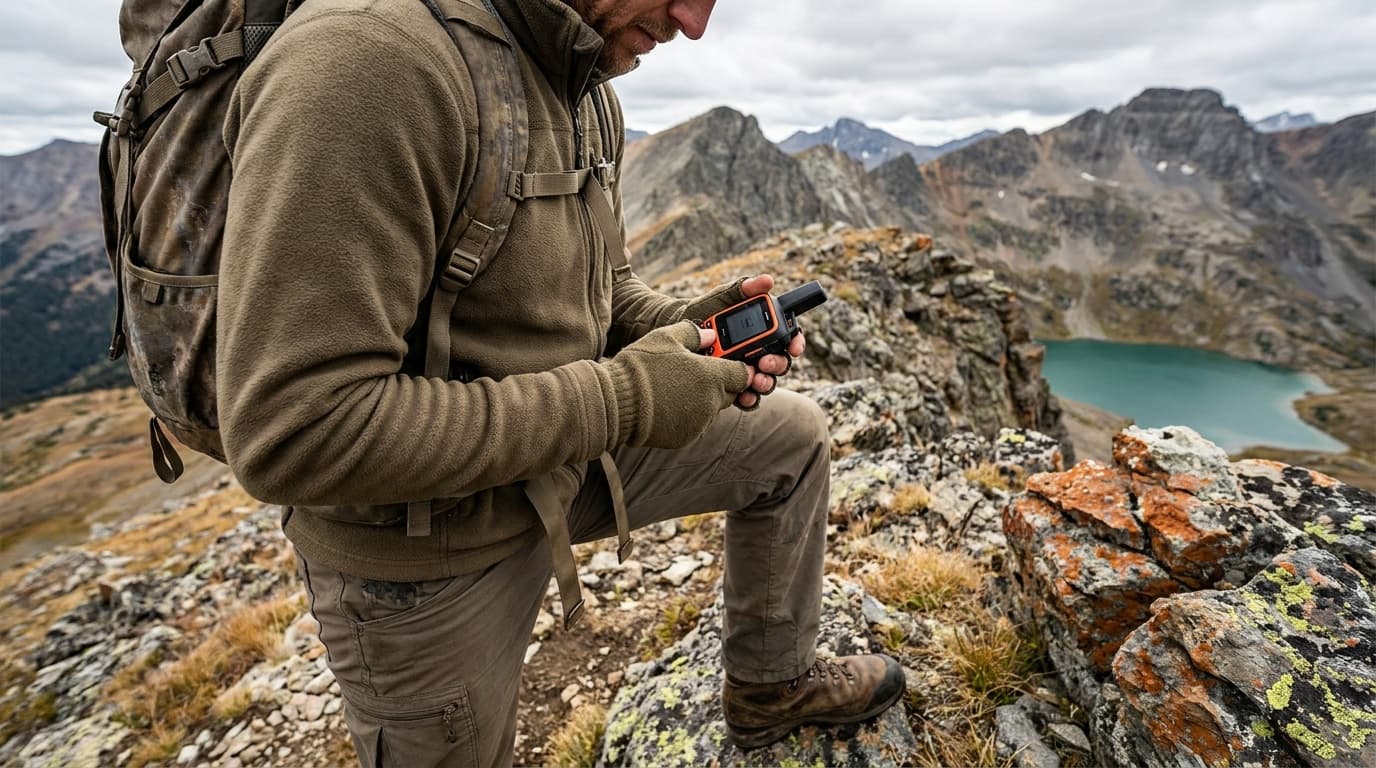
 Complete hike loadoutDay hike kitBuild the complete kit
Researched, not hands-on tested
Updated Oct 3, 2026Our recommendations draw on manufacturer documentation, retailer listings, owner feedback, and comparisons with alternatives.
As an Amazon Associate I earn from qualifying purchases. We may earn a commission from links here, at no extra cost to you. How we research →