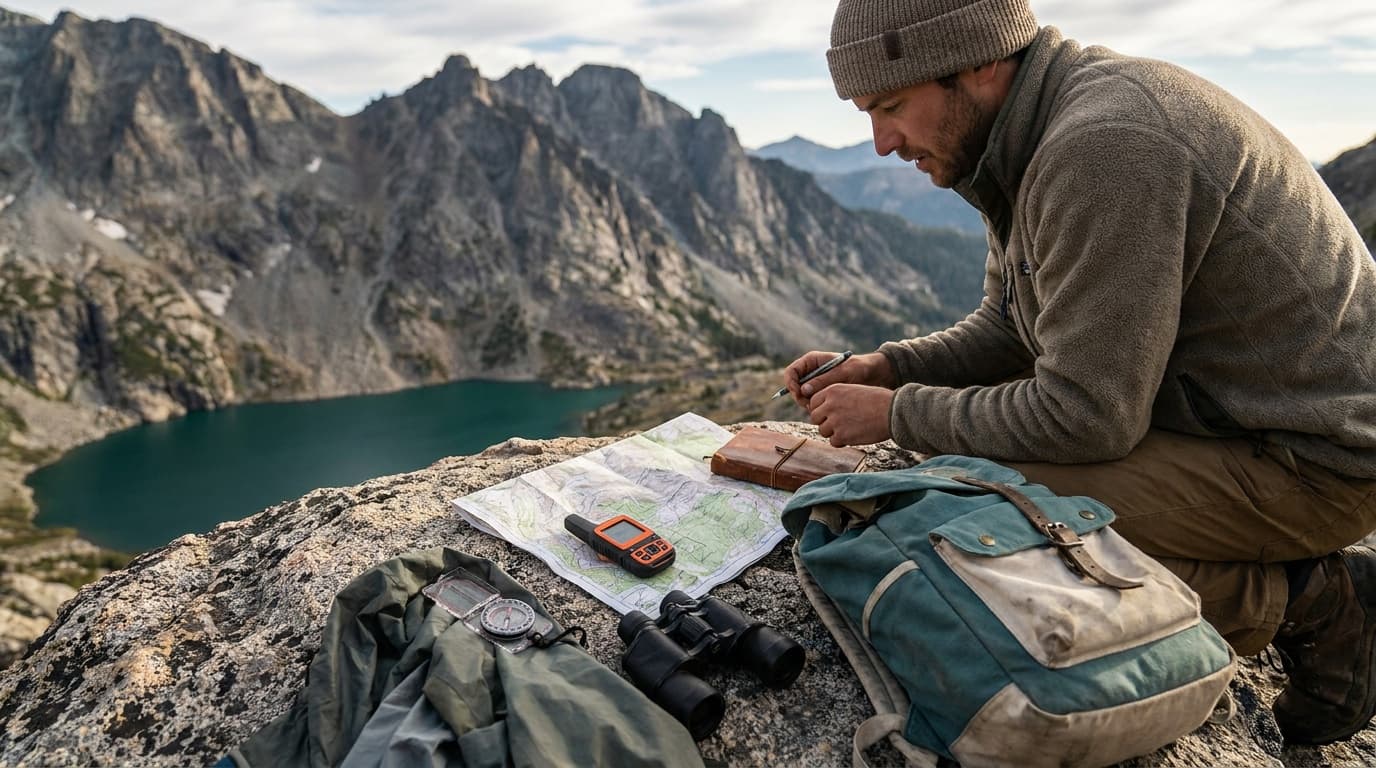
Choose a two-way satellite messenger when check-ins, tracking, weather, and communicating details during an emergency justify an ongoing plan. Choose a PLB when you want a long-life, subscription-free SOS device for genuine emergencies and do not need messaging. Both can summon rescue, but they use different networks and solve different communication needs.
Compare current two-way devices in our guide to the best satellite messengers.
How each technology works
A satellite messenger (like the Garmin inReach Mini 3 or inReach Messenger, SPOT X, Zoleo, or Bivy Stick) uses commercial satellite networks like Iridium or Globalstar to pass short messages in both directions. You can text your family, share a live track, and receive weather forecasts. When you press SOS, the device contacts the company's 24/7 monitoring center, which then coordinates with local search and rescue.
A PLB (personal locator beacon) like the ACR ResQLink View RLS transmits a single distress signal on 406 MHz directly to the international COSPAS-SARSAT satellite system, which is operated jointly by the US, Russia, Canada, and France. That signal goes straight to NOAA's Mission Control Center and then to the appropriate rescue coordination center. There is no middleman company, no subscription, and no dependency on a commercial network staying solvent. Registration is free with NOAA.
A PLB's SOS goes directly to a government rescue system that has been running continuously since 1982; a messenger's SOS goes to a private monitoring center first.
Real-world reliability and coverage
Both technologies work in the backcountry, but with meaningful differences.
Iridium-based messengers (inReach, Bivy Stick) have near-global pole-to-pole coverage. Globalstar-based devices (SPOT) have coverage gaps at high latitudes and in some equatorial regions. Check the coverage map for your specific device before a remote trip.
PLBs operating on 406 MHz reach COSPAS-SARSAT satellites regardless of which commercial network is up. Modern PLBs also include a 121.5 MHz homing signal and GPS coordinates in the distress burst, which lets rescue teams home in within 100 meters. Response time depends entirely on local SAR resources, not on network latency.
Cost comparison over five years
The upfront prices are similar. The ongoing costs are not.
Five-year total cost (approximate)
PLB hardware
$250–$350 one-time; register free with NOAA; replace battery every 5–7 years (~$100 service)
Messenger hardware
$150–$400 depending on model; the [ZOLEO Satellite Communicator](/api/go?product=zoleo-satellite-communicator&retailer=amazon&article=satellite-messenger-vs-plb) sits at the budget end
Messenger subscription (basic)
$15/month x 60 months = $900 over five years
Messenger subscription (full-featured)
$35–$50/month x 60 months = $2,100–$3,000 over five years
Carrying both
Add PLB cost (~$300) to your messenger costs for maximum redundancy
Subscription pricing is the decisive factor for most buyers. If you hike heavily for three months a year and suspend the plan for nine months, costs drop significantly. Most messenger providers allow seasonal suspension for a small holding fee.
What each device does well
Messengers shine in scenarios where communication matters as much as rescue. You can send a "running late, don't call SAR" message before your family panics. You can request a non-emergency medical evacuation for a twisted ankle. You can share your track with a partner monitoring from home. During multi-day trips, the ability to receive weather updates can change your route before conditions deteriorate.
PLBs are optimized for one scenario: the genuine life-threatening emergency. They are simpler to operate under stress (flip the cover, pull the antenna, press the button). They have no subscription to lapse and no app to update. Search and rescue agencies and mariners have trusted them for decades precisely because there is nothing to go wrong beyond the battery, which is date-stamped on the housing.
The clear verdict
Choose a satellite messenger if: you hike solo and want to stay in contact with people at home, you want live tracking shared with family or a trip partner, or you value the ability to send a non-emergency update before a situation escalates.
Choose a PLB if: you want the lowest total cost over multiple years, you operate in extreme environments where battery life and ruggedness matter most, or you want a completely subscription-free safety net.
Choose both if: you are heading into genuinely remote terrain, sailing offshore, or you want a PLB as a backup in case your messenger battery dies or the commercial network has an outage. Many guides and expedition leaders carry a charged PLB alongside their day-to-day messenger for exactly this reason.
Neither device replaces navigation skills, a solid trip plan left with someone reliable, and the judgment to turn around early.
Frequently asked questions
Do I need to register a PLB, and what happens if I forget?
Yes. US PLBs must be registered free at beaconregistration.noaa.gov with your contact information and typical activity area. An unregistered or outdated registration slows rescue response because coordinators cannot immediately verify the signal or reach your emergency contacts. Set a calendar reminder to update your registration whenever your contact info changes.
Can a satellite messenger replace a PLB entirely?
For most recreational hikers, yes. A messenger with a monitored SOS (Garmin inReach uses GEOS 24/7 monitoring) is a capable life-safety device. The practical gap is subscription dependency and battery life: if your messenger battery runs out on day three of a five-day trip, you have no SOS. A PLB's 72-hour active transmission time and multi-year shelf battery fills that gap. Neither device is wrong; it depends on your trip length, remoteness, and risk tolerance.
Which satellite network is most reliable for messengers?
Iridium (used by Garmin inReach and Bivy Stick) has the broadest coverage, including polar regions, because its 66 low-earth-orbit satellites cover the entire globe. Globalstar (SPOT) has strong mid-latitude coverage but documented gaps above roughly 70 degrees north or south. For trips in Alaska, Greenland, Patagonia, or Antarctic regions, an Iridium-based device is the safer choice.
For specific picks, see our guide to the best satellite messengers. Browse all hike guides or read how we research and rate gear.
Recommended gear
Our current top picks from the Best satellite messengers for backcountry hiking 2026 guide, if you are ready to buy.
GARMIN
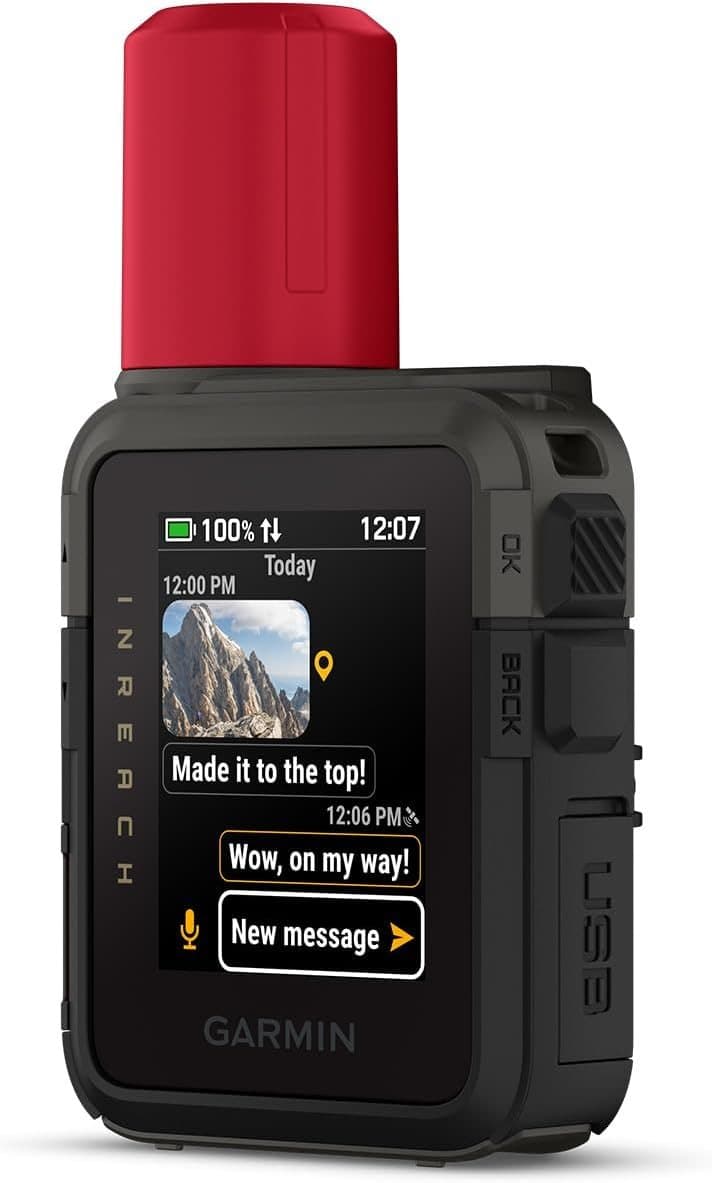
Garmin inReach Mini 3 Plus
BEST SATELLITE MESSENGER
Kit Score 8.8/10
$445.75 Price checked Oct 23, 4:16 PM CDT
Best for: Hikers who navigate with a phone or watch and want the lightest way to add two-way satellite messaging and SOS.
- Satellite texts, photos, voice, and SOS at 4.42 oz
- Not a standalone mapping GPS; it relies on your phone for maps
- Display
- 1.9 in color MIP touchscreen, 306 x 230
- Battery
- Up to 350 hr with 10-min tracking; 95 hr in performance messaging mode
- Satellites
- Multi-band GPS, Galileo, QZSS, BeiDou
- Maps
- Basemap only; topo maps through the paired phone app
- Satellite comms
- inReach Plus: texts, photos, voice messages, interactive SOS (plan required)
- Build
- 4.42 oz, IP67, compass
About this pick
The inReach Mini 3 Plus replaces the Mini 2 as Garmin's smallest two-way satellite communicator. It adds a 1.9-inch color touchscreen and inReach Plus, so you can send photos and 30-second voice messages as well as texts and SOS, and Garmin rates it at up to 350 hours with 10-minute tracking. It pairs with your phone for maps.
Strengths
- Satellite texts, photos, voice, and SOS at 4.42 oz
- Up to 350 hours with 10-minute tracking
- Picked by Treeline Review, Backpacker, Switchback Travel, and GearJunkie
Weaknesses
- Not a standalone mapping GPS; it relies on your phone for maps
- Needs a monthly inReach plan, and photo and voice messages count against plan limits
Kit Score breakdown
Best for: Backpackers and remote-area travelers who want reliable two-way messaging and interactive SOS on a single charge for multi-week trips.
- Longest battery of any inReach here: up to 672 hours with 10-minute tracking, at 4 oz
- No onboard maps or navigation: best treated as a communicator paired with a separate GPS, not a standalone navigator
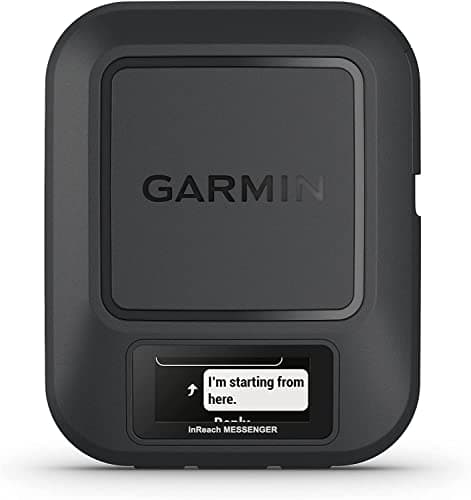
- Satellite network
- Iridium (global)
- Weight
- 4 oz (113.9 g)
- Battery life
- Up to 672 hours (28 days) with 10-min tracking
- Water resistance
- IPX7
- Subscription (entry)
- inReach plans from $7.99/month plus $39.99 activation
- Communication type
- Two-way text + SOS
About this pick
A compact, two-way Iridium satellite communicator that Garmin rates at up to 672 hours (28 days) with 10-minute tracking, with Safety Charging to top off a depleted phone. Paired with the Garmin Messenger app, it switches between satellite, cellular, and Wi-Fi to save satellite messages.
Strengths
- Longest battery of any inReach here: up to 672 hours with 10-minute tracking, at 4 oz
- Seamless network switching between satellite, cellular, and Wi-Fi reduces message costs on trips that pass through coverage
- Reverse USB-C charging lets it serve as an emergency power bank for a phone
Weaknesses
- No onboard maps or navigation: best treated as a communicator paired with a separate GPS, not a standalone navigator
- Small screen and button-driven UI make composing long messages on the device itself cumbersome
Kit Score breakdown
GARMIN
Garmin inReach Mini 3
BEST TOUCHSCREEN MESSENGER
Kit Score 8.5/10
$389.99 Price checked Oct 23, 4:16 PM CDT
Best for: Hikers who want a small inReach they can text from without a phone, and do not need photo or voice messages.
- Two-way satellite texts and interactive SOS at 4.31 oz
- No photo or voice messages; that needs the Mini 3 Plus
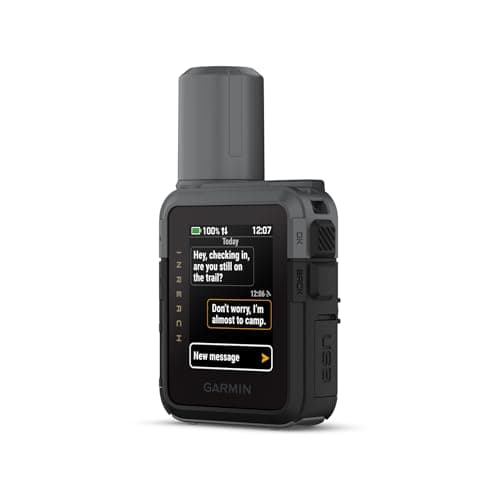
- Display
- 1.9 in color MIP touchscreen plus buttons, 306 x 230
- Battery
- Up to 350 hr with 10-min tracking
- Satellites
- Multi-band GPS, Galileo, QZSS, BeiDou
- Maps
- Basemap only; topo maps through the paired phone app
- Satellite comms
- Two-way texts (160 characters) and interactive SOS over Iridium (plan required)
- Build
- 4.31 oz, IP67, MIL-STD-810, compass
About this pick
The inReach Mini 3 is the touchscreen successor to the Mini 2 without the Plus model's photo and voice messaging. Garmin gives it a 1.9-inch color touchscreen with physical buttons, multi-band GPS, an IP67 rating, and up to 350 hours with 10-minute tracking, and it sends two-way texts and an interactive SOS over Iridium. It pairs with your phone for maps.
Strengths
- Two-way satellite texts and interactive SOS at 4.31 oz
- Color touchscreen and on-screen keyboard, with physical buttons for gloves
- Up to 350 hours with 10-minute tracking, and it can top up a phone
Weaknesses
- No photo or voice messages; that needs the Mini 3 Plus
- Not a mapping GPS on its own, and it needs a monthly inReach plan
Kit Score breakdown
See all picks in Best satellite messengers for backcountry hiking 2026
Keep going
Related guides
 Complete hike loadoutDay hike kitBuild the complete kit
Researched, not hands-on tested
Updated Oct 3, 2026Our recommendations draw on manufacturer documentation, retailer listings, owner feedback, and comparisons with alternatives.
As an Amazon Associate I earn from qualifying purchases. We may earn a commission from links here, at no extra cost to you. How we research →