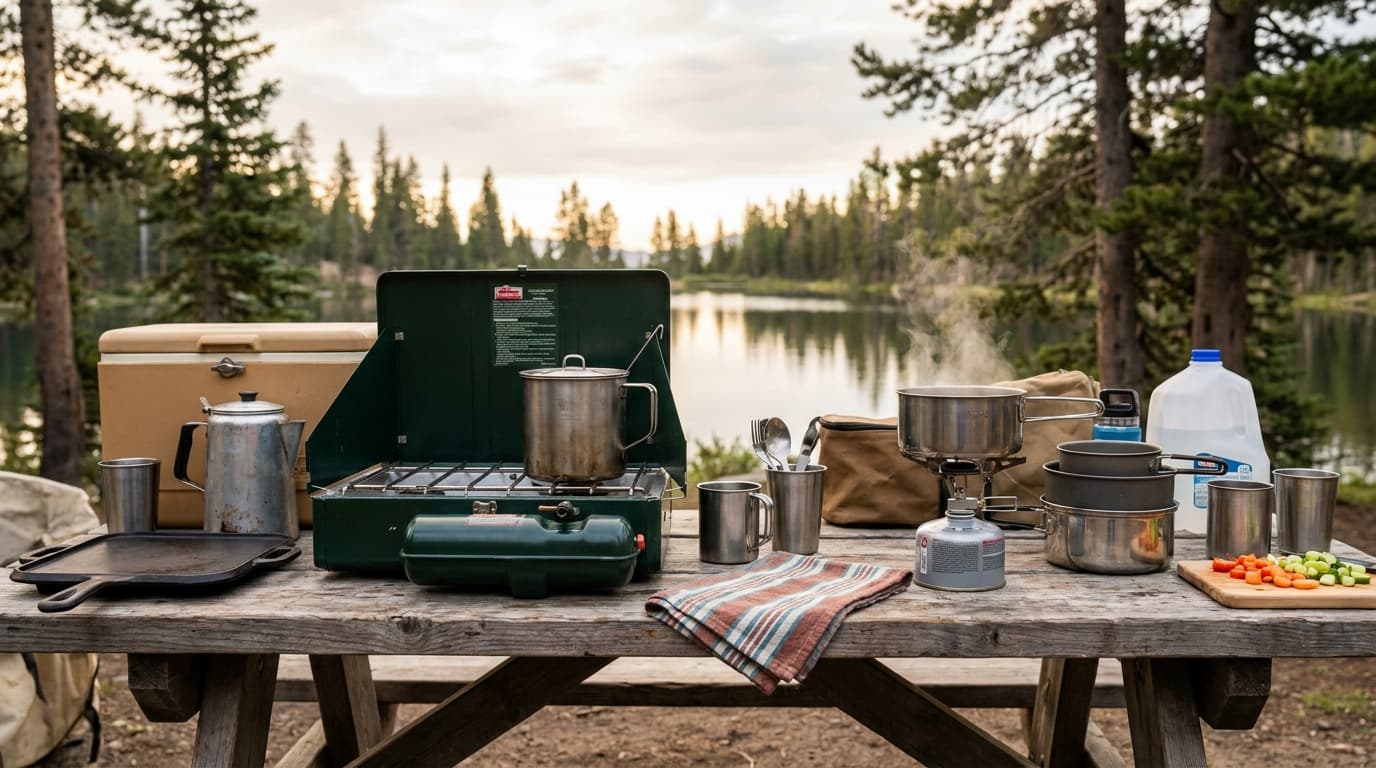
The fuel in your canister determines whether dinner happens or whether you are eating cold oatmeal at 9,000 feet. Propane, isobutane, and n-butane are not interchangeable in cold weather, and the cheap canister at the gas station is not the same thing as the one at REI.
The boiling points that explain everything
Every canister fuel has a temperature floor below which it simply will not vaporize. That floor is its boiling point. Fall below it and the fuel stays liquid, pressure in the canister collapses, and the burner goes silent.
Those numbers are not abstractions. They are the reason a canister stove that worked fine in August sputters and dies at a shoulder-season basecamp, and why a full canister can feel heavy while delivering nothing.
Propane: the cold-weather floor and the weight penalty
Propane's -42C boiling point is a genuine advantage. It vaporizes in conditions that paralyze every other canister fuel. For car camping in cold weather, propane is the obvious choice: Coleman 1-lb cylinders are on shelves at gas stations, hardware stores, and most grocery chains. Weight is irrelevant when the stove rides in the car.
The trade-off is vapor pressure. At 70F (21C), propane reaches roughly 850 PSI. That figure forces canister manufacturers to use thick-walled steel, adding around 110g over a comparable isobutane canister. For backpacking, that weight penalty matters. For a two-burner car-camping stove like the Camp Chef Everest 2X running off a large propane tank, it is irrelevant.
For car camping in cold weather, propane is the default. Weight does not matter when it rides in the back of your truck.
Isobutane: the backpacker's default
Isobutane's -12C (11F) boiling point covers virtually every three-season above-freezing campsite. Its vapor pressure at room temperature sits at roughly 350 PSI, less than half of propane's, which is why isobutane canisters can be made with thinner, lighter walls.
Nearly every major backpacking brand sells an isobutane-dominant blend. The most cited formulation is MSR IsoPro: 80% isobutane, 20% propane. The propane fraction pushes the effective cold-weather floor down; the isobutane provides manageable pressure and lighter construction. MSR notes that manufacturing tolerances allow up to 6% n-butane in a blend, but their production process keeps that figure below 2% in practice.
The practical result: a blended canister in the MSR/Jetboil/Primus family performs reliably in shoulder-season conditions where pure n-butane would fail, without the canister weight that propane demands.
N-butane: the warm-weather-only fuel to know about
N-butane (normal butane) has a boiling point of -1C (30F). Near freezing, it stops vaporizing. Budget canisters, particularly store-brand options from non-specialist retailers, are often 100% n-butane. There is no performance grade on the label to warn you.
If a canister does not say "isobutane" or "iso" somewhere on the packaging, assume n-butane and plan accordingly: fine for a summer car-camping trip, unreliable in October, useless in a snowstorm. MSR notes that 100% n-butane performs acceptably only in warm weather for short periods.
For international travel, the calculus flips. N-butane canisters are the most widely stocked fuel globally, available in markets and camping shops where isobutane blends are rare. Know what you are buying.
Canister compatibility: mostly a solved problem
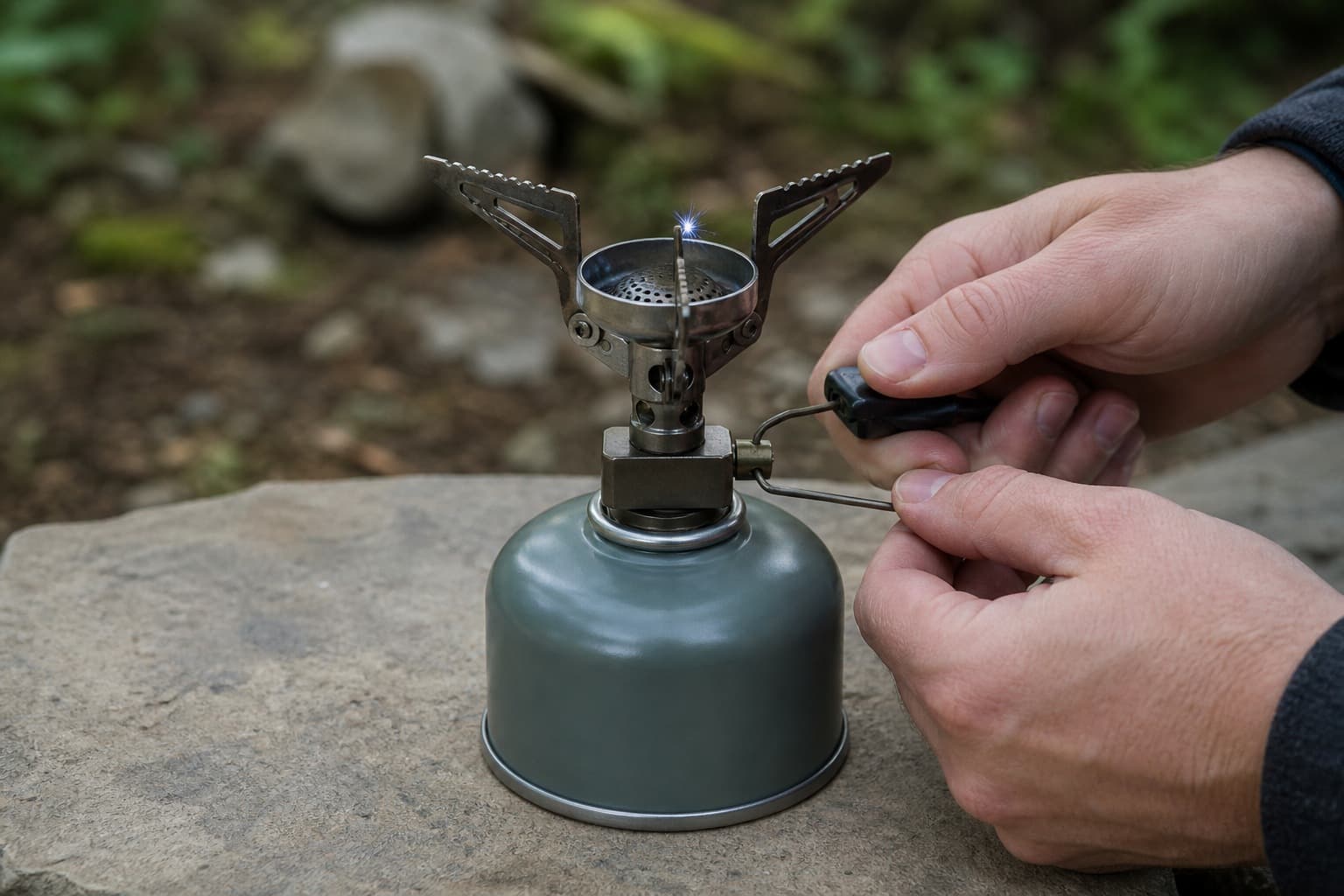
The threaded valve on virtually every backpacking canister sold in the US, UK, or Europe follows the EN 417 standard: the 7/16" UNEF thread, also called the Lindal B188 valve. Any EN 417 stove head mounts any EN 417 canister, regardless of brand or fuel blend.
Checking canister compatibility before you buy
Look for the threaded valve
A threaded metal valve on the canister top means EN 417. MSR, Jetboil, Primus, GSI, Snow Peak, and Coleman (backpacking line) all use it.
Match stove to canister type
Every EN 417 stove head screws onto every EN 417 canister. Brand does not matter.
Watch for non-threaded cartridges
Older Campingaz blue-cap style cartridges are pierceable, not threaded. They use a proprietary push-in connection and are not interchangeable with threaded stoves or canisters.
Skip budget canisters in cold conditions
Budget canisters without "iso" in the name are likely 100% n-butane. Fine in summer, unreliable near or below freezing.
Check the label for the blend
A quality backpacking canister will state the isobutane/propane ratio. If it does not, assume n-butane.
Why your canister sputters with fuel still inside
This is one of the more confusing failure modes in cold-weather camping. The canister feels heavy. The stove hisses and dies. The fuel is not gone.
The issue is the blend ratio shifting as you cook. Propane has a higher vapor pressure than isobutane or n-butane, so it vaporizes out of the liquid mixture first. As a canister empties, the remaining fuel becomes progressively more butane-heavy. In cold conditions, that butane-rich mix cannot generate enough pressure to feed the burner, even though liquid fuel remains.
When to skip canister fuel entirely
A canister stove is the right tool for most three-season backpacking: light, fast, and low maintenance. But canister fuel has a hard limit. Below about -12C (11F), even the best isobutane/propane blend starts to struggle. For genuine winter camping, sustained alpine conditions, or any situation where you need reliability below freezing for days at a time, a white-gas liquid-fuel stove is the more reliable long-term option. White gas is a liquid at ambient temperature and feeds the stove via a hand-pumped pressure system, so boiling point is irrelevant.
For everything above freezing, an isobutane/propane blend in a threaded canister is the default. For car camping in any season, propane and a stove like the Coleman Classic Propane Stove win on availability and cost.
For a practical look at which stove platforms work best with each fuel type, see our guide to the best camping stoves.
FAQ
Why does my canister stove sputter and die in cold weather even though the canister feels heavy?
The canister is not empty: it still has fuel. The problem is vapor pressure. As temperature drops, propane (the high-pressure component) vaporizes out first. What remains is mostly n-butane, which cannot vaporize below about -1C (30F). The canister cannot generate enough pressure to feed the burner. Fix it by warming the canister in a jacket pocket or inside your sleeping bag before and between uses. At sustained sub-freezing temperatures, a liquid-fuel stove running white gas is the more reliable tool.
Are isobutane canisters compatible with all backpacking stoves?
Yes, with one important caveat. Every threaded canister sold under the EN 417 standard uses the Lindal B188 valve thread, and any EN 417 stove head mounts any EN 417 canister regardless of brand. That covers MSR, Jetboil, Primus, GSI, Snow Peak, and essentially every major backpacking brand. The exception is older non-threaded, pierceable Campingaz cartridges, which use a proprietary push-in connection and are not interchangeable with threaded gear. Check for the threaded valve on the canister top before you buy.
What is the difference between butane and isobutane?
Butane and isobutane share the same chemical formula (C4H10) but have different molecular structures. N-butane has a straight-chain structure and a boiling point of about -1C (30F), meaning it stops vaporizing near freezing. Isobutane has a branched structure and a boiling point of about -12C (11F), giving it usable vapor pressure in conditions where n-butane would fail. Isobutane also produces slightly higher vapor pressure at room temperature, which translates to more consistent output as the canister empties. Budget canisters often use n-butane; quality backpacking canisters use isobutane or an isobutane/propane blend.
Browse the full camp gear section for stove reviews, cooking kit, and shelter picks, and see how we research and rate the products and information on this site.
Recommended gear
Our current top picks from the Best camping stoves for car camping (2026) guide, if you are ready to buy.
CAMP CHEF
Camp Chef Everest 2X 2-Burner Camping Stove
Best Overall
Kit Score 8.1/10
$226.63 Price checked Oct 23, 6:22 AM CDT
Best for: Car campers who want a single stove that can sear, saute, and simmer without compromise, and cook fast for groups of two to four.
- Exceptional simmer control despite high peak output: OGL rated simmering 9/10
- At roughly 14 lbs it is bulkier and heavier than budget alternatives
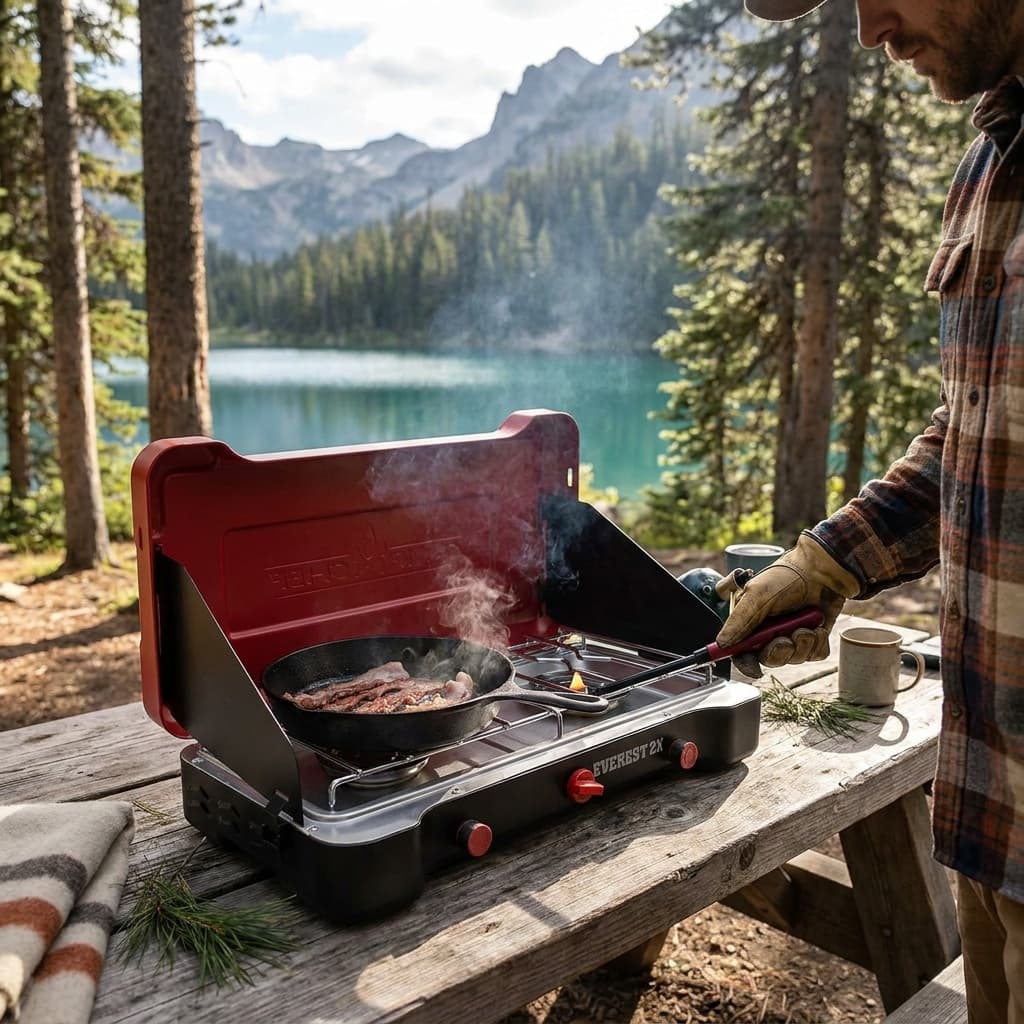
- BTU output
- 40,000 total (20,000 per burner)
- Cooking surface
- 215 sq. in. (21 x 9.5 in.)
- Weight
- 14 lbs
- Packed dimensions
- 24 x 13 x 6 in.
- Ignition
- Matchless piezo
- Fuel
- Propane (1 lb canister or adapter for 5 lb tank)
About this pick
The Everest 2X is the most versatile two-burner propane stove in its class, pairing jet-level output with enough low-end control to hold a steady simmer. A three-sided folding windscreen lid and stainless steel burner heads handle breezy conditions that stall most competitors.
Strengths
- Exceptional simmer control despite high peak output: OGL rated simmering 9/10
- Near-seamless folding windscreen performs well in moderate wind; boil time barely affected by breeze in third-party testing
- Boils 1 liter in about 3 min 21 sec: one of the fastest in class
Weaknesses
- At roughly 14 lbs it is bulkier and heavier than budget alternatives
- Fuel efficiency rated low (5/10 by OGL); burns through propane faster than the Mountaineer or Cascade Classic
Kit Score breakdown
COLEMAN
Coleman Cascade Classic 2-Burner Camping Stove
Best Value
Kit Score 7.7/10
$219.99 Price checked Oct 23, 6:22 AM CDT
Best for: Budget-conscious car campers who prioritize fuel economy and gentle heat control over raw speed, and do most cooking in sheltered sites.
- Lowest fuel consumption among two-burner propane stoves tested: ideal for multi-day trips
- Slow peak boil: averaged 6 min 39 sec for 1 liter, the slowest gas-powered stove in OGL testing
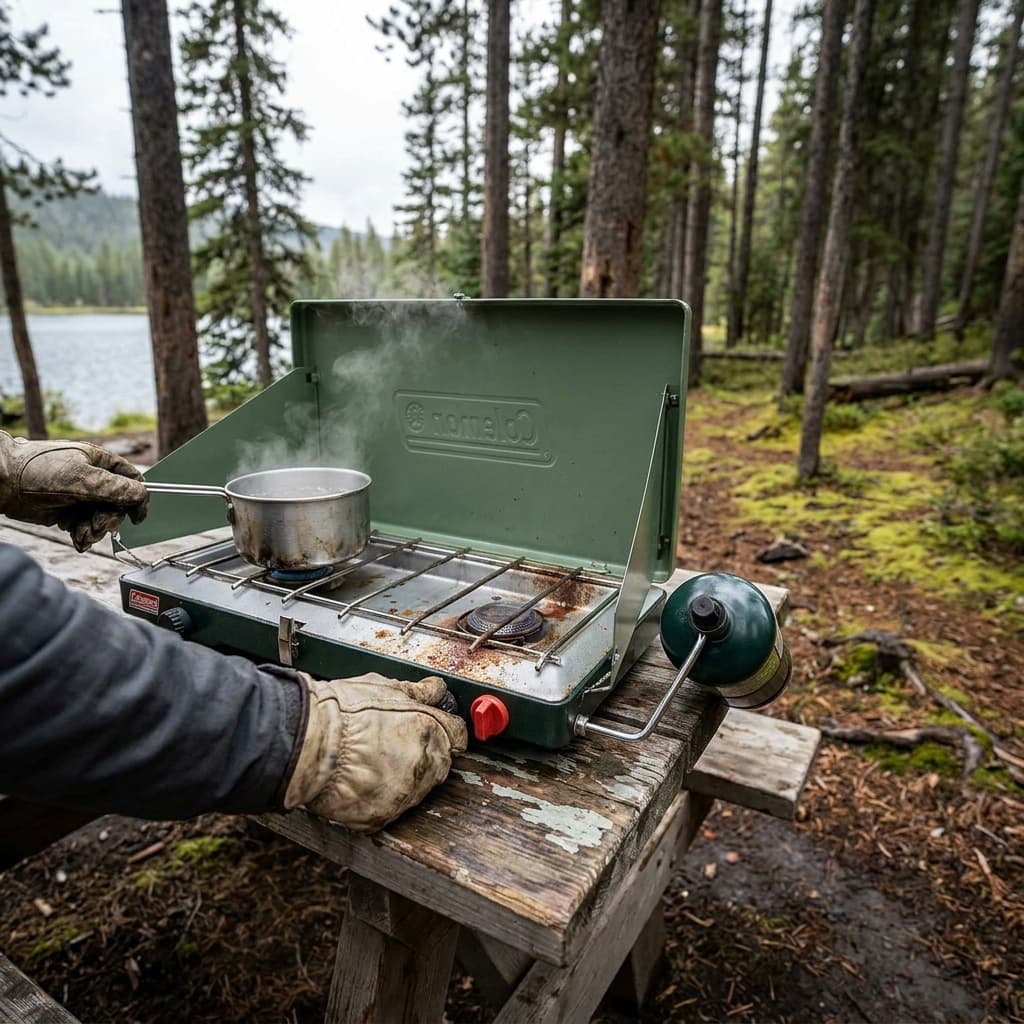
- BTU output
- 20,000 total (10,000 per burner)
- Cooking surface
- 240 sq. in. (20 x 12 in.)
- Weight
- 9.7 lbs
- Packed dimensions
- 21 x 13 x 3.5 in.
- Ignition
- Rotary piezo (matchless)
- Fuel
- Propane (1 lb canister)
About this pick
The Cascade Classic is Coleman's updated two-burner, the lightest full-size propane stove in its price bracket. Reviewers consistently note surprisingly precise simmer control for the price, though peak output is modest and wind resistance is below average.
Strengths
- Lowest fuel consumption among two-burner propane stoves tested: ideal for multi-day trips
- Multi-turn knobs deliver fine simmer control: sauteing and sauce work are manageable
- At 9.7 lbs and under 21 in. packed, it is easy to carry and store
Weaknesses
- Slow peak boil: averaged 6 min 39 sec for 1 liter, the slowest gas-powered stove in OGL testing
- Wind shields provide below-average protection; burners struggle to stay lit in moderate breezes without additional blocking
Kit Score breakdown
CAMP CHEF
Camp Chef Mountaineer 2-Burner Camp Stove
Best Premium
Kit Score 8.1/10
$469.99 Price checked Oct 23, 6:22 AM CDT
Best for: Overlanders, river-trip basecamp cooks, and serious outdoor chefs who cook daily in wind-exposed conditions and want a stove that can run on a 20 lb tank for a week without resupply.
- Top-rated fuel efficiency in OGL testing (10/10): the included 20 lb tank connection lowers per-meal fuel cost significantly
- At $470 it costs roughly twice the Everest 2X for incremental rather than transformative performance gains over that stove
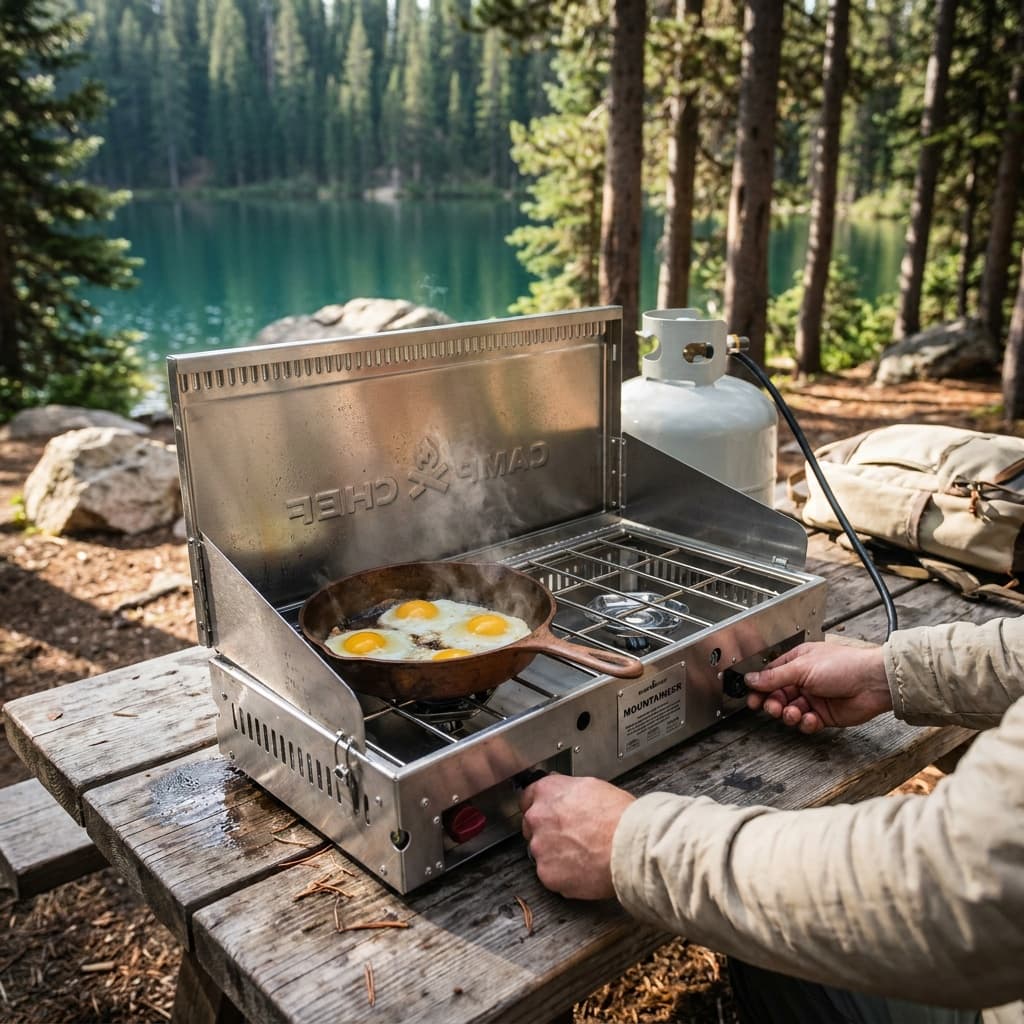
- BTU output
- 40,000 total (20,000 per burner)
- Cooking surface
- 302 sq. in. (24 x 12.5 in.)
- Weight
- 16 lbs
- Packed dimensions
- 25.25 x 13.75 x 5.25 in.
- Body material
- Rust-resistant aluminum
- Fuel
- Propane (compatible with 20 lb tank via included 5 ft hose and regulator)
About this pick
The Mountaineer is the most fuel-efficient stove in its BTU class and the most wind-resistant two-burner unit OGL has tested: only 40 seconds slower in windy versus calm conditions. Comes with a 5-foot hose and regulator for 20 lb propane tanks, a meaningful advantage for extended base camping or overlanding.
Strengths
- Top-rated fuel efficiency in OGL testing (10/10): the included 20 lb tank connection lowers per-meal fuel cost significantly
- Exceptional wind resistance: nearly no boil-time penalty in breezy conditions, outperforming every two-burner stove tested
- Larger 302 sq. in. aluminum cooking surface handles cast iron, large stockpots, and wide skillets simultaneously
Weaknesses
- At $470 it costs roughly twice the Everest 2X for incremental rather than transformative performance gains over that stove
- Heavier and bulkier than any other option here; some owners report latch fit issues requiring adjustment
Kit Score breakdown
Keep going
Complete loadoutCamp kitchen kitA durable base-camp cooking setup built around heat, cookware, coffee, cold storage, workspace, and water.Free tool: Stove Fuel Calculator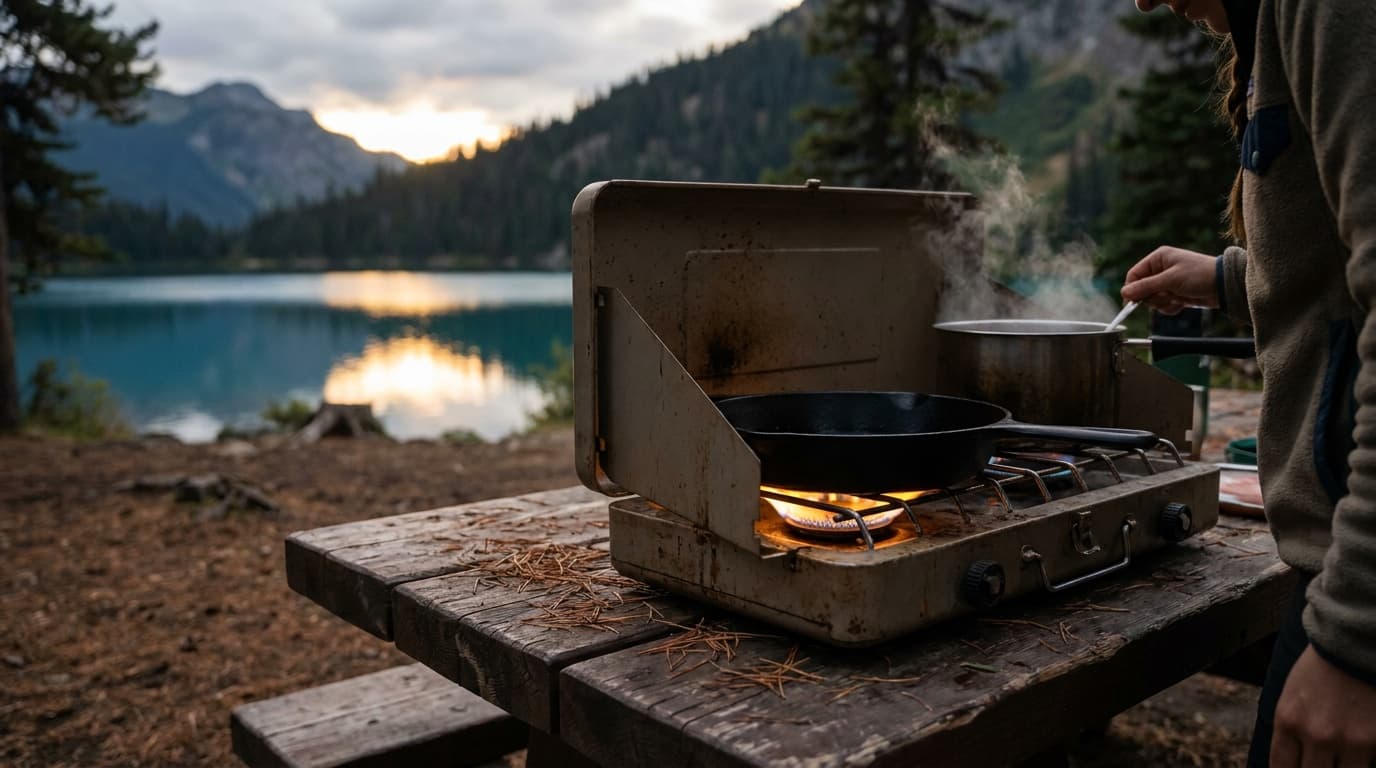
Researched, not hands-on tested
Updated Jun 3, 2026Our recommendations draw on manufacturer documentation, retailer listings, owner feedback, and comparisons with alternatives.
As an Amazon Associate I earn from qualifying purchases. We may earn a commission from links here, at no extra cost to you. How we research →