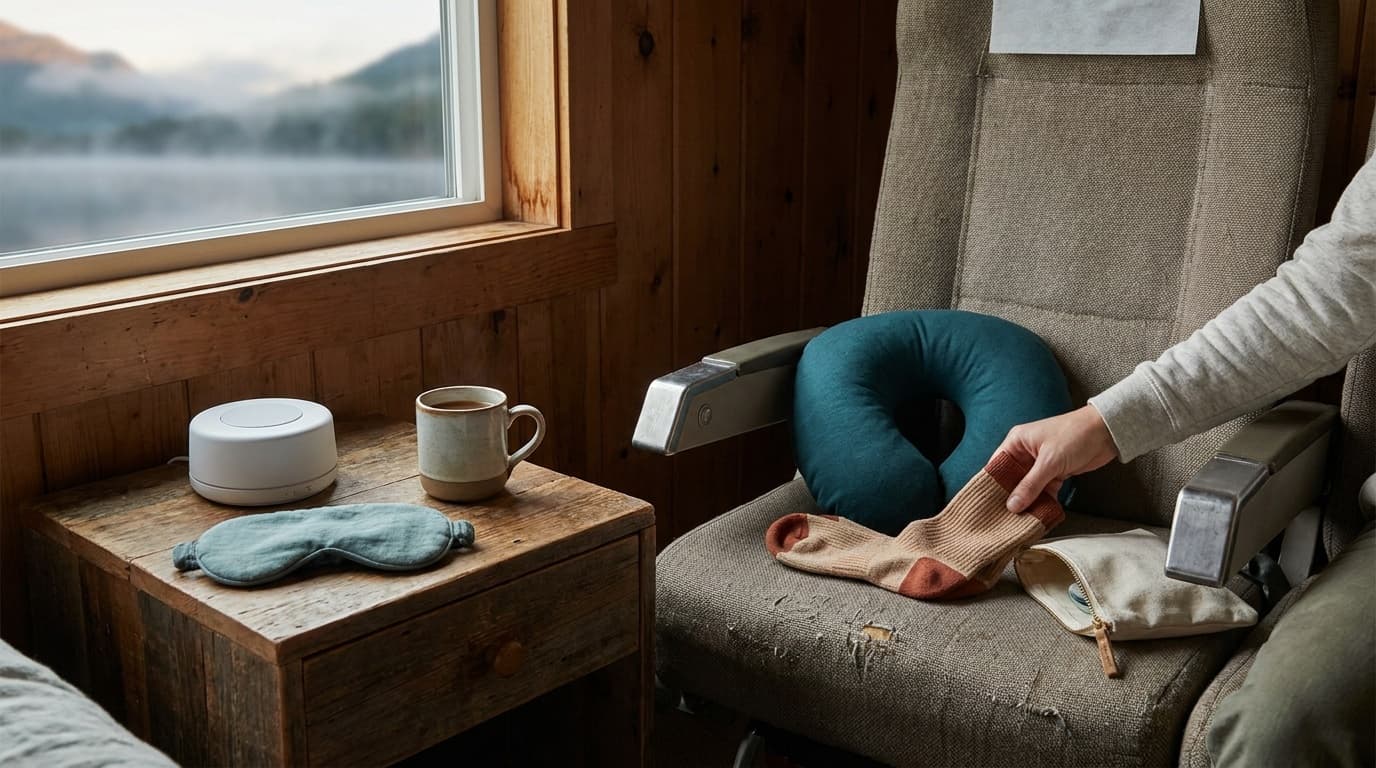
Yes, on long flights. A 2021 Cochrane review of 12 trials (2,918 passengers on flights of at least five hours) found below-knee compression stockings cut symptomless deep vein thrombosis from 47 cases to 3 and reduced ankle swelling, with no significant side effects reported. Clot-prevention guidelines recommend them mainly for travelers with added clot risk; for low-risk flyers they are a comfort choice for swelling.
The DVT risk on long-haul flights
Sitting still for hours in a cramped seat slows venous blood flow in the legs. When blood pools in the deep veins of the calf, the conditions for a clot form. The CDC Yellow Book says long-distance air travel might increase venous thromboembolism (VTE) risk 2- to 4-fold, though the data are inconsistent. The absolute number is still low: studies of flights over four hours report about 1 VTE per 4,656 to 6,000 person-flights.
Serious outcomes are rarer still. A 2001 study (Lapostolle, New England Journal of Medicine) found pulmonary embolism in about 4.8 per million passengers on flights over 10,000 km. But the risk is not evenly distributed: the NHLBI says the chance of VTE nearly doubles every 10 years after age 40, and that compounds with the flight-related risk.
What the clinical evidence actually shows
The most comprehensive evidence comes from a 2021 Cochrane systematic review of 12 randomized trials covering 2,918 passengers on flights of at least five hours. Among the 2,637 passengers with follow-up data, 50 developed a symptomless DVT: 3 who wore stockings and 47 who did not. That is an odds ratio of 0.10, rated high-certainty evidence, meaning sock wearers had roughly one-tenth the odds of subclinical clot formation. Stockings also reduced ankle swelling.
3 clots in the compression group versus 47 in the control group across 12 trials. That is not a marginal signal.
The trials used below-knee stockings with ankle pressures of 10–20 mmHg in five studies and 20–30 mmHg in four others. No significant adverse effects were reported.
How compression socks work
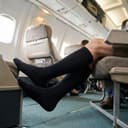
Compression socks apply graduated pressure: highest at the ankle, tapering up the calf. That gradient squeezes the vein walls inward, narrowing the vessel and increasing blood velocity back toward the heart. During prolonged sitting, when the calf-muscle pump is mostly idle, this mechanical assist is what keeps blood from pooling and stagnating.
The pressure rating in millimeters of mercury (mmHg) tells you how much squeeze is applied at the ankle. More is not always better: the right level depends on your baseline vascular health and what you are asking the socks to do.
Choosing the right compression level
Compression level by traveler profile
15–20 mmHg (mild to moderate)
A sensible comfort level for low-risk adults who want less swelling on long flights; guidelines do not require stockings for this group. Available over the counter; the [Comrad Knee High Compression Socks](/api/go?product=comrad-knee-high-compression-socks-3pack&retailer=amazon&article=do-compression-socks-help-on-flights) sit in this range.
15–30 mmHg for higher-risk travelers
The ACCP range for properly fitted below-knee stockings in travelers at increased risk, such as a prior DVT or PE, recent surgery, pregnancy, active cancer, obesity, or estrogen use. Flight-specific options like CEP's Core Flight socks are rated 20–30 mmHg. Talk to a doctor before your trip if you are in this group.
30–40 mmHg and above
Prescription territory. Do not use without medical guidance. Excess pressure on an arterial circulation that cannot compensate can cause tissue damage.
Fit over pressure
Getting accurate calf circumference and ankle circumference measurements matters more than chasing a higher number. A sock that fits poorly creates uneven pressure points regardless of its mmHg rating.
Who benefits most
The case for compression socks is strongest for passengers who already carry added clotting risk. The factors that compound flight risk most significantly:
- Age over 40 (risk roughly doubles per decade after this point)
- Pregnancy or the postpartum period (up to 3 months after delivery)
- Obesity
- Active cancer or recent cancer treatment
- Personal or family history of DVT or clotting disorders
- Current estrogen use, including combined hormonal contraceptives and HRT
- Recent surgery or injury, especially to the lower limbs
For younger, healthy travelers, the absolute DVT risk is low enough that comfort is the main argument, and the Cochrane review found stockings reduce ankle swelling.
How to wear them correctly
How to wear compression socks for a flight
Put them on early
Wear them before you leave for the airport, or at the very latest while sitting at your gate. Putting them on after your ankles have already started to swell is less effective at establishing the correct graduated pressure gradient.
Smooth every wrinkle
Bunched or wrinkled fabric creates high-pressure ridges at specific points rather than a graduated gradient. Turn the sock inside out to the heel, place it on your foot, and roll it up the calf, smoothing as you go.
Keep them on through the flight
Do not take them off mid-flight. The circulatory benefit depends on continuous wear during the immobile period.
Take them off once you are moving normally
The trials covered the flight itself. Once you are up and walking again, your calf muscles take over the pumping, so remove them whenever they become uncomfortable.
Do not roll the tops down
NHS guidance warns that rolled-down stockings form a restricting band, reversing the graduated effect. If the tops are uncomfortable, the sock is likely the wrong size.
Move regularly
Compression socks work best as a supplement to movement, not a substitute. The CDC notes guidelines recommend frequent walking and calf exercises for higher-risk travelers; calf raises in your seat and aisle walks keep the calf-muscle pump active.
When to check with a doctor first
Compression is not appropriate for everyone. Consult a physician before wearing compression socks if you have:
- Peripheral artery disease or known poor lower-limb arterial circulation
- Open leg wounds, active skin infections, or fragile skin on the lower legs
- Severe peripheral neuropathy (inability to detect excessive pressure)
- Congestive heart failure (compression can shift fluid load; your cardiologist needs to weigh in)
Increased compression on an arterial circulation that cannot compensate will worsen perfusion, not help it.
Where these numbers come from
| Claim | Source | Checked |
|---|---|---|
| 12 trials, 2,918 passengers, flights of at least 5 hours; symptomless DVT in 3 with stockings vs 47 without (OR 0.10, high certainty); less swelling; no PE, deaths, symptomatic DVT, or significant adverse effects | Cochrane, compression stockings for preventing DVT in airline passengers | Sep 2026 |
| Five trials used 10 to 20 mmHg, four used 20 to 30 mmHg; below-knee stockings | AAFP, compression stockings for DVT in airline passengers | Sep 2026 |
| Air travel may raise VTE risk 2- to 4-fold; 1 in 4,656 to 1 in 6,000 person-flights over 4 hours; ASH and ACCP stocking guidance, 15 to 30 mmHg below-knee for at-risk travelers; walking and calf exercises | CDC Yellow Book, deep vein thrombosis and pulmonary embolism | Sep 2026 |
| Pulmonary embolism in 4.8 per million passengers on flights over 10,000 km (Lapostolle, NEJM 2001) | CMAJ, air travel and venous thromboembolism (PMC) | Sep 2026 |
| VTE risk nearly doubles every 10 years after 40 | NHLBI, venous thromboembolism causes and risk factors | Sep 2026 |
| Postpartum clot risk lasts up to 3 months | CDC, blood clot risk factors | Sep 2026 |
| Do not roll stockings down; smooth wrinkles; contraindications include arterial disease, severe neuropathy, heart failure with fluid on the lungs, fragile skin | Bedfordshire Hospitals NHS, anti-embolism stockings | Sep 2026 |
| CEP Core Flight socks rated 20 to 30 mmHg | CEP, Core Flight Tall compression socks | Sep 2026 |
| Comrad knee-high: 15 to 20 mmHg graduated compression | Comrad listing on Amazon, ASIN B0BJ6VF46C | Sep 2026 |
This is general information, not medical advice.
For specific product guidance, see our roundup of the best compression socks for travel, covering a range of mmHg ratings, fabrics, and fit profiles judged against the criteria above.
Browse more in travel gear, or read about how we research and rate the products and evidence we cover.
What mmHg compression level do I need for flying?
For low-risk travelers who want less swelling, 15–20 mmHg (mild to moderate compression) is enough for a long flight. If you have a history of clots or other risk factors, the ACCP recommends properly fitted below-knee stockings of 15–30 mmHg for long trips; ask your doctor which level suits you. Anything above 30 mmHg should only be used on medical advice. Getting the right fit for your calf circumference matters more than chasing a higher pressure number.
Do compression socks actually prevent blood clots on flights?
The clinical evidence is solid for symptomless DVT. The clinical evidence is solid for symptomless DVT. A Cochrane review of 12 trials found sock wearers had roughly one-tenth the odds of symptomless clots on flights of five hours or more. No trial participant had a symptomatic DVT, pulmonary embolism, or clot-related death, so direct evidence on serious events is absent. Guidelines therefore recommend them for clot prevention mainly in higher-risk travelers.
When should I put on compression socks for a flight, and when can I take them off?
Put them on before you leave for the airport, or at the latest while sitting at your gate. Putting them on once you are already seated and your ankles have started to swell is less effective. Keep them on for the entire flight; once you are up and walking normally, you can take them off. Do not roll the tops down or bunch the fabric: that creates a tourniquet effect at one point rather than graduated pressure along the calf.
Recommended gear
Our current top picks from the Best compression socks for travel: 4 picks for long flights guide, if you are ready to buy.
PHYSIX GEAR SPORT
Physix Gear Sport Compression Socks 20-30 mmHg
Best Budget
Kit Score 8.2/10
$19.20 Price checked Oct 23, 4:16 PM CDT
Best for: Budget-conscious travelers who want clinically relevant 20-30 mmHg compression for flights without spending on premium brands.
- True 20-30 mmHg compression at a fraction of medical-grade pricing, backed by more than 94,000 Amazon reviews with consistently positive owner sentiment on travel and flight use
- The top band can feel constrictive on wider calves; owners with heavier legs report a tourniquet-like sensation at the cuff
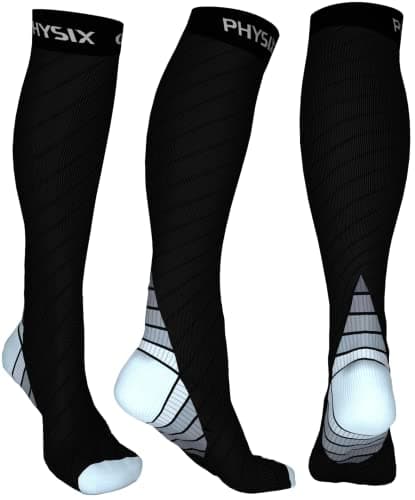
- Compression
- 20-30 mmHg graduated
- Materials
- Nylon, spandex
- Style
- Knee-high (calf-length)
- Sizing
- S/M, L/XL, XXL; men's and women's
- Amazon rating
- 4.5/5 (94,500+ reviews)
About this pick
A high-volume Amazon bestseller offering firm 20-30 mmHg graduated compression at a sub-$20 price point. The nylon-spandex blend is moisture-wicking and holds its compression well through repeated washings, making it a practical pick for occasional flyers who want real compression without a premium outlay.
Strengths
- True 20-30 mmHg compression at a fraction of medical-grade pricing, backed by more than 94,000 Amazon reviews with consistently positive owner sentiment on travel and flight use
- Lightweight nylon-spandex construction wicks moisture and stays thin enough to wear inside most travel footwear
- Easy to size: fits men's and women's feet across a wide range, available from S/M through XXL
Weaknesses
- The top band can feel constrictive on wider calves; owners with heavier legs report a tourniquet-like sensation at the cuff
- Some buyers note thinner fabric and reduced elasticity in more recent production runs compared to earlier pairs
Kit Score breakdown
SOCKWELL
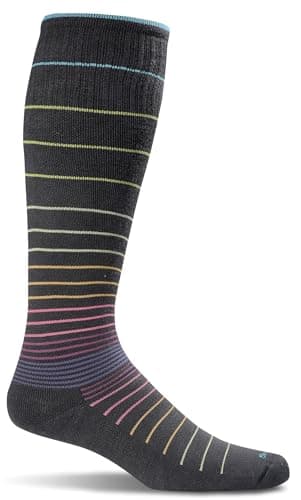
Sockwell Women's Circulator Moderate Graduated Compression Sock
Best Value
Kit Score 8.8/10
$32.95 Price checked Oct 23, 4:16 PM CDT
Best for: Women looking for a do-everything travel sock that covers long flights, layover walking, and evening use without switching pairs.
- Merino wool and bamboo rayon blend provides genuine thermoregulation: warm in cool cabins, non-clammy during walking, and naturally odor-resistant over multi-day trips
- Women's sizing only under this ASIN; men will need the separate Circulator listing
- Compression
- 15-20 mmHg graduated
- Materials
- 32% merino wool, 31% bamboo rayon, 32% stretch nylon, 5% spandex
- Style
- Knee-high with ultra-light cushion sole
- Sizing
- S/M (women's 4-7.5), M/L (women's 8-11)
- Origin
- Made in USA with American-grown wool
- Amazon rating
- 4.6/5 (5,100+ reviews)
About this pick
Sockwell's flagship travel sock pairs graduated compression at 15-20 mmHg with a merino-bamboo-nylon blend that regulates temperature, resists odor, and stays soft through a full day of airports and sitting. Designed and manufactured in the USA with American-grown wool, it sits at a price where the materials actually justify the spend.
Strengths
- Merino wool and bamboo rayon blend provides genuine thermoregulation: warm in cool cabins, non-clammy during walking, and naturally odor-resistant over multi-day trips
- 15-20 mmHg compression is the travel-medicine sweet spot for most healthy adults on long-haul flights, firm enough to reduce swelling without requiring a prescription
- Arch support, seamless toe closure, and a turn-welt top band deliver all-day comfort reported by owners who wear them for full travel days including flights and multi-hour train connections
Weaknesses
- Women's sizing only under this ASIN; men will need the separate Circulator listing
- Less firm grip at the top band compared to 20-30 mmHg options, which some owners with pronounced leg swelling find insufficient
Kit Score breakdown
COMRAD
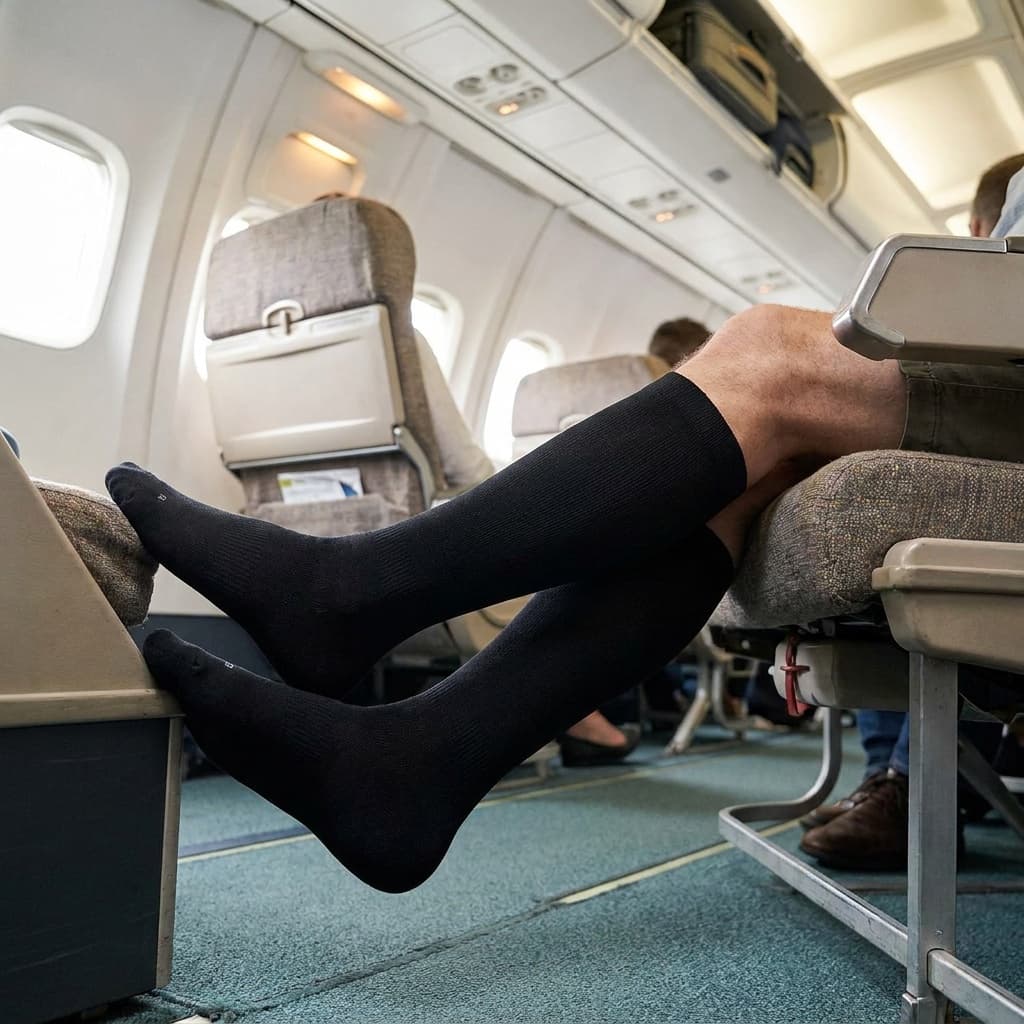
Comrad 3-Pack Knee High 15-20 mmHg Graduated Compression Socks
Best Overall
Kit Score 8.5/10
$101.99 Price checked Oct 23, 4:16 PM CDT
Best for: Frequent flyers who want to stock several pairs at once and value antibacterial treatment for back-to-back travel days.
- True graduated compression verified by owner reports: strongest at the ankle, tapering toward the knee, with consistent performance across the 4.4-star aggregate from 1,700+ Amazon reviewers
- Elasticity noticeably weakens after 3-6 months of daily use according to longer-term owners, shortening the effective lifespan compared to merino-blend alternatives
- Compression
- 15-20 mmHg true graduated compression
- Materials
- 91% nylon, 9% spandex with SmartSilver antibacterial treatment
- Style
- Knee-high, contoured fit
- Sizing
- S through XL; wide-calf options in M and L
- Amazon rating
- 4.4/5 (1,700+ reviews)
- Pack
- 3 pairs per listing
About this pick
Comrad's nylon-spandex knee-high delivers true graduated compression at 15-20 mmHg with a SmartSilver antibacterial finish that keeps odor in check across multi-day travel. The 3-pack format makes the per-pair cost competitive for anyone who wants a dedicated flight sock that can rotate through a week-long trip.
Strengths
- True graduated compression verified by owner reports: strongest at the ankle, tapering toward the knee, with consistent performance across the 4.4-star aggregate from 1,700+ Amazon reviewers
- SmartSilver antimicrobial treatment addresses the odor problem that plagues compression socks worn through long travel days and in shared sleeping spaces
- Wide-calf sizing in Medium and Large fills a gap that most competitors leave open, and owners with athletic builds confirm the contoured fit stays up without rolling
Weaknesses
- Elasticity noticeably weakens after 3-6 months of daily use according to longer-term owners, shortening the effective lifespan compared to merino-blend alternatives
- The 3-pack format requires a higher upfront outlay; per-pair cost is competitive only when all three pairs are needed
Kit Score breakdown
See all picks in Best compression socks for travel: 4 picks for long flights
Keep going
Complete loadoutLong-flight comfort kitFive packable pieces for neck support, darkness, quieter cabins, leg comfort, and more consistent sleep away from home.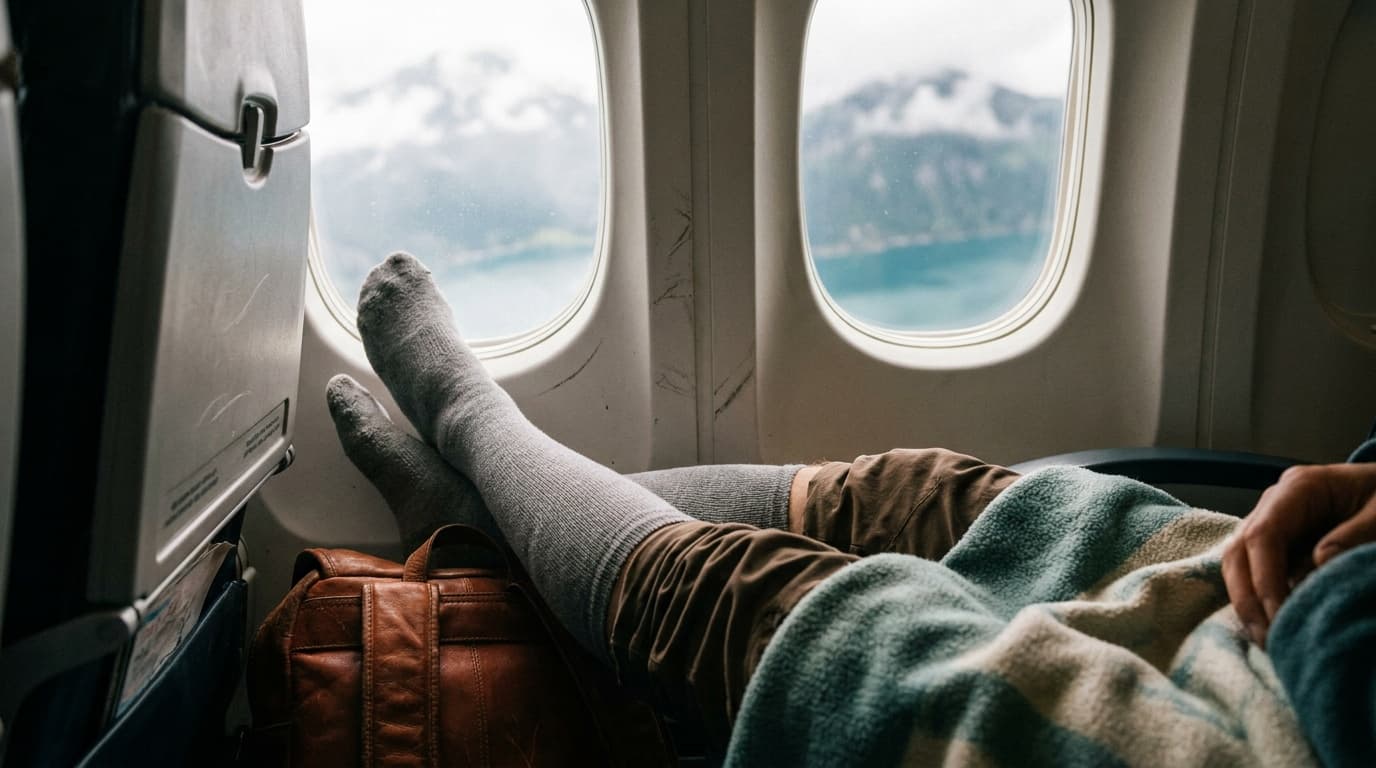

Researched, not hands-on tested
Updated Sep 25, 2026Our recommendations draw on manufacturer documentation, retailer listings, owner feedback, and comparisons with alternatives.
As an Amazon Associate I earn from qualifying purchases. We may earn a commission from links here, at no extra cost to you. How we research →