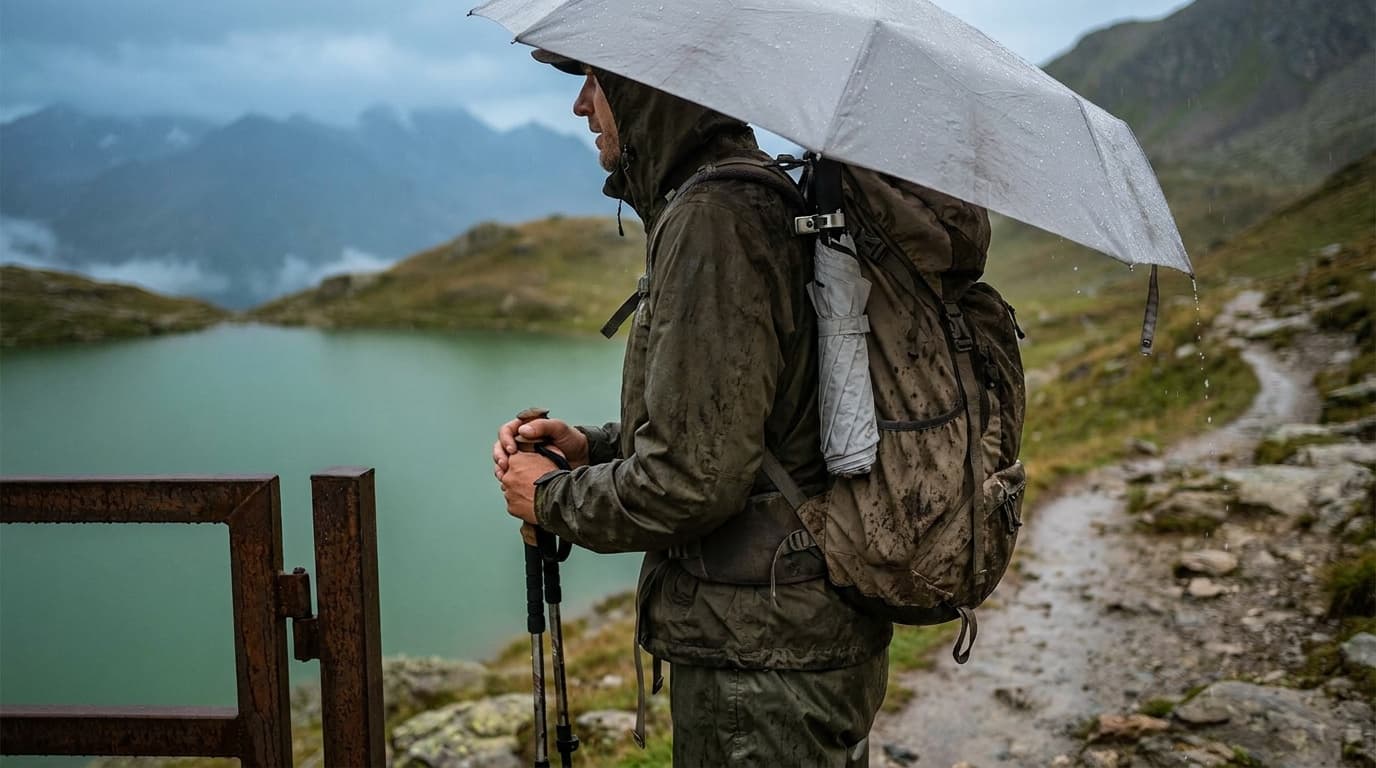
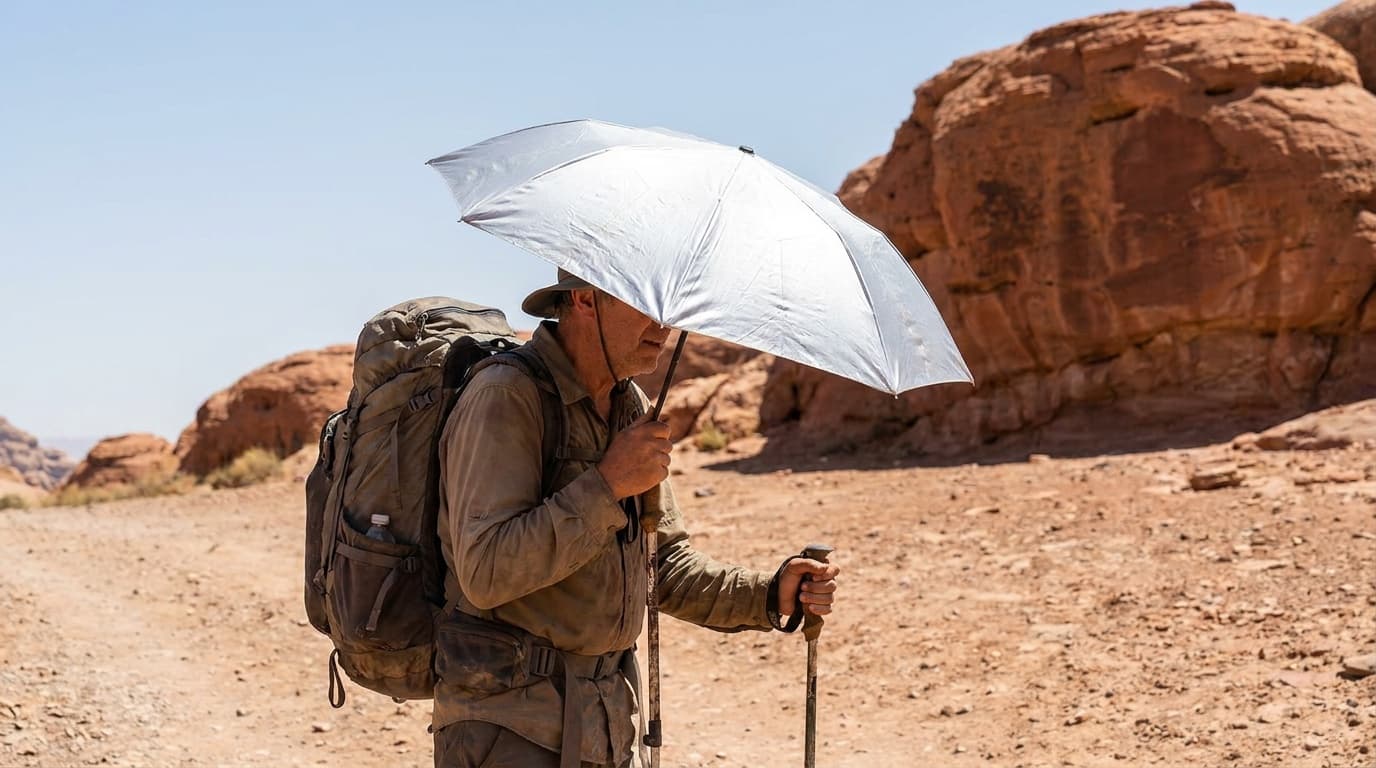
The simplest way to attach an umbrella to a backpack is a shoulder-strap holster: clip the umbrella shaft to the daisy chain on your shoulder strap above the sternum strap, then cinch a shock-cord loop around the handle lower down. Zpacks' Umbrella Holster (6 g) and Gossamer Gear's Handsfree Umbrella Clamp (15.2 g) both work this way, and going hands-free keeps your poles in your hands and your arms relaxed.
Why hands-free matters and what you are working with
Carrying an umbrella in one hand for three hours locks up your arm, kills your pole rhythm, and tires your shoulder. A hands-free mount solves all three, and some umbrellas, like the EuroSCHIRM Swing Handsfree, are designed around exactly this carry. The challenge is that a backpack shoulder strap is a flexible, moving platform, not a rigid post. Your rig needs to grip firmly enough to hold the umbrella steady under a gust, yet angle-adjust quickly when conditions change.
Trekking umbrellas range from about 165 g (Gossamer Gear's Lightrek, 5.8 oz) to about 410 g (the EuroSCHIRM Swing Handsfree, 14.4 oz), and most have a straight handle. Check that your clip closes snugly around your umbrella's shaft, or add a small foam shim to close the gap.
Shoulder-strap clamp mounts
Dedicated umbrella holsters for hiking packs are the cleanest solution, and the popular ones are simpler than you might expect. The Zpacks Umbrella Holster is a clip and an adjustable shock-cord loop that together weigh 6 g; Gossamer Gear's Handsfree Umbrella Clamp is a clip plus a bungee clamp at 15.2 g and fits almost any shoulder strap, per the maker. The upper clip holds the shaft, and the lower loop pins the handle so the umbrella cannot swing.
To install a clamp mount:
Installing a shoulder-strap clamp
Attach the upper clip
Fasten it to the shoulder-strap daisy chain above the sternum strap, which is where Zpacks places its holster clip. Higher placement gives more clearance over your head.
Attach the lower loop
Hook the shock cord or bungee near the bottom of the strap so it can cinch around the handle.
Insert the umbrella
Clip the shaft into the upper clip, then cinch the lower loop around the handle so the umbrella cannot pivot.
Adjust for clearance
Open the umbrella and walk a few steps. The canopy edge should clear your head comfortably; move the clip up or down the daisy chain as needed.
Recheck on the move
After the first stretch of trail, confirm the clip and loop have not crept, and snug the cord if they have.
Left-shoulder mounting works for most right-handed trekking-pole users because your dominant pole hand stays free and the umbrella covers the sun or rain angle where you need it most.
DIY cord-and-clip rigs
A cord-and-clip rig costs a few dollars and takes minutes to assemble. You need two small carabiners or locking cord locks, a length of 2 mm accessory cord, and a foam grip shim if your umbrella handle is narrower than your clips.
Thread a loop of cord around the shoulder strap, pass the cord through a carabiner, and clip the carabiner over the umbrella handle near the top of the grip. Add a second clip 15–20 cm lower on the handle for stability. The two-point contact prevents the umbrella from pivoting freely, which is the main failure mode of a single-clip rig. Adjust cord length until the shaft angle sits where you want it, then tie off.
The trade-off: a cord rig does not pivot easily on the fly. You need to untie or re-thread to change angle. Use it when conditions are consistent, such as a full-day desert approach where the sun stays on one side.
Angle, stability, and wind management
Angle is the most underestimated variable. An umbrella held perfectly vertical acts as a sail: wind catches the full canopy face and either rips the umbrella back or torques the mount off the strap. Tipping the canopy toward the oncoming air, so the wind flows over the dome rather than into its underside, reduces the pull on your mount and the risk of the umbrella inverting.
In strong or gusty wind, close the umbrella and stow it. No strap rig holds a full canopy in real gusts without risking a broken frame or a lost umbrella.
For side-wind gusts, adjust your body angle rather than the mount. Turning slightly into the wind is faster than re-locking a clamp mid-trail.
Tilt the canopy into the wind rather than fighting it upright, and your mount holds with a fraction of the force.
Attaching to a trekking pole (when to use it)
Some hikers prefer to clip the umbrella to a trekking pole and plant the pole tip in the ground during rest stops, creating a sunshade without carrying the umbrella at all. On the trail, this means switching the umbrella from pole to strap as you walk, which works better for some systems than others.
A few trekking-pole brands sell dedicated umbrella adapters that thread onto the top of the pole handle. These are useful at camp or on long exposed traverses where you stop frequently, but they are not genuinely hands-free while moving unless you use a second pole in your other hand and ignore the pole with the umbrella, which most hikers find awkward.
The cleaner trail solution remains the shoulder-strap clamp. Use the pole adapter at the trailhead or camp.
What works for trekking-pole users specifically
If you use two poles, the shoulder-strap clamp on your non-dominant side is the standard answer. You keep both poles in both hands, the umbrella covers your upper body, and your arm swing is barely affected. A well-positioned clamp on the left strap of a right-handed hiker covers the body adequately without interfering with pole plant rhythm.
If you use a single pole on the trail, you can carry the umbrella in the opposite hand for variety without a mount, or use a hip-belt rig. The EuroSCHIRM Swing Handsfree, for example, ships with two clips that fasten to the shoulder strap with Velcro plus an elastic loop for the hip belt.
Frequently asked questions
Can I use any umbrella clamp on any backpack?
Mostly, but check the attachment point. The Zpacks holster needs a daisy chain on the shoulder strap, while Gossamer Gear says its clamp clips to almost any shoulder strap. If your strap has no webbing or daisy chain to clip into, a cord-and-clip rig wrapped around the strap is the fallback.
Will a hands-free umbrella affect my balance on rocky terrain?
On flat or moderate trail, the effect is minimal. On technical scrambling or very uneven ground, the umbrella shifts your center of gravity slightly and reduces your peripheral vision on one side. Close the umbrella on scrambling sections and re-open on easier trail. The balance penalty is small enough that most hikers adapt within a few minutes.
What umbrella size is best for shoulder-strap mounting?
A mid-size trekking canopy covers one person well without excessive wind resistance. The G4Free 46 Inch Hiking Umbrella, for example, is 46 inches measured over the arc but 41 inches (about 104 cm) straight across, and weighs 12 oz. Bigger canopies add coverage but catch more wind and stress the mount, so for hands-free use a moderate size is the safer bet.
Where these numbers come from
| Claim | Source | Checked |
|---|---|---|
| Zpacks Umbrella Holster: clip plus adjustable shock-cord loop, 6 g, clip above the sternum strap on the daisy chain | Zpacks, Umbrella Holster | Sep 2026 |
| Gossamer Gear Handsfree Umbrella Clamp: clamp plus bungee clamp, 15.2 g, fits almost any shoulder strap | Gossamer Gear, Handsfree Umbrella Clamp | Sep 2026 |
| Gossamer Gear Lightrek umbrella weighs 5.8 oz (164.4 g) | Gossamer Gear, Lightrek Hiking Umbrella | Sep 2026 |
| EuroSCHIRM Swing Handsfree: 14.4 oz, two Velcro strap clips plus an elastic hip-belt loop | EuroSCHIRM USA, Swing Handsfree | Sep 2026 |
| G4Free: 46 in arc, 41 in diameter, 12 oz | G4Free listing on Amazon, ASIN B09TRCWJGW | Sep 2026 |
For specific picks, see our guide to the best trekking umbrellas. Browse all hike guides or read how we research and rate gear.
Recommended gear
Our current top picks from the Best trekking umbrellas for hiking: 4 useful oddities guide, if you are ready to buy.
SIX MOON DESIGNS
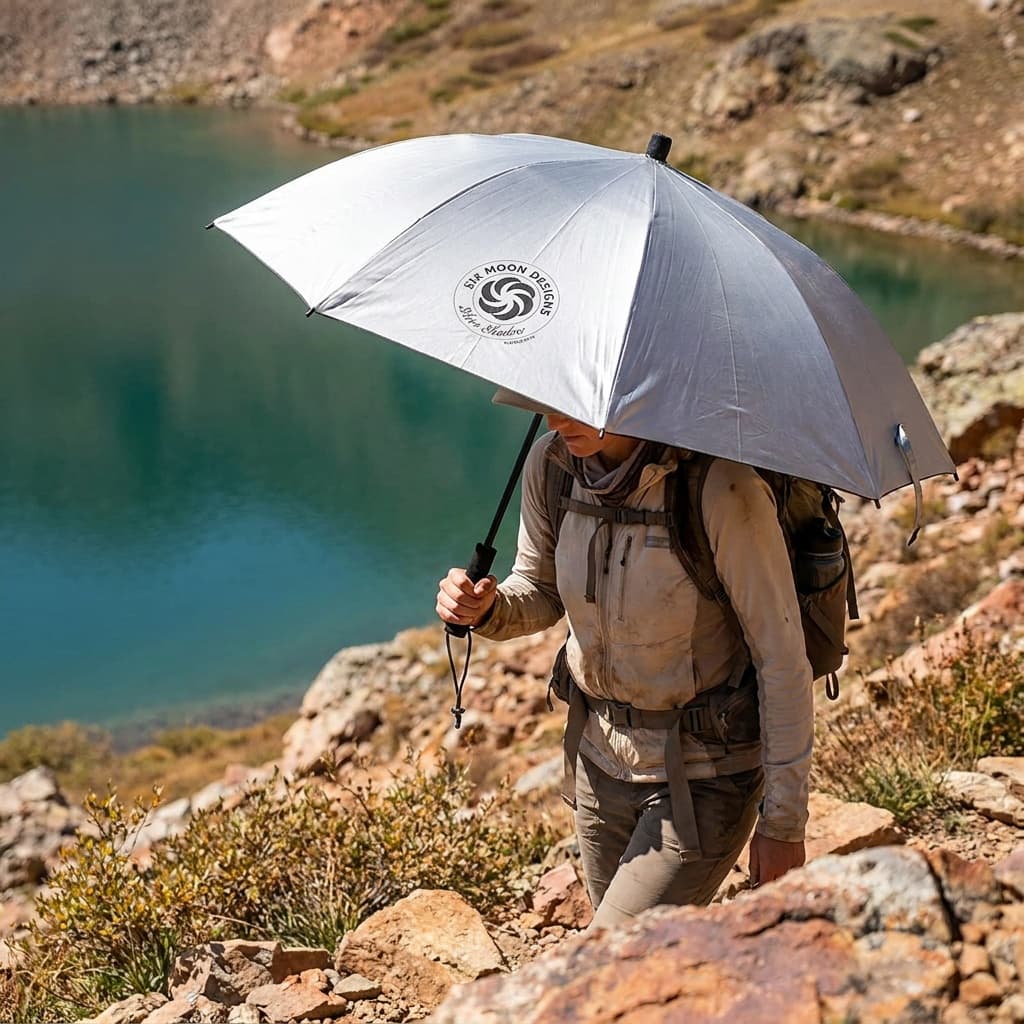
Six Moon Designs Silver Shadow Carbon
Best Overall
Kit Score 8.8/10
$55.00 Price checked Oct 23, 4:16 PM CDT
Best for: Thru-hikers and desert day-hikers who want a proven, heat-blocking sun shield that doubles as rain cover without adding meaningful pack weight.
- Rigid carbon shaft and ribs keep total weight to 6.8 oz with no telescoping joints
- Fixed 25-inch length does not pack as compactly as collapsible designs
- Weight
- 6.8 oz (193 g)
- Canopy open width
- 37 in (94 cm)
- Packed length
- 25 in
- UPF rating
- UPF 50+
- Frame material
- Carbon fiber shaft, spreader, and ribs
- Canopy
- 210T polyester, silver reflective outer, black underside
About this pick
The Silver Shadow Carbon pairs a full-carbon frame with a silver-reflective UPF 50+ canopy. At 6.8 oz it matches the compact Mini's weight while using a simpler rigid 25-inch shaft, trading packability for fewer moving joints.
Strengths
- Rigid carbon shaft and ribs keep total weight to 6.8 oz with no telescoping joints
- Silver-over-black canopy design actively deflects heat while suppressing glare underneath
- Hands-free ready: compatible with the Six Moon Designs shoulder-strap holster (sold separately)
Weaknesses
- Fixed 25-inch length does not pack as compactly as collapsible designs
- It still needs a $10 attachment kit for hands-free use, and that kit is sometimes out of stock
Kit Score breakdown
SIX MOON DESIGNS
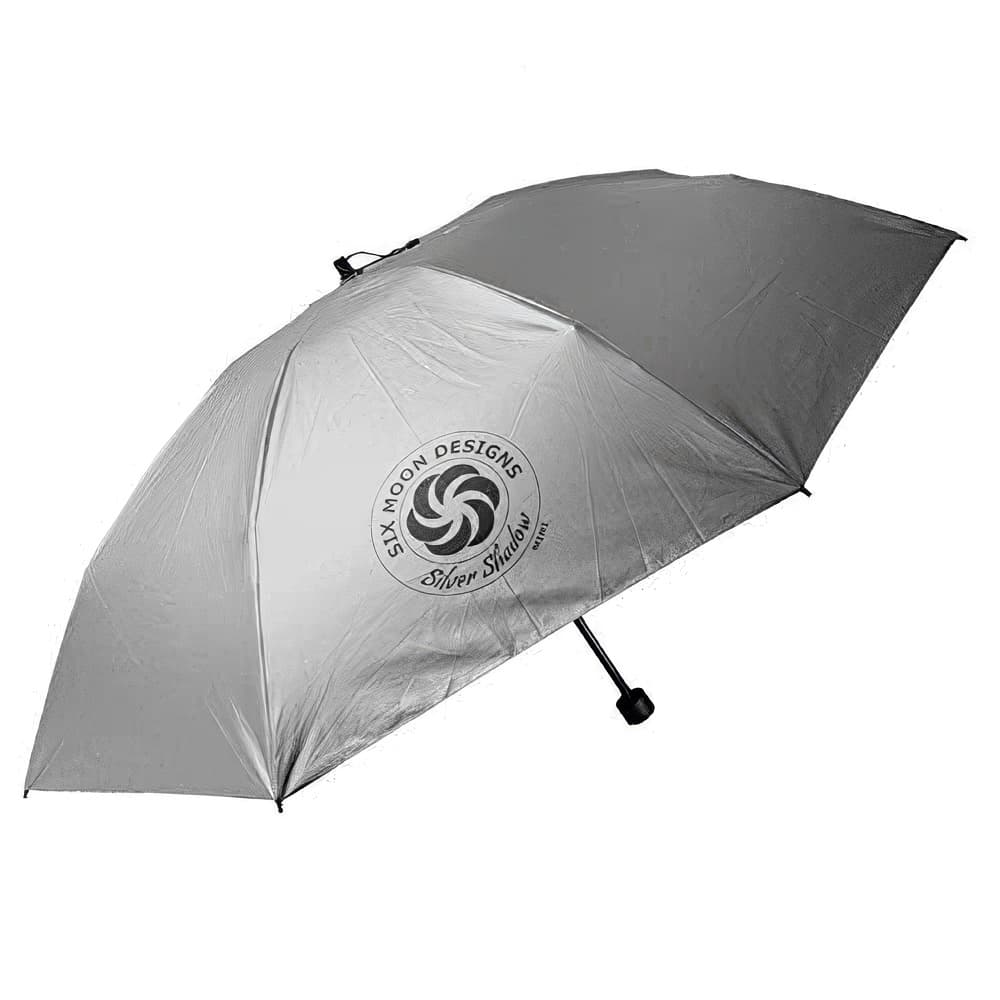
Six Moon Designs Silver Shadow Mini
Best Compact
Kit Score 8.2/10
$50.00 Price checked Oct 23, 4:16 PM CDT
Best for: Travelers, bikepackers, and hikers whose bag cannot accommodate a 25-inch rigid umbrella.
- Ten-inch packed length fits carry-ons, bikepacking bags, and small daypacks
- Collapsible mechanism takes more deliberate opening and closing than a normal automatic umbrella
- Weight
- 6.8 oz (193 g)
- Open width
- 38 in (96.5 cm)
- Packed length
- 10 in (25.4 cm)
- UPF rating
- UPF 50+
- Frame
- Carbon/aluminum ribs; aluminum shaft
- Canopy
- 210T silver-reflective polyester; 5,000 mm water column
About this pick
The Silver Shadow Mini compresses to 10 inches, 40% of the rigid models' packed length, while keeping a 38-inch reflective canopy and the same 6.8 oz weight as the Carbon. Its additional joints make opening and wind handling less simple, but it fits bags the full-length models cannot.
Strengths
- Ten-inch packed length fits carry-ons, bikepacking bags, and small daypacks
- 38-inch UPF 50+ canopy is one inch wider than the rigid Silver Shadow models
- Included replacement EVA handle improves grip and hands-free-kit compatibility
Weaknesses
- Collapsible mechanism takes more deliberate opening and closing than a normal automatic umbrella
- More frame joints create more potential failure points than a rigid shaft
Kit Score breakdown
SIX MOON DESIGNS
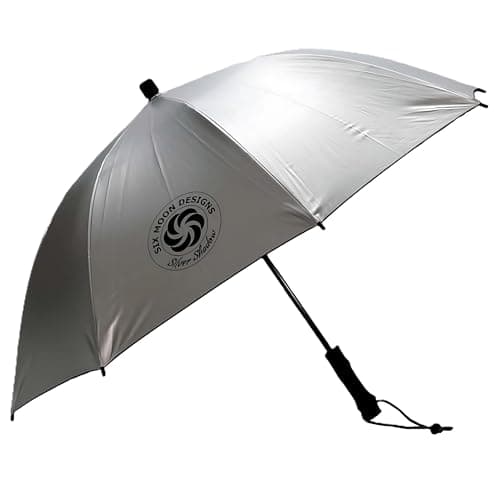
Six Moon Designs Silver Shadow Ultralight
Best Value
Kit Score 8.5/10
$50.00 Price checked Oct 23, 4:16 PM CDT
Best for: Hikers who want the Silver Shadow canopy and rigid simplicity without paying extra to save 2.1 oz.
- Rigid fiberglass frame has fewer moving parts than the collapsible Mini
- At 8.9 oz it is 31% heavier than the Carbon
- Weight
- 8.9 oz (252 g)
- Open width
- 37 in (94 cm)
- Packed length
- 25 in (63.5 cm)
- UPF rating
- UPF 50+
- Frame
- Fiberglass shaft and ribs
- Canopy
- 210T silver-reflective polyester; 5,000 mm water column
About this pick
The standard Silver Shadow uses a rigid fiberglass frame beneath the same 37-inch UPF 50+ reflective canopy as the Carbon. It adds 2.1 oz but costs less and gives buyers who are not counting every ounce the simplest value equation in the family.
Strengths
- Rigid fiberglass frame has fewer moving parts than the collapsible Mini
- Same 37-inch reflective canopy and 5,000 mm water-column rating as the Carbon
- Costs less than both the Carbon and Mini
Weaknesses
- At 8.9 oz it is 31% heavier than the Carbon
- The fixed 25-inch length still requires an external pack pocket or compression strap
Kit Score breakdown
See all picks in Best trekking umbrellas for hiking: 4 useful oddities
Keep going
Related guides
 Complete hike loadoutDay hike kitBuild the complete kit
Researched, not hands-on tested
Updated Sep 25, 2026Our recommendations draw on manufacturer documentation, retailer listings, owner feedback, and comparisons with alternatives.
As an Amazon Associate I earn from qualifying purchases. We may earn a commission from links here, at no extra cost to you. How we research →