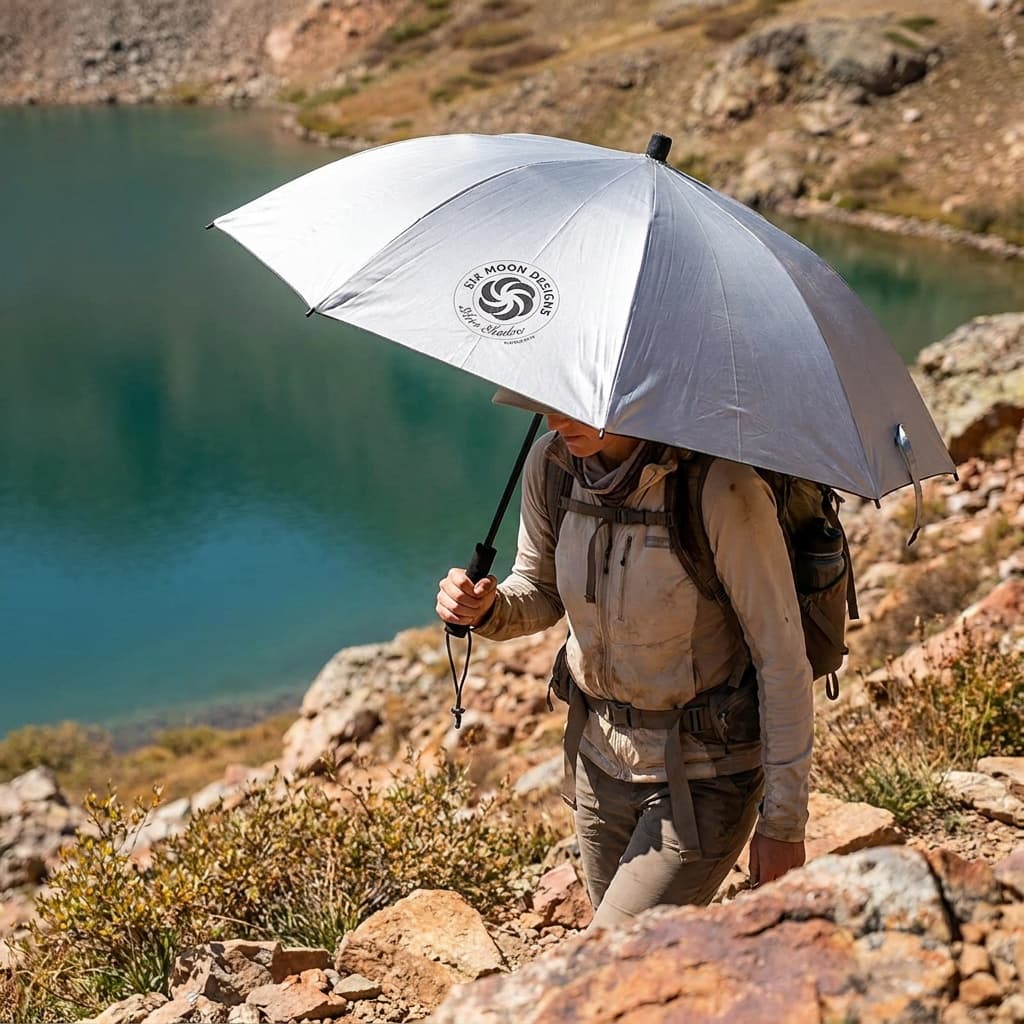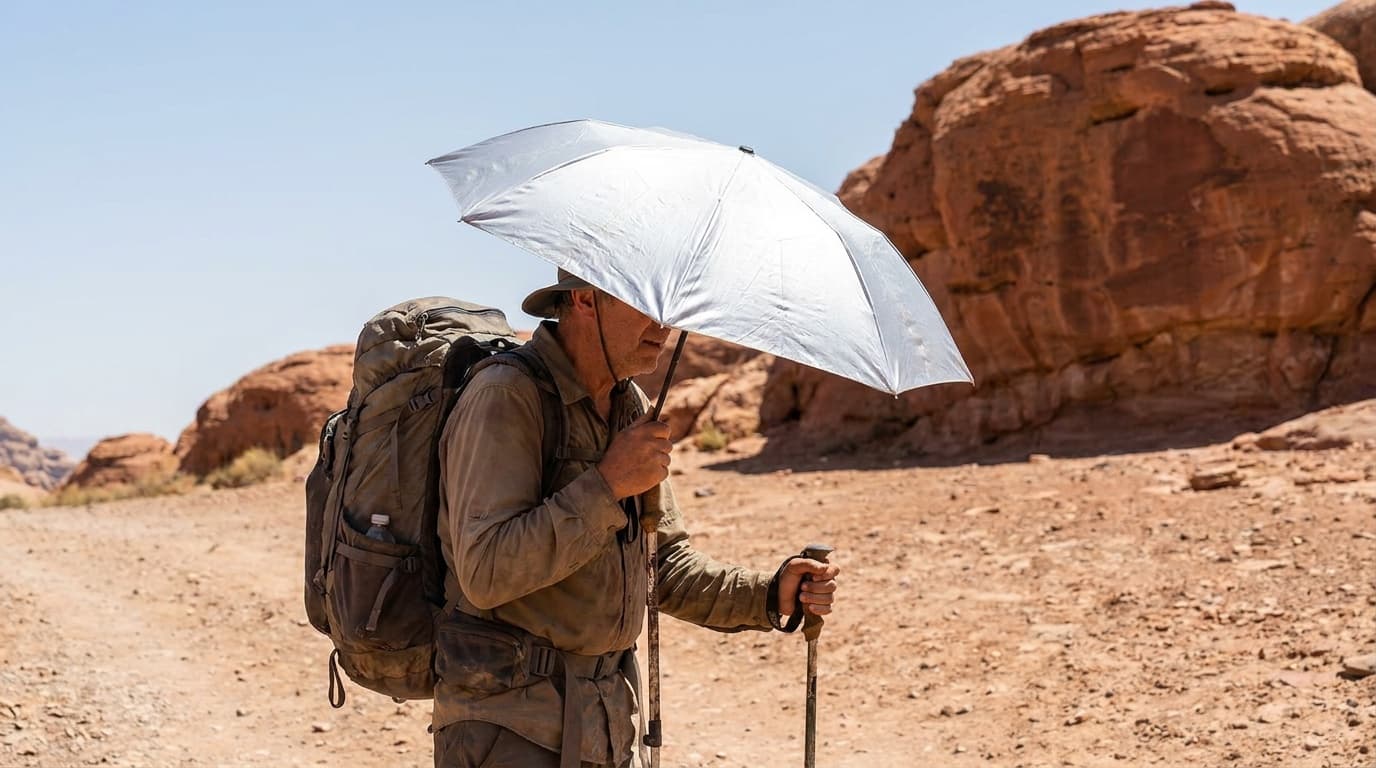
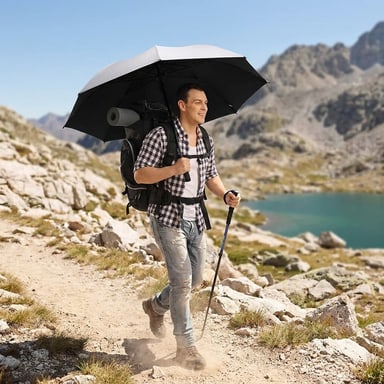
A hiking umbrella is portable shade first and warm-rain ventilation second. It is most useful on exposed trails where a reflective canopy blocks direct sun without adding another clothing layer. It is least useful in wind, brush, scrambling, and cold driving rain.
Our quick picks
What changed in this guide
We removed the Zpacks Lotus UL from the recommendation path after the verified Amazon offer ran at several times the direct price. A product available near $50 direct should not be presented as an affiliate value at a multiple of that amount. We also replaced a search-only EuroSCHIRM destination with products that had direct, live Amazon offers on July 31.
Best overall: Silver Shadow Carbon
BEST OVERALL
Six Moon Designs Silver Shadow Carbon
Best for: Thru-hikers and desert day-hikers who want a proven, heat-blocking sun shield that doubles as rain cover without adding meaningful pack weight.
- Rigid carbon shaft and ribs keep total weight to 6.8 oz with no telescoping joints
- Fixed 25-inch length does not pack as compactly as collapsible designs
Kit Score 8.8/10 · $55.00 Price checked Oct 23, 6:22 AM CDT · how we score gear
Buy on AmazonProduct details
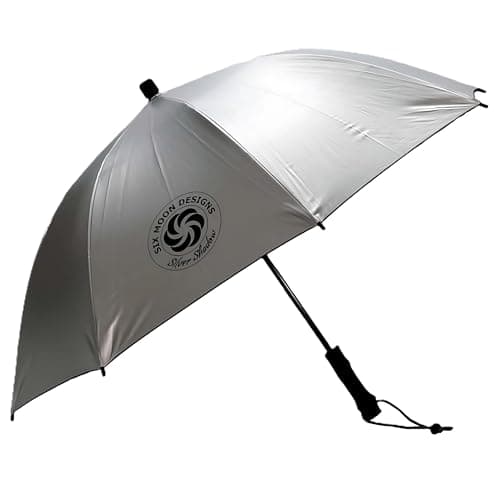
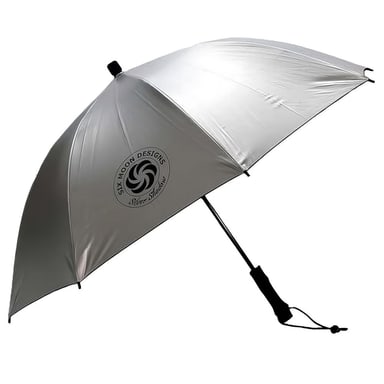
The Silver Shadow Carbon pairs a full-carbon frame with a silver-reflective UPF 50+ canopy. At 6.8 oz it matches the compact Mini's weight while using a simpler rigid 25-inch shaft, trading packability for fewer moving joints.
- Weight
- 6.8 oz (193 g)
- Canopy open width
- 37 in (94 cm)
- Packed length
- 25 in
- UPF rating
- UPF 50+
- Frame material
- Carbon fiber shaft, spreader, and ribs
- Canopy
- 210T polyester, silver reflective outer, black underside
More strengths
- Silver-over-black canopy design actively deflects heat while suppressing glare underneath
- Hands-free ready: compatible with the Six Moon Designs shoulder-strap holster (sold separately)
Other tradeoffs
- It still needs a $10 attachment kit for hands-free use, and that kit is sometimes out of stock
Carbon weighs 6.8 oz, opens to 37 inches, and uses a rigid 25-inch carbon shaft and ribs. The simple frame has fewer moving joints than the compact Mini, while the silver 210T polyester canopy carries a UPF 50+ rating and 5,000 mm water-column claim.
The long packed form rides outside a backpack. A separately sold 0.35 oz kit can mount it to a shoulder strap, but the kit is not always in stock and does not make the canopy suitable for severe wind.
Read the Silver Shadow Carbon review.
Best compact: Silver Shadow Mini
BEST COMPACT
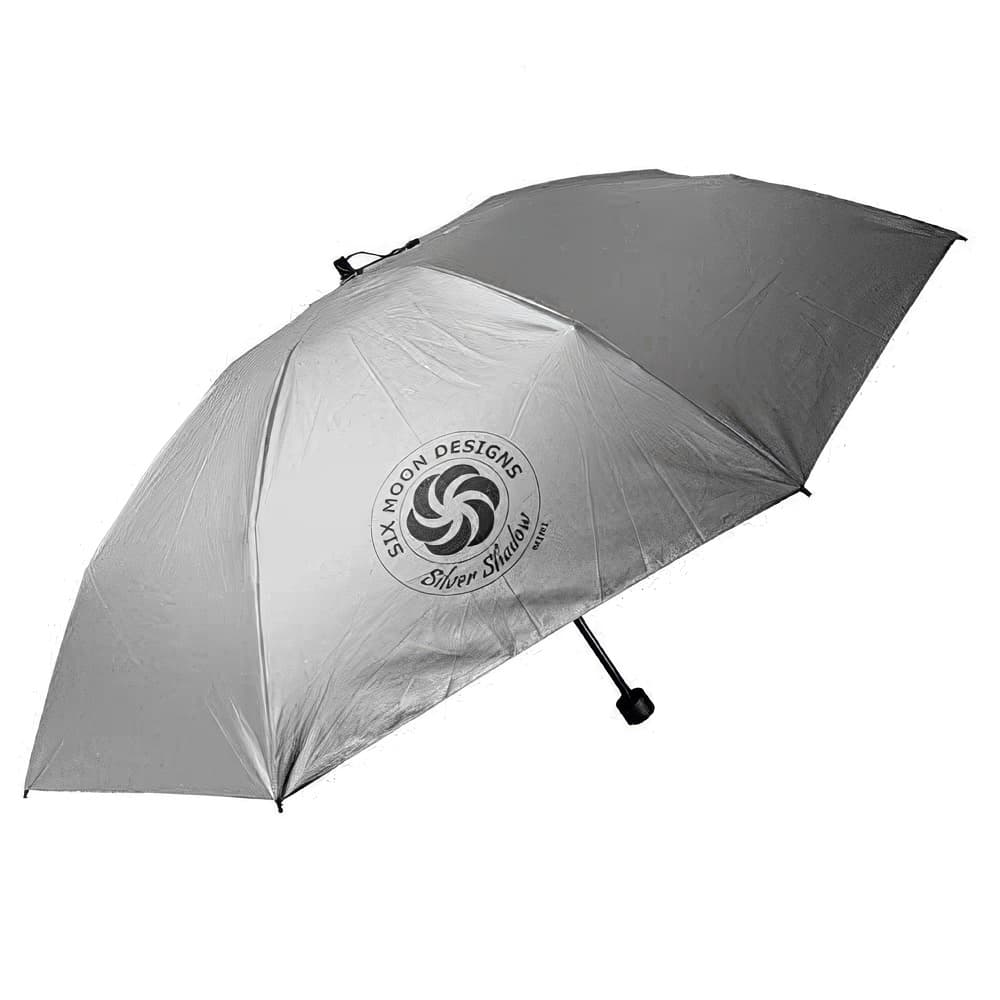
Six Moon Designs Silver Shadow Mini
Best for: Travelers, bikepackers, and hikers whose bag cannot accommodate a 25-inch rigid umbrella.
- Ten-inch packed length fits carry-ons, bikepacking bags, and small daypacks
- Collapsible mechanism takes more deliberate opening and closing than a normal automatic umbrella
Kit Score 8.2/10 · $50.00 Price checked Oct 23, 6:22 AM CDT · how we score gear
Buy on AmazonProduct details
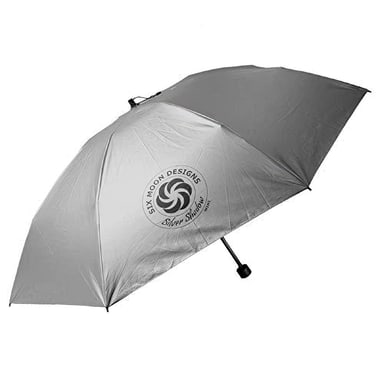
The Silver Shadow Mini compresses to 10 inches, 40% of the rigid models' packed length, while keeping a 38-inch reflective canopy and the same 6.8 oz weight as the Carbon. Its additional joints make opening and wind handling less simple, but it fits bags the full-length models cannot.
- Weight
- 6.8 oz (193 g)
- Open width
- 38 in (96.5 cm)
- Packed length
- 10 in (25.4 cm)
- UPF rating
- UPF 50+
- Frame
- Carbon/aluminum ribs; aluminum shaft
- Canopy
- 210T silver-reflective polyester; 5,000 mm water column
More strengths
- 38-inch UPF 50+ canopy is one inch wider than the rigid Silver Shadow models
- Included replacement EVA handle improves grip and hands-free-kit compatibility
Other tradeoffs
- More frame joints create more potential failure points than a rigid shaft
Mini weighs the same 6.8 oz but collapses to 10 inches and opens to 38 inches. That is the clear choice for a carry-on, bikepacking bag, or small daypack.
More joints and a telescoping shaft make opening less direct. Current manufacturer reviews include both enthusiasm for the packed size and criticism of deployment or rib durability. Compactness is a trade, not a free upgrade.
Read the Silver Shadow Mini review and Carbon vs Mini.
Best value: standard Silver Shadow
BEST VALUE
Six Moon Designs Silver Shadow Ultralight
Best for: Hikers who want the Silver Shadow canopy and rigid simplicity without paying extra to save 2.1 oz.
- Rigid fiberglass frame has fewer moving parts than the collapsible Mini
- At 8.9 oz it is 31% heavier than the Carbon
Kit Score 8.5/10 · $50.00 Price checked Oct 23, 6:22 AM CDT · how we score gear
Buy on AmazonProduct details
The standard Silver Shadow uses a rigid fiberglass frame beneath the same 37-inch UPF 50+ reflective canopy as the Carbon. It adds 2.1 oz but costs less and gives buyers who are not counting every ounce the simplest value equation in the family.
- Weight
- 8.9 oz (252 g)
- Open width
- 37 in (94 cm)
- Packed length
- 25 in (63.5 cm)
- UPF rating
- UPF 50+
- Frame
- Fiberglass shaft and ribs
- Canopy
- 210T silver-reflective polyester; 5,000 mm water column
More strengths
- Same 37-inch reflective canopy and 5,000 mm water-column rating as the Carbon
- Costs less than both the Carbon and Mini
Other tradeoffs
- The fixed 25-inch length still requires an external pack pocket or compression strap
The standard model uses the same 37-inch canopy dimensions, UPF rating, water-column claim, and 25-inch packed length as Carbon. A fiberglass frame raises weight to 8.9 oz and lowers direct price by about $10.
That is sensible for day hikers and occasional backpackers. The standard Silver Shadow review explains why fiberglass is not automatically an inferior umbrella material. Carbon vs standard turns the upgrade into a simple price-per-ounce decision.
Best budget coverage: G4Free 46
BEST BUDGET
G4Free 46 Inch Large Hiking Umbrella
Best for: Casual day-hikers, car-campers, and budget-focused backpackers who want maximum shade coverage and built-in hands-free straps without paying premium brand prices.
- 46-inch arc is the largest canopy here, covering hiker and pack simultaneously without an accessory holster
- At 12 oz it is nearly double the weight of the ultralight field; the weight penalty is real on multi-day carries
Kit Score 7.2/10 · Check current price · how we score gear
Buy on AmazonProduct details
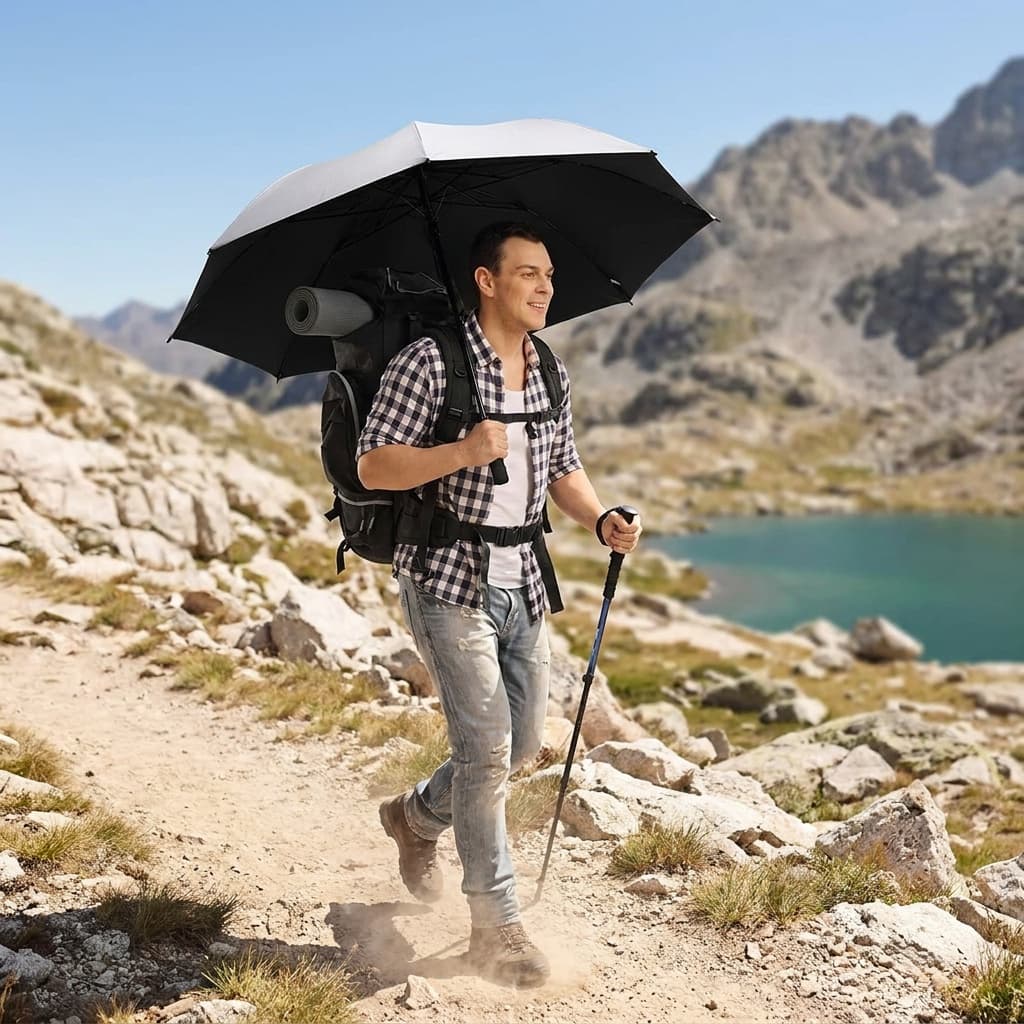
The G4Free 46" delivers the widest canopy coverage in this roundup, a silver-reflective UPF 50+ canopy, and two included shock cord hands-free straps, all at a price that undercuts every specialist brand by at least $15. Weight is the honest trade-off at 12 oz.
- Weight
- 12 oz (340 g)
- Open arc
- 46 in arc / 41 in diameter
- Packed length
- 28 in (fixed)
- UPF rating
- UPF 50+
- Frame
- Carbon fiber and fiberglass combination shaft
- Hands-free system
- Two included shock cord straps attach to pack shoulder straps; no separate purchase needed
More strengths
- Hands-free shock cord straps included in the box at no extra cost, unlike most ultralight competitors that sell holsters separately
- Silver UPF 50+ canopy provides broad shade coverage without the price of a specialist ultralight model
Other tradeoffs
- Some owners report build consistency concerns, consistent with the budget price tier
G4Free is the budget option here. Its 46-inch arc produces about a 41-inch diameter, wider than the Silver Shadow models, and the listing includes simple shoulder attachment straps.
At roughly 12 oz and 28 inches packed, it is a day-hiking value rather than an ultralight choice. The low price buys shade area, not compact travel or specialist frame refinement.
Side-by-side comparison
| Product | Kit Score | Price | Best for |
|---|---|---|---|
| Six Moon Designs Silver Shadow Carbon | 8.8 | $55.00 Price checked Oct 23, 6:22 AM CDT | Best for: Thru-hikers and desert day-hikers who want a proven, heat-blocking sun shield that doubles as rain cover without adding meaningful pack weight. Why it stands out: Rigid carbon shaft and ribs keep total weight to 6.8 oz with no telescoping joints Tradeoff: Fixed 25-inch length does not pack as compactly as collapsible designs |
| Six Moon Designs Silver Shadow Mini | 8.2 | $50.00 Price checked Oct 23, 6:22 AM CDT | Best for: Travelers, bikepackers, and hikers whose bag cannot accommodate a 25-inch rigid umbrella. Why it stands out: Ten-inch packed length fits carry-ons, bikepacking bags, and small daypacks Tradeoff: Collapsible mechanism takes more deliberate opening and closing than a normal automatic umbrella |
| Six Moon Designs Silver Shadow Ultralight | 8.5 | $50.00 Price checked Oct 23, 6:22 AM CDT | Best for: Hikers who want the Silver Shadow canopy and rigid simplicity without paying extra to save 2.1 oz. Why it stands out: Rigid fiberglass frame has fewer moving parts than the collapsible Mini Tradeoff: At 8.9 oz it is 31% heavier than the Carbon |
| G4Free 46 Inch Large Hiking Umbrella | 7.2 | Check current price | Best for: Casual day-hikers, car-campers, and budget-focused backpackers who want maximum shade coverage and built-in hands-free straps without paying premium brand prices. Why it stands out: 46-inch arc is the largest canopy here, covering hiker and pack simultaneously without an accessory holster Tradeoff: At 12 oz it is nearly double the weight of the ultralight field; the weight penalty is real on multi-day carries |
Six Moon Designs Silver Shadow Carbon
- Best for
- Thru-hikers and desert day-hikers who want a proven, heat-blocking sun shield that doubles as rain cover without adding meaningful pack weight.
- Why it stands out
- Rigid carbon shaft and ribs keep total weight to 6.8 oz with no telescoping joints
- Tradeoff
- Fixed 25-inch length does not pack as compactly as collapsible designs
Six Moon Designs Silver Shadow Mini
- Best for
- Travelers, bikepackers, and hikers whose bag cannot accommodate a 25-inch rigid umbrella.
- Why it stands out
- Ten-inch packed length fits carry-ons, bikepacking bags, and small daypacks
- Tradeoff
- Collapsible mechanism takes more deliberate opening and closing than a normal automatic umbrella
Six Moon Designs Silver Shadow Ultralight
- Best for
- Hikers who want the Silver Shadow canopy and rigid simplicity without paying extra to save 2.1 oz.
- Why it stands out
- Rigid fiberglass frame has fewer moving parts than the collapsible Mini
- Tradeoff
- At 8.9 oz it is 31% heavier than the Carbon
G4Free 46 Inch Large Hiking Umbrella
- Best for
- Casual day-hikers, car-campers, and budget-focused backpackers who want maximum shade coverage and built-in hands-free straps without paying premium brand prices.
- Why it stands out
- 46-inch arc is the largest canopy here, covering hiker and pack simultaneously without an accessory holster
- Tradeoff
- At 12 oz it is nearly double the weight of the ultralight field; the weight penalty is real on multi-day carries
Choose by the failure condition
Where will the umbrella stop helping?
Open desert
Reflective canopy, low weight, and a secure pack mount matter most.
Air or bike travel
Measure packed length first; Mini is the only 10-inch option here.
Brush and low branches
An umbrella may be the wrong tool regardless of model.
Cold or windy rain
Carry a rain jacket capable of protecting you when the canopy cannot be controlled.
Frequently asked questions
Can a trekking umbrella replace a rain jacket?
It can replace a worn shell during warm, low-wind rain on open trails. It should not be the only protection when cold, wind, brush, or technical terrain makes getting wet consequential. See trekking umbrella vs rain jacket.
Are silver hiking umbrellas cooler?
The reflective canopy blocks direct solar radiation and creates shade. The exact temperature difference is not universal, so we do not repeat fixed 15- or 20-degree claims without a controlled test matching the route conditions.
How do you use trekking poles with an umbrella?
Use a two-point shoulder-strap attachment on open trail, or hold the umbrella in one hand and one pole in the other. Our backpack attachment guide covers the setup and its limits.
Sources
- Six Moon Designs Silver Shadow family comparison
- Silver Shadow Carbon specifications
- Silver Shadow Mini specifications
- Silver Shadow standard specifications
Read are trekking umbrellas worth it before buying the category, then browse more high-intent hiking gear.
Keep going
Related guides
 Complete hike loadoutDay hike kitBuild the complete kit
Our recommendations draw on manufacturer documentation, retailer listings, owner feedback, and comparisons with alternatives.
As an Amazon Associate I earn from qualifying purchases. We may earn a commission from links here, at no extra cost to you. How we research →