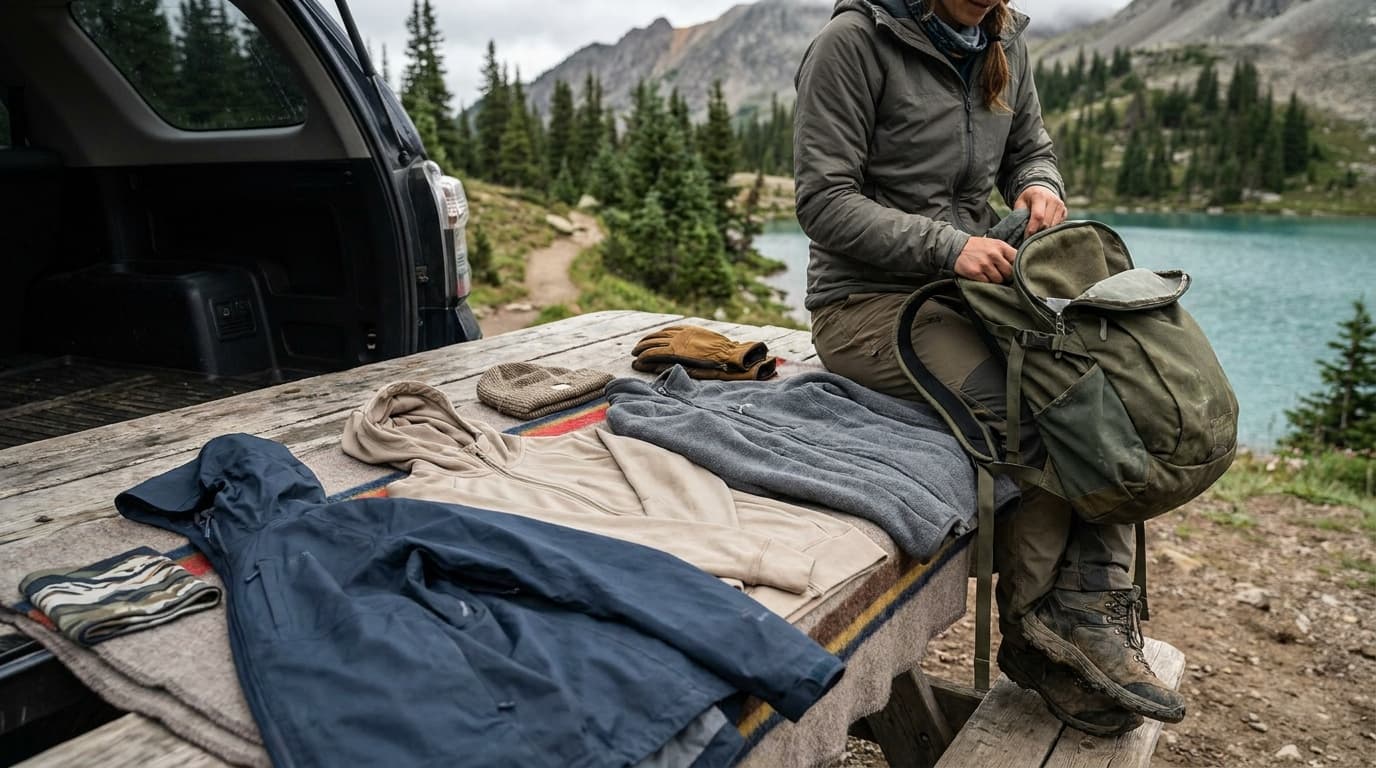
Rain jacket specs are full of numbers that look precise but rarely come with context. This guide explains what each number actually measures, where it breaks down in the field, and how to match construction type to the hiking you actually do.
What the waterproof rating actually measures
The hydrostatic head test pressurizes a column of water against the fabric and records the height (in millimetres) at which moisture begins to seep through. A rating of 10,000mm means the fabric resisted a 10-metre column of water before any passed through.
For most day hikers in variable weather, 10,000mm is a reasonable floor. At 20,000mm and above, diminishing returns set in: seam quality and DWR condition become the limiting factors, not the membrane rating itself.
Breathability: the number the marketing obscures
Breathability is measured as moisture vapour transmission rate (MVTR), in grams of water vapour that pass through one square metre of fabric in 24 hours. A higher number means more moisture escapes.
The lab number overpromises in one important way: once the DWR coating on the outer face fabric degrades and the fabric wets out, moisture loading clamps the membrane regardless of its rated g value. A jacket rated 20,000g breathability with a failed DWR performs worse in practice than a 10,000g jacket with intact DWR. The rating tells you the ceiling; DWR condition determines whether you reach it.
Keeping the DWR active is a more reliable variable than chasing a higher breathability number on the hangtag.
2L vs 2.5L vs 3L: the construction trade-off
The "layer count" describes how the waterproof membrane is assembled, and it drives most of the durability-versus-weight trade-off.
Understanding rain jacket construction
2L (two-layer)
The membrane bonds to the outer face fabric only. A separate loose liner (or mesh) hangs inside to protect the membrane from abrasion. Lightest and most packable, but the loose inner layer can feel clammy and snag over time.
2.5L (two-and-a-half layer)
The membrane bonds directly to the outer face fabric, and a printed or textured pattern is applied to the membrane's inner face instead of a separate liner. No true third layer, which keeps weight low. The Outdoor Research Helium Rain is a 2.5L jacket at 6.3 oz (179 g). Can feel clammy against skin on long hauls.
3L (three-layer)
The outer fabric, membrane, and an inner protective fabric are all laminated together into a single bonded structure. Most durable, most comfortable next to skin, and the cleanest moving silhouette. The Patagonia Torrentshell 3L runs 14.1 oz (400 g). That roughly 8 oz difference over a 2.5L jacket is the real-world cost of the added durability and comfort.
For day hikes where the jacket lives in a pack pocket most of the time, a 2.5L jacket like the Marmot PreCip Eco is often the sweet spot. For multi-day or high-abrasion use, 3L's bonded construction earns its weight.
DWR: what it is, what it is not, and how to maintain it
DWR (durable water repellent) is a fiber-level treatment applied to the outer face fabric. It causes water to bead and roll off rather than saturating the fabric. It is not the waterproof membrane, and it does not prevent rain from entering the jacket on its own.
When DWR degrades (from UV exposure, body oils, sunscreen, or repeated wet compression), the face fabric wets out. Wet fabric against the membrane surface drives moisture loading, reducing the rate at which perspiration vapour can escape. The jacket still keeps rain out; it stops letting sweat out.
From Spring 2025, Patagonia transitioned 100% of new products to PFAS-free (C0) DWR chemistry. PFAS-free formulations bead water effectively when new, but they degrade faster than the older fluorinated C6 chemistry and need more frequent reactivation, particularly where sunscreen and body oils contact the fabric. Most major brands are on the same trajectory. Expect to heat-reactivate PFAS-free jackets more often, not less.
Maintenance extends past the coating, too. A snag or puncture in a laminated shell is repairable at home, and a clean patch preserves both the membrane and the jacket's remaining seasons. Our sister site Stitch Authority's guide to repairing outdoor gear covers patching DWR-treated and laminated fabrics without compromising the waterproofing.
Pit zips: useful, but not for pack hiking
Pit zips open a vented seam along the underarm, releasing heat during aerobic effort. The practical limitation is significant: backpack shoulder straps press directly over the underarm area and close the vents under load.
Fit over layers
Shell jackets are typically offered in two or three fits. The labels vary by brand, but the underlying intent is consistent.
Matching fit to your layering plan
Alpine or performance fit
Cut close to reduce snagging on gear. Usually sized for a base layer only. Limited room for a midlayer.
Active fit
The most common design for hiking shells. Room for a midlayer (fleece or light synthetic). This is the right starting point for most hikers.
Relaxed or casual fit
Accommodates a full midlayer including a puffy. Tends to add bulk and reduce packability.
Size-up test
Put on your heaviest intended midlayer, then try the shell. You want arm mobility without pulling across the shoulders, and enough chest room that the front zip lies flat without gapping.
Compressing a down or synthetic midlayer reduces its loft and its warmth. A shell that fits a base layer only is not the right shell for three-season alpine hiking with a puffy underneath.
Packability
Packability matters most on full-day or multi-day hikes where the jacket moves between your pack and your body repeatedly. 2.5L jackets typically compress to fist size or smaller and often stuff into their own chest pocket. 3L jackets compress, but rarely to the same volume. If the jacket is a permanent layer on your back, packability is secondary; if it comes on and off several times per day, the size difference becomes real.
Frequently asked questions
What waterproof rating do I actually need for hiking?
For day hikes in variable weather, 10,000mm is a reasonable floor. For sustained rain or exposed ridgelines, a 20,000mm-class shell like the Arc'teryx Beta SL gives meaningful extra headroom. Beyond 20,000mm, returns diminish: real-world seam quality and DWR condition matter more than a higher membrane rating at that point.
Does a higher breathability number always mean I will stay drier inside?
Not automatically. Breathability ratings are measured in a lab under controlled temperature and humidity. In practice, once the DWR degrades and the face fabric wets out, moisture loading clamps the membrane's breathability regardless of its rated g/m2 number. Keeping the DWR active via heat or re-proofing is the more reliable variable you can control.
Should I size up to fit layers underneath?
Yes, if you plan to layer. Most shell manufacturers design active-fit shells to accommodate a midlayer (fleece or light synthetic). If you want room for a full puffy, size up one. The test: put on your heaviest intended midlayer, then try the shell. You want arm mobility without pulling across the shoulders, and enough chest room that the front zip lies flat.
When you are ready to compare specific options, see our guide to the best rain jackets for hiking. For more gear coverage, browse hike gear or read how we research and rate.
Recommended gear
Our current top picks from the Best rain jackets for hiking: 3 shells compared guide, if you are ready to buy.
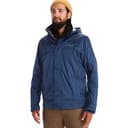
Best for: Shoppers who prioritize a listed pocket-stow design and pit zips.
- The linked listing specifies pit zips and an adjustable hood that rolls into the collar.
- Listing model
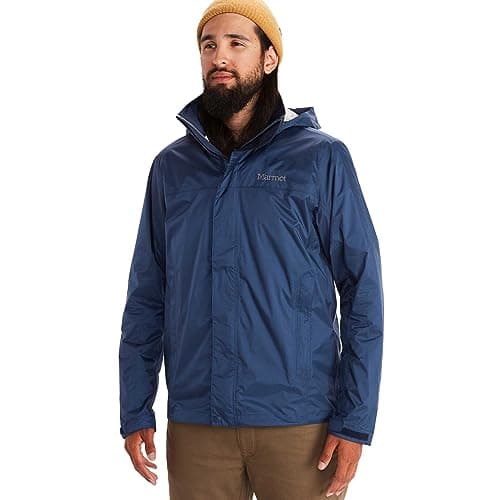
- 41500_F22 (part 41500); linked Arctic Navy listing is XX-Large
- Fabric
- NanoPro nylon ripstop, per linked listing
- Seam construction
- Sealed seams, per linked listing
- Ventilation
- Pit zips, per linked listing
- Packability
- Stuffs into its own pocket, per linked listing
- Hood
- Adjustable; rolls into collar, per linked listing
About this pick
The linked Arctic Navy listing is a men's XX-Large PreCip Eco, model 41500_F22 (part 41500). Its listing describes NanoPro nylon ripstop, sealed seams, pit zips, an adjustable hood that rolls into the collar, and own-pocket stowage. Marmot's current M15881 page is not established as the same revision, so its generation-specific specifications are not transferred here. Select your size on the retailer page before ordering.
Strengths
- The linked listing specifies pit zips and an adjustable hood that rolls into the collar.
- The linked listing says the jacket stuffs into its own pocket.
- The linked listing specifies NanoPro nylon ripstop and sealed seams.
Best for: Shoppers seeking a women's technical shell with a helmet-compatible hood, underarm vents and a RECCO reflector.
- Helmet-compatible StormHood, pit zippers and RECCO reflector are listed for the reconciled maker model.
- Fitted cut; confirm sizing and intended layering using Arc'teryx's size guide.
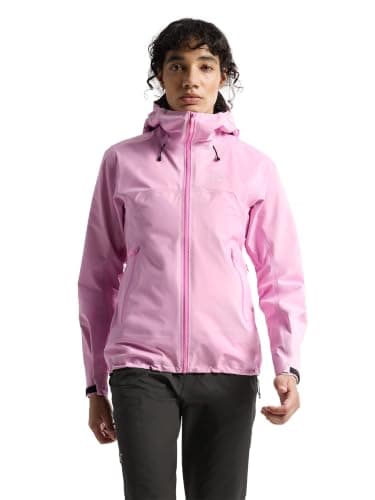
- Model
- X000010020 (listed part X000010020068)
- Construction
- 3-layer GORE-TEX ePE with C-KNIT backer, maker-listed for model X000010020
- Ventilation
- Pit zippers, maker-listed for model X000010020
- Locator feature
- RECCO reflector, maker-listed for model X000010020
- Fit
- Fitted, maker-listed for model X000010020
About this pick
The linked offer is the women's Beta SL in Pineberry, size Large. Arc'teryx's maker page for matching model X000010020 lists 3-layer GORE-TEX ePE with C-KNIT, a helmet-compatible StormHood, pit zippers and a RECCO reflector. The maker's listed weight is for size Small and is not assigned to this linked size Large.
Strengths
- Helmet-compatible StormHood, pit zippers and RECCO reflector are listed for the reconciled maker model.
- The maker lists a 3-layer GORE-TEX ePE shell with C-KNIT backer.
Weaknesses
- Fitted cut; confirm sizing and intended layering using Arc'teryx's size guide.
MOUNTAIN HARDWEAR
Mountain Hardwear Men's Stretch Ozonic Jacket
$280.00 Price checked Oct 23, 4:16 PM CDT
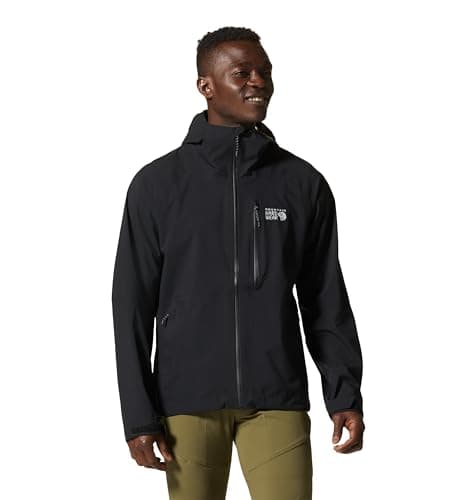
Best for: Shoppers who prefer a stretch shell and want underarm vents and zippered storage.
- Stretch-ripstop construction, underarm vents, adjustable hood and zippered pockets are listed for style 2093461.
- Maker style family
- 2093461; linked listing part/model 2093461010
- Construction
- 2.5-layer stretch ripstop shell; maker-listed for style 2093461
- Ventilation
- Underarm zip vents
- Pockets
- Zippered chest and hand pockets
- Packability
- Maker page says shell stuffs into a hand pocket
- Hood
- Adjustable hood
About this pick
The linked men's listing's part/model number shares maker style 2093461. Maker pages describe a 2.5-layer stretch-ripstop shell with an adjustable hood, underarm vents, zippered chest and hand pockets, and hand-pocket stowage. The exact fabric trade name is omitted because the linked listing says Dry.Q while the current maker page says DrySpell.
Strengths
- Stretch-ripstop construction, underarm vents, adjustable hood and zippered pockets are listed for style 2093461.
- The maker describes a hand-pocket stow design.
See all picks in Best rain jackets for hiking: 3 shells compared
Keep going
Complete loadoutDay hike kitSeven slots for a full trail day, from the pack and water system to light and weather protection.
Researched, not hands-on tested
Updated Jul 18, 2026Our recommendations draw on manufacturer documentation, retailer listings, owner feedback, and comparisons with alternatives.
As an Amazon Associate I earn from qualifying purchases. We may earn a commission from links here, at no extra cost to you. How we research →