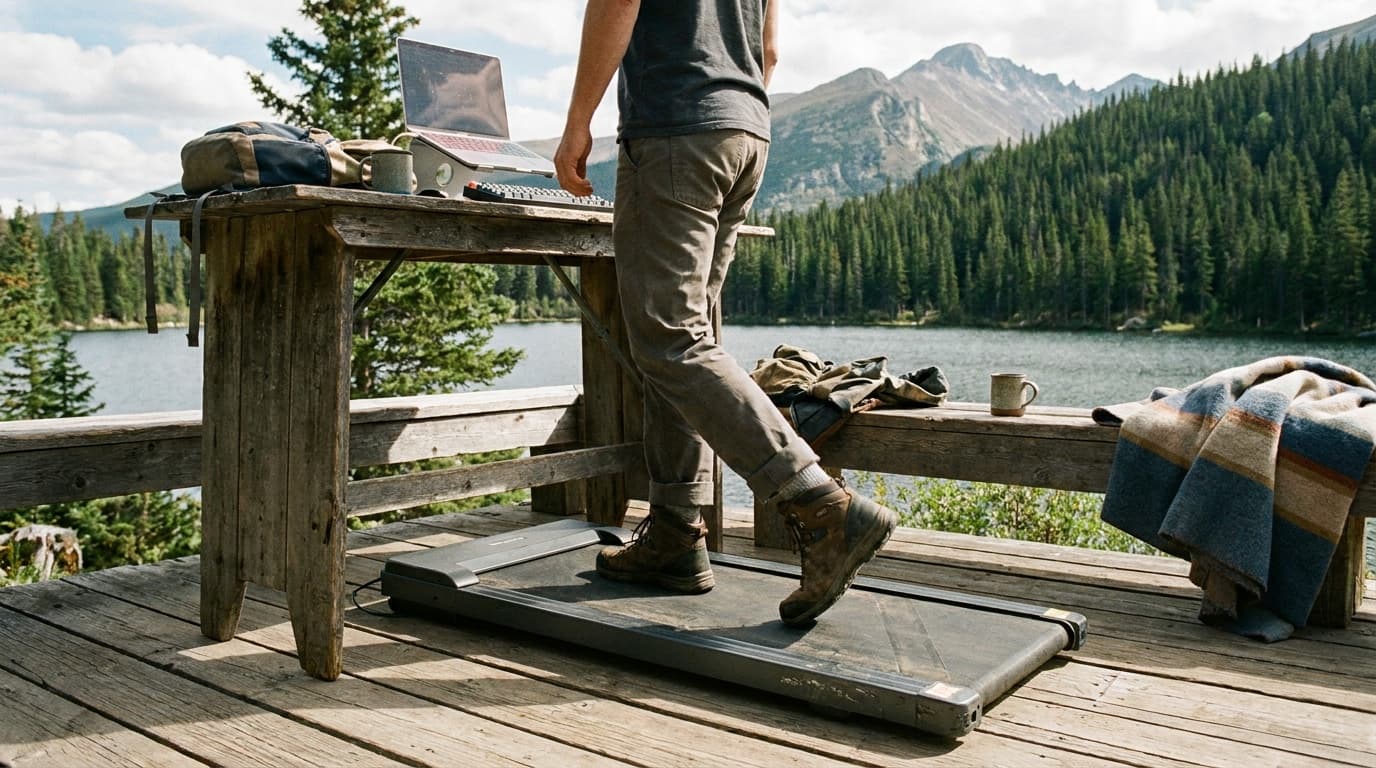
This guide compares nine selected walking pads from six established makers by the job each is suited to. The UREVO Strol 2E Pro combines a 12 percent manual incline with a raised-handlebar speed mode up to 6.2 mph; its current URTM059 manual sets a 265 lb maximum user weight. The right fit depends on your weight, desired incline, daily use, and storage space. Specs come from maker pages or current listings, and material discrepancies are noted. These are selective use-case picks, not a full score or hard ranking of every model. If your main job is walking while you type, the under-desk walking pad guide compares desk-specific numbers.
Our quick picks
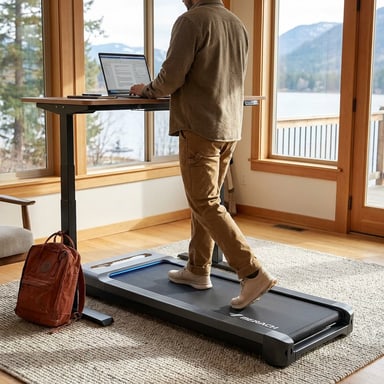
If you need to check belt length or desk height before choosing, use the walking pad fit checker.
Walking pad specs compared
Every figure below is the maker's published spec unless marked as the Amazon listing. Where the two disagree, both appear.
| Pad | Walking area | Speed | Incline | Max user | Height | Pad weight | Storage |
|---|---|---|---|---|---|---|---|
| UREVO Strol 2E Pro (URTM059) | 36.2 x 15.2 in | 0.6 to 4.0 mph; 6.2 mph handlebar up | 12%, manual | 265 lb / 120 kg (manual maximum) | 4.2 in, handlebar down (Amazon) | 44 lb (Amazon) | Slides flat |
| UREVO Smart Walking Pad | 35.43 x 15 in (Amazon) | 0.6 to 4 mph (Amazon) | None listed | 265 lb (listing claim; manual limit unconfirmed) | 4.1 in (Amazon) | 39.7 lb (Amazon) | 42 x 19 in footprint; folding and upright storage unconfirmed |
| Goplus 2-in-1 | 40 x 16 in (Amazon) | About 0.6 to 2.5 mph walking; 7.5 mph handrail up (Amazon) | None | 265 lb (Amazon) | 5 in folded (Amazon) | 69.5 lb (Amazon) | Handrail folds flat to 52 x 27 in |
| UREVO CyberPad for Office (URTM051) | 39.4 x 16.5 in | 0.6 to 4.0 mph | 0 to 14%, motorized | 300 lb / 136 kg (current US guide maximum) | 6.3 in | 63.1 lb | Does not fold |
| MERACH W50 | 41.3 x 16.5 in | 0.6 to 4.0 mph | Up to 12%, motorized | 400 lb (MERACH) | 6.1 in | 69.2 lb | Does not fold; stands upright |
| WalkingPad P1 | 47 x 16.5 in | 0.3 to 3.75 mph | None | 220 lb | 5 in | 62 lb | Folds to 32.5 x 21.5 in |
| WalkingPad Z1 | 47.6 x 15.7 in | 1 to 4 mph | None | 242 lb | 4.1 in | 51 lb | Folds to 31.8 x 22 in |
| WalkingPad C2 | 47.2 x 15.7 in | 1 to 4 mph listed; 3.7 mph in WalkingPad's comparison | None | 220 lb | 4.9 in (Amazon) | 55 lb | Folds to 32.5 x 20.4 in |
| LifeSpan TX6-GlowUp | 48 x 20 in | 0.4 to 6.0 mph | None | 400 lb | 5.8 in | 98.5 lb | Does not fold |
The picks
UREVO Strol 2E Pro: manual incline and raised-handlebar mode
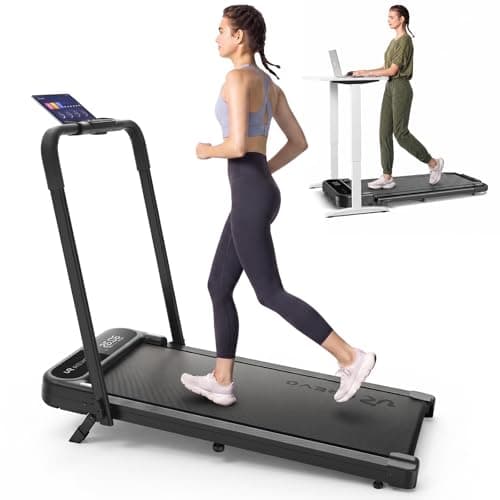
The Strol 2E Pro has a 12 percent incline set by hand with flip-down front legs and two speed modes: 0.6 to 4.0 mph with the handlebar down and up to 6.2 mph with it raised. The current US URTM059 manual sets the maximum user weight at 265 lb (120 kg); use that operating limit rather than UREVO's higher product-page figure. UREVO rates the motor at 2.25 HP and lists the running surface at 36.2 by 15.2 inches. Handlebar down, the Amazon listing puts it at 44.9 by 21.9 by 4.2 inches and 44 lb, with a one-hand SwiftFold hinge and transport wheels, so it rolls under a sofa between sessions.
The incline and raised-handlebar speed mode make it a different fit from flat desk-only pads. The app syncs sessions to Apple Health or Google Fit. Garage Gym Reviews names the non-Pro Strol 2E its best foldable under-desk treadmill.
Treat 6.2 mph as jogging headroom, not a running treadmill. Read the full UREVO Strol 2E Pro review for dimensions, desk-fit math, and how it differs from the Strol 2E and 2S Pro.
MANUAL INCLINE + JOG MODE
UREVO Strol 2E Pro Walking Pad Treadmill
Best for: Desk walkers who also want manual incline and a raised-handlebar speed mode.
- URTM059 manual specifies a 265 lb / 120 kg maximum.
- The manual's 265 lb maximum differs from the 300 lb figure on UREVO's product page.
Check current price
Buy at UREVOProduct details
The UREVO Strol 2E Pro listing is crosswalked to model URTM059. Its manual sets a 265 lb / 120 kg maximum, while UREVO's product page lists 300 lb; use the manual limit. UREVO lists a 12% incline and the manual describes a support-leg setup. Walking mode is listed to 4 mph with the handlebar down and up to 6.2 mph with it raised. The linked listing gives handlebar-down dimensions of 44.9 x 21.9 x 4.2 inches; the belt is listed at 36.2 x 15.2 inches.
- Speed range
- 0.6–6.2 mph (walking mode 0.6–4 mph)
- Max incline
- 12% (manual, flip-down front legs)
- Weight capacity
- 265 lb / 120 kg maximum per URTM059 manual; UREVO product page says 300 lb
- Running surface
- 36.2" x 15.2"
- Handlebar-down dimensions
- 44.9" L x 21.9" W x 4.2" H
- Unit weight
- 43.4 to 43.6 lb per UREVO; 44 lb per the linked Amazon listing
- Motor
- 2.25 HP
More strengths
- UREVO lists a 12% incline and separate handlebar-down walking and handlebar-up speed modes.
- The linked listing provides handlebar-down dimensions for clearance checks.
Other tradeoffs
- The manual describes a manual support-leg incline setup; no noise figure is established here.
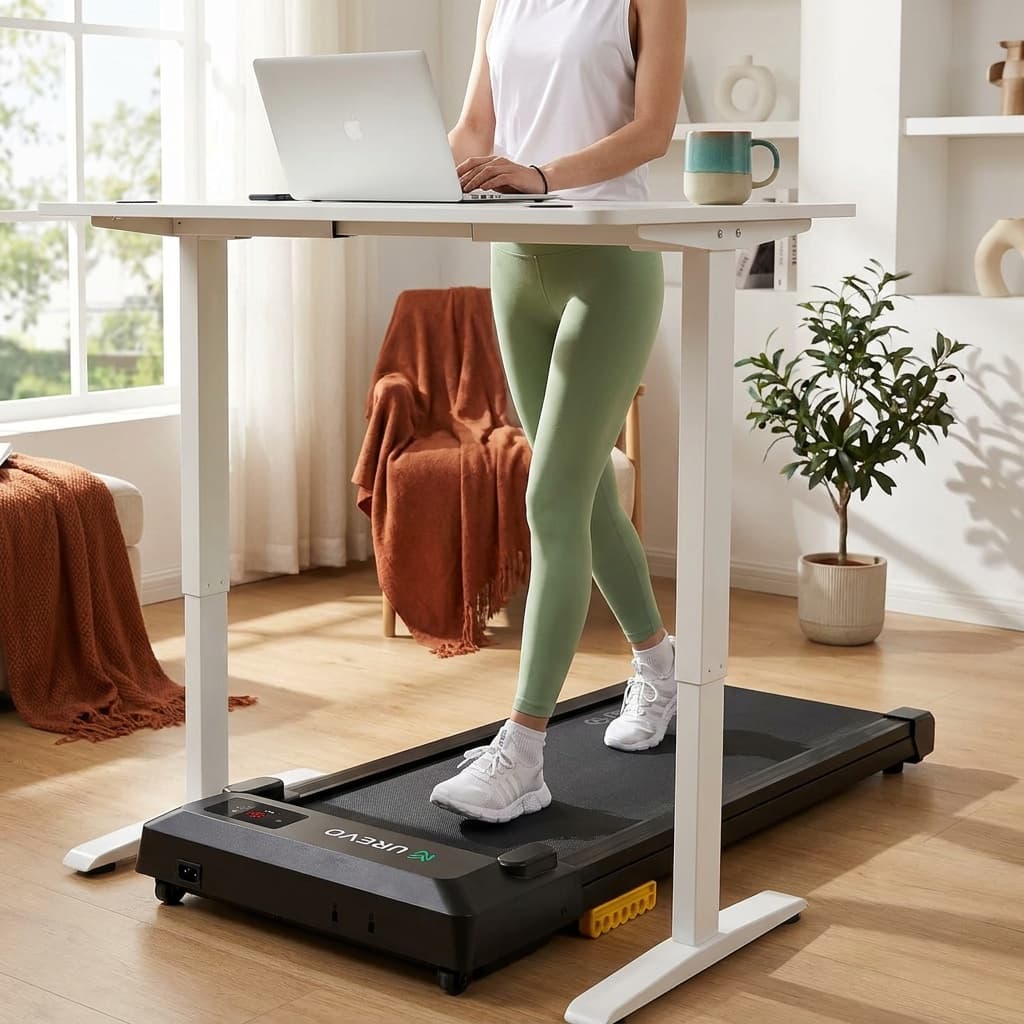
UREVO Smart Walking Pad: flat desk walking
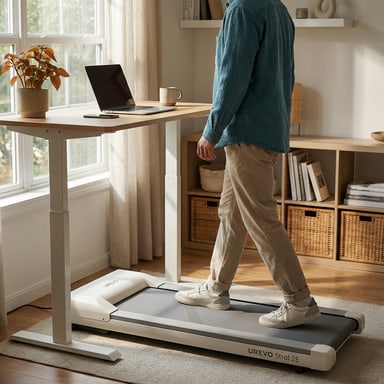
The current Amazon listing for model URTM025 (part URTM057) gives 0.6 to 4 mph, a 2.5 HP motor, a 265 lb capacity claim, and a 35.43 by 15 inch belt with a 4.1 inch profile. Its listed item weight is 39.7 lb. Allow for the full 42 by 19 inch footprint; folding and upright storage are not confirmed for this model.
Controls are simple: an LED display, a small remote, and Bluetooth app tracking. Incline and a raised-handlebar jogging mode are not listed. Check the 35.43 inch belt against your stride rather than assuming it will suit brisk walking. At a steady 2 to 3 mph it covers the core desk-walking job.
The 265 lb figure is the listing claim, not a reviewed manual limit. Read our full UREVO Smart Walking Pad review.
FLAT WALKING, REMOTE + APP
UREVO Smart Walking Pad
Best for: People seeking listed flat-walking, remote and app features for desk use.
- The exact listing identifies model URTM025 / part URTM057 and gives a 42 x 19 inch footprint.
- The exact listing's 265 lb capacity has not been verified against a manual.
$169.99 Price checked Oct 23, 4:16 PM CDT
Buy on AmazonProduct details
The linked Amazon listing identifies this Smart Walking Pad as UREVO model URTM025 / part URTM057. Listing dimensions are 42 x 19 x 4 inches, while separate listing copy calls the profile 4.1 inches; use 4.1 inches for preliminary clearance planning. The listing specifies a 35.43 x 15 inch belt, up to 4 mph, remote/app features and a 265 lb capacity claim. That capacity has not been confirmed against a reviewed manual. The listing does not establish upright-storage permission.
- Speed range
- 0.6 – 4.0 mph
- Motor
- 2.5 HP
- Weight capacity
- 265 lb per exact-ASIN listing; operating limit not confirmed from a reviewed manual
- Belt size
- 35.43" x 15"
- Machine weight
- 39.68 lb per exact-ASIN listing
- Footprint
- 42 x 19 x 4 in per exact-ASIN item dimensions; listing copy separately claims 4.1-inch profile
More strengths
- Remote and app features are listed for this exact item.
Other tradeoffs
- Listing dimensions state 4 inches high, while listing copy separately claims 4.1 inches.
- Upright-storage permission is unconfirmed.
Best budget 2-in-1: Goplus 2-in-1 Folding Treadmill
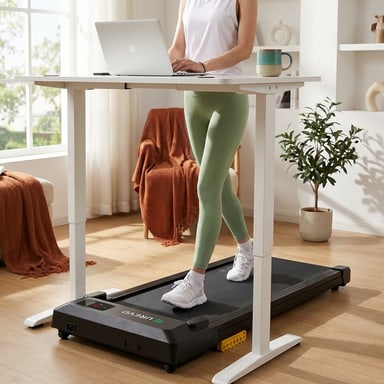
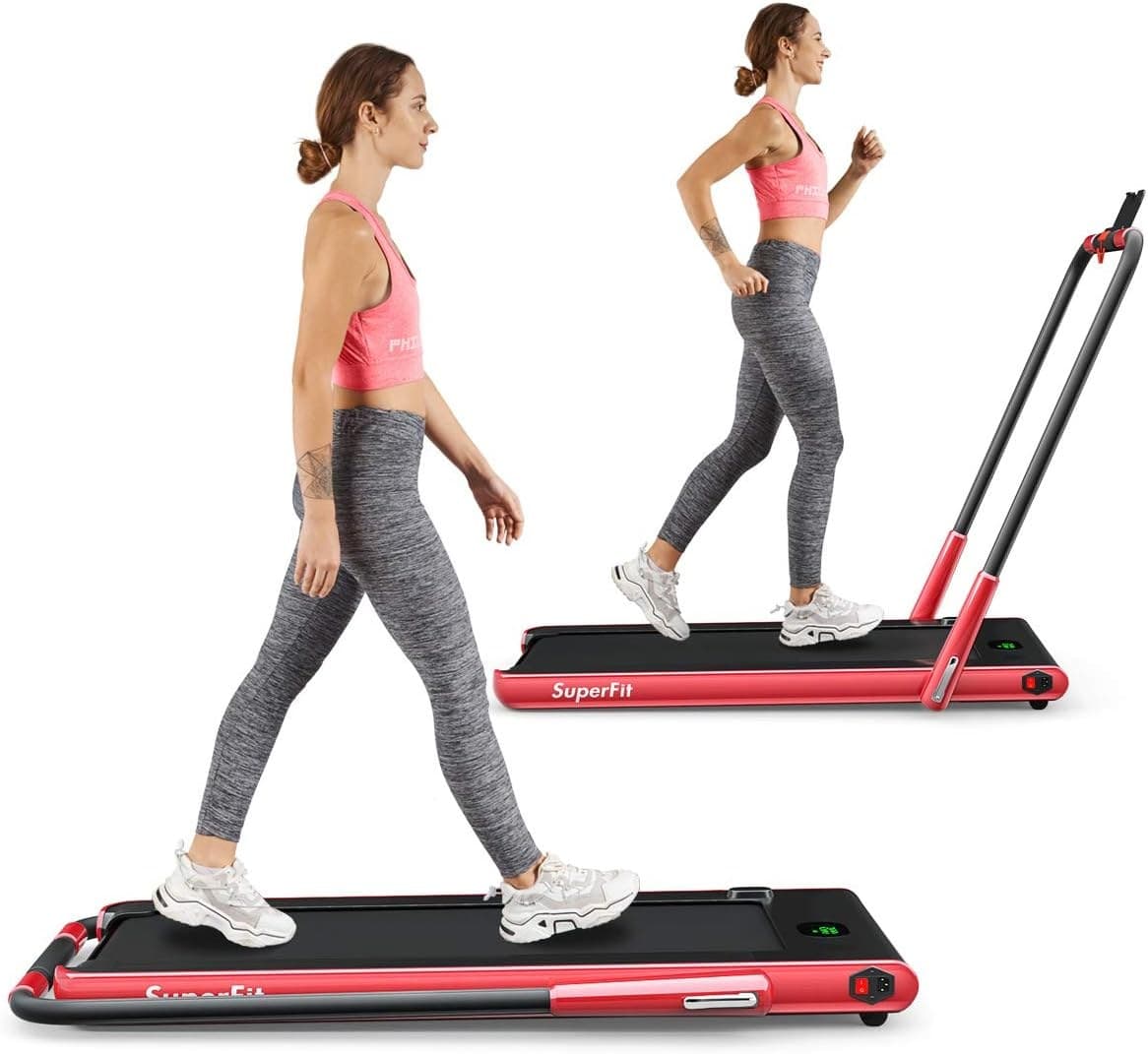
The Goplus 2-in-1 (sold under the SuperFit name) is the lowest-priced pad here and the one tested outlets point to most often at this level: Wirecutter calls the Goplus 2 in 1 its under-desk treadmill choice, and BarBend ranks it the best under-desk treadmill overall. It works in two modes. With the handrail folded flat it walks at 1 to 4 km/h, about 0.6 to 2.5 mph, under a desk; with the handrail raised it runs to 12 km/h, about 7.5 mph.
The Amazon listing gives a 40 by 16 inch running area, a 265 lb user limit, a 2.25 HP motor, and a folded size of 52 by 27 by 5 inches at 69.5 lb. It comes with a remote, app control, a Bluetooth speaker and a phone holder, and it carries 4.1 stars across 1,424 Amazon ratings.
Two catches decide whether it suits you. Desk mode tops out near 2.5 mph, so brisk walks mean raising the handrail. And the listing states only a 3-month warranty, while Amazon's review summary reports mixed experiences with noise and some units that stopped running. For a first pad on a tight budget it is hard to beat; for years of daily use, the UREVO pads carry a 1-year warranty.
BEST BUDGET 2-IN-1
Goplus 2-in-1 Folding Under Desk Treadmill (SuperFit)
Best for: First-time buyers on a tight budget who want to walk at a desk and jog occasionally, and who accept a short warranty.
- The lowest price of any pad Kit covers, with a jogging mode to about 7.5 mph when the handrail is up
- Walking mode under a desk tops out near 2.5 mph, so brisk walks need the handrail raised
Kit Score 7.2/10 · $113.99 Price checked Oct 23, 4:16 PM CDT · how we score gear
Buy on AmazonProduct details
The Goplus 2-in-1 (sold under the SuperFit name) is the budget way to get both a desk pad and an easy jogger. With the handrail folded flat it runs at 1 to 4 km/h, about 0.6 to 2.5 mph, for under-desk walking; with the handrail raised it reaches 12 km/h, about 7.5 mph. The running area is 40 by 16 inches, the user limit is 265 lb, and folded it measures 52 by 27 by 5 inches and weighs 69.5 lb. Every figure here is from the Amazon listing, which also states a 3-month warranty.
- Walking mode (handrail folded)
- 1–4 km/h (about 0.6–2.5 mph)
- Running mode (handrail up)
- 1–12 km/h (about 0.6–7.5 mph)
- Running area
- 40" x 16"
- Weight capacity
- 265 lb
- Folded size
- 52" x 27" x 5"
- Unit weight
- 69.5 lb
- Motor
- 2.25 HP
- Warranty
- 3 months (Amazon listing)
More strengths
- 40 by 16 inch running area and a 265 lb rating, roomy for the money
- Remote, app control, Bluetooth speaker and phone holder included
Other tradeoffs
- 3-month warranty on the listing and mixed owner reports on noise and early failures
UREVO CyberPad: motorized incline
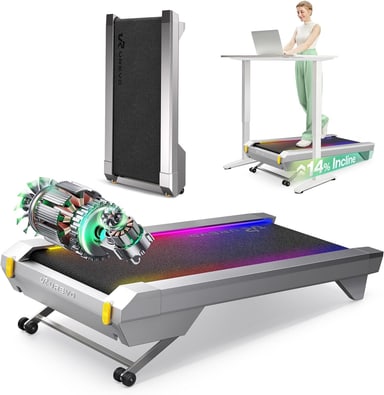
The CyberPad for Office (model URTM051, part URTM039) has a motorized 0 to 14 percent grade, set in 14 levels from the remote or app. The current US quick guide sets its maximum user weight at 300 lb (136 kg); use that operating limit. UREVO specifies a 42.9 by 22.8 by 6.3 inch footprint and 63.1 lb weight, with a 39.4 by 16.5 inch walking area and 0.6 to 4.0 mph. Wired named the longer CyberPad for Home its best walking pad overall in July 2026.
UREVO's sales page advertises a higher capacity, but that is not the operating limit in the current URTM051 quick guide. The guide does not specify motor horsepower or upright storage. UREVO publishes a noise figure without a test method, so it is not a comparative result.
It does not fold and tops out at 4 mph. LifeSpan, which leaves incline off its desk treadmills, cites ergonomists who advise against walking on a grade while you type, so treat the CyberPad's incline as a break-time workout rather than a working setting. Our UREVO CyberPad review covers the Office and Home versions, and Strol 2E Pro vs CyberPad weighs manual against motorized incline.
0-14% MOTORIZED INCLINE
UREVO CyberPad Smart Walking Pad with 14% Auto Incline
Best for: Walkers who want motorized incline and have room for a taller, heavier deck.
- UREVO lists motorized incline up to 14% in 14 levels.
- The guide's 300 lb maximum differs from the 400 lb figure on UREVO's US product page.
Check current price
Buy at UREVOProduct details
The linked listing is the CyberPad for Office, model URTM051 / part URTM039. UREVO lists motorized incline up to 14% in 14 levels, a 39.4 x 16.5 inch walking area and a 4 mph maximum. The US URTM051 V1.0 quick guide sets a 300 lb / 136 kg maximum; UREVO's US product page says 400 lb. The quick guide does not specify motor horsepower or authorize upright storage.
- Incline
- Motorized, up to 14% in 14 levels (UREVO)
- Speed range
- 0.6–4.0 mph
- Walking area
- 39.4" x 16.5"
- Weight capacity
- 300 lb / 136 kg maximum per US URTM051 V1.0 quick guide; US product page says 400 lb
- Dimensions
- 42.9" L x 22.8" W x 6.3" H
- Unit weight
- 63.1 lb
- Motor
- UREVO product page lists 2.5 HP; guide does not specify motor HP
More strengths
- The maker lists a 39.4 x 16.5 inch walking area.
- The US URTM051 quick guide specifies a 300 lb / 136 kg maximum.
Other tradeoffs
- The reviewed quick guide does not confirm upright storage.
MERACH W50: published capacity and duty rating
The MERACH W50 (sold as the NovaWalk W50 TrekPad on MERACH's site) is rated by MERACH to 400 lb (181 kg), has motorized incline up to 12 percent, and a 16.5 by 41.3 inch belt. MERACH lists a brushless motor at 1.25 HP continuous and 3.5 HP peak, and up to 10 continuous hours of use. That endurance figure is a manufacturer claim, not our test result. Its page conflicts on the minimum incline: 0 percent in its copy, 1 percent in its specification table.
Top speed is 4 mph, so this is a walking and incline machine, not a jogger. MERACH publishes conflicting sound figures without comparable test methods, so no quietness comparison is supported. Garage Gym Reviews' incline pick is MERACH's UltraWalk W60 Plus, a sibling it lists with the same 41.3 by 16.5 inch tread.
The trade-off is bulk. The W50 does not fold, measures 50.2 by 22.2 by 6.1 inches, and weighs 69.2 lb, so it stays on the floor. Speed and incline run from a handheld remote or the MERACH app, with no buttons on the deck. It may suit buyers who need its published capacity or plan long incline sessions. Read the full MERACH W50 review, or see the model comparison in UREVO CyberPad vs MERACH W50.
400 LB LISTED CAPACITY
MERACH W50 Walking Pad with 12% Auto Incline
Best for: Walkers seeking a maker-listed 400 lb capacity and motorized incline.
- MERACH lists motorized incline up to 12%.
- MERACH's published minimum incline differs between 0% and 1%; the minimum is unresolved.
$296.99 Price checked Oct 23, 4:16 PM CDT
Buy on AmazonProduct details
MERACH identifies this listing as W50 model MR-T25B2-US. The maker lists motorized incline up to 12%; its product page and comparison material differ on the minimum incline (0% versus 1%), so the minimum is not stated here. MERACH lists a 400 lb user limit, a 41.3 x 16.5 inch belt, and up to 10 hours of continuous use. The 10-hour figure is a maker rating, not an independently tested or guaranteed session length.
- Speed range
- 0.6 – 4.0 mph
- Motor
- 1.25 HP continuous / 3.5 HP peak brushless
- Weight capacity
- 400 lb (MERACH)
- Belt size
- 41.3" x 16.5"
- Incline
- Motorized, up to 12%; minimum is unresolved (maker sources list 0% and 1%)
More strengths
- MERACH lists a 400 lb user limit and a 41.3 x 16.5 inch belt.
- MERACH rates the model for up to 10 hours of continuous use; this is not an independent test result.
Other tradeoffs
- Top speed is listed at 4 mph.
Best for desk walking: WalkingPad P1
The WalkingPad P1 is Garage Gym Reviews' best overall under-desk treadmill as of its September 2026 update, and its belt explains why it suits desk work. WalkingPad lists a 47 by 16.5 inch walking area, the widest belt among the folding pads here, so your feet have room to drift while your eyes are on a screen. The deck stands 5 inches tall, runs from 0.3 to 3.75 mph, and folds in half to 32.5 by 21.5 inches for storage. Speed runs from the remote, the app, or an automatic mode.
The limits are real. It is rated to 220 lb, and at 3.75 mph it has one of the lowest top speeds here, so it is a desk-pace pad first. It uses a brush motor (746 W input per WalkingPad) rather than the brushless motors on the newer Z1 and C2. It carries 4.2 stars across 1,234 Amazon ratings, and Amazon's review summary reports mixed reliability, with some units failing early and some remotes not pairing.
For higher listed capacities, compare the LifeSpan TX6-GlowUp and W50, but confirm each model's operating limit in its user guide. MERACH lists the W50 at 400 lb; its exact US manual limit remains unverified. Our WalkingPad P1 review covers its specs and published owner feedback.
BEST FOR DESK WALKING
WalkingPad P1 Foldable Walking Pad
Best for: Desk walking when the pad needs to fold away after work.
- 16.5 inch wide by 47 inch long walking area, the roomiest belt among the folding pads Kit covers
- 220 lb limit and a 3.75 mph ceiling, both at the low end of the pads Kit covers
Kit Score 7.3/10 · $349.00 Price checked Oct 23, 4:16 PM CDT · how we score gear
Buy on AmazonProduct details
The WalkingPad P1 is WalkingPad's classic fold-in-half pad, and its 47 by 16.5 inch walking area is the widest belt among the folding pads Kit covers. WalkingPad lists a 5 inch height, a 0.3 to 3.75 mph speed range, a 220 lb limit and a 62 lb weight; it folds to 32.5 by 21.5 inches. Speed runs from the remote, the app, or an automatic mode. It uses a brush motor rather than the brushless motors on the newer Z1 and C2, and it has no incline.
- Speed range
- 0.3–3.75 mph per WalkingPad; 0.5–3.75 mph per the Amazon listing
- Walking area
- 47" x 16.5"
- Weight capacity
- 220 lb
- Unfolded size
- 56.5" x 21.5" x 5"
- Folded size
- 32.5" x 21.5" x 5"
- Unit weight
- 62 lb
- Motor
- Brush motor, 746 W input per WalkingPad; 2 HP per the Amazon listing
More strengths
- Folds in half to 32.5 by 21.5 inches and stands 5 inches tall open
- Desk-speed range starting at 0.3 mph, with remote, app and automatic speed modes
Other tradeoffs
- Brush motor, and Amazon's review summary reports mixed reliability with some early failures
Best compact walking pad: WalkingPad Z1
The WalkingPad Z1 is the pick when the pad has to disappear and you still want a full stride. WalkingPad's specs give a 47.6 by 15.7 inch walking area on a deck 4.1 inches tall, and it folds in half to 31.8 by 22 by 5.4 inches, the smallest folded size here. At 51 lb with wheels it is the lightest folding pad in this guide. Tom's Guide picks it as the best WalkingPad in its under-desk treadmill guide.
It runs at 1 to 4 mph from a 2.25 HP brushless motor (the Amazon listing says 2 HP) with remote and app control, and it is rated to 242 lb, a little more than the 220 lb WalkingPad C2 and P1. There is no incline. It carries 4.2 stars across 410 Amazon ratings; Amazon's review summary praises the fold and quick setup but flags belt drift, some noise, and a few early belt failures, so register the 1-year warranty. The full WalkingPad Z1 review has the owner details.
BEST COMPACT
WalkingPad Z1 Foldable Walking Pad
Best for: Apartment walkers who need the pad to fold away after every session but still want a long deck for a natural stride.
- Folds in half to 31.8 by 22 inches, yet opens to a 47.6 inch walking area for a full stride
- No incline, a 4 mph ceiling, and a standard 15.7 inch belt width
Kit Score 7.5/10 · Check current price · how we score gear
Buy on AmazonProduct details
The WalkingPad Z1 is the compact member of WalkingPad's fold-in-half line. Open, it gives a 47.6 by 15.7 inch walking area on a 4.1 inch tall deck; folded, it measures 31.8 by 22 by 5.4 inches, small enough for a closet floor or under a bed. WalkingPad rates it to 242 lb at 1 to 4 mph, with a 2.25 HP brushless motor (the Amazon listing says 2 HP) and remote or app speed control. There is no incline. At 51 lb it is lighter than the C2 and costs less.
- Speed range
- 1–4 mph
- Walking area
- 47.6" x 15.7"
- Weight capacity
- 242 lb
- Unfolded size
- 56.1" x 22" x 4.1"
- Folded size
- 31.8" x 22" x 5.4"
- Unit weight
- 51 lb
- Motor
- 2.25 HP brushless per WalkingPad; 2 HP per the Amazon listing
More strengths
- 4.1 inches tall and 51 lb, the slimmest folding pad Kit covers
- 242 lb rating, a little more headroom than the WalkingPad C2 and P1 at 220 lb
Other tradeoffs
- Amazon's review summary flags belt drift and a few early belt failures, so register the 1-year warranty
Also great for small spaces: WalkingPad C2
The WalkingPad C2 is the folding pad tested outlets have recommended longest: Wired names it the best foldable walking pad and BarBend its best folding under-desk treadmill. It folds 180 degrees at a center hinge to 32.5 by 20.4 by 5.4 inches, and WalkingPad's manual says to store it lying flat, not on its end or side. Open, it has a 47.2 by 15.7 inch walking area.
WalkingPad's product page lists 1 to 4 mph, while its own A1 Pro vs C2 comparison gives a 3.7 mph maximum. WalkingPad lists a 3 HP brushless motor; the Amazon listing says 2.0 HP. FootSense mode adjusts speed from where your feet land on the belt, and the unit weighs 55 lb on built-in wheels.
Against the Z1, the C2 costs more, weighs more, and carries a lower 220 lb rating, so choose it for FootSense or a color you prefer rather than for the specs. Longer-term owners also name the fold hinge as the weak point. Read our full WalkingPad C2 review, or compare the two side by side in WalkingPad C2 vs Z1.
ALSO GREAT FOR SMALL SPACES
WalkingPad C2 Foldable Walking Pad Treadmill
Best for: Small-space and apartment users who need a walking pad that genuinely disappears into a closet or under a sofa when not in use.
- Folds to 33 inches long and 5 inches tall, the only compact walker that fits a standard closet or apartment storage
- 220 lb weight limit is the lowest in this comparison, and owners near that limit report reduced belt stability
Kit Score 7.1/10 · $429.00 Price checked Oct 23, 4:16 PM CDT · how we score gear
Buy on AmazonProduct details
The C2 folds 180 degrees down the middle to a 33-inch length and 5-inch height, making it the only widely-available walking pad that fits a standard closet or car trunk. At 55 lbs with built-in transport wheels, it is genuinely portable, and the KS Fit app adds step goals and remote speed control.
- Speed range
- Product page says 1 – 4 mph; WalkingPad's A1 Pro vs C2 comparison says 3.7 mph max
- Motor
- 3 HP brushless per WalkingPad; the Amazon listing says 2.0 HP
- Weight capacity
- 220 lbs
- Belt size
- 47.2" x 15.75"
- Machine weight
- 55 lbs
- Folded dimensions
- 32.5" x 20.4" x 5.4"
More strengths
- 55 lbs with transport wheels: easy to move between rooms or take to a second location
- Quiet brushless motor and multiple color options make it a natural fit for home-office aesthetics
Other tradeoffs
- Long-term owner reviews note belt centering drift and occasional noise development after several months of heavy use
Best premium: LifeSpan TX6-GlowUp
The LifeSpan TX6-GlowUp is an office-grade under-desk treadmill rather than a consumer pad, and the specs show the difference. LifeSpan rates it for 7 hours of use per day and users up to 400 lb, on a 20 by 48 inch belt, the widest and longest in this guide. A 4.5 HP peak brushless motor drives a self-lubricating belt over a phenolic deck with six compression shocks, at 0.4 to 6.0 mph. The frame carries a 10-year warranty, parts 2 years, and labor 1 year.
It is built to stay put: 60 by 28 by 5.8 inches and 98.5 lb, rolling on two front wheels, with no fold and no incline (LifeSpan leaves incline out on ergonomic grounds). LifeSpan sells it direct, not on Amazon, and its site shows only 6 reviews so far, so long-term reliability is unproven for this exact model. Garage Gym Reviews names LifeSpan's TR1200 GlowUp, a sibling, its quietest under-desk treadmill, but that model showed out of stock on LifeSpan's site on October 3, 2026.
It costs several times as much as any other pick here. It earns that only if you walk for hours every day, weigh more than the consumer pads comfortably carry, or share one machine in an office.
BEST PREMIUM
LifeSpan TX6-GlowUp Under Desk Treadmill
Best for: Remote workers who walk for hours every day, heavier walkers who want a 400 lb rating with a wide belt, and offices sharing one machine.
- 20 by 48 inch belt and a 400 lb rating, far roomier than any folding walking pad
- Costs several times as much as a consumer walking pad and is sold only direct from LifeSpan
Kit Score 8.1/10 · Check current price · how we score gear
Buy at LifeSpan FitnessProduct details
The LifeSpan TX6-GlowUp is an office-grade under-desk treadmill rather than a consumer walking pad. LifeSpan rates it for 7 hours of use per day and users up to 400 lb, on a 20 by 48 inch self-lubricating belt over a phenolic deck with six compression shocks, driven by a 4.5 HP peak brushless motor at 0.4 to 6.0 mph. It stands 5.8 inches tall, measures 60 by 28 inches, and weighs 98.5 lb, so it rolls on front wheels but does not fold. LifeSpan leaves out incline on purpose, citing ergonomists. The frame carries a 10-year warranty.
- Belt size
- 20" x 48"
- Speed range
- 0.4–6.0 mph
- Weight capacity
- 400 lb
- Recommended use
- 7 hours per day
- Dimensions
- 60" L x 28" W x 5.8" H (5.8" step-up)
- Unit weight
- 98.5 lb
- Motor
- 4.5 HP peak brushless
- Warranty
- Frame 10 years, parts 2 years, labor 1 year
More strengths
- Rated for 7 hours of use per day, with a self-lubricating belt and a 10-year frame warranty
- 0.4 to 6.0 mph range covers the slowest typing pace and brisk walking breaks
Other tradeoffs
- 98.5 lb, 60 by 28 inches and non-folding, with no incline and only 6 site reviews so far
What tested reviewers recommend
We did not walk on these pads; we cross-checked our shortlist against outlets that test them hands-on. Their picks overlap with ours in several places, and where they do not, the reason is usually availability or listing quality rather than performance.
| Outlet (latest update) | Their picks | How it maps to this guide |
|---|---|---|
| Garage Gym Reviews (Sep 11, 2026) | WalkingPad P1 best overall; MERACH UltraWalk W60 Plus best with incline; LifeSpan TR1200 GlowUp quietest; UREVO Strol 2E best foldable | P1 is our desk pick; we cover the W50 and TX6, siblings of their MERACH and LifeSpan picks |
| Wired (Jul 2026) | UREVO CyberPad for Home best overall; WalkingPad C2 best foldable; UREVO Strol 2S Pro most versatile | CyberPad is our incline pick (the Office version); C2 is an also-great pick |
| Wirecutter | Goplus 2 in 1 Under-Desk Treadmill | Our budget 2-in-1 pick |
| Tom's Guide (Oct 1, 2026) | DeerRun Q1 Mini best overall; WalkingPad Z1 best WalkingPad | Z1 is our compact pick |
| BarBend (Nov 2024) | Goplus 2-in-1 best overall; WalkingPad C2 best folding; LifeSpan TR1000-GlowUp best quality | Goplus and C2 are picks here |
We left out DeerRun, a Tom's Guide and TechRadar favorite, because its current Amazon listings are sold by a third-party storefront and carry a near-identical spec sheet to another brand's pad, so we could not tie a listing to the model those outlets tested. Amazon's walking pad search results are also crowded with brand names that appear and disappear within months; every pick here comes from a maker with a track record and a published spec sheet.
How we picked
We compare selected pads on use-case specifications: user-weight limit, speed range, incline, walking-area size, motor rating, pad weight, published duty rating, and storage. Specs come from maker pages or current listings, with material differences identified. This is not a rating of every model or a hard ranking, and we did not walk on these pads ourselves; it is research from published sources, not a lab test.

How to choose the right walking pad
How to choose a walking pad
Start with weight capacity
Choose a pad whose operating limit covers the heaviest user, plus any weighted vest, with headroom where possible. Published figures here include 220 lb (WalkingPad P1 and C2), 242 lb (Z1), 265 lb (UREVO Strol manual and Smart listing; Goplus listing), 300 lb (CyberPad current US guide), and 400 lb (MERACH W50 and LifeSpan TX6-GlowUp). Follow the model-specific manual for the operating limit.
Match deck length to your height and speed
Your stride grows with speed. By our fit checker's math, a 5'10" walker needs about 36.5 inches of belt at a 2 mph desk pace and about 45 inches at a brisk 3.5 mph; a 6'2" walker needs about 38 and 48 inches. The 47 to 48 inch belts on the WalkingPads and the LifeSpan cover brisk walking for most heights; the 35 to 36 inch UREVO belts suit desk speeds.
Check belt width
Most pads run 15 to 16.5 inches wide, enough at desk pace. The 16.5 inch belts on the P1, CyberPad and W50 give more room to drift, and the TX6's 20 inches is treadmill width.
Decide on incline
Flat pads cover desk walking. For harder sessions without running, look at how the grade is set: the CyberPad (14%) and W50 (12%) change it from the remote, while the Strol 2E Pro's 12% is set by hand with flip-down legs, so you stop to change it.
Be honest about jogging
Most walking pads stop at about 4 mph. For an occasional easy jog you need a two-mode pad with a raised handrail, like the Strol 2E Pro (6.2 mph) or the Goplus 2-in-1 (about 7.5 mph). To run regularly, buy a treadmill.
Plan the storage and the lift
Closet storage needs a fold-in-half pad; the Z1 folds to 31.8 inches long. Sliding under a sofa needs a low deck, and every pad here stands 4.1 to 6.3 inches tall. Pad weight runs from 39.7 lb (UREVO Smart) to 98.5 lb (LifeSpan), so check you can move it.
Treat noise claims with caution
Maker-published noise figures for the CyberPad and MERACH W50 lack comparable test methods. They are not a basis for ranking quietness; check sound and vibration in your own room if this matters.
If you are 6 ft or taller, our best walking pads for tall people guide ranks every pad here by belt length and pairs each long belt with its weight rating. To test a pad against your floor and ceiling with treadmill clearance behind it, use the home cardio space checker.
If the pad has to share a room with furniture or strength equipment, our small-space indoor fitness guide compares operating space with stored size. A folding deck can save storage space while still being longer than a non-folding pad during use.
Still weighing a pad against a full treadmill? Our walking pad vs treadmill comparison covers where rails, a bigger motor, and a longer deck earn their footprint, and the walking pad buying guide walks through every spec in more depth. Once your pad arrives, the walking pad workouts guide has five routines and a speed chart built around the 4 mph ceiling most pads share.
Once a flat, steady pace feels easy, a weighted vest is another way to make the same walk harder. Our best weighted vests for walking guide covers the options. Add the vest's weight to your own when you check a pad's maximum user weight.
Want help narrowing the shortlist?
Two-minute decision
Match a walking pad to how you will use it
Body weight, session type, storage and budget decide this category more than brand. Answer four questions to narrow eight pads with very different strengths.
Manual incline and raised handlebar
UREVO Strol 2E Pro
The URTM059 manual sets a 265 lb / 120 kg maximum; UREVO lists up to 12% incline and up to 6.2 mph with the handlebar raised.
See this path →Maker-listed capacity and incline
MERACH W50
MERACH lists a 400 lb user limit, motorized incline up to 12%, a 16.5 inch belt and up to 10 hours of continuous use.
See this path →Motorized incline
UREVO CyberPad for Office
UREVO lists motorized incline up to 14% in 14 levels and a 39.4 x 16.5 inch walking area.
See this path →Flat desk walking
UREVO Smart Walking Pad
The exact listing identifies model URTM025 / part URTM057 and gives a 42 x 19 inch footprint, remote/app features and up to 4 mph.
See this path →Best budget 2-in-1
Goplus 2-in-1 Folding Treadmill
It walks under a desk with the handrail down and jogs to about 7.5 mph with it up, on a 40 by 16 inch running area, at the lowest price here.
See this path →Best for desk walking
WalkingPad P1
Its 47 by 16.5 inch walking area is the widest folding belt here, on a 5 inch deck that folds in half for storage.
See this path →Best compact
WalkingPad Z1
It folds in half to 31.8 by 22 inches yet opens to a 47.6 inch walking area, on a 4.1 inch deck at 51 lb.
See this path →Best premium
LifeSpan TX6-GlowUp
LifeSpan rates it for 7 hours a day and 400 lb on a 20 by 48 inch belt, with a 10-year frame warranty.
See this path →
Frequently asked questions
What is the best walking pad?
There is no single best fit across these different use cases. The Strol 2E Pro combines a 12% manual incline and raised-handlebar speed up to 6.2 mph, with a 265 lb maximum in its current manual. The CyberPad offers motorized incline and a 300 lb maximum in its current US guide; MERACH lists the W50 at 400 lb and up to 10 continuous hours. The P1 has a wide desk belt, the Z1 folds for storage, and LifeSpan rates the TX6-GlowUp for hours of daily use.
Which walking pad suits flat walking?
The UREVO Smart Walking Pad listing describes a flat 0.6 to 4 mph model with a 2.5 HP motor, a 265 lb capacity claim, and an item weight around 40 lb. The Goplus 2-in-1 adds a jogging mode to about 7.5 mph with its handrail up, but desk mode tops out near 2.5 mph and its listing states a 3-month warranty. Compare the operating modes and current listing details for your use.
What is the best walking pad with incline?
The UREVO CyberPad has a 0 to 14% motorized incline; its current US quick guide sets a 300 lb maximum. The MERACH W50 reaches 12% motorized and MERACH lists it at 400 lb and up to 10 continuous hours. The UREVO Strol 2E Pro also reaches 12%, set by hand with flip-down legs, and its current manual sets a 265 lb maximum. The Egofit Walker Pro M1 in our under-desk guide has a fixed 5% grade.
What is the best walking pad for heavier people?
The MERACH W50 and LifeSpan TX6-GlowUp are listed at 400 lb; the W50 adds motorized incline, while the TX6 has a 20 inch belt and a 7 hour daily-use rating. The current US CyberPad quick guide sets a 300 lb maximum, and the current Strol URTM059 manual sets a 265 lb maximum. Follow the operating limit in the manual for your exact model. The WalkingPad P1 and C2 are listed at 220 lb, and the Z1 at 242 lb.
What is the best lightweight or compact walking pad?
The UREVO Smart Walking Pad listing gives a 39.7 lb item weight and a 4.1 inch profile. Folding and upright storage are unconfirmed for this model. If you need a folding deck, the WalkingPad Z1 folds in half to 31.8 by 22 inches at 51 lb while still opening to a 47.6 inch walking area. For a short footprint during use, see the 38.4 inch Egofit Walker Pro M1 in our under-desk guide.
Can you jog on a walking pad?
Only on a two-mode pad. Most pads here stop at about 4 mph, a brisk walk. The UREVO Strol 2E Pro reaches 6.2 mph and the Goplus 2-in-1 about 7.5 mph with their handrails raised, enough for an easy jog, but both have belts far shorter than the roughly 55 inches treadmill makers suggest for running. The LifeSpan TX6-GlowUp reaches 6.0 mph, but LifeSpan builds it for walking under a desk, with no handrail. If you want to run regularly, buy a treadmill.
Are walking pads worth it?
For people who struggle to fit movement into the day, generally yes: walking at 2 mph through two hours of calls and light work adds roughly 4,000 to 5,000 steps without carving time out of the schedule. The pad only pays off if you have a realistic plan for when you will step on it and a place to use it. Our breakdown of whether walking pads are worth it runs the numbers.
What is the difference between a walking pad and a treadmill?
A walking pad is a low, slim motorized belt built for walking speeds, usually capped at 4 mph, with no console tower and often no rails. It is quieter, cheaper, and easier to store than a treadmill, but most models cannot support running and many skip incline. If your goal is daily steps rather than training runs, a walking pad is the right tool.
Which walking pad is best under a desk?
Desk use has its own priorities: a low deck your standing desk can clear, a belt wide enough for a steady typing posture, a duty rating that covers long sessions, and sound you have checked in your room. Our under-desk walking pads guide compares selected pads on those points; it is not an all-model rating.
Which walking pad is best for a senior or an older parent?
The UREVO Strol 2E Pro and the Goplus 2-in-1 are the only pads here with a rail to hold, and the WalkingPad P1 (0.3 mph) and LifeSpan TX6-GlowUp (0.4 mph) have the slowest starts. Our guide to the best walking pads for seniors compares all four on rail, minimum speed, step-up height, safety key, and weight rating, and lists the pads to avoid for an older walker.
Where these numbers come from
| Claim | Source | Checked |
|---|---|---|
| Strol 2E Pro (URTM059): 0.6 to 4.0 mph walking mode, up to 6.2 mph with handlebar raised, 12% manual incline, 2.25 HP maker figure, 36.2 x 15.2 in running surface, SwiftFold hinge, Apple Health and Google Fit sync | UREVO, Strol 2E Pro Smart Treadmill | Oct 13, 2026 |
| Strol 2E Pro listing: 44.9 x 21.9 x 4.2 in and 44 lb; model URTM059 | Amazon listing, ASIN B0H1H4JT4C | Oct 13, 2026 |
| Strol 2E Pro manual: safety instruction 19 sets maximum user weight at 265 lb (120 kg); incline is set with front support legs | UREVO Strol 2E Pro User Manual V2.0, US model URTM059 | Oct 13, 2026 |
| UREVO Smart Walking Pad: listing copy gives 0.6 to 4 mph, 2.5 HP, 265 lb capacity claim, 35.43 x 15 in belt; item dimensions 42 x 19 x 4 in and weight 39.68 lb; model URTM025 / part URTM057 | Amazon listing, ASIN B097BKS6Z9 | Oct 13, 2026 |
| Goplus 2-in-1: walking 1 to 4 km/h, running 1 to 12 km/h, 40 x 16 in running area, 265 lb, 2.25 HP, folded 52 x 27 x 5 in, 69.5 lb, 3-month warranty; 4.1 stars from 1,424 ratings | Amazon listing, ASIN B07ZRSBP5S | Oct 3, 2026 |
| UREVO CyberPad for Office sales-page specifications include footprint 42.9 x 22.8 x 6.3 in, 39.4 x 16.5 in walking area, 63.1 lb, 0.6 to 4.0 mph, motorized 0 to 14% incline, and a higher advertised capacity that is not the operating limit | UREVO, CyberPad for Office | Oct 13, 2026 |
| CyberPad listing identity: model URTM051 / part URTM039; dimensions about 43 x 23 x 6 in and 63 lb; no capacity field returned | Amazon listing, ASIN B0F6LJGZ12 | Oct 13, 2026 |
| CyberPad for Office current US quick guide: safety instruction 19 sets maximum user weight at 300 lb (136 kg); guide does not specify motor HP or upright storage | UREVO CyberPad for Office Quick Guide V1.0, model URTM051 | Oct 13, 2026 |
| MERACH W50: 0.6 to 4.0 mph, motorized incline up to 12% (minimum conflicts: 0% vs 1%), 1.25 HP continuous and 3.5 HP peak, maker-listed 400 lb, 41.3 x 16.5 in belt, 50.2 x 22.2 x 6.1 in, 69.2 lb, maker-claimed up to 10 hours continuous use, non-folding; sound statements are conflicting and unmethoded | MERACH, NovaWalk W50 TrekPad | Oct 14, 2026 |
| WalkingPad P1: 0.3 to 3.75 mph, 47 x 16.5 in walking area, 220 lb, brush motor, 746 W, 62 lb, unfolded 56.5 x 21.5 x 5 in, folded 32.5 x 21.5 x 5 in | WalkingPad, P1 Foldable Treadmill | Oct 3, 2026 |
| WalkingPad P1 listing: 0.5 to 3.75 mph, 2 HP, 62 lb; 4.2 stars from 1,234 ratings | Amazon listing, ASIN B0D2ZVB8DJ | Oct 3, 2026 |
| WalkingPad Z1: 1 to 4 mph, 47.6 x 15.7 in walking area, 242 lb, 2.25 HP brushless, 51 lb, unfolded 56.1 x 22 x 4.1 in, folded 31.8 x 22 x 5.4 in | WalkingPad, Z1 Under-Desk Treadmill | Oct 3, 2026 |
| WalkingPad Z1 listing: 2 HP, 242 lb, 51 lb; 4.2 stars from 410 ratings | Amazon listing, ASIN B0H2YYZTL8 | Oct 3, 2026 |
| WalkingPad C2: 1 to 4 mph, 220 lb, 47.2 x 15.7 in walking area, 3 HP brushless motor, FootSense; 3.7 mph max, folded 32.5 x 20.4 x 5.4 in, 55 lb | WalkingPad, C2 product page and A1 Pro vs C2 comparison | Sep 25, 2026 |
| LifeSpan TX6-GlowUp: 20 x 48 in belt, 0.4 to 6.0 mph, 400 lb, 7 hours per day, 4.5 HP peak brushless, self-lubricating belt, 60 x 28 x 5.8 in, 98.5 lb, no incline, 10-year frame warranty; 6 reviews averaging 4.83 | LifeSpan, TX6-GlowUp Under Desk Treadmill | Oct 3, 2026 |
| Tested-outlet picks named in this guide | Garage Gym Reviews, Wired, Wirecutter, Tom's Guide and BarBend pages linked in the reviewer table above | Oct 3, 2026 |
We did not walk on these pads ourselves. Speed, capacity, motor, and noise figures are the makers' published ratings; noise claims in particular are not lab-verified by anyone we can cite. For deck height, folded size, and every other figure side by side with its source, download the walking pad specs dataset.
For more gear that supports an active daily routine, see the full fitness gear hub or read more about how we research and rate products.
Keep going
Free toolWalking Pad Fit CheckerWhich walking pad fits your height, weight, desk, and floor space.
Our recommendations draw on manufacturer documentation, retailer listings, owner feedback, and comparisons with alternatives.
As an Amazon Associate I earn from qualifying purchases. We may earn a commission from links here, at no extra cost to you. How we research →
Top picks
 Manual Incline + Jog ModeUREVO Strol 2E Pro Walking Pad Treadmill
 Flat Walking, Remote + AppUREVO Smart Walking Pad
 Best Budget 2-in-1Goplus 2-in-1 Folding Under Desk Treadmill (SuperFit)7.2/10
 0-14% Motorized InclineUREVO CyberPad Smart Walking Pad with 14% Auto Incline
 400 Lb Listed CapacityMERACH W50 Walking Pad with 12% Auto Incline