We may earn a commission from links on this page, at no extra cost to you.
A good walking pad comes down to four load-bearing specs: a motor with real continuous power, a belt long enough for your stride, a weight rating with headroom above your body weight, and a storage format that matches your space. The touchscreen-era extras are mostly noise.
First: confirm you want a walking pad, not a treadmill
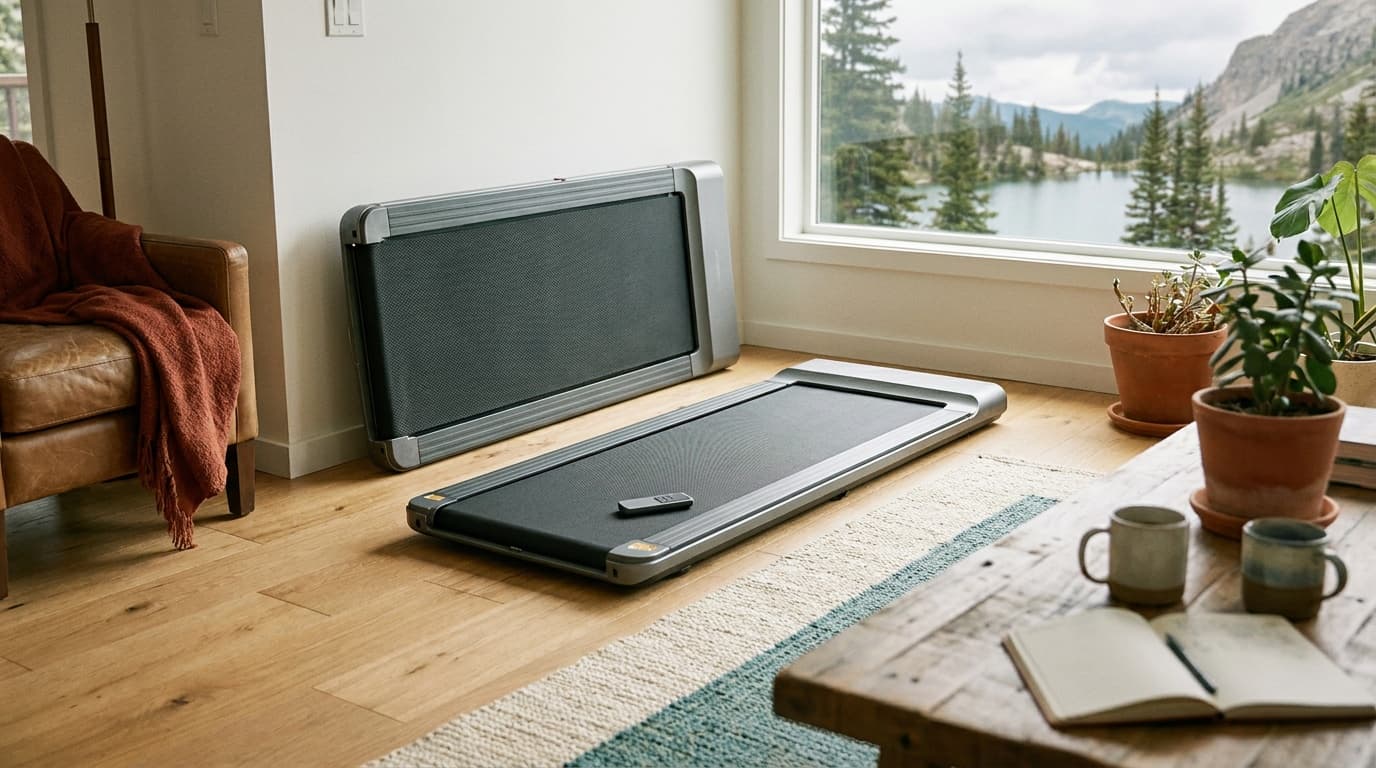
A walking pad tops out at 3.5 to 4 mph with no handrails and a low-profile deck. That makes it perfect for desk steps and easy movement, and wrong for running, sprint intervals, or anyone who wants rails to hold. If any part of your plan involves jogging, read our walking pad vs treadmill comparison before spending anything, and if you are still deciding whether the category earns its cost at all, start with are walking pads worth it.
Motor power and duty cycle: peak HP is a marketing number
Walking pad motors are usually advertised in peak horsepower, which describes a burst the motor can survive, not what it sustains. A "2.5 HP peak" motor delivers roughly 1.0 HP continuously. That is fine for walking, which is the point, but it explains why two pads with the same sticker HP can behave very differently after an hour.
What to look for instead:
- Brushless motors. Quieter, cooler, and longer-lived than brushed motors. At this point a brushed motor is a red flag at any price.
- A stated duty cycle or continuous-use rating. Most budget pads want a rest after 50 to 60 minutes. Pads built for all-day desk use say so: the MERACH W50 carries a 10 hour continuous-use rating, which is the kind of number that matters far more than peak HP.
- Headroom over your body weight. A motor moving a load well under its ceiling runs quieter and cooler than the same motor near its max. Heavier walkers should treat motor spec and weight capacity as one combined decision.
Belt size vs stride length: the spec tall buyers regret skipping
Belt length limits your stride, and your stride grows with speed. At 2 mph almost any belt works. At 3.5 mph, a 6-foot walker on a 35 inch belt starts clipping their step or drifting toward the front edge.
Rough guide: under 5'8", belts around 35 to 40 inches are comfortable at all walking speeds. Between 5'8" and 6'2", look for 40 inches or more. Over 6'2", treat 42+ inches as the floor and keep your fast walking modest. Width matters less, but 16 inches or more gives your feet room to wander while your eyes are on a screen.
For a number sized to your own height, speed, and desk, run the free walking pad fit checker: it calculates the deck length, weight capacity, and desk height you need and matches them against the pads we cover.
Weight capacity: rated vs realistic
The printed capacity is a structural maximum, not a comfort zone. Owner reports across the category are consistent: belts get unstable, motors get loud, and components wear fastest when the user sits near the rated limit.
The working rule is simple: buy at least 50 lbs of headroom. A 220 lb rating is honest for a 170 lb walker and optimistic for a 210 lb one. If you are over about 250 lbs, shop the reinforced end of the category; 300 and 400 lb rated pads exist now at reasonable prices, and the sturdier deck benefits everyone who walks on it.
Speed ranges: what you will actually use
Nearly every walking pad covers 0.5 to 4 mph, and that range is genuinely all you need:
- 1.2–2 mph: typing and precise mouse work. This is where desk walkers live.
- 2–2.5 mph: calls, reading, video. Comfortable for hours.
- 3–4 mph: focused walking between work blocks. Real exercise pace.
Pads advertising 6+ mph "running modes" are selling a capability the form factor cannot safely deliver: no rails, a short belt, and a motor that is not rated for sustained impact. Do not pay extra for speed you should not use.
Folding vs flat storage: choose by floor plan
There are three storage formats, and the right one is dictated by your home, not by preference:
- Flat pads (4 to 5 inches tall) slide under a sofa, bed, or desk. Simplest and usually sturdiest, since there is no hinge in the deck.
- Fold-in-half pads pack small enough for a closet floor or under a bed. This is the only format that truly disappears in a studio apartment. Store them the way the maker says: WalkingPad's C2 manual prohibits standing it on its end or side. The trade-off is the hinge: it adds a seam you can feel underfoot and it is the most common long-term failure point in owner reports.
- Handle-fold 2-in-1 pads fold a riser or handle rather than the deck, splitting the difference.
If the pad will live permanently under a standing desk, skip the hinge and buy flat. If it must vanish after each session, the fold is worth its compromises.
App connectivity: convenient, not essential
Bluetooth apps add step logging, session history, and sync to Apple Health or Google Fit. That is genuinely convenient, and remote speed control from your phone is nicer than hunting for a physical remote mid-call. But no walking pad app should change your buying decision, and any pad that requires the app for basic speed control is a pad that stops working when the app does. A fitness tracker or phone in your pocket replicates most of the data anyway; see our best fitness trackers for walking if step data is the goal.
Incline: the one premium feature worth paying for
Powered incline is rare on walking pads, and it is the upgrade with the clearest physiological payoff. Raising grade increases calorie burn and glute and calf work at the same comfortable speed, which matters on a machine capped at 4 mph. A 2.5 mph walk at 8 to 12 percent is a legitimately hard workout; a flat 4 mph walk is not.
If incline interests you, buy it motorized so you can change the grade without stepping off. The MERACH W50 runs a 0 to 12 percent motorized incline from its remote and carries a 400 lb rating. The UREVO Strol 2E Pro, our overall pick, also reaches 12 percent, but its incline is manual: you stop, flip down the front support legs, and fit the center support feet. That works if you plan dedicated incline sessions; fixed manual risers that require repositioning the pad before every session tend to go unused. For the steepest motorized grade, the UREVO CyberPad reaches 14 percent; our UREVO CyberPad vs MERACH W50 comparison sets the two motorized-incline pads side by side, and the MERACH W50 review covers that pad in depth.
Warranty and brand service: the spec sheet nobody prints
The walking pad market is crowded with near-identical hardware from young brands, and the real difference shows up when a belt drifts or a control board dies at month nine. Before buying:
- Expect a 1 year warranty as the baseline. Shorter than that is a warning. Frame warranties longer than motor warranties are normal.
- Check whether the brand answers. Search the brand name plus "warranty claim" and skim recent buyer feedback. Established names in the category (UREVO, WalkingPad, MERACH) maintain US support channels and spare parts; the cheapest rotating storefront brands often do not exist by the time you need them.
- Belt maintenance is on you. Every walking pad needs occasional silicone lubrication and a tension adjustment. A brand that publishes those instructions and sells the parts is a brand planning to support the machine.
A budget pad from a proven brand, like the UREVO Smart Walking Pad at under $180, is a safer buy than an unknown pad with a longer spec sheet at the same price.
What to spend
- Under $150: viable for light, occasional use, but expect brushed motors, 220 lb caps, short belts, and coin-flip support.
- $150–$250: the value zone. Brushless motors, 240 to 300 lb capacities, app support, and proven brands live here. Most desk walkers should land in this band.
- $300–$450: incline, higher duty cycles, 400 lb capacities, or fold-in-half storage. Buy up only for the specific feature you need.
For ranked picks at each of these tiers, see the best under-desk walking pads and the broader best walking pads roundup.
FAQ
How much horsepower does a walking pad need?
For walking speeds, a brushless motor advertised at 2 to 2.5 HP peak (roughly 1 HP continuous) is sufficient for most users. More useful than the HP number is a stated continuous-use or duty-cycle rating, plus weight-capacity headroom: a motor moving a load well below its ceiling runs quieter and lasts longer than a bigger motor near its limit.
What belt length do I need on a walking pad?
Match it to your height and top speed. Under 5'8", 35 to 40 inches works at any walking pace. From 5'8" to 6'2", look for 40 inches or more. Over 6'2", treat 42 inches as the minimum. Stride length grows with speed, so a belt that feels fine at 2 mph can feel cramped at 3.5 mph.
Are walking pad weight limits accurate?
They are structural maximums, not comfort ratings. Near the printed limit, owners report louder motors, belt instability, and faster wear. Buy at least 50 lbs of headroom above your body weight; walkers over about 250 lbs should shop 300 to 400 lb rated pads specifically.
Is a folding walking pad better than a flat one?
Only if you need the storage. Fold-in-half pads pack small enough for a closet floor, which full-length pads cannot do, but the deck hinge adds a seam underfoot and is the most common long-term failure point in owner reports. If your pad will live under a desk or slide under furniture, a flat pad is the sturdier choice.
Is incline on a walking pad worth it?
Yes, if fitness rather than step count is the goal. Incline is the only way to raise intensity meaningfully on a machine capped at about 4 mph: a 2.5 mph walk at a 10 percent grade works the heart and legs far harder than a flat walk at top speed. Make sure it is motorized; manual risers that require repositioning the pad tend to go unused.
For specific models matched to these criteria, start with the best under-desk walking pads, then see how to use a walking pad while working once it arrives. Browse more fitness guides or read how we research and rate.
Recommended gear
Our current top picks from the Best walking pads 2026: budget, incline, and heavy-duty picks guide, if you are ready to buy.
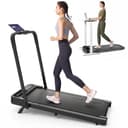
The UREVO Strol 2E Pro is a 2-in-1 folding walking pad with a 12% manual incline (set with flip-down front legs), a 265 lb user limit per its manual (300 lb on UREVO's product page), and a 0.6 to 6.2 mph range: walking mode with the handlebar down, jogging with it up. Handlebar down it measures 44.9 by 21.9 by 4.2 inches and weighs 44 lb, so it slides under most standing desks and under a sofa on its transport wheels. The running surface is 36.2 by 15.2 inches. The app syncs with Apple Health and Google Fit and can auto-adjust speed to your pace. Amazon owners rate it 4.0 out of 5 across 2,170 ratings as of September 2026, with motor longevity under running use the recurring complaint.
Best for: Home-office walkers who want incline, up to 265 lb, and the option to jog, from one pad near $200.
- Only pad near $200 that combines a 12% incline, a 265 lb user limit and a 6.2 mph top speed
- 4.2 inches tall with the handlebar down and 44 lb with transport wheels, so it fits under most standing desks and rolls under a sofa
- 4.0-star Amazon average across 2,170 ratings, with motor longevity under running use the recurring complaint
- Speed range
- 0.6–6.2 mph (walking mode 0.6–4 mph)
- Max incline
- 12% (manual, flip-down front legs)
- Weight capacity
- 265 lb (manual and Amazon; 300 lb on UREVO's product page)
- Running surface
- 36.2" x 15.2"
- Handlebar-down dimensions
- 44.9" L x 21.9" W x 4.2" H
- Unit weight
- 43.4 to 43.6 lb per UREVO; 44 lb per the Amazon listing
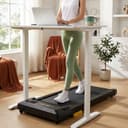
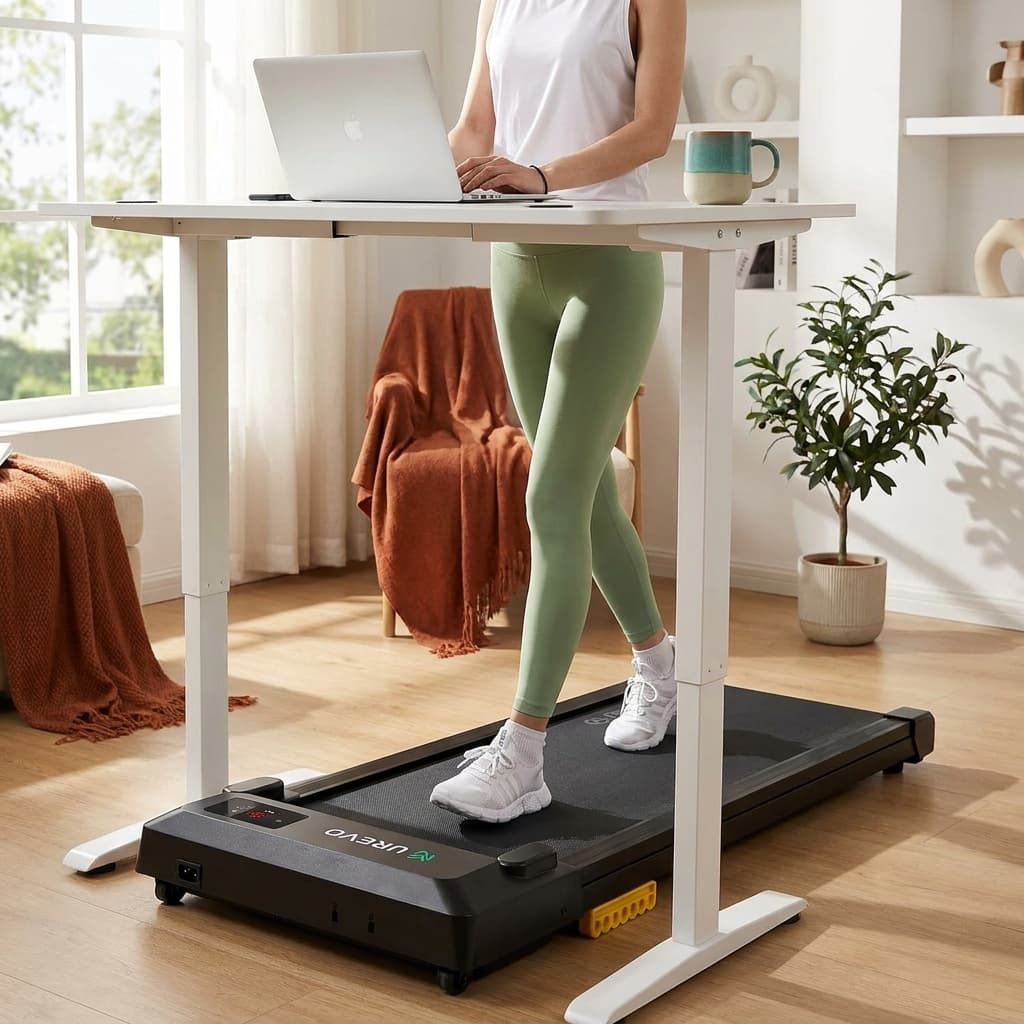
The UREVO Smart Walking Pad packs a 2.5 HP quiet motor, double shock-absorbing belt, and Bluetooth app control into one of the more affordable under-desk options. At a 265 lb capacity (per the current Amazon listing) and a 35.43-inch belt, it covers most users and supports remote or app speed control without the premium price of branded alternatives.
Best for: Work-from-home walkers who want reliable daily-use performance and app tracking without paying a premium brand markup.
- 2.5 HP motor and multi-layer shock absorption at a budget price point
- App-connected with MIIT workout modes and step tracking, remote included
- 35.43-inch belt is much shorter than the WalkingPad C2's 47.2 inches, which may feel limiting for taller users or long strides
- Speed range
- 0.6 – 4.0 mph
- Motor
- 2.5 HP
- Weight capacity
- 265 lb (Amazon listing for ASIN B097BKS6Z9, checked 2026-09-26)
- Belt size
- 35.43" x 15"
- Machine weight
- About 40 lb (39.7 lb per the Amazon listing); 4.1" slim profile
- Shock absorption
- 5-layer belt, 8 silicone shock absorbers, 2 soft rubber pads
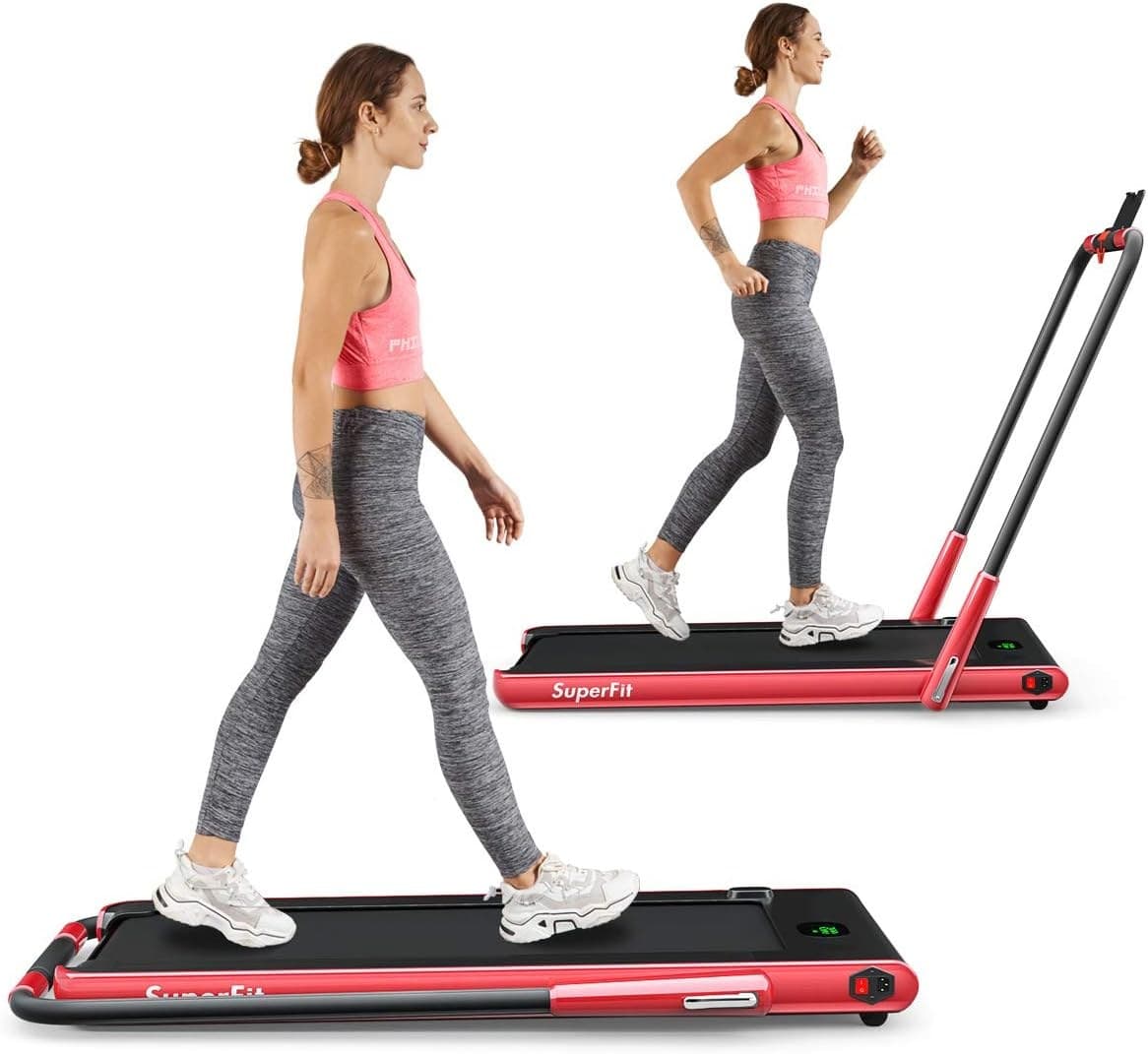
The Goplus 2-in-1 (sold under the SuperFit name) is the budget way to get both a desk pad and an easy jogger. With the handrail folded flat it runs at 1 to 4 km/h, about 0.6 to 2.5 mph, for under-desk walking; with the handrail raised it reaches 12 km/h, about 7.5 mph. The running area is 40 by 16 inches, the user limit is 265 lb, and folded it measures 52 by 27 by 5 inches and weighs 69.5 lb. Every figure here is from the Amazon listing, which also states a 3-month warranty.
Best for: First-time buyers on a tight budget who want to walk at a desk and jog occasionally, and who accept a short warranty.
- The lowest price of any pad Kit covers, with a jogging mode to about 7.5 mph when the handrail is up
- 40 by 16 inch running area and a 265 lb rating, roomy for the money
- Walking mode under a desk tops out near 2.5 mph, so brisk walks need the handrail raised
- Walking mode (handrail folded)
- 1–4 km/h (about 0.6–2.5 mph)
- Running mode (handrail up)
- 1–12 km/h (about 0.6–7.5 mph)
- Running area
- 40" x 16"
- Weight capacity
- 265 lb
- Folded size
- 52" x 27" x 5"
- Unit weight
- 69.5 lb
See all picks in Best walking pads 2026: budget, incline, and heavy-duty picks
Keep going
Free toolWalking Pad Fit CheckerWhich walking pad fits your height, weight, desk, and floor space.Related guides
 Complete fitness loadoutWeighted-vest starter kitBuild the complete kit
Researched, not hands-on tested
Updated Sep 25, 2026Our recommendations draw on manufacturer documentation, retailer listings, owner feedback, and comparisons with alternatives.
As an Amazon Associate I earn from qualifying purchases. We may earn a commission from links here, at no extra cost to you. How we research →