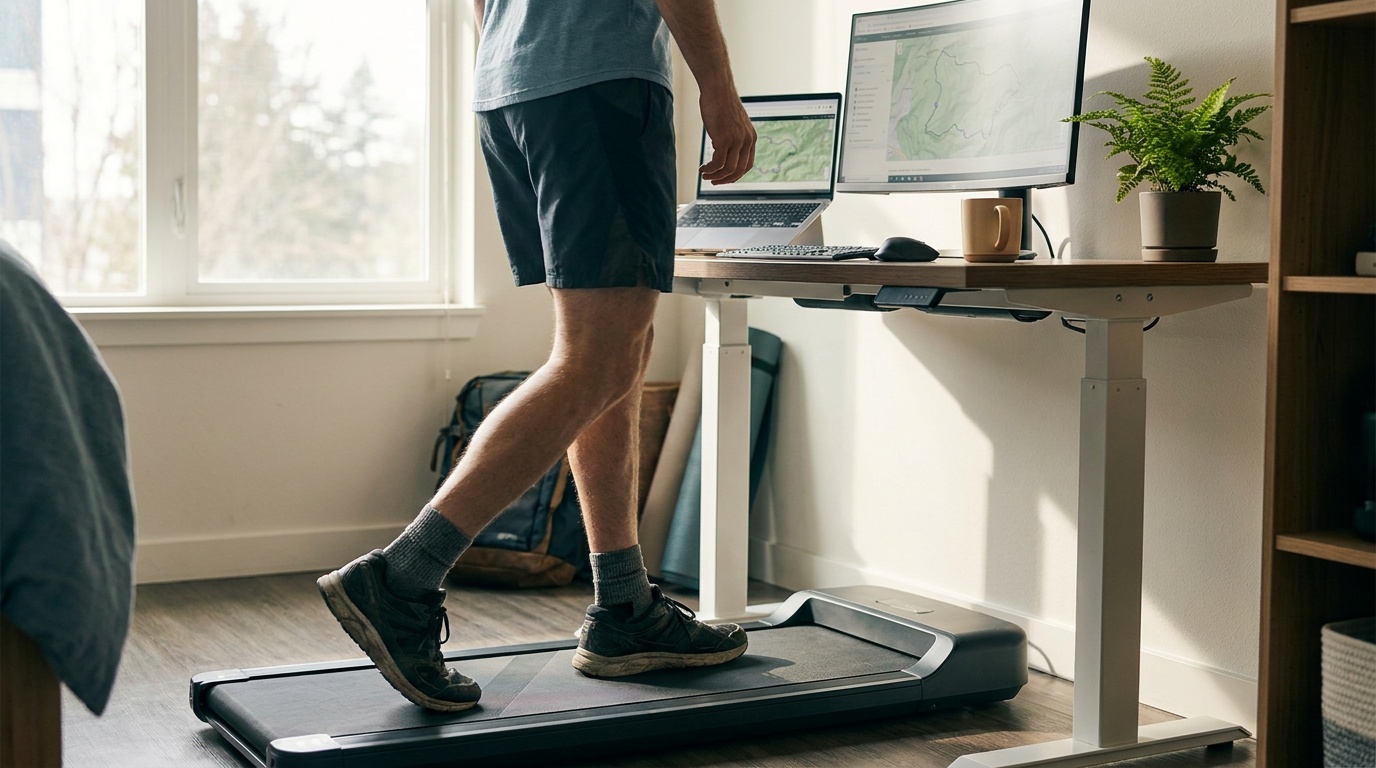
Most walking pad regret comes from three numbers nobody checks: a deck too short for your stride, a weight rating with no headroom, and a standing desk that cannot rise high enough once you are standing on the pad. This checker works out all three for your body and your room, then shows which of the pads in our best walking pads guide clear every check.
How this works
Deck length. Your stride is what has to fit on the belt: the distance from the heel of your back foot to the toe of your front foot. We take step length at each walking speed from the CADENCE-Adults treadmill study, which counted steps per minute for 76 adults at every half mile per hour (mean height 170.7 cm), and scale it to your height. We add foot length at 15.2% of height, a standard anthropometric ratio, then 3 inches of room to drift forward and back while your attention is on a screen. The height scaling and the drift allowance are our own conservative assumptions, not published standards. The checker sizes desk walking at 2 mph, incline walking at 2.5 mph, and brisk walking at 3.5 mph; the table in your results shows every speed.
Jogging. Walking pads are not built for it. In the CADENCE-Adults data, cadence reaches about 140 steps per minute at 4.5 mph, the point the researchers cite for the switch from walking to running, and treadmill maker SOLE recommends a 20 by 55 inch belt for jogging, so that is the bar the checker uses. For a real running setup, compare walking pads and treadmills.
Weight capacity. WalkingPad advises at least 25 lb of headroom over the heaviest user for walking and 50 lb for running. We use 50 lb as the target for everyone and 25 lb as the hard floor for walking only, and we add any vest or pack you enter. If you plan to walk loaded, the weighted vest calculator gives a sensible starting load.
Desk height. OSHA's computer workstation guidance puts the keyboard at about elbow height, and CCOHS puts light standing work 5 to 10 cm below the elbow, so we target a desk surface at or up to 2 inches below your elbow. Standing elbow height is estimated at 63% of height, plus 1 inch for shoes (our assumption), plus the pad's deck height. UREVO's own setup guide gives the same test: elbows at about 90 degrees with hands on the keyboard.
Picks. A pad is shown only if it passes every check you gave it. Pads that pass with a caveat (a tight fit, or a dimension the maker does not publish) rank below clean passes, then by Kit Score. Noise does not change the ranking, because none of these pads has an independently measured noise figure. For the full buying framework, see how to choose a walking pad.
Sources
- Tudor-Locke C, et al. Walking cadence (steps/min) and intensity in 21 to 40 year olds: CADENCE-adults. Int J Behav Nutr Phys Act, 2019 (Table 2)
- Winter DA, Biomechanics and Motor Control of Human Movement, Figure 4.1 (segment lengths as a fraction of height, after Drillis and Contini 1966)
- OSHA Computer Workstations eTool: Keyboards
- CCOHS, Working in a Standing Position: Basic Information
- WalkingPad, Best Treadmills for Heavy People (weight-capacity margin guidance)
- SOLE Fitness, Treadmill Running Belt Size Guide
- UREVO, How to Use a Walking Pad Under Your Desk
- Levine JA, Miller JM. The energy expenditure of using a walk-and-work desk for office workers with obesity. Br J Sports Med, 2007
- Pad specs: the makers' product pages, as cited in our best walking pads guide (checked September 2026). Every figure, with its source and conflicting values noted, is in the downloadable walking pad specs dataset.
This is general guidance, not medical advice. If you have a balance, joint, or heart condition, check with a professional before walking while you work.