Which winter traction do you need?
Ice cleats, spikes, snowshoes, and crampons solve different problems. Describe the surface, the slope, how far you sink, and what is on your feet, and get the category that fits, with the limits that matter.
Your traction
Chain-style spikes
Good match
Chain-style spikes fit these conditions.
Why
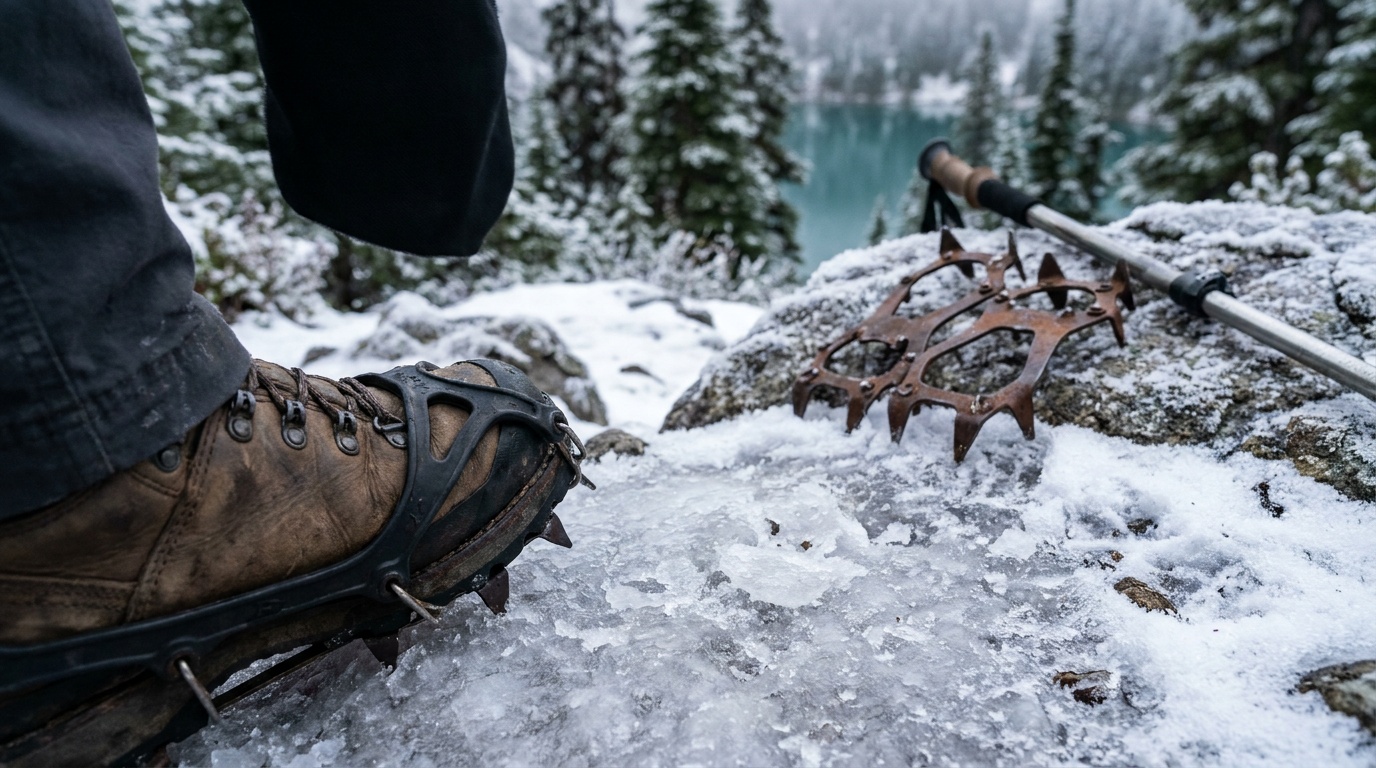
- Steel chains and longer points under the sole that bite into packed snow and nontechnical ice on climbs, traverses, and descents.
- Packed snow and ice on a hiking trail is the job chain-style spikes are built for. Rocky Mountain National Park recommends traction devices for hard-packed snow and ice.
- Moderate climbs and descents are where chains earn their weight, especially going downhill.
Know the limits
- Chain spikes are not crampons. If the route steepens into hard snow or ice where a slip could become a slide, that is mountaineering terrain: turn around.
- Long sections of bare pavement or rock wear the points and feel unstable. Take them off on a flat, safe spot.
- Conditions change through the day as snow falls and melts. Check the trail report before you leave and always be willing to turn back.
Read next
Slipping or sinking? Start there
Most winter traction mistakes come from solving the wrong problem. If your feet slide on a hard surface, you need grip, and the right amount of grip depends on the surface: short studs for pavement, chains for packed trail. If your legs punch through soft snow, grip does almost nothing and you need flotation from snowshoes. And if the ground is steep, hard, and a slip would not stop on its own, the answer is no longer a stretch-on device. It is crampons, an ice axe, and the training to use them, or a different route. The full comparison, with fit and care tips, is in our guide to ice cleats vs microspikes vs crampons.
The rest of the winter kit
Traction is one piece. Gaiters keep snow out of your boots but add no grip; see our hiking gaiter picks. Short days make a reliable headlamp essential, and staying dry matters more than staying bundled: start with the cold-weather layering guide and our base layer picks, or plan the day with the layering advisor.
How this works
The chooser checks consequence first, then flotation, then surface. Steep firm snow or ice, or a steep packed trail where a slip could become a slide, goes straight to crampon terrain, and the result says to stop and rethink the route unless you have both crampon-compatible boots and crampon and ice axe training. Next, sinking past the ankle, or deep soft snow, points to snowshoes, with spikes as a backup when the trail may pack down. Otherwise the surface decides: low-profile cleats for icy pavement, road-to-trail spikes for mixed routes or loose snow over pavement, and chain-style spikes for packed trail.
It gives a category, not a product pick, and it never replaces a current trail report, avalanche forecast, or your own judgment on the day. Kit Authority has not field-tested traction devices; this guidance comes from the manufacturer, land-manager, and club sources below. See how we research and rate.
| Claim | Source | Checked |
|---|---|---|
| Point lengths: 5.3 mm low-profile for hard icy surfaces, 7.4 mm road to trail, 10.4 mm chain-style trail traction | Kahtoola traction line-up | Sep 2026 |
| Traction devices for hard-packed snow and ice; snowshoes for soft, deeper snow | Rocky Mountain National Park, NPS | Sep 2026 |
| Snowshoes and traction recommended on ice and snow; waterproof boots with gaiters; be willing to turn around | National Park Service winter hiking tips | Sep 2026 |
| Snowshoes once boots sink past the ankle tops; crampons for hard snow or ice on steep terrain | Appalachian Mountain Club traction primer | Sep 2026 |
| Steel crampons generally need a very stiff or rigid mountaineering boot | Appalachian Mountain Club, Get a Grip | Sep 2026 |
| Most slab avalanches start on slopes between 30 and 50 degrees | Avalanche.org encyclopedia | Sep 2026 |
Frequently asked questions
Do I need microspikes or crampons for winter hiking?
For most packed, icy hiking trails, chain-style spikes are the usual choice. Crampons are for steep, firm snow or ice that your boots cannot kick into, and they go with compatible stiff boots, an ice axe, and training. If a route needs crampons and you do not have those skills, choose a different route.
When should I switch from spikes to snowshoes?
When you are sinking instead of slipping. The Appalachian Mountain Club's rule of thumb is that once your boots sink past the ankle tops in unbroken snow, you need snowshoes and gaiters. Rocky Mountain National Park gives the same split: traction devices for hard-packed snow and ice, snowshoes for soft, deeper snow.
Can I wear ice cleats on sidewalks?
Yes. Low-profile cleats with short carbide points are built for hard, icy surfaces like sidewalks and parking lots. Longer chain spikes feel unstable on bare pavement and wear faster, so save those for the trail.
Are chain spikes safe on steep terrain?
They help on moderate climbs and descents on packed snow and ice. They are not a substitute for crampons on steep, hard snow or ice where a slip could turn into a slide. Steep open slopes of 30 degrees and more are also avalanche terrain, so check the avalanche forecast and be ready to turn around.
Will traction devices fit my shoes or boots?
Size them to the exact footwear you will wear, using the maker's size chart. Bulky winter boots can need a different size than trail runners. Practice putting them on at home, because stretching a harness over a boot with cold hands is harder than it looks.
More free tools
 Vest Sizing CalculatorHow heavy a vest to start with, plus a safe progression.
 Which Vest? QuizAnswer three questions, get matched to the right vest.
 Shoe FinderFive questions match you to the right outdoor shoes, men's and women's.Vest Walking PlanA multi-week weighted-walking plan built around your level.