We may earn a commission from links on this page, at no extra cost to you.
Winter traction is a surface decision, not a temperature decision. A device that feels secure on an icy sidewalk can be too shallow for a packed trail, while a mountaineering crampon is excessive and awkward on ordinary winter walks.
The quick comparison
| Traction type | Best surface | Poor match | Typical footwear |
|---|---|---|---|
| Low-profile ice cleats | Icy sidewalks, parking lots, hard urban paths | Deep snow, steep exposed trail | Walking or running shoes |
| Road-to-trail spikes | Mixed pavement, frozen dirt, moderate icy trail | Deep loose snow, technical ice | Trail shoes or hiking boots |
| Chain-style spikes | Packed snow, frozen trail, sustained nontechnical ice | Long bare-pavement sections, steep technical terrain | Hiking or winter boots |
| Snowshoes | Deep, unconsolidated snow where you posthole | Hard ice and polished packed trail | Insulated hiking or winter boots |
| Mountaineering crampons | Steep firm snow, alpine ice, glacier travel | Sidewalks and ordinary maintained trails | Compatible mountaineering boots |
The terms are messy. “Microspikes” is commonly used as a category name, but MICROspikes is also a Kahtoola product name. This guide uses chain-style spikes for the general category and reserves the capitalized name for that specific product.
Choose by what your foot lands on
Icy pavement and hard urban paths
Low-profile carbide studs keep the foot close to the ground and tolerate abrasive surfaces better than longer steel chains. This is the right category for winter walking, commuting, and running where bare pavement appears between icy sections.
The important limitation is depth. Short studs can bite glare ice, but they do not reach through a layer of loose snow to the firm surface underneath. If a walk regularly moves from streets to packed wooded trails, a road-to-trail device gives up some pavement smoothness for more bite.
Mixed road and moderate trail
Road-to-trail spikes bridge the gap between sidewalk cleats and chain spikes. They use a deeper lug or carbide point than an urban cleat but remain lower and less aggressive than a trail system built around steel chains.
Kahtoola's current traction comparison illustrates the progression clearly: NANOspikes use 5.3 mm points, EXOspikes use 7.4 mm points, and MICROspikes use 10.4 mm points. Those measurements explain intended surface more usefully than a generic “more aggressive” label. They do not, by themselves, prove grip, durability, or fit for a particular shoe.
Packed snow and icy hiking trails
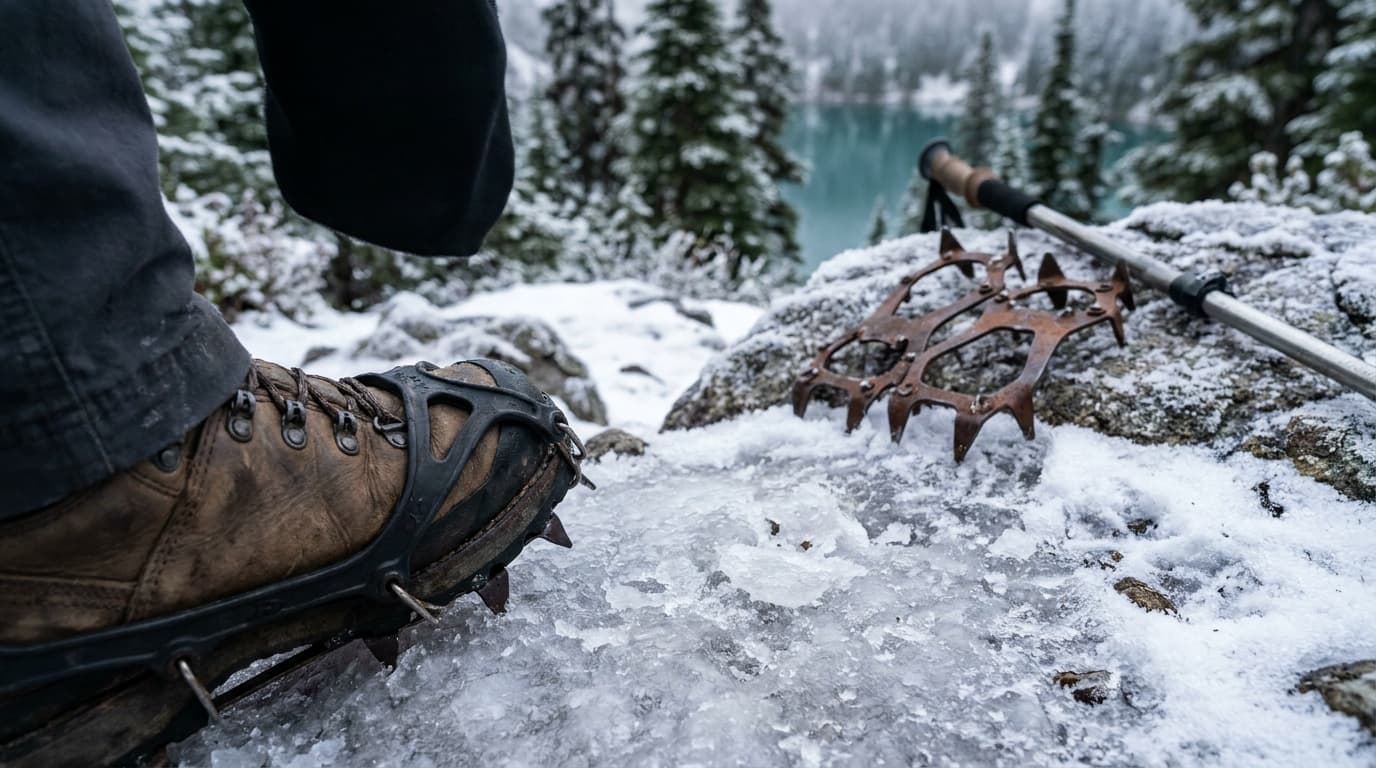
Chain-style spikes are the default for popular winter trails after repeated foot traffic compresses snow into a hard, slick surface. Chains wrap under the sole and multiple longer points bite on climbs, traverses, and descents.
The National Park Service winter hiking guidance recommends over-the-shoe traction for ice and snow. Rocky Mountain National Park makes the surface distinction explicit: traction devices for hard-packed snow and ice, snowshoes for softer and deeper snow.
Chain spikes still have a ceiling. They are not a substitute for mountaineering crampons, an ice axe, route judgment, or the skills needed where a fall has serious consequences.
Deep, soft snow
If each step sinks to the ankle, shin, or knee, the problem is flotation rather than grip. Snowshoes spread body weight over a larger area to reduce postholing. A chain spike adds bite beneath the boot but does almost nothing to keep the leg from punching through unconsolidated snow.
Conditions can change over a single trip. Fresh snow may call for snowshoes in the morning; a heavily traveled return route may become packed enough for chain spikes. Check current trail reports and carry the second tool when the route is likely to cross both conditions.
Steep firm snow and technical ice
Mountaineering crampons use a rigid or semi-rigid frame with longer points. They are designed for firm snow, alpine ice, glaciers, and steeper terrain where edging and front-pointing techniques matter.
They also require the correct boot interface and training. REI's crampon skills guide emphasizes solid contact between the boot and crampon frame, specific footwork, and safe descent technique. If a route description calls for crampons and an ice axe, treat that as a skills threshold, not a shopping-list suggestion.
Five questions to answer before buying
Match traction to the trip
What surface covers most of the route?
Pavement favors low-profile studs. Mixed road and trail favors intermediate spikes. Packed trail favors chains. Deep snow favors snowshoes.
How steep is the consequential section?
A short icy sidewalk and an exposed hard-snow traverse are different problems even if both look white. Technical terrain may require crampons, an ice axe, and instruction.
How much bare ground will you cross?
Carbide studs tolerate pavement better. Longer steel points are less comfortable and wear faster on long bare sections.
Which shoes or boots will you wear?
Use the manufacturer's size chart for that exact footwear. Bulky winter boots can require a different size than trail runners.
Can you put them on with cold hands?
Practice at home. A device that is technically compatible but nearly impossible to stretch over the boot in the cold is not a dependable system.
Planning a specific trip? The winter traction chooser runs these questions for your route and footwear and flags when the terrain is beyond hiking traction.
Fit and inspection matter as much as spike length
The harness should sit evenly around the shoe with the toe and heel fully captured. Underfoot plates and chains should be centered, not pulled to one side. Walk indoors on a protected surface for a few steps, then recheck the fit.
Inspect the harness, eyelets, chains, plates, and every spike before a trip. Remove the device after use, rinse off salt and grit, and air-dry it. Do not leave wet steel packed in a tote where corrosion can develop unseen.
Winter boots, trail runners, and insulated pac boots can all change the required size. Do not assume the traction size is identical to the shoe size printed on the box. Manufacturer charts are starting points; the assembled fit on the actual footwear is the test.
What Kit Authority is evaluating next
The missing buying question is not “which spike has the highest score?” It is whether the product stays centered, can be installed with gloves, releases snow, tolerates pavement transitions, and matches the boot sizes readers actually use.
We are preparing a direct comparison across low-profile, mixed-surface, and chain-style traction. Until that field work is complete, this page gives a category decision rather than pretending manufacturer specifications are a product test. Any future product verdict will show the exact footwear, surface, temperature, distance, and wear observed.
For the rest of the cold-weather system, see the three-layer hiking guide, hiking glove picks, and headlamp comparison. Gaiters keep snow and debris out of the boot but do not add grip; our hiking gaiter guide covers that separate job.
Frequently asked questions
Are ice cleats and microspikes the same thing?
They overlap, but the labels are not precise. “Ice cleat” often means a low-profile studded device for pavement. “Microspikes” commonly means a chain-style trail device with longer points, although MICROspikes is also a specific Kahtoola product. Compare the underfoot design and intended surface rather than relying on the name.
Do microspikes work in deep snow?
They add grip if the boot reaches a firm layer, but they do not provide flotation. If you are sinking deeply with each step, snowshoes solve the actual problem. Rocky Mountain National Park recommends traction for hard-packed snow and ice and snowshoes for soft, deeper snow.
Can I use chain spikes instead of crampons?
Not on terrain that genuinely requires mountaineering crampons. Chain spikes suit packed hiking trails and nontechnical ice. Crampons are built for steep firm snow, alpine ice, and compatible mountaineering boots, and they require specific movement and arrest skills.
Can I wear traction devices on pavement?
Low-profile carbide devices are designed for hard surfaces. Longer steel chain spikes can feel unstable on bare pavement and wear more quickly. Remove them for sustained bare ground when you can do so from a safe, flat position.
Do gaiters provide traction?
No. Gaiters keep snow, mud, and debris out of the boot. Traction devices attach under the sole to improve grip. Winter hikers often use both, but they solve different problems.
Check current weather, trail reports, avalanche information, and park guidance before leaving. Winter conditions change faster than a gear list can.
Keep going
Related buying guideBest hiking gaiters: our top picks for 2026Related guides

 Complete hike loadoutDay hike kitBuild the complete kit
Researched, not hands-on tested
Updated Sep 24, 2026Our recommendations draw on manufacturer documentation, retailer listings, owner feedback, and comparisons with alternatives.
As an Amazon Associate I earn from qualifying purchases. We may earn a commission from links here, at no extra cost to you. How we research →
Related buying guide
Best hiking gaiters: our top picks for 2026