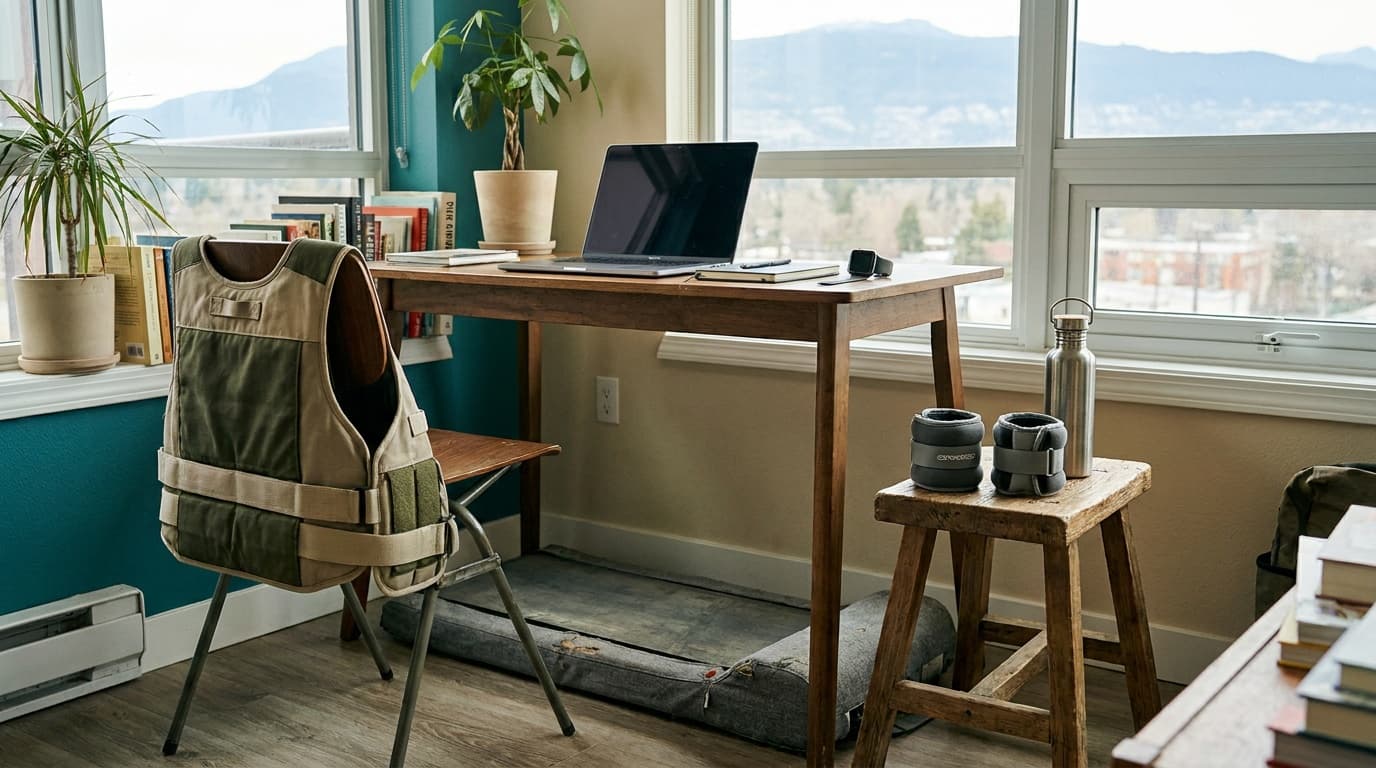
Start with a vest of about 5% of your body weight, roughly 7.5 lb for a 150 lb walker, on a short loop, and add time before you add weight. That is the starting point UCLA Health's sports medicine guidance gives, while Harvard Health suggests about 10% for starters, so 5% is the cautious end of the published advice. Walking is one of the most sustainable forms of exercise. Adding a weighted vest raises the external load, but it also changes the demand and the forces your body must manage. The useful beginner goal is not to chase the heaviest percentage. It is to preserve normal gait and posture while changing one variable at a time.
Why add weight to a walk
The metabolic case is the clearest. A 2006 laboratory study of 10 young adults found that oxygen use and relative exercise intensity increased as vest load (10% to 20% of body mass) and treadmill speed rose. A small 2026 conference abstract of 9 adults found that a fixed 10 lb vest added about 0.25 calories per minute during brisk treadmill walking, roughly 15 calories per hour. That is a measurable change, but not a shortcut.
The bone evidence is mixed. Small older studies that combined progressive vest loading with resistance exercise or jumping reported strength, balance, and some hip bone benefits in postmenopausal women. A 2025 randomized trial of 150 older adults in a weight-loss program found that neither prolonged daily vest use nor resistance training prevented hip bone loss. The honest conclusion is that the surrounding program and population matter; ordinary vest walking has not been proven to protect everyone's bones.
Read every source, protocol, limitation, and Kit Authority interpretation in the weighted vest research index. It also explains why 5% and 10% are planning defaults rather than proven clinical thresholds.
How heavy to start
Around 5% of bodyweight is the conservative editorial starting estimate used throughout Kit Authority. Ten percent is our planning ceiling for ordinary walking, not a line between safe and unsafe. The weighted-vest sizing calculator exposes those assumptions and adjusts the estimate for goal and experience.
For a 150-pound person, 5% is 7–8 pounds. For someone at 180 pounds, it is 9 pounds. These are not intimidating numbers, which is exactly the point. The first few weeks are about letting your joints and tissues get used to the extra load, not about maximizing it.
Do not assume that reaching 10% is the goal. A load that preserves normal gait, posture, and recovery can be useful even if it never increases. An adjustable model helps because its smallest increment, not its maximum capacity, determines how gently you can progress.
The beginner mistake is not starting too light. It is adding too much, too fast, before the connective tissue has caught up.
How to progress safely
Progress one variable at a time. This is the rule that separates people who build a sustainable habit from those who end up with a sore back or a stress fracture.
Building your weighted walking practice
Start light and short
Use a vest at 5% of your body weight and walk 10–20 minutes per session, 2–3 times per week. Rest or unweighted walk on other days.
Extend duration first
Once sessions feel comfortable with no lingering joint soreness, build toward 30–40 minutes before you think about adding weight.
Add weight in small increments
A cautious rule of thumb is roughly 1–2% of body weight at a time, every 1–2 weeks. Never jump weight and distance simultaneously.
Introduce terrain last
Once you are comfortable at 30–40 minutes with your target weight, you can add inclines. A 2022 lab study found a vest raised physiological demand when walking at a 10% grade, so hills add effort quickly.
Build toward a sustainable frequency
A realistic long-term target is 3–5 sessions per week of 30–60 minutes. Expect it to take several weeks of gradual progression to get there.
Kit Authority's pain rule: discomfort should stay at or below 3 out of 10 and resolve by the following morning. If it does not, reduce either the weight or the duration before the next session.
Vest fit and form
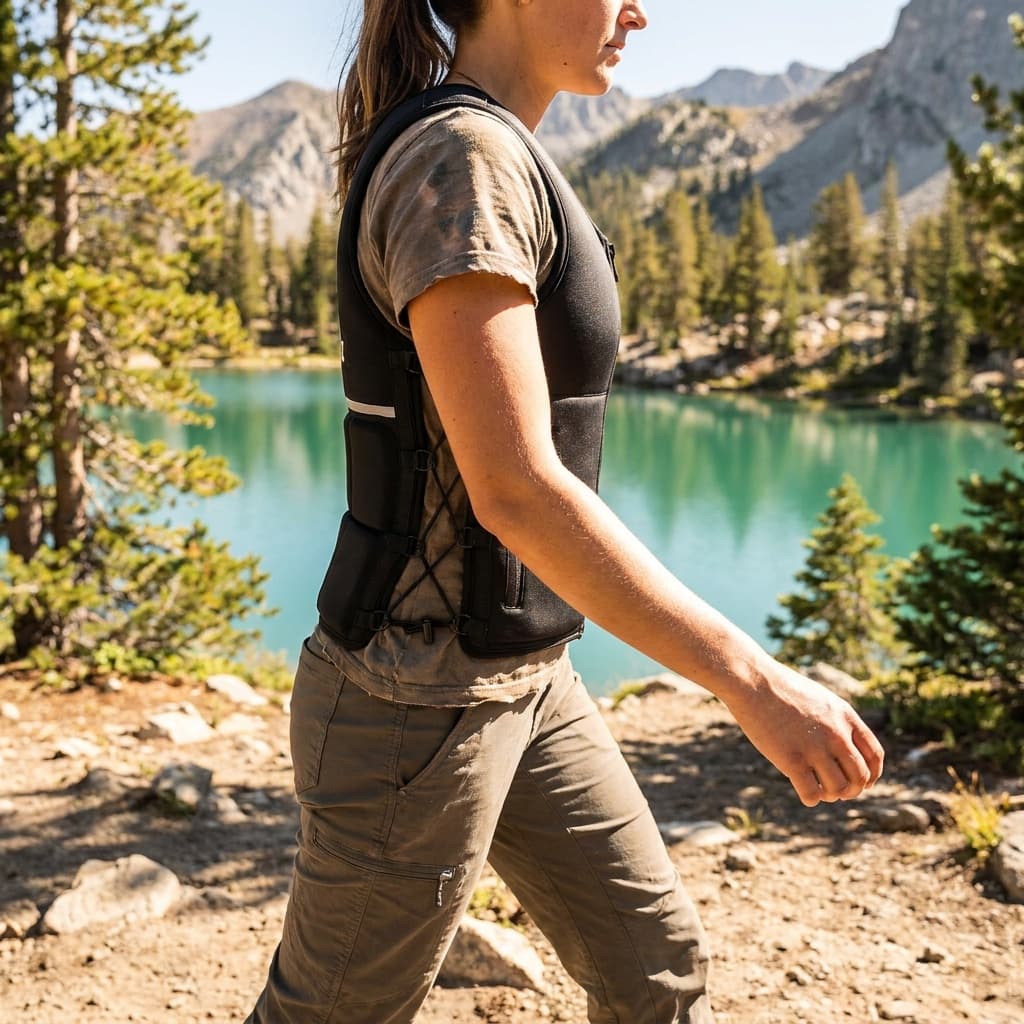
A vest that fits poorly creates problems a heavier vest only amplifies. UCLA Health's advice is to get a vest that fits properly so the weight is evenly distributed and does not shift as you move. The vest should sit snug against the torso, the way body-hugging designs like the Hyperwear Hyper Vest PRO are built to, with weight distributed front and back, not riding loose on the shoulders or pulling you into a forward lean. Plates or shot-filled pockets that shift during movement force compensatory posture that stresses the lower back.
Form cues to hold through the session: stand tall, keep the shoulders back and down, engage your core lightly, and land softly with each step. The vest should feel like an extension of your torso, not like a load you are carrying. If your posture is degrading before the session is over, the weight is too heavy or the session is too long.
Vest vs. rucksack
A weighted vest and a rucksack (a loaded backpack, sometimes called rucking) both add external load to a walk, but they place it differently on your body. A 2024 study built a separate energy-cost model term for vest-borne loads because the military's existing load-carriage model was built around backpacks.
A vest keeps the load close to your center of mass and splits it front and back, which makes an upright posture easier. A rucksack puts all of the load behind you, which tends to pull the trunk into a forward lean and asks more of the back extensors.
For beginners and commuters, a vest is usually the easier starting tool. The upright posture it encourages is also more transferable to everyday movement. Rucking is a legitimate alternative with a different muscular emphasis and a strong community behind it. It is not worse; it is different (our sibling site Ruck Authority covers that side in depth: start with their beginner's guide to rucking). If you want to explore options, see our guide to the best weighted vests for walking for a breakdown of the vest styles worth considering.
Who should be cautious
Some situations call for extra care or a conversation with a clinician before adding external load.
UCLA Health specifically flags people who are new to exercise, people with back or neck injuries, and people with arthritis in the hips, knees, or ankles. Use caution if you have any of the following:
- Back or neck pain or injury. Wait until an acute phase has resolved, then consider working with a physical therapist on re-introduction.
- Arthritis in the hips, knees, or ankles. Added load raises the force through those joints with every step.
- Uncontrolled hypertension. Added load raises cardiovascular demand. Get blood pressure managed first.
- Osteoporosis. Bone-density findings are mixed and protocol-specific. A clinician should help decide whether vest loading belongs in your plan.
- Active plantar fasciitis. More load on an already irritated fascia slows recovery.
- Balance issues or fall risk. A vest raises your center of mass slightly. Anyone with balance concerns should work with a physical therapist before adding load.
- Recent surgery or pregnancy. Both require individualized guidance. This is not the place to experiment.
- No exercise baseline. If you are new to regular movement of any kind, build a foundation of unweighted walking, at least 30 minutes at a comfortable pace three times a week, before adding load.
Frequently asked questions
How heavy should a weighted vest be for walking?
Kit Authority uses about 5% of bodyweight as a conservative starting estimate. A 150-pound person gets about 7.5 pounds. Ten percent is an editorial walking ceiling, not a proven safe cap or a target everyone should reach. Start shorter than your normal walk, preserve normal gait and posture, and change one variable at a time.
Will walking with a weighted vest help with bone density?
Possibly in a specific exercise program, but the evidence is mixed. Small studies combining a vest with resistance exercise or jumping found benefits in postmenopausal women. A 2025 randomized trial of 150 older adults losing weight found that prolonged daily vest use did not prevent hip bone loss. See the full evidence ledger before treating a vest as a bone-health intervention.
Can I wear a weighted vest every day?
There is no universal evidence-based daily schedule. A cautious beginner plan starts with two or three loaded walks per week and uses unweighted or rest days between them. Do not add frequency, duration, and load together. Persistent pain, changed gait, or recovery that worsens is a reason to reduce the dose and seek qualified advice when appropriate.
What is the best weighted vest for a beginner?
The best beginner vest is adjustable, starts light, and fits snug against the torso. You want removable weights so you can load it near 5% of your body weight on day one and add 1–2 lb increments over the following weeks; a fixed 20 lb vest forces most beginners to start too heavy. A front zip or front closure makes it easier to get on and off, and a snug, no-bounce fit protects your lower back. Our roundup of the best weighted vests for walking ranks the adjustable options across budgets, and the vest sizing calculator gives you a personalized starting weight before you buy.
Is a tactical weight vest or plate carrier good for beginners?
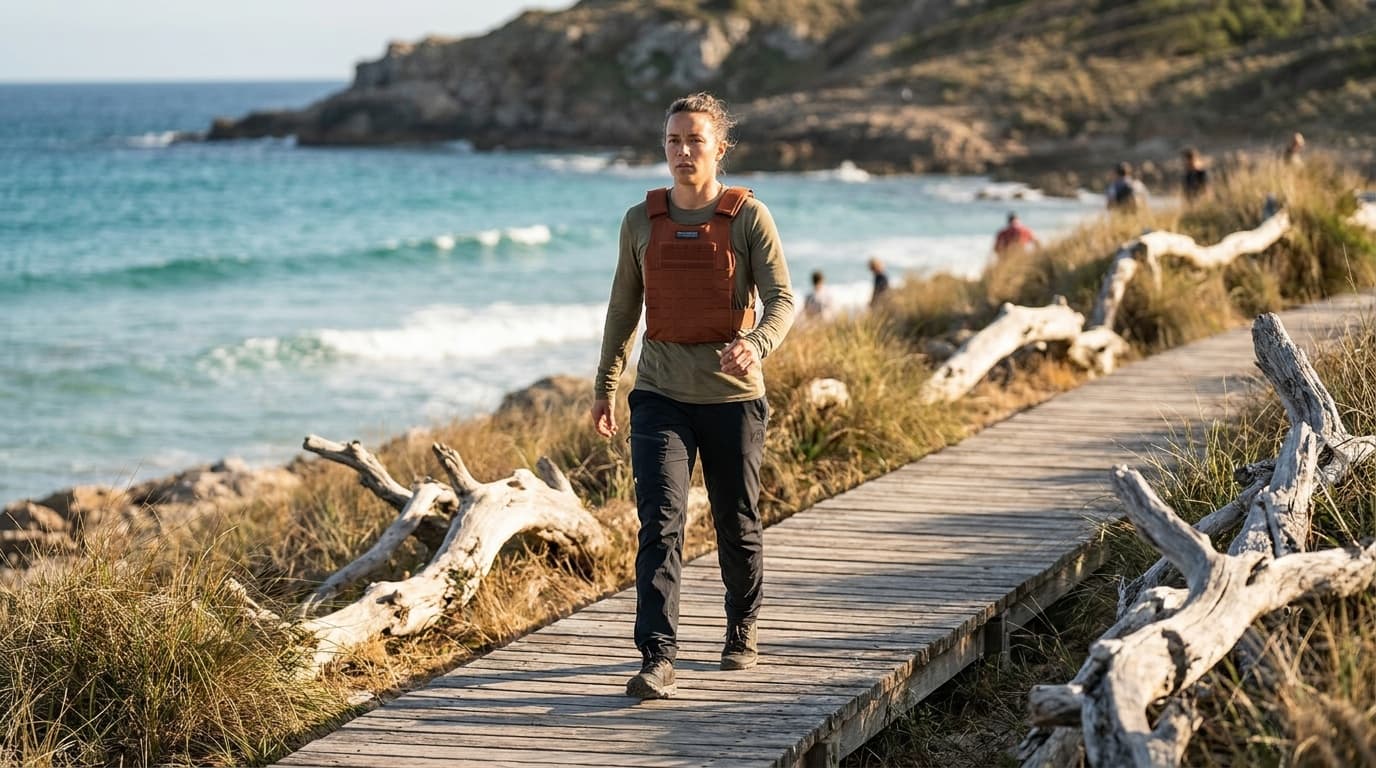
Usually not as a first vest. Tactical plate carriers are built around standardized plates, so the jumps between loads are large and the lightest plate set may already exceed a 5% starting weight for smaller walkers. They also concentrate weight in two rigid slabs rather than distributing it around the torso. Plate carriers shine for CrossFit-style workouts and rucking-adjacent training where the standard plate weights are the point. For walking, a soft adjustable vest with small increments is the friendlier starting tool; you can always move to a carrier later.
What weighted vest workouts can a beginner do besides walking?
Once vest walking feels routine, the same or a lighter load can be used for simple strength patterns such as sit-to-stands, controlled squats, step-ups on a low step, and incline walking. Keep repetitions modest and treat running or jumping as separate skills rather than automatic next steps. Research shows that vest load changes acute running mechanics, while long-term performance benefits remain uncertain.
Where these numbers come from
| Claim | Source | Checked |
|---|---|---|
| Start with a vest of about 5% of body weight, build up in small increments, begin with a short loop; caution for people new to exercise, with back or neck injuries, or with hip, knee, or ankle arthritis | UCLA Health, should you walk with a weighted vest? (Oct 2025) | Oct 2026 |
| About 10% of body weight for starters; people with neck or back pain should check first | Harvard Health, benefits of walking with a weighted vest (Jul 2025) | Oct 2026 |
| 10 young adults: oxygen use, relative intensity, and ground reaction forces rose with vest loads of 10% to 20% of body mass | Puthoff et al. 2006, Medicine & Science in Sports & Exercise (PubMed) | Oct 2026 |
| 9 adults at a brisk 3.3 mph: a 10 lb vest added 0.25 kcal per minute (4.9%), preliminary abstract | Brown and Joubert 2026, IJES conference abstract | Oct 2026 |
| 5 years of vest plus jumping exercise maintained hip bone density in 9 postmenopausal women while 9 controls lost bone | Snow et al. 2000, Journal of Gerontology (PubMed) | Oct 2026 |
| 150 older adults losing weight: 12 months of daily vest use did not prevent hip bone loss | Beavers et al. 2025, JAMA Network Open | Oct 2026 |
| Vest raised physiological demand when walking at a 10% grade | Gaffney et al., Ergonomics 2022 (LJMU repository) | Oct 2026 |
| A vest-specific term was added to the US Army load-carriage energy model, which was built around backpacks; 20 active adults, vest loads up to 66% of body mass | Looney et al. 2024, Medicine & Science in Sports & Exercise | Oct 2026 |
The 5% start, the 1–2% steps, and the pain rule are Kit Authority's conservative planning defaults, not clinical thresholds.
For the next decision, inspect the weighted vest research index, calculate a conservative starting estimate, compare the best weighted vests for walking, or read how we research and rate.
Recommended gear
Our current top picks from the The best weighted vests for walking, from beginner to budget guide, if you are ready to buy.
BAGAIL
BAGAIL Comfort-Fit Weighted Vest
Best Overall
Kit Score 8.8/10
$24.99 Price checked Oct 23, 4:16 PM CDT
Best for: Walkers and everyday fitness enthusiasts who want a polished, comfort-first vest they can wear daily without irritation.
- Even weight distribution prevents the vest from shifting or bouncing during walks
- Fixed weight per vest means you need to buy a new vest to add significant load
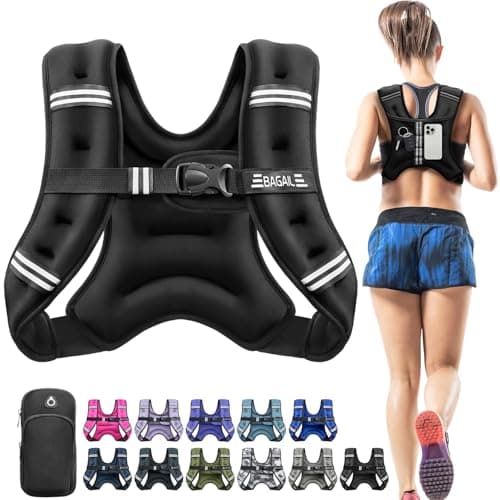
- Weight Options
- 5, 8, 10, 12, 15, 20, 25, 30 lb
- Material
- Neoprene outer, iron sand fill
- Closure
- Adjustable buckle straps
- Safety
- Reflective stripes
- Storage
- Detachable phone pouch + back pocket
- Rating (Amazon)
- 4.6 stars / 3,661 reviews
About this pick
The BAGAIL Comfort-Fit pairs a stable fit with practical details like a detachable phone pouch. It is sold in fixed loads from 5 to 30 lb, so buyers must choose the weight before purchase.
Strengths
- Even weight distribution prevents the vest from shifting or bouncing during walks
- No-chafe construction with padded contact points, comfortable for extended daily wear
- Detachable phone pouch is a practical feature most budget vests omit
- Multiple fixed-load options from 5 to 30 lb let buyers choose a conservative current load
Weaknesses
- Fixed weight per vest means you need to buy a new vest to add significant load
- Neoprene can retain heat on warm days; breathability is limited compared to open-mesh designs
Kit Score breakdown

Best for: Budget-conscious walkers who want the highest-rated vest in the category without spending more than necessary.
- Highest owner rating (4.7 stars) in the category backed by nearly 5,000 verified reviews
- Fixed weight construction, no option to incrementally add or remove plates
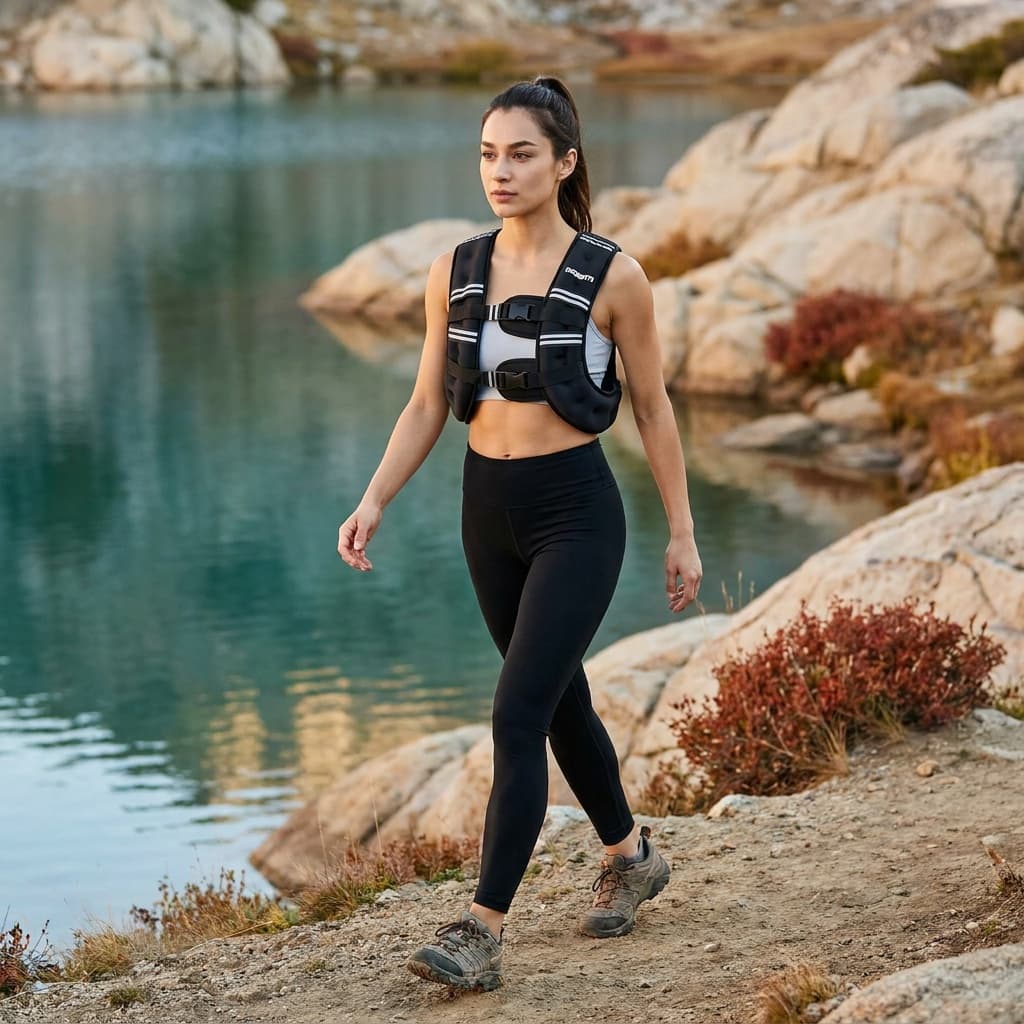
- Weight Options
- 6, 8, 10, 12, 16, 20, 25, 30 lb
- Material
- Odor-free Lycra fabric, fixed internal weight
- Shoulder Padding
- Yes, integrated padded shoulders
- Safety
- Reflective stripes
- Storage
- Phone pouch
- Rating (Amazon)
- 4.7 stars / 4,881 reviews
About this pick
The PACEARTH edges out rivals on owner satisfaction, scoring 4.7 stars from nearly 5,000 buyers. Odor-resistant Lycra and integrated shoulder padding punch well above its low price, making it the top pick for value-focused walkers.
Strengths
- Highest owner rating (4.7 stars) in the category backed by nearly 5,000 verified reviews
- Odor-free Lycra fabric stays fresher longer than neoprene alternatives
- Padded shoulders reduce fatigue on longer walks, uncommon at this price point
- Low price on the lighter weight options makes it an accessible entry point
Weaknesses
- Fixed weight construction, no option to incrementally add or remove plates
- One-size-fits-most fit may not suit very petite or very large frames as snugly
Kit Score breakdown
Best for: Walkers who want the most proven vest on the market with the largest owner review base and excellent breathability for warm-weather walks.
- Over 16,000 reviews makes this the most battle-tested vest in the category, a strong signal of consistent quality
- Fixed weight only, no modular plates or removable inserts for incremental progression
- Weight Options
- 6, 8, 12, 16, 20, 25, 30 lb
- Material
- Spandex fabric, iron sand fill
- Chest Fit Range
- 31.5" – 45" (one-size-fits-most)
- Safety
- Reflective stripes
- Storage
- Built-in back pocket
- Rating (Amazon)
- 4.6 stars / 16,028 reviews
About this pick
With 16,000+ Amazon reviews and a nod from Garage Gym Reviews as their top budget pick, the ZELUS is the most extensively validated walking vest in this roundup. Its soft spandex construction and wide chest-fit range make it a dependable choice for a broad range of body types.
Strengths
- Over 16,000 reviews makes this the most battle-tested vest in the category, a strong signal of consistent quality
- Spandex construction tends to run cooler than full neoprene vests
- Adjustable straps accommodate a wide range of chest sizes from 31.5 to 45 inches
- Named Best Budget Weighted Vest by Garage Gym Reviews in their independently tested 2026 roundup
Weaknesses
- Fixed weight only, no modular plates or removable inserts for incremental progression
- Universal sizing may feel slightly loose on smaller frames without maximum strap tightening
Kit Score breakdown
See all picks in The best weighted vests for walking, from beginner to budget
Keep going
Free toolVest Walking PlanA multi-week weighted-walking plan built around your level.Related guides

 Complete fitness loadoutWeighted-vest starter kitBuild the complete kit
Researched, not hands-on tested
Updated Oct 3, 2026Our recommendations draw on manufacturer documentation, retailer listings, owner feedback, and comparisons with alternatives.
As an Amazon Associate I earn from qualifying purchases. We may earn a commission from links here, at no extra cost to you. How we research →