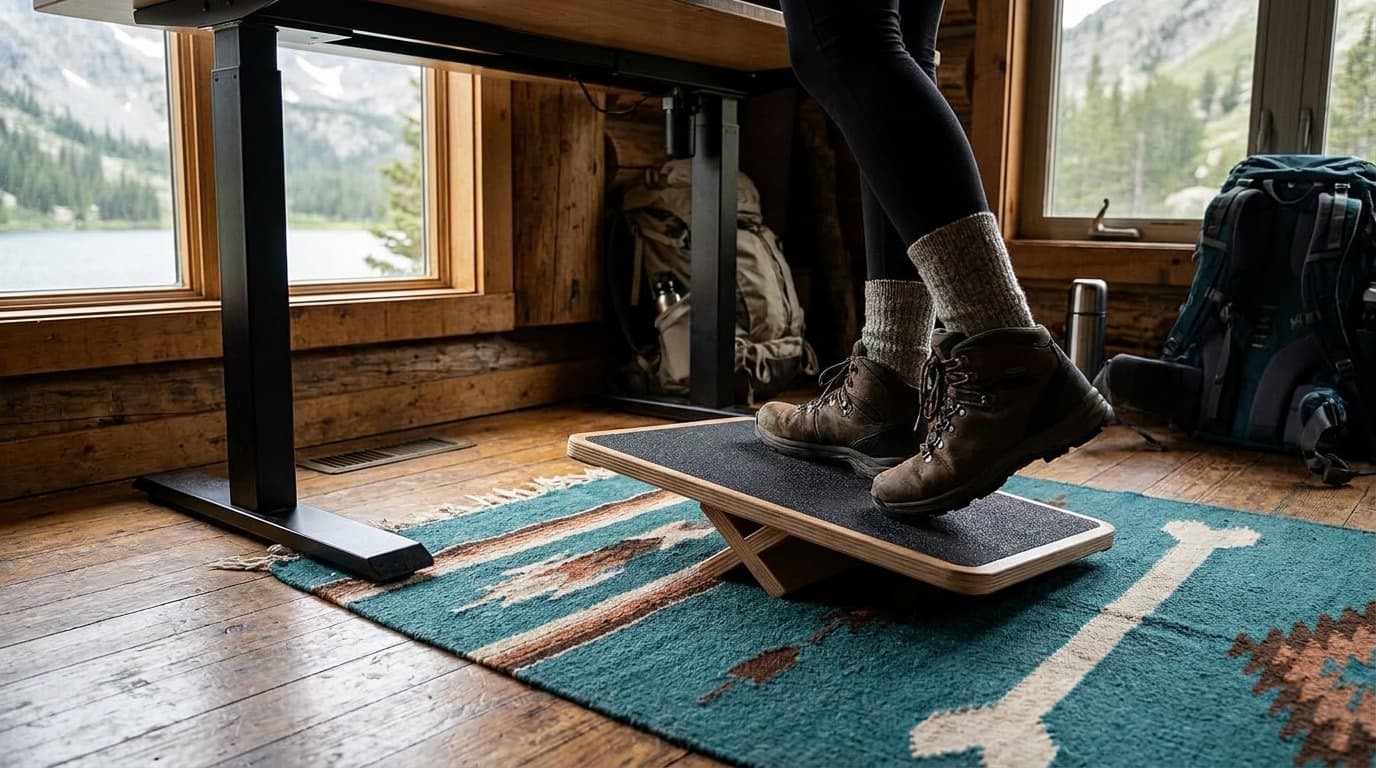
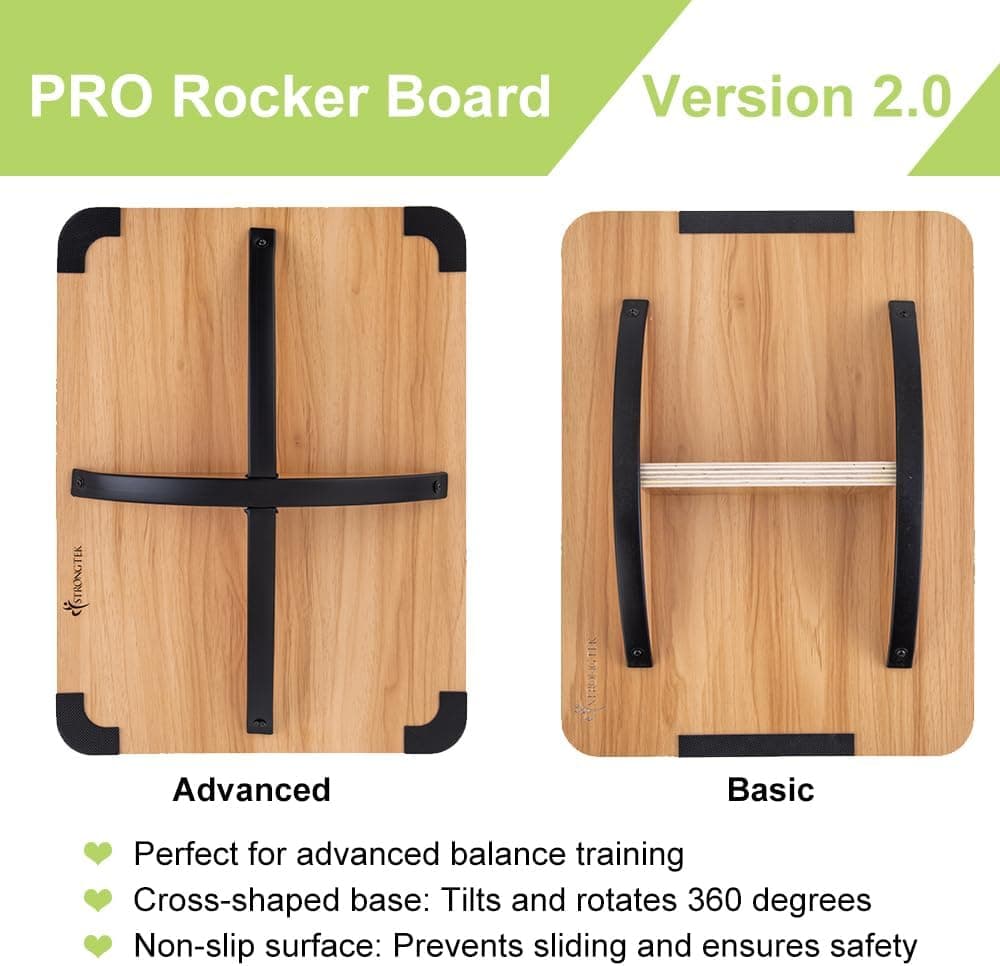
The StrongTek Advanced sits between a simple front-to-back rocker and a free wobble board. Its crossed base tilts in every direction, but the mechanism stays attached to the deck. That combination makes it the easiest board in our roundup to use near a standing desk.
BEST VALUE
StrongTek Advanced Wooden Balance Board, Cross Base (Standard)
Best for: Standing-desk workers and early-stage rehab users who want multi-directional challenge without the steep learning curve or fall risk of a roller board.
- Cross base enables 360-degree tilt so users can work all planes without the unpredictability of a free-pivot wobble dome
- Single-material tilt still has a ceiling for progression: advanced athletes will outgrow it before competitive riders do
Kit Score 8.2/10 · $38.99 Price checked Oct 26, 7:39 AM CDT · how we score gear
Buy on AmazonProduct details
A rocker-style board with a cross-shaped wooden base that allows multi-directional tilt instead of a single-axis rock, bridging the gap between beginner rocker boards and full wobble boards. The linked standard size has a 17.5 x 13.5-inch deck, roomier than a 15.75-inch wobble disc for standing-desk intervals and rehab exercises.
- Board dimensions
- 17.5 x 13.5 x 3 in (standard size, the linked listing)
- Type
- Rocker board with crossed hardwood base, 360-degree tilt
- Deck material
- Lauan hardwood plywood, textured non-slip top
- Base construction
- Cross-shaped wooden base, 360-degree tilt
- Weight capacity
- 350 lbs
- Board weight
- 2.23 kg (about 4.9 lb)
- Best use
- Standing desk, rehab, core training, squat/push-up work
More strengths
- The 17.5 x 13.5-inch rectangular deck gives more stance room than a round wobble disc for standing-desk intervals
- At around $40 it delivers a meaningful step up from round wobble discs at a fraction of roller-board prices
Other tradeoffs
- Board can shift on polished hard floors if the base feet move
- StrongTek's extra-large 24 x 16.5-inch version had no seller offer on Amazon on 2026-09-25, so wide-stance users are limited to the standard deck
Who it is for
Buy the StrongTek if you want a broad, predictable platform rather than a loose roller. The attached crossed base allows left-right and front-back movement without traveling across the floor. That makes mounting and dismounting less eventful, which matters when the board lives beside a desk.
The board also suits beginners who want more stance room than a 15.75-inch wobble disc. Its rectangular platform lets you change foot spacing and use the surface for shallow squats, supported reaches, or push-up variations.
Skip it if the goal is rola-bola, surf-style rolling, or a long progression of tricks. The fixed base cannot reproduce a free roller and its challenge ceiling is lower than the Revbalance, Indo, or Whirly.
Full specifications
| Spec | Detail |
|---|---|
| Kit Score | 8.2 / 10 (researched, not personally tested) |
| Type | Rocker-style board with crossed fixed base |
| Platform | 17.5 x 13.5 x 3 in (standard, the linked size) |
| Material | Lauan hardwood plywood, textured non-slip top |
| Board weight | 2.23 kg (about 4.9 lb) |
| Surface | Non-slip |
| Base | Cross-shaped wooden base |
| Motion | Multi-directional tilt |
| Weight capacity | 350 lb |
| Typical price | $35-$50 |
The dimensions and capacity above apply to the standard Advanced board, ASIN B09KM43WHY, which is the one we link. StrongTek also sells a Basic single-axis rocker and an extra-large Advanced (24 x 16.5 x 4.8 in) under similar names; the extra-large version showed no seller offer when we checked, so confirm the selected size and style before checkout.
Why it works at a standing desk
A desk board should be easy to leave when the phone rings, your feet fatigue, or a precise task needs a stable stance. The StrongTek's rectangular platform and attached base meet that requirement better than a loose cylinder. At 17.5 by 13.5 inches it fits a hip-width stance; if you stand wide or have large feet, the extra-large version is the better size when it is available.
That does not make it an all-day surface. Alternate short board intervals with flat standing, sitting, and walking. If you are bracing against the desk, gripping with your toes, or losing typing accuracy, move the board aside.
Build and floor behavior
The platform is Lauan hardwood plywood (FSC-certified, per the listing) with a textured non-slip top, and the crossed base gives it a larger floor contact area than a round wobble dome. The construction is not as refined as a $160 to $200 premium roller board, but it is substantial for the price.
The main setup issue is floor grip. A hard base can migrate on polished wood or tile, especially when the user pushes laterally. Use an appropriate thin non-slip mat and inspect the base before each session. Avoid a thick foam pad that makes the fixed mechanism behave unpredictably.
Pros and cons
What works:
- The 17.5 x 13.5-inch rectangular deck gives more stance room than a round wobble disc.
- Attached crossed base offers multi-directional movement without a loose roller.
- A 350 lb capacity is generous at this price.
- Roughly $40 makes it the best value in the five-board roundup.
Tradeoffs:
- The fixed movement range creates a lower skill ceiling.
- It can shift on a slick floor without the right mat.
- The roomier extra-large version was not available from any seller when we checked, and similar StrongTek listings mix sizes and styles, so verify the selection.
- It does not reproduce roller-board or board-sport movement.
StrongTek vs Amazon Basics wobble board
The Amazon Basics board is a smaller, cheaper 15.75-inch disc that pivots around a central dome. That gives it a more continuous 360-degree wobble but less stance room. The StrongTek costs more, spreads both feet across a much larger rectangle, and feels more controlled under a desk.
Choose the Amazon Basics board for compact storage and the lowest entry price. Choose the StrongTek for a broad platform, desk use, and a predictable rocker-style base. Our rocker vs wobble vs roller guide explains the mechanisms in more detail.
Frequently asked questions
What size is the StrongTek balance board?
The standard StrongTek Advanced board we link measures 17.5 by 13.5 by 3 inches. StrongTek also lists an extra-large 24 by 16.5-inch version, which had no seller offer on Amazon on September 25, 2026. StrongTek sells other boards with similar names, so check the selected size and style before ordering.
What is the StrongTek balance board weight capacity?
The current listing publishes a 350 lb capacity. Use the board only on a sound surface, inspect the base regularly, and follow the retailer and manufacturer limits for the exact variant you receive.
Is the StrongTek good for a standing desk?
Yes, it is the most desk-friendly pick in our current roundup. The attached base and rectangular platform allow controlled weight shifts without a loose roller. Use it in short intervals and keep a flat standing option nearby rather than staying on an unstable surface all day.
Is the StrongTek a rocker or wobble board?
It is best described as a rocker-style board with a crossed fixed base. It can tilt in multiple directions, unlike a basic single-axis rocker, but it does not pivot on a loose central dome or roll across a cylinder.
Where these numbers come from
| Claim | Source | Checked |
|---|---|---|
| StrongTek Advanced (standard): 17.5 x 13.5 x 3 in, 2.23 kg, Lauan hardwood plywood, 350 lb, 360-degree crossed base, non-slip top, FSC-certified, 4.6 stars from 810 ratings | Amazon listing B09KM43WHY | 2026-09-25 |
| StrongTek Advanced extra-large: 24 x 16.5 x 4.8 in, 350 lb, no featured seller offer | Amazon listing B0CZL4W5DB | 2026-09-25 |
| Amazon Basics wobble board: 15.75 in diameter, 265 lb | Amazon listing B07DWKNXNY | 2026-09-25 |
We have not used this board ourselves; every figure is the retailer's published specification.
The StrongTek delivers the most usable platform per dollar in this group. See how it ranks against all five picks in the best balance boards guide.
Keep going
Related buying guideBest balance boards: rehab, desk, tricks, circus training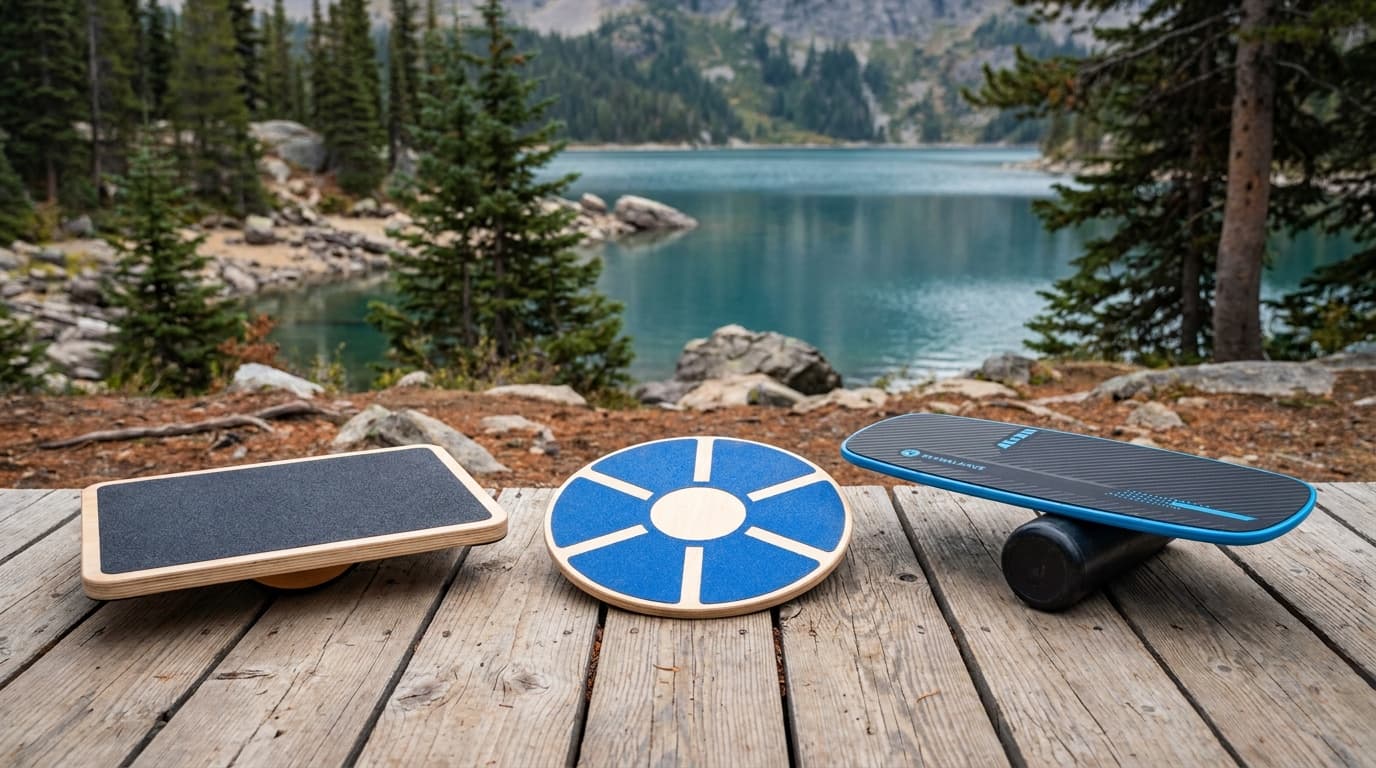
Researched, not hands-on tested
Updated Sep 25, 2026Our recommendations draw on manufacturer documentation, retailer listings, owner feedback, and comparisons with alternatives.
As an Amazon Associate I earn from qualifying purchases. We may earn a commission from links here, at no extra cost to you. How we research →
In this review
Related buying guide
Best balance boards: rehab, desk, tricks, circus training