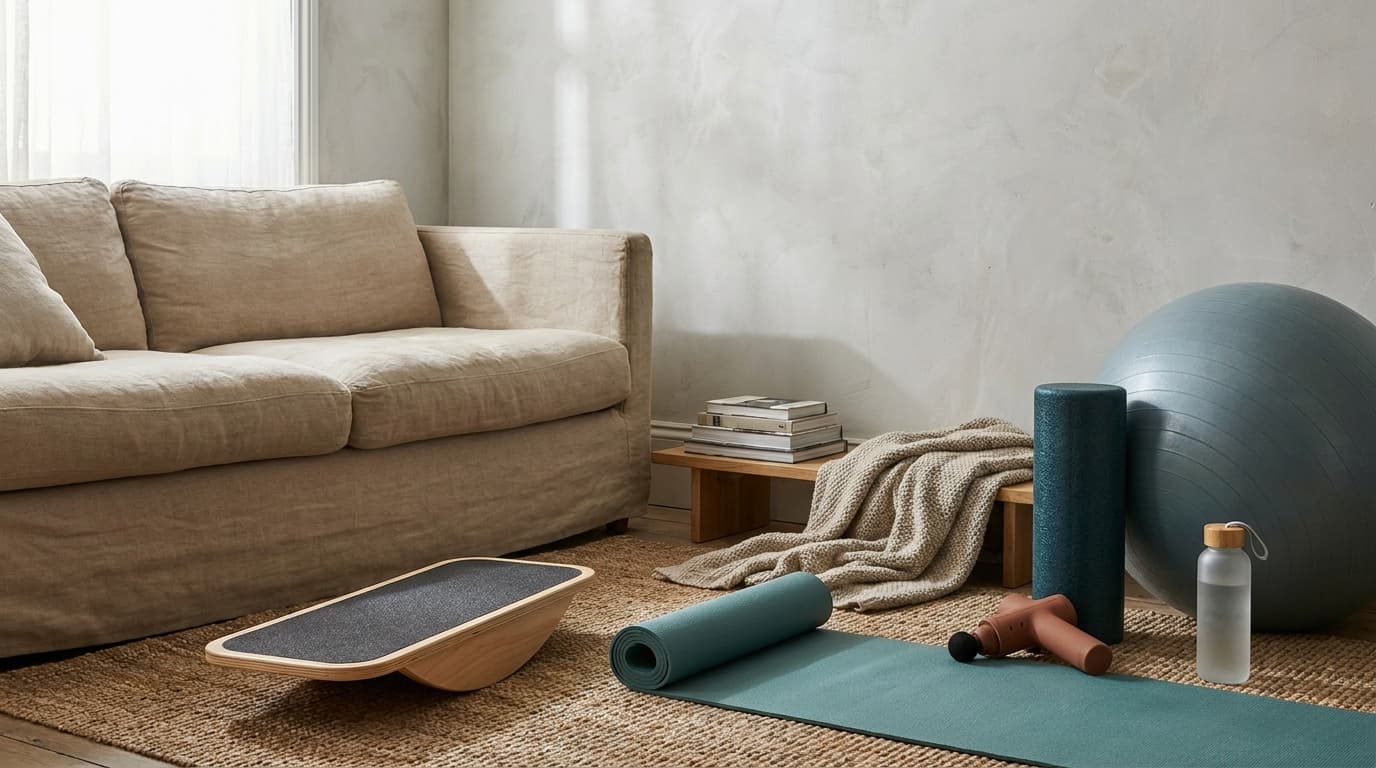
Balance boards can be useful, but the defensible benefits are narrower than the marketing. They train control on an unstable surface. That can improve the balance tasks you practice and may support structured ankle-sprain prevention or rehabilitation programs. It does not automatically mean better posture, major calorie burn, a stronger core, or protection from every injury.
What a balance board trains
Standing on an unstable surface asks your nervous system to detect movement and coordinate corrections through the feet, ankles, knees, hips, and trunk. The practical adaptation is better control of that practiced task: mounting the board, keeping the deck within a range, shifting weight, and recovering from small disturbances.
Carryover exists, but it is not unlimited. A systematic review of balance training in healthy people found that improvements were strongly specific to the trained task, with less transfer to balance tasks that looked different (Kümmel et al., 2016). That is a useful reality check. A roller board can make you better at controlling a roller board and related board-sport movements; it does not prove broad athletic improvement on its own.
Where the evidence is strongest
Ankle-sprain programs
Balance and proprioceptive exercises have credible support in athletic ankle-sprain prevention. A 2018 systematic review and meta-analysis of randomized trials found fewer ankle sprains and improvements in measures of dynamic neuromuscular control among athletes who completed proprioceptive training (Clinical Rehabilitation).
The 2021 clinical practice guideline for lateral ankle sprains also recommends structured therapeutic exercise that can include protected range of motion, neuromuscular training, and balance work according to the injury and stage of recovery (JOSPT guideline).
Neither source says that buying a particular board treats an ankle. The studies use programs with defined exercises, progression, supervision, and participant criteria. A rocker or wobble board may be one tool inside that plan after a clinician decides unstable-surface work is appropriate.
Balance performance
Repeated balance practice can improve performance on trained and closely related balance tasks. Reviews in healthy and older adults support balance exercise as a useful training category, but they combine many methods, not just retail boards. The effect depends on the population, program, and outcome being measured.
For older adults, the strongest practical takeaway is to use a structured, appropriately challenging program, often with strength and walking work as well. A 2015 systematic review found balance training improved balance performance in healthy older adults, while noting that the available studies did not establish one universal dose (Sports Medicine).
An unsupervised roller board is not the same intervention and can add unnecessary fall risk.
What the evidence does not justify
Large calorie-burn claims
An unstable surface requires muscular activity, but no reliable evidence supports a universal claim that a balance board burns a specific percentage more calories. Studies of seated versus standing desk work show small, context-dependent energy differences, not a guaranteed board effect (PubMed).
Use a balance board for balance practice or movement variety, not as a fat-loss device or cardio replacement.
Automatic posture correction
A board can prompt position changes because staying still is difficult. That does not mean it permanently corrects posture or treats back pain. Posture and pain are influenced by load, time, strength, sleep, work setup, injury history, and many other factors. A comfortable workstation still needs a normal flat standing option and regular position changes.
A complete core workout
Your trunk helps control the board, but the resistance is low and the movement is task-specific. Balance-board practice does not replace progressive strength training for the trunk, hips, or legs. Treat it as coordination work that can sit beside strength and conditioning, not above them.
Guaranteed injury prevention
Some structured balance programs reduce ankle-sprain incidence in defined athletic populations. That cannot be generalized to every injury, age group, or recreational user. Training on a surface that is too difficult can also create a fall or aggravate an existing problem.
A balance board is a way to deliver a balance task. The program, progression, and person matter more than the retail shape of the board.
Are balance boards useful at a standing desk?
They can make brief standing intervals more active and less monotonous, but the evidence for balance boards specifically is limited. A wide, attached-base rocker is more practical than a roller because it allows controlled weight shifts and a predictable step-off.
Do not assume more instability is better. Alternate between sitting, flat standing, walking, and short board intervals. If the board reduces typing accuracy, creates foot fatigue, or makes you brace against the desk, move it aside.
Our StrongTek balance board review covers the most desk-friendly model in the current roundup.
Who should be cautious
Get clinical guidance before using a balance board if you have:
- an acute ankle, knee, hip, or back injury;
- recent lower-limb surgery or a fracture;
- unexplained dizziness, fainting, or a vestibular disorder;
- reduced foot sensation or peripheral neuropathy;
- repeated falls or a high fall risk;
- an ankle that repeatedly gives way;
- a condition or medication that affects balance.
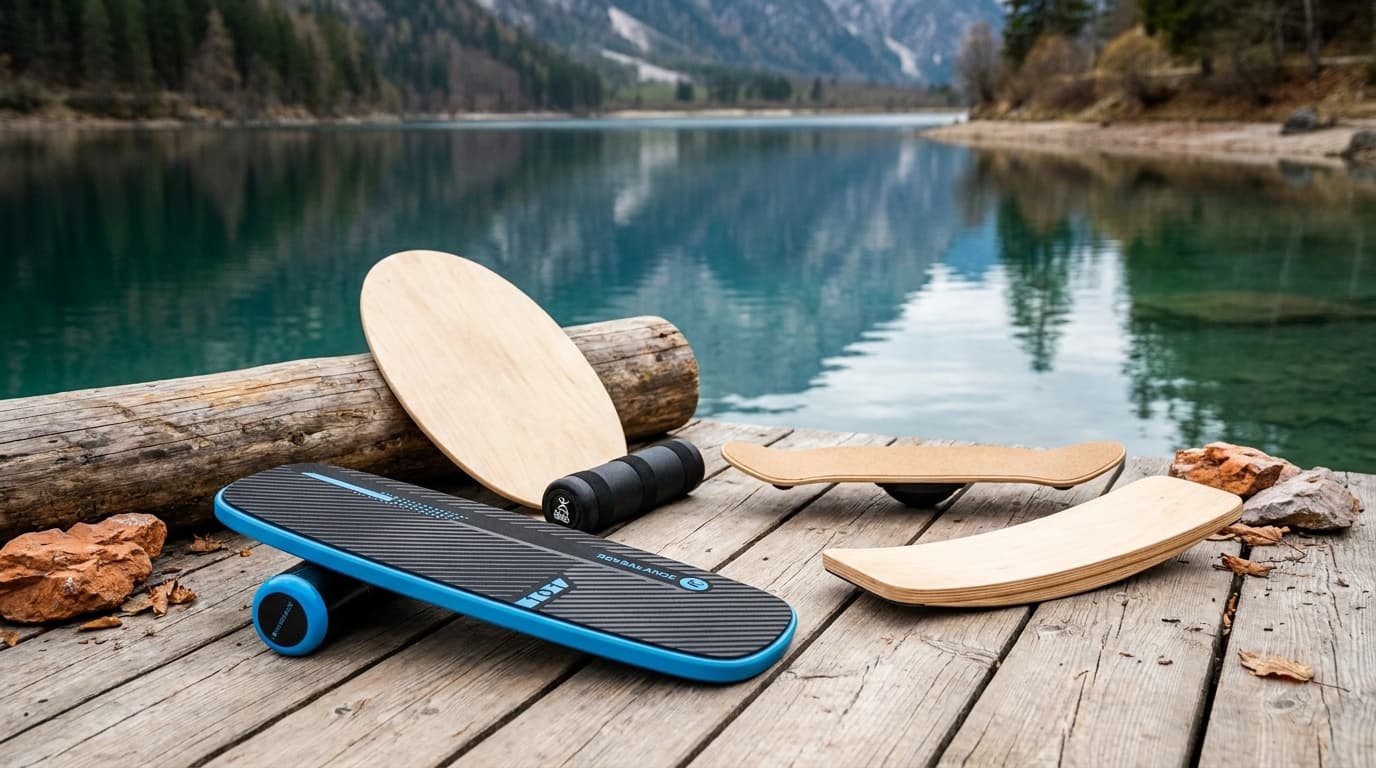
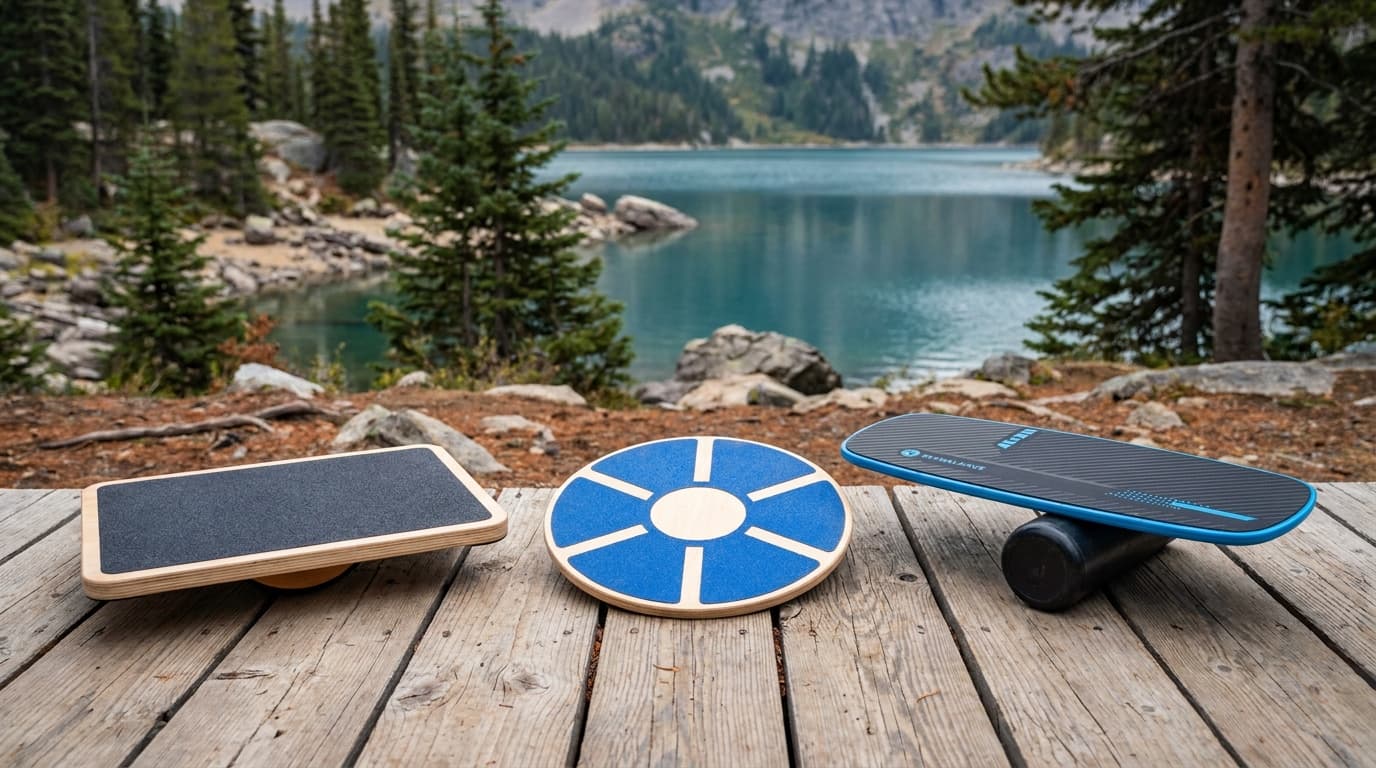
Healthy beginners should still learn beside a fixed support in a clear area. A rocker is the most controlled starting shape, followed by a wobble board, then a roller or spinning board.
How to get a useful benefit
Make the task trainable
Choose the right base
Start with a rocker, progress to a wobble board, and reserve rollers or spinning boards for controlled skill work.
Use a stable support
Keep a counter or fixed rail within reach while learning.
Keep the challenge repeatable
Small, recoverable movement is more useful than repeated emergency step-offs.
Progress one variable
Add time, range, reach, or a harder board separately rather than all at once.
Pair it with strength
Keep walking, resistance training, and sport practice in the program instead of treating balance work as a replacement.
The beginner balance-board guide explains the setup and milestones, while rocker vs wobble vs roller helps match the mechanism to the skill.
Frequently asked questions
Do balance boards strengthen your ankles?
They challenge the muscles and coordination used to control the ankle, but the effect is specific to the task and does not replace progressive resistance exercise. In rehabilitation, a clinician may combine balance work with range-of-motion and strengthening exercises rather than use a board alone.
Can balance boards prevent ankle sprains?
Structured proprioceptive and balance-training programs have reduced ankle-sprain incidence in some athletic studies. That evidence supports the program category, not a guarantee from a specific board. Previous injury, sport, adherence, exercise selection, and progression all affect the result.
Are balance boards good for your core?
Your trunk contributes to balance corrections, so the board can train coordination under a small unstable load. It is not a substitute for progressive trunk and full-body strength training, and evidence does not support treating passive board standing as a complete core workout.
Can I use a balance board every day?
Healthy users may tolerate frequent short practice, but there is no universal schedule. Let control, soreness, and the rest of your training determine frequency. Stop for joint pain, swelling, dizziness, numbness, or a worsening sense of instability.
Is a balance board worth it for a standing desk?
It can be worth it if you enjoy brief movement breaks and choose a wide, fixed-base board. It should not replace a flat surface for the whole day, and it is unlikely to create a meaningful fitness program by itself. A roller board is usually too demanding for passive desk work.
See the best balance boards for current rocker, wobble, roller, and spinning picks, all separated by actual use case.
Recommended gear
Our current top picks from the Best balance boards: rehab, desk, tricks, circus training guide, if you are ready to buy.
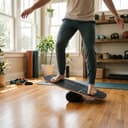
Best for: Athletes training for board sports or anyone who wants one board that can grow from beginner ankle rehab to advanced sport-specific balance work.
- Magnetic stops make difficulty progression genuinely seamless, no extra purchases required
- Roller boards carry a real fall risk for first-timers, so a spotter or nearby wall is advisable on day one
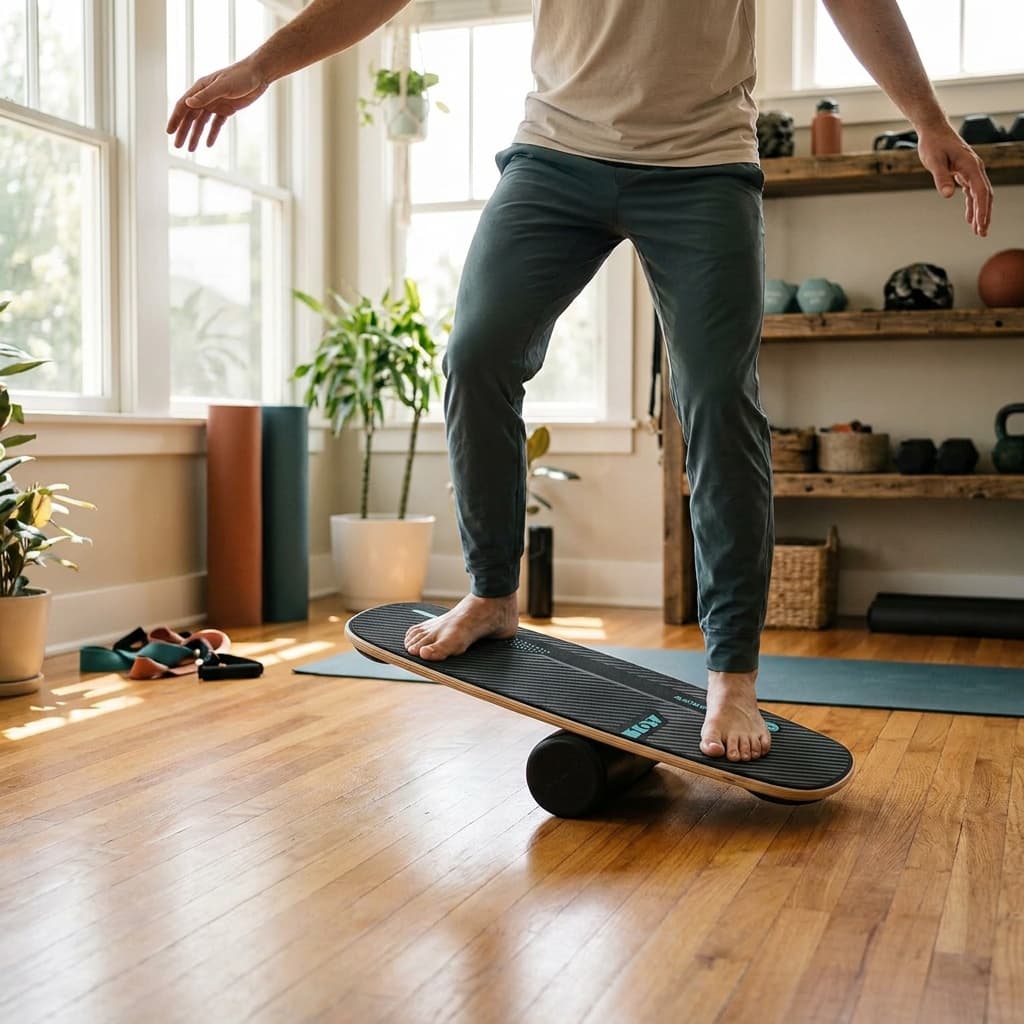
- Board dimensions
- 30 in x 12 in
- Type
- Roller board with adjustable magnetic stops
- Deck surface
- DuraSoft traction (no grip tape)
- Weight capacity
- 400 lbs
- Difficulty range
- Beginner to advanced (stops remove for full roll)
- Origin
- Made in USA, lifetime warranty
About this pick
A roller-style board with a tool-free magnetic stop system that adjusts the rolling arc in seconds, letting one board serve beginners doing ankle rehab drills and advanced athletes simulating surf and snowboard carves. The DuraSoft deck is comfortable barefoot and floor-safe.
Strengths
- Magnetic stops make difficulty progression genuinely seamless, no extra purchases required
- 400 lb rated capacity and heavy-duty USA construction back up the lifetime-use claim from most owners
- Roller motion closely mimics the heel-to-toe weight shift used in surfing, skateboarding, and snowboarding
Weaknesses
- Roller boards carry a real fall risk for first-timers, so a spotter or nearby wall is advisable on day one
- Not suited for standing-desk use: the rolling arc needs open floor space and active attention
Kit Score breakdown
STRONGTEK
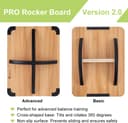
StrongTek Advanced Wooden Balance Board, Cross Base (Standard)
Best Value
Kit Score 8.2/10
$38.99 Price checked Oct 23, 4:16 PM CDT
Best for: Standing-desk workers and early-stage rehab users who want multi-directional challenge without the steep learning curve or fall risk of a roller board.
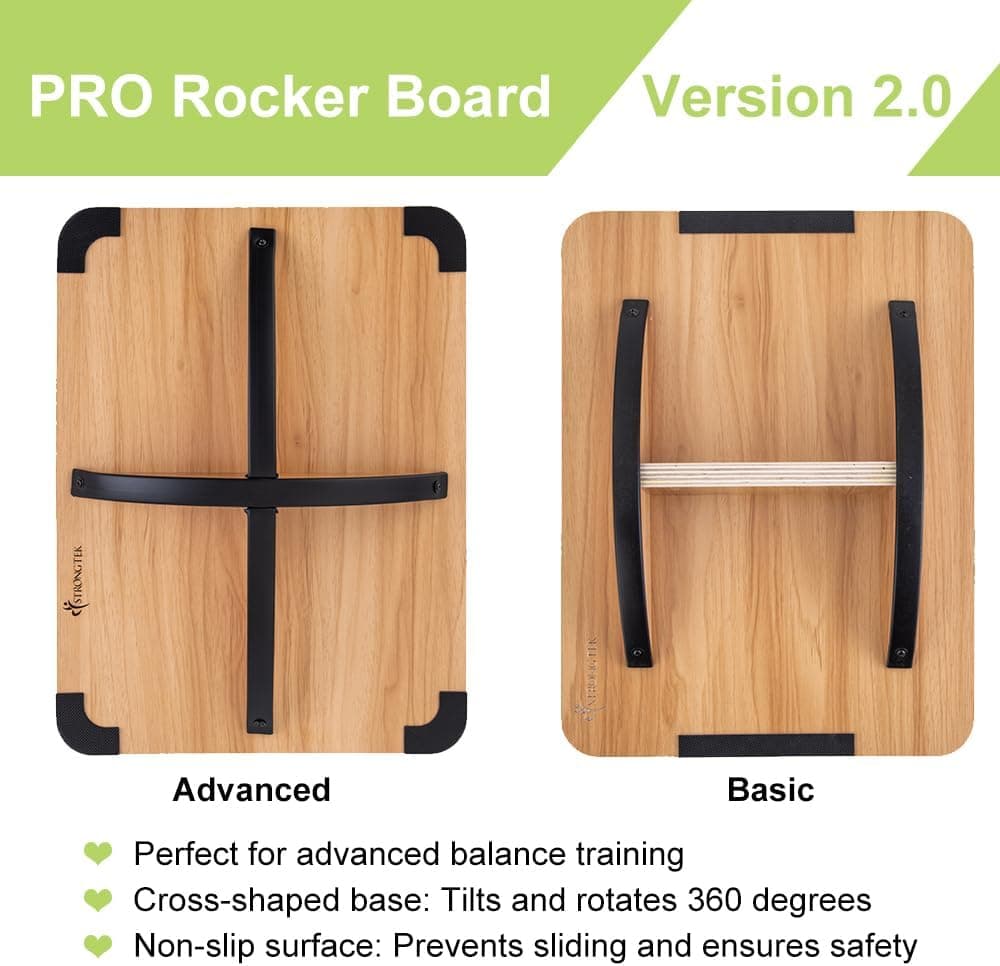
- Cross base enables 360-degree tilt so users can work all planes without the unpredictability of a free-pivot wobble dome
- Single-material tilt still has a ceiling for progression: advanced athletes will outgrow it before competitive riders do
- Board dimensions
- 17.5 x 13.5 x 3 in (standard size, the linked listing)
- Type
- Rocker board with crossed hardwood base, 360-degree tilt
- Deck material
- Lauan hardwood plywood, textured non-slip top
- Base construction
- Cross-shaped wooden base, 360-degree tilt
- Weight capacity
- 350 lbs
- Board weight
- 2.23 kg (about 4.9 lb)
About this pick
A rocker-style board with a cross-shaped wooden base that allows multi-directional tilt instead of a single-axis rock, bridging the gap between beginner rocker boards and full wobble boards. The linked standard size has a 17.5 x 13.5-inch deck, roomier than a 15.75-inch wobble disc for standing-desk intervals and rehab exercises.
More specifications
- Best use
- Standing desk, rehab, core training, squat/push-up work
Strengths
- Cross base enables 360-degree tilt so users can work all planes without the unpredictability of a free-pivot wobble dome
- The 17.5 x 13.5-inch rectangular deck gives more stance room than a round wobble disc for standing-desk intervals
- At around $40 it delivers a meaningful step up from round wobble discs at a fraction of roller-board prices
Weaknesses
- Single-material tilt still has a ceiling for progression: advanced athletes will outgrow it before competitive riders do
- Board can shift on polished hard floors if the base feet move
- StrongTek's extra-large 24 x 16.5-inch version had no seller offer on Amazon on 2026-09-25, so wide-stance users are limited to the standard deck
Kit Score breakdown
AMAZON BASICS
Amazon Basics Wood Wobble Balance Trainer Board
Best Budget
Kit Score 8.1/10
$23.99 Price checked Oct 23, 4:16 PM CDT
Best for: Budget buyers who want a compact, well-proven wobble board for short balance drills before committing to a pricier board.
- One of the most reviewed wobble boards on Amazon: 4.6 stars across nearly 16,000 ratings
- 265 lb capacity is lower than the 300 to 400 lb ratings of the other picks
- Diameter
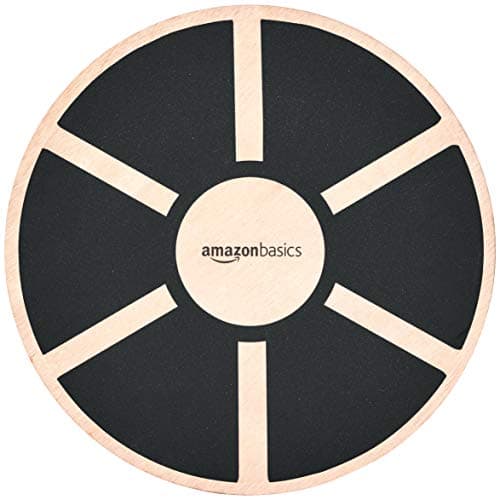
- 15.75 in round
- Height
- 3.15 in
- Type
- Wobble board, central dome
- Deck material
- Solid wood top with non-slip surface
- Weight capacity
- 265 lbs
- Weight
- 3.4 lbs
About this pick
A plain 15.75-inch wooden wobble board with a non-slip top over a central dome, sized for short balance drills, push-up and plank holds, and ankle and core work. It weighs about 3.4 lb, supports up to 265 lb, and carries a 1-year Amazon Basics limited warranty.
More specifications
- Warranty
- 1-year Amazon Basics limited warranty
Strengths
- One of the most reviewed wobble boards on Amazon: 4.6 stars across nearly 16,000 ratings
- About $19, the cheapest way to add multi-directional balance work
- Light enough at 3.4 lb to slide under a desk or carry to another room
Weaknesses
- 265 lb capacity is lower than the 300 to 400 lb ratings of the other picks
- 15.75-inch deck is tight for larger feet, and the fixed tilt cannot get harder as you improve
- Amazon Basics warns against use on wet or smooth floors, so plan on a mat for hardwood or tile
Kit Score breakdown
See all picks in Best balance boards: rehab, desk, tricks, circus training
Keep going
Researched, not hands-on tested
Updated Jul 29, 2026Our recommendations draw on manufacturer documentation, retailer listings, owner feedback, and comparisons with alternatives.
As an Amazon Associate I earn from qualifying purchases. We may earn a commission from links here, at no extra cost to you. How we research →