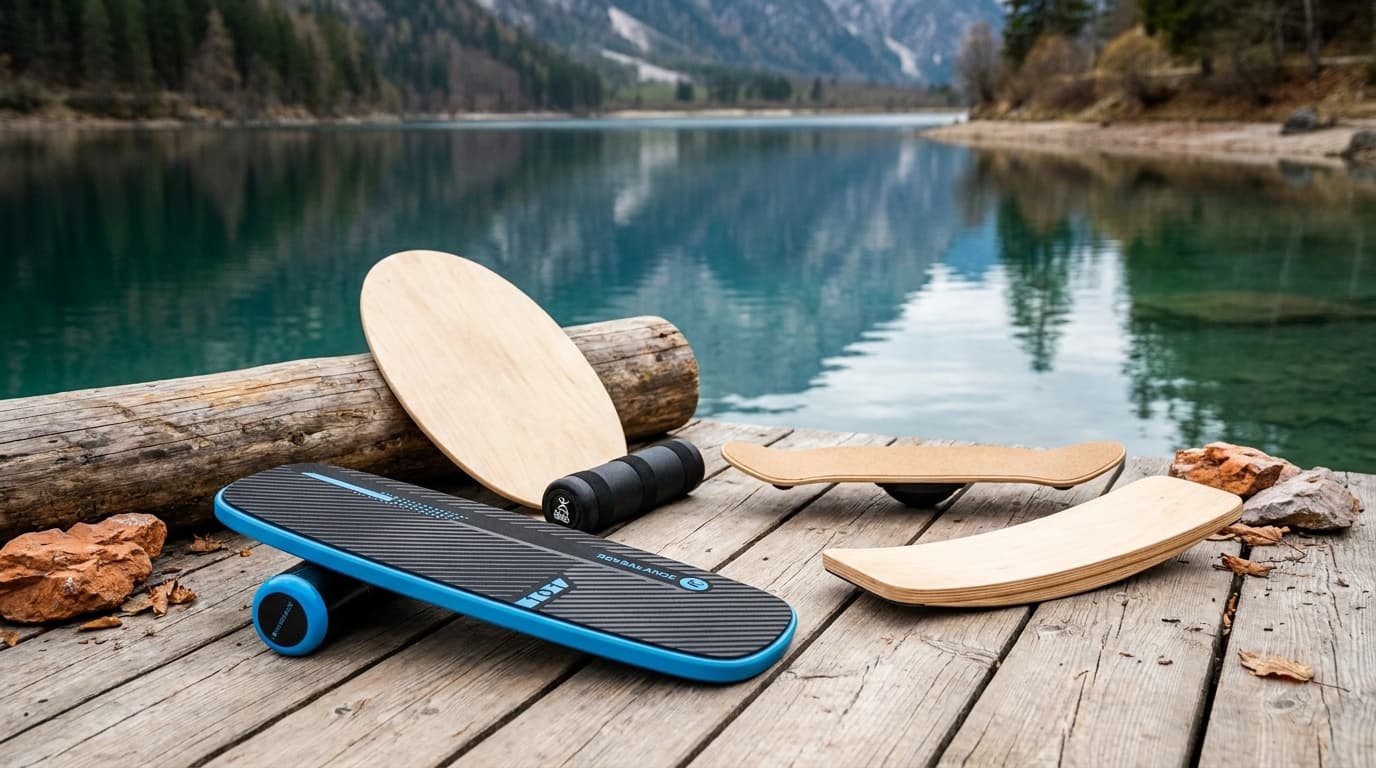
The Revbalance 101 v2 is the best balance board for most people because its tool-free magnetic stops let a roller board start narrow and open up as you improve, and Revbalance backs it with a lifetime warranty. The best board is not simply the hardest one, though: a controlled rocker suits desk work and first balance drills, a wobble board adds movement in every direction, and a roller or spinning board turns practice into a skill session. These five picks cover those jobs without pretending one shape does everything.
Our quick picks
The picks
Best overall
BEST OVERALL
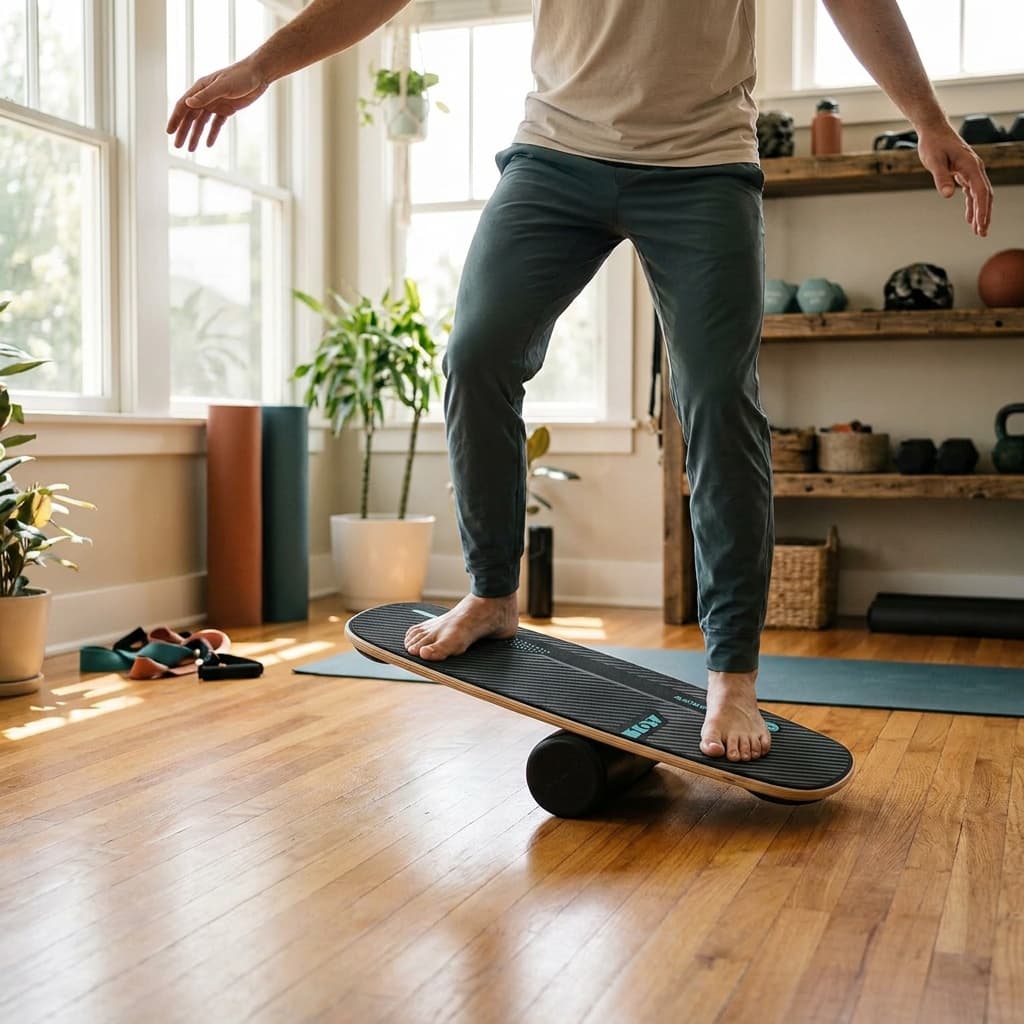
Revbalance 101 v2 Balance Board Sports Trainer
Best for: Athletes training for board sports or anyone who wants one board that can grow from beginner ankle rehab to advanced sport-specific balance work.
- Magnetic stops make difficulty progression genuinely seamless, no extra purchases required
- Roller boards carry a real fall risk for first-timers, so a spotter or nearby wall is advisable on day one
Kit Score 8.6/10 · Check current price · how we score gear
Buy at RevbalanceProduct details
A roller-style board with a tool-free magnetic stop system that adjusts the rolling arc in seconds, letting one board serve beginners doing ankle rehab drills and advanced athletes simulating surf and snowboard carves. The DuraSoft deck is comfortable barefoot and floor-safe.
- Board dimensions
- 30 in x 12 in
- Type
- Roller board with adjustable magnetic stops
- Deck surface
- DuraSoft traction (no grip tape)
- Weight capacity
- 400 lbs
- Difficulty range
- Beginner to advanced (stops remove for full roll)
- Origin
- Made in USA, lifetime warranty
More strengths
- 400 lb rated capacity and heavy-duty USA construction back up the lifetime-use claim from most owners
- Roller motion closely mimics the heel-to-toe weight shift used in surfing, skateboarding, and snowboarding
Other tradeoffs
- Not suited for standing-desk use: the rolling arc needs open floor space and active attention
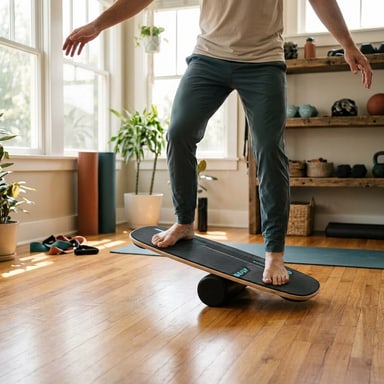
The Revbalance 101 v2 makes a difficult category easier to enter without building in a low ceiling. Two tool-free magnetic stops under the 30 x 12-inch deck limit how far the roller can travel. Move the stops outward as control improves, then remove them for an unrestricted roll. That adjustment is more useful than a cosmetic beginner mode because it changes the consequence of a bad weight shift.
The 400 lb rating, DuraSoft traction surface, US construction, and lifetime warranty against manufacturing and material defects support the premium price. It still needs open floor space and active attention, so it is a poor choice for passive desk standing. For focused sessions and board-sport cross-training, however, it covers more skill levels than any other single pick here. Read the full Revbalance 101 v2 review.
Best for: buyers who want one roller board that can progress from a bounded first ride to unrestricted training.
Best value and desk pick
BEST VALUE
StrongTek Advanced Wooden Balance Board, Cross Base (Standard)
Best for: Standing-desk workers and early-stage rehab users who want multi-directional challenge without the steep learning curve or fall risk of a roller board.
- Cross base enables 360-degree tilt so users can work all planes without the unpredictability of a free-pivot wobble dome
- Single-material tilt still has a ceiling for progression: advanced athletes will outgrow it before competitive riders do
Kit Score 8.2/10 · $38.99 Price checked Oct 23, 4:16 PM CDT · how we score gear
Buy on AmazonProduct details
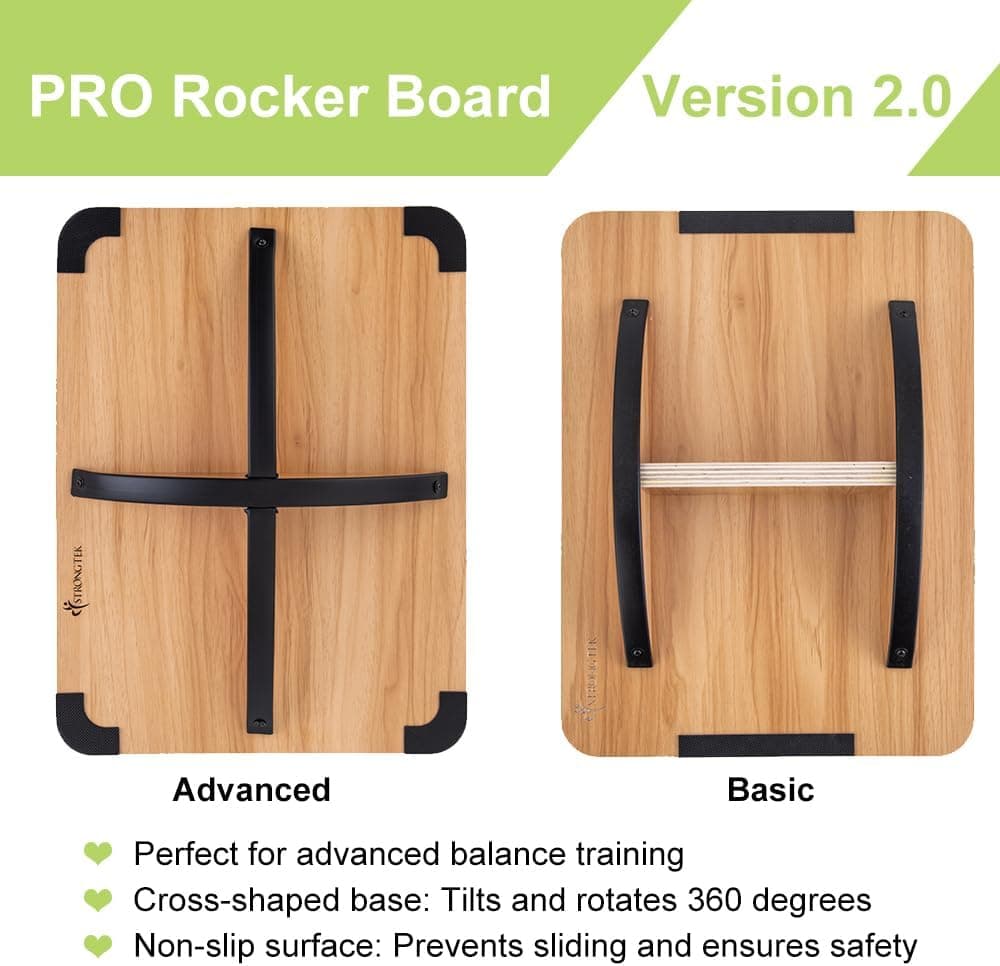
A rocker-style board with a cross-shaped wooden base that allows multi-directional tilt instead of a single-axis rock, bridging the gap between beginner rocker boards and full wobble boards. The linked standard size has a 17.5 x 13.5-inch deck, roomier than a 15.75-inch wobble disc for standing-desk intervals and rehab exercises.
- Board dimensions
- 17.5 x 13.5 x 3 in (standard size, the linked listing)
- Type
- Rocker board with crossed hardwood base, 360-degree tilt
- Deck material
- Lauan hardwood plywood, textured non-slip top
- Base construction
- Cross-shaped wooden base, 360-degree tilt
- Weight capacity
- 350 lbs
- Board weight
- 2.23 kg (about 4.9 lb)
- Best use
- Standing desk, rehab, core training, squat/push-up work
More strengths
- The 17.5 x 13.5-inch rectangular deck gives more stance room than a round wobble disc for standing-desk intervals
- At around $40 it delivers a meaningful step up from round wobble discs at a fraction of roller-board prices
Other tradeoffs
- Board can shift on polished hard floors if the base feet move
- StrongTek's extra-large 24 x 16.5-inch version had no seller offer on Amazon on 2026-09-25, so wide-stance users are limited to the standard deck
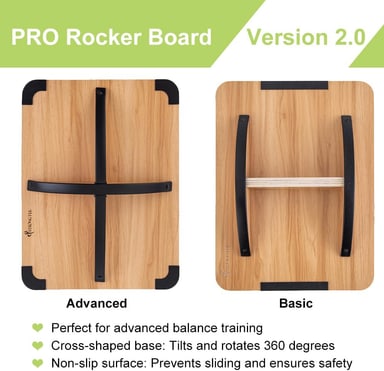
The StrongTek Advanced uses a fixed crossed base rather than a loose roller. We link the standard 17.5 x 13.5-inch platform, which gives a hip-width stance more room than a round wobble disc. StrongTek also lists an extra-large 24 x 16.5-inch version that would suit larger feet and wide desk stances better, but it had no seller offer on Amazon when we checked on September 25, 2026. The platform tilts in every direction, but the movement remains bounded and predictable. That makes it easier to step on, easier to step off, and more realistic for short standing-desk intervals than a roller board.
The Lauan plywood platform has a textured non-slip top and a 350 lb published capacity. At roughly $35 to $50, it is the strongest value in this group. Advanced riders will outgrow its fixed range, and it can shift on polished floors without a mat. Our StrongTek balance board review covers the fit and floor-surface tradeoffs.
Best for: standing-desk users, cautious beginners, and anyone who values a broad platform and controlled movement.
Best budget
BEST BUDGET
Amazon Basics Wood Wobble Balance Trainer Board
Best for: Budget buyers who want a compact, well-proven wobble board for short balance drills before committing to a pricier board.
- One of the most reviewed wobble boards on Amazon: 4.6 stars across nearly 16,000 ratings
- 265 lb capacity is lower than the 300 to 400 lb ratings of the other picks
Kit Score 8.1/10 · $23.99 Price checked Oct 23, 4:16 PM CDT · how we score gear
Buy on AmazonProduct details
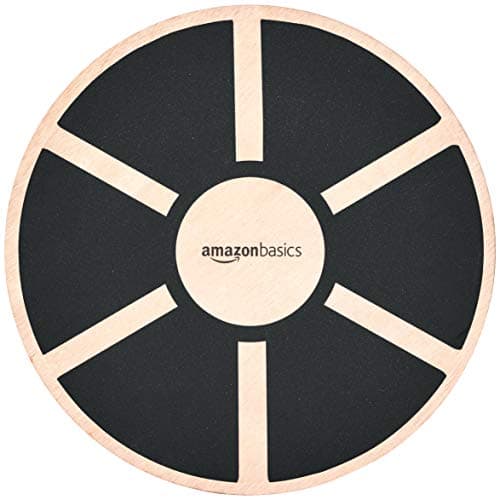
A plain 15.75-inch wooden wobble board with a non-slip top over a central dome, sized for short balance drills, push-up and plank holds, and ankle and core work. It weighs about 3.4 lb, supports up to 265 lb, and carries a 1-year Amazon Basics limited warranty.
- Diameter
- 15.75 in round
- Height
- 3.15 in
- Type
- Wobble board, central dome
- Deck material
- Solid wood top with non-slip surface
- Weight capacity
- 265 lbs
- Weight
- 3.4 lbs
- Warranty
- 1-year Amazon Basics limited warranty
More strengths
- About $19, the cheapest way to add multi-directional balance work
- Light enough at 3.4 lb to slide under a desk or carry to another room
Other tradeoffs
- 15.75-inch deck is tight for larger feet, and the fixed tilt cannot get harder as you improve
- Amazon Basics warns against use on wet or smooth floors, so plan on a mat for hardwood or tile
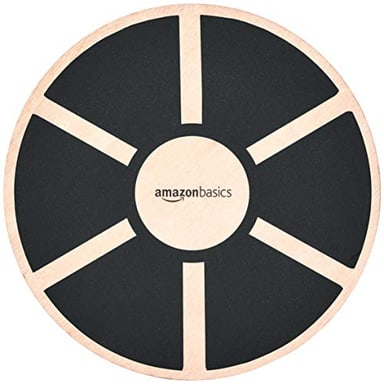
The Amazon Basics board is a 15.75-inch solid wood disc with a non-slip top over a central dome. It stands 3.15 inches tall, weighs about 3.4 lb, supports up to 265 lb, and carries a 1-year limited warranty. Nearly 16,000 Amazon owners rate it 4.6 out of 5, and at under $20 it is an inexpensive way to learn whether short balance sessions belong in your routine.
Its compact size works well for two-foot holds, one-foot drills, and push-up holds, but larger feet have less room and the fixed tilt cannot become harder as skill improves. The 265 lb limit is the lowest in this group, and Amazon Basics warns against using it on wet or smooth floors, so put it on a mat over hardwood or tile. Use it as a focused wobble board, not as an all-day standing mat.
Best for: budget buyers who want a compact, multi-directional board for short balance drills.
Best for surf and snow training
BEST FOR BOARD SPORTS
The Original Indo Board Balance Board Trainer (Includes Board and Roller)
Best for: Surfers, snowboarders, and active adults who want a proven roller board with the widest deck in its class and a track record backed by nearly 30 years of use.
- Wide 30 x 18 in maple deck provides more margin for error than narrower roller boards, making the steep learning curve less steep
- Roller is loud on hardwood floors, a real consideration in apartments or shared spaces
Kit Score 8.6/10 · $199.00 Price checked Oct 23, 4:16 PM CDT · how we score gear
Buy on AmazonProduct details
The board that established the category in 1998: a wide American maple deck on a 6.5-inch cylindrical roller with built-in wood stops that bound the roll arc. The 30 x 18-inch deck is the widest in its class, giving beginner-to-intermediate riders a larger stability margin before the roller reaches the stops.
- Deck dimensions
- 30 in x 18 in
- Roller diameter
- 6.5 in, solid construction
- Deck material
- Dense warp-resistant American maple with GripFlex non-slip coating
- Weight capacity
- 350 lbs
- Inlaid wood stops
- Prevent roller from sliding out from under board
- In the box
- Board deck and 6.5 in roller
More strengths
- Decades of documented use by surfers, snowboarders, and physical therapists give it a credibility base no newer brand can match yet
- Dense maple construction holds up to heavy daily use, and the GripFlex coating stays grippy without scratching floors
Other tradeoffs
- At roughly $199 it costs substantially more than a basic wobble or rocker board
The Indo Board Original pairs a wide 30 x 18-inch American maple deck with a 6.5-inch cylindrical roller. Inlaid wood stops keep the roller under the deck, while the GripFlex surface provides traction without conventional abrasive grip tape. The current board is rated to 350 lb.
Indo Board has used this basic format since 1998, and it covers the deck for life and the bases for two years. The wide, flat platform gives riders more stance freedom than a narrow skateboard deck and makes the initial roller-board learning curve more manageable. It is still loud on hard floors and expensive beside a wobble board. See the full Indo Board Original review for the warranty and setup details.
Best for: surfers, snowboarders, wakeboarders, and riders who want a roomy roller platform.
Most fun
MOST FUN
Whirly Board Sport 360
Best for: Active adults, board-sport athletes, and families who want balance training to feel like a skill toy rather than a rehabilitation chore.
- Three pivot points support more movement patterns than a single dome or cylindrical roller
- Steep first-session learning curve and a real fall risk without a rail or stabilizer ring
Kit Score 8.4/10 · $169.95 Price checked Oct 23, 4:16 PM CDT · how we score gear
Buy on AmazonProduct details
A narrow maple deck with three independent half-sphere pivots instead of a roller. It tilts, transfers between balance points, and spins through 360 degrees, creating a compact skill toy with a much higher ceiling than a basic wobble board.
- Deck
- 31.875 x 8.25 in
- Height
- 5 in
- Weight
- 5 lb
- Construction
- 8-ply Canadian maple
- Motion
- 3 independent half-sphere pivots, 360-degree spins
- Suggested limit
- 350 lb on current product warranty page
More strengths
- Narrow skateboard-style deck makes transfers and spins genuinely playful
- US-made maple construction carries a lifetime warranty against manufacturing defects
Other tradeoffs
- Narrow deck is less comfortable than a wide rocker for passive standing-desk use
- Hard pivots need a mat or thin carpet to protect finished floors and control sliding
The Whirly Board Sport 360 looks like a narrow skateboard deck, but three independent half-sphere pivots replace the trucks. You can balance over the center, transfer toward either end, and practice full spins without chasing a loose cylinder across the room. Whirly lists a 31.875 x 8.25-inch deck, a 5 lb weight, eight-ply Canadian maple, a suggested 350 lb limit, and a lifetime guarantee against defects. (Its Amazon listing says seven-ply and 400 lb; we use the maker's page.)
This is the playful outlier. Its narrow deck and hard pivots are less comfortable for passive desk use than the StrongTek, but they create a much deeper trick vocabulary. Put it on a protective mat and keep a stable support within reach while learning. Read our Whirly Board Sport 360 review, or compare it directly with the Indo Board.
Best for: active adults and families who want balance practice to feel like learning a new board skill.
| Product | Kit Score | Price | Best for |
|---|---|---|---|
| Revbalance 101 v2 Balance Board Sports Trainer | 8.6 | Check current price | Best for: Athletes training for board sports or anyone who wants one board that can grow from beginner ankle rehab to advanced sport-specific balance work. Why it stands out: Magnetic stops make difficulty progression genuinely seamless, no extra purchases required Tradeoff: Roller boards carry a real fall risk for first-timers, so a spotter or nearby wall is advisable on day one |
| StrongTek Advanced Wooden Balance Board, Cross Base (Standard) | 8.2 | $38.99 Price checked Oct 23, 4:16 PM CDT | Best for: Standing-desk workers and early-stage rehab users who want multi-directional challenge without the steep learning curve or fall risk of a roller board. Why it stands out: Cross base enables 360-degree tilt so users can work all planes without the unpredictability of a free-pivot wobble dome Tradeoff: Single-material tilt still has a ceiling for progression: advanced athletes will outgrow it before competitive riders do |
| Amazon Basics Wood Wobble Balance Trainer Board | 8.1 | $23.99 Price checked Oct 23, 4:16 PM CDT | Best for: Budget buyers who want a compact, well-proven wobble board for short balance drills before committing to a pricier board. Why it stands out: One of the most reviewed wobble boards on Amazon: 4.6 stars across nearly 16,000 ratings Tradeoff: 265 lb capacity is lower than the 300 to 400 lb ratings of the other picks |
| The Original Indo Board Balance Board Trainer (Includes Board and Roller) | 8.6 | $199.00 Price checked Oct 23, 4:16 PM CDT | Best for: Surfers, snowboarders, and active adults who want a proven roller board with the widest deck in its class and a track record backed by nearly 30 years of use. Why it stands out: Wide 30 x 18 in maple deck provides more margin for error than narrower roller boards, making the steep learning curve less steep Tradeoff: Roller is loud on hardwood floors, a real consideration in apartments or shared spaces |
| Whirly Board Sport 360 | 8.4 | $169.95 Price checked Oct 23, 4:16 PM CDT | Best for: Active adults, board-sport athletes, and families who want balance training to feel like a skill toy rather than a rehabilitation chore. Why it stands out: Three pivot points support more movement patterns than a single dome or cylindrical roller Tradeoff: Steep first-session learning curve and a real fall risk without a rail or stabilizer ring |
Revbalance 101 v2 Balance Board Sports Trainer
- Best for
- Athletes training for board sports or anyone who wants one board that can grow from beginner ankle rehab to advanced sport-specific balance work.
- Why it stands out
- Magnetic stops make difficulty progression genuinely seamless, no extra purchases required
- Tradeoff
- Roller boards carry a real fall risk for first-timers, so a spotter or nearby wall is advisable on day one
StrongTek Advanced Wooden Balance Board, Cross Base (Standard)
- Best for
- Standing-desk workers and early-stage rehab users who want multi-directional challenge without the steep learning curve or fall risk of a roller board.
- Why it stands out
- Cross base enables 360-degree tilt so users can work all planes without the unpredictability of a free-pivot wobble dome
- Tradeoff
- Single-material tilt still has a ceiling for progression: advanced athletes will outgrow it before competitive riders do
Amazon Basics Wood Wobble Balance Trainer Board
- Best for
- Budget buyers who want a compact, well-proven wobble board for short balance drills before committing to a pricier board.
- Why it stands out
- One of the most reviewed wobble boards on Amazon: 4.6 stars across nearly 16,000 ratings
- Tradeoff
- 265 lb capacity is lower than the 300 to 400 lb ratings of the other picks
The Original Indo Board Balance Board Trainer (Includes Board and Roller)
- Best for
- Surfers, snowboarders, and active adults who want a proven roller board with the widest deck in its class and a track record backed by nearly 30 years of use.
- Why it stands out
- Wide 30 x 18 in maple deck provides more margin for error than narrower roller boards, making the steep learning curve less steep
- Tradeoff
- Roller is loud on hardwood floors, a real consideration in apartments or shared spaces
Whirly Board Sport 360
- Best for
- Active adults, board-sport athletes, and families who want balance training to feel like a skill toy rather than a rehabilitation chore.
- Why it stands out
- Three pivot points support more movement patterns than a single dome or cylindrical roller
- Tradeoff
- Steep first-session learning curve and a real fall risk without a rail or stabilizer ring
How we picked
Each product was scored through the Kit Score, using current product specifications, warranty terms, verified-owner patterns, construction, price, and fit for its intended job. These are researched recommendations, not personal-use claims.
We gave the most weight to four questions:
- Is the movement predictable enough for the intended user?
- Does the deck provide enough stance room and traction?
- Can the challenge progress, or will the board be outgrown quickly?
- Does the price make sense for its construction and useful life?
Manufacturer information was checked against the Revbalance 101 v2 page, Revbalance FAQ, Indo Board Original page, Whirly Board Sport 360 page, and Whirly warranty. StrongTek dimensions and capacity come from the live Amazon listing, where the linked ASIN is the standard Advanced size and the extra-large version is a selectable variant. All sources are listed in the table at the end.
Rocker vs wobble vs roller vs spinning board
The base determines the skill, not just the difficulty.
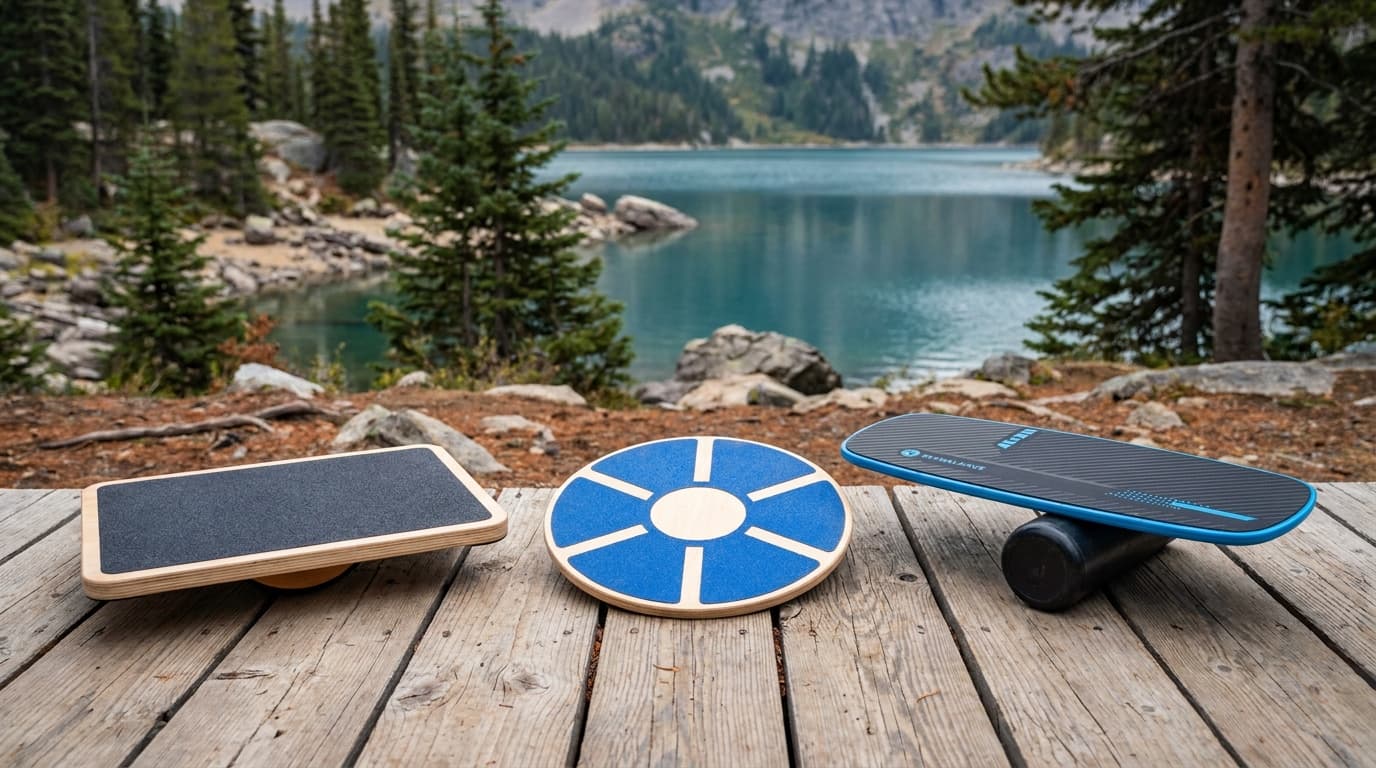
Rocker-style boards move through a fixed, bounded range. The StrongTek crossed base tilts in multiple directions, but the base remains attached and cannot roll away. That predictability makes it the right first step for most beginners.
Wobble boards pivot around a central dome. They move in every direction and require more continuous ankle and hip correction, but the deck edge limits the motion before the board can travel across the floor.
Roller boards place a loose cylinder under a deck. They demand active side-to-side control, use more floor space, and carry a greater fall risk. The Revbalance adds adjustable stops; the Indo uses fixed deck stops.
Spinning boards such as the Whirly use multiple fixed pivots. They add rotational and transfer skills without a loose roller, but their narrow decks and hard pivots still make them advanced equipment.
For a deeper breakdown, read rocker vs wobble vs roller balance boards.
The sensible progression
For a healthy beginner, the equipment progression is rocker, then wobble, then roller or spinning board. That sequence moves from constrained motion to multi-axis motion and finally to a surface that can roll or rotate under you.
Progress by control, not by a deadline. Move on when you can step on and off without jumping, hold a relaxed two-foot stance, and make deliberate weight shifts without grabbing support. An injury-rehabilitation plan can follow a different order or use different equipment; let a physical therapist choose the progression when pain, swelling, instability, or surgery is involved.
Which board fits your goal?
Choose by the way you will use it
Standing desk
Choose the StrongTek and use it in short intervals. A bounded base is easier to leave and re-enter while working.
First balance board
Start with the StrongTek for maximum control or the Amazon Basics board for a compact, inexpensive wobble challenge.
One board with room to improve
Choose the Revbalance 101 v2. Its magnetic stops create a genuine progression without another purchase.
Surf or snow cross-training
Choose the Indo Board Original for a wide roller deck or the Revbalance for adjustable travel.
Tricks and family play
Choose the Whirly Board Sport 360 for transfers and spins on three fixed pivots.
Safety before difficulty
Clear enough room to step off in every direction. Learn beside a counter, rail, or solid wall, not beside a chair that can slide. Use a thin non-slip mat when the manufacturer permits it, and keep the area free of tables, weights, and sharp furniture.
A balance board is not a substitute for clinical assessment. If you are dealing with an acute injury, repeated falls, dizziness, numbness, or a neurological or vestibular condition, ask a qualified clinician whether unstable-surface training is appropriate. Our beginner balance-board guide covers setup and progression in more detail.
Where these numbers come from
| Claim | Source | Checked |
|---|---|---|
| Revbalance 101 v2: Magswitch tool-free magnetic stops, removable; Durasoft grip; made in the USA; 400 lb rating; lifetime warranty | Revbalance 101 v2 and Revbalance FAQ | 2026-09-25 |
| Revbalance 101 v2 deck: 30 x 12 in | Outdoorplay retailer listing | 2026-09-25 |
| StrongTek Advanced (linked standard size): 17.5 x 13.5 x 3 in, 2.23 kg, Lauan hardwood plywood, 350 lb, 360-degree crossed base; the extra-large 24 x 16.5 x 4.8 in version showed no seller offer | Amazon listings B09KM43WHY (standard) and B0CZL4W5DB (extra-large) | 2026-09-25 |
| Amazon Basics wobble board: 15.75 x 15.75 x 3.15 in, 3.4 lb, solid wood top, 265 lb, 1-year limited warranty, not for wet or smooth floors, 4.6 stars from 15,976 ratings | Amazon listing B07DWKNXNY | 2026-09-25 |
| Indo Board Original: 30 x 18 in American maple, 6.5 in roller, inlaid wood stops, GripFlex, 350 lb, since 1998, lifetime deck and 2-year base warranty | Indo Board Original | 2026-09-25 |
| Whirly Board Sport 360: 31.875 x 8.25 x 5 in, 5 lb, 8-ply Canadian maple, triple half-sphere pivots, 350 lb suggested limit, lifetime guarantee | Whirly Board | 2026-09-25 |
| Proprioceptive training reduced repeat ankle sprains (RR 0.64) in athletes with a sprain history | Rivera et al., J Athl Train 2017, reviewing Schiftan et al. 2015 | 2026-09-25 |
Every product figure is the maker's or retailer's published specification; none is a Kit Authority measurement.
Frequently asked questions
What is the best balance board for a complete beginner?
The StrongTek crossed-base board is the most approachable pick because its broad platform and attached base create bounded, predictable movement. The Amazon Basics wobble board is cheaper but moves in every direction. A roller board can be a first purchase if it has adjustable stops, like the Revbalance 101 v2, and you learn beside a stable support.
What is the best balance board for a standing desk?
The StrongTek is the best fit in this group. Its 17.5 x 13.5-inch platform leaves room for a hip-width stance (StrongTek's extra-large 24 x 16.5-inch version is the better desk size when it is in stock), and its attached crossed base cannot shoot away like a roller. Use it for short movement intervals rather than assuming any balance board should replace a flat standing surface all day.
Is the Indo Board or Revbalance better?
Choose the Indo Board if you want the wider 30 x 18-inch deck and a classic surf-style platform. Choose the Revbalance if adjustable difficulty matters more: its magnetic stops can narrow or open the roller travel. Both are premium roller boards; our Revbalance pick is more adaptable, while the Indo is roomier underfoot.
Which balance board is best for circus or rola-bola practice?
A roller board trains the closest movement pattern. The wide Indo Board is a forgiving starting platform, while the Revbalance lets you open the roller travel gradually. Neither is a certified performance prop, so check deck, roller, and venue requirements before using one in an act. The Whirly trains spins and transfers but does not reproduce a free cylinder under a rola-bola deck.
How long should I stand on a balance board each day?
Start with short sessions, a few minutes at a time, and stop when your form gets shaky rather than at a set time. Balance training works through quality repetitions, not endurance, and fatigue makes falls more likely. At a standing desk, treat the board as an interval tool: a few minutes on, then back to the floor. Add time only once you can step on and off without jumping and hold a relaxed stance.
Can a balance board help after an ankle sprain?
It can be part of the plan. A meta-analysis of randomized trials in athletes (Schiftan and colleagues, 2015) found that proprioceptive training cut the rate of repeat ankle sprains by about a third (relative risk 0.64) in people with a previous sprain. But the correct timing and board type depend on the injury. A board is not appropriate during every stage. Get clearance and a progression from a physical therapist or other qualified clinician instead of choosing a device from marketing language alone.
Start with the board you will actually use, then earn the harder movement. The fitness hub has more training gear, and how we research explains the evidence standard behind every recommendation.
Keep going
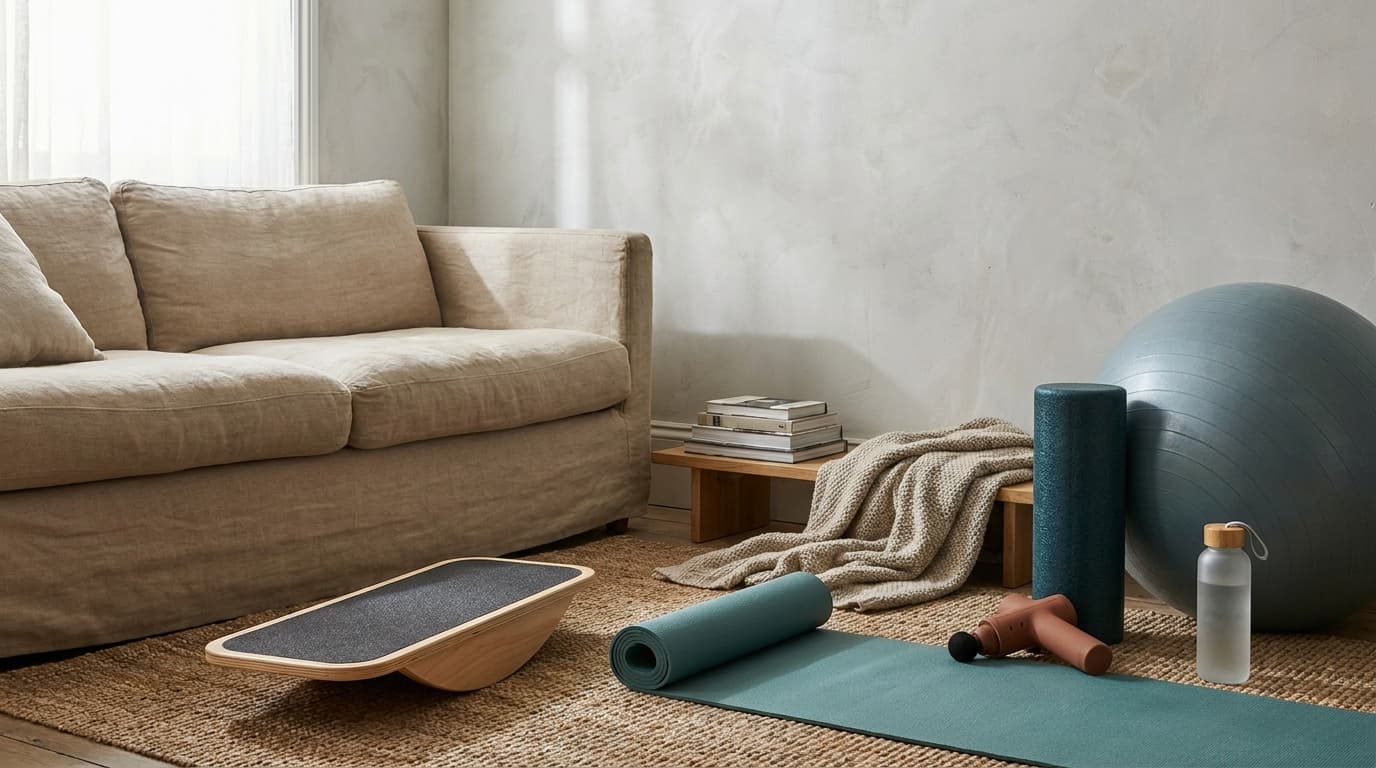
Our recommendations draw on manufacturer documentation, retailer listings, owner feedback, and comparisons with alternatives.
As an Amazon Associate I earn from qualifying purchases. We may earn a commission from links here, at no extra cost to you. How we research →
Top picks
 Best OverallRevbalance 101 v2 Balance Board Sports Trainer8.6/10
 Best ValueStrongTek Advanced Wooden Balance Board, Cross Base (Standard)8.2/10
 Best BudgetAmazon Basics Wood Wobble Balance Trainer Board8.1/10
 Best For Board SportsThe Original Indo Board Balance Board Trainer (Includes Board and Roller)8.6/10
 Most FunWhirly Board Sport 3608.4/10